
Asia - Pacific Container Homes Market Size and Share
Market Overview
| Study Period | 2021 - 2032 |
|---|---|
| Forecast Data Period | 2027 - 2032 |
| Base Year Market Size (2026) | USD 21.54 Billion |
| Market Size (2027) | USD 23.18 Billion |
| Market Size (2032) | USD 33.48 Billion |
| Growth Rate (2027 - 2032) | 7.63 % |
| Market Concentration | Low |
Major Players *Disclaimer: Major Players sorted in no particular order Image © Mordor Intelligence. Reuse requires attribution under CC BY 4.0. | |
Asia - Pacific Container Homes Market Analysis by Mordor Intelligence
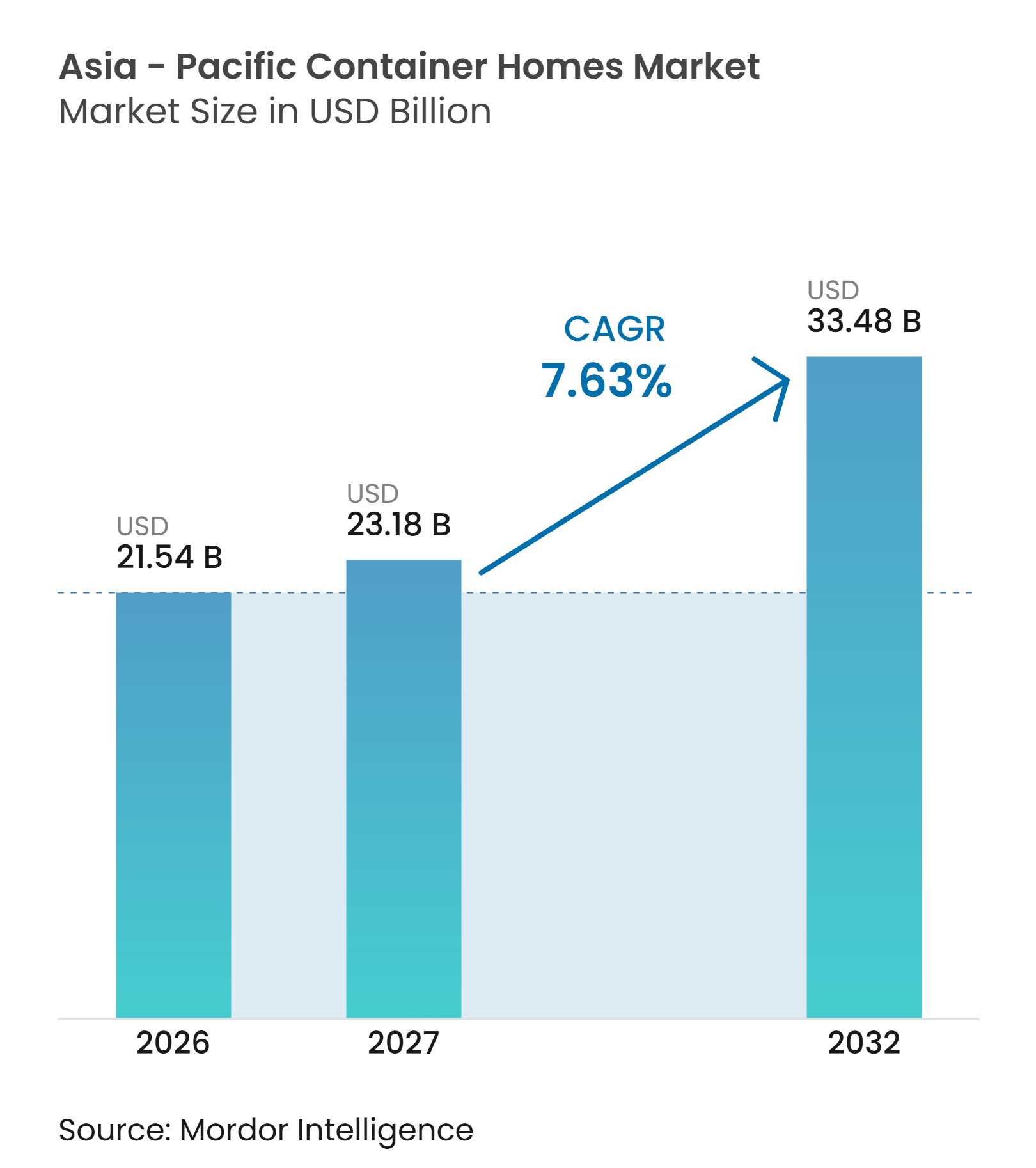
The Asia - Pacific Container Homes Market size is expected to increase from USD 21.54 billion in 2026 to USD 23.18 billion in 2027 and reach USD 33.48 billion by 2032, growing at a CAGR of 7.63% over 2027-2032.
The Asia-Pacific container homes market is supported by housing cost pressure in major cities, government affordable-housing programs, and the need for faster delivery of temporary and permanent housing. Factory work can reduce the time needed to complete a unit to 15 to 25 days, which gives public agencies and developers a faster response option for housing shortages. China’s manufacturing base is reshaping pricing and availability across the region, while Japan and South Korea are moving toward higher-specification modular homes. Disaster response in Southeast Asia is also creating a more regular pipeline for temporary housing, workforce camps, and reconstruction projects. Regulatory differences remain a practical limit because approval processes, thermal rules, and quality requirements vary across countries.
Key Report Takeaways
- By offering, On-Site Built held 60.75% of the Asia-Pacific container homes market share in 2026, while Factory-Built is forecast to grow at an 8.45% CAGR through 2032.
- By construction type, Fixed Structures accounted for 53.6% of the Asia-Pacific container homes market size in 2026, while Movable units are forecast to expand at an 8.85% CAGR through 2032.
- By end use, Residential Homes held 50% of the Asia-Pacific container homes market share in 2026, while Emergency Homes is forecast to grow at a 9.15% CAGR through 2032.
- By country, China accounted for 41% of the Asia-Pacific container homes market size in 2026, while India is forecast to expand at an 8.65% CAGR through 2032.
Note: Market numbers in this report are based on Mordor Intelligence's proprietary estimation framework, which combines nine months of actuals with Q4 projections for base year 2026.
Market Trends and Insights
Drivers Impact Analysis of Asia-Pacific Container Homes Market of Asia - Pacific Container Homes Market*
| Driver | (~) % Impact on CAGR Forecast | Geographic Relevance | Impact Timeline |
|---|---|---|---|
| Rising Housing Costs and Affordable-Housing Pipelines | +1.8% | India, South Asia, East Asia urban centers | Medium term (2-4 years) |
| Chinese Container Manufacturing and Deployment Capacity | +1.6% | Asia-Pacific, with spillover to Oceania and South Asia | Short term (≤ 2 years) |
| Disaster-Relief and Rapid-Deployment Housing Growth | +1% | ASEAN, Pacific Island states, Indonesia, Philippines | Short term (≤ 2 years) |
| High-Specification Modular Housing Demand | +0.8% | Japan, South Korea | Long term (≥ 4 years) |
| Workforce and Labor Housing for Infrastructure Projects | +0.6% | ASEAN, South Asia, Australia | Short term (≤ 2 years) |
| Source: Mordor Intelligence | |||
Rising Housing Costs in Gateway Cities and Affordable-Housing Pipelines
Housing shortages, rather than home prices alone, are creating sustained demand for faster and lower-cost housing across South and East Asia. India’s affordable housing share in new residential supply declined to 17%, and urban homelessness reached 13 people per 10,000 residents, according to the UN-Habitat World Cities Report 2026. Pradhan Mantri Awas Yojana 2.0 provides financial assistance of up to INR 250,000, equal to USD 3,000 in the supplied draft, for 10 million additional families to construct or purchase a home[1]. This support can make faster construction methods more relevant to developers serving subsidy-eligible households. Chennai’s 200 container-based shelters for migrant workers show how municipal authorities are using container units as a scalable housing option. The Asia-Pacific container homes market therefore benefits when housing programs require speed, lower construction cost, and repeatable delivery.
Chinese Container Manufacturing and Deployment Capacity
China’s production system gives the Asia-Pacific container homes market a large and established supply base. China’s prefabricated building exports rose 45% year over year in the first quarter of 2026, with Indonesia, Malaysia, and Australia among the destination markets. Industrial clusters in Jiangsu, Guangdong, and Shandong bring steel fabrication, insulated panel production, and interior fit-out together, allowing completed units to reach overseas buyers in less than 3 months. The same production base also supports workforce camps and infrastructure projects, where units can be supplied in volume and relocated as site needs change. Competition among more than 1,000 factories pushes producers to seek overseas orders and maintain low prices. This improves access for public buyers, but it also raises pressure on manufacturers elsewhere in the Asia-Pacific container homes market that lack similar automation and scale.
Growth in Disaster-Relief and Rapid-Deployment Housing
Earthquakes, typhoons, and flooding are making rapid-deployment housing a regular public procurement need in parts of Southeast Asia. The Philippine Department of Human Settlements and Urban Development mobilized emergency housing support after the June 2026 Mindanao earthquake. Indonesia’s Ministry of Housing and Settlement was accelerating 7,952 permanent housing units across Aceh, West Sumatra, and North Sumatra in November 2026 using modular panel systems. Indonesia’s National Research and Innovation Agency is also promoting earthquake-resistant modular housing prototypes for reconstruction in disaster-prone areas[2]. Emergency use familiarizes government agencies and communities with modular methods, which can shorten later adoption cycles for permanent homes. This recurring need gives the Asia-Pacific container homes market a source of demand that is less dependent on conventional residential construction cycles.
Demand for High-Specification Modular Homes in Japan and South Korea
Japan and South Korea are directing the Asia-Pacific container homes market toward higher standards for energy use, factory quality, and connected-home features. LG Electronics launched its Smart Cottage in South Korea in August 2026 with artificial intelligence appliances, heat-pump heating, ventilation, and air conditioning, and energy-management features. The supplied draft reports that the exhibition attracted 7,000 visitors within 1 month. LG’s MONO Plus 26 received South Korea’s first Zero Energy Building Plus grade for a prefabricated building from the Korea Energy Agency. Samsung Electronics also worked with Gongganjeakso on a timber modular home with SmartThings integration and planned supply growth from 4,000 units in 2026 to 12,000 by 2030. These offerings shift competition away from basic structure costs and toward performance, compliance, and complete home systems.
Restraints Impact Analysis of Asia-Pacific Container Homes Market of Asia - Pacific Container Homes Market*
| Restraint | (~) % Impact on CAGR Forecast | Geographic Relevance | Impact Timeline |
|---|---|---|---|
| Thermal, Corrosion, and Humid-Tropic Performance Requirements | -1% | ASEAN, South Asia, Oceania tropical zones | Long term (≥ 4 years) |
| Fragmented Building-Code Requirements in Urban Centers | -0.8% | Urban centers across Asia-Pacific | Medium term (2-4 years) |
| Limited Financing and Valuation Infrastructure | -0.7% | Australia, India, Southeast Asia | Medium term (2-4 years) |
| Price Competition from Conventional and Sandwich-Panel Prefabricated Housing | -0.5% | India, Southeast Asia, Rest of Asia-Pacific | Medium term (2-4 years) |
| Source: Mordor Intelligence | |||
Thermal, Corrosion, and Humid-Tropic Performance Requirements
Thermal control and corrosion resistance remain technical limits for the Asia-Pacific container homes market in hot, humid, and coastal settings. A 2026 review of 60 peer-reviewed studies found that natural ventilation and passive cooling can reduce cooling loads by up to 59% in controlled settings, but none of the reviewed work assessed occupied modular buildings of 4 or more stories in warm-humid climates[3]. A separate 2026 study found a trade-off in hot climates between passive thermal comfort and energy efficiency in container housing. Coastal locations also require galvanized frames, protective coatings, and marine-grade fasteners to manage corrosion. These additions raise costs and weaken the price advantage of standardized units against local alternatives. The constraint will remain until more validated design approaches and multi-story performance standards are available for warm-humid conditions.
Fragmented Building-Code Requirements in Urban Centers
Different codes, financing practices, and competing low-cost construction options can slow project approvals in the Asia-Pacific container homes market. Fixed container structures in Japan generally require building confirmation when they exceed 10 square meters, and some urban planning areas require confirmation for smaller units as well. Singapore applies demanding prefabricated construction requirements, while enforcement is less consistent outside major Indonesian cities. Manufacturers must therefore retain market-specific documentation and adjust products for each approval process. Limited lending and valuation practices in Australia, India, and Southeast Asia can also make it harder for buyers to finance nontraditional homes. Price competition from conventional building methods and sandwich-panel units adds another constraint where buyers place more weight on initial cost than on lifecycle performance.
*Our forecasts treat driver/restraint impacts as directional, not additive. The impact forecasts reflect baseline growth, mix effects, and variable interactions.
Asia - Pacific Container Homes Market Segment Analysis
By Offering:
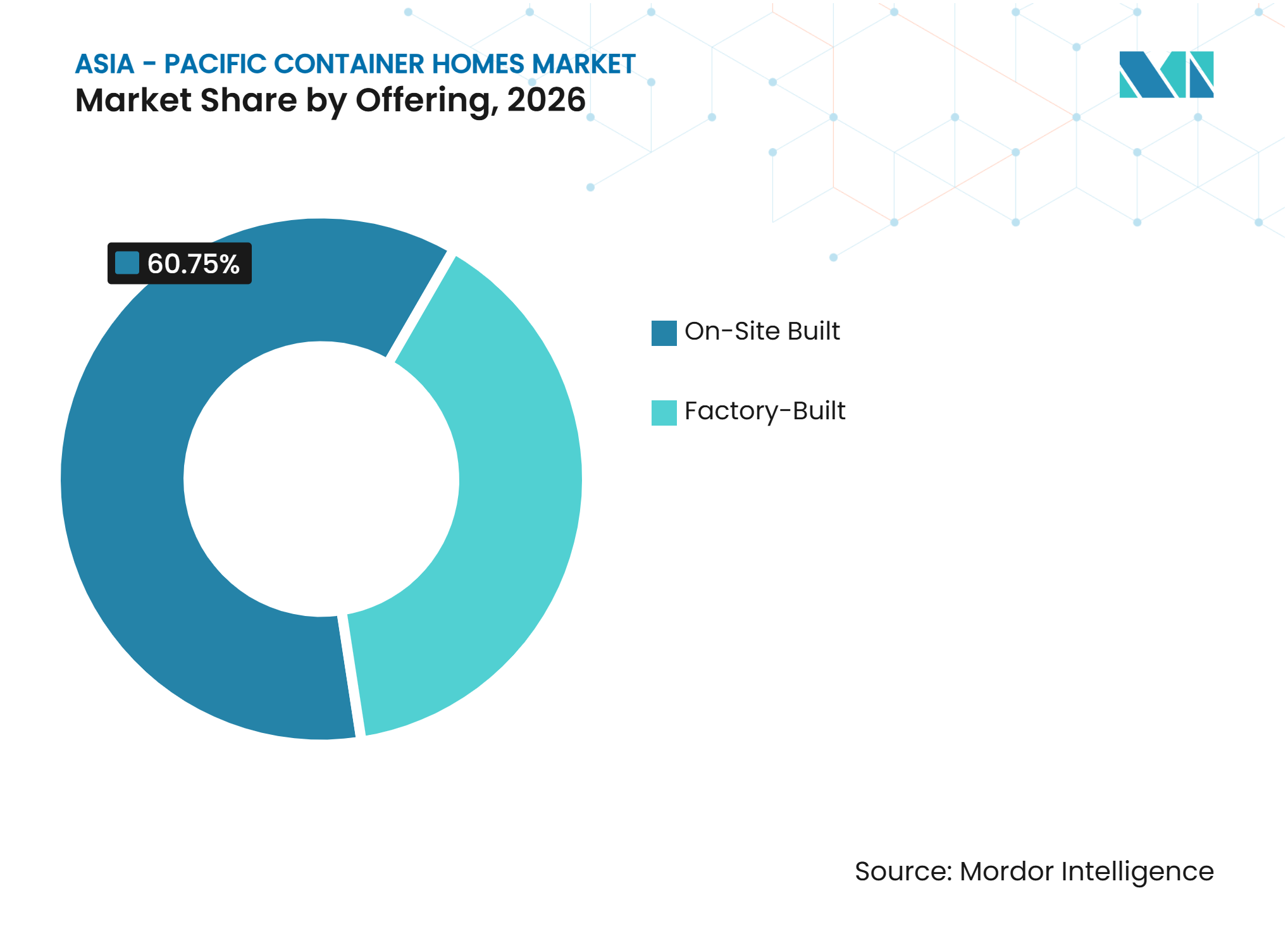
On-Site Built Leads, Factory Production AcceleratesOn-Site Built units held 60.75% of the Asia-Pacific container homes market share in 2026, showing the continued importance of site-specific projects. The segment serves residential builds, construction camps, and infrastructure accommodation where local customization is important. On-site assembly allows developers to adapt layouts, foundations, utility connections, and external finishes to local site conditions. This remains useful across ASEAN markets and in India, where permitting, climate, and land conditions vary widely. It also supports projects that need a mix of dormitories, offices, canteens, and shared facilities. The Asia-Pacific container homes industry continues to rely on this approach where standardized factory products cannot fully meet local construction requirements.
Factory-Built units are forecast to grow at an 8.45% CAGR through 2032, faster than the broader Asia-Pacific container homes market. Institutional purchasing, automation, and demand for consistent quality support this expansion. Modscape and Modbotics broke ground in August 2026 on a 50,000 square meter advanced manufacturing facility at Vantage Yatala in Queensland. The facility is planned to produce 2,000 modules per year and create 300 ongoing manufacturing jobs when operations begin in mid-2027. Factory production is particularly relevant where labor is expensive or building codes require repeatable documentation. It also supports more predictable delivery schedules for public housing and commercial projects.


By Construction Type:
Fixed Structures Prevail, Movable Units Gain ShareFixed Structures accounted for 53.6% of the Asia-Pacific container homes market size in 2026. Their lead reflects demand for permanent residences, nursing homes, and long-term workforce accommodation. Fixed units need more site preparation and closer coordination with local utilities and planning rules. In return, they can offer greater design flexibility and a more conventional residential experience. They may also be better suited to mortgage consideration in places where lending for container homes is gradually developing. The Asia-Pacific container homes market is therefore using fixed structures for projects where occupancy is expected to extend well beyond a temporary construction or relief period.
Movable units are forecast to grow at an 8.85% CAGR through 2032, the highest rate in this construction category. Their value comes from relocation, reuse, and rapid deployment across infrastructure, mining, and disaster sites. Folding-frame systems can be erected in less than 15 minutes without heavy equipment, according to the supplied material. These practical advantages keep movable products relevant where temporary demand may shift from one site to another.
By End Use:
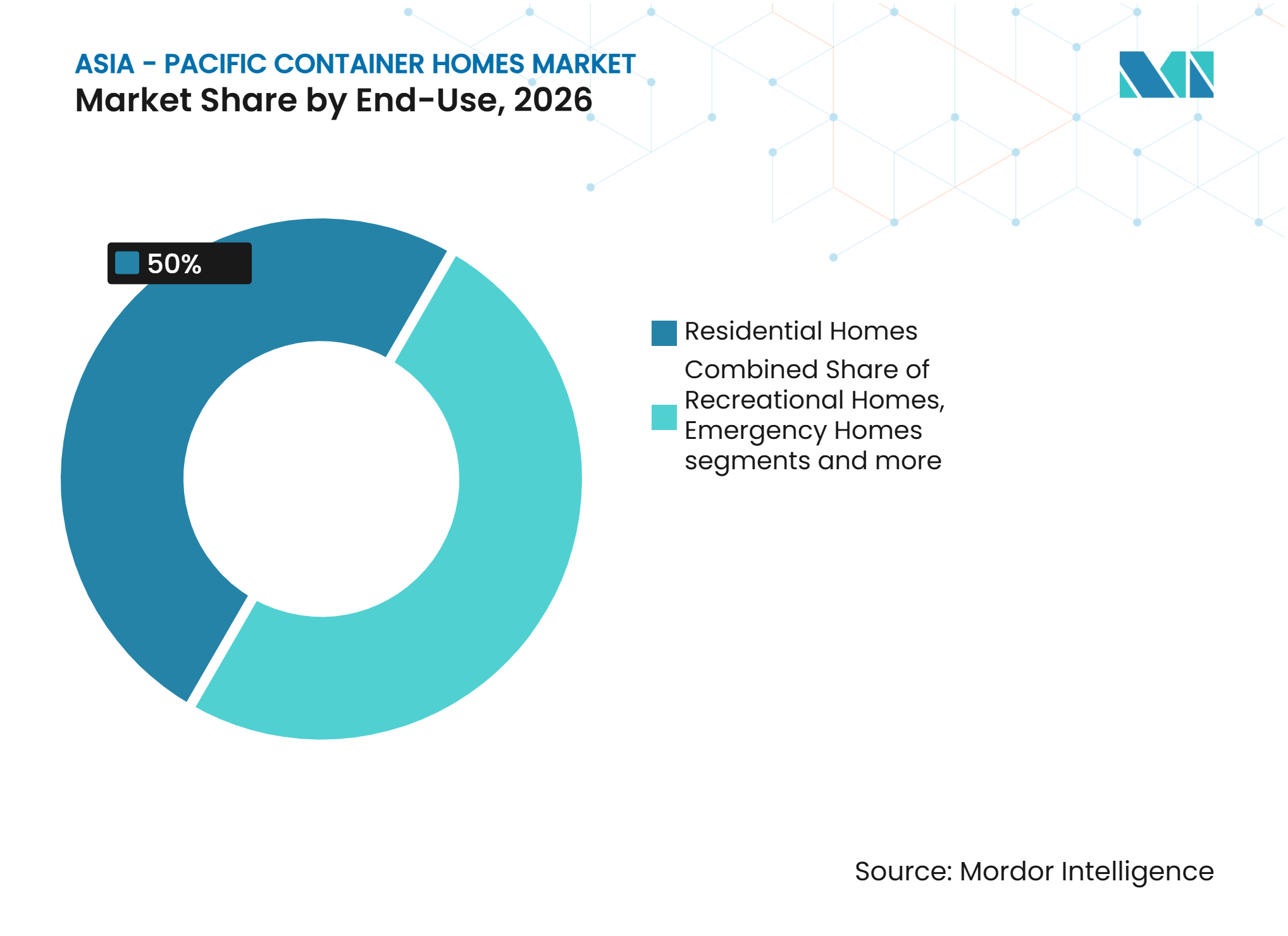
Residential Homes Dominant, Emergency Demand SurgingResidential Homes held 50% of the Asia-Pacific container homes market share in 2026. China’s modular housing base, South Korea’s higher-end prefabricated homes, and India’s affordable housing needs support this position. Residential buyers increasingly assess thermal performance, energy use, interiors, and compliance alongside cost. LG’s Smart Cottage is an example of this shift because it combines factory construction with connected appliances and energy systems. Recreational homes also support demand through eco-tourism and glamping projects. Nursing homes are a related opportunity as several regional economies face aging populations and need faster delivery of suitable care facilities.
Emergency Homes are forecast to expand at a 9.2% CAGR through 2032, the fastest rate among end uses. Disaster-response programs in the Philippines, Indonesia, and Pacific island states support this demand. Mandaue City opened Bayanihan Village in April 2026 with 200 modular shelter units for families displaced by Typhoon Tino. The development included a daycare center, a government satellite office, and a skills-training facility. This model shows that emergency units can include community infrastructure rather than only short-term shelter. Regular public use can create a clearer procurement path for suppliers serving the Asia-Pacific container homes market.


Geography Analysis
China: Manufacturing Powerhouse and Domestic Market Leader
China accounted for 41% of Asia-Pacific container homes market share in 2026. Manufacturing clusters in Jiangsu, Guangdong, and Shandong connect steel fabrication, panel production, electrical work, and internal fit-out, helping producers complete factory work within 15 to 25 days. The country also provides a large domestic base for affordable housing and infrastructure worker accommodation. National support for larger-scale prefabricated construction under the 15th Five-Year Plan supports the wider production ecosystem. More than 1,000 factories compete in the domestic market, according to the supplied draft. This competition is encouraging producers to use export orders to keep capacity active. For buyers across the region, Chinese supply can improve availability and prices. For regional competitors, it raises the need to differentiate through automation, performance certification, and integrated delivery.
India: Policy-Accelerated Demand and an Underserved Market
India’s container homes demand is forecast to grow at an 8.65% CAGR through 2032. The country’s urban housing constraints are reflected in the decline in affordable new supply to 17% and the urban homelessness figure of 13 per 10,000 residents. PMAY 2.0 offers financial assistance of up to INR 250,000 for eligible households and extends support to 10 million additional families. The Ministry of Housing and Urban Affairs shapes demand timing through its housing policy and funding framework. Demand is strongest where builders can provide a lower-cost structure without giving up safety or basic comfort. India’s varied climates require product design that suits local heat, humidity, ventilation, and rainfall. This need creates a role for companies that offer tested insulation and ventilation packages rather than generic imports. Municipal use of container shelters in Chennai also indicates that demand can extend to migrant-worker and homeless housing.
ASEAN, Japan, South Korea, and Australia: Divergent Paths, Shared Growth
South Korea is moving toward technology-led modular housing through consumer electronics participation and higher energy standards. LG’s Smart Cottage integrates artificial intelligence appliances, a heat pump, and energy management. The Zero Energy Building Plus grade awarded to LG’s prefabricated model points to energy performance as a more important factor in this part of the Asia-Pacific container homes market. Samsung’s timber modular home project follows the same direction through SmartThings integration and a planned rise in supply. Japan’s Building Standards Law creates a more formal approval process for fixed container structures, which limits simple deployment but supports demand for units with clear compliance documentation. Indonesia and the Philippines use modular and container solutions for disaster recovery and workforce needs. Australia combines social-housing needs with premium modular development, supported by new manufacturing capacity in Queensland. These markets have different demand patterns, but each rewards suppliers that can meet quality, energy, and project-delivery requirements.
Competitive Landscape
Market Concentration
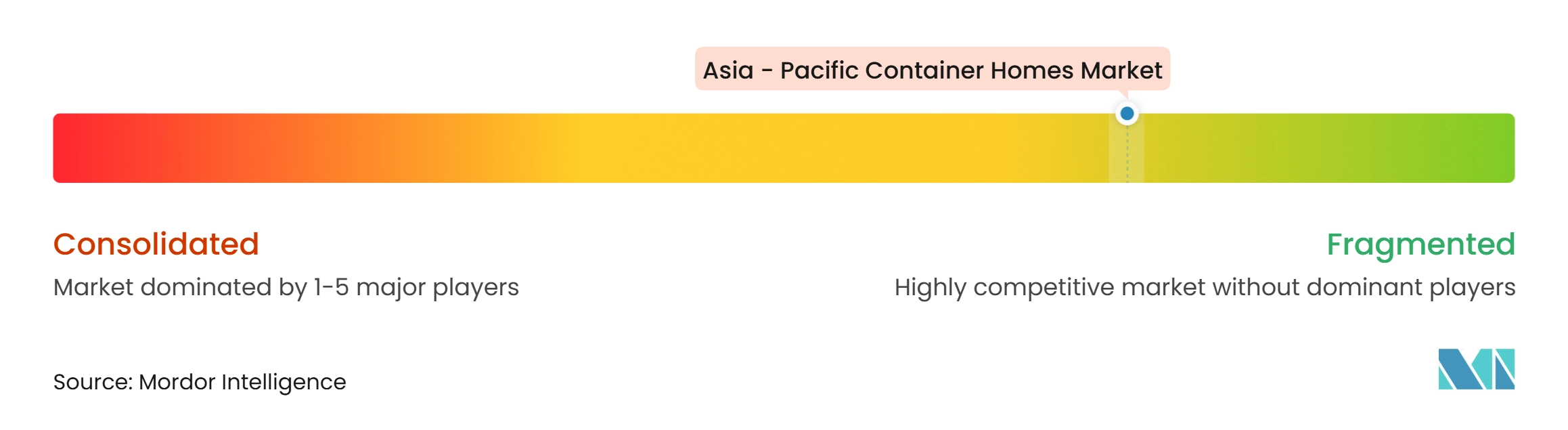
The Asia-Pacific container homes market is fragmented among product suppliers, especially in China, but it is becoming more concentrated in integrated project delivery. Chinese producers compete through scale, price, and delivery speed. Buyers in Australia, Japan, and South Korea increasingly expect certification, seismic capability, and documented quality controls. This raises the value of manufacturers that can combine production with logistics, on-site work, and compliance support. Smaller suppliers can still win specialized orders, but basic unit supply faces strong price pressure. The Asia-Pacific container homes market is therefore more competitive in standardized products than in complete project delivery.
Technology and factory processes are becoming key areas of differentiation. Modscape and Modbotics began developing their Queensland facility in August 2026, with the planned capacity to produce 2,000 modules annually. LG Electronics introduced a factory-built Smart Cottage with artificial intelligence appliances, heat-pump heating, ventilation, and air conditioning, and energy-management features. Samsung Electronics worked with Gongganjeakso on a timber modular home that integrates the SmartThings platform. These moves show that larger brands are using connected technology and building performance to address higher-value buyers. They also make it harder for low-cost suppliers to compete only on the unit price.
Opportunities remain in elderly care, workforce accommodation, disaster recovery, student housing, and affordable residential delivery. China’s export capacity can improve access to modular projects for public and private buyers that previously faced higher costs. Tropical thermal requirements, corrosion protection, and different planning rules favor providers with local engineering capability and established local partners. Compliance with national and local standards can protect established suppliers in stricter markets because imported products may not have the required documentation or testing history. The Asia-Pacific container homes market also rewards firms that adapt a standard product for local climate, code, utility connections, financing needs, and site conditions. Companies that provide planning support, transport coordination, installation, and after-sales service can offer a more complete proposition than companies that only sell a basic unit. This makes the integrated delivery model relevant for projects with several buildings or a mix of residential and shared facilities. It also supports public buyers that need one provider to coordinate product quality, site delivery, and documented compliance. Product suppliers that cannot offer these services are more exposed to competition on initial price alone.
It may also improve accountability when public agencies need clear responsibility for defects, safety checks, final installation, and resident handover.
The shift matters because buyers in housing and disaster programs often need a provider to manage delivery from design approval through handover. A supplier that understands local inspections, transport limits, and installation sequencing can reduce project uncertainty even when its initial quoted price is not the lowest. This operational capability is especially relevant where multiple units must be delivered within a short construction window.
Asia - Pacific Container Homes Industry Leaders
-
Fleetwood Australia
-
Boxman Industries
-
CIMC Modular Building Systems
-
Guangdong C.BOX Co., Ltd
-
GS Housing
- *Disclaimer: Major Players sorted in no particular order
Asia - Pacific Container Homes Market Companies Covered in this Report
- Fleetwood Australia
- Boxman Industries
- CIMC Modular Building Systems
- Guangdong C.BOX Co., Ltd
- GS Housing
- CGCH (China Green Container House)
- K-HOME
- ZN House
- Konbuild
- HiG Housing Tech Co., Ltd
- Heshi (Hebei) Integrated Housing Co., Ltd
- Max Prefab House Co., Ltd
- Nanjing Tuopeng Construction Technology Co., Ltd
- UVO Construction
- Modscape
- Container Homes Australia
- Smarthouse Corporation
- iBuild Building Solutions
- Casa Box
- WIDE HZ
Recent Industry Developments in Asia - Pacific Container Homes Market
- August 2026: Modscape + Modbotics broke ground on a purpose-built 50,000 square metres advanced manufacturing facility at Vantage Yatala, Stapylton, Queensland in a partnership with Frasers Property Industrial and CIP Constructions, signing a 15-year lease funded with private capital. The facility targets 2,000 modules per year and approximately 300 ongoing manufacturing jobs once operational in mid-2027.
- August 2026: LG Electronics launched its Smart Cottage modular home with AI appliances, heat pump HVAC, and energy management through the CJ OnStyle home shopping channel in South Korea, attracting approximately 7,000 showroom visitors within a month. The MONO Plus 26 model became South Korea's first prefabricated building to receive Zero Energy Building Plus certification from the Korea Energy Agency.
- April 2026: Mandaue City, Cebu, opened a Bayanihan Village comprising 200 modular shelter units for families displaced by Typhoon Tino, including community facilities such as a daycare center, a DHSUD satellite office, and a Technical Education and Skills Development Authority training facility.
Asia - Pacific Container Homes Market Report Scope
Segmentation Overview
| Factory-Built |
| On-Site Built |
| Fixed |
| Movable |
| Residential Homes |
| Recreational Homes |
| Emergency Homes |
| Nursing Homes |
| China |
| India |
| Japan |
| South Korea |
| Indonesia |
| Rest of Asia-Pacific |
| By Offering | Factory-Built |
| On-Site Built | |
| By Construction Type | Fixed |
| Movable | |
| By End-Use | Residential Homes |
| Recreational Homes | |
| Emergency Homes | |
| Nursing Homes | |
| By Country | China |
| India | |
| Japan | |
| South Korea | |
| Indonesia | |
| Rest of Asia-Pacific |
Key Questions Answered in the Report
What is the projected value of Asia-Pacific container homes by 2032?
The Asia-Pacific container homes market is projected to reach USD 33.48 billion by 2032, growing at a 7.63% CAGR from 2027.
Which offering type leads Asia-Pacific container homes?
On-Site Built units lead with 60.75% share in 2026, while Factory-Built units are forecast to grow faster at an 8.45% CAGR through 2032.
Which end use is growing fastest for container homes in Asia-Pacific?
Emergency Homes is the fastest-growing end use, with a forecast CAGR of 9.15% through 2032, supported by disaster-relief needs.
Which country has the largest share of container homes in Asia-Pacific?
China holds 41% share in 2026 because of its manufacturing scale, supplier networks, and export capability.
Why is India a high-growth opportunity for container homes?
India is forecast to grow at an 8.65% CAGR through 2032, supported by housing needs, PMAY 2.0 assistance, and urban migration.
What factors can limit container-home adoption in Asia-Pacific?
Thermal performance, corrosion protection, different building codes, limited financing, and low-cost alternatives can slow adoption.