
Asia-Pacific Container Depot Logistics Market Size and Share
Market Overview
| Study Period | 2020 - 2031 |
|---|---|
| Forecast Data Period | 2026 - 2031 |
| Base Year Market Size (2025) | USD 35.12 Billion |
| Market Size (2026) | USD 37.27 Billion |
| Market Size (2031) | USD 49.47 Billion |
| Growth Rate (2026 - 2031) | 5.83 % |
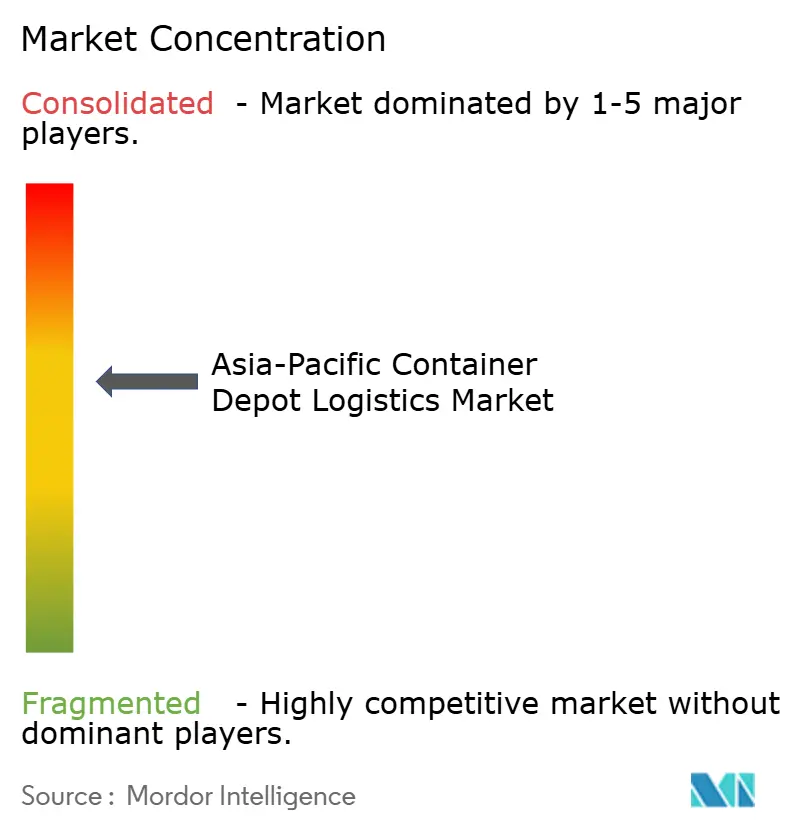
| Market Concentration | Medium |
Major Players *Disclaimer: Major Players sorted in no particular order Image © Mordor Intelligence. Reuse requires attribution under CC BY 4.0. | |
Asia-Pacific Container Depot Logistics Market Analysis by Mordor Intelligence
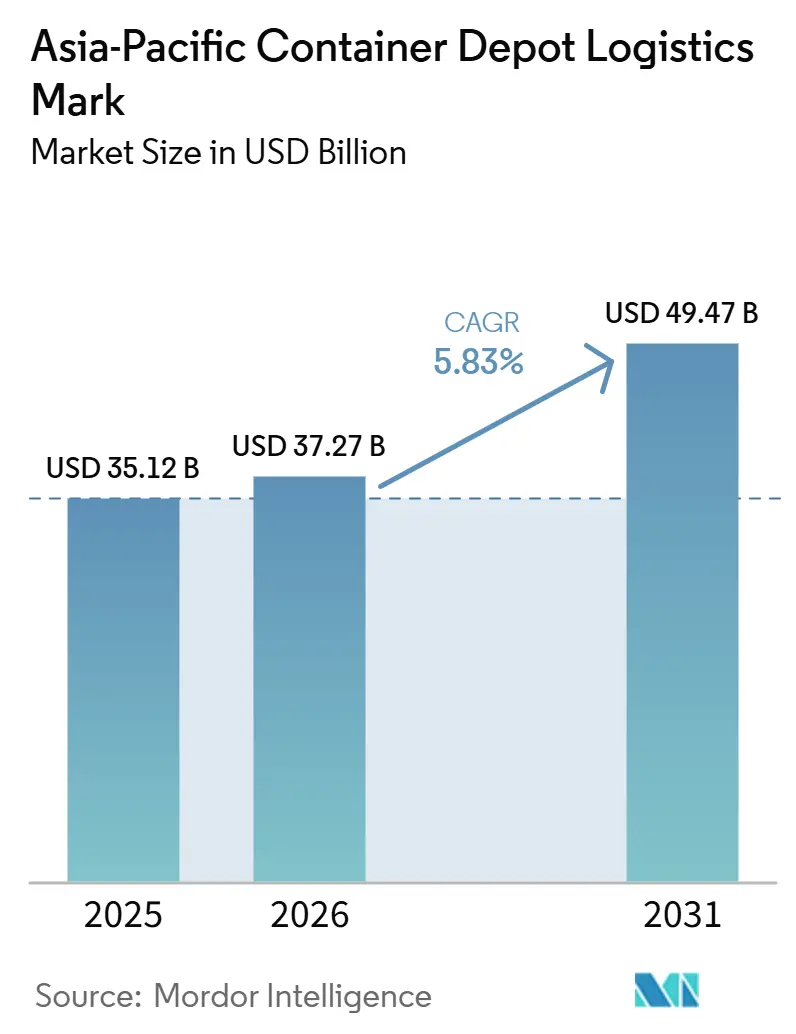
The Asia-Pacific container depot logistics market size was valued at USD 35.12 billion in 2025 and is forecast to reach USD 37.27 billion in 2026 and USD 49.47 billion by 2031 at 5.83% CAGR over 2026-2031.
Production is also spreading to Vietnam, India, and Indonesia, so cargo is moving across a wider set of inland and coastal corridors rather than remaining concentrated in older export centers. That shift is raising the need for rail-linked inland depots, empty container yards, and bonded logistics support, especially where exporters need faster turnaround between inland factories and gateway ports. The Asia-Pacific container depot logistics market is also benefiting from stronger cold-chain activity, increased inspection requirements for older container fleets, and a broader role for depots in customs-linked value-added services. Competition remains split between large global terminal groups and many regional specialists. At the same time, limited land near major corridors and uneven digital systems still slow the pace at which the Asia-Pacific container depot logistics market can add efficient capacity.
Key Report Takeaways
- By depot type, inland container depots accounted for 41.13% of the Asia-Pacific container depot logistics market size in 2025, while empty container depots are forecast to expand at 8.69% CAGR through 2031.
- By service type, container storage services accounted for 33.94% of the Asia-Pacific container depot logistics market share in 2025, while container maintenance and repair services recorded the fastest projected CAGR at 9.84% through 2031.
- By container type, dry containers accounted for 86.82% of the Asia-Pacific container depot logistics market size in 2025, while reefer containers are projected to grow at 8.26% CAGR through 2031.
- By trade orientation, international and transshipment container handling accounted for 68% of the Asia-Pacific container depot logistics market share in 2025 and is projected to grow at 7.97% CAGR through 2031.
- By geography, China accounted for 31.61% of the Asia-Pacific container depot logistics market size in 2025, while India is forecast to post the fastest 8.69% CAGR through 2031.
Note: Market size and forecast figures in this report are generated using Mordor Intelligence’s proprietary estimation framework, updated with the latest available data and insights as of January 2026.
Asia-Pacific Container Depot Logistics Market Trends and Insights
Drivers Impact Analysis*
| Driver | (~) % Impact on CAGR Forecast | Geographic Relevance | Impact Timeline |
|---|---|---|---|
| Rising Container Repositioning Needs Across Export-Led Hubs | +1.1% | Global, concentrated in China, India, Vietnam, and South Korea | Short term (≤ 2 years) |
| Expansion of Inland Dry Port and ICD Networks | +1.0% | India, China, Vietnam, Malaysia, Bangladesh | Medium term (2-4 years) |
| Growth in Reefer Throughput and Temperature-Controlled Cargo Handling | +0.9% | India, Japan, Australia, Southeast Asia | Medium term (2-4 years) |
| Shift Toward Digital Yard Visibility and Asset Tracking | +0.7% | China, Singapore, Australia, South Korea | Medium term (2-4 years) |
| Port Congestion Deflection Into Off-Dock and Inland Depots | +0.8% | Singapore, South Korea, China | Short term (≤ 2 years) |
| Demand for Bonded, Free-Trade-Zone Linked Value-Added Services | +0.6% | China, Vietnam, Singapore, Malaysia, India | Long term (≥ 4 years) |
| Source: Mordor Intelligence | |||
Rising Container Repositioning Needs Across Export-Led Hubs
Container flows across the Asia-Pacific region remain uneven, and export-heavy locations continue to need faster access to empty boxes. In early 2026, carriers were moving equipment back from Europe to China and Southeast Asia after depot utilization in Europe exceeded 90%. That movement increases sorting, inspection, repair, and staging work at empty container depots in Vietnam, India, and South Korea. The Asia-Pacific container depot logistics market benefits from this, as empty repositioning has become a direct operating line for off-dock yards rather than just a support task. Shipping lines are also placing more value on depot partners that can show faster box identification, cleaner yard discipline, and shorter turnaround times.
Expansion of Inland Dry Port and ICD Networks
The build-out of inland dry ports and ICDs remains one of the clearest supports for the Asia-Pacific container depot logistics market. CONCOR expanded its logistics footprint to more than 190 locations with 68 terminals in India, while new facilities were commissioned at Dalpatpur, Kanpur Logistics Park, and Kadakola[1]Source: India Seatrade News, “CONCOR Expands India Logistics Network to 190+ Locations with 68 Terminals,” India Seatrade News, indiaseatradenews.com. Vietnam approved 19 ICDs in its planning list, including Cai Mep and Tan Cang-Moc Bai, and Bangladesh removed foreign ownership caps on ICD facilities to attract outside capital. China also set out a multimodal action plan for 2026-2030 that calls for direct rail siding access at large logistics parks and stronger rail-sea links into inland zones. As more customs clearance and value-added work moves inland, gateway ports lose some of their earlier hold on container freight station and yard pricing.
Growth in Reefer Throughput and Temperature-Controlled Cargo Handling
Reefer movement is changing investment priorities across the Asia-Pacific container depot logistics market. CONCOR launched reefer express services from ICD Hyderabad and ICD Kanpur, and Adani Logistics operates a dedicated reefer rail corridor between ICD Virochannagar and Mundra Port. Kamigumi also announced a temperature-controlled warehouse at Kobe Port Island with whole-building automated temperature control and an automated pallet system[2]Source: Kamigumi Co., Ltd., “Notice Regarding Construction of Kamigumi Kobe Port Island Temperature-Controlled Warehouse,” Kamigumi, en.kamigumi.co.jp. These moves show that inland and port-side operators now see cold-chain handling as a core service area, not a side offering. GEODIS also warned that reefer equipment shortages during peak export windows could run 40-45% below demand, underscoring the value of depots that already have plug capacity, power reliability, and stronger monitoring processes.
Port Congestion Deflection Into Off-Dock and Inland Depots
Port congestion continues to push part of the container workload away from quayside terminals and into off-dock facilities. The Port of Melbourne reported 7% year-on-year container growth in April 2026, tightening terminal storage buffers and increasing pressure on nearby support infrastructure. When core terminals fill up, storage, consolidation, and other support work are moved first to off-dock stations and then to inland rail-linked depots. That directly supports revenue conversion for well-located yards in the Asia-Pacific container depot logistics market. In 2025, Flinders Port Holdings invested USD 243 million in the Flinders Adelaide Container Terminal to expand empty depot capacity and install a new depot operating system, reflecting the growing centrality of off-port assets.
Restraints Impact Analysis*
| Restraint | (~) % Impact on CAGR Forecast | Geographic Relevance | Impact Timeline |
|---|---|---|---|
| Scarcity and Cost Inflation of Depot-Grade Land Near Major Corridors | -0.6% | Singapore, Sydney, Tokyo, Bangkok, Mumbai | Short term (≤ 2 years) |
| Manual Operations and Low Interoperability Across Depot IT Systems | -0.4% | Southeast Asia, South Asia, Rest of Asia-Pacific | Medium term (2-4 years) |
| Uneven Customs Digitization Slowing Cross-Border Container Release | -0.4% | India, Bangladesh, Indonesia, Vietnam | Medium term (2-4 years) |
| Power Reliability and Water Constraints for Wash and Reefer Support Operations | -0.3% | South Asia, parts of Southeast Asia | Long term (≥ 4 years) |
| Source: Mordor Intelligence | |||
Scarcity And Cost Inflation Of Depot-Grade Land Near Major Corridors
Depot-grade land near major ports and industrial corridors remains limited across the region. Thailand’s Eastern Economic Corridor saw industrial land prices rise by 20-30% over the past 2 years, and vacancy in industrial estates fell to 6.2%. Similar pressure is visible around primary port corridors where operators need hardstand capacity, truck access, and room for reefer or wash support. This makes it harder for new entrants to match the economics of incumbents that already hold legacy land banks. It also pushes some developers toward outer-metro sites, where longer travel distances and toll costs can erode service competitiveness.
Manual Operations And Low Interoperability Across Depot IT Systems
Manual yard processes and disconnected systems continue to slow throughput across many parts of the Asia-Pacific container depot logistics market. Depot operating systems, gate modules, vehicle booking tools, and terminal platforms often do not exchange data smoothly, so operators still rely on manual checks and repeated reconciliation. That raises labor intensity and can lengthen container dwell time even when physical yard space is available. The gap is becoming more visible as some operators deploy more automated depots and real-time visibility tools, while many smaller yards still run on older workflows. This problem is likely to stay important because customs and compliance systems increasingly depend on cleaner electronic records across carriers, terminals, and inland depots.
*Our forecasts treat driver/restraint impacts as directional, not additive. The impact forecasts reflect baseline growth, mix effects, and variable interactions.
Segment Analysis
By Depot Type: ICD Volume Anchored, Empty Depots Accelerating
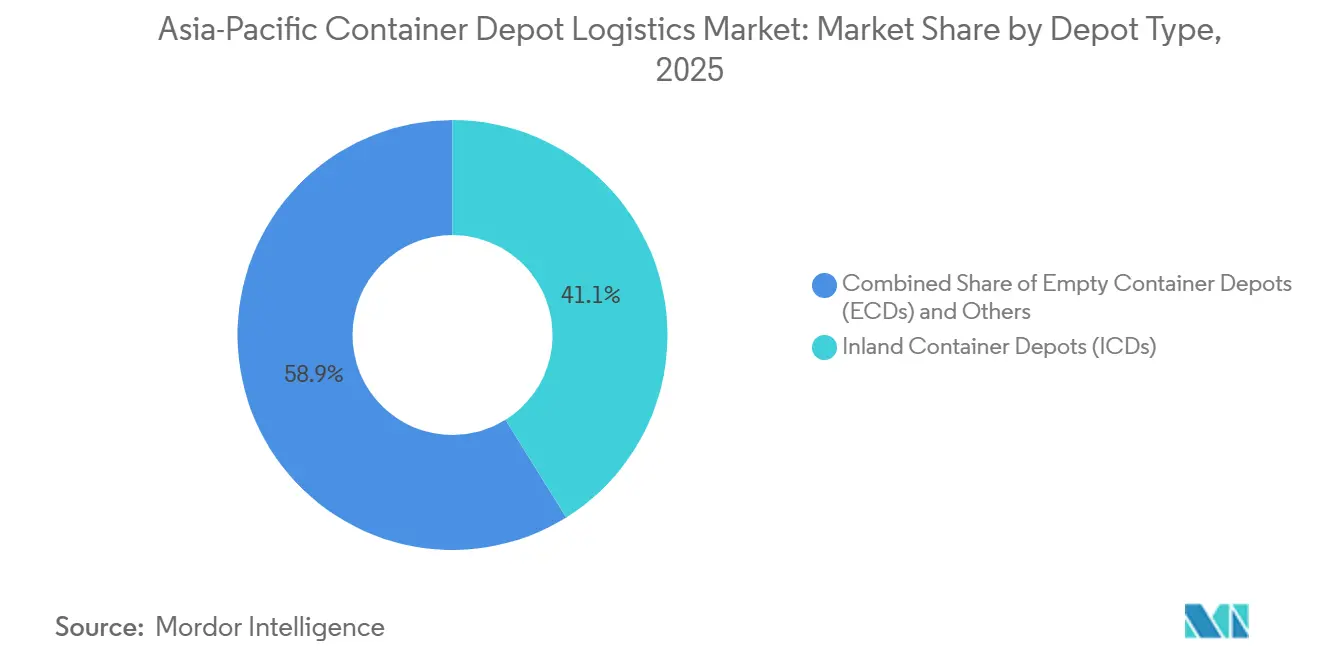
Inland container depots accounted for 41.13% of the Asia-Pacific container depot logistics market share in 2025, reflecting their role as the main customs and rail interface across large export corridors. Their position is supported by policy-led multimodal investment, including China’s push to expand rail-sea intermodal volumes by 15% a year through 2027. Container freight stations still have an important base near gateway ports because they support less-than-container-load consolidation and short-distance port-side handling. Empty container depots are the fastest-growing depot type, with a 8.69% CAGR through 2031, as equipment imbalance is turning empty box management into a larger and more specialized activity.
Port-based depots still matter for carriers that need controlled storage close to terminals, but higher land costs inside port areas are making off-dock alternatives more attractive. RSA Global announced India’s largest automated empty container facility in the JNPA ecosystem with an INR 2,580 crore (USD 305 million) investment, and capacity to handle more than 50,000 TEUs a month. The project includes an automated storage and retrieval system, OCR-enabled gates, and digital yard management, which shows how capital is moving toward higher-efficiency empty yards. Similar operating models are likely to appear more often in Vietnam and Indonesia as export-oriented manufacturing spreads and manual yards face heavier turnaround pressure.



By Service Type: Storage Leads, Maintenance and Repair Services Accelerates Fastest
Container storage services accounted for 33.94% of the Asia-Pacific container depot logistics market size in 2025, making them the largest service line. The lead position came from persistent trade imbalances, longer dwell cycles at busy nodes, and wider use of inventory buffers by shippers seeking greater schedule flexibility. Container maintenance and repair services are the fastest-growing service type, with a 9.84% CAGR through 2031, driven by stricter inspection requirements and an aging global container fleet. Container handling services still represent a major revenue stream, but they are becoming more standardized, putting greater pressure on scale and yard productivity.
Cleaning and washing services are growing more slowly because access to water and compliance with wastewater regulations remain practical constraints in several locations. Other value-added logistics services, including bonded warehousing, cross-docking, relabeling, and container modification, are gaining importance as depot operators try to keep more cargo activity inside a single site. Yusen Logistics’ cold storage expansion in Binh Duong showed how customers increasingly value service bundles that combine storage, temperature control, and supporting logistics functions in one place[3]Source: Container News, “Yusen Logistics and SkyCell Expand Partnership to China-Japan Lane,” Container News, container-news.com. The Asia-Pacific container depot logistics industry is therefore moving toward broader service platforms rather than stand-alone yard operations.
By Container Type: Dry Dominates, Reefer Redefines Growth Expectations
Dry containers accounted for 86.82% of the Asia-Pacific container depot logistics market share in 2025. Reefer containers, however, are projected to grow at a 8.26% CAGR through 2031, making them the stronger growth story within the Asia-Pacific container depot logistics market. This gap reflects expanding pharmaceutical exports from India, wider agri-food export corridors across Southeast Asia, and higher demand for controlled distribution of consumer goods. It also means depots need more power support, plug availability, equipment checks, and thermal monitoring than a dry-heavy yard mix would require.
Kamigumi’s planned temperature-controlled warehouse at Kobe Port Island shows that operators are investing ahead of reefer demand rather than waiting for congestion to force late upgrades. Yusen Logistics and SkyCell also extended their pharmaceutical cold-chain partnership to the China-Japan lane, pointing to a stronger role for depot-linked cold handling in cross-border life sciences logistics. GEODIS warned that reefer equipment availability during peak export windows could fall 40-45% below demand, so depots with stronger electrical infrastructure can better protect cargo flows. The Asia-Pacific container depot logistics industry is likely to see reefer capability emerge as a clearer line of differentiation as export lanes for food and healthcare products continue to expand.
By Trade Orientation: International Flows Dominate, Domestic Gains Ground
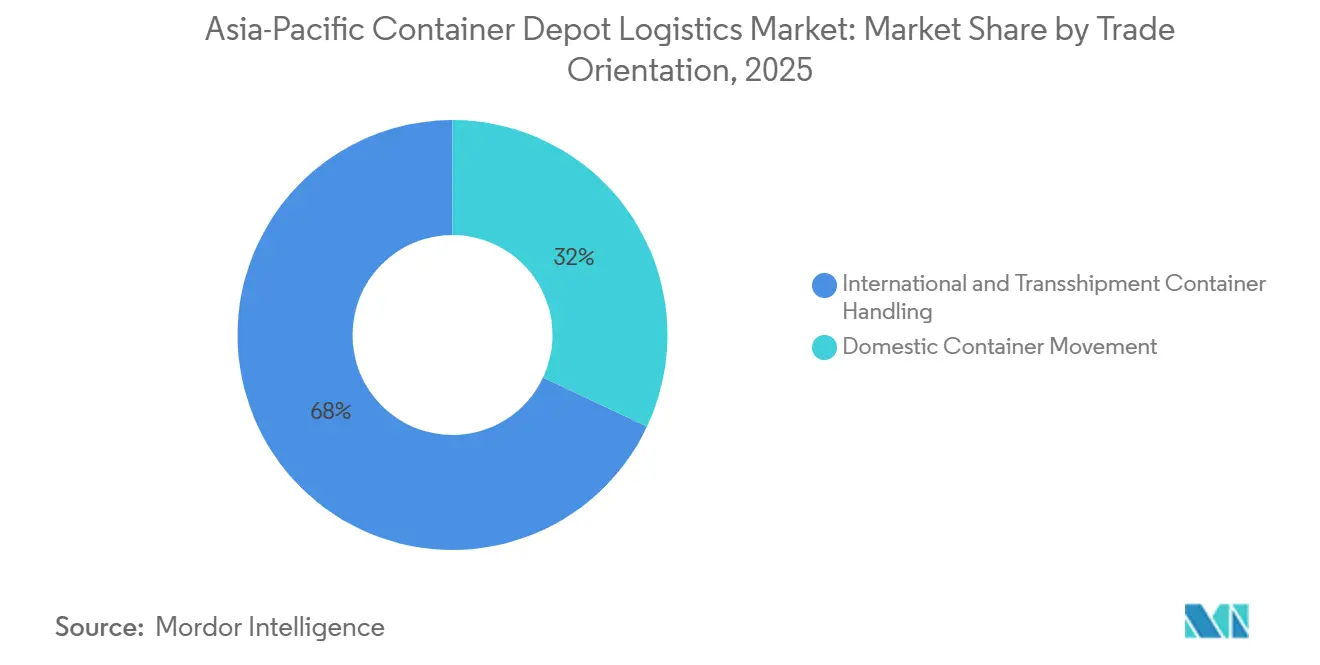
International and transshipment container handling accounted for 68% of the Asia-Pacific container depot logistics market size in 2025 and is also projected to grow at 7.97% CAGR through 2031. That dual lead is unusual because mature freight systems often show slower growth in their largest operating category. In this case, export platform growth in Vietnam and India, along with steady transshipment demand in Singapore and Malaysia, is keeping international movement ahead of domestic container growth. Domestic container movement is still gaining relevance in China, India, and Indonesia as inland production and distribution networks expand.
PSA Vietnam and Lach Huyen International Logistics & Industrial Park agreed to jointly develop and operate 4 deep-sea container berths at Hai Phong, and the project links with PSA’s existing ICD presence in Bac Ninh province. That model shows how port operators are trying to control more of the inland connection instead of stopping at the terminal gate. Domestic flows will keep improving as rail networks and containerization rates deepen, but those conditions remain uneven across the region. The Asia-Pacific container depot logistics industry, therefore, remains more closely shaped by international and transshipment volume than by domestic movement alone.
Geography Analysis
China held 31.61% of the Asia-Pacific container depot logistics market share in 2025, reflecting the scale of its ports, bonded zones, and inland logistics network. Ningbo-Zhoushan Port handled more than 4,300 million TEUs and more than 14 billion tons of cargo in 2025, which kept it among the region’s most important cargo gateways. China also operated 168 comprehensive bonded zones that generated CNY 7.2 trillion (USD 1 trillion) in import and export trade value in 2025. Inland utilization continued to widen as the Zheng-Ou China-Europe Railway service recorded 555 trains in January and February 2026, up 11.3% year on year, further extending depot demand into interior provinces.
India is the fastest-growing country in the Asia-Pacific container depot logistics market with an 8.69% CAGR projected through 2031. The Western Dedicated Freight Corridor link to JNPA is expected to lift EXIM throughput by more than 15% in FY2027, which gives inland depots a stronger role in port access and cargo timing. CONCOR’s network of more than 190 locations and 68 terminals shows how broad the country’s inland base has already become. It's February 2026, move to form Bharat Container Shipping Line with SCI, JNPA, VOCPA, CPA, and SMFCL also points to a more integrated port-to-inland strategy. Vietnam and Singapore are also important nodes, with Vietnam adding more ICD capacity under government planning and Singapore’s tight logistics footprint increasing interest in the Johor-Singapore corridor.
Japan, Australia, and South Korea remain important operating markets because they combine stable trade volumes with tight industrial logistics capacity. Thailand’s Eastern Economic Corridor is also attracting container-linked investment, and industrial estate vacancy there fell to 6.2% as land demand increased. Indonesia and the rest of Asia-Pacific are earlier in the build-out cycle, so they offer room for faster gains once transport links, customs processes, and inland containerization improve.
Competitive Landscape
The Asia-Pacific container depot logistics market remains moderately consolidated at the global terminal operator tier, while off-dock ICD and regional depot activity stays far more fragmented. DP World, PSA International, APM Terminals, and China Merchants Port Holdings have the strongest position in port-adjacent and transshipment-linked operations. Regional players such as Container Corporation of India, Flinders Port Holdings, and Hind Terminals compete more through rail access, bonded connectivity, local customer relationships, and wider service coverage. PSA has been pushing a network strategy that joins ports with inland logistics, and its Xiamen investment paired terminal exposure with a stake in the Xiamen Port Intermodal Logistics Hub[4]Source: AJOT, “PSA Expands Network in China with Successful Bid for Xiamen Port Investment,” AJOT, ajot.com.. APM Terminals also acquired a 49% stake in Hateco Hai Phong International Container Terminal in March 2026, giving it a direct operating position at a fast-growing Vietnam gateway.
Regional and sub-regional groups are also making larger capital moves. ICTSI announced a USD 740 million capital expenditure plan for 2026, and part of that program is supported by a USD 300 million AIIB loan for terminal upgrades in the Philippines. Flinders Port Holdings also signed a contract for Australia’s first cantilever automated rubber-tire gantry crane at FACT, which shows that automation is moving from the trial stage into asset deployment. These moves show that competition now depends as much on system capability and inland reach as on terminal scale.
Service bundling is becoming another clear point of separation across the Asia-Pacific container depot logistics market. Shipping-line-linked groups are tying depot control more closely to equipment programs and cargo origination, as seen in NX China’s branded container partnership with SITC on the Shanghai-Osaka route. Operators that can combine maintenance, repair, digital reporting, and visibility across storage and movement steps are better placed to win work from shipping lines and large exporters. The Asia-Pacific container depot logistics market still has room for new entrants. Still, access to land, capital, and interoperable systems will continue to decide which firms can scale beyond local footprints.
Asia-Pacific Container Depot Logistics Industry Leaders
DP World
PSA International
Hutchison Ports
China COSCO Shipping Ports Limited
Container Corporation of India Limited
- *Disclaimer: Major Players sorted in no particular order

Recent Industry Developments
- July 2026: PSA Vietnam and Lach Huyen International Logistics & Industrial Park signed an agreement to jointly develop and operate 4 deep-sea container berths at Lach Huyen Port in Hai Phong, northern Vietnam. This partnership integrated with PSA's existing ICD facility in Bac Ninh province to create a multimodal inland-to-deepwater logistics corridor.
- May 2026: PSA International secured investment in Xiamen Container Terminal Group through a public bidding process. XCTG comprises 8 container terminals with a combined designed capacity of 20 million TEU in Fujian Province. PSA concurrently deepened its stake in the Xiamen Port Intermodal Logistics Hub, aligning with its Node-to-Network integration strategy.
- March 2026: APM Terminals acquired a 49% minority stake in Hateco Hai Phong International Container Terminal, Vietnam's fastest-growing deepwater terminal at Lach Huyen, marking Maersk's terminal arm's first direct port equity in Vietnam. The deal converts APM Terminals from development partner to co-owner, complementing its concurrent agreement with Hateco Group to develop Da Nang's Lien Chieu Container Port.
- February 2026: Nippon Express China launched NX Brand Containers in partnership with SITC International Holdings, affixing NX Group branding on SITC-owned 40-foot containers on the Shanghai-Osaka route, projecting 20-30 branded container voyages annually.


Asia-Pacific Container Depot Logistics Market Report Scope
| Inland Container Depots (ICDs) |
| Container Freight Stations (CFS) |
| Empty Container Depots (ECDs) |
| Port-Based Container Depots |
| Container Storage Services |
| Container Handling Services |
| Container Maintenance and Repair (M&R) Services |
| Container Cleaning & Washing Services |
| Other Value-Added Logistics Services |
| Dry Containers |
| Reefer Containers |
| International/Transshipment Container Handling |
| Domestic Container Movement |
| China |
| Japan |
| India |
| South Korea |
| Australia |
| Indonesia |
| Singapore |
| Vietnam |
| Thailand |
| Rest of Asia-Pacific |
| By Depot Type | Inland Container Depots (ICDs) |
| Container Freight Stations (CFS) | |
| Empty Container Depots (ECDs) | |
| Port-Based Container Depots | |
| By Service Type | Container Storage Services |
| Container Handling Services | |
| Container Maintenance and Repair (M&R) Services | |
| Container Cleaning & Washing Services | |
| Other Value-Added Logistics Services | |
| By Container Type | Dry Containers |
| Reefer Containers | |
| By Trade Orientation | International/Transshipment Container Handling |
| Domestic Container Movement | |
| By Country | China |
| Japan | |
| India | |
| South Korea | |
| Australia | |
| Indonesia | |
| Singapore | |
| Vietnam | |
| Thailand | |
| Rest of Asia-Pacific |


Key Questions Answered in the Report
What is the 2031 value forecast for Asia-Pacific container depot logistics?
The Asia-Pacific container depot logistics market is forecast to reach USD 49.47 billion by 2031, rising from USD 37.27 billion in 2026 at a 5.83% CAGR.
Which depot type leads revenue in Asia-Pacific container depot logistics?
Inland container depots led with 41.13% share in 2025 because they anchor customs clearance and rail-linked inland cargo movement.
Which service line is expanding the fastest through 2031?
Container maintenance and repair services are projected to grow the fastest, at a 9.84% CAGR, supported by aging fleets and tighter inspection requirements.
Why are empty container depots gaining importance across the Asia-Pacific?
Carriers are repositioning more empty boxes back into Asian export hubs, which raises demand for sorting, inspection, repair, and quick redeployment at specialized empty yards.
Which country offers the strongest growth outlook in this region?
India has the fastest projected growth at 8.69% CAGR through 2031, supported by the Western Dedicated Freight Corridor link to JNPA and a broad inland terminal network.
How is reefer handling changing depot investment decisions?
Reefer containers are projected to grow at 8.26% CAGR, so operators are investing more in plug capacity, power support, temperature-controlled storage, and cold-chain rail links.
Page last updated on:





