
Asia-Pacific Construction Technical Textile Market Size and Share
Market Overview
| Study Period | 2021 - 2032 |
|---|---|
| Forecast Data Period | 2027 - 2032 |
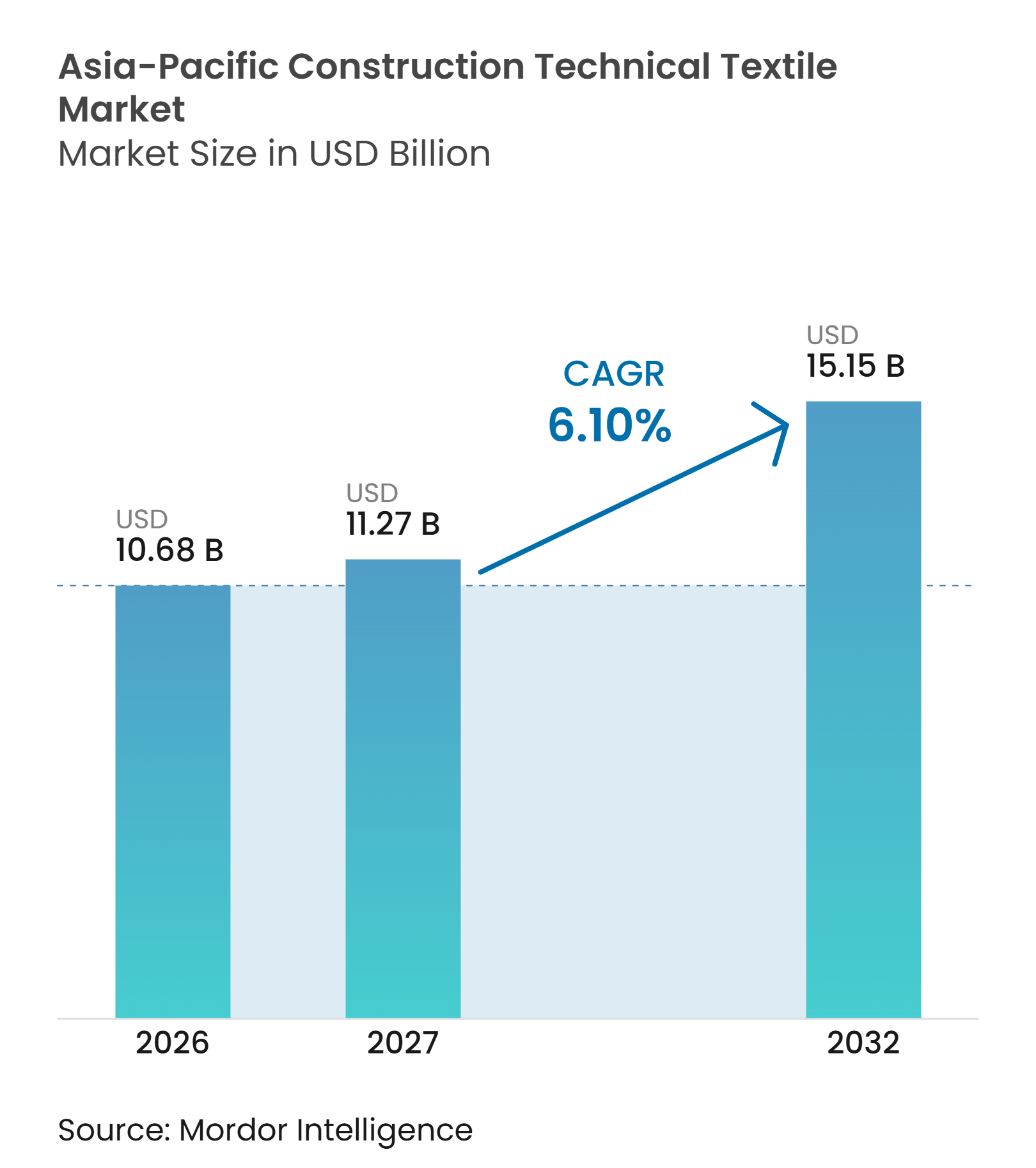
| Base Year Market Size (2026) | USD 10.68 Billion |
| Market Size (2027) | USD 11.27 Billion |
| Market Size (2032) | USD 15.15 Billion |
| Growth Rate (2027 - 2032) | 6.10 % |
| Market Concentration | Medium |
Major Players *Disclaimer: Major Players sorted in no particular order Image © Mordor Intelligence. Reuse requires attribution under CC BY 4.0. | |
Asia-Pacific Construction Technical Textile Market Analysis by Mordor Intelligence
The Asia-Pacific Construction Technical Textile Market size is expected to increase from USD 10.68 billion in 2026 to USD 11.27 billion in 2027 and reach USD 15.15 billion by 2032, growing at a CAGR of 6.10% over 2027-2032.
The Asia-Pacific construction technical textile market is supported by sustained transport, housing, industrial, and coastal-protection construction across the region. Asia-Pacific needs USD 43 trillion in transport infrastructure investment between 2020 and 2035, covering construction, maintenance, and climate resilience. Policy action also supports demand, as India has mobilized INR 1,480 crore (USD 164.7 million) through the National Technical Textiles Mission for domestic geotextile and buildtech capacity through 2025-26. Higher standards are making product qualification, testing capability, and installation support more important competitive factors. The Asia-Pacific construction technical textile market therefore offers opportunities for suppliers that combine regional fabrication with certified materials and project design support.
Key Report Takeaways
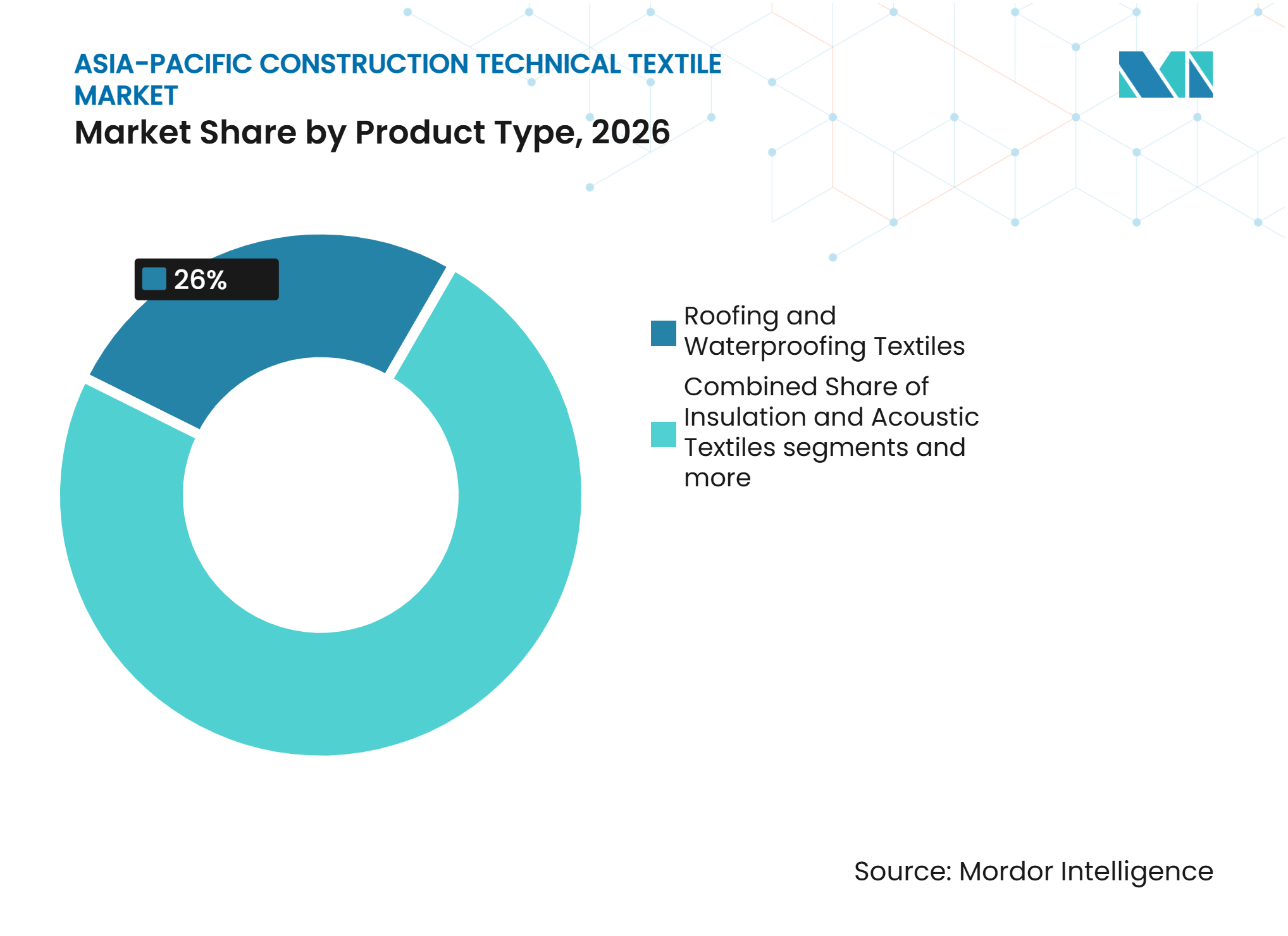
- By product type, roofing and waterproofing textiles held 26% of the Asia-Pacific construction technical textile market share in 2026, while architectural membranes and tensile fabrics are projected to grow at a CAGR of 7.8% through 2032.
- By material type, polyester accounted for 31% of the Asia-Pacific construction technical textile market size in 2026, while carbon, Aramid, and other high-performance fibers are projected to grow at a CAGR of 8.2% through 2032.
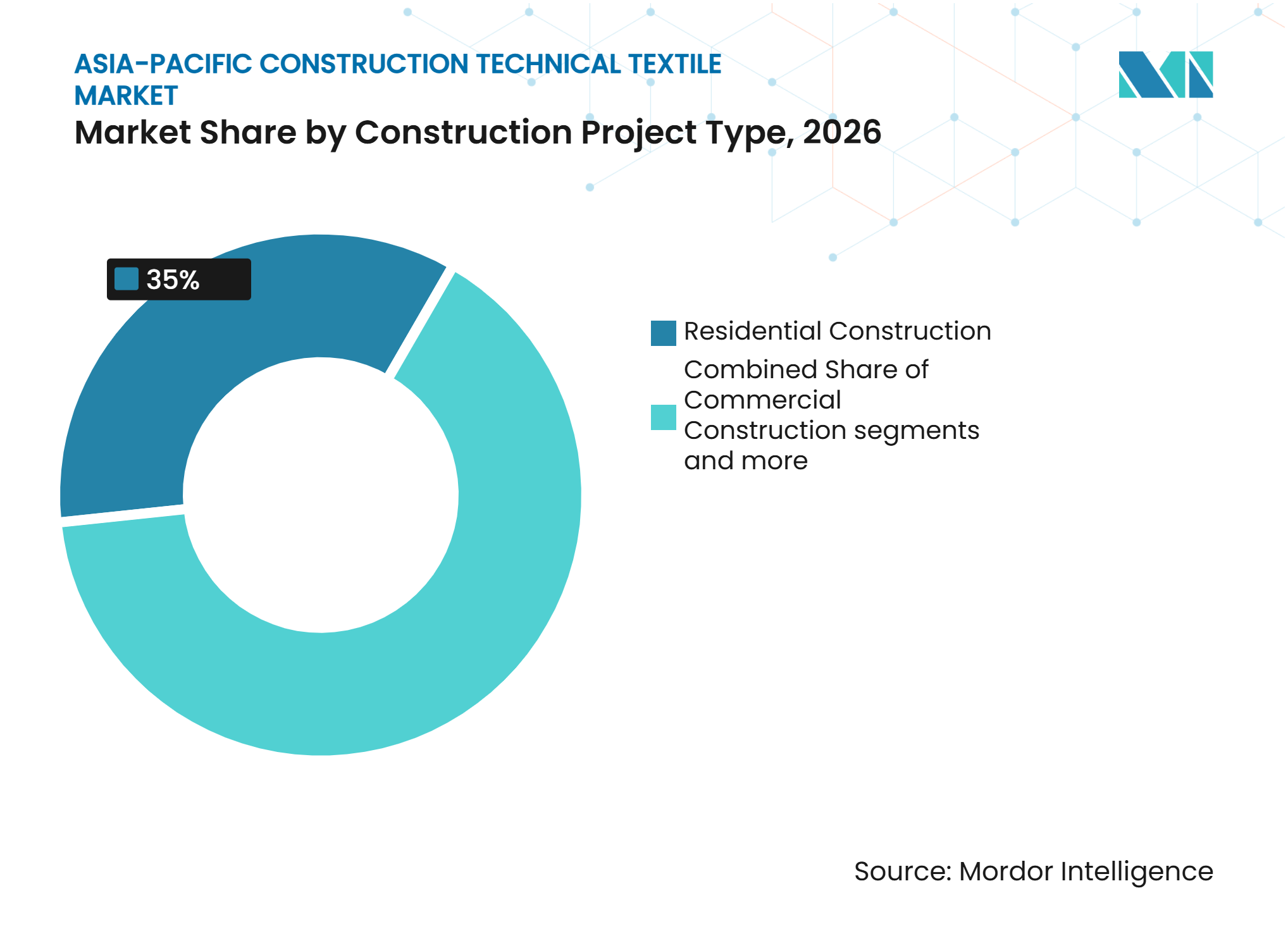
- By construction project type, residential construction held a 35% share in 2026, while industrial and logistics construction is projected to register a CAGR of 7.5% through 2032.
- By geography, China held 36% of the Asia-Pacific construction technical textile regional revenue share in 2026, while India is projected to register a CAGR of 8% through 2032.
Note: Market numbers in this report are based on Mordor Intelligence's proprietary estimation framework, which combines nine months of actuals with Q4 projections for base year 2026.
Market Trends and Insights
Drivers Impact Analysis of Asia-Pacific Construction Technical Textile Market*
| Driver | (~) % Impact on CAGR Forecast | Geographic Relevance | Impact Timeline |
|---|---|---|---|
| Transport and Urban Infrastructure Expansion | +1.6% | Pan-regional, highest intensity in India, ASEAN, and China | Short term (≤ 2 years) |
| Climate-Resilient Coastal, Flood, and Slope Protection | +1.2% | Southeast Asia, South Asia, coastal China, Singapore, Indonesia, and Vietnam | Medium term (2-4 years) |
| Stricter Waste, Water, and Containment Requirements | +0.9% | China, India, and ASEAN | Medium term (2-4 years) |
| Lifecycle Cost Savings from Soil Stabilization and Drainage | +0.7% | India, Southeast Asia, and Australia | Medium term (2-4 years) |
| Regional Manufacturing and Engineering Capability Expansion | +0.5% | India, Vietnam, Taiwan, and South Korea | Long term (≥ 4 years) |
| Specification Pull from Digital Design and Performance-Based Procurement | +0.4% | Japan, South Korea, Australia, and Singapore | Long term (≥ 4 years) |
| Source: Mordor Intelligence | |||
Transport and Urban Infrastructure Expansion
Transport investment remains the largest volume driver for the Asia-Pacific construction technical textile market. Vietnam allocated VND 875 trillion (USD 35 billion) in public investment for 2025, including the North-South Expressway, Long Thanh International Airport, and a USD 8.4 billion railway link to China. Thailand’s 2025-26 plan covers 223 infrastructure projects, with rail as the largest category and the Thai-China high-speed railway Phase 2 budgeted at THB 341.35 billion (USD 10 billion).[1] These projects require subgrade stabilization, embankment reinforcement, drainage management, and tunnel waterproofing. They expand demand for geotextiles, geocells, and geomembranes across long transport corridors. Railway-grade requirements can strengthen pricing for producers that meet the applicable performance specifications.
Climate-Resilient Coastal, Flood and Slope Protection
Climate resilience is raising demand for higher-value drainage, containment, and erosion-control materials. Annual coastal-flood losses in Asia-Pacific stand at USD 26.8 billion and could rise to USD 143.7 billion to USD 197.8 billion by 2050 under moderate climate scenarios. Singapore committed SGD 5 billion (USD 3.9 billion) to its Coastal and Flood Protection Fund in 2025 and plans a coastal-protection code covering design, construction, and operations in 2026.[2] Malaysia committed more than MYR 20 billion (USD 4.9 billion) to 103 flood-mitigation projects, while Indonesia opened its USD 80 billion Java seawall project to foreign investors. These programs use recomposite drainage systems, lined containment bunds, geotextile tubes, and erosion-control matting. Their technical requirements favor products with stronger performance attributes than commodity geotextiles. The Asia-Pacific construction technical textile market benefits when these programs move from planning into funded procurement.
Stricter Waste, Water and Containment Requirements
Waste, water, and containment rules create demand that is less dependent on discretionary construction spending. India’s geotextiles quality-control regime became effective in April 2025 and requires BIS certification for specified geotextile products used in coastal and waterway protection.[3] China’s 2025 polyethylene geomembrane standard strengthens acid-alkali resistance requirements and updates thickness tolerances. These requirements support geomembranes, filtration geotextiles, and drainage composites in landfill, wastewater, mining, and groundwater protection. Manufacturers with testing laboratories can compete more effectively for qualified procurement. The changes also reduce room for lower-quality materials that do not meet updated specifications.
Lifecycle Cost Savings from Soil Stabilization and Drainage
Lifecycle cost savings support wider use of geosynthetics in road construction, foundation stabilization, and drainage applications. ISO/TR 18228-5:2025 guides stabilization design in paved and unpaved roads, working platforms, and foundations, supporting the selection of suitable geosynthetic solutions for different ground conditions. Geosynthetics can extend pavement service life, improve load distribution, limit soil deformation, and reduce repeated excavation, aggregate replacement, and reinstatement requirements. These benefits are particularly relevant in ASEAN markets, where constrained road-maintenance budgets and challenging ground conditions increase the importance of long-term infrastructure performance. Although geosynthetic materials can cost 20–30% more upfront than conventional aggregates in some applications, the overall economic benefits can outweigh the initial premium when reduced material consumption, faster installation, lower maintenance requirements, and longer service intervals are considered.
Restraints Impact Analysis of Asia-Pacific Construction Technical Textile Market*
| Restraint | (~) % Impact on CAGR Forecast | Geographic Relevance | Impact Timeline |
|---|---|---|---|
| Petrochemical Feedstock and Resin Price Volatility | -0.9% | Pan-regional, most acute for small and mid-sized producers in Southeast Asia and India | Short term (≤ 2 years) |
| Installation Damage, Clogging, and Performance Failure Risk | -0.6% | India and ASEAN, with lower severity in Japan, South Korea, and Australia | Medium term (2-4 years) |
| Shortage of Geosynthetic Design and Testing Expertise | -0.4% | India, ASEAN, Bangladesh, and smaller Pacific markets | Long term (≥ 4 years) |
| Fragmented Approval Codes and Uneven Contractor Qualification | -0.3% | ASEAN, especially Indonesia, Vietnam, and the Philippines | Long term (≥ 4 years) |
| Source: Mordor Intelligence | |||
Petrochemical Feedstock and Resin Price Volatility
Polypropylene and polyester price fluctuations create margin pressure for geosynthetic suppliers and increase procurement uncertainty for construction buyers. China’s polypropylene market faced excess supply in 2025, while crude oil price movements influenced feedstock costs and created pricing uncertainty that producers could not always pass through under short-cycle contracts. In India, geotextile production is concentrated in Maharashtra and Gujarat, increasing transportation costs and delivery lead times for infrastructure projects in remote regions. Rupee depreciation can further raise the cost of imported advanced geocomposites, specialized polymers, and production equipment. Volatile input prices also complicate inventory planning, quotation validity, and long-term project budgeting, particularly when infrastructure contracts have limited provisions for material price escalation. Smaller manufacturers without vertical integration, long-term supply agreements, or sufficient purchasing scale face greater difficulty absorbing sudden cost increases. These pressures can reduce their ability to compete with larger integrated producers, limit investment in product innovation, and weaken the mid-market supply layer serving local procurement channels. Consequently, sustained feedstock volatility may constrain supplier profitability and discourage consistent investment in domestic manufacturing capacity.
Installation Damage, Clogging, and Performance Failure Risk
Improper installation, ultraviolet exposure, and clogging can limit confidence in geosynthetic applications. Training gaps can result in errors on hill roads, embankments, retaining walls, and other civil engineering projects, particularly where installation requires specialized handling, soil assessment, and surface preparation. Ultraviolet exposure and low-temperature conditions can damage geogrids during storage or installation, while inadequate anchoring, improper overlap, and insufficient compaction can reduce reinforcement effectiveness. Fine-grained soils can clog geotextiles and restrict water flow, compromising drainage performance and increasing the risk of water accumulation, soil erosion, and structural instability. Inadequate site supervision and inconsistent adherence to installation guidelines can further increase the likelihood of premature material failure. Remediation costs, including excavation, replacement, and project delays, can exceed the initial savings from using lower-cost materials. Quality certification helps address material consistency, but installation assurance remains uneven across many ASEAN markets. Limited access to trained installers, standardized site inspection procedures, and technical guidance can therefore slow adoption, particularly among smaller contractors working on cost-sensitive infrastructure projects. Improving installer training, conducting pre-installation material inspections, and implementing routine quality checks can help reduce performance risks and strengthen confidence in geosynthetic solutions.
*Our forecasts treat driver/restraint impacts as directional, not additive. The impact forecasts reflect baseline growth, mix effects, and variable interactions.
Asia-Pacific Construction Technical Textile Market Segment Analysis
By Product Type:
Roofing Textiles Anchor Revenue While Membranes AccelerateRoofing and waterproofing textiles held 26% of the Asia-Pacific construction technical textile regional revenue share in 2026. The segment benefits from the large residential and commercial construction base in China, India, and Vietnam. Every new building needs a moisture-management solution, which provides a broad and recurring volume base. Roofing applications must also perform across varied climate conditions. This makes established roofing materials important in both new construction and maintenance. Their wider unit volume remains difficult for project-specific membranes to match.
Architectural membranes and tensile fabrics have the highest projected CAGR at 7.8% through 2032. Airports, railway terminals, stadiums, and expo venues support demand for large-span structures using PTFE-coated and ETFE membrane solutions. Taiyo Kogyo commercially launched TensoDiaRoof in October 2025 for parking lots, parks, and sports grounds. The system reduces installation barriers by eliminating scaffolding requirements. Façade and building-envelope textiles and reinforcement textiles retain stable positions, including fiberglass mesh for external insulation systems. Construction-site protection textiles continue to serve scaffolding, debris-containment, and specialty façade applications.



By Material Type:
PET Maintains Lead While High-Performance Fibers ExpandPolyester held 31% of the Asia-Pacific construction technical textile regional revenue share in 2026. Its position reflects high tensile strength, ultraviolet stability, chemical resistance, and established manufacturing capacity across China, India, and Taiwan. PET supports woven geotextiles, geomembrane composites, roofing membranes, and façade membranes. These applications account for a large part of regional material demand. Polypropylene and polyethylene also remain important for commodity geotextiles and geomembranes. Their relative cost position remains exposed to resin-price movements.
Carbon, aramid and other high-performance fibers are expected to expand at a CAGR of 8.2% through 2032. Japan and South Korea use these materials in seismic reinforcement, while carbon-fiber textiles support concrete rehabilitation. Aramid is suited to fire-resistant architectural membranes. Dextra tested Durabar GFRP carpet under industrial loads at its Thailand facility in October 2025. The activity demonstrates the use of glass-fiber technical textiles in nearby construction applications. Natural and regenerated fibers have selective support through India’s technical-textiles program, including coir geotextiles for specific rural-road uses.
By Construction Project Type:
Residential Leads as Industrial Build-Out Gains MomentumResidential construction held 35% of the Asia-Pacific construction technical textile regional revenue share in 2026. Urban housing growth in India, Vietnam, Indonesia, and the Philippines supports demand for waterproofing membranes, house wraps, and vapor barriers. India’s urban population is projected to exceed 40% of the national total by 2030. Residential construction creates a stable volume base because such materials are embedded in common building specifications. Demand spans both formal urban developments and broader housing stock expansion.
Industrial and logistics construction is projected to grow at a CAGR of 7.5% through 2032. Manufacturing activity moving into Vietnam, Indonesia, and India is increasing warehouse and factory construction. These projects require durable roofing membranes, flooring textiles, and façade systems. Industrial facilities tend to favor higher-specification products because they face demanding operating conditions. Freudenberg introduced fine-denier spunbond nonwovens for roofing, façade membranes, vapor barriers, and house wraps in 2025. Commercial projects remain slower in China during the real estate correction, while institutional buildings provide a steadier budget-cycle base.

Geography Analysis
China held 36% of the Asia-Pacific construction technical textile regional revenue share in 2026. Its lead reflects the scale of domestic construction and an integrated supply chain for geotextiles, nonwovens, and architectural membranes. China’s revised standards for nonwoven composite geomembranes and polyethylene geomembranes became effective in November 2025. Tighter performance thresholds should favor producers with qualified testing capability. The National Railway Administration also published TB/T 3618.4-2025 in October 2025, creating a quality floor for geotextiles on rail projects from May 2026.
India is the fastest-growing geography, with the Asia-Pacific construction technical textile market size projected to grow at a CAGR of 8% from 2027 to 2032. ADB’s USD 10 billion urban-transformation initiative supports metro extensions, RRTS corridors, and urban services in more than 100 cities. The NTTM and PLI Scheme have expanded domestic capacity alongside BIS enforcement from April 2025. Indonesia, Vietnam, and the Philippines form a separate demand cluster linked to public infrastructure and coastal-protection needs. Indonesia’s proposed Java seawall and Vietnam’s public-investment program support demand for containment, waterproofing, and drainage materials.
Japan and South Korea remain smaller in volume but support higher-value applications in slope protection, port construction, seismic reinforcement, and river management. Australia’s compliance environment supports a premium tier for infrastructure and environmental containment. Singapore’s 2025 coastal-protection fund increase creates a high-specification procurement channel for engineered geosynthetics and membranes. Taiwan contributes to high-performance fibers and coated membranes. Covestro began producing PFAS-free polyester coating resin at its Pingtung site in September 2025. Local production supports regional availability for coated building-material applications.
Competitive Landscape
Market Concentration
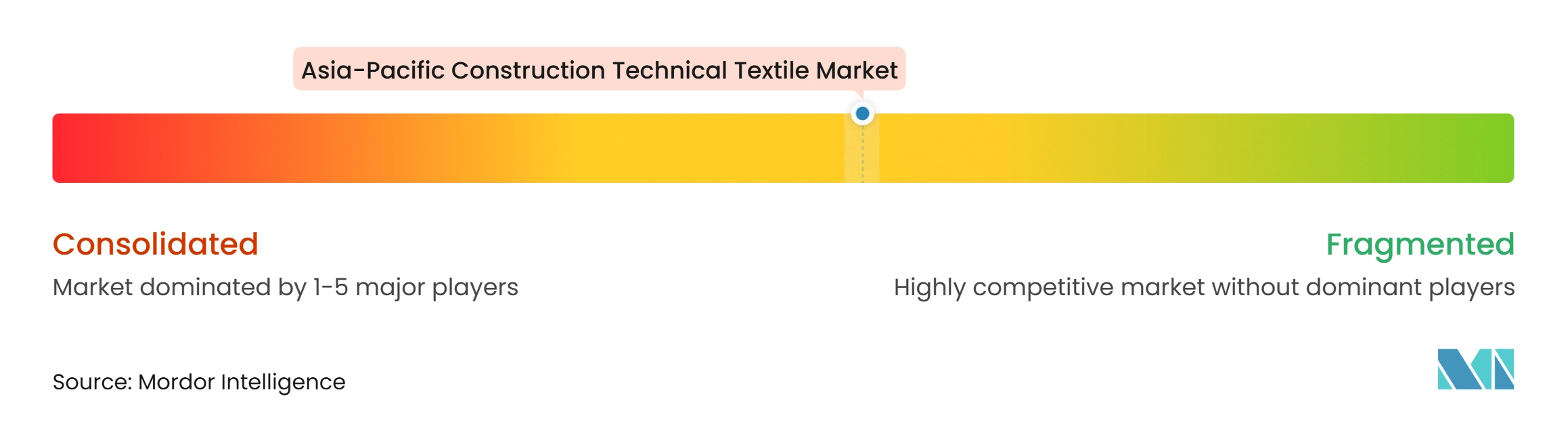
The Asia-Pacific construction technical textile market exhibits a medium level of market concentration. Solmax, HUESKER Synthetic GmbH, Naue GmbH & Co. KG, and Officine Maccaferri S.p.A. compete through engineering services, regional certification, and project-specific design support. TechFab India Industries Ltd., ACE Geosynthetics, Geofabrics Australasia, and Asahi Kasei Advance Corporation benefit from local approval lists and public-specification frameworks. Competition is stronger on price among Chinese and Indian commodity producers. Suppliers therefore need to balance material cost, technical performance, and local service.
Solmax unified its legacy TenCate Geosynthetics and Propex portfolios under its Performance Materials platform in 2025. This move combines established product lines for geosynthetics customers. Taiyo Kogyo launched TensoDiaRoof in October 2025 and continued work on flexible membrane structures with Cosmobloom. Saint-Gobain reported a 13.4% Asia-Pacific operating margin in the first half of 2025, supported by volume growth in India and expansion in Indonesia, the Philippines, and Vietnam. These actions show the importance of product development, local reach, and broader material portfolios.
Updated guidance and China’s revised standards widen the gap between qualified suppliers and commodity producers. Suppliers that provide testing records, certification support, and installation guidance can create stronger positions in public projects. Digitally verified installation monitoring remains an open area in smaller ASEAN markets. Local fabrication is also an opportunity where imported materials create cost or delivery constraints. Buyers continue to assess technical support alongside product price in specialized applications. The competitive structure remains consistent with a fragmented market rather than one controlled by a small group of suppliers. This structure leaves the Asia-Pacific construction technical textile market open to regional specialists that meet local specifications.
Asia-Pacific Construction Technical Textile Industry Leaders
-
Solmax
-
Freudenberg Performance Materials
-
Fibertex Nonwovens A/S
-
HUESKER Synthetic GmbH
-
Naue GmbH & Co. KG
- *Disclaimer: Major Players sorted in no particular order
Asia-Pacific Construction Technical Textile Market Companies Covered in this Report
- Solmax
- Freudenberg Performance Materials
- Fibertex Nonwovens A/S
- HUESKER Synthetic GmbH
- Naue GmbH & Co. KG
- Officine Maccaferri S.p.A.
- Strata Geosystems
- TechFab India Industries Ltd.
- Geofabrics Australasia Pty Ltd.
- Global Synthetics
- AGRU America, Inc.
- TENAX Group
- SKAPS Industries, Inc.
- ACE Geosynthetics
- Kaytech
- BontexGeo NV
- Asahi Kasei Advance Corporation
- Berry Global Inc.
- DuPont de Nemours, Inc.
- Saint-Gobain S.A.
- Taiyo Kogyo Co., Ltd.
- Sioen Industries NV
- Carlisle Companies Incorporated
- Owens Corning
Recent Industry Developments in Asia-Pacific Construction Technical Textile Market
- March 2026: Geotrans Technology published a development on intelligent geotextile laying technology, highlighting automation-oriented methods for geosynthetic installation.
- February 2026: Strata Geosystems acquired India-based Venus Interlinings, a manufacturer of nonwoven geotextiles and technical textiles, expanding into the nonwoven geotextiles segment and strengthening its manufacturing capabilities.
- October 2025: Taiyo Kogyo Co., Ltd. and Kyushu Daiichi Industry Co. commercially launched TensoDiaRoof, a scaffolding-free lightweight membrane roof incorporating a diagrid steel-tube structure covered with light-transmissive membrane material, targeting parking lots, parks, and sports grounds.
- October 2025: China’s National Railway Administration published TB/T 3618.4-2025, Railway Engineering Geosynthetics, Part 4, Geotextile, effective May 1, 2026, tightening performance requirements for geotextiles in subgrade, ballast-bed drainage, and slope-protection applications on Chinese railway lines.
Asia-Pacific Construction Technical Textile Market Report Scope
The Asia-Pacific Construction Technical Textile Market Report is segmented by Product Type (Roofing and Waterproofing Textiles, Insulation and Acoustic Textiles, and more), by Material Type (Polyester (PET), Polypropylene (PP), and more), by Construction Project Type (Residential Construction, Commercial Construction, and more), and by Geography (China, Japan, and More). The Market Forecasts are Provided in Terms of Value (USD).
Segmentation Overview
| Architectural Membranes and Tensile Fabrics (PVC-Coated Membranes, PTFE-Coated Fiberglass Membranes, etc.) |
| Roofing and Waterproofing Textiles |
| Façade and Building Envelope Textiles (Wraps & weather-Resistive Barriers, Façade Membrane Fabrics, etc.) |
| Construction Reinforcement Textiles (Fiberglass Plaster, Reinforcement Fabric & Meshes, Scrims, etc.) |
| Insulation and Acoustic Textiles |
| Architectural Shading and Canopy Textiles |
| Construction Site Protection Textiles (Debris Nets, Dust and Containment Fabrics, etc.) |
| Other Construction Technical Textiles |
| Polyester (PET) |
| Polypropylene (PP) |
| Polyethylene (PE) |
| Glass Fiber |
| Acrylic and Polyamide Fibers |
| Carbon, Aramid and Other High-Performance Fibers |
| Natural and Regenerated Fibers |
| Other Specialty Materials |
| Residential Construction |
| Commercial Construction |
| Industrial and Logistics Construction |
| Institutional and Other Building Construction |
| China |
| Japan |
| India |
| South Korea |
| Taiwan |
| Australia |
| Indonesia |
| Vietnam |
| Rest of Asia-Pacific |
| By Product Type | Architectural Membranes and Tensile Fabrics (PVC-Coated Membranes, PTFE-Coated Fiberglass Membranes, etc.) |
| Roofing and Waterproofing Textiles | |
| Façade and Building Envelope Textiles (Wraps & weather-Resistive Barriers, Façade Membrane Fabrics, etc.) | |
| Construction Reinforcement Textiles (Fiberglass Plaster, Reinforcement Fabric & Meshes, Scrims, etc.) | |
| Insulation and Acoustic Textiles | |
| Architectural Shading and Canopy Textiles | |
| Construction Site Protection Textiles (Debris Nets, Dust and Containment Fabrics, etc.) | |
| Other Construction Technical Textiles | |
| By Material Type | Polyester (PET) |
| Polypropylene (PP) | |
| Polyethylene (PE) | |
| Glass Fiber | |
| Acrylic and Polyamide Fibers | |
| Carbon, Aramid and Other High-Performance Fibers | |
| Natural and Regenerated Fibers | |
| Other Specialty Materials | |
| By Construction Project Type | Residential Construction |
| Commercial Construction | |
| Industrial and Logistics Construction | |
| Institutional and Other Building Construction | |
| By Geography | China |
| Japan | |
| India | |
| South Korea | |
| Taiwan | |
| Australia | |
| Indonesia | |
| Vietnam | |
| Rest of Asia-Pacific |
Key Questions Answered in the Report
What is the forecast growth rate for construction technical textiles in Asia-Pacific?
The sector is forecast to grow at a 6.10% CAGR from 2027 to 2032, reaching USD 15.15 billion by 2032.
Which product category leads demand in Asia-Pacific construction technical textiles?
Roofing and waterproofing textiles lead with a 26% share in 2026, supported by widespread residential and commercial building activity.
Which material is used most widely in construction technical textiles?
Polyester leads with a 31% share in 2026 because it combines tensile strength, ultraviolet stability, chemical resistance, and established regional supply.
Why are geotextiles gaining importance in Asian infrastructure projects?
Road, rail, flood-control, and coastal projects use geotextiles for stabilization, drainage, containment, and erosion control.
Which country is expected to grow fastest through 2032?
India is projected to expand at an 8% CAGR through 2032, supported by urban infrastructure, highways, and domestic capacity development.
What are the main risks affecting demand for construction technical textiles?
Resin-price volatility, installation failures, limited design expertise, and fragmented approval codes can delay adoption and pressure supplier margins.