
Asia-Pacific Commercial Roofing Market Size and Share
Market Overview
| Study Period | 2021 - 2032 |
|---|---|
| Forecast Data Period | 2027 - 2032 |
| Base Year Market Size (2026) | USD 13.34 Billion |
| Market Size (2027) | USD 14.37 Billion |
| Market Size (2032) | USD 20.81 Billion |
| Growth Rate (2027 - 2032) | 7.69 % |
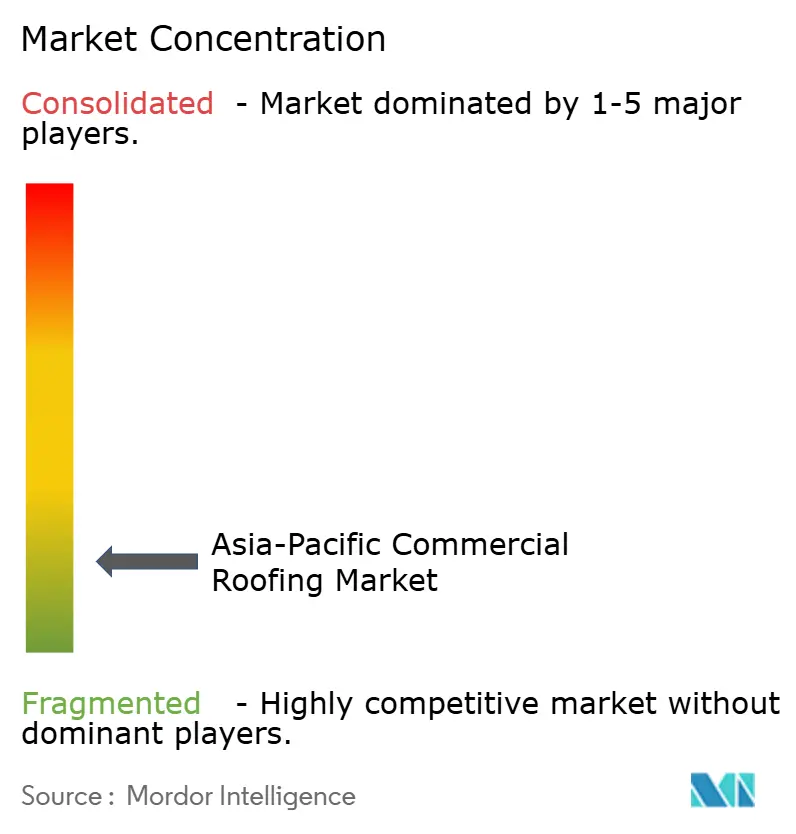
| Market Concentration | Medium |
Major Players *Disclaimer: Major Players sorted in no particular order Image © Mordor Intelligence. Reuse requires attribution under CC BY 4.0. | |
Asia-Pacific Commercial Roofing Market Analysis by Mordor Intelligence
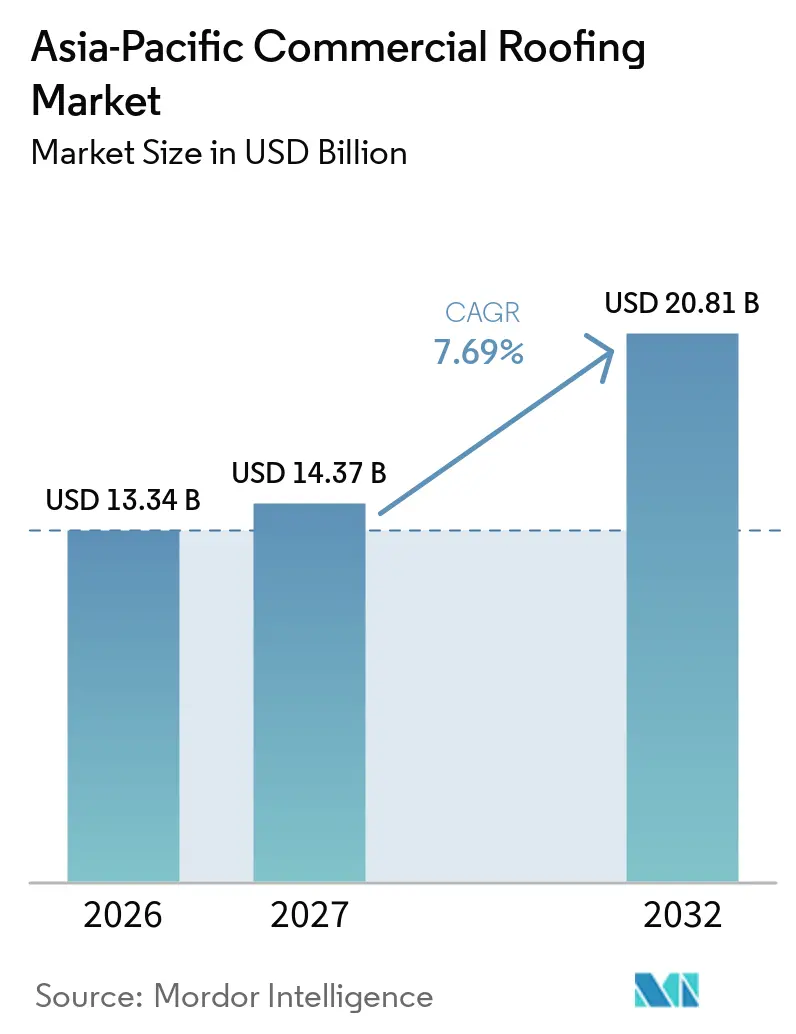
The Asia-Pacific Commercial Roofing Market size was valued at USD 13.34 billion in 2026 and is estimated to grow from USD 14.37 billion in 2027 to reach USD 20.81 billion by 2032, at a CAGR of 7.69% during the forecast period (2027-2032).
Growth is tied to industrial construction, logistics facilities, public infrastructure, and commercial projects that require larger and more durable roof assemblies. Developers are placing greater weight on water resistance, insulation, wind performance, and warranty coverage, particularly in hot and humid locations. This is raising demand for membrane systems and insulated metal roofs in projects where operating costs and building performance matter. The Asia-Pacific commercial roofing market also has a wide gap between premium projects and price-led projects, with domestic manufacturers increasing competition in standard roofing products. Supply capability, trained installation teams, and local technical support will shape which suppliers can benefit from higher-value specifications.
Key Report Takeaways
- By material type, single-ply membranes held 43.00% of the Asia-Pacific commercial roofing market share in 2026, while the Other segment is forecast to grow at a 7.80% CAGR through 2032.
- By construction type, new construction accounted for 60.00% of the Asia-Pacific commercial roofing market size in 2026 and is projected to expand at an 8.00% CAGR through 2032.
- By application, industrial represented 37.10% of the Asia-Pacific commercial roofing market share in 2026 and are forecast to advance at an 8.20% CAGR through 2032.
- By geography, China held 43.70% of the regional total in 2026, while India is forecast to grow at a 7.10% CAGR through 2032.
Note: Market numbers in this report are based on Mordor Intelligence's proprietary estimation framework, which combines nine months of actuals with Q4 projections for base year 2026.
Market Trends and Insights
Drivers Impact Analysis of Asia-Pacific Commercial Roofing Market*
| Drivers | (~) % Impact on CAGR Forecast | Geographic Relevance | Impact Timeline |
|---|---|---|---|
| Export Manufacturing and Industrial Campus Expansion | +2.1% | China, Vietnam, India, Indonesia, Thailand | Medium term (2-4 years) |
| E-Commerce Fulfillment and Cold Storage Construction | +1.8% | China, India, Vietnam, Thailand, Indonesia | Short term (≤ 2 years) |
| Typhoon, Monsoon, and High Humidity Roof Specifications | +1% | Southeast Asia, coastal China, Philippines, Bangladesh | Long term (≥ 4 years) |
| Public Infrastructure and Transit-Oriented Development | +0.9% | India, China, Thailand, Philippines, Southeast Asia | Medium term (2-4 years) |
| Pre-Engineered Building Adoption | +0.8% | India, Vietnam, Indonesia, Thailand | Medium term (2-4 years) |
| Local Production of Membranes, Metals, and Insulation | +0.5% | China, India | Long term (≥ 4 years) |
| Source: Mordor Intelligence | |||
Export Manufacturing and Industrial Campus Expansion
Supply-chain diversification continues to support greenfield factory construction in Southeast Asia and coastal India. Expansion requirements account for more than half of industrial demand in Asia-Pacific, while third-party logistics and distribution operators represent more than 30% of active tenant requirements[1]. Electronics, automotive components, and pharmaceutical facilities often require better fire resistance, insulation, and long warranty coverage than standard factories. These requirements strengthen demand for single-ply membranes and insulated metal systems in Vietnam, Thailand, India, and Indonesia. The Asia-Pacific commercial roofing market benefits because larger industrial campuses require extensive roof areas and consistent installation quality. The move toward higher specifications also reduces the share of basic corrugated products in premium industrial projects.
E-Commerce Fulfillment and Cold Storage Construction
Warehouse construction remains an important source of demand because Asia-Pacific accounts for 40% of global e-commerce volume. Cold-chain investment adds a more specialized requirement, as refrigerated facilities need strong insulation and reliable vapor barriers. The Asia-Pacific cold-chain sector grew at a 29.6% CAGR from 2017 to 2022, and the remaining gap in cold-storage capacity points to further construction demand[2]. Polyisocyanurate insulated panels, thermoplastic polyolefin, and polyvinyl chloride systems are suitable for facilities where energy use and temperature control are central concerns. Demand for temperature-controlled logistics space continues to exceed available supply in several regional markets. This supports a durable source of higher-value roofing demand beyond ordinary warehouse development.
Typhoon, Monsoon, and High Humidity Roof Specifications
Typhoons, monsoons, and high humidity are raising performance requirements for commercial roofs in exposed areas. WISKIND tested its standing-seam panel system to 4.2 kilopascals under national standard GB/T 39794.1-2021. The Philippines requires commercial structures to meet wind-load requirements under its National Structural Code, which makes documented system performance important in procurement. Taiwan receives average annual rainfall of 2,500 millimeters, and developers are moving toward mechanically locked standing-seam and membrane systems as warranty requirements become more demanding. The Asia-Pacific commercial roofing market is therefore separating into higher-performance coastal projects and lower-cost standard projects. Suppliers with proven wind, drainage, and waterproofing credentials have a clearer position in these locations.
Public Infrastructure and Transit-Oriented Development
Transit-oriented development concentrates offices, retail space, transport facilities, and public services around transport nodes. The Asian Development Bank describes how this approach links land use and transportation planning in India, Indonesia, the Philippines, and Thailand[3]. These projects often create larger roof packages because they combine several building types in one development. A June 2025 Chennai contract covered a multimodal complex with more than 108,000 square meters of built-up area. Malls, terminals, offices, and public interchanges also require more formal purchasing and technical review than smaller private projects. The Asia-Pacific commercial roofing market gains where metro and urban infrastructure programs support demand for long-span, durable, and well-documented roof systems.
Restraints Impact Analysis of Asia-Pacific Commercial Roofing Market*
| Restraints | (~) % Impact on CAGR Forecast | Geographic Relevance | Impact Timeline |
|---|---|---|---|
| Monsoon Season Installation Interruptions | -0.8% | India, Bangladesh, Vietnam, Indonesia, Philippines | Short term (≤ 2 years) |
| Uneven Substrate Quality in Rapid-Build Projects | -0.7% | India, Southeast Asia, China secondary cities | Medium term (2-4 years) |
| Import Duties on Specialty Membranes and Coatings | -0.6% | India, Vietnam, Indonesia | Medium term (2-4 years) |
| Shortage of Certified Applicators Outside Major Cities | -0.5% | India, Indonesia, Vietnam, Philippines | Long term (≥ 4 years) |
| Inconsistent Warranty Enforcement Across Markets | -0.4% | Association of Southeast Asian Nations and South Asia | Long term (≥ 4 years) |
| Source: Mordor Intelligence | |||
Monsoon Season Installation Interruptions
Monsoon conditions limit the installation period in India, Bangladesh, Vietnam, Indonesia, and the Philippines. Many construction corridors have fewer than 8 workable months each year, concentrating work into dry-season windows. Adhesive applications and field seaming for single-ply membranes require acceptable temperature and humidity conditions. Delays can raise labor costs, restrict delivery schedules, and push revenue into later periods. The Asia-Pacific commercial roofing market also faces quality risk when contractors compress work to meet fixed lease dates. This constraint will remain because it is linked to weather patterns rather than a condition that suppliers can solve alone.
Uneven Substrate Quality in Rapid-Build Projects
Fast construction methods can create deck alignment and deflection issues before roofing work begins. These problems are important for mechanically attached membranes and standing-seam systems because their performance depends on a stable substrate. A 2026 peer-reviewed study of a long-span galvalume installation in Pasuruan, Indonesia, identified substrate alignment and panel fit as major quality-control concerns. Roofing specialists may only identify these issues after structural work has been completed. Remediation adds cost, and some projects may switch to systems with lower performance requirements. The resulting choice can reduce the value captured by premium roofing suppliers.
*Our forecasts treat driver/restraint impacts as directional, not additive. The impact forecasts reflect baseline growth, mix effects, and variable interactions.
Asia-Pacific Commercial Roofing Market Segment Analysis
By Material Type:
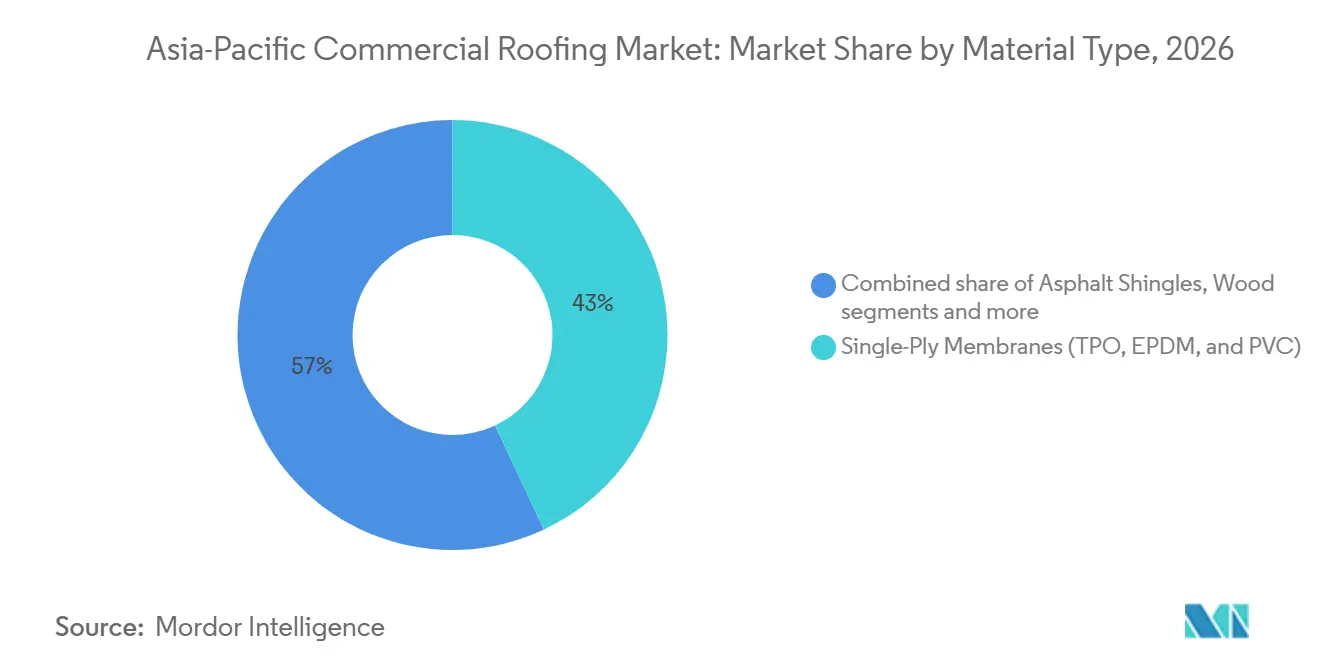
Single-Ply Systems Lead Commercial SpecificationsSingle-ply membranes held 43.00% of the Asia-Pacific commercial roofing market in 2026. Thermoplastic polyolefin, ethylene propylene diene monomer, and polyvinyl chloride are widely used on low-slope commercial and industrial roofs where waterproofing, reflectivity, and installation speed matter. Other segment is the fastest-growing material, with a forecast CAGR of 7.80% through 2032. Its chemical resistance supports use in pharmaceutical and food-processing facilities. Its dimensional stability also supports use in hot and humid settings. Rooftop solar installations can further increase the appeal of membrane systems that can accommodate mounting requirements.
Higher thermal standards in Singapore, China, South Korea, and Japan support demand for reflective thermoplastic polyolefin and polyvinyl chloride roofs. The Asia-Pacific commercial roofing market is shifting toward systems that meet energy, drainage, and lifecycle requirements instead of choosing products mainly on upfront cost. Metal roofing remains essential in industrial, logistics, and transit projects across Southeast Asia. BlueScope Steel supplies COLORBOND and LYSAGHT products for industrial and logistics roofs, where corrosion resistance and solar readiness are important. Modified bitumen maintains a role in Chinese reroofing projects because local installers are familiar with the system and its cost position. Asphalt shingles, clay and concrete tiles, and wood products serve smaller hospitality, resort, heritage, and leisure projects.

By Construction Type:
New Construction Holds the Largest PositionNew construction accounted for 60.00% of the Asia-Pacific commercial roofing market size in 2026 and is also forecast to grow at an 8.00% CAGR through 2032. Industrial corridors in India support the segment, export manufacturing zones in Vietnam, industrial estates in Indonesia, and data-center and pharmaceutical clusters in China. Large project requirements favor suppliers that can provide consistent material quality, technical documentation, and installation support. First-generation commercial developments in the region often select thermoplastic polyolefin and polyvinyl chloride systems instead of traditional built-up assemblies. This provides an opening for suppliers that can meet project schedules and offer warranties suited to large developments.
Reroofing and replacement are also becoming more relevant as buildings constructed from 2000 to 2010 approach normal roof replacement periods. Australia already has notable retrofit demand from commercial properties built from 1995 to 2005, although the source data does not provide a comparable regional share. Japan and South Korea also have aging industrial and commercial assets that need energy upgrades and planned maintenance. These projects are technically demanding because contractors must work around operating facilities and existing roof conditions. The Asia-Pacific commercial roofing industry can therefore generate better margins in reroofing projects where engineering support matters. The segment may become more important through the 2030s as replacement needs build across mature property stock.
By Application:
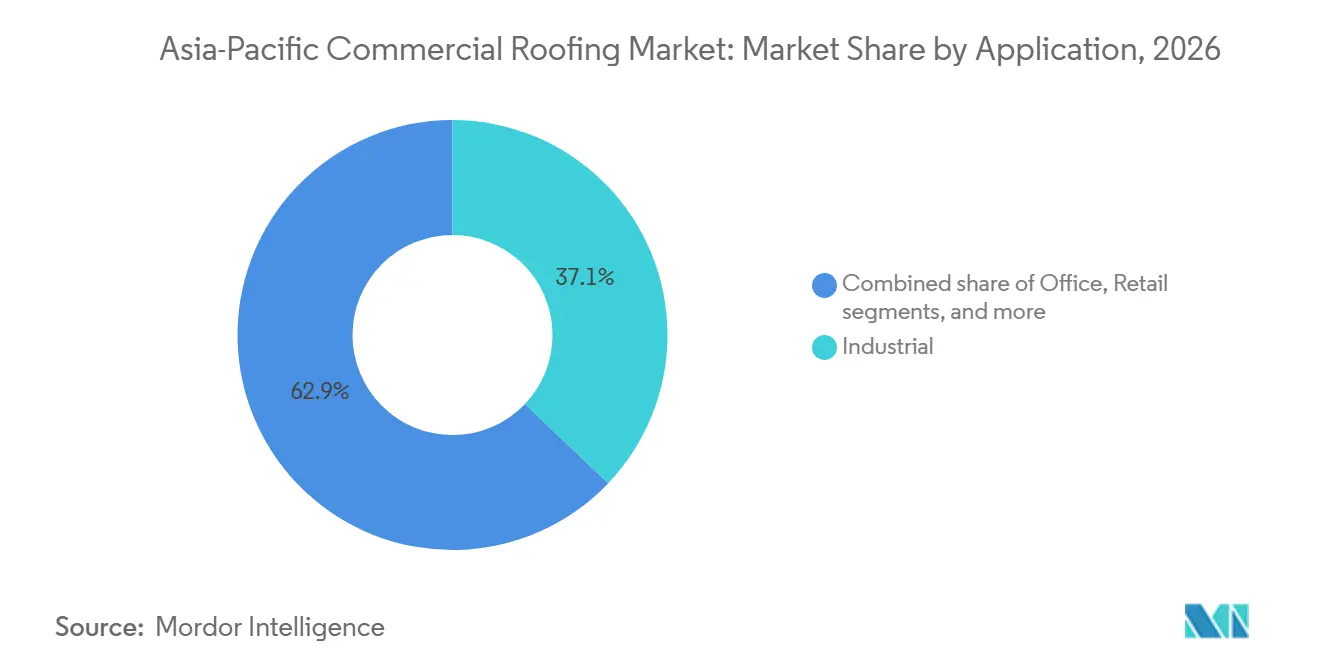
Industrial and Logistics Facilities Generate the Most ValueIndustrial and logistics facilities represented 37.10% of the Asia-Pacific commercial roofing market size in 2026 and are forecast to grow at an 8.20% CAGR through 2032. Large clear-span buildings need wide roof coverage, robust waterproofing, and better thermal performance. E-commerce, cold storage, pharmaceutical production, and export manufacturing all increase demand for these assets. These uses support insulated membrane systems and coated-metal roofs that can serve long spans. India is also seeing growing use of pre-engineered buildings across logistics, cold storage, and pharmaceutical facilities. This application base gives suppliers opportunities to offer materials, accessories, installation support, and warranty services together.
Retail projects continue to support steady demand in Association of Southeast Asian Nations countries, India, and China’s Tier 2 and Tier 3 cities. Office roofing demand is linked to data centers and technology campuses in Singapore, India, South Korea, and Japan. Data-center owners place strong emphasis on thermal management and dependable waterproofing. The other application group includes transit terminals, hospitals, education facilities, stadiums, and airport concourses. Public procurement and long-span designs in these buildings can favor higher-quality assemblies. The Asia-Pacific commercial roofing market is moving toward lifecycle cost and warranty evaluation across these applications, which favors suppliers with technical service capacity.
Geography Analysis
China held 43.70% of the Asia-Pacific commercial roofing market in 2026. Its position reflects the scale of industrial parks, logistics facilities, institutional buildings, and infrastructure construction. A China National Building Engineering Corporation subsidiary deployed a metal composite thermoplastic polyolefin insulated roof at an industrial facility in Shandong in October 2026. Shanghai Baoyye also had a metal roofing and thermoplastic polyolefin waterproofing subcontract for a Shaoxing factory project in 2026. Canlon’s Suzhou polymer industrial park has a total investment of USD 206.4 million and produces single-layer roofing and commercial waterproofing products. China’s commercial and industrial construction activity continues to offer a more resilient outlet than residential construction, despite pressure in the wider property sector.
India is the fastest-growing geography, with a forecast CAGR of 7.10% through 2032. Logistics facilities, warehouses, airport expansion, pharmaceutical manufacturing parks, and transit infrastructure support demand. India’s November 2025 anti-dumping duty on liquid epoxy resin imports imposed duties ranging from USD 37 to USD 483 per tonne on a relevant coating input. This can increase costs for imported specialty systems while encouraging local production. Japan benefits from renewal work on commercial buildings built in the 1990s, as well as energy-efficiency and solar-roof integration requirements. South Korea also benefits from industrial upgrades and redevelopment, while domestic steel availability supports local contractors.
Australia and Indonesia illustrate different demand conditions in the Asia-Pacific commercial roofing market. Australia’s nonresidential building activity exceeded USD 32 billion in 2024 to 2025, while drainage requirements were updated through AS/NZS 3500.3:2025 in April 2025. The Australian opportunity is supported by retrofit needs and attention to drainage performance in commercial roof design. Indonesia’s industrial estates and e-commerce logistics construction support demand for large-span roofing. The Pasuruan study found that on-site roll forming for seamless galvalume roofing reduced installation time by 35% and recorded zero work-related accidents in the assessed project. These conditions support more efficient construction methods for major industrial sites.
Competitive Landscape
The Asia-Pacific commercial roofing market is moderately fragmented because no supplier has a commanding position across every country and material category. Sika AG, Holcim through Elevate, Carlisle Companies through Carlisle SynTec Systems, Soprema Group, Kingspan Group, and BlueScope Steel compete in higher-specification projects. They use product performance data, installed-system warranties, local applicator certification, and relationships with architects and engineers to compete. Canlon Building Materials and Oriental Yuhong in China, Everest Industries and JSW Steel in India, and BlueScope’s LYSAGHT network in Southeast Asia have local supply and code familiarity. Their presence increases price competition in standard products while giving buyers more local sourcing options.
Sika acquired Elmich Pte Ltd in February 2025 to add urban-greening and green-roof capabilities in Asia-Pacific. The acquisition creates a link between green-roof specifications and Sika’s established roofing and waterproofing portfolio. Kingspan signed a memorandum of understanding with Meranti Green Steel in October 2025 to source lower-carbon steel for its Phu My insulated-panel facility in Vietnam. This move makes carbon-related material sourcing part of the competitive offer for projects seeking green-building certification. BlueScope also reported stronger demand for premium coated-metal roofing products in Malaysia and Vietnam during fiscal year 2026.
Opportunities remain in India’s Tier 2 and Tier 3 industrial corridors, where basic roofing still has a strong position and certified installers are less available. Public and institutional projects in Southeast Asia can also create large procurement packages for airport, hospital, transit, and public facility roofs. Holcim’s October 2025 agreement to acquire Xella for USD 2.2 billion broadens its building-solutions capability. That broader offer could support future building-envelope specifications alongside Elevate roofing products. Domestic Chinese manufacturers are improving technical capability for typhoon-rated and solar-integrated systems. Their competitive position may strengthen in Southeast Asian manufacturing projects where price and performance are considered together.
Asia-Pacific Commercial Roofing Industry Leaders
-
Sika AG
-
Holcim
-
Kingspan Group plc
-
BlueScope Steel
-
JSW Steel
- *Disclaimer: Major Players sorted in no particular order
Asia-Pacific Commercial Roofing Market Companies Covered in this Report
- Sika AG
- Holcim
- Kingspan Group plc
- BlueScope Steel
- JSW Steel
- TechnoNICOL Corporation
- Saint-Gobain
- Soprema Group
- Carlisle Companies Incorporated
- Owens Corning
- BMI Group
- RENOLIT SE
- Etex Group
- Wienerberger AG
- McElroy Metal
- Atlas Roofing Corporation
- Duro-Last Inc.
- Versico Roofing Systems
- Tremco Construction Products Group
- Firestone Building Products (Elevate)
Recent Industry Developments in Asia-Pacific Commercial Roofing Market
- October 2026: A subsidiary of China National Building Engineering Corporation deployed a metal composite thermoplastic polyolefin insulated roofing system at the Shanghe industrial facility in Shandong Province, integrating double-layer metal panel lamination with mechanically attached thermoplastic polyolefin waterproofing. The technique addresses large-span industrial facilities’ challenges of seam leakage and thermal deformation under extreme temperature variation, marking an upgrade in baseline commercial specifications for state-owned construction projects in China.
- April 2026: BlueScope Steel reported USD 68.6 million in underlying earnings before interest and taxes for its Coated Products Asia division in the first half of fiscal year 2026. This was a 39% improvement over the second half of fiscal year 2025, attributable to higher volumes of premium COLORBOND and LYSAGHT roofing products across Malaysia and Vietnam. The result reflects demand for coated-metal products used in infrastructure, logistics, and industrial construction. Premium products are relevant where buyers need corrosion resistance, long spans, dependable coating performance, and building-envelope specifications that can support energy and solar objectives.
- April 2026: Canlon Polymer Industrial Park in Suzhou introduced expanded production capabilities for single-layer roofing systems and commercial waterproofing products. The facility has a total investment of USD 206.4 million and uses multiple imported production lines. The site strengthens domestic supply for polymer-based roofing materials in China and for international customers. Its scale supports shorter local supply routes for contractors seeking higher-performance waterproofing systems. The investment also adds to competitive pressure on imported membrane products in projects where local sourcing is preferred.
Asia-Pacific Commercial Roofing Market Report Scope
Segmentation Overview
| Asphalt Shingles |
| Clay & Concrete Tiles |
| Metal Roofing |
| Bituminous / Modified Bitumen Membranes |
| Single-Ply Membranes (TPO, EPDM, and PVC) |
| Wood |
| Others |
| New Construction |
| Reroofing and Replacement |
| Retail |
| Office |
| Industrial |
| Others |
| China |
| India |
| Japan |
| South Korea |
| Australia |
| Indonesia |
| Rest of Asia-Pacific |
| By Material Type | Asphalt Shingles |
| Clay & Concrete Tiles | |
| Metal Roofing | |
| Bituminous / Modified Bitumen Membranes | |
| Single-Ply Membranes (TPO, EPDM, and PVC) | |
| Wood | |
| Others | |
| By Construction Type | New Construction |
| Reroofing and Replacement | |
| By Application | Retail |
| Office | |
| Industrial | |
| Others | |
| By Countries | China |
| India | |
| Japan | |
| South Korea | |
| Australia | |
| Indonesia | |
| Rest of Asia-Pacific |
Key Questions Answered in the Report
What is the projected value of Asia-Pacific commercial roofing by 2032?
The Asia-Pacific commercial roofing market is forecast to reach USD 20.81 billion by 2032, growing at a 7.69% CAGR from 2027 to 2032. Industrial and logistics construction remains central to this expansion.
Which material category leads commercial roofing in Asia-Pacific?
Single-ply membranes lead with 43.00% of the regional total in 2026.
Why are industrial and logistics facilities important for roofing suppliers?
They are the largest application group at 24.00% in 2026 and the fastest-growing application at an 8.20% CAGR through 2032. Large clear-span buildings require extensive roof coverage and reliable waterproofing.
Which country is growing fastest in regional commercial roofing?
India is forecast to grow at a 7.10% CAGR through 2032, supported by logistics, airports, pharmaceutical facilities, and transit projects. Local manufacturing capacity is also becoming more important to project supply.
What limits installation activity in South and Southeast Asia?
Monsoon conditions shorten installation windows, delay adhesive and seaming work, and can increase scheduling and labor pressure. Contractors also face added risk when dry-season workloads are compressed.
How are leading suppliers competing in Asia-Pacific?
Leading suppliers compete through system performance, warranties, installer certification, local material supply, and lower-carbon product options. Their technical support is most valuable in larger and performance-led projects.