
Size and Share of Asia-Pacific Commercial Dishwasher Market Size
Market Overview
| Study Period | 2021 - 2032 |
|---|---|
| Forecast Data Period | 2026 - 2032 |
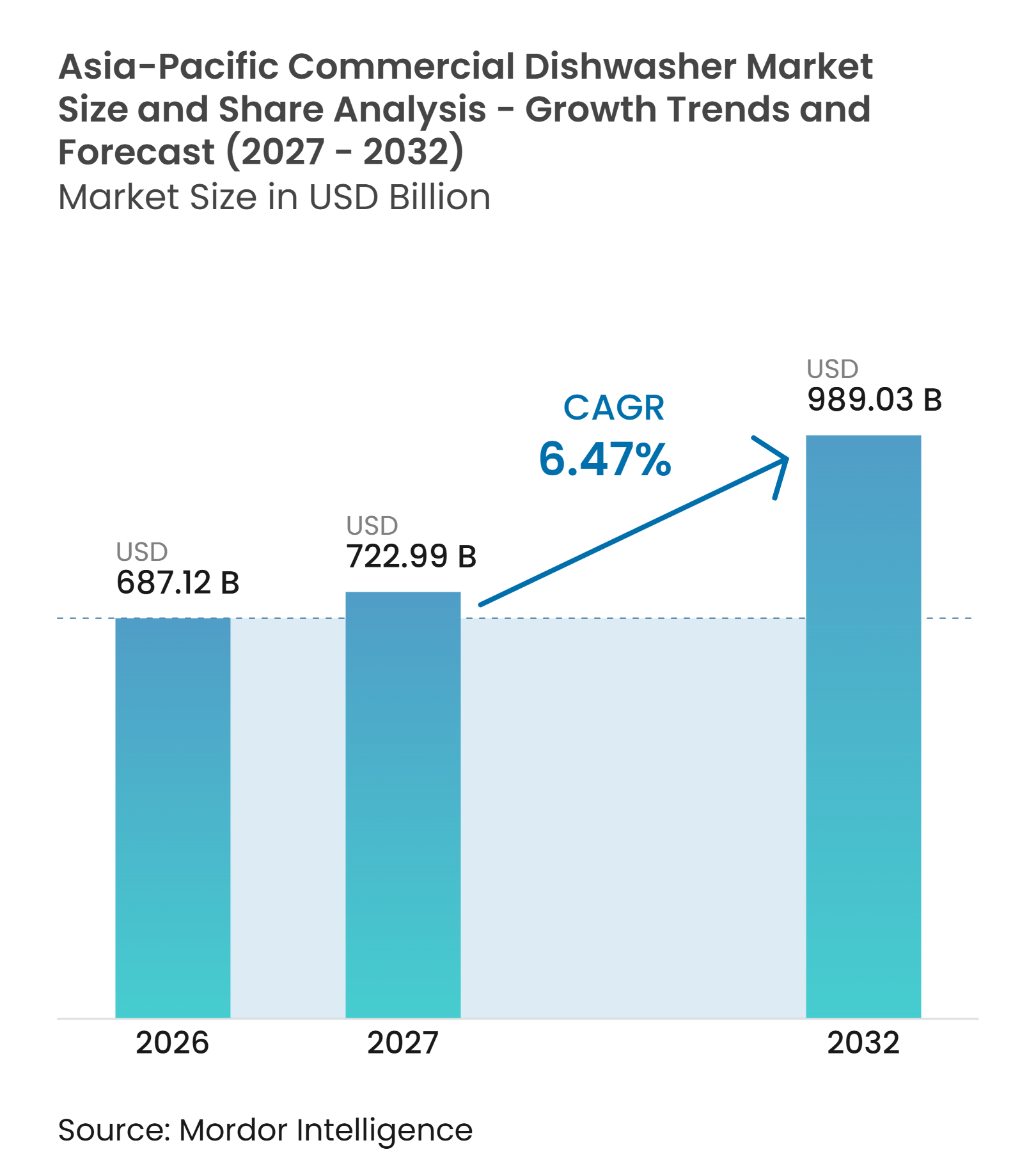
| Base Year Market Size (2026) | USD 687.12 Billion |
| Market Size (2027) | USD 722.99 Billion |
| Market Size (2032) | USD 989.03 Billion |
| Growth Rate (2026 - 2032) | 6.47 % |
| Market Concentration | Medium |
Major Players *Disclaimer: Major Players sorted in no particular order Image © Mordor Intelligence. Reuse requires attribution under CC BY 4.0. | |
Analysis of Asia-Pacific Commercial Dishwasher Market Size by Mordor Intelligence
The Asia-Pacific commercial dishwasher market size is projected to expand from USD 687.1 million in 2026 to USD 989.0 million by 2032, registering a CAGR of 6.47% between 2027 and 2032. Organized foodservice, quick-service restaurant expansion, and higher kitchen labor costs are strengthening the case for automated warewashing across the region. Food safety requirements are also making documented cleaning processes more important for chain operators. Demand is concentrated where commercial kitchen density is increasing, and enforcement of sanitation requirements is becoming more consistent. Manufacturers are responding with machines that reduce labor needs, improve water and energy use, and support service-led relationships. Smaller cities and price-sensitive markets remain harder to serve because manual washing, infrastructure limitations, and limited technical support still slow adoption.
Key Report Takeaways
-
By product type, undercounter machines held 30.35% of Asia-Pacific commercial dishwasher market share in 2026, while glasswashers are forecast to expand at a 6.90% CAGR through 2032.
-
By capacity, the 50-150 racks/hour tier held 43.36% of the Asia-Pacific commercial dishwasher market share in 2026, while the above-150 racks/hour tier is forecast to expand at a 6.88% CAGR through 2032.
-
By installation configuration, free-standing units held a 68.52% share in 2026, while built-in and undercounter integrated configurations are forecast to expand at a 7.22% CAGR through 2032.
-
By price range, economy machines held a 48.71% share in 2026, while premium machines are forecast to expand at a 6.95% CAGR through 2032.
-
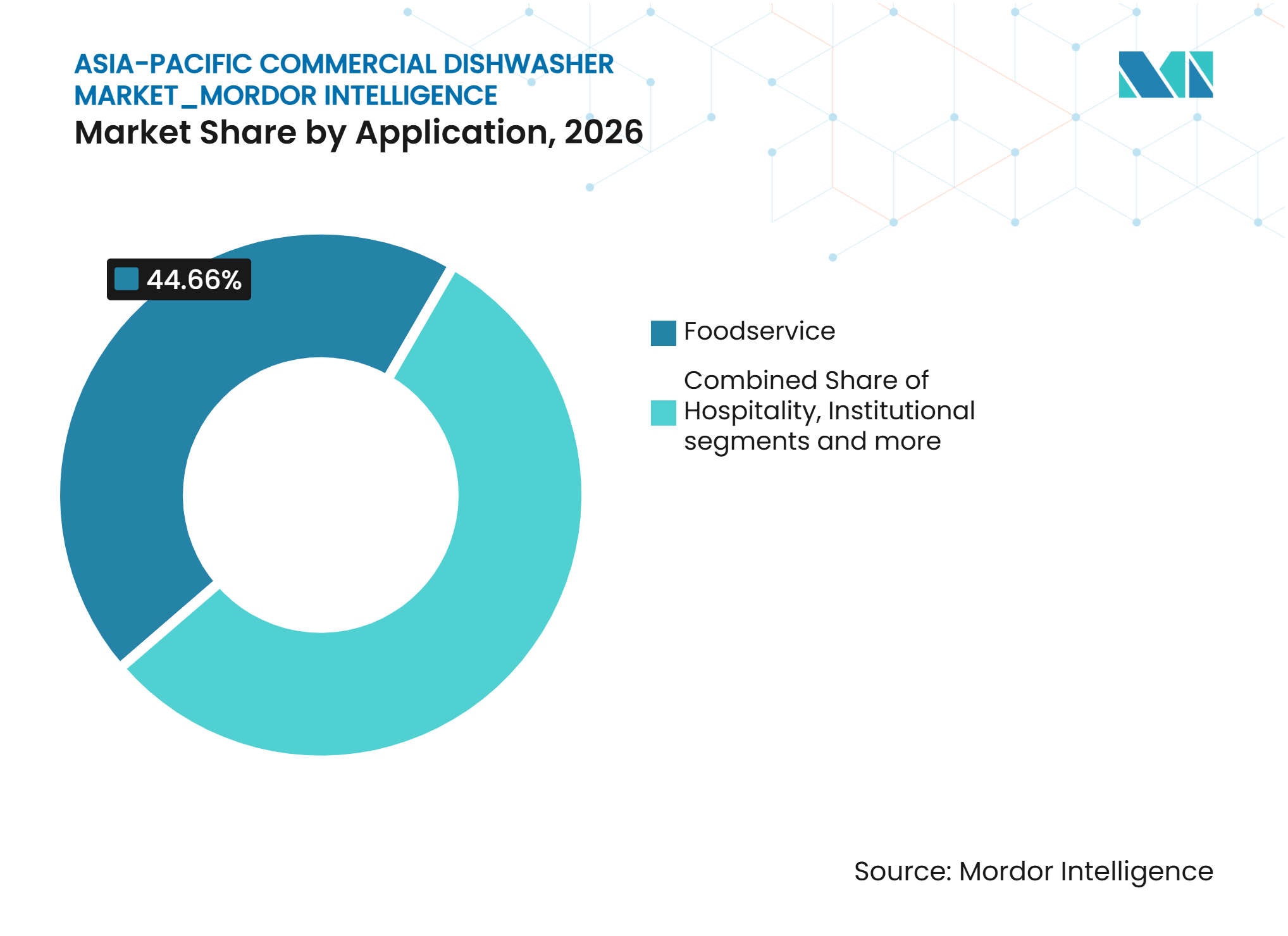
By application, foodservice held a 44.66% share in 2026, while catering and central kitchens are forecast to expand at a 7.11% CAGR through 2032.
-
By distribution channel, dealers and distributors held a 74.53% share in 2026, while direct sales are forecast to expand at a 7.23% CAGR through 2032.
Note: Market numbers in this report are based on Mordor Intelligence's proprietary estimation framework, which combines nine months of actuals with Q4 projections for base year 2026.
Market Trends and Insights
Drivers Impact Analysis of Asia-Pacific Commercial Dishwasher Market of Asia-Pacific Commercial Dishwasher Market Size*
| Driver | (~) % Impact on CAGR Forecast | Geographic Relevance | Impact Timeline |
|---|---|---|---|
| Expansion Of Organized Foodservice And QSR Chains | +1.6% | China, India, Southeast Asia | Short term (≤ 2 years) |
| Hospitality And Tourism Infrastructure Expansion | +1.2% | Japan, India, Southeast Asia | Medium term (2-4 years) |
| Commercial Kitchen Labor Shortages And Wage Inflation | +1.1% | South Korea, Japan, Singapore, Vietnam | Short term (≤ 2 years) |
| Stricter Hygiene, HACCP, And Food Safety Compliance | +0.9% | China, Japan, Australia | Medium term (2-4 years) |
| Demand For Water, Energy, And Chemical Efficiency | +0.7% | Global, with early gains in Australia and Japan | Long term (≥ 4 years) |
| Cloud Kitchens, Delivery-First Formats, And Multi-Unit Fleet Standardization | +0.8% | India, China, Southeast Asia | Short term (≤ 2 years) |
| Source: Mordor Intelligence | |||
Expansion of Organized Foodservice and QSR Chains
Asia-Pacific foodservice expansion is moving quick-service formats into smaller cities where commercial kitchen infrastructure was previously limited. Yum China is targeting 1,600-1,800 net new stores in 2025, adding to its network of more than 17,000 KFC and Pizza Hut stores in China. This scale requires consistent cleaning cycles and repeatable kitchen workflows. The supplied research also identifies planned Burger King and Domino's expansion in India as part of the same procurement pattern. Multi-unit operators increasingly benefit when a common machine specification supports consistent operating procedures across outlets. This supports replacement and first-time demand in the Asia-Pacific commercial dishwasher market, particularly where manual washing has been common.
Hospitality and Tourism Infrastructure Expansion
New hotel and food-and-beverage facilities create demand for equipment that can handle recurring, high-volume warewashing. Large hotels, banquet operations, and institutional catering sites generally need rack, conveyor, or flight-type systems rather than compact countertop equipment. The supplied material links premium equipment demand with upscale hospitality settings because these sites operate fine-dining outlets and banquet areas. These uses require higher throughput and more specialized wash cycles. Hotel development also supports the need for integrated kitchen layouts that can accommodate water treatment, drainage, and ventilation at the design stage. This improves the commercial case for higher-capacity systems in the Asia-Pacific commercial dishwasher market.
Commercial Kitchen Labor Shortages and Wage Inflation
Labor shortages are making automation more relevant to commercial kitchens across Asia-Pacific. In Vietnam, 88% of food and beverage businesses reported staff shortages during the first 8 months of 2025, while demand for kitchen assistants rose 33%[1]. A Singapore National Employers Federation survey published in August 2025 found that 79% of employers saw rising manpower costs as their main challenge for the coming year[2]. South Korean restaurants also faced persistent staffing gaps, which encouraged greater use of automated and digital kitchen solutions. The user-supplied analysis indicates that labor savings, combined with water and energy savings, can shorten payback periods for small operators. This makes automated equipment more relevant where dishwashing and kitchen-assistant roles are difficult to fill.
Stricter Hygiene, HACCP, and Food Safety Compliance
Food safety compliance is increasing the value of predictable cleaning and recordkeeping in commercial kitchens. China’s State Administration for Market Regulation issued Order No. 104 in September 2025, effective December 1, 2025, requiring tiered food safety management systems for chain restaurant enterprises and daily records for cleaning and disinfection[3]. Japan Food Safety Management Association released JFS Food Service Standards Ver. 2.0 in September 2025, aligned with Japan’s updated food safety framework[4]. ISO 22002-2:2025 covers prerequisite programs for catering and provides a formal reference point for food safety management. These frameworks make hygiene equipment a practical part of compliance planning for restaurants, hotels, and institutional kitchens. They also favor machines with repeatable wash performance and accessible operating records.
Restraints Impact Analysis of Asia-Pacific Commercial Dishwasher Market of Asia-Pacific Commercial Dishwasher Market Size*
| Restraint | (~) % Impact on CAGR Forecast | Geographic Relevance | Impact Timeline |
|---|---|---|---|
| High Upfront Cost And Retrofit Complexity | -1.4% | Southeast Asia, India tier-2 and tier-3 cities | Short term (≤ 2 years) |
| Hard-Water Mineral Buildup And Limited Specialized Service Technicians | -0.7% | India interior, Southeast Asia, Rest of Asia-Pacific | Medium term (2-4 years) |
| Uneven Plumbing, Drainage, Electrical, And Water-Pressure Infrastructure | -0.6% | Asia-Pacific developing markets, Southeast Asia | Medium term (2-4 years) |
| Low Awareness And Manual-Washing Inertia In Price-Sensitive Markets | -0.6% | Southeast Asia rural areas, South Asia tier-2 and tier-3 cities | Long term (≥ 4 years) |
| Source: Mordor Intelligence | |||
High Upfront Cost and Retrofit Complexity
Capital cost remains a major barrier to commercial dishwasher adoption among smaller operators. The purchase decision includes electrical upgrades, drainage changes, and water-treatment components, rather than the machine price alone. Older restaurants in Bangkok, Jakarta, and Ho Chi Minh City can lack the drainage fall, water pressure, or ventilation clearance specified in installation guides. Those requirements can materially increase the total cost of a retrofit. Equipment-as-a-Service and efficiency-financing offers could address this obstacle, but the supplied research describes their regional rollout as early-stage in 2026. As a result, many independent operators continue to rely on manual washing despite the operational limits of that approach.
Hard-Water Mineral Buildup and Limited Specialized Service Technicians
Hard-water conditions can reduce wash performance, increase detergent use, and shorten equipment life in inland India, Central China, and parts of Southeast Asia. Operators outside major cities can also face longer repair times and limited access to original spare parts. Informal maintenance arrangements can compromise warranties and weaken hygiene control. A 2025 study in Energies found that internal heat-exchanger retrofits can recover up to 50% of energy in discharged wash water, although reliable performance depends on water quality and disciplined descaling. This shows why water treatment and service coverage are not peripheral considerations for commercial buyers. Equipment suppliers that improve local servicing and simplify maintenance can reduce a key adoption barrier in the Asia-Pacific commercial dishwasher market.
*Our forecasts treat driver/restraint impacts as directional, not additive. The impact forecasts reflect baseline growth, mix effects, and variable interactions.
Asia-Pacific Commercial Dishwasher Market Size Segment Analysis
By Product Type:
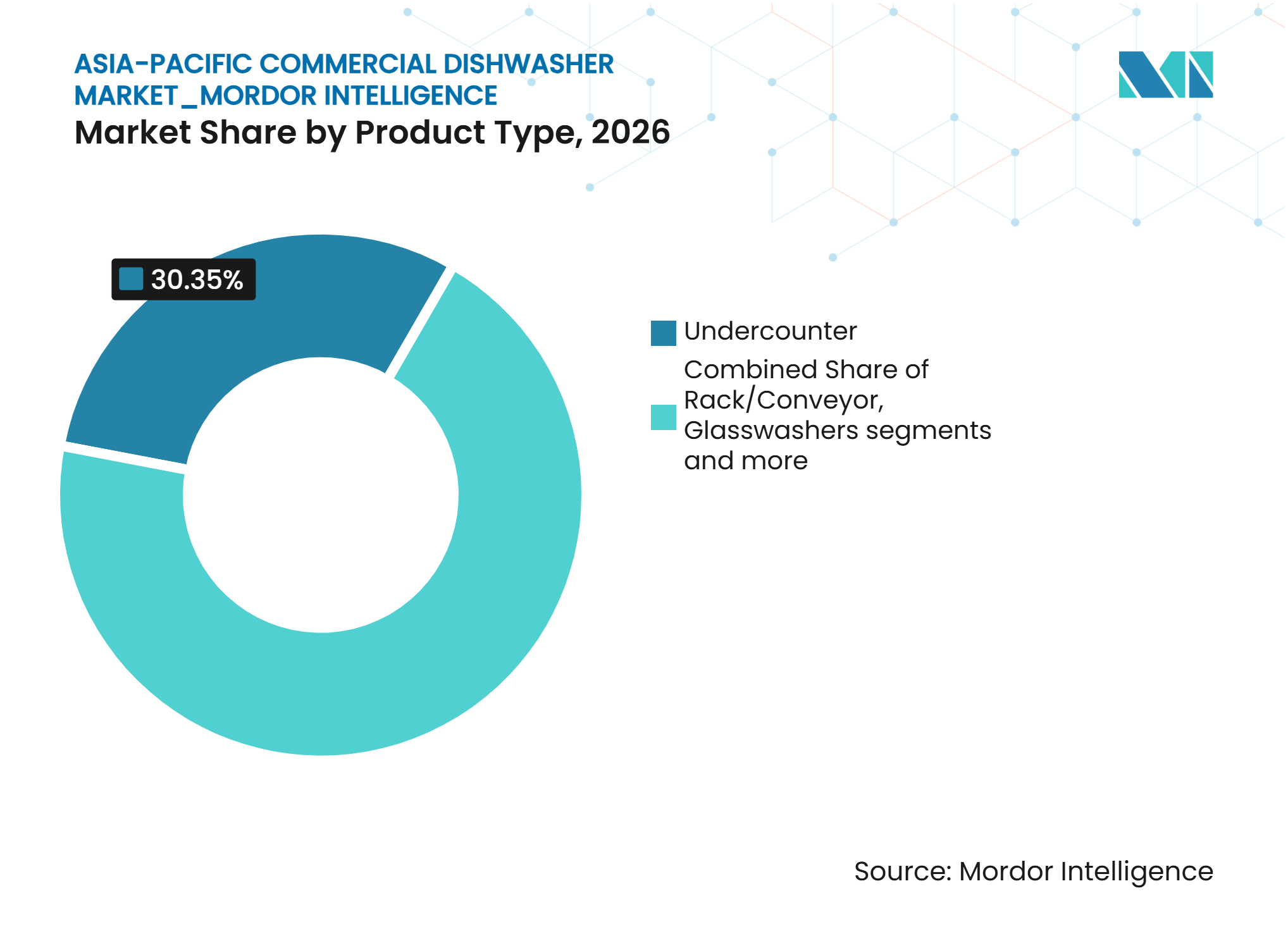
Undercounter Machines Lead Compact-Kitchen AdoptionUndercounter machines held 30.35% of the Asia-Pacific commercial dishwasher market in 2026. Cloud kitchens, quick-service kiosks, and café-bar formats favor smaller footprints, making undercounter systems suitable for sites with limited floor area. Rack and conveyor units, door and hood machines, and flight-type systems serve higher-volume sites such as institutional kitchens, catering operations, and hotel restaurants. Glasswashers are forecast to grow at a 6.90% CAGR through 2032, supported by beverage-led hospitality formats in Japan, South Korea, Singapore, and other urban markets. Specialty coffee outlets, cocktail bars, and tea-focused formats need dedicated glass-care cycles rather than general warewashing programs. This places glasswashing equipment in a different operating context from standard restaurant dishwashing. It also means that operators can treat glassware quality as part of customer service, rather than as a routine back-of-house task. Dedicated cycles can help a venue protect presentation standards while managing frequent turnover. Product selection in this category depends on basket format, cycle speed, and the available space behind the bar. Those needs differ from the priorities of a full-service restaurant kitchen.
MEIKO presented its M-iFlow IPB feeding device and M-iQ BlueFire system at HOST Milan in October 2025. The supplied content states that the technology can reduce infeed staffing by up to 50% for the feeding device and supports premium-tier differentiation through automation. MEIKO also announced a next-generation R-Series rack-conveyor machine for smaller dishwashing areas. This product direction aligns with the middle range of regional foodservice demand, where a compact layout still requires reliable throughput. The Asia-Pacific commercial dishwasher market size for undercounter equipment is supported by the continued growth of compact commercial kitchens. Manufacturers that pair small footprints with labor-saving functions can better address this demand. The key requirement is not simply faster washing. Compact operators need a machine that fits the available workspace, is easy for staff to use, and can be maintained without interrupting trading hours. This gives smaller formats a distinct procurement logic from high-volume institutional kitchens. It also makes practical service access an important part of product choice.



By Capacity:
Mid-Range Throughput Anchors the Core MarketThe 50-150 racks/hour tier held a 43.36% share of the Asia-Pacific commercial dishwasher market in 2026. This capacity range fits mid-scale restaurants, hotel all-day dining outlets, and institutional canteens that manage recurring service volumes. Below-50 racks/hour machines address small independent outlets and specialty cafés where upfront cost and installation simplicity are more important. The above-150 racks/hour tier is forecast to grow at a 6.88% CAGR through 2032. Catering aggregators, hospitals, universities, and central kitchens need this capacity as they consolidate food preparation. Their demand is based on throughput, labor reduction, and a need to maintain consistent sanitation at scale. In many cases, the purchasing decision is linked to the wider design of a central production line. A machine must work with storage, waste handling, rack movement, and the timing of meal service. This makes service reliability as important as nameplate capacity. Buyers also need equipment that can maintain output through peak service periods without disrupting the kitchen flow.
The cited 2025 Energies research found that heat-exchanger design can recover up to 50% of energy in discharged wash water when operating conditions are maintained. Higher-capacity systems can therefore offer a stronger operating-efficiency case than manual workflows for large buyers. However, equipment performance still depends on water quality, preventative maintenance, and correct installation. The Asia-Pacific commercial dishwasher market share of the mid-range tier reflects the large base of operators whose volumes do not require a full flight-type line. At the higher end, buyers increasingly value systems that integrate labor, energy, and hygiene considerations. This creates room for manufacturers to position high-throughput units as an operating solution rather than a stand-alone capital purchase for larger facilities. The operating case is strongest when a buyer can link the investment to a repeatable workload and a defined labor constraint. Capacity alone does not determine suitability. Rack flow, wash quality, utility availability, and staff routines all influence the outcome. Suppliers that can assess these conditions before installation can reduce the risk of a poor equipment match.
By Installation Configuration:
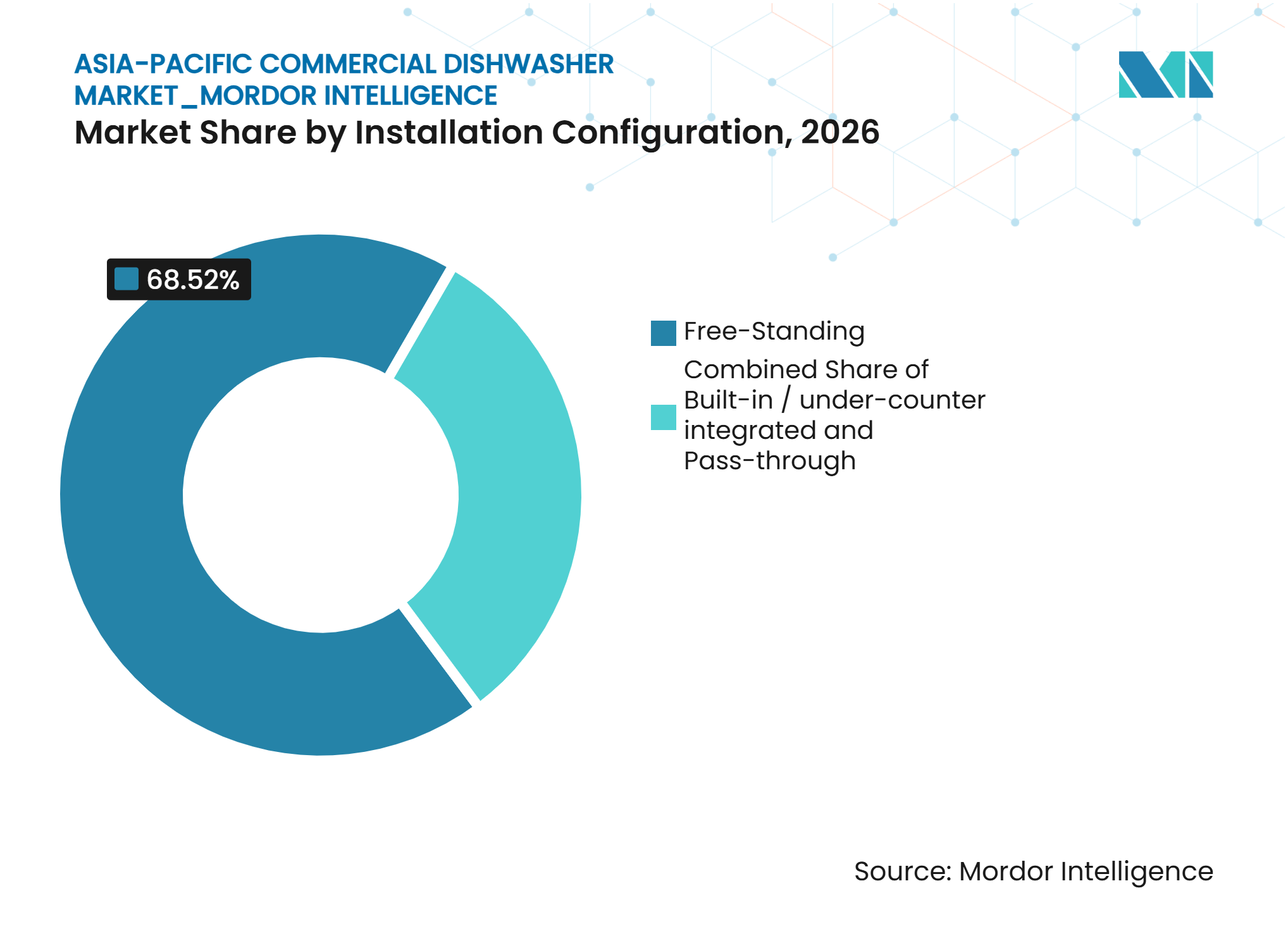
Free-Standing Units Dominate Retrofit-Heavy MarketsFree-standing machines held a 68.52% share of the installation configuration segment in 2026. Their position reflects the region’s large stock of existing commercial kitchens, where installing built-in or pass-through systems can require expensive structural modification. Pass-through and line-integrated systems serve high-throughput institutional kitchens, stadium catering, and large hotel banquet operations. These sites need a continuous flow from soiled ware to clean ware. Built-in and undercounter integrated configurations are forecast to grow at a 7.22% CAGR through 2032. New kitchen projects can include drainage, electrical, ventilation, and warewashing space in the original design.
The shift toward integrated equipment does not eliminate the need for free-standing machines. Existing independent restaurants and older hospitality sites will continue to depend on retrofit-friendly units. The supplied research links integrated layouts with greenfield hospitality and foodservice development in India and Vietnam. This is relevant because design-stage installation can reduce the complexity that constrains adoption in older premises. The Asia-Pacific commercial dishwasher market continues to include both upgrade cycles and new installation demand. Product portfolios therefore need to serve buyers with very different site conditions. A free-standing unit may be the most practical choice when an operator needs to upgrade an existing kitchen without altering its layout. An integrated unit can be more suitable when a developer can design the whole back-of-house workflow in advance. These choices affect installation time, the requirement for supporting utilities, and the type of service arrangement a buyer needs. The category continues to require both flexible retrofit options and systems built into new projects.

By Price Range:
Economy Models Set the Volume, Premium Gains PaceEconomy machines held a 48.71% share of the price range segment in 2026. Independent restaurants, small hotels, and institutional canteens often prioritize purchase cost over longer-term operating cost. Our mid-range equipment is for organized foodservice buyers who need dependable performance against defined brand specifications. Premium machines are forecast to grow at a 6.95% CAGR through 2032. Demand is supported by upscale hospitality and buyers in Japan, South Korea, and Australia that value energy efficiency, connectivity, and service contracts. Labor shortages also make the total cost of ownership more relevant to premium equipment decisions.
Electrolux Professional’s NeoBlue Touch undercounter unit includes smart connectivity, single-button operation, and water use of 2.1 liters per cycle, according to the supplied draft. The example illustrates how suppliers are simplifying operation while adding features for labor-constrained kitchens. Premium buyers are likely to evaluate water use, chemical use, hygiene consistency, and service availability as part of procurement. Economy equipment will remain important because many Asia-Pacific operators are still highly price sensitive. This dual demand structure keeps the Asia-Pacific commercial dishwasher market broad across price points. It also creates a need for manufacturers to explain which operational benefits justify moving from economy equipment to a premium model. The buyer must be able to connect the extra cost to a clear requirement, such as labor availability, wash consistency, or operating-resource control. Without that link, lower acquisition cost will remain the stronger consideration for many small operators. Suppliers with clear product and service differentiation can serve both entry-level and specification-led demand. Entry-level buyers need a straightforward machine and a transparent installation requirement. Premium buyers are more likely to assess operating controls, documentation, and service-contract terms alongside machine performance. The difference is not only a matter of price. It reflects the variation in staffing, customer volumes, and food safety requirements across commercial kitchens. This is why a broad price ladder remains important in the region.
By Application:
Foodservice Commands Volume, Catering Formats Drive New DemandFoodservice operators held a 44.66% share of the application segment in 2026. Independent restaurants and chain formats across China, India, and Southeast Asia form the largest installed base of commercial kitchen buyers. Hospitality remains a substantial application because hotels, resorts, and food-and-beverage venues require repeated dish and glass washing. Institutional kitchens in hospitals, schools, and corporate facilities provide steady demand tied to hygiene responsibilities. Catering and central kitchens are forecast to grow at a 7.11% CAGR through 2032. These users require standardized equipment and can purchase several units under fleet agreements.
Central kitchens serve multiple delivery channels and may combine food preparation for several brands. This operating model increases the value of repeatable wash cycles and predictable service support. The supplied material describes catering buyers as strategically valuable because they purchase multiple machines against common specifications. Foodservice growth is not uniform, as smaller operators can remain constrained by upfront costs and retrofit complexity. The Asia-Pacific commercial dishwasher market size for foodservice remains substantial because restaurants and chain outlets represent the core buyer base. Catering growth offers a clear opportunity for suppliers who can support multi-site service and fleet procurement. These accounts require consistent equipment across several locations and therefore place greater value on common operating procedures. They can also expect support that is coordinated across a network rather than arranged machine by machine. This makes account management and service coverage material to the sale. Suppliers that can standardize commissioning and staff training can make fleet deployments easier for these buyers.
By Distribution Channel:
Distributors Hold the Network, Direct Sales AccelerateDealers and distributors held a 74.53% share of the distribution channel in 2026. Their role is especially important in a region that spans many languages, local regulations, and service conditions. Distributors can provide local installation coordination, spare parts, financing support, and customer service. Direct sales are forecast to grow at a 7.23% CAGR through 2032. Multi-unit operators increasingly seek fleet pricing and specification control through direct negotiations with manufacturers. Digital configuration and ordering tools can also support direct engagement where customers have mature procurement processes.
MEIKO’s connected compliance and predictive-service approach strengthens manufacturer relationships with operators by linking equipment use with ongoing service data. This does not remove the need for distributors in fragmented markets. Local partners remain central where buyers need commissioning, rapid repair, and practical training. Direct sales are most relevant to chains, institutional groups, and fleet buyers that can standardize procurement. The Asia-Pacific commercial dishwasher market share held by distributors shows their ongoing operational relevance. Suppliers need channel strategies that protect local service quality while developing closer links with larger accounts. They must also avoid a channel model that leaves smaller customers without timely support. Distributors remain useful where an installation requires local coordination and immediate troubleshooting. Direct relationships can be more appropriate where a large group can set its own technical specifications. A balanced approach allows manufacturers to pursue larger contracts without weakening their coverage in fragmented markets. This also protects the customer experience for operators that buy only a single unit. It keeps local service knowledge connected to manufacturer product-development priorities. Feedback from installation and repair work can help set more suitable specifications for future regional projects.
Geography Analysis
China
China held 41.71% of the Asia-Pacific commercial dishwasher market share in 2026. Its position is supported by a large commercial kitchen base and the continued formalization of foodservice operations. Yum China’s 2025 target of 1,600-1,800 net new stores illustrates the scale of chain restaurant expansion that needs standardized kitchen processes. SAMR Order No. 104 became effective on December 1, 2025, requiring chain restaurant enterprises to maintain food safety management systems and daily cleaning records. This regulatory influence creates a direct reason to improve documented sanitation processes. Domestic suppliers serve economy and mid-range demand, while international brands retain relevance where formal compliance specifications and institutional requirements carry more weight. The local market therefore supports both value-led competition and specialized premium demand.
India
India is forecast to expand at a 7.36% CAGR through 2032, the highest country growth rate in the Asia-Pacific commercial dishwasher market. The supplied RD links this performance to hospitality development, quick-service restaurant rollout, cloud kitchens, and rising labor costs. Growth is based more on new adoption than on replacement cycles because penetration remains lower than the commercial kitchen base. This supports a longer period of demand growth than in more mature markets. Price sensitivity, water conditions, and uneven infrastructure still limit the pace of adoption outside major cities. Suppliers that provide simple installation guidance, water treatment, and local support can address these practical constraints. This creates an opening for solutions that are easier to maintain in diverse operating conditions. Indian buyers also need clear information on operating costs and the supporting work required before installation. A solution that is difficult to connect or service can lose its appeal even when it provides labor savings. Product design, distribution, and after-sales support therefore need to work together. This is especially relevant outside major cities where specialist technicians can be less accessible.
Regional Dynamics Across a Diverse Landscape
Japan supports premium demand through high labor costs and food hygiene requirements under its revised food safety framework. JFSM’s 2025 Food Service Standards provide a recognized framework for foodservice operators and support attention to documented hygiene practices. South Korea’s restaurant labor shortages are increasing interest in automation and digital kitchen solutions. Southeast Asia is diverse, with price-sensitive demand in the Philippines, Malaysia, and Indonesia alongside higher-value hospitality demand in Singapore and Thailand. Vietnam stands out because food-and-beverage employers reported acute staffing shortages in 2025. Across the region, supplier success depends on matching machine specifications, local service access, water treatment, and buyer budgets. These differences prevent a single equipment or channel strategy from fitting every geography. A premium configuration that is suitable for a Japanese hotel may not fit the cost or service conditions of an independent outlet in a smaller Southeast Asian city. The common need across locations is dependable sanitation, but the route to that outcome varies. Suppliers need to match equipment design with local water conditions and customer skill levels. Regional growth will therefore depend on practical adaptation as much as on headline foodservice expansion.
Competitive Landscape
Market Concentration
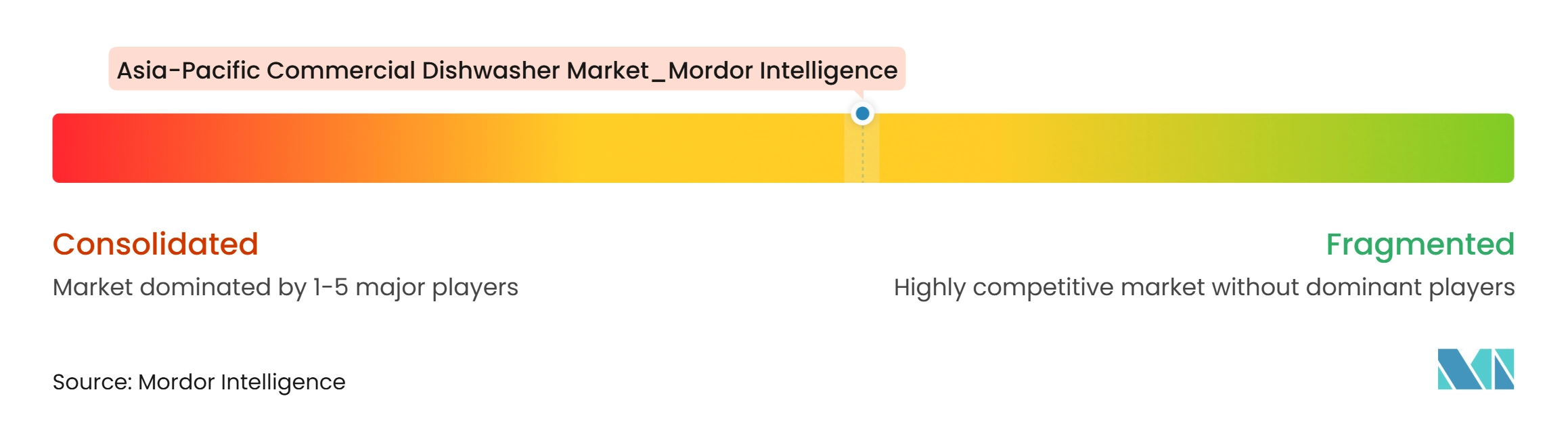
The Asia-Pacific commercial dishwasher market is moderately fragmented. MEIKO, Electrolux Professional, and Hoshizaki have strong brand recognition in premium and upper mid-range applications, while regional suppliers compete actively in value-oriented tiers. Competition is shaped by price, throughput, service access, hygiene performance, and operating efficiency. Market participants also need to address local installation conditions and the availability of qualified service technicians. This reduces the advantage of a product-only offering, especially when kitchen uptime, operator training, and replacement-part availability directly shape customer satisfaction. Commercial users depend on equipment every day so that downtime can affect kitchen capacity and foodservice quality. They consequently evaluate the availability of technicians and parts alongside upfront pricing. Local channel partners can be important because they understand site constraints and can support installation. Brand strength remains relevant, but operational support is often decisive after the initial sale. Companies that combine equipment with training, water-treatment support, and responsive servicing are better placed to retain commercial accounts.
MEIKO demonstrated the M-iQ BlueFire flight-type dishwasher and M-iFlow IPB feeding device at HOST Milan from October 17-21, 2025. The supplied research identifies reduced infeed labor as an important part of this system’s value proposition. Electrolux Professional announced a strategic partnership and minority investment in Mimbly on November 6, 2025. This move connected its offer with water reduction, microplastic filtration, and heat-recovery capabilities. Hobart introduced the PWn Prep Washer on March 28, 2025, with Ventless Energy Recovery technology and a stated water-saving proposition. These actions show that labor, resource efficiency, and installation cost are central areas of product development.
Connected monitoring is another area of competition. Diversey introduced IntelliDish CONTROL in 2025 to track wash and rinse temperatures, detergent and water use, and compliance alerts in real time. Such systems can be relevant to multi-unit operators that need consistent data across sites. Ali Group’s brand portfolio provides broad coverage across product and price categories, while regional contenders compete through locally configured equipment and lower pricing. Hoshizaki’s long-standing service presence strengthens its position in Japan and sets it apart in a service-intensive category. The competitive landscape remains broad enough that no concentration score can be calculated from the supplied company-share data. The available evidence supports a moderate level of concentration rather than dominance by a small group of suppliers. International specialists compete in segments that value automation, documented performance, and broad service coverage. Regional suppliers remain relevant where customers prioritize a lower purchase cost or locally tailored configuration. The result is competition across several levels rather than a uniform contest among the same brands. No single supplier-share figure is provided in the sourced draft, so a numerical concentration score would not be supportable.
Leaders of Asia-Pacific Commercial Dishwasher Market Size
-
Hoshizaki Corporation
-
ITW Food Equipment Group
-
MEIKO Maschinenbau GmbH and Co. KG
-
Winterhalter Gastronom GmbH
-
Electrolux Professional AB
- *Disclaimer: Major Players sorted in no particular order
Asia-Pacific Commercial Dishwasher Market Size Companies Covered in this Report
- Ali Group S.r.l.
- Blakeslee Inc.
- Champion Industries, Inc.
- CMA Dishmachines
- Comenda-Ali Group
- Electrolux Professional AB
- Fagor Industrial S. Coop
- Hoshizaki Corporation
- Insinger Machine Company
- ITW Food Equipment Group
- Jackson WWS, Inc.
- Kromo S.r.l.
- LG Electronics Inc.
- MEIKO Maschinenbau GmbH and Co. KG
- Miele and Cie. KG
- Middleby Corporation*
Recent Industry Developments in Asia-Pacific Commercial Dishwasher Market Size
- March 2026: Hoshizaki agreed to increase its ownership stake in ARICO from 51% to 99.6%, deepening its manufacturing commitment in Southeast Asia as commercial shipments of Hoshizaki-brand products from the Ho Chi Minh City factory commenced in early April 2026
- November 2025: Electrolux Professional Group announced a strategic partnership and minority equity investment in Swedish cleantech company Mimbly. Its Mimbox plug-in solution reduces water use, filters microplastics to 50 microns, and recovers heat energy in commercial laundry and warewashing operations.
- April 2025: Fagor Industrial introduced the iNOVA commercial dishwasher range with its Duo-Klip energy-recovery system. The range was presented at NAFEM 2025 and covers glasswashers, hood-type machines, and tunnel dishwashers.
- March 2025: Hobart launched the PWn Series Pot, Pan and Utensil Commercial Dishwasher. The company stated that the machine saves more than 75,000 gallons of water annually compared with a conventional 3-compartment sink. The Advansys configuration includes Ventless Energy Recovery technology and reduces installation costs by more than USD 3,500.
Scope of Report on Asia-Pacific Commercial Dishwasher Market Size
Segmentation Overview
| Rack/Conveyor |
| Undercounter |
| Door or Hood Type |
| Glasswashers |
| Flight-type / continuous conveyor dishwashers |
| Below 50 racks/hour |
| 50-150 racks/hour |
| Above 150 racks/hour |
| Free-Standing |
| Built-in / under-counter integrated |
| Pass-through / line-integrated |
| Economy |
| Mid-Range |
| Premium |
| Foodservice |
| Hospitality |
| Institutional |
| Catering and Central Kitchens |
| Others |
| Direct Sales |
| Dealers and Distributors |
| India |
| China |
| Japan |
| Australia |
| South Korea |
| South East Asia (Singapore, Malaysia, Thailand, Indonesia, Vietnam, and Philippines) |
| Rest of Asia-Pacific |
| By Product Type | Rack/Conveyor |
| Undercounter | |
| Door or Hood Type | |
| Glasswashers | |
| Flight-type / continuous conveyor dishwashers | |
| By Capacity | Below 50 racks/hour |
| 50-150 racks/hour | |
| Above 150 racks/hour | |
| By Installation Configuration | Free-Standing |
| Built-in / under-counter integrated | |
| Pass-through / line-integrated | |
| By Price Range | Economy |
| Mid-Range | |
| Premium | |
| By Application | Foodservice |
| Hospitality | |
| Institutional | |
| Catering and Central Kitchens | |
| Others | |
| By Distribution Channel | Direct Sales |
| Dealers and Distributors | |
| By Country | India |
| China | |
| Japan | |
| Australia | |
| South Korea | |
| South East Asia (Singapore, Malaysia, Thailand, Indonesia, Vietnam, and Philippines) | |
| Rest of Asia-Pacific |
Key Questions Answered in the Report
What is the forecast growth rate for commercial dishwashers in Asia-Pacific?
The Asia-Pacific commercial dishwasher market is forecast to grow at a 6.47% CAGR from 2027 to 2032, reaching USD 989.0 million.
Which product category leads commercial dishwasher demand in Asia-Pacific?
Undercounter machines lead with 30.35% share in 2026 because they fit compact cloud kitchens, quick-service outlets, and cafés.
Why are commercial kitchens adopting automated dishwashing equipment?
Labor shortages, higher wage pressure, repeatable hygiene performance, and food safety recordkeeping are supporting adoption.
Which country is expected to grow fastest for commercial dishwashers in Asia-Pacific?
India is forecast to grow at a 7.36% CAGR through 2032, supported by new adoption across foodservice and hospitality.
What limits commercial dishwasher adoption in smaller Asian cities?
Upfront cost, drainage and electrical retrofit requirements, hard-water conditions, and limited specialist servicing remain key barriers.