
Asia-Pacific Aviation Insurance Market Size and Share
Market Overview
| Study Period | 2021 - 2032 |
|---|---|
| Forecast Data Period | 2027 - 2032 |
| Base Year Market Size (2026) | USD 1.9 Billion |
| Market Size (2027) | USD 2 Billion |
| Market Size (2032) | USD 2.80 Billion |
| Growth Rate (2027 - 2032) | 7.00 % |
| Market Concentration | Low |
Major Players *Disclaimer: Major Players sorted in no particular order Image © Mordor Intelligence. Reuse requires attribution under CC BY 4.0. | |
Asia-Pacific Aviation Insurance Market Analysis by Mordor Intelligence
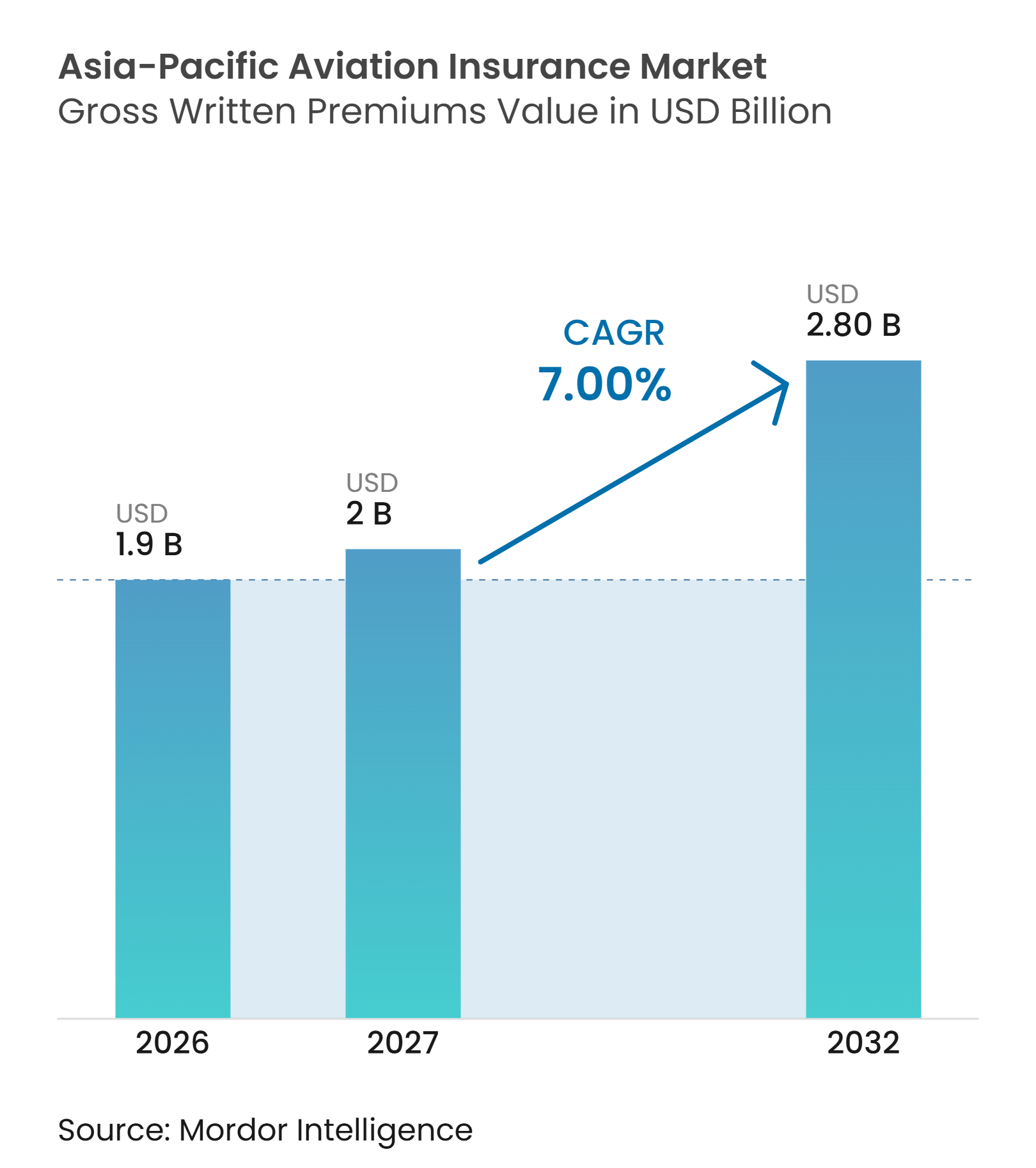
The Asia-Pacific Aviation Insurance Market size in terms of gross written premiums value is projected to be USD 1.9 billion in 2026, USD 2 billion in 2027, and reach USD 2.80 billion by 2032, growing at a CAGR of 7% from 2027 to 2032.
International traffic in the region grew 10.9% in 2025, and international load factors reached 84.4%, increasing the exposure carried on each flight. According to the Association of Asia Pacific Airlines (AAPA), regional carriers flew 30.4 million international passengers in September 2026, with revenue passenger-kilometers (RPK) demand rising 5.9% year-on-year, which supports a broad increase in aviation activity and insurance demand. Aircraft deliveries, leasing activity, and the expansion of low-cost carrier networks are adding hull and liability exposures across the region. Insurers are also giving more attention to claims severity, war-risk terms, specialist underwriting capacity, and local distribution as the Asia-Pacific aviation insurance market expands.
Key Report Takeaways
- By coverage type, aviation operating and premises liability captured 32.8% of the Asia-Pacific aviation insurance market share in 2026, while aviation products liability is projected to grow at a 7.5% CAGR through 2032.
- By end user, airlines and commercial operators captured 40.3% of the Asia-Pacific aviation insurance market share in 2026, while aviation products liability insureds are projected to grow at a 7.8% CAGR through 2032.
- By distribution channel, open-market broker placement captured 70.1% of the Asia-Pacific aviation insurance market share in 2026, while delegated authority is projected to grow at an 8.1% CAGR through 2032.
- By geography, China captured 27.2% of the Asia-Pacific aviation insurance market share in 2026, while India is projected to grow at a 9.2% CAGR through 2032.
Note: Market numbers in this report are based on Mordor Intelligence's proprietary estimation framework, which combines nine months of actuals with Q4 projections for base year 2026.
Market Trends and Insights
Drivers Impact Analysis of Asia-Pacific Aviation Insurance Market*
| Driver | (~) % Impact on CAGR Forecast | Geographic Relevance | Impact Timeline |
|---|---|---|---|
| Passenger Traffic, Fleet, and Airport Capacity Expansion | +3.2% | Global, with core concentration in China, India, and Southeast Asia | Long term (≥ 4 years) |
| Aircraft Replacement Values and Leasing Activity | +1.5% | China, India, Southeast Asia, Australia | Medium term (2-4 years) |
| Low-Cost Carrier and Regional Connectivity Expansion | +0.8% | Southeast Asia, India, China | Long term (≥ 4 years) |
| Digital Flight, Maintenance, and Telematics Data Adoption | +0.5% | Asia-Pacific core, Singapore, Japan, and Australia as early adopters | Medium term (2-4 years) |
| Rising Cyber and Operational Disruption Coverage Demand | +0.6% | Asia-Pacific core, China, Japan, and Singapore | Short term (≤ 2 years) |
| Fragmented Asia-Pacific Risk Pools Creating Demand for Local Specialist and Parametric Products | +0.4% | Southeast Asia, South Korea, and Rest of Asia-Pacific | Medium term (2-4 years) |
| Source: Mordor Intelligence | |||
Passenger Traffic, Fleet, and Airport Capacity Expansion
Asia-Pacific's expanding aviation activity is increasing the underlying exposure base for aircraft hull, passenger liability, and related insurance products. The International Air Transport Association (IATA) projects that annual passenger traffic in the region will increase from 1.7 billion in 2024 to 4.1 billion by 2044, adding 2.4 billion passengers and accounting for 41% of global passenger growth[1]. Higher passenger traffic increases the potential scale of passenger liability claims, while fleet expansion raises the number of aircraft requiring insurance coverage. In May 2026, Malaysia’s AirAsia ordered 150 Airbus A220-300 aircraft, representing a significant fleet expansion to support its network across ASEAN and Central Asia. These developments are expected to support long-term demand for aviation insurance, including hull, liability, and other specialized coverage. However, premium growth will also depend on insurance pricing, aircraft values, and underwriting conditions.
Aircraft Replacement Values and Leasing Activity
Aircraft acquisition and financing activity is increasing the value of assets requiring aviation insurance and expanding coverage needs beyond airline operators. Higher-value aircraft can raise hull insurance requirements and increase the financial exposure associated with individual losses. Aircraft financing and leasing arrangements may also create additional coverage requirements for lessors, lenders, and other financing counterparties. Malaysia’s AirAsia ordered 150 latest-generation A220-300 aircraft. The agreement marked the largest single-firm order for the A220, taking total firm orders beyond 1,000 and highlighting the aircraft’s global market appeal[2]. Separately, AXA XL’s Balthazar Finance platform demonstrates the role of specialist insurance solutions in supporting aircraft financing transactions and managing risks associated with aviation assets. As aircraft fleets and financing structures expand, insurers with expertise in hull valuation, contractual liability, and aviation finance can address a broader range of risks across the Asia-Pacific market.
Low-Cost Carrier and Regional Connectivity Expansion
The expansion of low-cost carriers and regional air connectivity is creating additional opportunities for aviation insurers across Southeast Asia and other high-growth Asia-Pacific markets. In October 2025, Vietjet announced an order for 100 Airbus A321neo aircraft as part of its fleet development and international expansion strategy[3]. The airline also announced a separate order for 100 A321neo aircraft in June 2025, underscoring the scale of its planned fleet expansion. An increasing number of aircraft and expanding route networks can drive demand for hull, passenger liability, and other aviation-related coverage, including policies tailored to regional operators. Insurers seeking to serve smaller airlines and operators across multiple jurisdictions may benefit from local distribution networks and specialized underwriting expertise. Delegated underwriting arrangements can also help insurers access local business, provided they maintain appropriate risk controls and oversight.
Digital Flight, Maintenance, and Telematics Data Adoption
The adoption of aircraft-level operational and weather data created opportunities to enhance aviation risk assessment, underwriting, and claims management. In July 2025, Spire Global launched Aircraft Exposure Analytics, a platform that combined aircraft flight trajectories derived from Automatic Dependent Surveillance-Broadcast (ADS-B) data with meteorological information to assess exposure to hazardous weather conditions[4]. The platform measured exposure to hazards such as turbulence, icing, and storms, providing detailed insights into aircraft operating conditions. For aviation insurers, these capabilities supported more granular exposure analysis, risk differentiation, and the assessment of weather-related incidents. Integrating reliable operational and maintenance records with flight and weather data also helped insurers evaluate risk controls and investigate claims more effectively. As Asia-Pacific aircraft fleets expanded, the broader adoption of these tools became increasingly valuable for insurers seeking more consistent, data-driven underwriting practices.
Restraints Impact Analysis of Asia-Pacific Aviation Insurance Market*
| Restraint | (~) % Impact on CAGR Forecast | Geographic Relevance | Impact Timeline |
|---|---|---|---|
| Aircraft Repair Inflation and High Claims Severity | -1.5% | Global, with a disproportionate effect on India and Southeast Asia | Short term (≤ 2 years) |
| War, Asset Detention, and Aviation Capacity Volatility | -0.8% | Asia-Pacific carriers with Middle East, Central Asia, or conflict-zone routes | Short term (≤ 2 years) |
| Fragmented Regulation and Limited Cross-Border Claims Data | -0.5% | Asia-Pacific-wide, with the strongest effect in Southeast Asia and South Asia | Medium term (2-4 years) |
| Shortage of Aviation Underwriting Talent and Aggregation Visibility | -0.4% | Singapore and Hong Kong, with spillover to national markets | Medium term (2-4 years) |
| Source: Mordor Intelligence | |||
Aircraft Repair Inflation and High Claims Severity
The adoption of aircraft-level operational and weather data is creating opportunities to improve aviation risk assessment, underwriting, and claims management. In July 2025, Spire Global launched Aircraft Exposure Analytics, a platform that combines aircraft flight trajectories derived from Automatic Dependent Surveillance-Broadcast (ADS-B) data with significant meteorological information to assess exposure to hazardous weather conditions. The platform measures exposure to hazards including turbulence, icing, and storms, providing more detailed information on aircraft operating conditions. For aviation insurers, these capabilities can support more granular exposure analysis, risk differentiation, and the assessment of weather-related incidents. Integrating reliable operational and maintenance records with flight and weather data may also help insurers evaluate risk controls and investigate claims more effectively. Wider adoption of these tools could become increasingly valuable as Asia-Pacific fleets expand and insurers seek more consistent, data-driven underwriting practices.
War, Asset Detention, and Aviation Capacity Volatility
Geopolitical conflict, asset detention, and uncertainty over policy wording continue to influence aviation war-risk underwriting. On 11 June 2025, the High Court of England and Wales delivered its judgment in the Russian Aircraft Lessor Policy Claims, ruling in favor of aircraft lessors in disputes concerning aircraft and engines that remained in Russia following the 2022 invasion of Ukraine. The judgment addressed the interpretation of contingent and possessed cover, including whether the loss of possession triggered coverage under the relevant lessor policies. The litigation involved claims worth several billion United States dollars. For Asia-Pacific insurers, the case highlights the importance of precise war-risk exclusions, government-action provisions, detention clauses, and lessor coverage arrangements. Conflict-related route restrictions and changing exposure assessments may also affect pricing and the availability of specific war-risk protection, depending on the territory, policy terms, and reinsurance support.
*Our forecasts treat driver/restraint impacts as directional, not additive. The impact forecasts reflect baseline growth, mix effects, and variable interactions.
Asia-Pacific Aviation Insurance Market Segment Analysis
By Coverage Type:
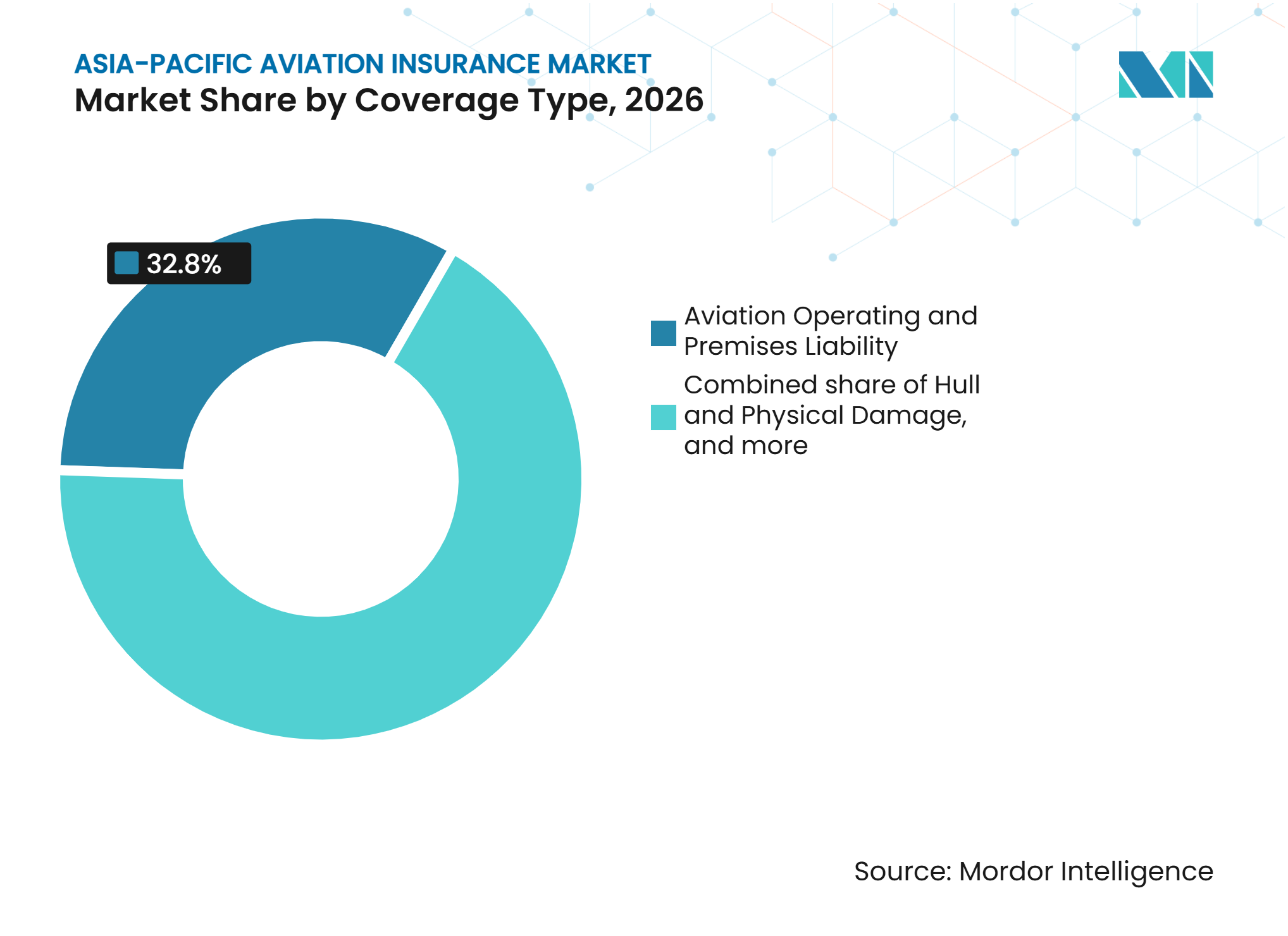
Liability Lines Account for the Largest PremiumsAviation operating and premises liability held 32.8% of the Asia-Pacific aviation insurance market size in 2026. The segment benefits from commercial passenger operations and the need to protect airlines and airport operators against third-party bodily injury, property damage, and other covered liabilities. Large passenger operations can increase the potential financial severity of a major incident, reinforcing the importance of liability protection within airline insurance programs. Hull and physical damage is another major coverage category because commercial aircraft represent substantial insured assets, with coverage requirements influenced by aircraft values, fleet composition, and financing arrangements. As airlines expand their fleets, insurers must assess both the physical value of aircraft and the liability exposures associated with their operation.
Aviation products liability is expected to record a 7.5% CAGR through 2032, making it the fastest-growing coverage type. China had approximately 3.29 million registered unmanned aerial vehicles at the end of 2025, representing a 51% year-on-year increase, while annual drone flight hours reached 45.3 million, up 69.9%. This expansion increases potential product-liability exposure for manufacturers, component suppliers, and other parties involved in the drone supply chain, although not every drone-related risk falls under aviation products liability. In February 2026, China's National Development and Reform Commission, National Financial Regulatory Administration, and Civil Aviation Administration issued guidelines targeting the initial establishment of compulsory unmanned-aircraft liability insurance by 2027 and a basic low-altitude insurance policy framework by 2030. These measures are expected to support the development of insurance products covering low-altitude aircraft manufacturing, operations, infrastructure, and associated services. Aviation war and allied perils remain sensitive to geopolitical developments and policy wording, while cyber and parametric products offer additional options for addressing selected operational and disruption risks.


By End User:
Airlines Support the Largest Insured BaseAirlines and commercial operators held 40.3% of the Asia-Pacific aviation insurance market in 2026. Their leading position reflects the concentration of commercial aircraft, passenger traffic, and operational exposures within scheduled airlines and other commercial aviation businesses. Airline insurance programs typically combine aircraft hull, third-party liability, passenger liability, and, where required, war-risk protection. Larger fleets and higher-value aircraft can require participation from multiple insurers and reinsurers to provide sufficient capacity for individual placements. Fleet utilisation, maintenance standards, route networks, and claims experience also influence underwriting decisions and coverage terms. Commercial aviation is therefore expected to remain a major source of insurance demand as passenger traffic and fleet capacity expand across the region.
Aviation products liability insureds are projected to grow at a 7.8% CAGR through 2032. China's registered drone fleet reached approximately 3.29 million in 2025, while annual drone flight hours increased to 45.3 million, indicating a substantial expansion in equipment deployment and operational activity. These developments create potential insurance needs for manufacturers, component suppliers, and technology businesses, particularly where product defects could cause bodily injury or property damage. General and business aviation operators also contribute to demand through private aircraft, business travel, charter services, and specialised flying activities. Aircraft lessors and financiers represent another distinct source of demand because financing structures can require protection against borrower non-payment and other contractual risks. AXA XL's Balthazar Finance platform provides long-term non-payment insurance for eligible aviation financing transactions, illustrating how specialist insurance can support lenders and lessors across the aviation value chain.
By Distribution Channel:
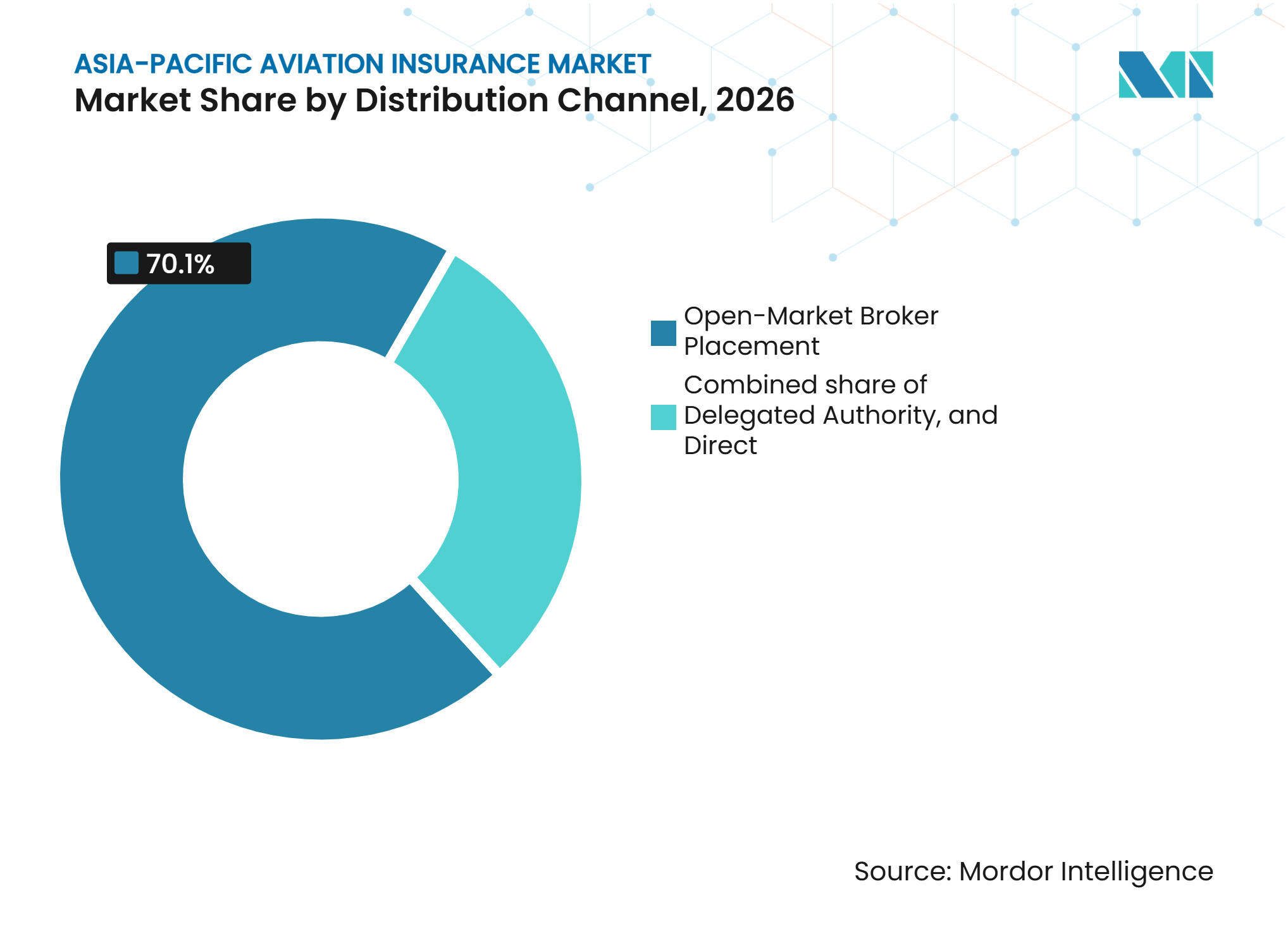
Brokers Lead While Delegated Authority ExpandsOpen-market broker placement accounted for 70.1% of the Asia-Pacific aviation insurance market in 2026. Aviation brokers play a central role in arranging complex placements by coordinating coverage requirements, negotiating policy wording, and accessing capacity from specialist insurers and reinsurers. Underwriters assess factors such as fleet composition, aircraft values, routes, maintenance practices, safety controls, and historical claims when evaluating risks. Brokers also help airlines, lessors, and other aviation businesses compare coverage terms and structure placements across multiple insurance markets. The technical complexity and potentially high limits associated with aviation risks support the importance of specialist brokerage. Open-market broker placement is therefore positioned to remain a major distribution channel for complex commercial aviation insurance programs.
Delegated authority is projected to grow at an 8.1% CAGR through 2032. Under delegated arrangements, insurers grant approved intermediaries or managing general agents authority to underwrite specified risks within agreed limits and controls. This model can support selected general aviation, drone, and other specialised risks where standardised underwriting processes and local distribution are commercially appropriate. Digital submission systems and data-led risk assessment may help delegated providers process eligible business more efficiently, although the scope of authority remains subject to insurer oversight. Direct sales can remain relevant for established airline relationships and simpler insurance products, while large or complex aviation placements may continue to rely on specialist brokers. The future role of delegated authority will depend on insurer appetite, the quality of underwriting controls, and the availability of suitable risks rather than technology adoption alone.

Geography Analysis
China accounted for 27.2% of the Asia-Pacific aviation insurance market in 2026. China's aviation insurance demand is supported by its large commercial aviation sector, extensive airport network, and expanding unmanned-aircraft activity. According to figures released by the Civil Aviation Administration of China (CAAC), the country had approximately 3.29 million registered unmanned aerial vehicles at the end of 2025, representing a 51% year-on-year increase. Drone flight hours reached 45.3 million in 2025, up 69.9% from the previous year. China also recorded more than 770 million passenger trips through its civil aviation system and had 270 transport airports at the end of 2025. In February 2026, Chinese authorities issued guidelines targeting the initial establishment of a compulsory unmanned-aircraft liability insurance system by 2027 and a basic low-altitude insurance policy framework by 2030.
India is forecast to grow at a 9.2% CAGR through 2032. India's aviation sector is supported by domestic passenger demand, fleet expansion, and continued development of commercial air connectivity. According to the International Air Transport Association (IATA), India's domestic passenger demand, measured in revenue passenger kilometres, increased by 5.2% in 2025, while available seat capacity rose by 6.7%. The domestic passenger load factor averaged 85.2% for the year. The Air India AI171 accident in June 2025 also highlighted the potential severity of a major aviation loss and the importance of coordinated claims handling.
Japan and South Korea have established commercial aviation sectors, while published traffic figures provide evidence of continued activity in the region's mature markets. IATA reported that Japan's domestic passenger demand increased by 4.8% in 2025, while its domestic passenger load factor rose by 3.4 % points to 81.4%. In Southeast Asia, aircraft procurement announcements provide evidence of planned fleet expansion. Malaysia's AirAsia placed a firm order for 150 Airbus A220-300 aircraft in May 2026, while Vietnam's Vietjet finalised a firm order for 100 Airbus A321neo aircraft in October 2025.
Competitive Landscape
Market Concentration
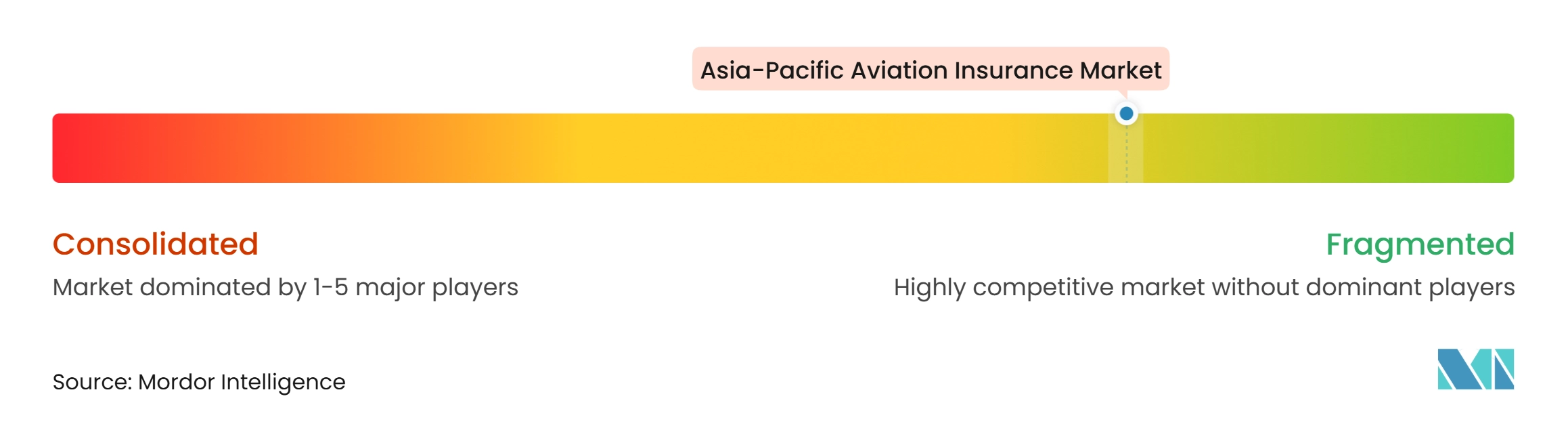
The Asia-Pacific aviation insurance market is characterised by a fragmented competitive environment, with international commercial insurers, domestic insurance companies, specialist aviation underwriters, and global reinsurers participating across different risk categories and national markets. Allianz Commercial, AXA XL, AIG, Chubb, Tokio Marine Kiln, and QBE are among the international insurers active in aviation-related coverage, while New India Assurance and Tata AIG are participants in India's general insurance market. Their capabilities vary by product, jurisdiction, underwriting appetite, and access to specialist capacity. The presence of multiple providers gives airlines, aircraft lessors, airports, manufacturers, and general aviation operators a range of potential insurance counterparties. Competition centres on technical underwriting expertise, claims handling, policy wording, financial strength, geographic reach, and the ability to arrange capacity for complex risks.
Competition also extends beyond conventional airline hull and liability policies into aircraft financing protection and analytics-enabled risk assessment. AXA XL's Balthazar Finance platform provides long-term non-payment insurance for eligible aviation financing transactions, supporting lenders and lessors that finance aircraft acquisitions. In July 2025, Spire Global launched Aircraft Exposure Analytics, which combines aircraft flight trajectories with weather-hazard information to help airlines, lessors, maintenance teams, and insurers assess aircraft-level environmental exposure. These examples demonstrate the development of specialised solutions and analytical tools relevant to aviation risk management. AirAsia's May 2026 order for 150 Airbus A220-300 aircraft also illustrates the scale of future fleet procurement in the region, although the order itself does not establish which insurers will underwrite the resulting risks.
Specialist intermediaries, managing general agents, and delegated underwriting arrangements can provide additional routes to market for selected aviation risks, subject to insurer authorisation and oversight. Reinsurers, including Munich Re, Swiss Re, Hannover Re, and Korean Re, are potential sources of risk-transfer capacity for primary insurers, although their participation and capacity for specific Asia-Pacific aviation placements must be established on a case-by-case basis. Domestic insurers also contribute through their local market knowledge, regulatory presence, and relationships with regional aviation businesses. The interaction between international insurers, domestic carriers, specialist intermediaries, and reinsurers creates multiple competitive channels across the region. Consequently, market positioning depends not only on underwriting capacity but also on product specialisation, local access, risk selection, and the ability to manage complex aviation exposures.
Asia-Pacific Aviation Insurance Industry Leaders
-
Tokio Marine Kiln
-
AXA XL
-
American International Group, Inc.
-
Chubb Limited
-
Allianz Commercial
- *Disclaimer: Major Players sorted in no particular order
Asia-Pacific Aviation Insurance Market Companies Covered in this Report
- Allianz Commercial
- American International Group (AIG)
- AXA XL
- Chubb Limited
- QBE Insurance Group Limited
- Sompo
- Tokio Marine Kiln
- Starr Insurance Companies
- Global Aerospace, Inc.
- HDI Global SE
- MSIG
- MS Amlin
- The New India Assurance Company Limited
- Tata AIG General Insurance Company Limited
- Great American Insurance Group
- Zurich Insurance Group
- Munich Re
- Swiss Re
- Hannover Re
- Korean Re
Recent Industry Developments in Asia-Pacific Aviation Insurance Market
- April 2026: AirAsia signed a firm order for 150 Airbus A220-300 aircraft, valued at USD 19 billion at list prices, with options for 150 additional aircraft. The order expands AirAsia's future hull and liability insurance requirements across ASEAN and Asia-Pacific.
- February 2026: China's National Development and Reform Commission, Financial Regulatory Authority, and Civil Aviation Administration of China issued guidelines mandating unmanned aerial vehicle liability insurance by 2027 and a low-altitude insurance framework by 2030.
- October 2025: VietJet Air signed a firm order for 100 Airbus A321neo aircraft, expanding its future insurable aircraft base and international connectivity.
- July 2025: Spire Global launched Aircraft Exposure Analytics, enabling aviation insurers and lessors to overlay individual flight paths with real-time and historical weather hazard data for more granular per-aircraft environmental risk and claims assessment.
Asia-Pacific Aviation Insurance Market Report Scope
Segmentation Overview
| Hull and Physical Damage |
| Aviation Operating and Premises Liability |
| Aviation Products Liability |
| Aviation War and Allied Perils |
| Other Specialty |
| Airlines and Commercial Operators |
| General and Business Aviation Operators |
| Aviation Products Liability Insureds |
| Aircraft Lessors and Financiers |
| Airports and Aviation Infrastructure |
| Open-Market Broker Placement |
| Delegated Authority |
| Direct |
| China |
| India |
| Japan |
| South Korea |
| Southeast Asia |
| Australia and Newzealand |
| Rest of Asia-Pacific |
| By Coverage Type | Hull and Physical Damage |
| Aviation Operating and Premises Liability | |
| Aviation Products Liability | |
| Aviation War and Allied Perils | |
| Other Specialty | |
| By End User | Airlines and Commercial Operators |
| General and Business Aviation Operators | |
| Aviation Products Liability Insureds | |
| Aircraft Lessors and Financiers | |
| Airports and Aviation Infrastructure | |
| By Distribution Channel | Open-Market Broker Placement |
| Delegated Authority | |
| Direct | |
| By Country | China |
| India | |
| Japan | |
| South Korea | |
| Southeast Asia | |
| Australia and Newzealand | |
| Rest of Asia-Pacific |
Key Questions Answered in the Report
What is the projected growth rate for aviation insurance in Asia-Pacific?
The Asia-Pacific aviation insurance market is projected to grow at a 7% CAGR from 2027 to 2032, reaching USD 2.8 billion by 2032.
Which coverage type leads aviation insurance demand in Asia-Pacific?
Aviation Operating and Premises Liability leads with a 32.8% share in 2026, supported by commercial airline operations and passenger liability needs.
Which end user is growing fastest in aviation insurance?
Aviation Products Liability Insureds are projected to grow at a 7.8% CAGR through 2032 as drone and aerospace manufacturing exposures increase.
Why is China important for regional aviation insurance?
China holds 27.2% of the regional total in 2026 and had 3.29 million registered unmanned aerial vehicles at the end of 2025 .
Why is India the fastest-growing country for aviation insurance?
India is projected to grow at a 9.2% CAGR through 2032 because of fleet expansion, low-cost carrier activity, and rising hull and liability exposure.
What is driving demand for aviation insurance analytics?
Flight-path and weather data can help insurers assess aircraft exposure to turbulence, icing, volcanic ash, and tropical cyclones.