
Market Overview
| Study Period | 2020 - 2031 |
|---|---|
| Forecast Data Period | 2026 - 2031 |
| Base Year Market Size (2025) | USD 409.20 Million |
| Market Size (2026) | USD 427.89 Million |
| Market Size (2031) | USD 534.92 Million |
| Growth Rate (2026 - 2031) | 4.57 % |
| Market Concentration | Medium |
Major Players *Disclaimer: Major Players sorted in no particular order Image © Mordor Intelligence. Reuse requires attribution under CC BY 4.0. | |
Asia-Pacific Anticoccidial Market Analysis by Mordor Intelligence
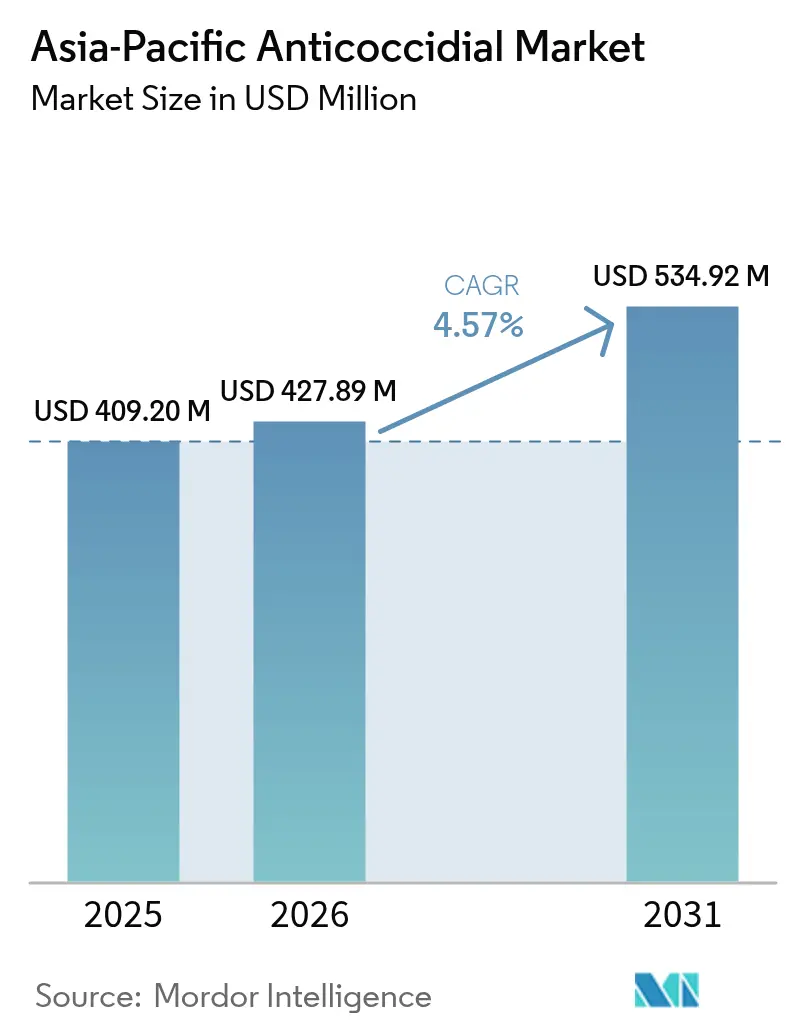
Asia-Pacific Anticoccidial Market size in 2026 is estimated at USD 427.89 million, growing from 2025 value of USD 409.20 million with 2031 projections showing USD 534.92 million, growing at 4.57% CAGR over 2026-2031.
Due to the COVID-19 outbreak, a short-term negative impact was seen on the market due to decreased visits to veterinary hospitals and clinics. Healthcare services were significantly reduced due to social distancing measures taken by governments across the globe. For instance, as per the data published by the National Institute of Health in March 2021, it was observed that pet adoption increased in Asian countries during the pandemic, and initial vaccinations on pets were done regularly. However, other than pets, the farm animal vaccination was not done at a given time due to the pandemic restrictions. Additionally, standard practices such as routine animal checkups, diagnoses, and surgeries were disrupted. These decreased services lowered the coccidiosis diagnosis. But, at the later stage of the pandemic, smart agriculture and livestock production systems with animal welfare aspects were adopted. For instance, according to an article published by Frontiers in Veterinary Science in January 2021, initiatives such as a national risk assessment, clear communication channels, contingency plans, a crisis response group, and support systems for animal care providers were taken by Australia for animal welfare. This initiative during the pandemic led to increased demand for diagnosing animal diseases, and market started to witnessed gradual growth.
Factors such as increasing incidence of coccidiosis and advancements in veterinary healthcare are expected to drive market growth over the forecast period. For instance, according to an article published by Veterinaria Digital S.A., in December 2021, humidity and temperature conditions in Southeast Asia are two critical factors for the development and survival of coccidia and its vector, the Alphitobius beetle. All of them promote high infectious pressure in indigenous chicken breeds. According to the above source, a prevalence of 65.83% and 68.5% of coccidia, respectively, was observed in Ben Tre and Hau Giang provinces. Such a high incidence of coccidiosis in the region is expected to increase the demand for anticoccidial drugs, thereby driving the market growth.
Moreover, Eimeria is a genus of apicomplexan parasites that includes various species capable of causing the disease coccidiosis in animals such as cattle, poultry, dogs, cats, and smaller ruminants, including sheep and goats. According to the research article published in August 2022, in Queensland, Australia, weaned cattle tend to be more affected in summer due to coccidiosis, possibly because of stress, and even if it can happen to a year-old cattle, clinical infection usually starts at 1-2 months of age because coccidiosis rarely manifests in the first three weeks of life. Thus, the burden of coccidiosis among the target animals of specific age demands the availability of the effective treatment which is expected to boosts the market growth over the forecast period.
However, the availability of alternative treatment options in the market is expected to hinder market growth over the forecast period.
Note: Market size and forecast figures in this report are generated using Mordor Intelligence’s proprietary estimation framework, updated with the latest available data and insights as of 2026.
Asia-Pacific Anticoccidial Market Trends and Insights
Poultry Segment is Expected to hold a Significant Share in the Anticoccidial Market Over The Forecast Period
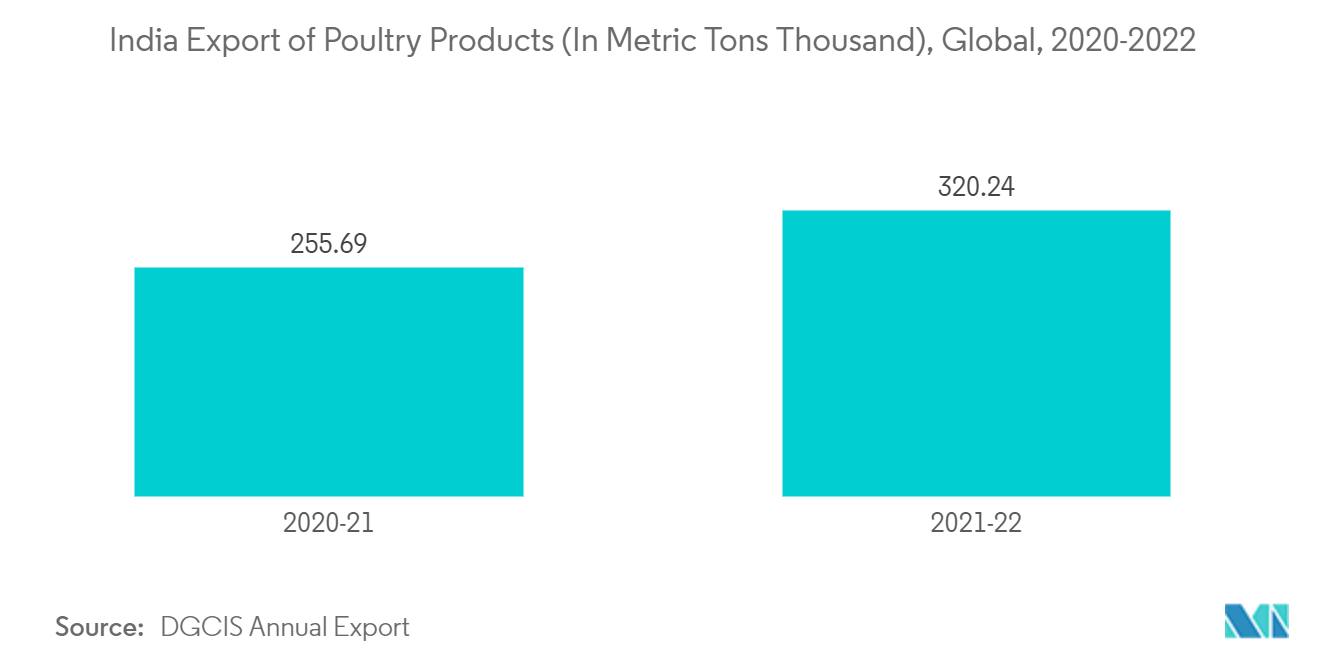
Coccidiosis is a parasitic disease with a great impact on poultry farming due to the high percentage of morbidity. The increase in the poultry population and the high prevalence of coccidiosis in poultry drive market growth. For instance, according to an article published by Veterinaria Digital, in September 2022, coccidiosis in India is highly prevalent, especially in the monsoon season. It causes many economic losses in the poultry sector, with high mortality and marked by worsening production indices. Additionally, according to the above source, the prevalence of coccidiosis in broilers ranges between 5% and 70% depending on many factors, such as management, the presence of vectors such as Alphitobius, high temperature, and humidity conditions, among many others. Thus, the region's high prevalence of coccidiosis is expected to drive market growth over the forecast period.
Furthermore, according to a report published in September 2022 by the United States Department of Agriculture (USDA), poultry production in China is expected to remain stable at 14.3 million metric tons in 2023. Additionally, according to the above source, China's poultry exports are expected to increase by 5% in 2023. Thus, with increased poultry production, the chances of developing coccidiosis increase, thereby increasing the demand for anticoccidial drugs.
Thus, owing to the factors above, the studied market is expected to witness significant growth over the forecast period.
South Korea is Expected to Dominate the Asia-Pacific Anticoccidial Market Over the Forecast Period
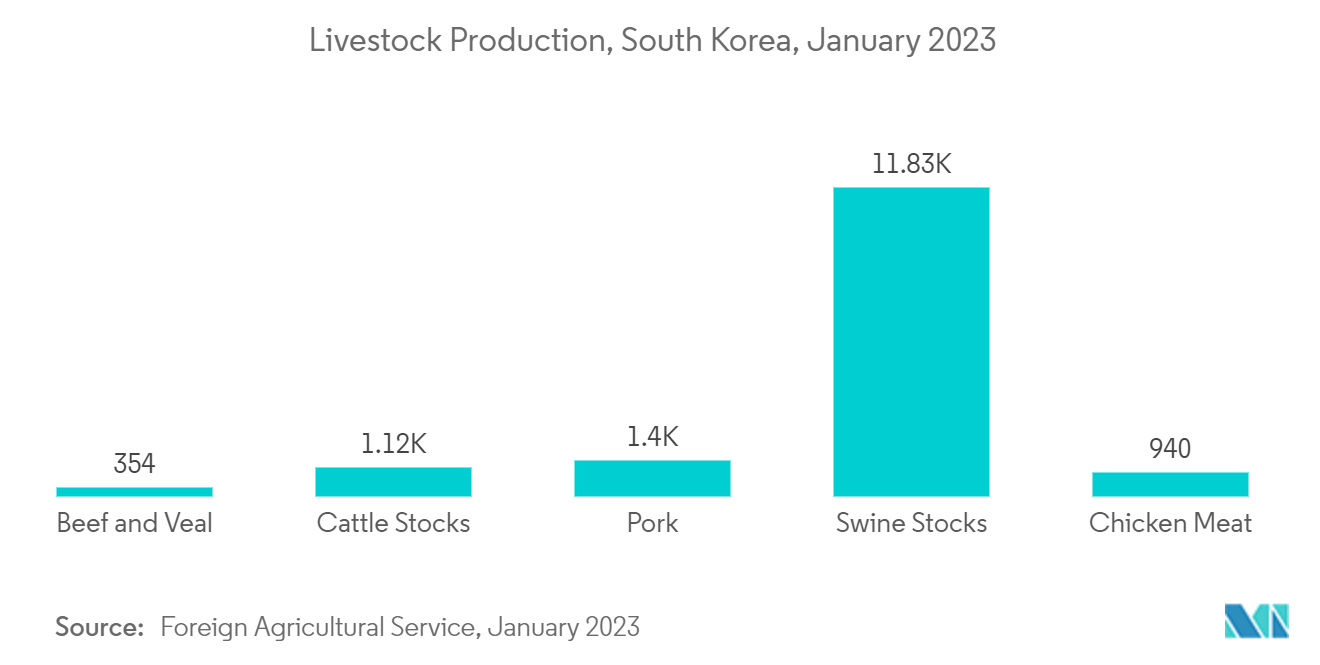
The major factors attributed to the market growth in South Korea are the rising animal population and animal expenditure, along with the growing burden of coccidiosis in the country. Besides, the country is actively involved in initiatives like research surveys and diagnostics to promote good pet health and awareness about pet diseases. For instance, the 2021 open survey of Pet Trends Report stated that in 2020, 73% of millennial pet owners prioritized pets' well-being by spending out-of-pocket. Additionally, according to the above report, medical treatment, insurance, and pet hotels were chosen as the top 3 features pet owners wanted to see growth in. According to the survey, between 2020 and 2021, a pet owner spent, on average, around USD 450 on veterinary care. Hence, pet owners' priority for their pet well-being is expected to drive market growth in South Korea over the forecast period.
The country's veterinary regulatory organizations were compelled to establish national animal health insurance programs due to the increasing expenses of owning pets and paying for veterinary care. For instance, in October 2021, the Ministry of Agriculture, Food and Rural Affairs instructed to conduct a nationwide study in Korea to understand the expenses of veterinary care and treatments to introduce state-run health insurance for pets. Such initiatives are likely to boost the demand for anticoccidial drugs during the forecast period.
Thus, owing to the abovementioned factors, the studied market in South Korea is expected to witness significant growth over the forecast period.
Competitive Landscape
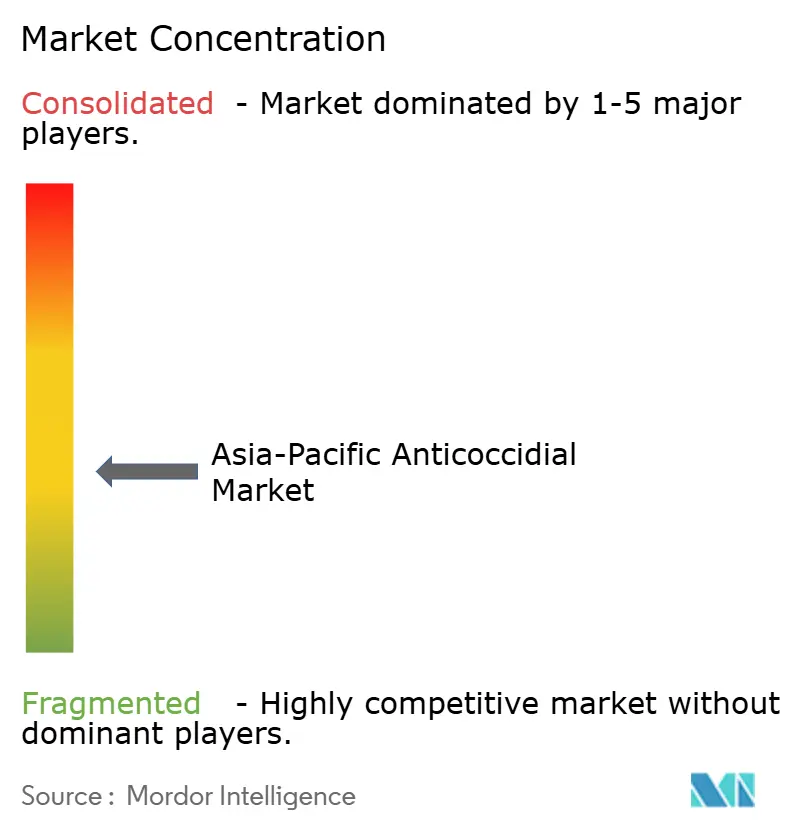
The Asia-Pacific anticoccidial market is moderately concentrated in nature due to the presence of companies operating globally and regionally. The competitive landscape includes an analysis of local companies which hold market shares and are well known, including Boehringer Ingelheim, Elanco Animal Health, Merck, Virbac, Vetoquinol SA, and Zoetis Animal Healthcare, among others.
Asia-Pacific Anticoccidial Industry Leaders
-
Elanco
-
Vetoquinol SA
-
Huvepharma
-
Virbac
-
Zoetis Animal Healthcare
- *Disclaimer: Major Players sorted in no particular order
Market Opportunities and Future Outlook
Coccidiosis pressure in humid parts of Southeast Asia, combined with seasonal stress patterns observed in markets such as Australia, continues to support demand for anticoccidial prevention and treatment across poultry and other livestock. Over the forecast period, an opportunity area is the way larger, vertically integrated poultry producers are moving toward structured rotation and shuttle programs that combine ionophores and synthetic anticoccidials with on-farm management practices, aiming to slow resistance development. This shift is tied to improved diagnostics and farm advisory services.
There is also room for growth around non-antibiotic, residue-conscious strategies used alongside conventional anticoccidials within integrated control programs, including botanicals, phytochemicals, and microbial-based gut modulators. Recent commercial activity points to this whitespace, including Amlan International introducing Phylox, a natural, non-pharmaceutical anticoccidial product, in the Philippines poultry market in 2024, and Huvepharma launching Monimax for poultry in Indonesia and Malaysia in 2025. Together, these moves suggest active channel building around anticoccidiosis solutions beyond traditional in-feed medication.
Recent Industry Developments
- February 2026: Elanco received Australian registration for Advocate Ultra Chew for dogs. While positioned as broad-spectrum parasite protection, the approval strengthens Elanco's companion-animal portfolio in a key Asia-Pacific market and supports deeper clinic and retail-channel engagement that also benefits its wider veterinary pharmaceuticals footprint.
- May 2025: Huvepharma launched Monimax for poultry in Indonesia and Malaysia. The introduction expands access to anticoccidial options in two large Southeast Asian poultry markets and adds momentum to program-based coccidiosis control approaches used by commercial integrators.
- August 2024: Amlan International introduced Phylox, a natural non-pharmaceutical anticoccidial product, to the Philippine poultry market via distributor Nezus Philippines Corporation. The launch reflects growing adoption of non-antibiotic tools in coccidiosis management programs and increases competitive intensity in the alternatives segment alongside conventional anticoccidials.
Research Methodology Framework and Report Scope
Market Definition and Coverage
This market is sized as the revenue generated from anticoccidial drugs used to prevent or treat coccidiosis in food producing animals across Asia-Pacific, counted at manufacturer and importer selling prices before retail markups.
Scope exclusions: We exclude vaccines, probiotics, and other non-drug gut health products, and we also exclude general antibiotics that are not positioned for coccidiosis control.
Segmentation Overview
- By Drug Class
- Ionophore
- Antibiotic
- Sulphonamides
- Chemical Derivative
- Other Drug Classes
- By Drug Action
- Coccidiostatic
- Coccidiocidal
- By Animal
- Livestock Animals
- Cattle
- Poultry
- Other Livestock Animals
- Companion Animals
- Dogs
- Cats
- Other Companion Animals
- Livestock Animals
- By Distribution Channel
- Veterinary Hospitals
- Retail Pharmacy
- Other Distribution Channels
- By Country
- China
- Japan
- India
- Australia
- South Korea
- Rest of Asia-Pacific
Data Sources, Market Sizing, and Validation
Desk Research
Desk work starts by mapping demand signals to poultry and livestock production in Asia-Pacific and then linking them to anticoccidial usage patterns. We relied on public sources such as FAOSTAT for poultry and livestock output, national agriculture and livestock ministries for production and disease control programs, and OIE-WAHIS for animal health notifications and related context.
To tighten the supply and trade view, import-export statistics (such as UN Comtrade and national customs dashboards) were used to sanity check cross-border flows for relevant drug categories. We then reviewed peer reviewed veterinary parasitology literature for resistance trends and dosing practices, plus company filings, investor presentations, product labels, and reputed press to confirm formulation mixes and route of administration patterns. Where available, we used paid subscriptions for company financials and news screening, and we also checked patent databases for molecule and formulation activity. These desk sources are illustrative, and we used many other public references in parallel to support data collection, validation, and clarification.
Primary Interviews and Surveys
Primary work was used to translate production and disease context into realistic adoption and pricing inputs, especially where public data is not reported consistently across countries. We spoke with manufacturers, distributors, poultry integrators, veterinarians, and feed and farm advisors across major APAC poultry producing countries. The inputs helped validate drug mix shifts, average treatment cycles, and channel margins before we finalized assumptions for the country model.
Distribution of primary research fieldwork respondents
| Company type | Respondent position |
|---|---|
| Top tier: 35% | CXOs: 16% |
| Mid tier: 49% | Functional/Unit leaders: 30% |
| Smaller Players: 16% | Managers: 54% |
Market-Sizing & Forecasting
Sizing is built using a top-down demand pool where poultry and other relevant animal populations by country are reconstructed from official production statistics, then filtered through disease prevalence, prevention intensity, and treatment coverage. Once the treated population is formed, volumes are translated into value using typical dose rates and an average selling price by drug class and route of administration.
To keep the model practical, we run a selective bottom-up check using supplier and distributor feedback on annual volumes, sampled price points, and channel splits. This helps adjust country totals when one indicator looks off. Inputs that matter most include broiler and layer placements, anticoccidial rotation practices (ionophore versus chemical), prevalence of resistance and switching behavior, farm level biosecurity adoption, and the mix of preventive versus therapeutic use, which changes the number of cycles per flock.
For forecasting, we use scenario analysis, since policy shifts on antimicrobial use and resistance signals can change demand quickly. The scenarios are anchored to expected poultry output growth and then tuned using interview consensus on pricing progression, switching between drug classes, and distribution channel changes. Where country level price data is limited, we handled gaps through conservative ranges.
Data Validation & Update Cycle
Outputs are checked against independent signals such as poultry production trends, trade movement direction, and the expected share of medicated programs reported by practitioners, before internal sign-off. When a country result shows an unusual jump, we re-open assumptions and re-contact the relevant interview cohort to confirm whether it is a real shift or a data artifact.
A second analyst review is completed to verify unit logic, currency conversions, and year alignment, followed by a final pass right before release so the view reflects the latest public updates. The report is refreshed annually, with interim updates when material events occur, such as major regulatory changes, supply disruptions, or sharp input cost moves that affect pricing.
Mordor Intelligence's Asia Pacific Anticoccidial Market Sizing Compared With Other Published Estimates
Published numbers for Asia-Pacific anticoccidial drugs can vary because the boundary is not always the same, and the timing of prices and currencies also changes the output. Differences usually come from whether the scope is strictly drug revenue, how prevention cycles are counted across poultry systems, and how quickly pricing assumptions are updated when input costs move.
In this study, the market value is kept consistent by refreshing average selling prices and exchange rates at a defined annual cut, then rechecking totals against country production and channel feedback. This explains why the 2025 figure in Mordor Intelligence can sit below or above other publications that lock older pricing, blend adjacent feed additive items, or extend coverage into less validated countries.
Benchmark comparison
| Source | Market Size | Gaps in Research Methodology |
|---|---|---|
| Mordor Intelligence | USD 409.20 M (2025) | |
| Regional Consultancy A | USD 471.92 M (2025) | Uses a broader country basket and appears to apply a higher ASP progression into 2025, which can lift totals when price timing and currency conversion are not aligned to a consistent cut-off. |
| Industry Publisher B | USD 414.80 M (2023) | Anchors on an earlier base year and may mix preventive and therapeutic volumes without a clear cycle logic by poultry system, which can shift the implied treated population and value. |
The comparison shows that the spread is mainly created by timing choices and scope edges, rather than by one single demand driver. By keeping the treated population build and the ASP and currency steps explicit, the estimate stays traceable to inputs that can be checked and repeated across APAC countries.
Key Questions Answered in the Report
How big is the APAC Anticoccidial Drugs Market?
The APAC Anticoccidial Drugs Market size is expected to reach USD 427.89 million in 2026 and grow at a CAGR of 4.57% to reach USD 534.92 million by 2031.
What is the current APAC Anticoccidial Drugs Market size?
In 2026, the APAC Anticoccidial Drugs Market size is expected to reach USD 427.89 million.
Who are the key players in APAC Anticoccidial Drugs Market?
Elanco, Vetoquinol SA, Huvepharma, Virbac and Zoetis Animal Healthcare are the major companies operating in the APAC Anticoccidial Drugs Market.
What years does this APAC Anticoccidial Drugs Market cover, and what was the market size in 2025?
In 2025, the APAC Anticoccidial Drugs Market size was estimated at USD 427.89 million. The report covers the APAC Anticoccidial Drugs Market historical market size for years: 2019, 2020, 2021, 2022, 2023 and 2024. The report also forecasts the APAC Anticoccidial Drugs Market size for years: 2026, 2027, 2028, 2029, 2030 and 2031.