
Artificial General Intelligence Market Size and Share
Market Overview
| Study Period | 2020 - 2031 |
|---|---|
| Market Size (2026) | USD 11.40 Billion |
| Market Size (2031) | USD 42.52 Billion |
| Growth Rate (2026 - 2031) | 30.12 % |
| Fastest Growing Market | Asia-Pacific |
| Largest Market | North America |
| Market Concentration | Medium |
Major Players *Disclaimer: Major Players sorted in no particular order Image © Mordor Intelligence. Reuse requires attribution under CC BY 4.0. | |
Artificial General Intelligence Market Analysis by Mordor Intelligence
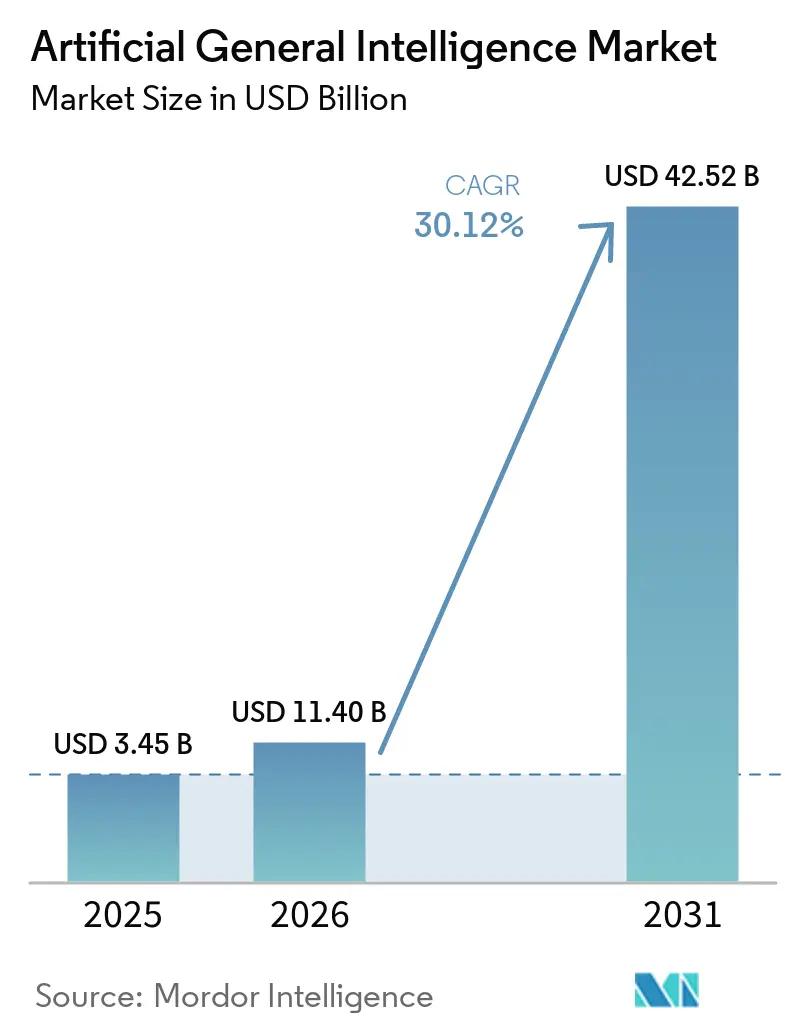
The Artificial General Intelligence Market size is expected to grow from USD 3.45 billion in 2025 to USD 11.40 billion in 2026 and is forecast to reach USD 42.52 billion by 2031 at 30.12% CAGR over 2026-2031.
The Artificial General Intelligence market is moving from experimental use toward enterprise deployment as model providers package reasoning, orchestration, and monitoring in integrated offerings. Demand is increasingly tied to systems that can handle multi-step work rather than isolated prompts or single-purpose automation. Large computing investments support this transition, but they also raise the cost of developing and operating advanced systems. Vendors are responding through cloud platforms, specialized hardware, and tools that help organizations manage model outputs. The Artificial General Intelligence market also faces a practical divide between broad platforms and deployments designed for regulated or data-sensitive settings.
Key Report Takeaways
- By technology, Foundation Model-Based AGI held 61.23% of the Artificial General Intelligence market in 2025, while Agentic AGI is projected to expand at a 31.17% CAGR through 2031.
- By component, platform solutions held 67.93% of the Artificial General Intelligence market in 2025 is projected to expand at a 30.78% CAGR through 2031.
- By deployment, Cloud-Based AGI Systems held 76.27% of the Artificial General Intelligence market in 2025, while Hybrid AGI Deployments are projected to expand at a 30.54% CAGR through 2031.
- By end-user industry, Information Technology and Telecommunications held 31.79% of the Artificial General Intelligence market in 2025, while Healthcare and Life Sciences is projected to expand at a 31.09% CAGR through 2031.
- By geography, North America held 52.76% of the global AGI share in 2025, while Asia-Pacific is projected to expand at a 31.67% CAGR through 2031.
Note: Market size and forecast figures in this report are generated using Mordor Intelligence’s proprietary estimation framework, updated with the latest available data and insights as of January 2026.
Global Artificial General Intelligence Market Trends and Insights
Drivers Impact Analysis*
| DRIVER | (~) % IMPACT ON CAGR FORECAST | GEOGRAPHIC RELEVANCE | IMPACT TIMELINE |
|---|---|---|---|
| Scaling of Foundation and Reasoning Models | +5.2% | Global, concentrated in North America and China | Short term (≤ 2 years) |
| Enterprise Demand for Autonomous Knowledge Work | +4.8% | North America and Europe, spill over to the Asia-Pacific | Short term (≤ 2 years) |
| Hyperscaler and Sovereign AI Infrastructure Investment | +4.5% | Global, led by North America, the Middle East, and Europe | Medium term (2-4 years) |
| Expansion of Multimodal and Agentic Capabilities | +4.0% | Global, led by North America and East Asia | Medium term (2-4 years) |
| Falling Inference Cost Through Specialized Compute | +3.5% | Global, early gains in North America | Short term (≤ 2 years) |
| Synthetic Environments for Closed-Loop Agent Training | +2.5% | North America and East Asia | Medium term (2-4 years) |
| Source: Mordor Intelligence | |||
Scaling of Foundation and Reasoning Models
The Artificial General Intelligence market benefits from continuing improvements in model reasoning and tool use. Developers can improve performance by adding additional computation during inference, rather than relying solely on a new training cycle. This makes advanced systems more useful for tasks that require planning, review, and several dependent actions. Microsoft’s Maia 200 announcement showed that providers are designing infrastructure for both inference and training workloads.[1] These developments favor service-based platform relationships because capability improvements can reach customers during the term of a contract. They also increase the value of evaluation and governance tools that help organizations assess changing model behavior, compare outcomes across releases, document limitations, and decide which tasks can move from supervised use to controlled autonomy.
Enterprise Demand for Autonomous Knowledge Work
Enterprise interest has shifted from assistance within individual applications to workflows that can coordinate tools and complete several stages of work. Microsoft reported that active agents in its Microsoft 365 ecosystem increased 15 times year over year between March 2025 and March 2026. This change broadens the addressable use cases for the Artificial General Intelligence market across administrative, technical, and analytical work. Organizations need clear permissions, audit trails, and human escalation paths before they can assign autonomous agents to consequential processes. Procurement decisions, therefore, increasingly cover orchestration and governance alongside model access. Vendors that support integration with existing business systems are better placed to address this demand because buyers need agents to work with established records, permissions, approval steps, and escalation procedures rather than operate as separate experimental tools.
Hyperscaler and Sovereign AI Infrastructure Investment
Infrastructure investment remains a central force in the Artificial General Intelligence market because advanced models require extensive computing capacity. National programs and private cloud providers are both building capacity, which creates demand beyond ordinary enterprise IT spending. NVIDIA, NAVER, and Brookfield announced a proposed expansion of South Korea’s sovereign AI factory to 200 MW, with a long-term path to 1 GW.[2] SoftBank also committed up to EUR 75 billion (USD 83 billion) for 5 GW of AI data center capacity in France by 2031.[3] Such commitments can support domestic access to computing and reduce dependence on a small group of external providers. They may also lengthen the time before smaller developers can compete at the frontier because capital and power requirements remain high, project delivery depends on scarce equipment and skilled operators, and access to dependable capacity can determine product release schedules.
Expansion of Multimodal and Agentic Capabilities
Multimodal systems can combine text with images, audio, video, and structured information within a single workflow. This capability matters where workers must interpret several forms of evidence before making a decision. Google introduced its Agent2Agent protocol and Agent Payments Protocol to help agents built on different frameworks interact and transact.[4] The Artificial General Intelligence market can gain from these standards because interoperability reduces the need to rebuild connections for every agent implementation. In drug discovery, research described agentic AI and laboratory automation as a route toward continuous design-make-test-analyze workflows. Organizations will still require controls over data access, model instructions, tool permissions, and transaction approvals before using these systems at scale, especially where an agent can retrieve internal records or initiate actions in connected enterprise applications.
Restraints Impact Analysis*
| RESTRAINT | (~) % IMPACT ON CAGR FORECAST | GEOGRAPHIC RELEVANCE | IMPACT TIMELINE |
|---|---|---|---|
| High Compute, Energy, and Data-Center Costs | -3.8% | Global, most acute in North America and Europe | Short term (≤ 2 years) |
| Reliability, Hallucination, and Evaluation Gaps | -2.9% | Global | Short term (≤ 2 years) |
| Capability-Control and Alignment Risk | -2.5% | Global, regulatory focus in Europe and North America | Medium term (2-4 years) |
| Frontier-Model Security and Weight-Exfiltration Exposure | -1.8% | Global, highest risk in hyperscaler-concentrated markets | Medium term (2-4 years) |
| Source: Mordor Intelligence | |||
High Compute, Energy, and Data-Center Costs
The cost of compute, power, and data center construction constrains the Artificial General Intelligence market, especially for organizations without large capital budgets. The White House reported that cloud computing costs increased at an average rate of 2.5 times per year from 2016 to 2024 and cited an estimated USD 490 million in training costs for Grok 4. Costs continue after training because production systems need inference capacity, monitoring, storage, and network resources. These requirements can concentrate advanced development among well-funded model developers and cloud providers. They can also delay adoption in cost-sensitive sectors and regions. Efficient inference hardware and workload management can mitigate this constraint, but they do not eliminate the need for substantial physical infrastructure, long-term electricity planning, and operating budgets that can be sustained beyond an initial pilot or model launch.
Reliability, Hallucination, and Evaluation Gaps
Reliable behavior remains essential when systems are used in finance, health care, legal work, and public administration. Hallucinated or unsupported output can create operational, compliance, and safety risks even when a model performs well in general tests. A peer-reviewed study on autonomous medical AI agents described the importance of evaluating agents in clinical action spaces, including tests, diagnoses, and treatment decisions. The Artificial General Intelligence market must therefore develop evaluation methods that measure end-to-end system behavior, not only isolated benchmark scores. Organizations may initially use these systems for lower-risk tasks while retaining human review for sensitive decisions. This approach may slow the path to full autonomy, but it can establish the evidence and controls needed for broader deployment, including documented review processes, records of system performance, and clear accountability when a workflow produces an incorrect or incomplete result.
*Our forecasts treat driver/restraint impacts as directional, not additive. The impact forecasts reflect baseline growth, mix effects, and variable interactions.
Segment Analysis
By Technology: Foundation Models Lead as Agentic Systems Accelerate
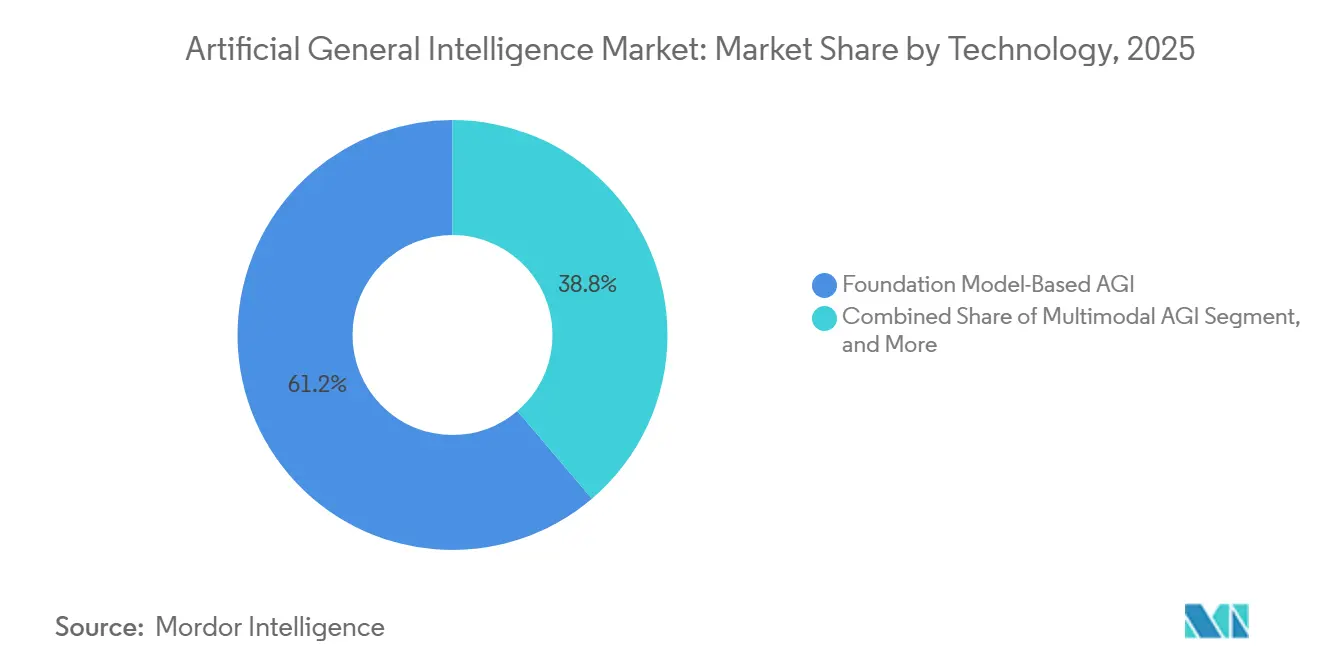
Foundation model-based AGI is projected to account for 61.23% of the Artificial General Intelligence market in 2025, while agentic AGI is forecast to expand at a 31.17% CAGR through 2031. Foundation models lead the market because they provide a flexible foundation for language, code, vision, and other applications. Major model families offer established developer tools, model interfaces, and integration ecosystems, reducing the time required to move early enterprise use cases into production. Advances in reasoning methods, longer-context processing, and tool use further extend the value of existing model architectures.
Agentic systems emphasize planning, tool selection, memory, and multi-step task execution. Their projected growth reflects rising demand for systems capable of performing tasks beyond content generation and question answering. Google's Agent2Agent protocol demonstrates efforts to enable interoperability among agents built on different frameworks. Adoption will depend on users' ability to establish boundaries for tool use, inspect agent actions, and recover from errors. Multimodal AGI also supports workflows involving documents, images, video, audio, and structured data.

By Component: Platforms Lead Through Integrated AI Stack Economics
Platform solutions are projected to account for 67.93% of the Artificial General Intelligence market in 2025 and to expand at a 30.78% CAGR through 2031. Enterprises often prefer platforms that combine inference, fine-tuning, orchestration, monitoring, and identity controls rather than assembling separate tools. Integrated platforms can simplify procurement, security reviews, and day-to-day operations across business units. They can also create switching costs once organizations configure workflows, permissions, data connections, and internal controls. These factors support the leading role of platforms during the early deployment phase.
Services support system integration, customization, model adaptation, governance, and training for operational teams. They are particularly important in regulated environments, where organizations require documented controls and specialized implementation support. Service providers help customers transition from proof-of-concept initiatives to production processes with defined ownership and measurable operating requirements. Over time, organizations may require less initial setup support and greater assistance with orchestration, risk management, and domain-specific optimization. The Artificial General Intelligence industry relies on both components, as software capabilities alone do not ensure a usable enterprise deployment.
By Deployment: Cloud Leadership Narrows as Hybrid Models Gain Traction
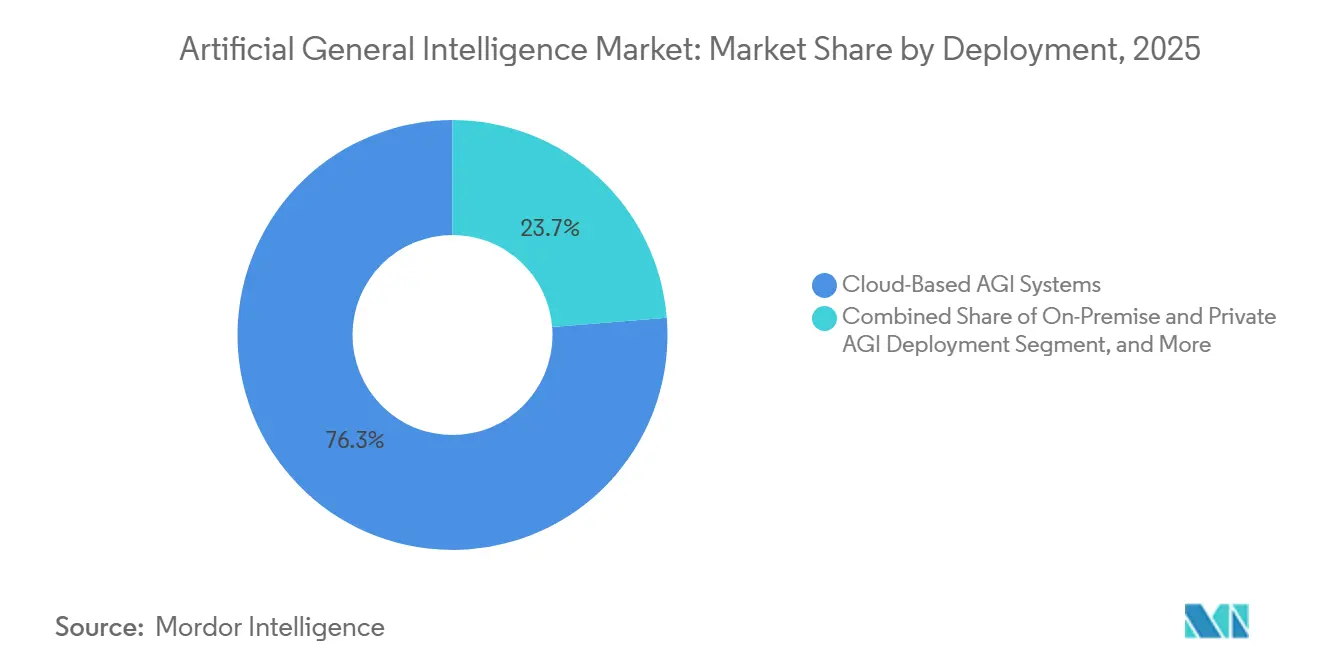
Cloud-based AGI systems are projected to account for 76.27% of the deployment segment in 2025. Cloud delivery provides organizations with access to scalable computing resources without requiring them to build their own inference infrastructure. It also enables teams to launch projects quickly while using managed security, model, monitoring, storage, and network services. These capabilities are valuable when internal AI operations remain limited or must accommodate changing demand. As a result, cloud-based systems serve as the primary entry point for many early deployments.
Hybrid AGI deployments are forecast to expand at a CAGR of 30.54% through 2031. A hybrid approach allows organizations to retain sensitive information in private environments while directing suitable workloads to cloud services. This structure addresses data sovereignty, latency, resilience, and internal control requirements. On-premise and private deployments remain relevant for government, defense, and financial services applications. The Artificial General Intelligence market supports a mix of deployment models rather than a simple transition from private environments to the public cloud.
By End-User Industry: IT Leads as Health Care and Life Sciences Advance
Information technology and telecommunications are projected to account for 31.79% of the end-user segment in 2025. Organizations in these industries adopt advanced AI for software development, network operations, internal support, and customer service. They also serve as delivery partners for clients in other sectors that require implementation support. Their technical capabilities and access to data infrastructure enable earlier implementation than in many other industries. These organizations can test agentic workflows within their own operations before offering similar capabilities to customers.
Health care and life sciences are forecast to expand at a CAGR of 31.09% through 2031. According to NVIDIA's 2026 health care survey, drug discovery and development represent the leading use case for 57% of pharmaceutical and biotechnology organizations. NVIDIA research on agentic AI and laboratory automation highlights the potential for a continuous experimental cycle. Banking, financial services, insurance, manufacturing, government, defense, retail, and e-commerce also present use cases where data management and workflow controls are critical. Across all industries, deployment remains subject to the cost, reliability, and governance conditions surrounding the Artificial General Intelligence market.
Geography Analysis
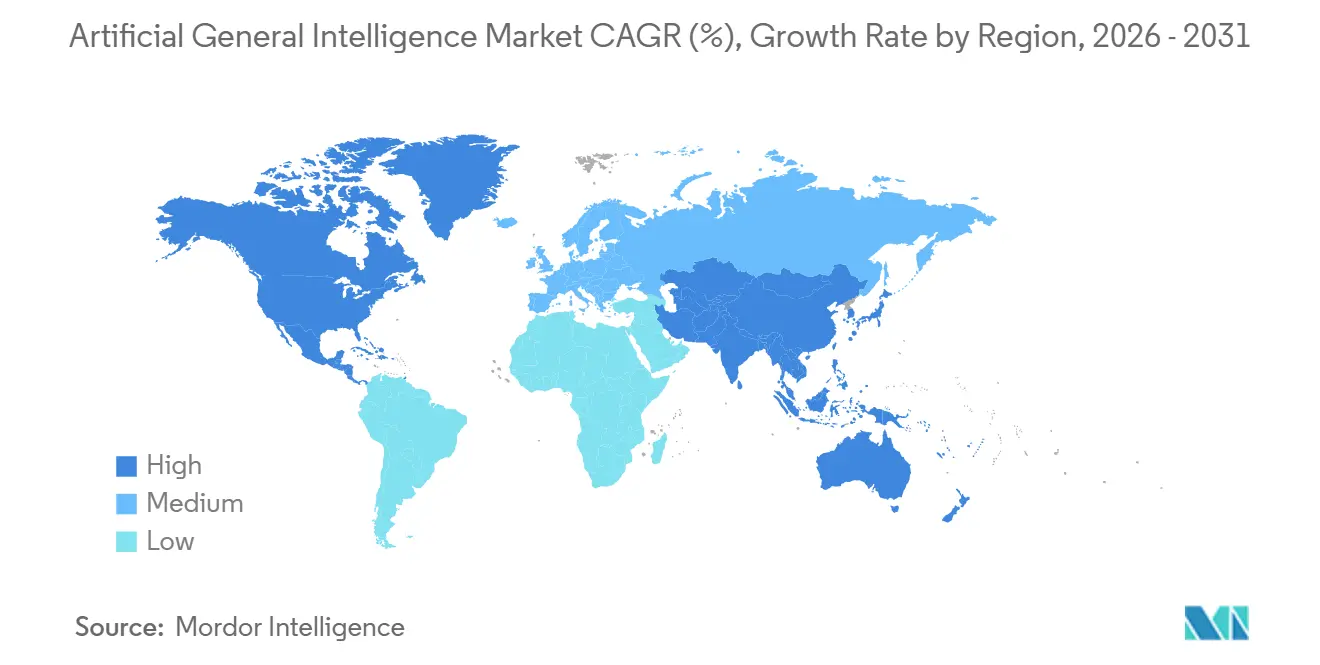
North America is expected to hold a 52.76% share of the artificial general intelligence market in 2025. The region combines frontier model developers, cloud infrastructure, venture capital funding, and enterprise users with strong early-adoption capabilities. Stanford University’s 2026 AI Index is expected to report that U.S. private AI investment will reach USD 285.9 billion in 2025 and that 1,953 newly funded AI companies will be incorporated in the United States during the year. This ecosystem is expected to support rapid testing, commercialization, and infrastructure expansion. North America’s position also reflects the concentration of hyperscaler capital and computing resources.
Asia-Pacific is projected to expand at a CAGR of 31.67% through 2031. China’s digital infrastructure programs, Japan’s investment activity, India’s digital enterprise base, and South Korea’s sovereign computing plans are expected to support this growth. NVIDIA, NAVER, and Brookfield have announced a proposed pathway to develop a 1 GW AI factory in South Korea. This investment could increase the availability of models and services tailored to regional requirements and gradually narrow infrastructure gaps with North American providers.
Europe, South America, the Middle East, and Africa account for the remaining demand in the artificial general intelligence market. SoftBank’s plan to develop 5 GW of AI data center capacity in France indicates growing interest in large-scale regional infrastructure. The Middle East is using AI investments to support broader economic diversification programs. South America and Africa remain at earlier stages of adoption, where accessible cloud services may be more practical than sovereign computing projects.
Competitive Landscape
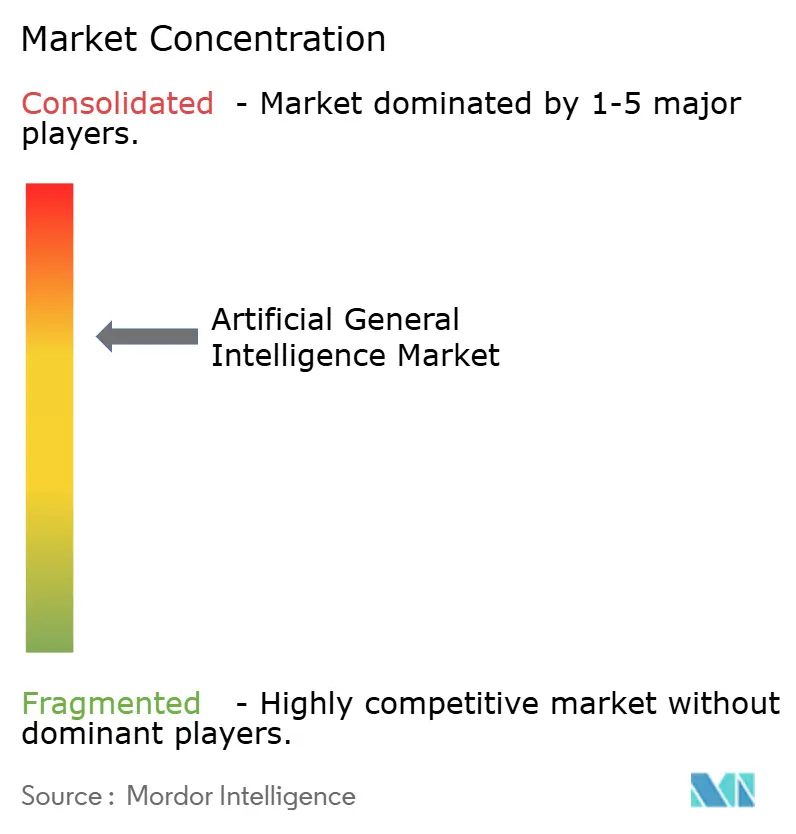
The artificial general intelligence market is concentrated among a limited group of frontier model providers, while platform, application, and services activities remain more dispersed. OpenAI, Google DeepMind, and Anthropic compete in the general-purpose frontier model segment. NVIDIA occupies a distinct position by combining accelerated computing hardware, software, and AI infrastructure offerings. Microsoft, Amazon Web Services, and Google integrate model access into broader cloud service portfolios. Leading companies benefit from substantial capital resources, technical talent, data center access, and established customer channels.
OpenAI is expected to complete a USD 122 billion funding round at a USD 852 billion post-money valuation in March 2026. The company is also expected to launch the Agents API in public beta, providing developers with access to persistent memory, tool use, and multi-step planning capabilities. NVIDIA, NAVER, and Brookfield are advancing a South Korean sovereign AI factory plan that connects model infrastructure with national computing capacity. Microsoft is expected to introduce Maia 200, a purpose-built AI inference accelerator. These developments indicate that companies are competing through funding, infrastructure, developer access, and hardware efficiency.
Specialized providers can address deployment costs, privacy, language, and domain-specific requirements that may not be the primary focus of large general-purpose platforms. Mistral AI, Cohere Inc., DeepSeek, Meta Platforms, and IBM represent different approaches to open-weight models, enterprise deployment, and governance tools. The artificial general intelligence market may favor vendors that integrate effectively with existing enterprise systems and provide clear accountability for model outputs.
Artificial General Intelligence Industry Leaders
-
OpenAI
-
Microsoft Corporation
-
NVIDIA Corporation
-
Amazon Web Services, Inc.
-
Meta Platforms, Inc.
- *Disclaimer: Major Players sorted in no particular order
Recent Industry Developments
- July 2026: NAVER, NVIDIA, and Brookfield announced a proposed expansion of South Korea's sovereign AI factory infrastructure to 200 MW, with a planned long-term path to 1 GW. Brookfield agreed to fund up to USD 9 billion, and NVIDIA plans to invest USD 1 billion into NAVER Corp., in the largest sovereign AI factory buildout announced to date in Northeast Asia.
- July 2026: OpenAI launched the Agents API in public beta, providing developers with versioned access to agent orchestration infrastructure, including persistent memory, tool use, and multi-step planning. The API was built on the open-source Codex harness and provided enterprise developers with a stable interface for deploying autonomous agents without having to rebuild orchestration systems after each model update.
- May 2026: SoftBank Group announced a commitment to invest up to EUR 75 billion (USD 83 billion) to develop 5 GW of AI data center capacity in France's Hauts-de-France region by 2031, representing the largest AI infrastructure commitment in Europe announced by a single entity to date.
- March 2026: OpenAI closed a USD 122 billion funding round at a USD 852 billion post-money valuation, anchored by Amazon (USD 50 billion), NVIDIA (USD 30 billion), and SoftBank (USD 30 billion), alongside Microsoft and additional institutional investors. The round was the largest private financing event in Silicon Valley history at the time of closing.
Global Artificial General Intelligence Market Report Scope
The Artificial General Intelligence Market Report is Segmented by Technology (Foundation Model-Based AGI, Agentic AGI, Multimodal AGI, and Other Technologies), Component (Platforms, and Services), Deployment (Cloud-Based, On-Premise, and Hybrid), End-User (Information Technology and Telecommunications, Banking, Financial Services and Insurance, Healthcare and Life Sciences, Manufacturing and Industrial Automation, Government and Defense, Retail and E-commerce, and Other End-user Industries), and Geography (North America, South America, Europe, Asia-Pacific, the Middle East and Africa). The Market Forecasts are Provided in Value (USD).
| Foundation Model-Based AGI |
| Agentic AGI |
| Multimodal AGI |
| Other Technologies |
| Platforms |
| Services |
| Cloud-Based AGI Systems |
| On-Premise and Private AGI Deployment |
| Hybrid AGI Deployments |
| Information Technology and Telecommunications |
| Banking, Financial Services and Insurance |
| Healthcare and Life Sciences |
| Manufacturing and Industrial Automation |
| Government and Defense |
| Retail and E-commerce |
| Other End-user Industries |
| North America | United States |
| Canada | |
| Mexico | |
| South America | Brazil |
| Argentina | |
| Rest of South America | |
| Europe | United Kingdom |
| Germany | |
| France | |
| Italy | |
| Rest of Europe | |
| Asia-Pacific | China |
| India | |
| Japan | |
| South Korea | |
| Rest of Asia-Pacific | |
| Middle East | Saudi Arabia |
| United Arab Emirates | |
| Israel | |
| Turkey | |
| Rest of Middle East | |
| Africa | South Africa |
| Rest of Africa |
| By Technology | Foundation Model-Based AGI | |
| Agentic AGI | ||
| Multimodal AGI | ||
| Other Technologies | ||
| By Component | Platforms | |
| Services | ||
| By Deployment | Cloud-Based AGI Systems | |
| On-Premise and Private AGI Deployment | ||
| Hybrid AGI Deployments | ||
| By End-User Industry | Information Technology and Telecommunications | |
| Banking, Financial Services and Insurance | ||
| Healthcare and Life Sciences | ||
| Manufacturing and Industrial Automation | ||
| Government and Defense | ||
| Retail and E-commerce | ||
| Other End-user Industries | ||
| By Geography | North America | United States |
| Canada | ||
| Mexico | ||
| South America | Brazil | |
| Argentina | ||
| Rest of South America | ||
| Europe | United Kingdom | |
| Germany | ||
| France | ||
| Italy | ||
| Rest of Europe | ||
| Asia-Pacific | China | |
| India | ||
| Japan | ||
| South Korea | ||
| Rest of Asia-Pacific | ||
| Middle East | Saudi Arabia | |
| United Arab Emirates | ||
| Israel | ||
| Turkey | ||
| Rest of Middle East | ||
| Africa | South Africa | |
| Rest of Africa | ||
Key Questions Answered in the Report
What is the Artificial General Intelligence market size?
The Artificial General Intelligence market was valued at USD 11.40 billion in 2026 and is projected to reach USD 42.52 billion by 2031 at a 30.12% CAGR. The forecast reflects expanding enterprise use of platforms, agents, and managed computing capabilities across enterprise workflows that previously relied on separate tools and manual coordination.
Which technology segment leads Artificial General Intelligence adoption?
Foundation Model-Based AGI led the technology segment in 2025 with 61.23%, while Agentic AGI is projected to expand at a 31.17% CAGR through 2031. Foundation models retain an advantage through their mature tools, established developer ecosystems, and their ability to support varied applications across languages, code, reasoning, and information processing.
Why are hybrid AGI deployments gaining attention?
Hybrid deployments are projected to expand at a 30.54% CAGR because they can separate sensitive processing from general-purpose cloud inference. They allow organizations to manage data sovereignty, latency, resilience, and internal control requirements across different workloads, while retaining access to cloud capacity for less sensitive tasks.
Which end-user sector is expanding fastest for AGI solutions?
Healthcare and Life Sciences are projected to expand at a 31.09% CAGR through 2031, supported by use cases in drug discovery, laboratory automation, and clinical decision support. Health care deployment still requires rigorous reliability testing, clear human oversight, and controls that match the clinical consequences of each use case.
Which region has the largest AGI presence?
North America held 52.76% of global demand in 2025, supported by leading model developers, cloud infrastructure, and early enterprise adoption. Asia-Pacific is projected to record the fastest regional CAGR at 31.67% through 2031, supported by regional infrastructure plans and a widening digital enterprise base.
What limits enterprise implementation of AGI systems?
High compute and energy costs, reliability risks, limited evaluation methods, alignment concerns, and model security exposure can delay wider autonomous deployment. Organizations often begin with controlled workflows before assigning systems broader authority, using staged deployment to confirm performance, security, governance, and operational readiness.