
Argentina Solid Waste Management Market Size and Share
Market Overview
| Study Period | 2020 - 2031 |
|---|---|
| Forecast Data Period | 2026 - 2031 |
| Base Year Market Size (2025) | USD 4.24 Billion |
| Market Size (2026) | USD 4.56 Billion |
| Market Size (2031) | USD 6.62 Billion |
| Growth Rate (2026 - 2031) | 7.75 % |
| Market Concentration | Medium |
Major Players *Disclaimer: Major Players sorted in no particular order Image © Mordor Intelligence. Reuse requires attribution under CC BY 4.0. | |
Argentina Solid Waste Management Market Analysis by Mordor Intelligence
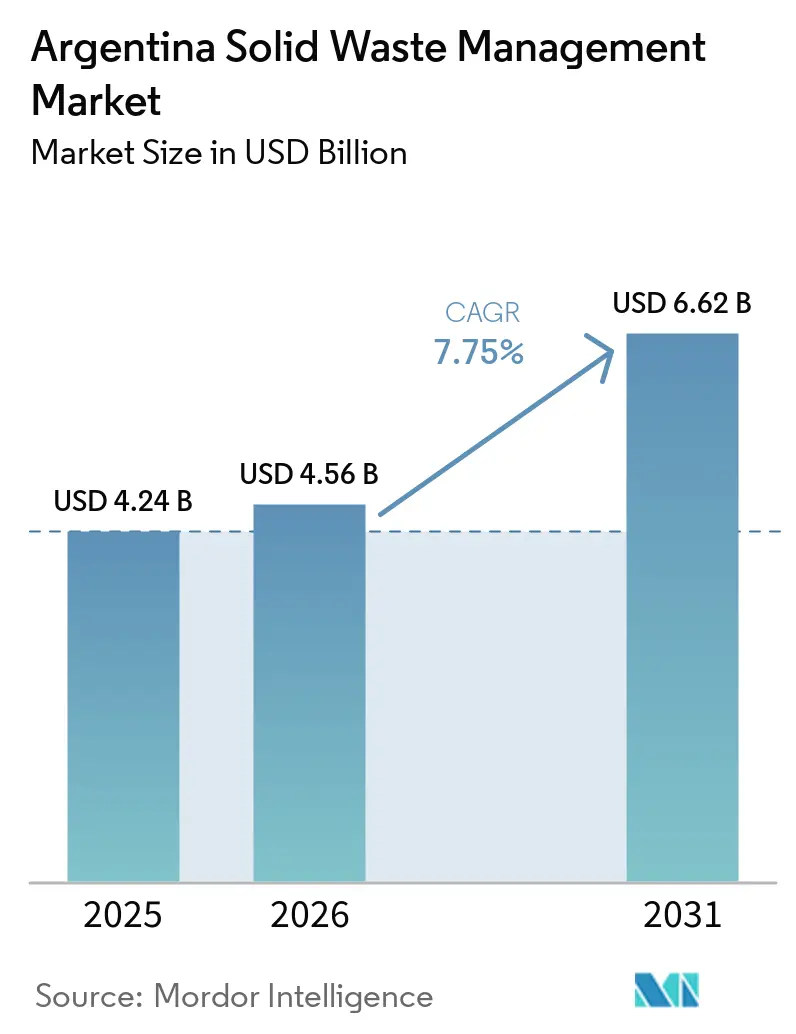
The Argentina Solid Waste Management Market size is projected to be USD 4.24 billion in 2025, USD 4.56 billion in 2026, and reach USD 6.62 billion by 2031, growing at a CAGR of 7.75% from 2026 to 2031.
The Argentina solid waste management market is shaped by rising urban waste volumes, provincial waste rules, and the need to replace open disposal sites with managed systems. Argentina generates 45,000 tons of urban solid waste each day, or nearly 16.5 million tons annually, a volume that continues to exceed licensed collection and treatment capacity. This gap supports demand for collection, transfer, treatment, and recovery services across the Argentina solid waste management market. Fiscal pressure limits municipal capital spending, so operators increasingly need projects that combine service contracts, equipment renewal, and outside financing. The formal sector can also gain work as municipalities bring urban recycler cooperatives into licensed recovery systems and landfill operators use methane projects to support investment.
Key Report Takeaways
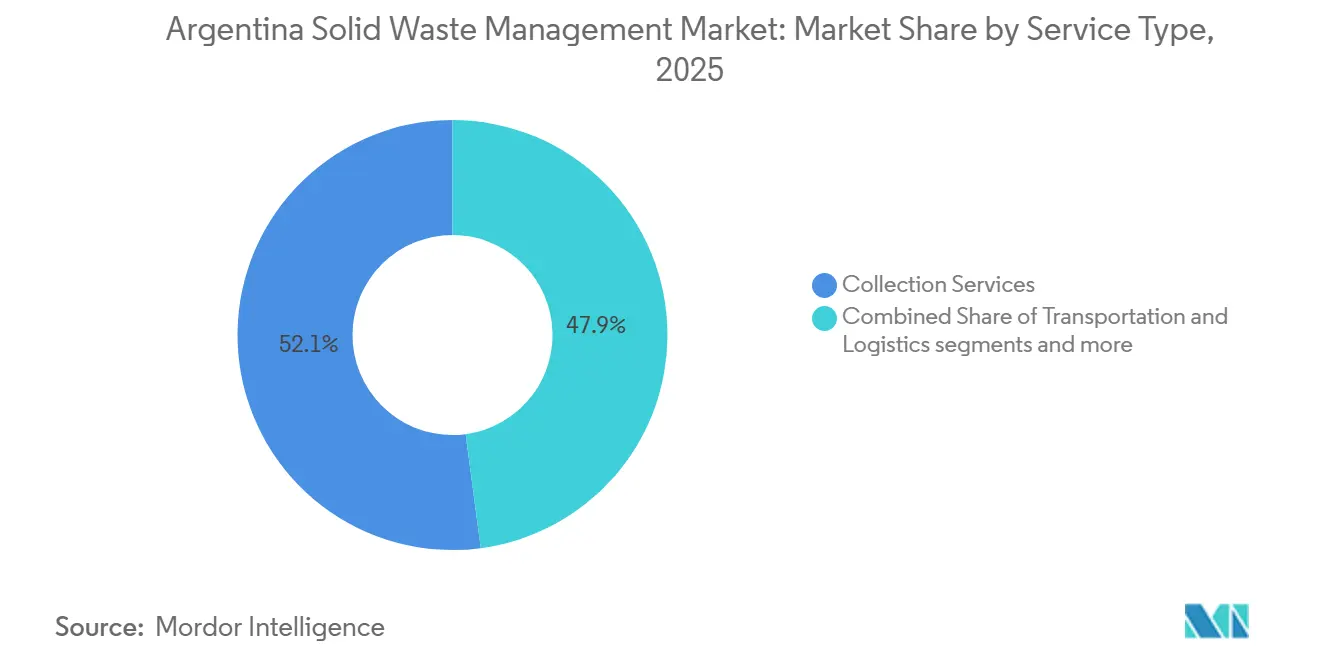
- By service type, collection services held 52.1% of the Argentina solid waste management market share in 2025, while recycling and material recovery is forecast to grow at a 9.8% CAGR through 2031.
- By waste type, municipal solid waste held 62% of the Argentina solid waste management market size in 2025, while hazardous waste is forecast to grow at a 9.2% CAGR through 2031.
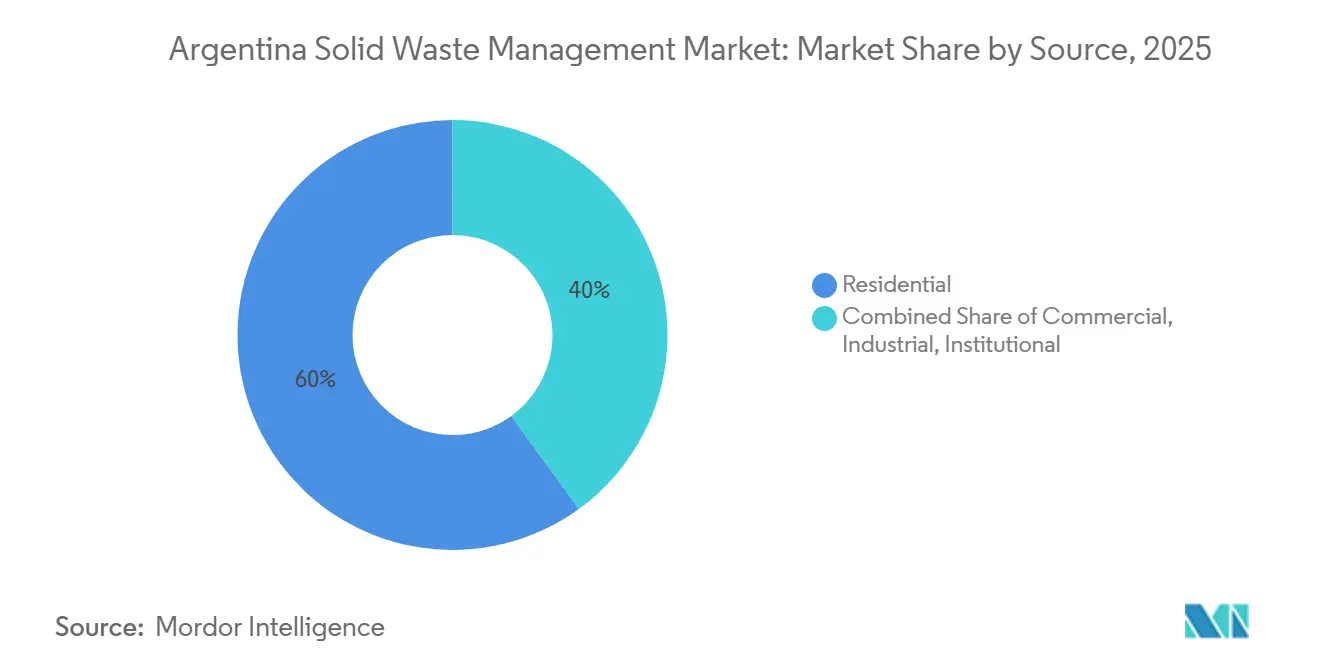
- By source, residential waste held 60% share in 2025, while industrial sources are forecast to grow at a 9.1% CAGR through 2031.
Note: Market size and forecast figures in this report are generated using Mordor Intelligence’s proprietary estimation framework, updated with the latest available data and insights as of January 2026.
Argentina Solid Waste Management Market Trends and Insights
Drivers Impact Analysis*
| Driver | (~) % Impact on CAGR Forecast | Geographic Relevance | Impact Timeline |
|---|---|---|---|
| Expansion of Integrated Urban Environmental Management (GIRSU) Programs Across Provinces | +2.2% | National, with activity in Buenos Aires, Mendoza, Córdoba, and Jujuy | Medium term (2-4 years) |
| Rapid Growth of Municipal Waste Generation in Buenos Aires Metropolitan Region | +1.6% | AMBA and Buenos Aires Province | Short term (≤ 2 years) |
| Increasing Government Investments in Sanitary Landfills Replacing Open Dumps | +1.4% | National, with early activity in Santiago del Estero, Río Negro, Salta, and Santa Cruz | Medium term (2-4 years) |
| Rising Recovery of Recyclables Through Urban Recycler (Cartonero) Integration Programs | +1.0% | Buenos Aires, Córdoba, Rosario, and cooperative networks nationwide | Medium term (2-4 years) |
| Growth in Agro-Industrial Waste Processing and Biomass Valorization | +0.8% | Pampa region, Tucumán, Córdoba, and San Juan | Long term (≥ 4 years) |
| Expansion of Extended Producer Responsibility (EPR) Initiatives for Packaging and Special Waste Streams | +0.6% | National | Medium term (2-4 years) |
| Source: Mordor Intelligence | |||
Expansion of Integrated Urban Environmental Management (GIRSU) Programs Across Provinces
Argentina's Plan GIRSU provides provinces and municipalities with a national framework for integrated urban waste management, supporting environmental complexes, source separation, and the closure of open disposal sites.[1]Ministerio de Ambiente y Desarrollo Sostenible, “Plan GIRSU Gestión Integral de Residuos Sólidos Urbanos,” Argentina.gob.ar, argentina.gob.ar. Mendoza's 2025 regulations under Law 9659 require municipalities to prepare five-year integrated waste management plans across four provincial zones, incorporating measurable performance indicators and formal participation by urban recyclers. Jujuy has similarly expanded coordinated waste governance through its Pachamama Te Cuido program, aligning provincial and municipal waste management strategies around San Salvador de Jujuy. These initiatives encourage municipalities to modernize collection, transfer, and treatment infrastructure while creating more standardized procurement opportunities for private service providers in the Argentina solid waste management market. In parallel, stronger provincial planning requirements are increasing demand for engineering, environmental consulting, fleet modernization, transfer stations, material recovery facilities (MRFs), and landfill rehabilitation projects.[2]Gobierno de Jujuy, “Un Segundo Relleno Sanitario para Garantizar la Disposición Final Adecuada de RSU,” Prensa Jujuy, prensa.jujuy.gob.ar. The emphasis on measurable service performance and regional coordination is also promoting longer-term public-private service contracts, enabling waste management companies to invest in advanced collection systems, sorting technologies, and recycling infrastructure with greater revenue visibility.
Rapid Growth of Municipal Waste Generation in Buenos Aires Metropolitan Region
The Argentina solid waste management market depends heavily on the Buenos Aires Metropolitan Area (AMBA), where waste generation and service demand are significantly higher than in most other provinces. CEAMSE managed approximately 23,000 tonnes of municipal solid waste per day from 45 municipalities and the City of Buenos Aires in 2025, with the Norte III Environmental Complex processing around 85% of the city's waste stream.[3]CEAMSE, “CEAMSE Presentó Avances de Gestión y una Renovada Flota Operativa Junto a Intendentes de la Provincia,” CEAMSE, ceamse.gov.ar. Organic waste accounts for nearly 50% of municipal waste, yet composting and anaerobic digestion infrastructure remains insufficient to process this volume. While CEAMSE operates 23 MW of landfill gas-to-energy capacity and plans to expand it to 33 MW, energy recovery remains concentrated within a limited number of facilities. This geographic concentration places substantial operational pressure on a few large treatment assets, while many secondary municipalities continue to rely on conventional disposal methods with limited recovery infrastructure. The uneven distribution of advanced treatment facilities increases transportation costs, constrains regional investment in recycling and organics processing, and limits the development of decentralized waste management systems. As a result, the market continues to require additional transfer stations, material recovery facilities, organics treatment capacity, and modern landfill infrastructure to improve regional service coverage and reduce dependence on large metropolitan disposal complexes.
Increasing Government Investments in Sanitary Landfills Replacing Open Dumps
Sanitary landfill construction provides operators, equipment suppliers, and engineering providers with a route into the Argentina solid waste management market. Jujuy began work on a second sanitary landfill at its provincial Environmental Center in 2025 with USD 12.4 million in combined financing. The facility is part of the province’s wider plan to improve final disposal. Río Negro also introduced a 2025 proposal that requires municipalities to eliminate open-air dumps within 2 years. These actions create defined deadlines for municipal procurement and site remediation. They also make it more practical to link disposal projects with recovery, methane capture, and fleet investments. The Argentina solid waste management market can therefore benefit when provincial rules translate broad waste targets into projects with timetables.
Rising Recovery of Recyclables Through Urban Recycler (Cartonero) Integration Programs
Urban recycler integration is increasing the volume of recyclables entering formal recovery channels, creating additional opportunities for collection, sorting, and processing for waste management companies. Reciclar S.A. has the capacity to process up to 600 million plastic bottles annually, demonstrating the scale of processing infrastructure that formal collection systems can support. According to the Federación Argentina de Cartoneros, Carreros y Recicladores, cooperative employment declined from 18,000 workers in 2023 to around 10,000 by early 2025, as lower prices for recyclable commodities reduced the economic viability of informal collection. This decline increases the need for municipalities and private waste operators to expand contracted collection and material recovery services to maintain recycling volumes, supporting growth in service revenues within the Argentina solid waste management market. In 2025, the Chamber of Deputies received a bill to establish minimum environmental standards for post-consumer packaging. If enacted, the framework would increase producer participation in financing collection and recovery activities, strengthening demand for contracted recycling, sorting, logistics, and processing services. Municipal integration of cartonero cooperatives can further improve traceability, service quality, and recovery measurement while providing more stable feedstock to recycling facilities, supporting both environmental objectives and the expansion of the formal waste management market.
Restraints Impact Analysis*
| Restraint | (~) % Impact on CAGR Forecast | Geographic Relevance | Impact Timeline |
|---|---|---|---|
| Economic Instability Limiting Public Investment in Modern Waste Infrastructure | -2.0% | National | Short term (≤ 2 years) |
| Heavy Dependence on Open Dumpsites in Smaller Municipalities | -1.4% | Santa Fe, Córdoba, Salta, and smaller municipalities nationwide | Long term (≥ 4 years) |
| Low Source Segregation and Recycling Participation Outside Major Cities | -1.0% | National, excluding Buenos Aires and major urban centers | Medium term (2-4 years) |
| Aging Collection Fleets and Inadequate Transfer Station Infrastructure | -0.6% | Interior provinces and secondary cities | Medium term (2-4 years) |
| Source: Mordor Intelligence | |||
Economic Instability Limiting Public Investment in Modern Waste Infrastructure
Argentina's macroeconomic instability continues to constrain investment in modern solid waste infrastructure, particularly in provinces and municipalities that rely on public budgets to fund collection systems, sanitary landfills, transfer stations, and material recovery facilities (MRFs). High inflation, fiscal constraints, and limited access to long-term financing raise the cost of capital projects and delay fleet renewal and facility upgrades. Although the national government continues to promote integrated waste management through the National Strategy for Integrated Municipal Solid Waste Management (ENGIRSU) and Plan GIRSU, municipalities vary significantly in implementation due to budget limitations and institutional capacity. In September 2025, the federal government is expected to present a balanced 2026 budget proposal focused on fiscal discipline, indicating continued pressure on public capital expenditure despite expectations of economic growth. This fiscal environment may slow investment in advanced waste treatment infrastructure, particularly outside major metropolitan areas.
Heavy Dependence on Open Dumpsites in Smaller Municipalities
The continued reliance on open dumpsites in smaller municipalities remains a major challenge for the Argentina solid waste management market. According to the national government, Argentina still has approximately 5,000 open dumpsites, averaging more than two dumpsites per municipality, many of which serve as the official disposal method for local governments. These sites generally lack engineered liners, leachate treatment, landfill gas collection systems, and environmental monitoring, limiting waste recovery and increasing environmental and public health risks. In a 2025 study conducted in Tucumán Province, researchers identified 40 active open dumps, many of which were located within 5 km of urban centers and near rivers and agricultural land. The study estimated that 35% of municipal solid waste in Argentina is still disposed of in untreated open dumps, highlighting persistent infrastructure gaps despite ongoing national initiatives to close these sites and to develop regional treatment facilities under Plan GIRSU. These conditions continue to restrain recycling, composting, and waste-to-energy investments in secondary cities.
*Our forecasts treat driver/restraint impacts as directional, not additive. The impact forecasts reflect baseline growth, mix effects, and variable interactions.
Segment Analysis
By Service Type: Collection Leads Revenue, While Recovery Grows Fastest
Collection services held 52.1% of the Argentina solid waste management market share in 2025 because cities need frequent and reliable pickup across dense residential areas. Municipalities use contracted operators or in-house services, depending on their fiscal and administrative capacity. Buenos Aires illustrates the concession approach, in which operators serve designated zones and operate under service-level requirements. The Buenos Aires regulator issued penalty resolutions in 2026 for collection operators who did not meet service obligations, underscoring the importance of execution quality.
Recycling and material recovery is forecast to expand at a 9.8% CAGR between 2026 and 2031, the fastest rate among service types. Benito Roggio Ambiental signed a memorandum of understanding with Dow to study recycling technologies for post-consumer flexible plastics. This type of collaboration can improve the value recovered from materials that are difficult to recycle. San Juan’s VERSU project began construction in March 2026 and is designed to process 10 tons of municipal solid waste per day. The project is intended to generate electricity for 1,300 households. Transportation, logistics, treatment, and disposal are likely to grow with the overall waste stream. Recovery services could outpace them where separation programs and packaging rules increase the supply of usable material. Formal processors need a consistent supply of sorted material to support investment in equipment and quality control. The service category, therefore, depends on both collection design and processing capacity. Municipal source-separation programs can reduce contamination before material reaches a sorting facility. Packaging rules could make the connection between collection, sorting, and end markets more predictable. These conditions would improve the commercial basis for recycling projects in cities beyond Buenos Aires.



By Waste Type: Municipal Waste Is Largest, Hazardous Waste Is Fastest Growing
Municipal solid waste accounted for 62% of the total in 2025, making it the largest waste category by volume. Its scale reflects the country’s urban concentration and the central role of household collection. Organic material accounted for 50% of Buenos Aires municipal solid waste, creating a major unmet need for composting and anaerobic digestion. Construction and demolition waste is also under-managed. The Buenos Aires metropolitan area generated 855,564 tons of construction and demolition waste annually, yet only a portion of that material was formally recovered.
Hazardous waste is forecast to expand at a 9.2% CAGR between 2026 and 2031, the fastest rate among waste types. Agro-processing, mining, and pharmaceutical activity create waste streams that require permitted handling and treatment. Veolia Argentina’s Aesa Misiones unit processed 117 tons of pathological waste per month in 2024. Its final autoclave is certified to operate beyond 2030. Agricultural residues also create a larger feedstock base for biogas and related recovery methods. Argentina’s agriculture ministry reported in 2025 that only 5% of the country’s biogas potential from agro-industrial residues is commercially used. This leaves scope for treatment facilities that handle industrial and agricultural residues close to where they are produced. Such facilities can reduce the distance that organic and specialized waste must travel before treatment. They can also provide a local outlet for feedstocks that are unsuitable for conventional municipal collection. The opportunity is strongest where farms, food plants, and livestock operations create regular volumes. These requirements favor operators who can combine waste-handling expertise with local industrial relationships.
By Source: Residential Waste Leads, Industrial Sources Gain Ground
Residential sources accounted for 60% of the share in 2025 because municipal waste systems are primarily designed for household collection. National per capita waste generation averaged 1.15 kg per inhabitant per day. Major cities have established collection routes, although peri-urban and rural areas still show coverage gaps. Buenos Aires has more than 6,000 urban recyclers organized in 12 cooperatives, helping connect household source separation with formal recycling and material recovery. However, limited and inconsistent funding for collection and recycling services, along with weak prices for recyclable commodities, has constrained the expansion of these programs and slowed the integration of recovered materials into formal waste management systems.
Industrial sources are forecast to expand at a 9.1% CAGR between 2026 and 2031, the fastest rate among source categories. Agro-processing, food and beverage manufacturing, and mining each generate conventional and specialized waste that requires permitted services. The agriculture ministry’s 2025 review identifies livestock, poultry, slaughterhouses, and food processing as important sources of biogas feedstock. Industrial parks can use co-located treatment and recovery facilities to reduce transport needs. Commercial and institutional sources provide a steadier volume base in business districts and public facilities. Their demand is more closely tied to economic activity than to the regulatory changes that shape municipal collection.
Geography Analysis
AMBA held the largest share of the Argentina solid waste management market in 2025 because it combines the country’s highest waste density with its most developed formal infrastructure. CEAMSE managed 23,000 tons of waste per day across 45 municipalities and the City of Buenos Aires. Its service area extended over 9,000 km². Norte III handled 85% of the City of Buenos Aires waste stream. CEAMSE operates 23 MW of biogas electricity capacity and expects to reach 33 MW. The region has the widest range of collection, transfer, landfill, and recovery operations, even though the 14% diversion rate indicates a significant treatment need.
Córdoba, Mendoza, Santa Fe, and Salta constitute the next active group in the Argentina solid waste management market. Mendoza’s 2025 regulations require 5-year municipal waste plans in 4 management zones. These plans create clearer procurement needs for collection and treatment providers. Córdoba allocated funds for a regional plant at Porteña to replace open disposal sites in the San Justo department. Santa Fe is pursuing biogas recovery around Rosario, where the provincial government is moving residential waste toward energy recovery. These provinces combine meaningful urban volumes with increasingly formal local rules. Their activity provides operators with opportunities outside AMBA without requiring the same level of capital deployment.
Northern and Patagonian provinces accounted for a smaller part of formal revenue in 2025, but they can grow from a lower base as local infrastructure is built. Jujuy started a second sanitary landfill with USD 12.4 million in financing. Río Negro’s 2025 proposal requires municipalities to end open-air dumping within 2 years. San Juan began construction of VERSU in March 2026 for a facility designed for municipalities with fewer than 100,000 inhabitants. These projects show how smaller service areas can use landfill, recovery, and energy projects that fit their local volumes. Their progress will depend on co-financing, stable operating contracts, and local technical capacity. Smaller municipalities often have fewer staff and less experience with technical procurement. A project that aligns with local waste volumes can reduce the risk of building capacity that goes unused. It can also make phased investment more realistic than a single large facility. Provincial coordination remains important when nearby municipalities can share transfer, treatment, or final-disposal assets. This approach can extend formal services without requiring every locality to develop a complete system independently.
Competitive Landscape
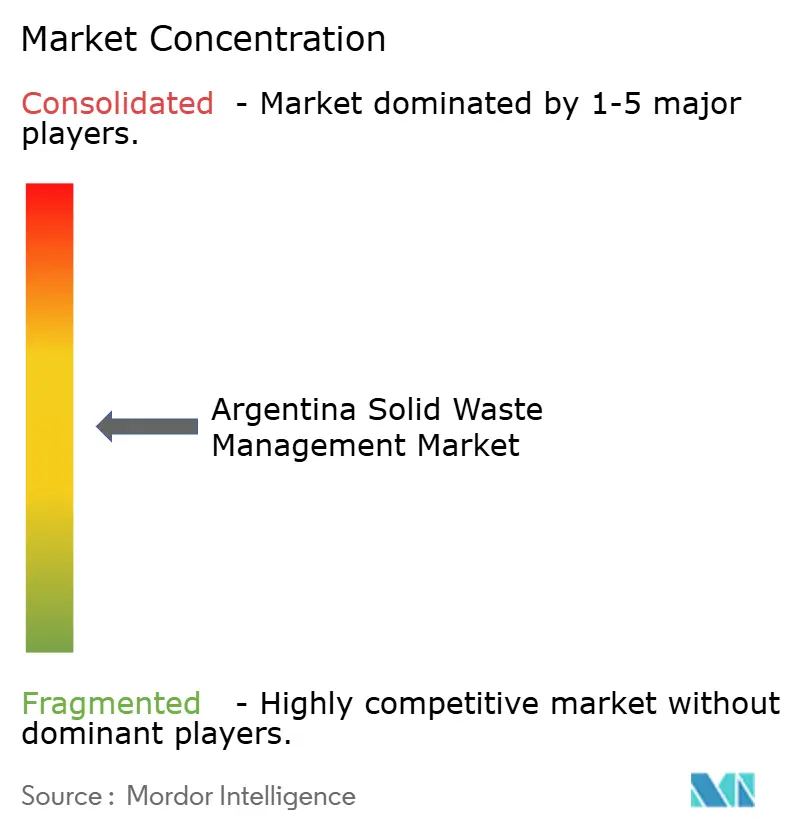
The Argentina solid waste management market exhibits a medium level of market concentration. In Buenos Aires, Cliba, Solbayres, AESA Buenos Aires, Urbaser Argentina, and Transportes Olivos operate major concession areas, while CEAMSE manages inter-municipal transfer and final disposal infrastructure. Service providers compete primarily on operational reliability, fleet efficiency, environmental compliance, and their ability to meet increasingly stringent municipal reporting requirements. Cliba processed more than 750,000 tonnes of waste and treated over 5.1 million tonnes during 2025 while achieving carbon neutrality verification for its Scope 1 and Scope 2 operations in Buenos Aires, demonstrating how environmental performance is becoming an additional differentiator alongside pricing.
Digitalization is increasingly shaping competitive positioning. Buenos Aires deployed 4,500 fill-level sensors through Urbetrack's smart waste platform, achieving 97% service compliance by improving container monitoring, route optimization, and fleet management. Similarly, Quilmes introduced a smart waste pilot using Urbetrack's digital platform for real-time fleet monitoring and route planning. At the treatment level, Veolia Argentina presented its 2026–2036 environmental infrastructure plan for Misiones, including an Environmental Technology Park, biogas-to-energy generation, and thermal treatment facilities, highlighting the growing integration of digital operations with resource recovery and energy generation.
Strategic portfolio activity is also influencing the competitive landscape. Urbaser Argentina entered a separate sale process following Urbaser's global transaction announced in February 2026. The Argentine business generated approximately USD 90 million in EBITDA during 2025 and was valued between EUR 300 million (USD 338.6 million) and EUR 400 million (USD 451.5 million), reflecting the value investors place on long-term municipal concession portfolios. Growth opportunities remain in construction and demolition waste recycling, hazardous waste treatment in interior provinces, agricultural biogas projects, and digital fleet management solutions. In addition, the gradual implementation of extended producer responsibility (EPR) requirements for packaging waste is expected to improve the commercial viability of material recovery activities. As the sector evolves, larger operators are expected to benefit from established concession portfolios, processing infrastructure, financing capacity, and operational expertise, while regional companies are likely to remain competitive in smaller municipalities and specialized waste streams. Future market positioning will increasingly depend on the ability to deliver measurable environmental performance, reliable service quality, and efficient long-term contract execution rather than competing primarily on price.
Argentina Solid Waste Management Industry Leaders
Cliba Ingeniería Ambiental S.A.
CEAMSE
Veolia Argentina S.A.
Urbaser Argentina S.A.
Tecsan Ingeniería Ambiental S.A.
- *Disclaimer: Major Players sorted in no particular order

Recent Industry Developments
- March 2026: San Juan Province commences VERSU waste-to-energy plant construction. Energía Provincial Sociedad del Estado initiated construction work at the VERSU facility in Cañada Honda, in the department of Sarmiento. Designed to process 10 tons of MSW per day and generate electricity for 1,300 households, the project is positioned as a replicable model for interior municipalities.
- February 2025: Platinum Equity retains Urbaser Argentina and initiates a separate sale. Following the USD 6.6 billion global sale of Urbaser to Blackstone and EQT, Platinum Equity retained the Argentine subsidiary, which generated USD 90 million in EBITDA in 2025 and employed 3,500 people.
- November 2025: CEAMSE presents a fleet renewal and management modernization roadmap. CEAMSE presented a new operational fleet and strategic modernization plan to the Province and City of Buenos Aires, as well as 45 municipal mayors. The plan covered infrastructure investment, equipment upgrades, and future planning milestones.


Argentina Solid Waste Management Market Report Scope
The Argentina Solid Waste Management Market is Segmented by Service Type (Collection Services, Transportation & Logistics, Recycling & Material Recovery, Treatment & Disposal, Waste-To-Energy, Others), by Waste Type (Municipal Solid Waste, Industrial Waste, Hazardous Waste, Agricultural Waste, and More), by Source (Residential, Commercial, Industrial, and Institutional). The Market Forecasts are Provided in Terms of Value (USD).
| Collection Services |
| Transportation & Logistics |
| Recycling & Material Recovery |
| Treatment & Disposal |
| Waste-to-Energy |
| Others |
| Municipal Solid Waste |
| Industrial Waste |
| Hazardous Waste |
| Construction & Demolition Waste |
| Agricultural Waste |
| Medical Waste |
| Others |
| Residential |
| Commercial |
| Industrial |
| Institutional |
| By Service Type | Collection Services |
| Transportation & Logistics | |
| Recycling & Material Recovery | |
| Treatment & Disposal | |
| Waste-to-Energy | |
| Others | |
| By Waste Type | Municipal Solid Waste |
| Industrial Waste | |
| Hazardous Waste | |
| Construction & Demolition Waste | |
| Agricultural Waste | |
| Medical Waste | |
| Others | |
| By Source | Residential |
| Commercial | |
| Industrial | |
| Institutional |


Key Questions Answered in the Report
What is the forecast for Argentina's solid waste management services?
The sector stood at USD 4.24 billion in 2025 and is forecast to reach USD 6.62 billion by 2031, at a 7.75% CAGR from 2026 to 2031.
Which service category leads waste management revenue in Argentina?
Collection services led revenue in 2025 because urban areas require frequent municipal waste pickup and route coverage.
Which waste stream has the strongest growth outlook?
Hazardous waste treatment is expected to grow fastest, driven by industrial, agro-industrial, mining, and medical waste-handling requirements.
Why is Buenos Aires important to waste management providers?
CEAMSE managed 23,000 tons per day across 45 municipalities and the City of Buenos Aires in 2025, making AMBA the country’s main formal service area.
What limits the expansion of formal waste services in Argentina?
Fiscal limits, more than 5,000 open-air dumpsites, low separation outside major cities, and aging fleets slow the move toward formal collection and treatment.
What opportunities are emerging for waste operators?
Material recovery, landfill-gas projects, hazardous waste treatment, agricultural biogas, and digital fleet management offer areas for service expansion.
Page last updated on:


 Your data is secure and never sold or shared.


