
Argentina Electric Truck Market Size and Share
Market Overview
| Study Period | 2020 - 2032 |
|---|---|
| Forecast Data Period | 2027 - 2032 |
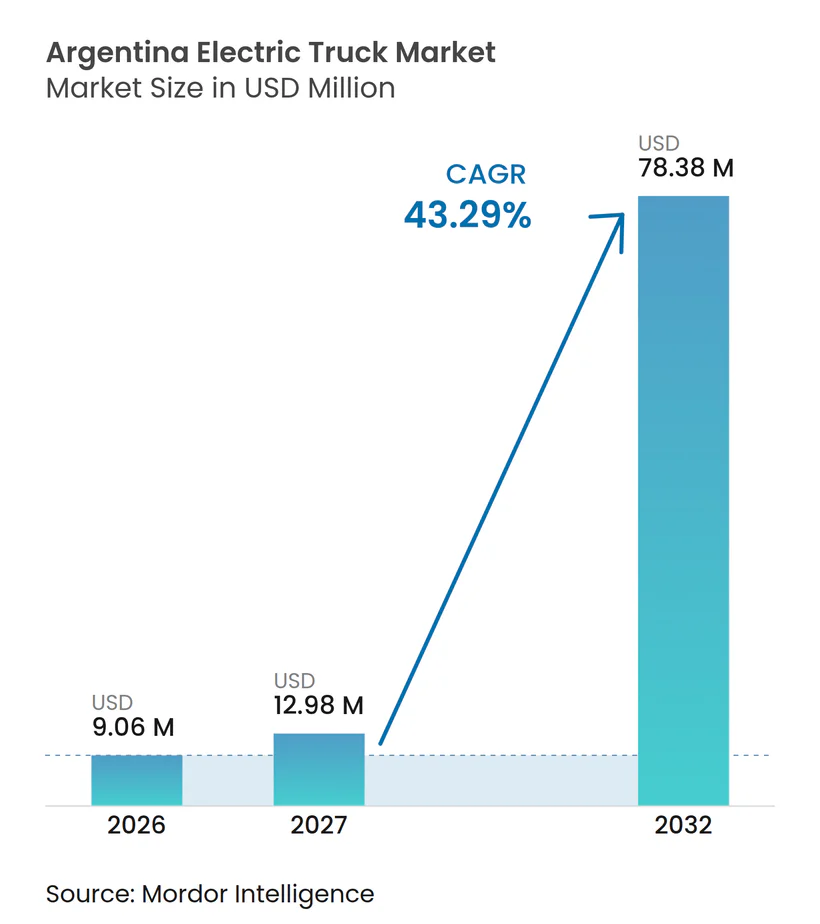
| Base Year Market Size (2026) | USD 9.06 Million |
| Market Size (2027) | USD 12.98 Million |
| Market Size (2032) | USD 78.38 Million |
| Growth Rate (2027 - 2032) | 43.29 % |
| Market Concentration | Low |
Major Players *Disclaimer: Major Players sorted in no particular order Image © Mordor Intelligence. Reuse requires attribution under CC BY 4.0. | |
Argentina Electric Truck Market Analysis by Mordor Intelligence
The Argentina electric truck market size was valued at USD 9.06 million in 2026 and is expected to grow from USD 12.98 million in 2027 to USD 78.38 million by 2032, at a CAGR of 43.29% during 2027-2032. Import-duty relief for alternative-propulsion vehicles under Decreto 49/2025 is limited to vehicles valued at up to USD 16,000 FOB, so electric trucks still face standard import costs. Demand is emerging across urban logistics, mining, construction, and industrial freight, where operating patterns vary considerably by route length and vehicle weight. The Argentina electric truck market is developing through fleet pilots, import activity, and compliance requirements rather than through a single nationwide purchase mandate. The policy framework recognizes both electric and hybrid truck configurations while continuing to accommodate gas-powered bitrenes, indicating a multi-energy transition in commercial transport. This environment allows suppliers to serve urban fleets first while preparing heavier platforms for captive industrial operations.
Key Report Takeaways
- By vehicle type, light-duty electric trucks held a 56.19% share of the Argentina electric truck market in 2026, while heavy-duty electric trucks are projected to grow at a 45.23% CAGR through 2032.
- By propulsion, battery electric vehicles held a 78.21% share of the Argentina electric truck market in 2026, while plug-in hybrid electric vehicles are projected to grow at a 44.10% CAGR through 2032.
- By gross vehicle weight class, units up to 3.5 tons held a 56.39% share of the Argentina electric truck market in 2026, while units above 12 tons are projected to grow at a 45.21% CAGR through 2032.
- By range, short-range electric trucks held a 64.17% share of the Argentina electric truck market in 2026, while long-range electric trucks are projected to grow at a 45.64% CAGR through 2032.
- By battery capacity, packs below 100 kWh held a 42.87% share of the Argentina electric truck market in 2026, while packs above 300 kWh are projected to grow at a 48.29% CAGR through 2032.
- By application, urban and last-mile distribution held a 47.43% share of the Argentina electric truck market in 2026, while mining and industrial haulage are projected to grow at a 44.42% CAGR through 2032.
Note: Market numbers in this report are based on Mordor Intelligence's proprietary estimation framework, which combines nine months of actuals with Q4 projections for base year 2026.
Market Trends and Insights
Drivers Impact Analysis of Argentina Electric Truck Market*
| Driver | (~) % Impact on CAGR Forecast | Geographic Relevance | Impact Timeline |
|---|---|---|---|
| Electrification of Mining and Industrial Fleets | +7.4% | Mendoza, San Juan, Jujuy, and Santa Cruz | Long term (≥ 4 years) |
| E-Commerce and Urban Last-Mile Delivery Growth | +6.1% | Buenos Aires, Rosario, Córdoba, and Mendoza | Short term (≤ 2 years) |
| Declining Battery-Pack Costs and Improving Total Cost of Ownership | +5.8% | Global, with early relevance in Buenos Aires, Córdoba, and Mendoza | Medium term (2–4 years) |
| Zero-Emission Fleet Procurement and Emissions Compliance | +5.2% | Buenos Aires Metropolitan Area, Rosario, and Córdoba | Short term (≤ 2 years) |
| Corporate Fleet-Decarbonization Commitments | +3.9% | National, with early activity in Buenos Aires, Mendoza, and San Juan | Medium term (2–4 years) |
| Battery-Electric Rigid-Truck Pilots in Urban Emission Zones | +3.6% | Buenos Aires Metropolitan Area and Córdoba | Short term (≤ 2 years) |
| Source: Mordor Intelligence | |||
E-Commerce and Urban Last-Mile Delivery Growth
Urban delivery represents the most accessible initial application for electric truck deployment, as vehicles typically return to a depot after each operating shift. Urban and last-mile distribution accounts for the largest application share in the market. In Argentina, Andreani, Edenor, and Coca-Cola are among the users of electric trucks. Short daily routes align with the operating range of current light-commercial battery-electric vehicle platforms without requiring en route charging. This allows fleet managers to compare electricity, diesel, maintenance, payload, and vehicle availability within a defined operational setting. It also explains why the Argentina electric truck market has developed first around Buenos Aires, Córdoba, Rosario, and Mendoza rather than along long intercity corridors.
Declining Battery-Pack Costs and Improving Total Cost of Ownership
Battery cost changes support the commercial case for electric trucks when fleets operate predictable return-to-base routes. Urban vehicles can avoid much of the range uncertainty that affects long-distance freight operations. The Argentina electric truck market benefits most where lower fuel use and reduced drivetrain maintenance can be assessed over a vehicle's full operating life. Foton launched the e-Aumark in Argentina in 2023 with CATL LFP batteries, 200 to 250 km of urban range, and about 3,575 kg of payload capacity, providing an example of a platform designed for that use case. Local lithium resources in Salta, Jujuy, and Catamarca remain relevant to longer-term supply discussions, although Argentina does not yet have commercial-scale battery-pack production for trucks. Fleet decisions still depend on financing terms, utilization levels, and the ability to install reliable depot charging.
Zero-Emission Fleet Procurement and Emissions Compliance
Resolución 289/2024 of the Energy Secretariat created the Programa de Movilidad Sustentable, which finances electric bicycles, electric motorcycles, and natural gas conversion equipment but does not fund heavy-truck charging [1]. Decreto 49/2025 set a 0% extrazone import duty for hybrid, electric, and fuel-cell vehicles for five years, within an annual quota of 50,000 units, for vehicles with a FOB value of up to USD 16,000. Because of this price cap, the measure mainly benefits passenger cars and the lightest commercial vehicles rather than electric trucks. This matters because early commercial vehicle supply is likely to depend on imported models. Freight companies serving multinational customers may also face pressure to document and reduce logistics emissions. The Argentina electric truck market can gain from this procurement pressure even where domestic rules do not require immediate fleet replacement. Vehicle homologation alignment with regional standards could further favor suppliers that prepare documentation and service support before sales volumes rise.
Corporate Fleet-Decarbonization Commitments
Multinational supply chains can transfer emissions-reporting expectations to local freight providers and industrial contractors. Holcim Argentina invested more than USD 300,000 in an electric quarry truck and related charging infrastructure at its Capdeville plant in Mendoza. The project was presented as part of the company's broader decarbonization agenda, not as a simple replacement purchase[2]. Automakers became eligible for the RIGI investment regime in August 2024 for projects involving new powertrain technologies, opening a possible route for large investment in alternative-powertrain platforms. This route is separate from the import-duty measure and could influence where manufacturers place future assembly activity. The Argentina electric truck market may therefore shift gradually from a primarily import-led model toward local production if projects obtain approval and reach execution.
Restraints Impact Analysis of Argentina Electric Truck Market*
| Restraint | (~) % Impact on CAGR Forecast | Geographic Relevance | Impact Timeline |
|---|---|---|---|
| High Upfront Vehicle Cost Versus Diesel Trucks | -5.0% | National | Medium term (2–4 years) |
| Limited Heavy-Duty Charging Infrastructure and Grid Capacity | -4.5% | Intercity routes, mining corridors, and Patagonian routes | Medium term (2–4 years) |
| Payload and Range Penalties from Large Battery Packs | -3.2% | Buenos Aires–Córdoba and Buenos Aires–Mendoza corridors | Long term (≥ 4 years) |
| Limited Residual-Value Data and High-Voltage Service Capability | -2.3% | National, with greater relevance in rural and interior provinces | Medium term (2–4 years) |
| Source: Mordor Intelligence | |||
High Upfront Vehicle Cost Versus Diesel Trucks
The high purchase price of electric trucks remains a significant barrier for fleets that depend on conventional financing. High annual financing rates can raise monthly payments. Heavy-duty electric vehicles can cost substantially more than comparable diesel units. Operators must therefore place greater emphasis on fuel savings, lower maintenance costs, high utilization rates, and extended ownership periods. Peso volatility can create additional uncertainty when vehicles are priced in USD. Because the duty-free quota under Decreto 49/2025 excludes vehicles above USD 16,000 FOB, imported electric trucks do not benefit from it.
Limited Heavy-Duty Charging Infrastructure and Grid Capacity
Heavy electric trucks require higher-power charging equipment than the infrastructure typically used by passenger vehicles and light commercial vehicles. A significant gap exists on intercity freight routes and in Patagonian mining corridors. This limitation is particularly relevant for vehicles with large battery packs. No national program currently funds heavy-truck charging corridors, and a national heavy-truck charging network is not yet operational. Grid reliability, station spacing, and utility investment timing remain key considerations for operators that cannot rely on depot charging. In the near term, these constraints are directing demand toward urban fleets and captive industrial sites, where electricity supply can be managed more directly.
*Our forecasts treat driver/restraint impacts as directional, not additive. The impact forecasts reflect baseline growth, mix effects, and variable interactions.
Argentina Electric Truck Market Segment Analysis
By Vehicle Type:
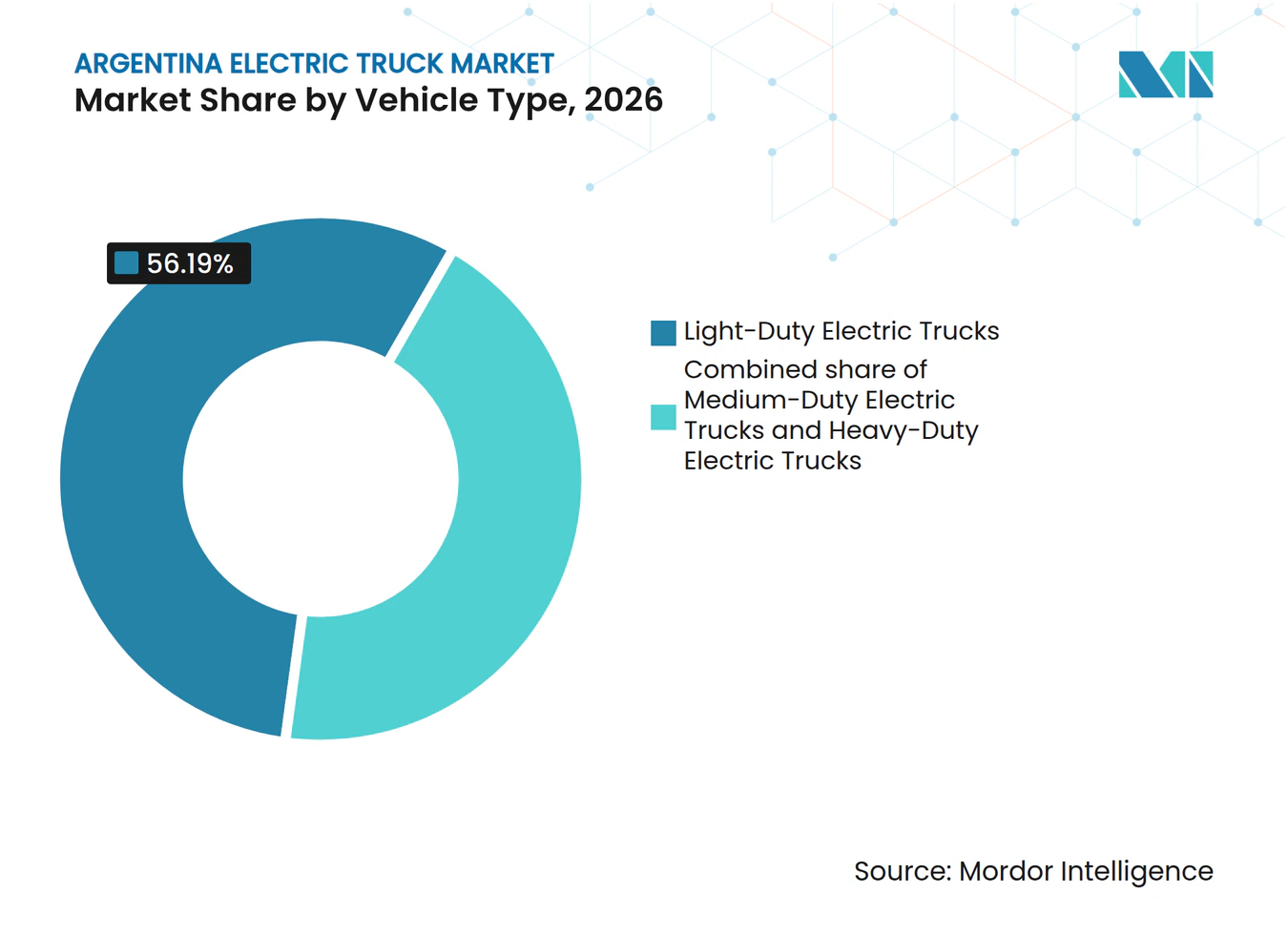
Light-Duty Units Lead as Heavy-Duty AcceleratesLight-duty electric trucks accounted for 56.19% of the Argentina electric truck market in 2026, making them the largest vehicle-type segment. Their lead reflects short urban routes, repeatable daily schedules, and return-to-base charging arrangements. These conditions limit the operational impact of battery weight and range constraints. Light-duty platforms are suited to last-mile delivery, municipal work, and urban logistics operations. Medium-duty trucks serve regional distribution and construction supply chains, although they have not displaced light-duty vehicles as the principal entry point. The Argentina electric truck market has a practical near-term base in these lighter platforms because existing duty cycles are easier to manage.
Heavy-duty electric trucks are forecast to grow at a 45.23% CAGR through 2032, the fastest rate among vehicle types. Progress in this segment is tied to mining pilots and other captive operations where vehicles return to a designated charging location. Foton's electric range in Argentina still centers on the e-Aumark light truck, while its Auman R heavy trucks remain diesel-powered. Decreto 689/2026 incorporated electric and hybrid configurations into updated regulations on truck weights and dimensions, providing a clearer administrative framework for heavy electric truck configurations. This supports additional model introductions, although charging availability and fleet financing will continue to govern the pace of adoption.



By Propulsion:
BEV Dominates While FCEV Positions for a Long-Horizon ShiftBattery electric vehicles accounted for 78.21% of the Argentina electric truck market in 2026. This position reflects the greater availability of BEV technology and the lack of a developed hydrogen refueling network for commercial heavy vehicles. BEV platforms are especially suitable for predictable urban and captive industrial operations. Plug-in hybrid vehicles offer a transitional option for routes that combine urban and regional driving. Their role is growing because battery capacity and charging access remain limited on longer routes. The Argentina electric truck market currently relies on BEV models because their energy supply requirements can be handled at fleet depots.
Plug-in hybrid electric vehicles are projected to grow at a 44.10% CAGR through 2032, the fastest rate among propulsion types, while fuel-cell electric vehicles are expanding from a very small base. FCEV potential is linked to long-haul and mining use cases, where battery-only range can be restrictive. Future FCEV interest draws on Argentina's hydrogen plans, Vaca Muerta gas resources, and Patagonian wind resources. However, Argentina does not yet have a public hydrogen refueling network for commercial fleets. Early use would therefore be more likely in industrial fleets with a defined fuel supply. This places FCEVs in a longer-horizon position while BEVs remain the principal commercial option.
By Range:
Short-Range Platforms Dominate, Long-Range Viability ExpandsShort-range electric trucks accounted for 64.17% of the Argentina electric truck market in 2026. This category is supported by urban operations where daily routes generally fit within a planned charging cycle. The Foton e-Aumark offers 200 to 250 km of urban range, which suits depot-based delivery work. Such specifications can support delivery work without mid-route charging when fleets use a managed depot. Medium-range platforms address operators that need more flexibility for peri-urban and regional distribution. Their adoption depends on whether the added battery cost produces a clear operational benefit.
Long-range electric trucks are forecast to grow at a 45.64% CAGR through 2032. That growth depends on improved battery energy density and possible high-power charging along national freight corridors. Decreto 689/2026 permits updated configurations for electric and hybrid vehicles within revised dimension rules. Those rules reduce one form of regulatory friction, but they do not remove charging or grid constraints. Long-range models will need dependable corridor charging and clear homologation processes. Fleet purchasing decisions will consequently remain closely tied to the timing of infrastructure development.
By Battery Capacity:
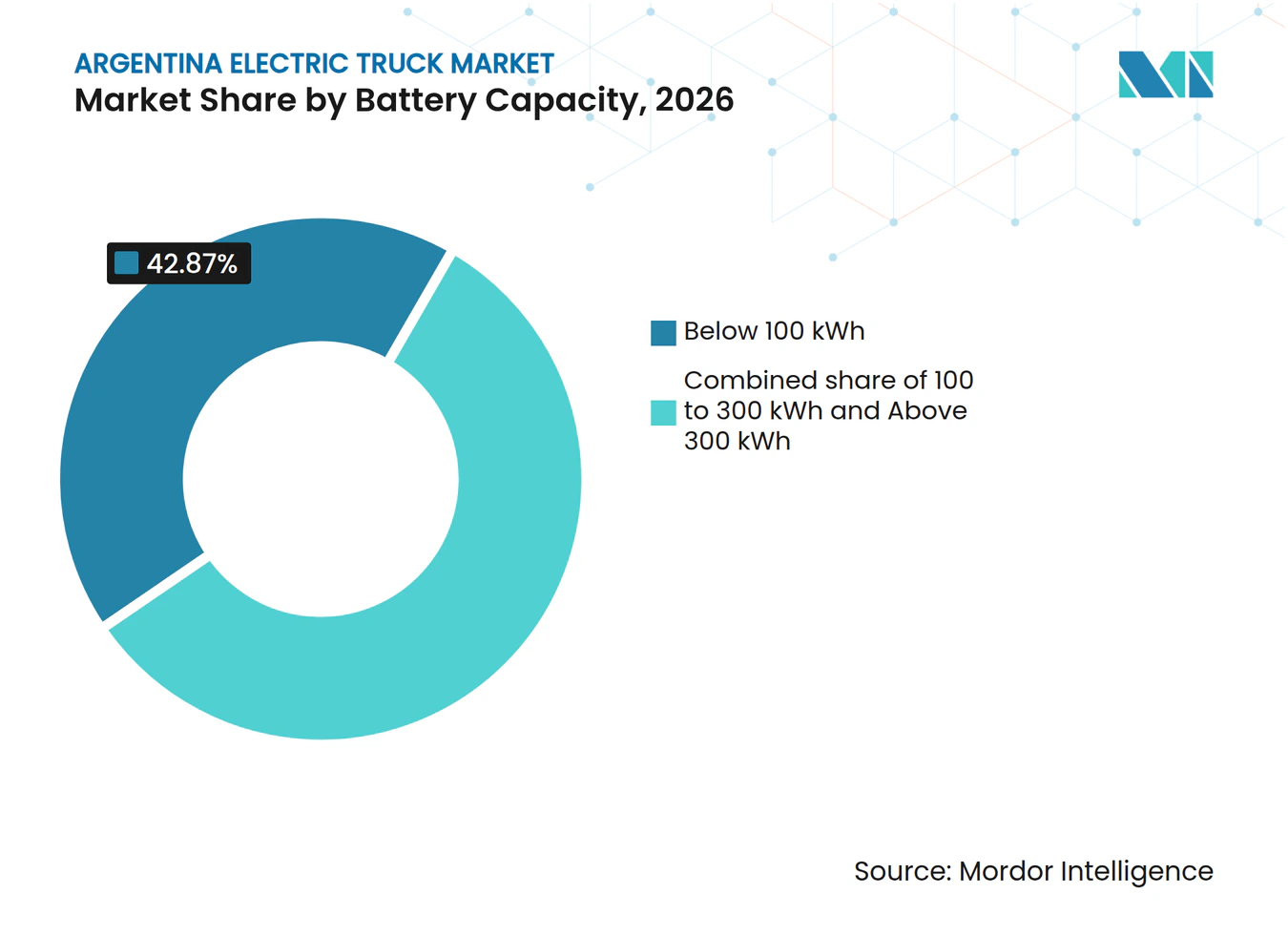
Small Packs Lead but High-Capacity Momentum BuildsBattery packs below 100 kWh accounted for 42.87% of the Argentina electric truck market in 2026. This result is consistent with the light-duty urban vehicles that dominate early deployments. Smaller packs reduce vehicle weight and can be recharged during scheduled depot downtime. Packs from 100 kWh to 300 kWh serve extended-range light-duty and medium-duty applications. Their appeal increases when operators need additional route flexibility but cannot justify the costs of heavy-duty vehicles. The segment structure shows that present demand is weighted toward practical urban operating conditions.
Packs above 300 kWh are forecast to grow at a 48.29% CAGR through 2032. These systems are relevant for heavy mining vehicles, industrial haulage, and possible long-haul operations. Heavy platforms of this class typically need high-power DC charging to fit operating shifts. High-capacity systems require equipment that can reliably deliver greater power. They also increase the importance of payload management, service training, and grid planning. The Argentina electric truck market will depend on these capabilities if heavy-duty demand is to develop beyond controlled pilot sites.

By Application:
Last-Mile Commands Volume as Mining Leads Value Per UnitUrban and last-mile distribution held a 47.43% share of the Argentina electric truck market in 2026. This leading application benefits from metropolitan route density and the availability of light and medium-duty BEV platforms. Vehicles can follow predictable schedules and return to a central location for charging. Regional distribution, construction and municipal services, and long-haul freight represent smaller application areas. Each requires a different balance of range, payload, charging access, and vehicle cost. Last-mile activity should continue to provide the principal volume base for the Argentina electric truck market.
Mining and industrial haulage are forecast to grow at a 44.42% CAGR through 2032. These applications have fewer vehicles than last-mile delivery, but the trucks are specialized and have higher value per unit. Holcim's Capdeville deployment demonstrates that electric quarry equipment can operate within a captive industrial setting. The company expects the project to avoid more than 225 metric tons of CO2 annually. This application favors suppliers that can provide heavy vehicle support, charging equipment, and dependable site service. It also separates high-value industrial demand from the larger volume opportunity in urban delivery.
Geography Analysis
The Buenos Aires Metropolitan Area is the primary early-adoption region for the Argentina electric truck market due to its high concentration of urban freight routes and logistics operators. Its route density and shorter distances are well-suited to light- and medium-duty battery-electric vehicle (BEV) operations. Depot-based charging is more practical where fleets operate from centralized facilities. Córdoba and Rosario serve as secondary urban centers with similar operational characteristics. The Buenos Aires–Córdoba corridor has also been identified as an early axis of commercial electric-vehicle activity.
Mendoza plays a strategic role in heavy electric truck testing due to its mining and industrial activity. Holcim deployed an electric quarry truck at its Capdeville plant in Mendoza, providing a documented heavy-duty operating case. The project utilizes site conditions that support regenerative braking and controlled charging operations. Patagonia, including Santa Cruz, Neuquén, and Río Negro, presents substantial heavy-freight potential linked to energy and mining activity. However, its charging and grid requirements are more demanding than those in urban-concentrated areas. The electric truck market size in these regions will depend on the pace of deployment of suitable charging infrastructure.
Jujuy, Salta, and Catamarca present a longer-term opportunity due to their ties to lithium mining and related industrial activity. Their freight requirements can generate demand for electric mining trucks, and their resource base is relevant to future battery supply considerations. Electrification in these provinces remains in its early stages. Santa Fe and Entre Ríos have a distinct profile, with agricultural and regional distribution routes extending 200-350 km per day. These distances approach the current operating limits of short-range BEV platforms. Updated vehicle regulations under Decreto 689/2026 may ease configuration approvals, though the transition of these routes remains dependent on improvements in range and charging infrastructure.
Competitive Landscape
Market Concentration
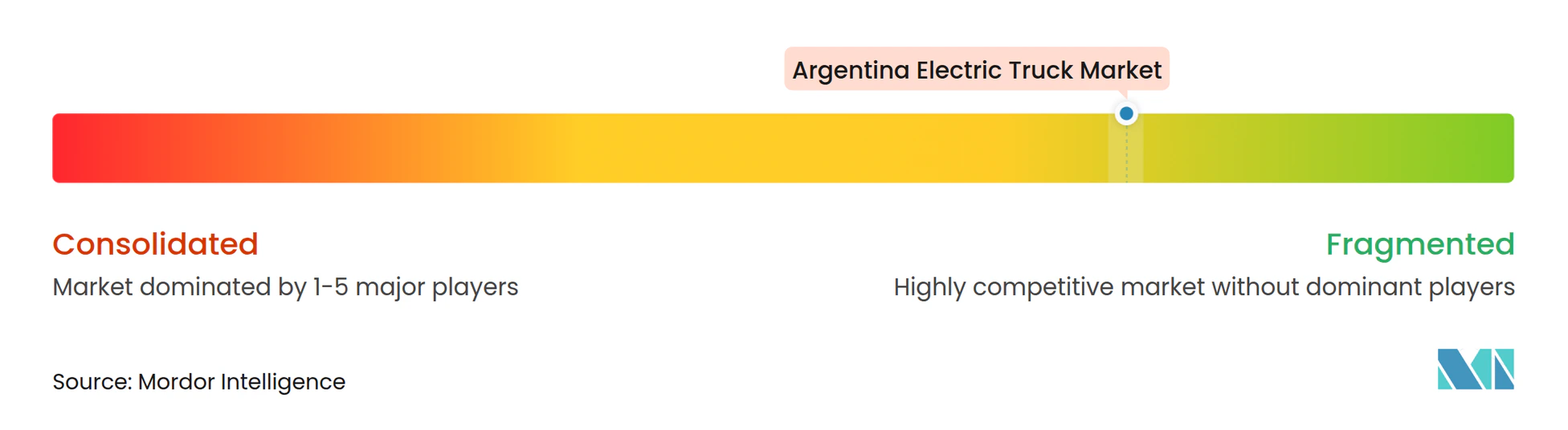
The Argentina electric truck market is fragmented and in its early stages of development. Chinese manufacturers, including BYD, Foton, Dongfeng, and XCMG, are among the early entrants. European suppliers include Daimler Truck, Volvo Group, Scania, MAN Truck and Bus, and Iveco. Competition currently depends on product availability, financing, service coverage, homologation, and fleet operating preferences.
Foton promotes its Blueline electric range, including the e-Aumark light truck, at Argentine logistics events. Holcim's continued use of an electric quarry truck at Capdeville provides XGMT equipment with a documented industrial reference in Argentina. Decreto 49/2025 offers a 0% extrazone duty only for vehicles valued at up to USD 16,000 FOB, so truck suppliers cannot rely on it to lower landed costs. Suppliers with charging partners and trained service teams may be better positioned to convert pilots into fleet orders.
Local assembly represents a potential competitive opportunity, as RIGI offers a framework for large investment projects in alternative-powertrain manufacturing. Prestige Auto, which now operates Mercedes-Benz's van plant in Virrey del Pino, has said that electric models could be produced locally in the future, although no electric van or truck project has been confirmed. Any such plan should therefore be treated as prospective rather than confirmed production capacity. Established suppliers can draw on existing certification and service relationships when preparing electric product launches. New entrants must demonstrate that they can meet vehicle homologation, battery support, and high-voltage maintenance requirements. The Argentina electric truck market is likely to remain diverse as fleet buyers compare imported offerings with potential locally assembled vehicles.
Argentina Electric Truck Industry Leaders
-
Daimler Truck Holding AG
-
Volvo Group
-
BYD Company Limited
-
Scania AB
-
Foton Motor Group Co., Ltd.
- *Disclaimer: Major Players sorted in no particular order
Argentina Electric Truck Market Companies Covered in this Report
- BYD Company Limited
- Daimler Truck Holding AG
- Volvo Group
- Scania AB
- PACCAR Inc.
- Foton Motor Group Co., Ltd.
- FAW Group Co., Ltd.
- Dongfeng Motor Corporation
- Renault Trucks
- Iveco Group N.V.
- Volkswagen Truck and Bus
- MAN Truck and Bus SE
- Ford Motor Company
- XCMG Group
- JAC Motors
- Hino Motors, Ltd.
- Isuzu Motors Limited
- Hyundai Motor Company
Recent Industry Developments in Argentina Electric Truck Market
- October 2026: Foton launched the eView Connect fully electric van in Argentina, expanding its Blueline zero-emission commercial vehicle range.
- September 2026: Foton exhibited its e-Aumark electric light truck at Management Logístico 2026 in Buenos Aires as part of its Blueline zero-emission range.
- July 2026: Decreto 689/2026 updated Argentina's truck weight and dimension rules, allowing electric and hybrid trucks the same extended length limits as dedicated alternative-fuel units.
- July 2026: Volkswagen Truck and Bus marked five years of e-Delivery electric truck operations in Latin America, offering 11- and 14-ton versions with up to 250 km of range.
Argentina Electric Truck Market Report Scope
The Argentina Electric Truck Market Report is Segmented by Vehicle Type (Light-Duty Electric Trucks, Medium-Duty Electric Trucks, and Heavy-Duty Electric Trucks), Propulsion (Battery Electric Vehicle, Plug-In Hybrid Electric Vehicle, and Fuel-Cell Electric Vehicle), Gross Vehicle Weight Class (Up to 3.5 Tons, Above 3.5 to 12 Tons, and Above 12 Tons), Range (Short Range, Medium Range, and Long Range), Battery Capacity (Below 100 kWh, 100 to 300 kWh, and Above 300 kWh), and Application (Urban and Last-Mile Distribution, Regional Distribution, Long-Haul Freight, Construction and Municipal Services, and Mining and Industrial Haulage). The Market Forecasts are Provided in Terms of Value (USD) and Volume (Units).
Segmentation Overview
| Light-Duty Electric Trucks |
| Medium-Duty Electric Trucks |
| Heavy-Duty Electric Trucks |
| Battery Electric Vehicle |
| Plug-In Hybrid Electric Vehicle |
| Fuel-Cell Electric Vehicle |
| Up to 3.5 Tons |
| Above 3.5 to 12 Tons |
| Above 12 Tons |
| Short Range |
| Medium Range |
| Long Range |
| Below 100 kWh |
| 100 to 300 kWh |
| Above 300 kWh |
| Urban and Last-Mile Distribution |
| Regional Distribution |
| Long-Haul Freight |
| Construction and Municipal Services |
| Mining and Industrial Haulage |
| By Vehicle Type | Light-Duty Electric Trucks |
| Medium-Duty Electric Trucks | |
| Heavy-Duty Electric Trucks | |
| By Propulsion | Battery Electric Vehicle |
| Plug-In Hybrid Electric Vehicle | |
| Fuel-Cell Electric Vehicle | |
| By Gross Vehicle Weight Class | Up to 3.5 Tons |
| Above 3.5 to 12 Tons | |
| Above 12 Tons | |
| By Range | Short Range |
| Medium Range | |
| Long Range | |
| By Battery Capacity | Below 100 kWh |
| 100 to 300 kWh | |
| Above 300 kWh | |
| By Application | Urban and Last-Mile Distribution |
| Regional Distribution | |
| Long-Haul Freight | |
| Construction and Municipal Services | |
| Mining and Industrial Haulage |
Key Questions Answered in the Report
What is the projected growth rate for electric trucks in Argentina?
The Argentina electric truck market is forecast to grow at a 43.29% CAGR from 2027 to 2032 and reach USD 78.38 million by 2032.
Which vehicle type currently leads electric truck adoption in Argentina?
Light-duty electric trucks led with a 56.19% share in 2026 because they suit urban logistics and return-to-base charging.
Why do battery electric trucks lead commercial adoption?
BEVs held a 78.21% share in 2026 because they are more available for fleet use and can operate from depot charging sites.
Which applications are growing fastest for electric trucks?
Mining and industrial haulage are forecast to grow at a 44.42% CAGR through 2032, supported by captive fleet operations.