
Architectural Window Films Market Size and Share
Market Overview
| Study Period | 2021 - 2031 |
|---|---|
| Market Size (2026) | USD 4.38 Billion |
| Market Size (2031) | USD 5.79 Billion |
| Growth Rate (2026 - 2031) | 5.73 % |
| Fastest Growing Market | Asia-Pacific |
| Largest Market | Asia-Pacific |
| Market Concentration | Medium |
Major Players *Disclaimer: Major Players sorted in no particular order Image © Mordor Intelligence. Reuse requires attribution under CC BY 4.0. | |
Architectural Window Films Market Analysis by Mordor Intelligence
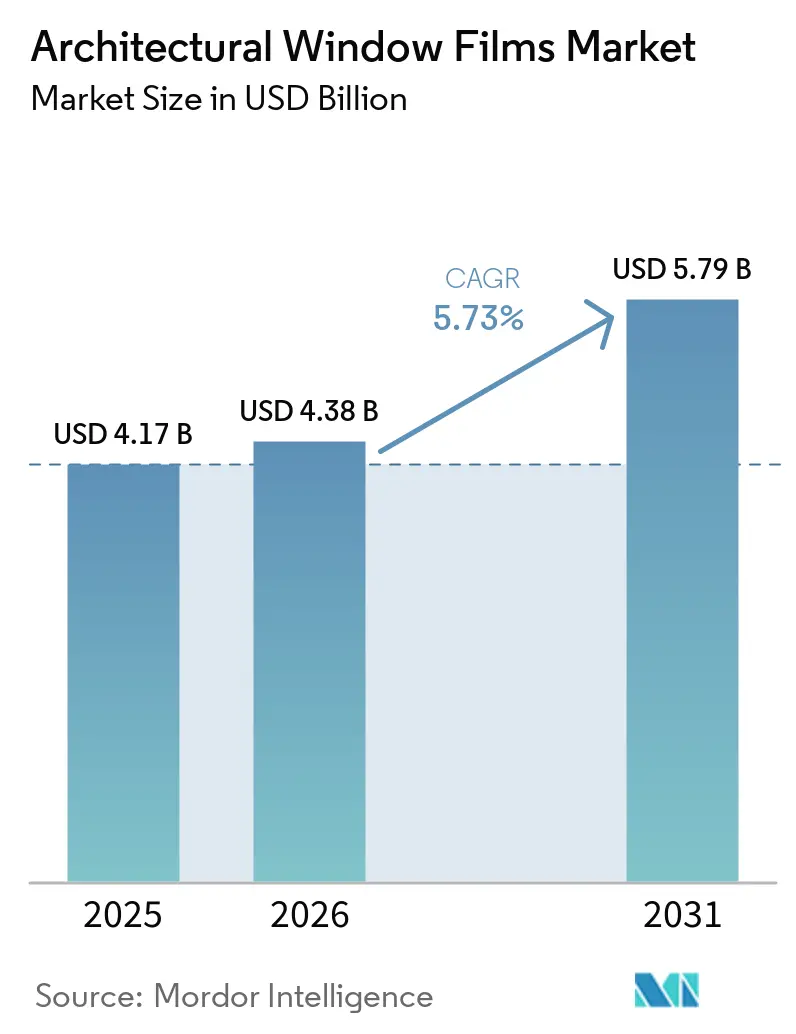
The architectural window films market size was valued at USD 4.17 billion in 2025 and is estimated to grow from USD 4.38 billion in 2026 to reach USD 5.79 billion by 2031, at a CAGR of 5.73% during the forecast period (2026-2031). The architectural window films market is supported by building owners seeking to reduce cooling demand without replacing existing glazing. Untreated glazing can increase solar heat gain and conductive heat loss, making window film a retrofit option that requires no structural work. Stricter energy standards are shifting purchasing decisions toward documented building performance. The transition from metalized films to ceramic products reflects the need to maintain indoor wireless coverage in connected buildings. The market, therefore, favors suppliers that can combine measured energy performance, compatible installation methods, and reliable project documentation.
Key Report Takeaways
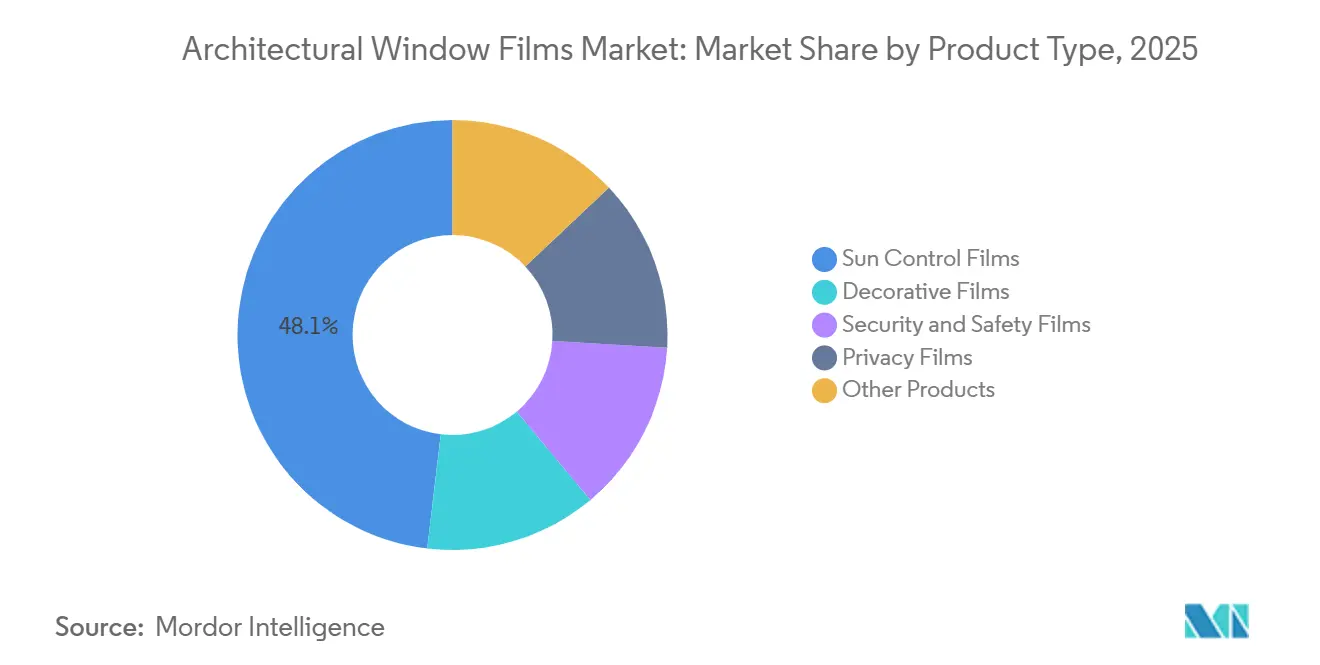
- By product type, Sun Control Films led with 48.12% revenue share in 2025, while Security and Safety Films are forecast to expand at a 6.34% CAGR through 2031.
- By material, Polyester held 40.76% revenue share in 2025, while Ceramic is forecast to expand at a CAGR of 6.66% through 2031.
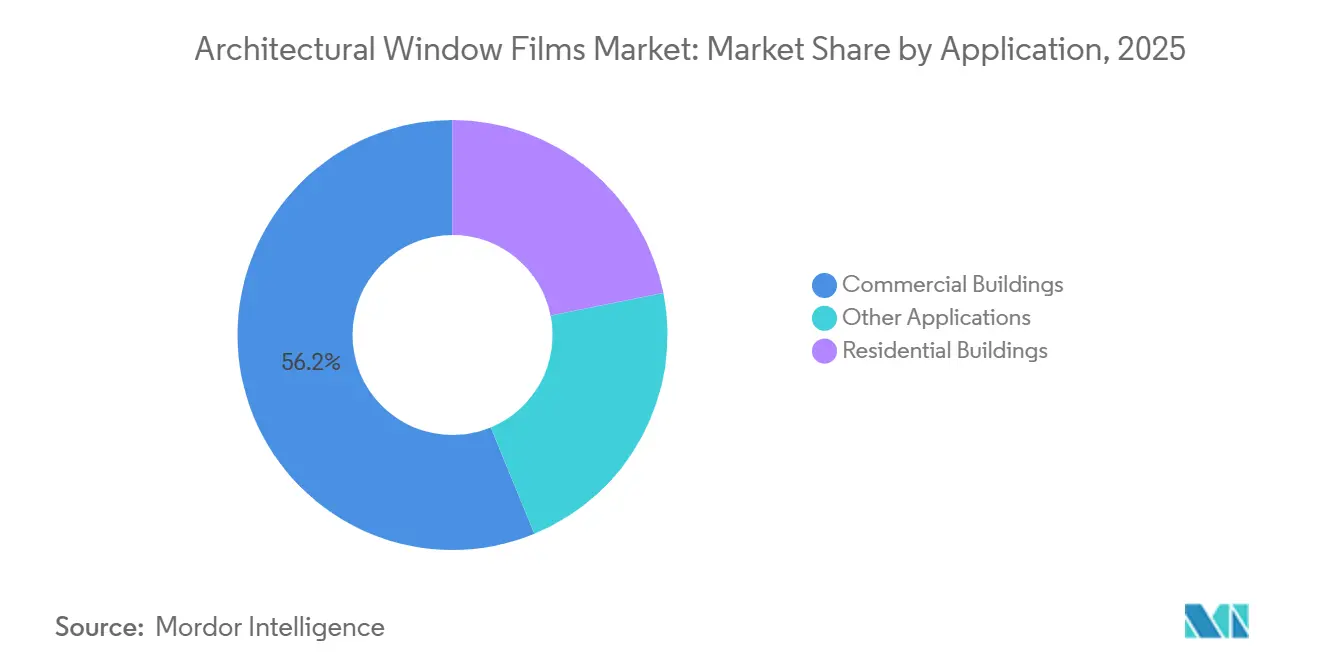
- By application, Commercial Buildings accounted for 56.23% of revenue in 2025 and are forecast to expand at a 6.95% CAGR through 2031.
- By geography, Asia-Pacific held 46.08% of revenue in 2025 and is forecast to grow at a 6.41% CAGR through 2031.
Note: Market size and forecast figures in this report are generated using Mordor Intelligence’s proprietary estimation framework, updated with the latest available data and insights as of January 2026.
Global Architectural Window Films Market Trends and Insights
Drivers Impact Analysis*
| Drivers | (~) % Impact on CAGR Forecast | Geographic Relevance | Impact Timeline |
|---|---|---|---|
| Energy-Efficient Building Retrofits and Cooling-Load Reduction | +1.4% | Global, with the highest intensity in the EU, UK, South Asia, and Southeast Asia | Medium term (2-4 years) |
| Commercial Glass-Facade and Sustainable-Building Adoption | +1.2% | Global, most prominent in APAC and North America | Long term (≥ 4 years) |
| UV, Glare, and Interior-Fade Protection | +0.8% | Global | Short term (≤ 2 years) |
| Security, Safety, and Post-Breakage Containment Requirements | +1.0% | North America, EU, APAC core, with spillover to MEA | Medium term (2-4 years) |
| Qualification of Low-Outgassing Films in Life-Science Facilities | +0.5% | North America and the EU | Long term (≥ 4 years) |
| Source: Mordor Intelligence | |||
Energy-Efficient Building Retrofits and Cooling-Load Reduction
Building envelope efficiency is increasingly linked to formal energy-performance requirements in major jurisdictions. The United Kingdom's Minimum Energy Efficiency Standards (MEES) framework requires qualifying non-domestic properties over 1,000 square meters to achieve Energy Performance Certificate (EPC) Band B by 2031. This requirement makes retrofit measures more relevant to landlords managing older commercial assets. The architectural window films market benefits because films can reduce solar heat gain without altering the building structure or requiring full replacement of the existing glazing system. A 2026 peer-reviewed study found that a spectrally selective polymer nanocomposite film reduced the maximum interior temperature by 10.2°C and saved 33.1-37.1 MJ of annual cooling energy per square meter in tropical and arid settings, where technical requirements shape product selection and installation planning[1]Zhang et al., “A Transparent Spectrally Selective Polymer Nanocomposite Film for Enhancing Window Energy Conservation,” Advances in Industrial and Engineering Polymer Research, doi.org. As heating systems become more electric, passive control of solar gain becomes more relevant during periods of high thermal load.
Commercial Glass-Facade and Sustainable-Building Adoption
Curtain-wall and full-glass designs remain common in new commercial properties because they increase daylight and improve the visual character of buildings, while operating costs and indoor conditions remain central to project decisions. These designs also create larger exposed glazing areas and higher cooling loads, giving the architectural window films market relevance beyond visual building upgrades. Solar-control films can be added after construction while maintaining product compatibility and qualified installation standards. Green-building programs in Asia and the Gulf are increasing demand for products with documented solar-heat-gain performance in projects that require clear evidence of expected outcomes. In 2025, the Indian Green Building Council certified more than 11.8 billion square feet of commercial space, creating a broad base for performance-focused retrofits where solar exposure and interior conditions are material operating concerns. Suppliers that provide certified Solar Heat Gain Coefficient (SHGC) and total solar energy rejection data are better positioned for specification-led projects and can help owners address practical performance needs across existing building stock.
UV, Glare, and Interior-Fade Protection
Ultraviolet (UV) exposure can cause lasting damage to furnishings, flooring, retail merchandise, and archival materials, creating a maintenance concern for property owners that extends beyond cooling costs. Architectural window films commonly block 99% or more of ultraviolet radiation while retaining clear views through the glass. Glare control can also improve visual comfort in offices, hospitality settings, and healthcare facilities, particularly for owners seeking retrofits with minimal disruption. Dual-reflective products provide daytime solar control and privacy while reducing interior reflectivity at night. Demand in the architectural window films market also comes from life-science and pharmaceutical facilities that use UV-filter films to protect light-sensitive processes and samples in projects where energy use, occupant comfort, and asset protection are considered together.
Security, Safety, and Post-Breakage Containment Requirements
Safety glazing rules and insurance requirements are increasing demand for architectural window films that retain glass fragments after breakage, without requiring full replacement of the existing glazing system. In the United States, hazardous locations are subject to safety-glazing requirements under the International Building Code (IBC) Section 2406, in which technical requirements govern product selection and installation planning. Retrofit film can provide a route for upgrading existing annealed glass when the installed system meets the required standard. A 2024 study found that anti-shatter films improved the residual load-bearing capacity of monolithic glass after breakage, giving the category relevance beyond visual building upgrades. This evidence helps engineers assess security-film specifications for critical buildings while maintaining product compatibility and qualified installation standards. Buyers meeting basic safety requirements may also select higher-grade forced-entry products for retail, banking, and government properties.
Restraints Impact Analysis*
| Restraints | (~) % Impact on CAGR Forecast | Geographic Relevance | Impact Timeline |
|---|---|---|---|
| Premium Material and Installation Cost | -0.9% | Emerging markets in South Asia, Southeast Asia, the Middle East and Africa (MEA), and South America | Short term (≤ 2 years) |
| Glass Compatibility and Thermal-Stress Specification Risk | -0.5% | Global, most acute in retrofit settings with legacy glazing | Medium term (2-4 years) |
| Installer Skill, Warranty, and Performance-Verification Gaps | -0.3% | Global, most pronounced in informal markets | Long term (≥ 4 years) |
| Source: Mordor Intelligence | |||
Premium Material and Installation Cost
The installed cost of basic solar-control film is materially lower than that of premium nano-ceramic systems in projects that require clear evidence of expected performance. This cost difference limits adoption in markets where owners prioritize a short capital payback period and where solar exposure and interior conditions are material operating concerns. Lower-cost dyed polyester products may lose color stability and infrared performance within 5-7 years, which commercial buyers weigh alongside installed cost. Replacement needs can weaken lifecycle value calculations for property managers, particularly in projects subject to formal approval or review. Lower labor costs in some emerging economies can reduce the gap in total installed cost. Still, they do not eliminate the material premium associated with ceramic products, thereby keeping the focus on measurable building performance. Building managers also require credible energy-price forecasts, glazing records, and thermal-load modeling to assess premium film over a 7-15-year service life, as project teams seek upgrades that avoid the disruption and cost of glass replacement.
Glass Compatibility and Thermal-Stress Specification Risk
An absorptive film can increase glass temperatures when applied to glazing not designed for the added thermal load, particularly in retrofit projects where owners seek to minimize disruption. This can cause stress fractures in sealed insulated glass units, especially where glass documentation is incomplete. The risk is more significant in older commercial buildings that predate modern glazing-performance records and do not require a full replacement of the existing glazing system. These buildings represent a large share of the retrofit opportunity in Europe, North America, and mature APAC markets, where technical requirements shape product selection and installation planning. Manufacturers provide compatibility charts, but inadequate pre-installation surveys can lead to avoidable specification failures. Voluntary quality frameworks support more thorough glass surveys, although consistent use is not required in most jurisdictions where documented product performance could otherwise support clearer procurement decisions.
*Our forecasts treat driver/restraint impacts as directional, not additive. The impact forecasts reflect baseline growth, mix effects, and variable interactions.
Segment Analysis
By Product Type: Sun Control Films Lead, Security Category Accelerates
Sun control films accounted for 48.12% of the architectural window film market share in 2025. Their dominance reflects their role in energy-compliance retrofits for commercial and residential properties, addressing solar heat gain and HVAC load reduction alongside visual building upgrades. Building owners typically prioritize solar-control products because they deliver measurable reductions in cooling costs, particularly in high-solar-load locations. Ceramic nanoparticle formulations are gaining importance in this category, as they can achieve total solar energy rejection above 55% without metal layers that may interfere with indoor signal propagation. Commercial buyers evaluate these products based on performance records and installed cost. Decorative films represent another product type, used for privacy, branding, and interior design in retail, corporate, and healthcare spaces. These films offer a lower-cost alternative to replacement glass, partition systems, and frosted glazing, with demand tied to commercial fit-out and renovation activity.
Security and safety films are the fastest-growing product type, with a projected CAGR of 6.34% from 2026 to 2031. Public buildings, educational facilities, healthcare settings, and government sites are increasing their use of post-breakage containment products. Compliance requirements make safety film a more durable purchase category than aesthetic upgrades, without requiring full glazing replacement. Privacy films are also incorporating Polymer Dispersed Liquid Crystal (PDLC) smart-film technology for switchable opacity. Smart-film installed pricing declined 30-40% over the five years before 2026, broadening its use in mid-range institutional refits. Other products include anti-graffiti coatings and UV-filter films for laboratories and photosensitive manufacturing settings. These specialized products serve applications where performance requirements reduce direct price competition. Overall, product demand is shifting toward higher-specification films as energy and safety requirements reduce the viability of undifferentiated products in projects where energy use, occupant comfort, and asset protection are evaluated together.



By Material: Polyester Substrate Dominates, Ceramic Gains Specification Ground
Polyester accounted for 40.76% of the architectural window film market share by material in 2025. Its position is based on dimensional stability, optical clarity, and compatibility with multiple coating systems. Polyester is used across sun-control, safety, and decorative film categories, and its market share reflects broad product use rather than a single performance attribute. Metalized products use vacuum-sputtered silver layers and can deliver strong heat rejection. However, their use is constrained in technology-intensive buildings with 5G, Wi-Fi 6E, and in-building cellular equipment. The architectural window films industry is responding with non-metallic options for applications where indoor connectivity is a design requirement. This shift is visible in North American and European office and hospitality projects, where project teams seek upgrades that avoid the disruption and cost of glass replacement.
Ceramic is the fastest-growing material, with the architectural window films market size for this segment projected to grow at a 6.66% CAGR from 2026 to 2031. A 2026 scientific study reported near-infrared shielding above 90%, UV shielding above 95%, and visible-light transmittance above 60% for a ceramic nanocomposite film. This balance supports occupant comfort while preserving daylight. Ceramic products also suit projects that require documented solar heat gain performance for Leadership in Energy and Environmental Design (LEED) or Building Research Establishment Environmental Assessment Method (BREEAM) submissions. Dyed polyester and conventional metalized products may not consistently meet the same specification thresholds. Other materials include hybrid polyester-ceramic laminates and Thermoplastic Polyurethane (TPU)-based films. TPU is relevant to safety applications because of its elongation and structural load characteristics. These materials also offer a cleaner end-of-life profile than Polyvinyl Chloride (PVC)-based alternatives.
By Application: Commercial Buildings Drive Demand on Both Revenue and Growth
Commercial buildings accounted for 56.23% of revenue in 2025 and are projected to expand at a 6.95% CAGR through 2031. Large offices, retail centers, hospitals, and schools have broad, uniform glazing areas that support project-scale installations. Professional procurement teams can assess the total cost of ownership and energy performance. The architectural window films market size for commercial buildings is driven by institutional requirements for certified energy performance. In India, Avery Dennison introduced the Clima Architectural Window Films series in June 2026 for commercial and luxury residential buildings. The range includes Clima Vista, Clima Fusion DR, Clima Sterling DR, and Clima Ceramic products designed for high-UV and high-heat conditions, with documented product performance to support procurement decisions.
Residential buildings form the second application category and involve smaller, more fragmented projects. Homeowners typically make faster purchase decisions and are more sensitive to the installed cost per window. Demand is strongest in Australia, India, and the GCC countries, where UV protection and cooling cost reduction are direct household concerns. Garware Hi-Tech Films introduced Garware Home Solutions as a pilot initiative in key Indian cities during FY2025, pointing to more direct residential distribution by vertically integrated manufacturers. Other applications include transport glazing, marine cabin windows, and specialized life-science facilities. These uses are smaller in scale but can command a premium because they require tailored performance. The architectural window films market benefits where products can meet low-outgassing, safety, or specialized UV-filter requirements across commercial properties with large glazing areas and recurring operating-cost concerns.
Geography Analysis
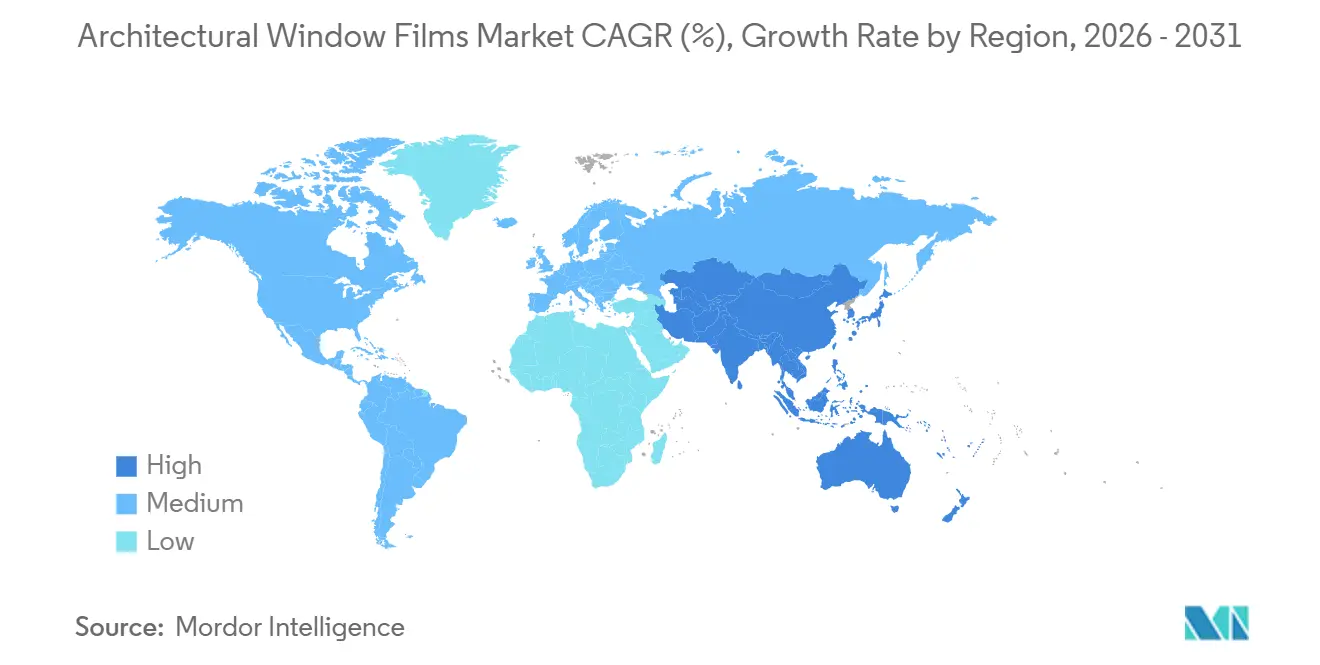
Asia-Pacific held 46.08% of revenue in 2025 and is forecast to grow at a 6.41% CAGR through 2031. China is the region's largest national market, supported by green-building standards, expanding high-rise commercial space, and stronger enforcement of solar-heat-gain requirements. Ceramic products are gaining value share as project teams seek verified performance to meet demanding commercial specifications. India is the fastest-growing major country, supported by commercial real estate expansion and a certified green-building stock exceeding 11.8 billion square feet in 2025. Avery Dennison's 2026 Clima launch reflects suppliers' interest in India's hot-climate construction base and its wide retrofit opportunity. Vietnam, Indonesia, and the Philippines offer further potential through exposure to tropical climates, young building stock, and expanding commercial real estate pipelines.
North America and Europe are the second- and third-largest revenue geographies for the architectural window films market. In the United States, American Society of Heating, Refrigerating and Air-Conditioning Engineers (ASHRAE) 90.1 updates and state-level rules in California, Florida, and Texas support investment in improved fenestration performance, while Arizona utility rebates can improve project access for facility managers. Canada's demand follows provincial energy-efficiency programs and federal net-zero building commitments. Mexico is gaining momentum as glass-facade construction expands in Monterrey, Mexico City, and Guadalajara. Germany and France are Europe's largest commercial markets, while Nordic countries favor insulating films that retain winter heat. The United Kingdom's Minimum Energy Efficiency Standards (MEES) 2031 requirements are generating specification activity for solar-control and insulating combinations in mixed-use and multi-let commercial portfolios.
South America, the Middle East, and Africa are smaller revenue geographies but offer favorable project conditions for the architectural window films market. Brazil is moving from commodity retrofits to spectrally selective film in São Paulo, Rio de Janeiro, and Curitiba as building certifications gain traction in commercial real estate. In Saudi Arabia, extreme solar exposure creates opportunities for large glass-facade retrofits, including a documented application in Riyadh covering 15,000 square meters. South Africa relies mainly on commercial retrofit activity in Johannesburg and Cape Town, with additional demand from mining-sector facilities requiring glare and UV control. Urban construction across Africa and certified building-performance requirements in the GCC provide separate sources of demand within the MEA region.

Competitive Landscape
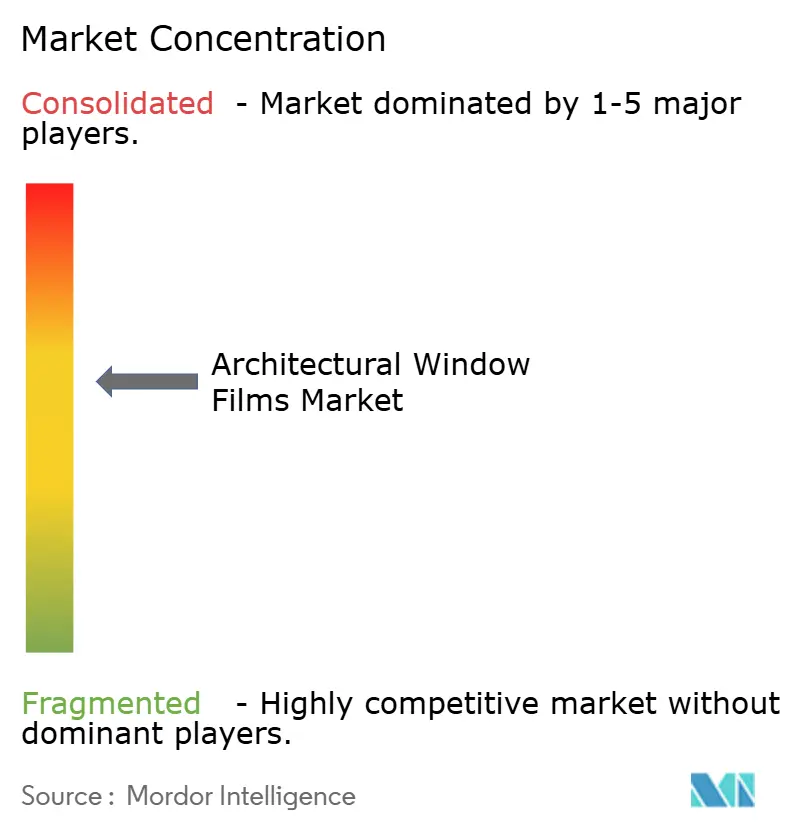
The architectural window films market is moderately consolidated. Key participants include 3M, Eastman Chemical (through LLumar and SunTek), Saint-Gobain (through Solar Gard), Avery Dennison (through Hanita Coatings), and Garware Hi-Tech Films. Regional ceramic-film specialists, integrated polyester manufacturers, and domestic distribution-led brands compete for the remaining revenue. Suppliers compete on technical performance, certification, installer coverage, and project documentation. National Fenestration Rating Council (NFRC)-certified SHGC data, verified total solar energy rejection results, and LEED-ready files can be decisive in commercial specification bids.
Premium ceramic and smart-film technologies are key areas of product development in the architectural window films market. Companies are also expanding across APAC and MEA, where construction activity and retrofit demand are both significant. Vertical integration provides control over polymer substrate supply and finished-film production. Garware Hi-Tech Films reported FY2025 consolidated revenue of INR 2,109 crore (USD 253 million), reflecting 25.80% year-on-year growth and 37.60% growth in its Sun Control Window Films division. Its UAE subsidiary and Global Application Studios show its commitment to strengthening regional installer networks and distribution support.
3M launched its 3M Cooling Film in September 2026 for fleet and rail operators, featuring a multilayer construction that reflects more than 85% of solar radiation[2]3M, “New 3M Cooling Film Helps Fleet and Rail Operators Keep Cabin Interiors Cooler and Improve Efficiency,” 3M News Center, 3m.com. Avery Dennison launched its Clima series in India in June 2026, offering four variants that block more than 99% of UV radiation and reduce interior heat. Low-outgassing life-science films, blast-mitigation systems for critical infrastructure, and smart Polymer Dispersed Liquid Crystal (PDLC) products linked to building-management systems remain underdeveloped opportunities. South Korean and Chinese manufacturers are narrowing the ceramic performance gap, although global incumbents retain an advantage where commercial customers require certification and compliance documentation.
Architectural Window Films Industry Leaders
Eastman Chemical Company
3M
Saint-Gobain
Madico, Inc.
Avery Dennison Corporation
- *Disclaimer: Major Players sorted in no particular order

Recent Industry Developments
- September 2026: 3M launched 3M Cooling Film, a roof-applied thermal management film reflecting over 85% of solar radiation, targeting fleet and rail transportation operators. The product uses multilayer film construction technology applied across its architectural window films portfolio.
- June 2026: Avery Dennison launched the Clima Architectural Window Films series in India, comprising four SKUs: Clima Vista, Clima Fusion DR, Clima Sterling DR, and Clima Ceramic, designed for high-UV, extreme-heat environments. All variants block over 99% of UV radiation, reduce interior temperatures, and lower dependence on air conditioning, addressing demand in high-growth commercial construction markets.


Global Architectural Window Films Market Report Scope
Architectural window films are engineered polymer layers applied to glass surfaces to control heat, glare, UV exposure, and privacy. These films are widely used in residential, commercial, and industrial buildings to improve energy efficiency, enhance occupant comfort, and reduce reliance on artificial cooling and lighting systems.
The architectural window films market is segmented by product type, material, application, and geography. By product type, the market is segmented into sun control films, decorative films, security and safety films, privacy films, and other products. By material, the market is segmented into polyester, ceramic, metalized, and other materials. By application, the market is segmented into commercial buildings, residential buildings, and other applications. The report also covers market size and forecasts for architectural window films across 16 countries in major regions. The market sizes and forecasts are provided in terms of value (USD).
| Sun Control Films |
| Decorative Films |
| Security and Safety Films |
| Privacy Films |
| Other Products |
| Polyester |
| Ceramic |
| Metalized |
| Other Materials |
| Commercial Buildings |
| Residential Buildings |
| Other Applications |
| Asia-Pacific | China |
| India | |
| Japan | |
| South Korea | |
| ASEAN Countries | |
| Rest of Asia-Pacific | |
| North America | United States |
| Canada | |
| Mexico | |
| Europe | Germany |
| United Kingdom | |
| France | |
| Italy | |
| NORDIC Countries | |
| Russia | |
| Rest of Europe | |
| South America | Brazil |
| Argentina | |
| Rest of South America | |
| Middle East and Africa | Saudi Arabia |
| South Africa | |
| Rest of Middle East and Africa |
| By Product Type | Sun Control Films | |
| Decorative Films | ||
| Security and Safety Films | ||
| Privacy Films | ||
| Other Products | ||
| By Material | Polyester | |
| Ceramic | ||
| Metalized | ||
| Other Materials | ||
| By Application | Commercial Buildings | |
| Residential Buildings | ||
| Other Applications | ||
| By Geography | Asia-Pacific | China |
| India | ||
| Japan | ||
| South Korea | ||
| ASEAN Countries | ||
| Rest of Asia-Pacific | ||
| North America | United States | |
| Canada | ||
| Mexico | ||
| Europe | Germany | |
| United Kingdom | ||
| France | ||
| Italy | ||
| NORDIC Countries | ||
| Russia | ||
| Rest of Europe | ||
| South America | Brazil | |
| Argentina | ||
| Rest of South America | ||
| Middle East and Africa | Saudi Arabia | |
| South Africa | ||
| Rest of Middle East and Africa | ||


Key Questions Answered in the Report
What is current market size of Architectural Window Films Market?
The architectural window films market size was valued at USD 4.17 billion in 2025 and is estimated to grow from USD 4.38 billion in 2026 to reach USD 5.79 billion by 2031, at a CAGR of 5.73% during the forecast period (2026-2031).
What is driving demand for architectural window films?
Building retrofits, cooling-load reduction, safety requirements, glare control, and protection from UV damage are key demand factors.
Which product type is the largest in the architectural window films market?
Sun Control Films led product revenue with a 48.12% share in 2025.
Which material is growing fastest for architectural window films?
Ceramic film is the fastest-growing material, with a projected 6.66% CAGR through 2031.
Page last updated on:





