
Antimony-free Polyesters Market Size and Share
Market Overview
| Study Period | 2022 - 2032 |
|---|---|
| Market Size (2027) | USD 0.89 Billion |
| Market Size (2032) | USD 1.23 Billion |
| Growth Rate (2027 - 2032) | 6.63 % |
| Fastest Growing Market | Asia-Pacific |
| Largest Market | Asia-Pacific |
| Market Concentration | Low |
Major Players *Disclaimer: Major Players sorted in no particular order Image © Mordor Intelligence. Reuse requires attribution under CC BY 4.0. | |
Antimony-free Polyesters Market Analysis by Mordor Intelligence
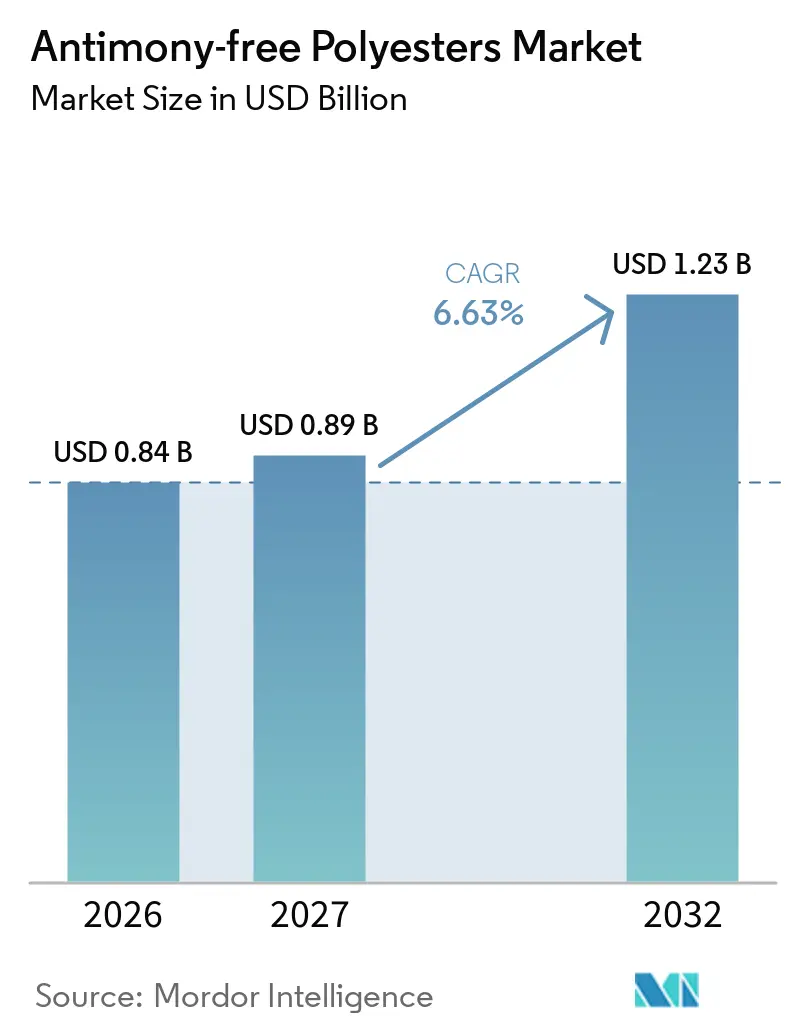
The antimony-free polyesters market size was valued at USD 0.84 billion in 2026 and is estimated to grow from USD 0.89 billion in 2027 to USD 1.23 billion by 2032, at a CAGR of 6.63% during the forecast period (2027-2032). The antimony-free polyesters market is shifting toward titanium, aluminum, and bimetallic catalysts as producers address compliance requirements and supply chain vulnerabilities related to antimony. China's export licensing rules and subsequent restrictions on antimony trioxide have increased the urgency of catalyst substitution among polyester producers. The EU's classification of antimony as a critical raw material, combined with stricter food-contact regulations, has heightened scrutiny of catalyst residues in packaging. Brand owners are also requiring suppliers to offer safer and recyclable polymer grades, broadening demand beyond large resin producers. The antimony-free polyesters market is therefore positioned to grow by simultaneously addressing supply security, food-contact compliance, recyclability, and process performance.
Key Report Takeaways
- By product type, Polyethylene Terephthalate (PET) held 52.12% of the antimony-free polyesters market share in 2026, while Polytrimethylene Terephthalate (PTT) is projected to grow at a 7.12% CAGR through 2032.
- By catalyst, titanium-based catalysts accounted for 47.45% of the 2026 antimony-free polyesters market share, while titanium-magnesium-based catalysts are forecast to expand at a 7.36% CAGR through 2032.
- By end-user industry, packaging accounted for 43.67% of the 2026 antimony-free polyesters market share, while textiles are forecast to record the highest CAGR of 7.65% through 2032.
- By geography, Asia-Pacific held 46.49% of the antimony-free polyesters market share in 2026 and is forecast to expand at a 7.44% CAGR through 2032.
Note: Market numbers in this report are based on Mordor Intelligence's proprietary estimation framework, which combines nine months of actuals with Q4 projections for base year 2026.
Market Trends and Insights
Drivers Impact Analysis of Antimony-free Polyesters Market*
| Drivers | (~) % Impact on CAGR Forecast | Geographic Relevance | Impact Timeline |
|---|---|---|---|
| Stricter Heavy-Metal and Food-Contact Compliance | +1.8% | Global, concentrated in the EU, North America, Japan, and South Korea | Medium term (2-4 years) |
| Brand-Owner Demand for Safer, Recyclable Packaging | +1.5% | Global, with early adoption in the EU and North America and spillover to APAC export markets | Medium term (2-4 years) |
| Antimony Supply-Chain Risk After Export Controls | +1.3% | North America and the EU are the most exposed, while APAC is partly insulated by domestic production | Short term (≤ 2 years) |
| Catalyst Innovations That Lower Energy Use and Improve Recyclability | +0.9% | Global, with initial deployment in China and Europe | Long term (≥ 4 years) |
| Textile and Bedding Buyers Seeking Low-Residue Polyester | +0.8% | APAC is central, with spillover to the EU and North America through brand sourcing requirements | Medium term (2-4 years) |
| Source: Mordor Intelligence | |||
Stricter Heavy-Metal and Food-Contact Compliance Pressure
Food-contact regulations are a significant driver in the antimony-free polyesters market because they apply to the material itself, not only to manufacturing sites. Under EU Regulation 10/2011, antimony migration from polyethylene terephthalate (PET) is subject to a specific migration limit of 40 μg/kg of food. This limit applies to catalyst residues that remain in the polymer after production. A 2025 European Food Safety Authority (EFSA) assessment of a recycled PET process identifies antimony as one of the parameters considered in evaluating food-grade recycled PET[1]. As chemical PET recycling grows, antimony in virgin material can affect the quality assessment of the recycled stream. This creates a case for antimony-free production that extends beyond brand preference and into the quality of recycled-material assets.
Brand-Owner Demand for Safer, Recyclable Packaging
Consumer brands are increasingly specifying antimony-free PET to manage regulatory exposure and meet recycled-content goals. This shift is changing supply agreements, as catalyst declarations are now being added to requirements that previously focused on physical and optical performance. Far Eastern New Century's SSP Division received EN 15343 certification in 2025, becoming the first Taiwanese company to meet this EU recycled-plastics traceability standard. The certification indicates that traceability infrastructure is developing alongside demand for recyclable polyester. Such specifications can require mid-sized Asian converters to qualify alternative catalyst systems, extending adoption beyond large producers. Indorama Ventures is also expanding its specialty polymer portfolio under IVL 2.0 while pursuing circular-material priorities, supporting demand for polyester grades with stronger sustainability credentials.
Antimony Supply-Chain Risk After Export Controls
China introduced licensing requirements for antimony exports in September 2024 and later restricted exports of antimony trioxide to the United States in December 2024. These measures created immediate pressure for PET supply chains that depend on antimony-based catalyst inputs. PET Europe has asked the European Commission to assess the export controls and consider trade-defense measures. The issue is particularly relevant for European producers represented by PET Europe, which reports 3.5 million tons of annual virgin PET capacity. The antimony-free polyesters market can benefit from this situation, as alternative catalysts offer a route to reduce exposure to a supply constraint with both geopolitical and commercial consequences. Demand for substitutes can remain resilient even if near-term antimony prices fluctuate.
Catalyst Innovations That Lower Energy Use and Improve Recyclability
Catalyst development will strongly influence the pace of the antimony-free polyesters market, as cost and operating performance remain central concerns for converters. Clariant plans to launch its water-stable AddWorks titanium-based catalyst in 2026, offering lower processing temperatures, improved color, lower heavy-metal residues, and applicability across virgin and recycled PET streams. Researchers supported by the Japan Science and Technology Agency reported in 2025 that an FeCl₃-amine catalyst system achieved 99.7%- 99.9% conversion of PET and textile waste into high-purity chemical feedstocks under mild conditions. A 2025 study found that titanium-magnesium bimetallic catalysts improved thermal stability and polycondensation behavior in the synthesis of polyethylene terephthalate glycol (PETG) compared with conventional single-metal catalysts. Zhejiang Lixing Technology also reported the use of titanium-based catalysts on a polyester line with an annual capacity of 700,000 tons, indicating that alternative systems are operating at commercial scale. These advances may reduce the historical performance gap between antimony-free and conventional production routes.
Restraints Impact Analysis of Antimony-free Polyesters Market*
| Restraints | (~) % Impact on CAGR Forecast | Geographic Relevance | Impact Timeline |
|---|---|---|---|
| Higher Catalyst and Qualification Costs Versus Antimony Systems | -0.9% | Global, most acute in India, Southeast Asia, and Latin America | Short term (≤ 2 years) |
| Limited Large-Scale Process Know-How Across Mid-Sized Producers | -0.5% | APAC mid-tier producers, South America, the Middle East, and Africa | Medium term (2-4 years) |
| Performance Trade-Offs in Color, Activity, and Polymerization Window | -0.3% | Global, more pronounced for optical and film-grade polyethylene terephthalate (PET) applications | Long term (≥ 4 years) |
| Source: Mordor Intelligence | |||
Higher Catalyst and Qualification Costs Versus Antimony Systems
Higher catalyst and qualification costs remain a barrier for price-sensitive polyester producers. Titanium and aluminum catalysts can require tighter handling, shelf-life control, and, in some cases, changes to reactor configurations. Antimony trioxide has a long history of operational use, and alternatives have not yet achieved the same cost position across all applications. For food-contact polyester, a change in catalyst can also require producers to submit revised regulatory dossiers. This process can take 12 to 36 months and requires analytical capabilities that smaller producers may not have. As a result, the antimony-free polyesters market is likely to see gradual adoption in price-sensitive locations until alternative catalyst costs decline further or export restrictions shift the cost comparison more permanently.
Limited Large-Scale Process Know-How Across Mid-Sized Producers
Larger producers have accumulated process knowledge of alternative catalysts, but many regional polyester operators lack comparable research and development resources. Continuous polymerization lines often run for months, so producers may be reluctant to change a catalyst that could cause downtime or off-specification output. China's GB 36889-2025 standard sets graded energy-consumption limits for chemical-fiber products, including bottle-grade polyester. The standard encourages efficiency upgrades but can make it more difficult to manage simultaneous changes to catalyst chemistry and energy performance. Technology licensing, partnerships, and practical support from catalyst suppliers can help producers navigate this transition. The growth of the antimony-free polyesters market will depend on how effectively these operators can access proven operating methods.
*Our forecasts treat driver/restraint impacts as directional, not additive. The impact forecasts reflect baseline growth, mix effects, and variable interactions.
Antimony-free Polyesters Market Segment Analysis
By Product Type:
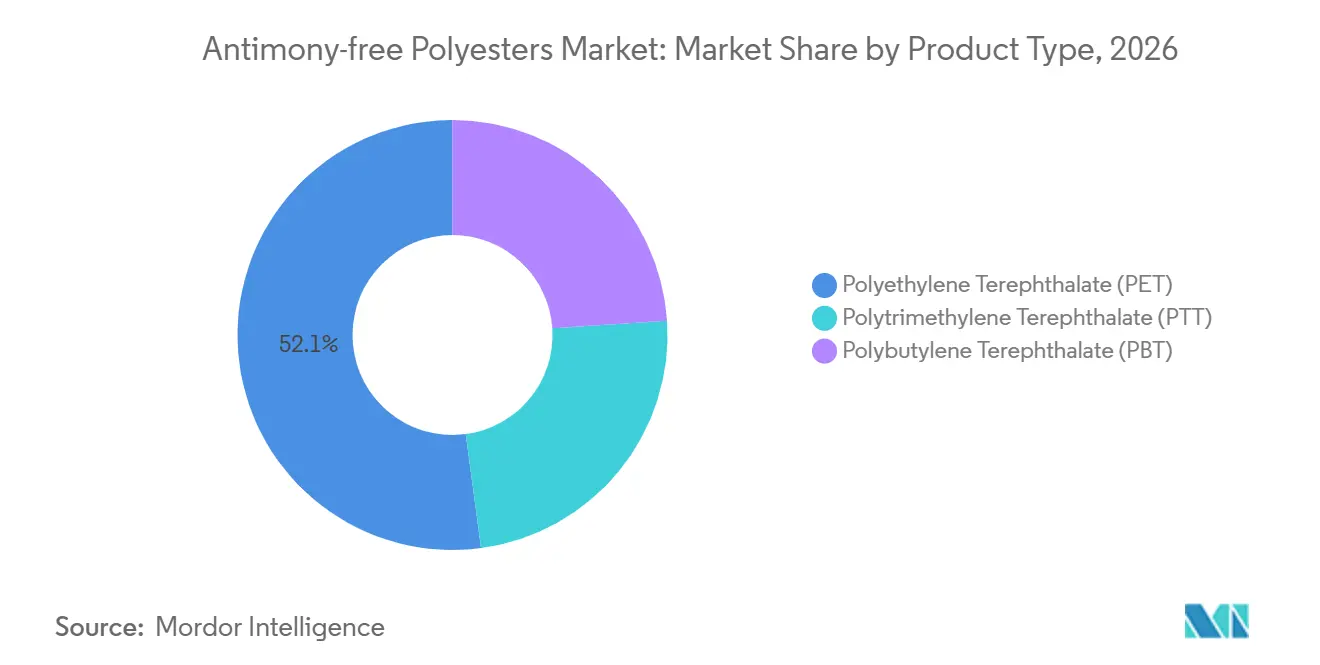
PET Anchors Output While PTT Drives Specialty GrowthPolyethylene Terephthalate (PET) held 52.12% of the antimony-free polyesters market share in 2026, and Polytrimethylene Terephthalate (PTT) is forecast to expand at a 7.12% CAGR from 2027 to 2032. PET's position reflects broad use in food and beverage packaging, polyester films, and recycled-fiber applications. Food-contact requirements have made PET a major focus for titanium-based catalyst development, and the resulting commercial process data provide producers with a clearer route to qualifying antimony-free PET. Polybutylene Terephthalate (PBT) represents a smaller but distinct demand pool, as automotive components and electronic connectors may use antimony trioxide as a flame-retardant synergist. This exposes PBT users to antimony supply risk and supports interest in antimony-free formulations.
PTT's elasticity, soft fiber feel, and dye uptake support demand from sportswear and athleisure brands with demanding sustainability specifications. A 2025 study of bio-based PTT-PO3G copolymer elastomers reported resilience exceeding 96% at 20% elongation, positioning PTT as a potential alternative to spandex in applications where provenance as an antimony-free material is increasingly important. These specialty applications allow the antimony-free polyesters industry to build value beyond commodity PET.

By Catalyst:
Titanium-Magnesium Systems Lead a Shifting Catalyst LandscapeTitanium-based catalysts held 47.45% of the catalyst segment in 2026, giving them the largest antimony-free polyesters market share among catalyst types. They are the most commercially developed alternative across PET, PTT, PBT, and newer polyester grades. Water-stable formulations address earlier concerns about moisture-driven deactivation, and their compatibility with chemical PET recycling is relevant as recycled-content requirements become more important. Aluminum-based catalysts play a distinct role in applications where cost sensitivity is high and optical requirements are less demanding, providing producers with an alternative substitution path when premium titanium systems are not suitable.
Titanium-magnesium-based catalysts are projected to grow at a 7.36% CAGR from 2027 to 2032, the fastest rate among catalyst types. A 2025 peer-reviewed study found that Ti-Mg catalysts improved esterification kinetics and thermal stability in Polyethylene Terephthalate Glycol (PETG) synthesis and identified the highest polycondensation rate among the tested Ti-Mg formulations. Other catalysts, including organocatalytic and iron-based systems, remain in the early commercial stage, although research supported by the Japan Science and Technology Agency (JST) on FeCl₃- amine systems demonstrates ongoing interest in chemical recycling applications. New catalyst systems must also meet food-contact migration requirements under frameworks such as EU Regulation 10/2011.
By End-User Industry:
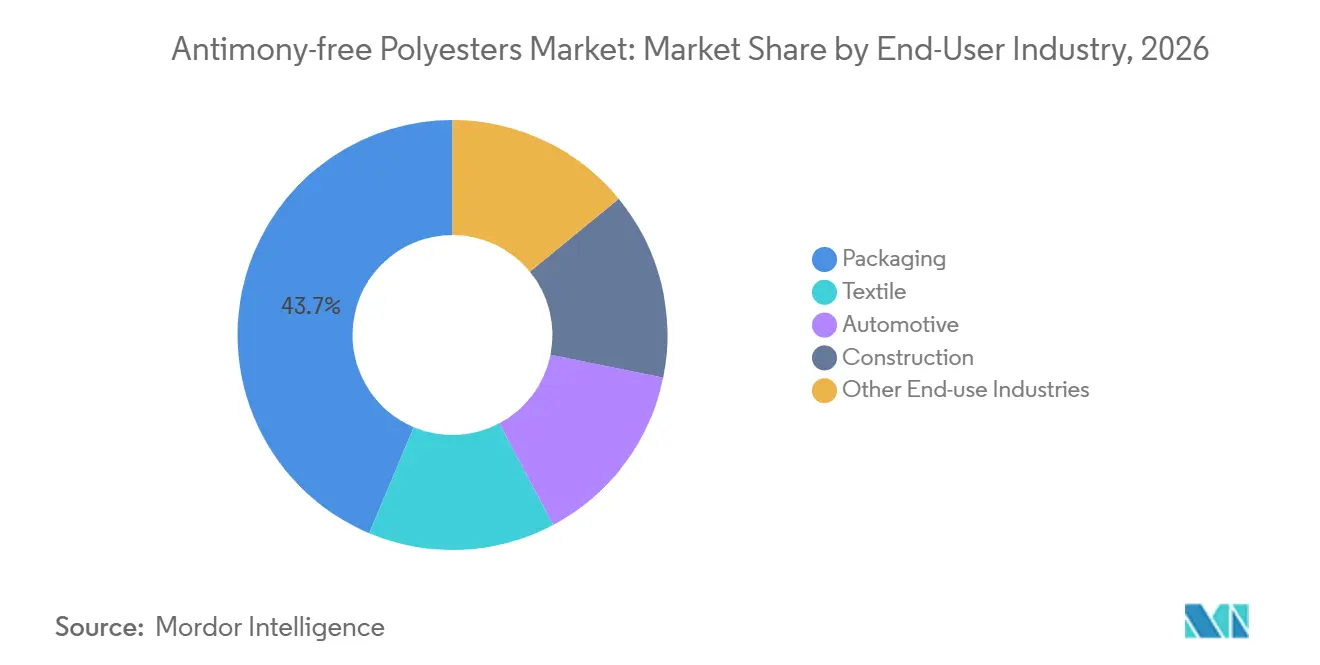
Packaging Commands Share While Textile Leads GrowthPackaging accounted for 43.67% of the antimony-free polyesters market in 2026. This position reflects the scale of PET bottle production for food and beverage use and the close scrutiny of food safety applied to packaging materials. Brand specifications for antimony-free PET are becoming more common among consumer-goods companies sourcing in Asia-Pacific, Europe, and North America. Automotive and construction applications represent smaller but structurally distinct demand pools. Mono-material PET interior concepts can support cleaner catalyst profiles when recyclability is part of the material design.
Textiles are forecast to grow at a 7.65% CAGR from 2027 to 2032, the highest rate among end-user categories. The phaseout of per- and polyfluoroalkyl substances (PFAS) coatings in the EU from January 2025 increased the relevance of PTT's built-in stain-repellent properties and raised the value of antimony-free PTT fiber relative to PFAS-dependent options. A 2025 study reported that antimony-free ZnO antibacterial polyester fabric reached 86% dye uptake and Grade 4 wash-fastness, demonstrating that antimony-free fabrics can deliver performance comparable with conventional alternatives. Bedding and home textiles are also gaining attention as retailers apply low-residue requirements to products with prolonged skin contact.
Geography Analysis
APAC Antimony-free Polyesters Market
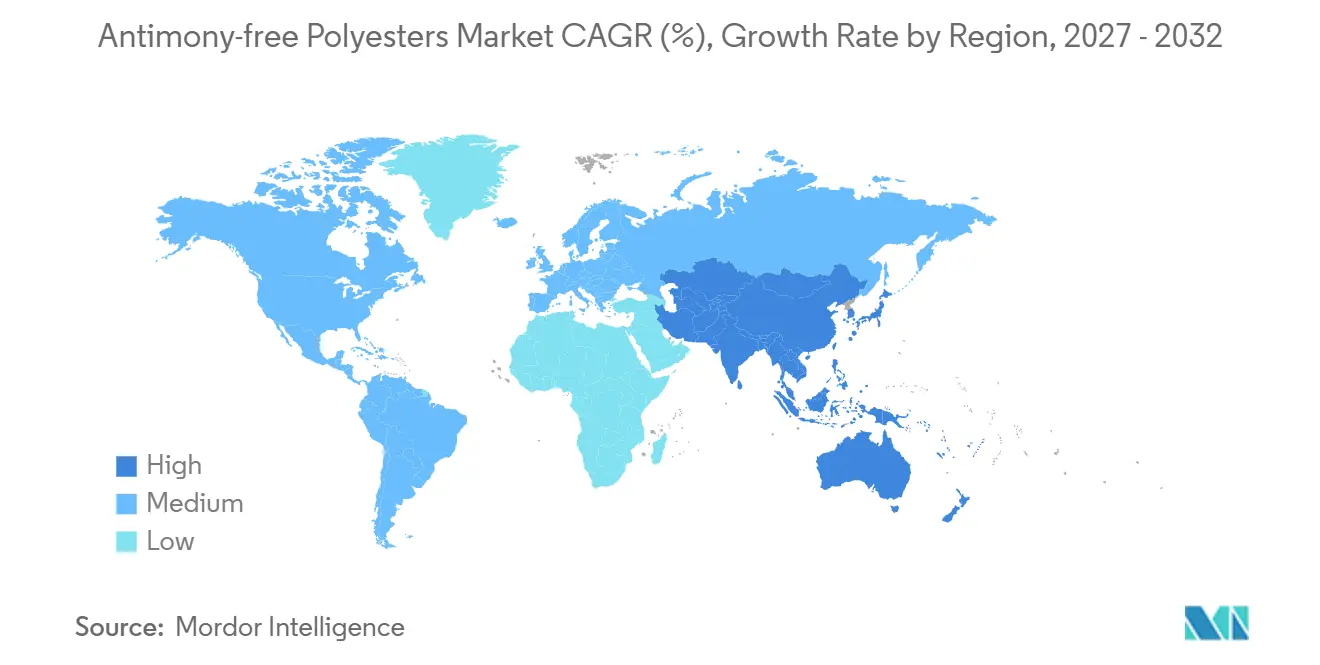
Asia-Pacific held 46.49% of the antimony-free polyesters market share in 2026 and is projected to grow at a 7.44% CAGR through 2032. The region has the world's largest polyester production base, combined with faster regulatory and procurement-driven conversion. China is both a major antimony producer and the largest polyester manufacturer, exposing domestic producers to disruption from its own export controls. Wankai New Materials reported that a bio-based polyethylene furanoate (PEF)/PET blend with 30% PEF remained recyclable and stable in performance. Japan and South Korea remain technology-export hubs, while South Korea's 2025 chemical law changes have increased documentation requirements for materials supply chains.
Europe Antimony-free Polyesters Market
Europe is the second-largest regional market for antimony-free polyesters. EU food-contact migration rules, the Critical Raw Materials Act, and Regulation (EU) 2025/40 on packaging and packaging waste create a defined compliance environment. This environment favors antimony-free PET for new food-contact product approvals, while Germany, France, the UK, and Nordic markets support demand through chemical procurement requirements. Eastern European converters such as Fatra face rising expectations for premium credentials but may have limited capacity to qualify catalyst systems independently. Eastman received 2025 RecyClass recyclability approvals for 8 specialty PET resins, demonstrating that certification routes are available for high-performance copolyesters[2].
The Americas and MEA Antimony-free Polyesters Market
North America is affected by regulatory uncertainty and supply-chain realignment. The December 2024 restriction on Chinese antimony trioxide exports removed an important input source for US PET producers, creating a clearer opening for alternative catalyst systems. Indorama Ventures has reviewed restarting construction of its USD 2.3 billion Texas PET and purified terephthalic acid facility, which was paused in 2023. South America, the Middle East, and Africa remain smaller demand centers, as premium grades face stronger cost constraints. Export requirements linked to EU regulations and sustainability requirements from global brand owners are generating early demand, with Brazil and Saudi Arabia positioned as possible early-growth locations.
Competitive Landscape
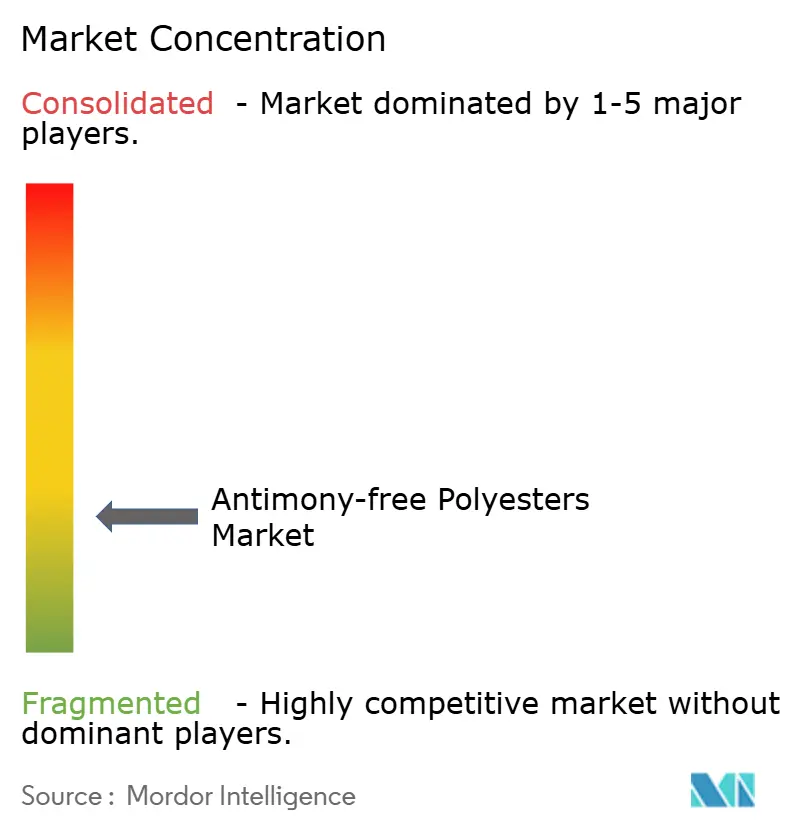
The antimony-free polyesters market is fragmented. A small group of global producers leads in output and sustainability-linked specialty products, while regional producers qualify alternative catalyst systems, and catalyst specialists influence technology choices. Indorama Ventures, Reliance Industries, and Far Eastern New Century have substantial production scale and recycled-content priorities that support antimony-free platforms. Their strategies connect material circularity, lower-emission production, and higher-value polyester grades. This structure gives leading producers an advantage in the investment and technical knowledge required to transition catalysts.
Clariant's 2026 AddWorks catalyst launch targets lower processing temperatures, improved color, and reduced heavy-metal residues. Eastman's methanolysis-based circular materials and RecyClass approvals demonstrate how recyclability certification has become a competitive differentiator. The antimony-free polyesters market favors companies that can combine catalyst technology with evidence of circular performance. Patent activity in titanium-magnesium catalyst systems also indicates that intellectual property protection is developing around high-performance formulations.
Competitive strategies follow two main paths: closer integration between catalyst development and polymer production, and differentiation through recycled-content credentials. The first approach includes direct technical relationships and internal catalyst research. The second strengthens the role of circular materials in product positioning. An opportunity exists among mid-tier converters in South and Southeast Asia, where qualification support and lower-cost titanium or aluminum formulations can unlock additional demand. EU regulatory attention to antimony compounds continues to increase pressure on companies retaining conventional catalyst routes. The antimony-free polyesters market is likely to remain divided among technology licensors, large qualified producers, and regional converters that require external technical support.
Antimony-free Polyesters Industry Leaders
-
Indorama Ventures Public Company Limited
-
Mitsubishi Polyester Film GmbH
-
Toray Advanced Materials Korea Inc.
-
NAN YA PLASTICS CORPORATION
-
Ester
- *Disclaimer: Major Players sorted in no particular order
Antimony-free Polyesters Market Companies Covered in this Report
- CLARIANT
- Eastman Chemical Company
- Ester
- Far Eastern New Century Corporation
- Fatra, a.s.
- HANGZHOU LEMMEJOY CHEMICAL FIBER CO., LTD.
- Indorama Ventures Public Company Limited
- Mitsubishi Polyester Film GmbH
- NAN YA PLASTICS CORPORATION
- Polyplex
- PT Asia Pacific Fibers Tbk
- Reliance Industries Limited
- SK chemicals Co., Ltd.
- Teijin Limited
- Toray Advanced Materials Korea Inc.
- TOYOBO CO., LTD.
- UFlex Limited
Recent Industry Developments in Antimony-free Polyesters Market
- October 2025: Clariant unveiled its AddWorks titanium-based catalyst solutions at K 2025 in Düsseldorf, with a commercial launch targeted for 2026. The water-stable, antimony-free catalyst system reduces processing temperatures, eliminates heavy-metal residues, and is designed for the full polyester family, including PET, PTT, PBT, and emerging PEF. The system is intended to deliver CAPEX and OPEX savings through increased throughput, lower energy consumption, and reduced wastewater treatment costs, supporting the broader shift toward antimony-free polyesters.
- June 2025: Indorama Ventures and PolySource entered a distribution agreement for specialty PET and PEN polymers across North America and key global markets. The agreement covers cosmetics, electronics, medical, defense, and industrial applications, where antimony-free polyester credentials have become increasingly relevant in procurement decisions.
Global Antimony-free Polyesters Market Report Scope
Antimony-free polyesters are polyester materials, such as Polyethylene Terephthalate (PET), Polybutylene Terephthalate (PBT), and Polytrimethylene Terephthalate (PTT), manufactured using alternative polycondensation catalysts such as titanium, aluminum, germanium, or organic compounds, rather than traditional antimony trioxide.
The antimony-free polyesters market is segmented by product type, catalyst, end-user industry, and geography. By product type, the market is segmented into polyethylene terephthalate (PET), polytrimethylene terephthalate (PTT), and polybutylene terephthalate (PBT). By catalyst, the market is segmented into titanium-based catalyst, aluminum-based catalyst, titanium-magnesium-based catalyst, and other catalysts. By end-user industry, the market is segmented into textile, packaging, automotive, construction, and other end-use industries. The report also covers market sizes and forecasts for antimony-free polyesters across 15 countries in major regions. The market sizes and forecasts are provided in terms of value (USD).
Segmentation Overview
| Polyethylene Terephthalate (PET) |
| Polytrimethylene Terephthalate (PTT) |
| Polybutylene Terephthalate (PBT) |
| Titanium-based Catalyst |
| Aluminum-based Catalyst |
| Titanium-Magnesium-based Catalyst |
| Other Catalysts |
| Textile |
| Packaging |
| Automotive |
| Construction |
| Other End-use Industries |
| Asia-Pacific | China |
| India | |
| Japan | |
| South Korea | |
| ASEAN Countries | |
| Rest of Asia-Pacific | |
| North America | United States |
| Canada | |
| Mexico | |
| Europe | Germany |
| United Kingdom | |
| France | |
| Italy | |
| NORDIC Countries | |
| Rest of Europe | |
| South America | Brazil |
| Argentina | |
| Rest of South America | |
| Middle East and Africa | Saudi Arabia |
| South Africa | |
| Rest of Middle East and Africa |
| By Product Type | Polyethylene Terephthalate (PET) | |
| Polytrimethylene Terephthalate (PTT) | ||
| Polybutylene Terephthalate (PBT) | ||
| By Catalyst | Titanium-based Catalyst | |
| Aluminum-based Catalyst | ||
| Titanium-Magnesium-based Catalyst | ||
| Other Catalysts | ||
| By End-User Industry | Textile | |
| Packaging | ||
| Automotive | ||
| Construction | ||
| Other End-use Industries | ||
| By Geography | Asia-Pacific | China |
| India | ||
| Japan | ||
| South Korea | ||
| ASEAN Countries | ||
| Rest of Asia-Pacific | ||
| North America | United States | |
| Canada | ||
| Mexico | ||
| Europe | Germany | |
| United Kingdom | ||
| France | ||
| Italy | ||
| NORDIC Countries | ||
| Rest of Europe | ||
| South America | Brazil | |
| Argentina | ||
| Rest of South America | ||
| Middle East and Africa | Saudi Arabia | |
| South Africa | ||
| Rest of Middle East and Africa | ||
Key Questions Answered in the Report
What is current market size of Antimony-free Polyesters Market?
The antimony-free polyesters market size was valued at USD 0.84 billion in 2026 and is estimated to grow from USD 0.89 billion in 2027 to USD 1.23 billion by 2032, at a CAGR of 6.63% during the forecast period (2027-2032).
Which catalyst type is growing the fastest?
Titanium-magnesium-based catalysts are forecast to grow at a 7.36% CAGR through 2032.
Which end-user application is expanding the fastest?
Textiles are expected to record the highest growth rate, with a 7.65% CAGR through 2032.
Which region has the strongest position in this sector?
Asia-Pacific leads with a 46.49% share in 2026 and is forecast to grow at a 7.44% CAGR through 2032.