
Antifog Films and Sheets Market Size and Share
Market Overview
| Study Period | 2022 - 2032 |
|---|---|
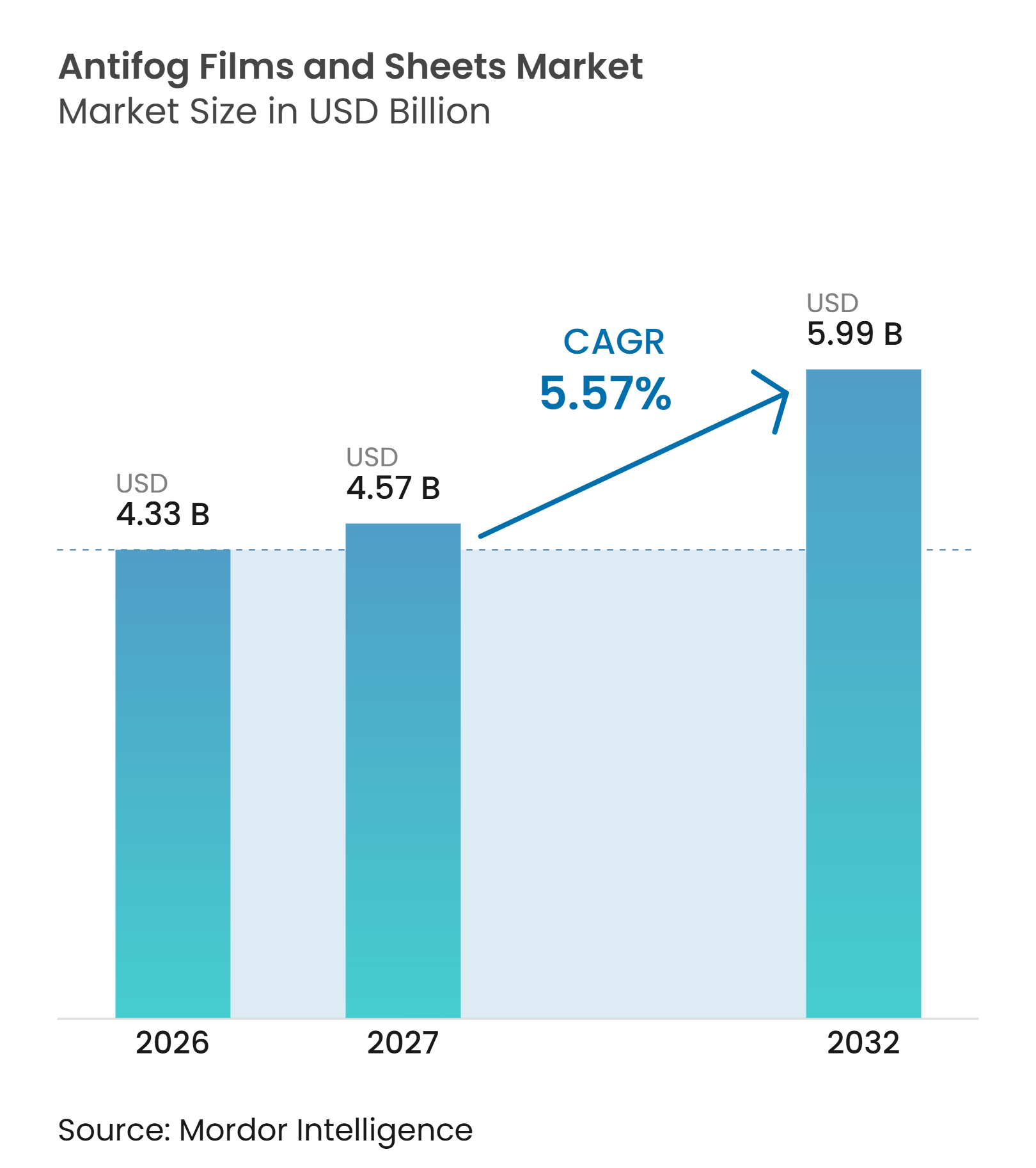
| Market Size (2027) | USD 4.57 Billion |
| Market Size (2032) | USD 5.99 Billion |
| Growth Rate (2027 - 2032) | 5.57 % |
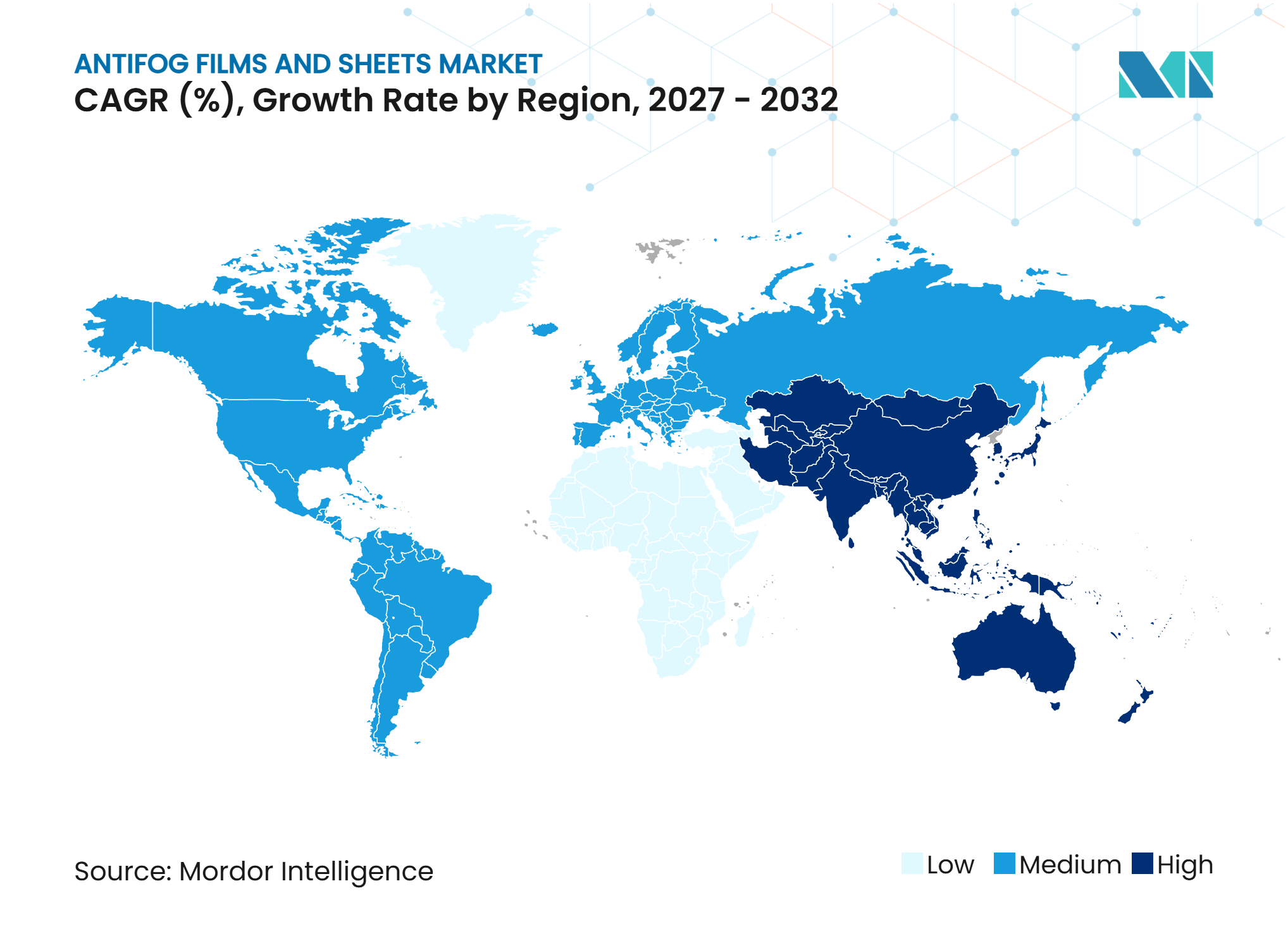
| Fastest Growing Market | Asia-Pacific |
| Largest Market | Asia-Pacific |
| Market Concentration | Medium |
Major Players *Disclaimer: Major Players sorted in no particular order Image © Mordor Intelligence. Reuse requires attribution under CC BY 4.0. | |
Antifog Films and Sheets Market Analysis by Mordor Intelligence
The antifog films and sheets market size was valued at USD 4.33 billion in 2026 and is estimated to grow from USD 4.57 billion in 2027 to USD 5.99 billion by 2032, at a CAGR of 5.57% during the forecast period (2027-2032). The antifog films and sheets market is supported by cold-chain expansion, protected cultivation, and rising requirements for optical clarity in safety eyewear and automotive glazing. Food retailers evaluate these products based on shelf life and waste economics, while original equipment manufacturers focus on optical performance and durability. These different buying priorities drive distinct coating chemistries, substrates, and raw-material choices within the antifog films and sheets market. Producers are responding through per- and polyfluoroalkyl substances (PFAS)-free formulations, water-based systems, UV-curable coatings, and hydrophilic surface designs, while larger packaging groups gain purchasing and distribution scale. Resin and surfactant price volatility, along with stricter food-contact documentation requirements, can extend approval times and increase the operational burden for smaller suppliers.
Key Report Takeaways
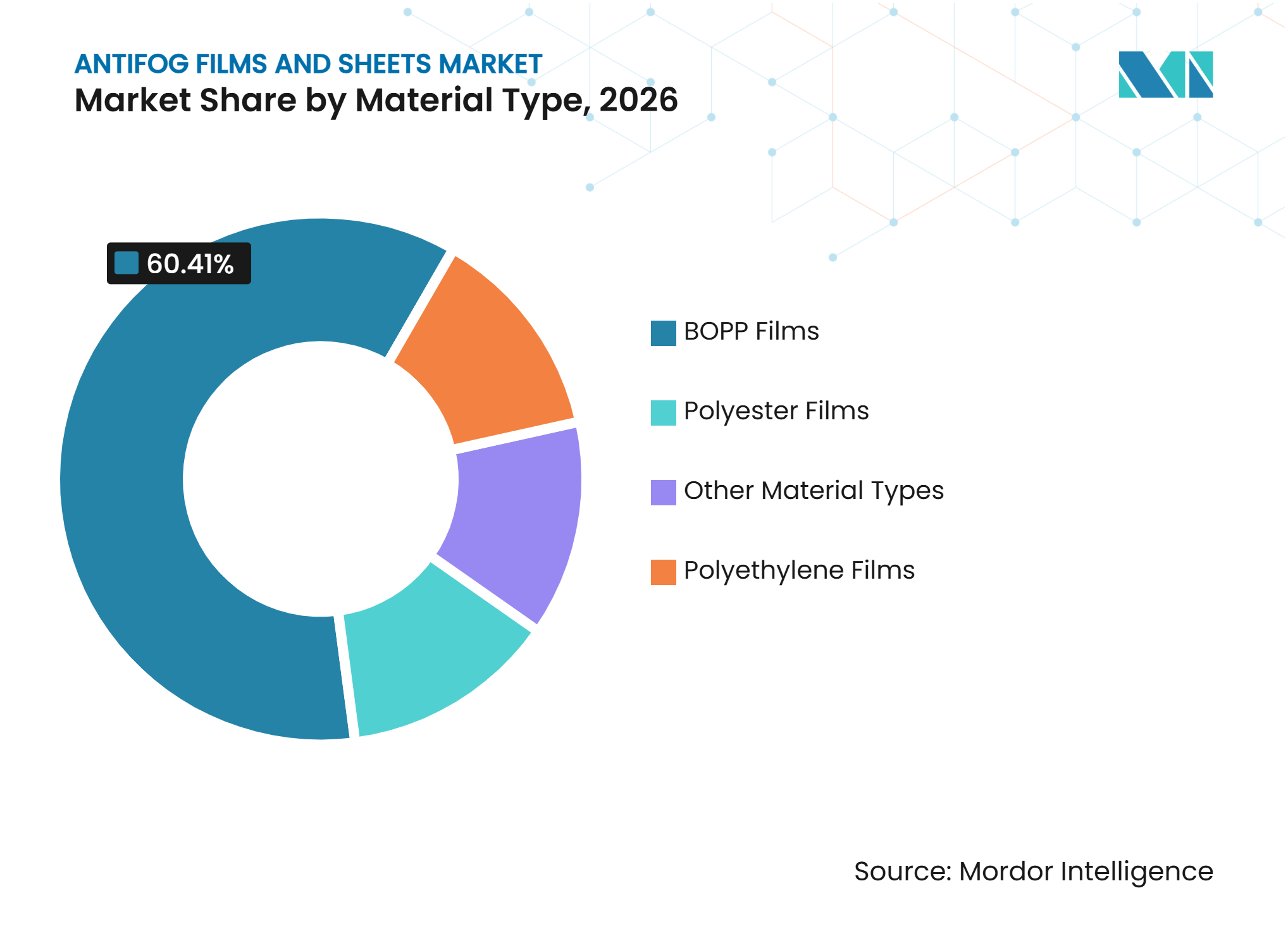
- By material type, Biaxially Oriented Polypropylene (BOPP) Films held 60.41% of the antifog films and sheets market share in 2026, while Polyester Films are forecast to expand at a 6.34% CAGR through 2032.
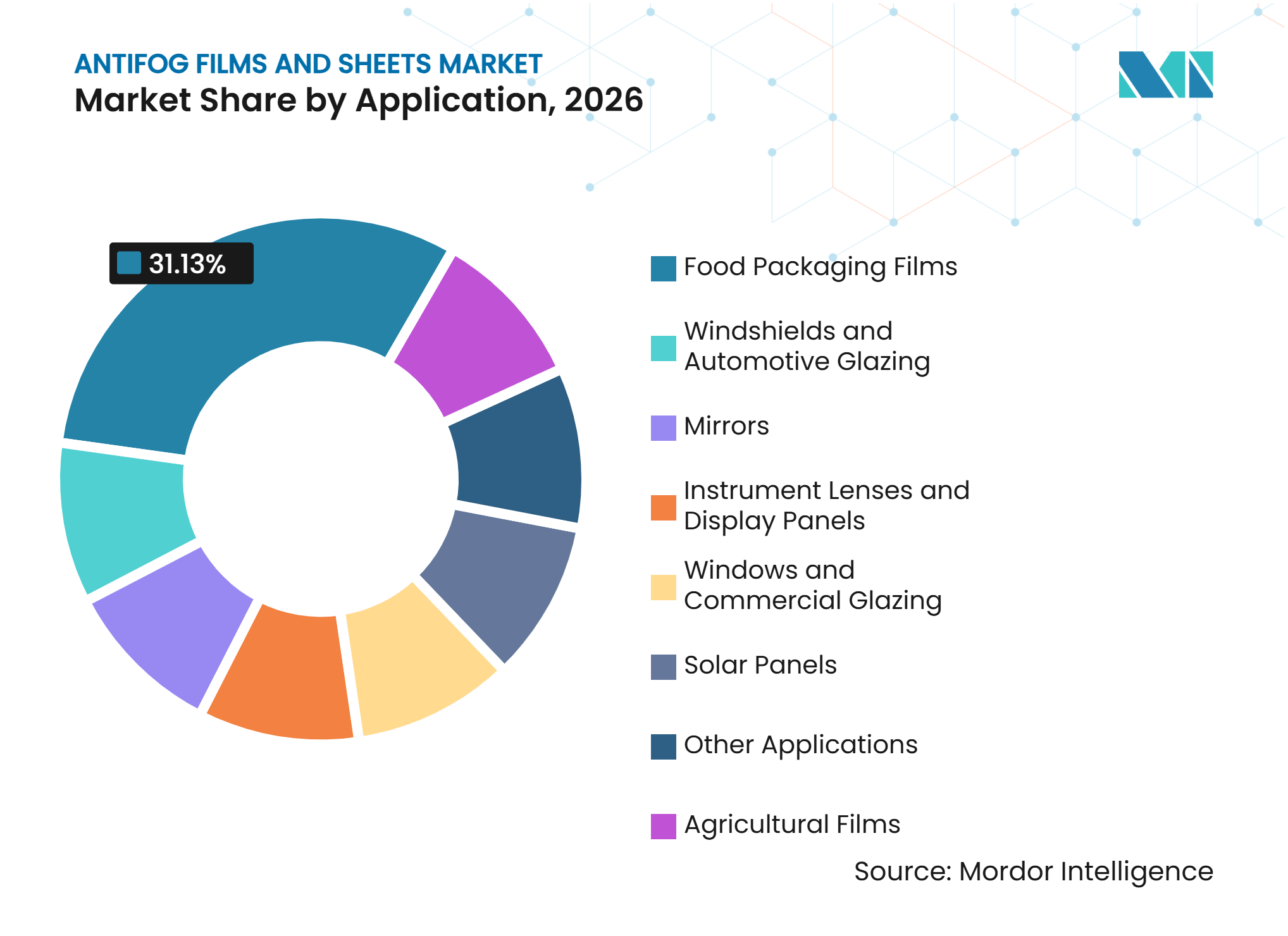
- By application, Food Packaging Films accounted for 31.13% of the antifog films and sheets market share in 2026, while Agricultural Films are forecast to advance at a 6.76% CAGR through 2032.
- By geography, Asia-Pacific held 33.56% of the antifog films and sheets market share in 2026 and is forecast to grow at a 6.44% CAGR through 2032.
Note: Market numbers in this report are based on Mordor Intelligence's proprietary estimation framework, which combines nine months of actuals with Q4 projections for base year 2026.
Market Trends and Insights
Drivers Impact Analysis of Antifog Films and Sheets Market*
| Drivers | (~) % Impact on CAGR Forecast | Geographic Relevance | Impact Timeline |
|---|---|---|---|
| Demand for Visible, Fresh Chilled Food Packaging | +2.0% | Global, with highest intensity in Europe, North America, and Asia-Pacific retail-dense markets | Short term (≤ 2 years) |
| Greenhouse Condensation Control and Light Management | +1.2% | Asia-Pacific core, with China, India, South Korea, and Japan, plus spillover to the Middle East and Africa and Southern Europe | Medium term (2-4 years) |
| Shift Toward Durable Water-Based and UV-Curable Coatings | +0.8% | North America and Europe, with early adoption in Japan and South Korea | Medium term (2-4 years) |
| Growth of Safety, Medical, and Sports Eyewear | +0.7% | Global, with North America and Europe leading and Asia-Pacific growing | Short term (≤ 2 years) |
| Asia-Pacific Packaging, Electronics, and Automotive Manufacturing Scale | +1.0% | Asia-Pacific core, including China, India, ASEAN countries, and South Korea | Long term (≥ 4 years) |
| Source: Mordor Intelligence | |||
Demand for Visible, Fresh Chilled Food Packaging
Chilled-food retailers depend on clear product visibility because shoppers cannot readily assess a product obscured by condensation. In fresh-meat counters, salad bars, and prepared-meal chillers, standard films can form droplets after display-case doors are opened. Hydrophilic antifog layers spread condensed water into a transparent film rather than allowing visible droplets to form. Cosmo Films stated that its antifog BOPET lidding film can extend the shelf life of fresh salads and vegetables by 4-5 days, linking antifog performance with lower retail waste costs. This gives suppliers in the antifog films and sheets market a basis for premium pricing on product protection rather than packaging appearance alone. Direct food-contact adoption also depends on migration testing and documented compliance under the EU framework for plastic food-contact materials.
Greenhouse Condensation Control and Light Management
Protected cultivation is expanding where water availability is limited, land is constrained, or weather is unstable, making open-field production less predictable. Greenhouse antifog films reduce drip damage, but their role also includes managing near-infrared heat and diffusing photosynthetically active radiation across crop canopies. These functions can create more even growing conditions and make film performance more important in purchasing decisions. Kafrit Industries offers antifog additive solutions for agricultural films, including grades designed for various climatic conditions[1]. Suppliers that combine antifog, infrared management, and light diffusion into a single co-extruded structure can reduce growers' need to purchase separate film products.
Shift Toward Durable Water-Based and UV-Curable Coatings
The antifog films and sheets market is shifting from solvent-borne formulations to water-based and UV-curable systems as producers respond to volatile organic compound (VOC) regulations and demand for PFAS-free chemistry. FSI Coating Technologies introduced Visgard Ultra, a PFAS-free antifog coating for medical, safety, and architectural uses, in 2025. UV-curable systems require UV-lamp infrastructure and careful control of substrate surface energy, making the transition more difficult for smaller converters. Large coating specialists with established ultraviolet processing capacity can focus on higher-value architectural and automotive applications. Commodity polyethylene-film converters are more likely to retain kneaded-in surfactant additives for agricultural and food-packaging products. A 2025 peer-reviewed study described photothermal antifog systems, including near-infrared-absorbing coatings, as moving toward commercial applications beyond eyewear.
Growth of Safety, Medical, and Sports Eyewear
Safety, medical, and sports eyewear is a high-value application for antifog films and coatings because lens fogging can affect user safety. ANSI/ISEA Z87.1-2020, EN 166, and EN 168 establish performance requirements that shift competition toward retained antifog performance rather than low unit price. 3M states that its Scotchgard Protector Antifog Coating can resist fogging up to 11 times longer than traditional coatings and remain effective for up to 25 washings. This performance supports a price premium where visibility failures can create occupational risk. Healthcare and food-processing procurement practices have retained antifog specifications across many supply chains following the pandemic. This continuing specification base gives the antifog films and sheets market demand that does not depend solely on short-term health-related purchasing.
Restraints Impact Analysis of Antifog Films and Sheets Market*
| Restraints | (~) % Impact on CAGR Forecast | Geographic Relevance | Impact Timeline |
|---|---|---|---|
| High Production Cost of Specialty Coatings and Additives | -0.7% | Global, with greater limits in cost-sensitive Asia-Pacific and South American markets | Medium term (2-4 years) |
| Raw-Material Price Volatility and Converter Margin Pressure | -0.5% | Global, with sharp pressure in BOPP and polyester manufacturing hubs in India and China | Short term (≤ 2 years) |
| Food-Contact Documentation and Migration-Test Delays | -0.3% | Europe, North America, and Japan, where regulatory influence is strongest | Long term (≥ 4 years) |
| Source: Mordor Intelligence | |||
High Production Cost of Specialty Coatings and Additives
Specialty antifog films require surfactant systems such as glycerol esters, ethoxylated sorbitan esters, or blended systems, which cost more than standard polymer additives. Costs increase further when converters require double-sided heat-sealable antifog formats instead of standard BOPP grades. Cosmo Films lists HST-2(AF) as a transparent antifog packaging film designed for heat-sealing. Converters also need precise process control to prevent surfactant migration to the wrong side of a film during corona treatment. For smaller companies, these requirements make antifog products viable mainly for premium or export accounts, limiting adoption in domestic supply chains where buyers prioritize the lowest packaging cost.
Raw-Material Price Volatility and Converter Margin Pressure
Propylene and purified terephthalic acid are major cost variables for BOPP and polyester antifog films. Their price volatility, driven by crude oil cycles and regional capacity additions, makes it difficult for converters to maintain stable margins. Jindal Poly Films disclosed an investment of INR 700 crore in additional BOPP, PET, and CPP capacity through its subsidiary JPFL Films. The planned addition includes up to 42,000 MT of BOPP, 55,000 MT of PET, and 18,000 MT of CPP capacity. If demand does not absorb the additional output as new lines come online, the additional supply could intensify pricing pressure. Agricultural film converters remain exposed, as their customers generally have limited tolerance for higher film prices.
*Our forecasts treat driver/restraint impacts as directional, not additive. The impact forecasts reflect baseline growth, mix effects, and variable interactions.
Antifog Films and Sheets Market Segment Analysis
By Material Type:
BOPP Dominates, Polyester Films Gain GroundBOPP films held a 60.41% market share in the antifog films and sheets market in 2026, supported by optical clarity, biaxial orientation, and heat-sealing performance for high-speed food-packaging lines. The material remains central to the market because it offers a practical balance of cost, clarity, converting performance, and broad equipment compatibility. Cosmo First commissioned an 81,200 MT-per-year BOPP line in June 2025, increasing total BOPP capacity by 40% to 277,000 MT, with part of the output directed toward specialty antifog and barrier-grade food and pet-food films. Polyethylene films retain an important position in food wrapping and agricultural products where cost and oxygen-transmission performance matter more than optical properties. Established BOPP converter supply chains further support the format's use in large-scale packaging applications.
Polyester films are forecast to grow at a 6.34% CAGR through 2032, supported by temperature resistance, dimensional stability, and suitability for humid environments. Polyester formats are increasingly used in lidding films, display-panel overlays, and solar-panel protective layers. Cosmo Films introduced an antifog, transparent BOPET lidding film in 2025 for fresh salads, meats, and dairy products, compatible with recycling alongside PET trays. This development narrows the sustainability gap between performance films and conventional packaging formats. Other material types, including cellulose diacetate and polycarbonate, serve specialized uses in freezer doors, architectural glazing, and eyewear, while Celanese positions Clarifoil cellulosic film within its biopolymer portfolio.



By Application:
Food Packaging Anchors the Market, Agriculture AcceleratesFood packaging films accounted for 31.13% of the antifog films and sheets market share in 2026, reflecting demand for clear chilled and fresh-food displays. This application shapes product development, as buyers require food-contact compliance, cold-fog and hot-fog performance, heat-seal integrity, and oxygen-transmission control. These specifications influence material selection across BOPP, polyethylene, and polyester products while improving visibility at the point of sale. Cosmo Films markets antifog packaging films for food applications that require transparent surfaces and heat-sealing performance. Regulatory documentation remains a key requirement when coated layers come into direct contact with food.
Agricultural films are forecast to record a 6.76% CAGR through 2032, making them the fastest-growing application in the antifog films and sheets market. Growth is tied to greenhouse expansion in Asia-Pacific, South America, and the Middle East, where protected cultivation supports food security. Automotive glazing and mirrors are smaller but technically demanding applications; FSI's Visgard Premium LTF-300 is designed for mirrors, windows, and related uses where antifog functionality can reduce the need for electric heating elements. Solar panels, instrument lenses, display panels, commercial glazing, and other applications increasingly combine antifog protection with hard coats and anti-reflective layers in multifunctional film structures.

Geography Analysis
Asia-Pacific
Asia-Pacific held 33.56% of the antifog films and sheets market share in 2026 and is forecast to expand at a 6.44% CAGR through 2032. Demand across several end uses is supported by China's greenhouse agriculture, India's cold-chain expansion, Japan and South Korea's quality requirements for food lidding and automotive glazing, and the modernization of ASEAN food retail. JPFL Films announced plans to expand in Nashik, adding BOPP, PET, and CPP capacity, reinforcing the role of Indian production in the regional film supply. China's food-safety packaging regulations and Japan's Ministry of Health, Labor and Welfare Notification No. 370 create compliance requirements that favor higher-quality film and coating systems. The region's combined production scale, domestic consumption, and technical requirements give it a broad role in the antifog films and sheets market.
North America
North America is characterized by high per-unit product value, strict compliance requirements, and demand from the food service and specialty retail sectors. FDA 21 Code of Federal Regulations (CFR) 177.1520 governs requirements for food-contact packaging materials in the United States. The regional supply base includes 3M, FSI Coating Technologies, Celanese, and Specialty America Inc., which focus on coated and high-performance products for the antifog films-and-sheets market. Specialty Polyfilms presented Forvara TW-40 NG U&U non-polyvinyl chloride (PVC) food-wrapping films at Pack Expo 2025, a product designed to meet the requirements of FDA 21 CFR 177.1520 and EU Regulation No. 10/2011. FSI's PFAS-free Visgard Ultra reflects demand for durable coatings in medical, safety, and architectural applications.
Europe, South America, and Middle East and Africa
Europe combines advanced food retail, strict food-contact regulation, and established greenhouse horticulture in the Netherlands, Spain, and Italy. Regulation (EU) 2025/351 is driving inventory adjustments and reformulation activity, as transitional provisions allow materials that were compliant before March 2025 to remain on the market until stocks are exhausted, subject to the September 2026 deadline. South America is concentrated around Brazil's fresh-produce export chain and Argentina's greenhouse vegetable production, although price sensitivity limits the adoption of premium products. Saudi Arabia's Vision 2030 food-security investment and South Africa's cold-chain retail growth are generating early-stage demand for agricultural and food-packaging films in the Middle East and Africa.
Competitive Landscape
Market Concentration
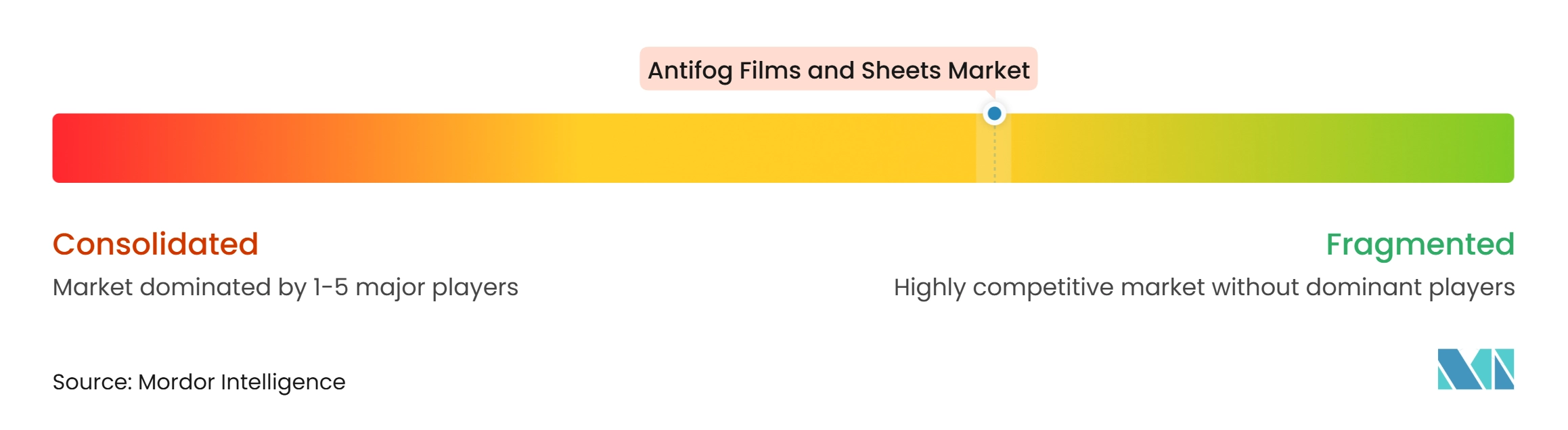
The antifog films and sheets market is moderately fragmented. FSI Coating Technologies, Celanese, and SABIC possess specialized formulation and materials capabilities that require significant research and development resources, whereas regional converters commonly use commodity additives on standard substrates. Amcor completed its combination with Berry Global on April 30, 2025. The combined company has flexible-packaging operations across 36 countries, annual revenue above USD 15 billion, and 75,000 employees. This scale strengthens purchasing and distribution capabilities for flexible packaging, including antifog-enabled formats.
Technology remains the primary basis for differentiation in the antifog films and sheets market. FSI Coating Technologies introduced Visgard Ultra in 2025 as a PFAS-free coating for military, medical, and eyewear applications. Mitsui Chemicals expanded SDC Technologies' research, development, and manufacturing base in the United States in November 2025, supporting lens coating and antifog work in vision care, automotive, and construction. Cosmo First and Jindal Poly Films are combining capacity additions with specialty-film programs for higher-value applications. These approaches illustrate how price, technical performance, and supply scale can function together in supplier strategy.
Sumitomo Bakelite acquired AGC Group's polycarbonate business in July 2025, strengthening access to substrate supply for sheet and film products. The company also markets co-extruded multilayer film and sheet products for food packaging[2]. Limited availability of products combining long-season agricultural antifog durability with compostable substrates leaves room for specialized offerings in the antifog films and sheets market. Smaller converters can compete through local supply, lower-cost formats, or application-specific specialization.
Antifog Films and Sheets Industry Leaders
-
3M
-
Amcor plc
-
SABIC
-
Berry Global Inc.
-
FSI Coating Technologies, Inc.
- *Disclaimer: Major Players sorted in no particular order
Antifog Films and Sheets Market Companies Covered in this Report
- 3M
- Amcor plc
- Berry Global Inc.
- Celanese Corporation
- Cosmo Films
- DuPont
- FSI Coating Technologies, Inc.
- Jindal Poly Films Limited
- Kafrit Industries Ltd.
- Mitsui Chemicals, Inc.
- SABIC
- Specialty Polyfilms India Pvt. Ltd.
- Sumitomo Bakelite Co., Ltd.
- TORAY INDUSTRIES, INC.
- WeeTect Material Limited
Recent Industry Developments in Antifog Films and Sheets Market
- November 2025: Mitsui Chemicals announced the expansion of SDC Technologies' R&D and manufacturing base in the United States. The expansion aimed to accelerate SDC's and subsidiary FSI Coating Technologies' capabilities across antifog, photochromic, and hard-coat formulations for eyewear, automotive, construction, and medical markets, broadening the commercial reach of Mitsui's antifog films and sheets platform globally.
- July 2025: Sumitomo Bakelite announced the acquisition of AGC Group's polycarbonate business, adding polycarbonate substrate capacity to its existing multilayer antifog food-packaging film operations. The acquisition strengthened Sumitomo Bakelite's vertical integration in antifog sheet and film products and expanded its addressable market in high-performance glazing and optical antifog applications.
Global Antifog Films and Sheets Market Report Scope
Antifog films and sheets are transparent plastic, polymer, or glass-like materials designed to prevent condensation and fogging on their surfaces. These materials are widely used across industries such as food packaging, agriculture, medical devices, and consumer goods, where optical clarity is essential. The antifog property is achieved either by applying a surface coating or by incorporating antifog additives directly into the base material during manufacturing.
The antifog films and sheets market is segmented by material type, application, and geography. By material type, the market is segmented into polyethylene films, BOPP films, polyester films, and other material types. By application, the market is segmented into food packaging films, agricultural films, windshields and automotive glazing, mirrors, instrument lenses and display panels, windows and commercial glazing, solar panels, and other applications. The report also covers market sizes and forecasts for antifog films and sheets across 15 countries in major regions. The market sizes and forecasts are provided in terms of value (USD).
Segmentation Overview
| Polyethylene Films |
| BOPP Films |
| Polyester Films |
| Other Material Types |
| Food Packaging Films |
| Agricultural Films |
| Windshields and Automotive Glazing |
| Mirrors |
| Instrument Lenses and Display Panels |
| Windows and Commercial Glazing |
| Solar Panels |
| Other Applications |
| Asia-Pacific | China |
| India | |
| Japan | |
| South Korea | |
| ASEAN Countries | |
| Rest of Asia-Pacific | |
| North America | United States |
| Canada | |
| Mexico | |
| Europe | Germany |
| United Kingdom | |
| France | |
| Italy | |
| NORDIC Countries | |
| Rest of Europe | |
| South America | Brazil |
| Argentina | |
| Rest of South America | |
| Middle East and Africa | Saudi Arabia |
| South Africa | |
| Rest of Middle East and Africa |
| By Material Type | Polyethylene Films | |
| BOPP Films | ||
| Polyester Films | ||
| Other Material Types | ||
| By Application | Food Packaging Films | |
| Agricultural Films | ||
| Windshields and Automotive Glazing | ||
| Mirrors | ||
| Instrument Lenses and Display Panels | ||
| Windows and Commercial Glazing | ||
| Solar Panels | ||
| Other Applications | ||
| By Geography | Asia-Pacific | China |
| India | ||
| Japan | ||
| South Korea | ||
| ASEAN Countries | ||
| Rest of Asia-Pacific | ||
| North America | United States | |
| Canada | ||
| Mexico | ||
| Europe | Germany | |
| United Kingdom | ||
| France | ||
| Italy | ||
| NORDIC Countries | ||
| Rest of Europe | ||
| South America | Brazil | |
| Argentina | ||
| Rest of South America | ||
| Middle East and Africa | Saudi Arabia | |
| South Africa | ||
| Rest of Middle East and Africa | ||
Key Questions Answered in the Report
What is current market size of Antifog Films and Sheets Market?
The antifog films and sheets market size was valued at USD 4.33 billion in 2026 and is estimated to grow from USD 4.57 billion in 2027 to USD 5.99 billion by 2032, at a CAGR of 5.57% during the forecast period (2027-2032).
Which material drives demand for antifog film?
BOPP films lead with a 60.41% share in 2026 because they combine optical clarity, heat-sealing performance, and cost-effective processing.
Which application is growing fastest for antifog films?
Agricultural films are projected to grow at a 6.76% CAGR through 2032, supported by greenhouse expansion and demand for condensation control, infrared management, and light diffusion.
Why are antifog films used in food packaging?
Hydrophilic antifog layers spread condensation across a transparent surface, supporting product visibility in chilled displays. Food-contact compliance and migration testing remain essential requirements.