
GCC Fruit And Vegetable Market Analysis by Mordor Intelligence
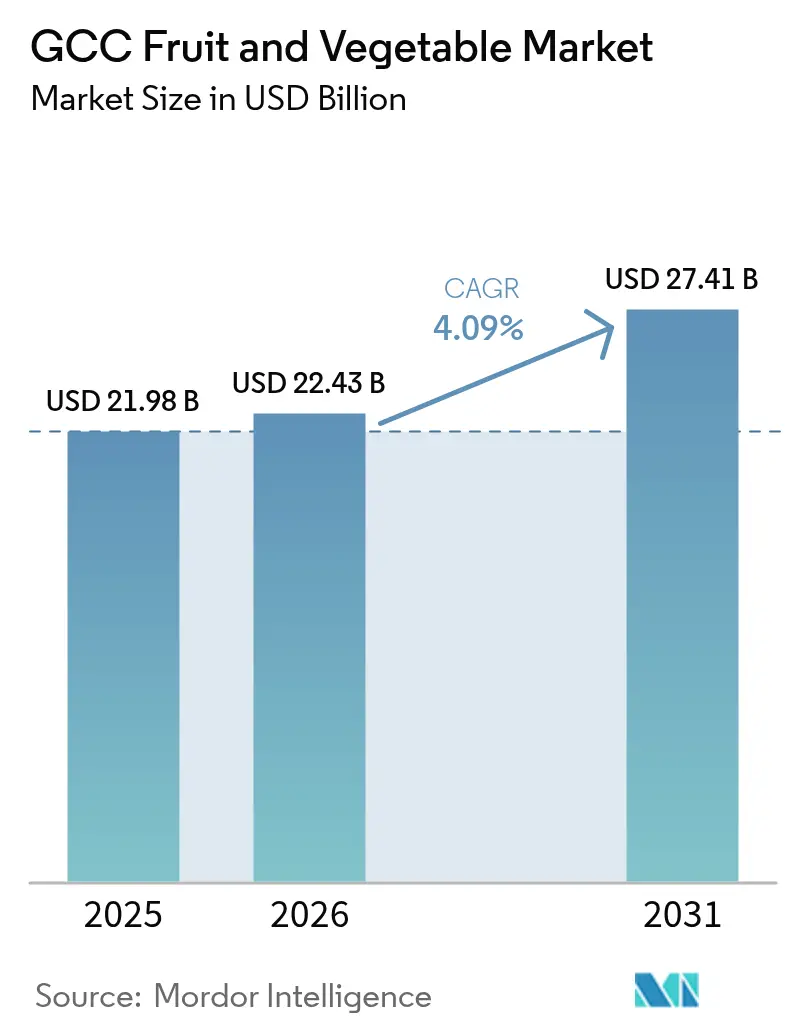
The GCC fruit and vegetable market size is projected to increase from USD 21.98 billion in 2025 to USD 22.43 billion in 2026 and reach USD 27.41 billion by 2031, growing at a CAGR of 4.09% over 2026-2031. Expanding protected-cultivation acreage, sovereign food-security funds, and dual-use agri-voltaic projects are raising domestic output and lowering post-harvest losses. Sovereign mandates to lift self-sufficiency have unlocked capital for climate-controlled greenhouses, hydroponics, and vertical farms, while desalination-brine valorization is trimming fertilizer import bills. Consumption targets of 400 grams per person per day are accelerating premiumization, and retail chains are carving out shelf space for locally grown produce. Competitive intensity remains moderate, yet technology adoption, artificial-intelligence climate optimization, Internet of Things fertigation control, and blockchain traceability are widening the gap between integrated operators and smallholders.
Key Report Takeaways
- By geography, Saudi Arabia led with 41.6% of the GCC fruit and vegetable market share in 2025, while the United Arab Emirates is forecast to expand at a 5.0% CAGR through 2031.
Note: Market size and forecast figures in this report are generated using Mordor Intelligence’s proprietary estimation framework, updated with the latest available data and insights as of 2026.
GCC Fruit And Vegetable Market Trends and Insights
Drivers Impact Analysis*
| Driver | (~) % Impact on CAGR Forecast | Geographic Relevance | Impact Timeline |
|---|---|---|---|
| Expanding protected cultivation acreage | +0.6% | Saudi Arabia, United Arab Emirates, and Qatar | Medium term (2-4 years) |
| Government food-security funds for desert agriculture | +0.5% | All six Gulf Cooperation Council states | Long term (≥ 4 years) |
| Agri-voltaic projects monetizing dual land use | +0.5% | United Arab Emirates, Saudi Arabia, and Oman | Medium term (2-4 years) |
| Increasing per-capita fruit and vegetable intake targets | +0.6% | All six Gulf Cooperation Council states | Long term (≥ 4 years) |
| Surplus desalination brine valorized for fertigation | +0.3% | Saudi Arabia, United Arab Emirates, and Kuwait | Short term (≤ 2 years) |
| Proven yield gains from hydroponics and vertical farms | +0.4% | United Arab Emirates, Qatar, and Bahrain | Short term (≤ 2 years) |
| Source: Mordor Intelligence | |||


Expanding Protected-Cultivation Acreage
Protected agricultural structures expanded significantly by the end of 2025, with a notable increase from the previous year, as farmers prioritized safeguarding crops from extreme summer temperatures that often exceed 45 degrees Celsius. The use of greenhouses has proven effective in extending growing seasons by several months and significantly reducing water consumption, particularly in regions with limited renewable freshwater resources. During this period, Qatar made substantial progress by commissioning additional protected structures, which contributed to a considerable improvement in its vegetable self-sufficiency. Similarly, the AgTech Park initiative in the United Arab Emirates set ambitious production goals to address a portion of Abu Dhabi's vegetable demand.
Government Food-Security Funds for Desert Agriculture
The United Arab Emirates is making significant investments in food security through strategic funds, aiming to become a global leader by 2051. The United Arab Emirates launched the National Strategy for Food Security in 2024, aiming to position the country as the best in the Global Food Security Index by 2051. This strategy focuses on developing a comprehensive national system to enable sustainable food production through modern technologies and enhanced local production[1]Source: Government of the United Arab Emirates, “UAE Food Security Strategy 2051,” u.ae. Qatar’s updated strategy aims to achieve 70% local leafy-green supply by 2030. These investments address long payback periods, secure long-term renewable power contracts, and require GlobalG.A.P. compliance as a financing condition. Consequently, capital-intensive facilities are scaling up more rapidly, advancing the GCC fruit and vegetable market toward improved quality standards.
Increasing Per-Capita Fruit and Vegetable Intake Targets
The nutrition campaigns in the United Arab Emirates and Saudi Arabia aim to increase annual consumption of fruits and vegetables, thereby driving demand for fresh produce. In 2024, the Ministry of Health and Prevention (MoHAP) launched a nutrition-focused awareness campaign to improve community health by encouraging the inclusion of fruits and vegetables in daily diets. The campaign was conducted across the United Arab Emirates, providing practical guidance on incorporating essential fruits and vegetables into regular meals and addressing challenges such as affordability, availability, and time constraints that hinder healthy eating[2]Source: Ministry of Health and Prevention, "MoHAP concludes nationwide campaign to boost health with fruits and vegetables," mohap.gov.ae. Saudi Arabia introduced origin labels in 2025 that favor greenhouse produce over imports. Retailers Lulu Hypermarket and Carrefour responded by expanding local-product aisles, mirroring the growth of the GCC fruit and vegetable market.
Surplus Desalination Brine Valorized for Fertigation
In 2025, a significant volume of reject brine was generated, amounting to billions of cubic meters. The Saudi utility company Marafiq undertook mineral extraction at its Jubail facility, contributing to a notable reduction in the country's reliance on imported fertilizers. During the same year, the United Arab Emirates committed substantial financial resources to upgrading multiple plants, with the objective of achieving a considerable production of nutrient salts within a few years. The Gulf Cooperation Council Standardization Organization has introduced a classification system that designates these inputs as organic, provided their heavy-metal concentration remains within permissible limits. The practice of reusing brine helps minimize marine discharge, significantly reduces fertilizer costs, and supports the objectives of Sustainable Development Goal Twelve, thereby creating a positive impact on the fruit and vegetable market in the GCC region.
Restraints Impact Analysis*
| Restraint | (~) % Impact on CAGR Forecast | Geographic Relevance | Impact Timeline |
|---|---|---|---|
| Shrinking groundwater reserves in arid regions | −0.7% | Saudi Arabia, Oman, and Kuwait | Long term (≥ 4 years) |
| Volatile energy prices inflating controlled-environment costs | −0.5% | All six Gulf Cooperation Council states | Short term (≤ 2 years) |
| High salinity drift clogging drip lines | −0.3% | United Arab Emirates, Bahrain, and Kuwait | Medium term (2-4 years) |
| Bio-security risks from expanding seed-import channels | −0.2% | All six Gulf Cooperation Council states | Short term (≤ 2 years) |
| Source: Mordor Intelligence | |||
Volatile Energy Prices Inflating Controlled-Environment Costs
Fluctuating energy prices are significantly increasing the operating costs of controlled-environment (CE) sectors, including vertical farming and greenhouse agriculture. High energy consumption, coupled with unpredictable spikes in electricity and natural gas prices, is raising operational expenses, impacting profitability, and complicating long-term planning for these energy-intensive industries. In 2024, commercial tariffs in the United Arab Emirates increased by 25%, with cooling and lighting accounting for up to 40% of greenhouse operating expenses. In Saudi Arabia, peak-hour surcharges rose by 15% during the summer of 2025. Controlled-environment facilities require 150-250 kilowatt-hours per square meter annually, putting margin pressure on operators lacking on-site solar energy solutions. Brent crude prices fluctuated between USD 70 and USD 95 per barrel in 2025, impacting subsidy levels. These cost increases have delayed capacity expansions and shifted focus toward retrofitting, thereby moderating growth in the GCC fruit and vegetable market.
High Salinity Drift Clogging Drip Lines
Electrical conductivity levels ranging from 4 to 16 deciSiemens per meter affect 60-80% of cultivated land. In 2025, 40% of drip irrigation systems in the United Arab Emirates required unscheduled maintenance due to salt deposits. Desalinated water continues to contain boron and chloride, which accumulate during high-frequency fertigation. Bahrain has mandated soil testing every six months, increasing the significant compliance cost[3]Source: Ministry of Works Bahrain, “Soil Salinity Testing Rules,” works.gov.bh. While reverse-osmosis pre-treatment and salt-tolerant rootstocks are available, their adoption remains low, limiting growth in certain segments of the GCC fruit and vegetable market.
*Our forecasts treat driver/restraint impacts as directional, not additive. The impact forecasts reflect baseline growth, mix effects, and variable interactions.
Geography Analysis
Saudi Arabia was the largest geographic segment, accounting for 41.6% of the GCC fruit and vegetable market share in 2025. According to the Ministry of Environment, Water, and Agriculture, Saudi Arabia’s annual date production exceeded 1.9 million metric tons in 2023. The total number of palm trees across all regions increased to 37.1 million, of which approximately 31.8 million are fruit-bearing. Al-Qassim Province led in date production across all varieties, producing over 578,100 metric tons. The total number of palm trees in the province, including productive ones, surpassed 10.7 million. Subsidized drip irrigation upgrades have reduced water use by 70%, while aquifer drawdown of up to 5 meters annually has necessitated a shift to desalination, underscoring the need to cultivate high-value crops.
The United Arab Emirates sets the growth pace at 5.0% CAGR through 2031. AgTech Park hosts 12 ventures that produce 40 metric tons of greens annually, and Bustanica supplies 3,000 kilograms daily with zero-day inventory. Retrofitting three desalination plants to produce brine-derived nutrients reduces fertilizer imports and meets circular-economy goals. Electricity rate hikes pressured margins in 2024, but on-site solar mitigated costs, underscoring the resilience of the GCC fruit and vegetable market.
Qatar, Oman, Kuwait, and Bahrain account for the remaining market share. Qatar's National Food Security Strategy 2030 aims to achieve 55% self-sufficiency in local vegetable production. The strategy also aims to increase agricultural land productivity by 50% to meet the targeted production levels. Oman has implemented extraction quotas to reduce cultivated acreage while extending the lifespan of aquifers. Kuwait and Bahrain are piloting vertical farming techniques that reduce water usage by 90% and limit post-harvest losses to below 5%. Intraregional trade remains limited due to overlapping agricultural calendars and non-tariff barriers, with India, Egypt, and Iran continuing as the primary suppliers.
Regulatory Landscape
Fresh fruit and vegetable trade across the GCC is governed by harmonized technical regulations developed through the Gulf Standardization Organization (GSO) and applied through country-level enforcement. Imports typically require a phytosanitary certificate and a certificate of origin, while food-safety controls focus on pesticide maximum residue limits aligned with Codex and implemented via national border-inspection and clearance systems.
Saudi Arabia has tightened and digitized import compliance via the Saudi Food and Drug Authority (SFDA), with shipment registration through the Ghad platform and clearance workflow through Fasah. In April 2025, SFDA updated its Conditions and Requirements for Food Clearance, reinforcing importer registration and documentation requirements for fresh produce. In the United Arab Emirates, the Ministry of Climate Change and Environment (MOCCAE) manages release procedures for agricultural consignments and requires prior approvals for new food items, with residue compliance against established MRLs. Labeling treatment also differs by category, with fresh produce generally exempt from standard expiry-date labeling under UAE S 9:2019 while still requiring clear packing or harvest marking.
Value Chain Analysis
The GCC fruit and vegetable value chain spans input supply (seeds, substrates, fertilizers, crop protection, irrigation hardware, and energy), production (open field, protected cultivation, hydroponics, and vertical farms), aggregation and post-harvest handling (grading, packing, and processing), and distribution through wholesale markets and modern retail. In-country production is increasingly organized around controlled-environment assets to manage extreme heat (often above 45 degrees Celsius) and water scarcity, while food-security funds and programs accelerate capex-heavy greenhouses and vertical farms that integrate AI climate optimization and IoT fertigation.
Trade and logistics remain critical because imports still anchor year-round availability, creating exposure to maritime chokepoints such as the Strait of Hormuz, Bab al-Mandab, and the Suez Canal, alongside freight volatility and port-level inspection delays. Food-safety enforcement at destination, including SFDA controls on pesticide residues, raises the value of documented compliance (ISO/IEC 17025 testing, traceability, and standardized packing), and poor cold-chain coverage contributes to elevated losses (commonly cited at 30-40% before the consumer). This has driven investment toward temperature-controlled storage, reefer distribution, and automated packhouse capability. Government-backed platforms and projects, such as Abu Dhabi's AGWA cluster and the May 2025 Silal and Shouguang Vegetable Industry Group Al Ain greenhouse and post-harvest processing megaproject (AED 120 million), indicate a shift toward more vertically integrated local supply for modern retail and e-grocery channels.
Competitive Landscape
The GCC fruit and vegetable market remains moderately concentrated. In December 2023, United Arab Emirates-based agritech company Pure Harvest Smart Farms announced the acquisition of RedSea's controlled-environment agriculture (CEA) production facility in Saudi Arabia. This acquisition includes a 6-hectare farm near Riyadh and a 40-hectare land bank, enabling Pure Harvest to expand its regional presence in the GCC. Bustanica demonstrates scale with 3,000 kilograms daily output that bypasses wholesale markets. Artificial-intelligence climate software, Internet of Things sensors, and blockchain traceability are becoming standard, widening efficiency gaps.
Opportunities exist in salt-tolerant cultivars, brine-derived fertilizers, and agri-voltaics. These innovations address challenges in arid and saline environments, enhancing agricultural sustainability and improving resource efficiency. Salt-tolerant cultivars enable farming in high-salinity soils, expanding the availability of arable land. Agri-voltaics, which combine agriculture with solar energy production, optimize land use by generating renewable energy while crops are cultivated. Masdar and Elite Agro’s Al Foah project has increased land productivity by up to 60% while producing renewable electricity, showcasing the potential of integrated solutions to address food and energy security. Saudi Arabia is pursuing 500 megawatts of agri-voltaic capacity, promoting diversified farm revenue streams, supporting the transition to renewable energy in agriculture, and contributing to the country’s broader sustainability goals.
Leafy greens and herbs are dominated by five to seven vertical farms, whereas tomatoes and cucumbers remain fragmented among hundreds of greenhouse operators. Retailers Carrefour and Lulu Hypermarket now offer shelf-space incentives for traceable local produce. Patent filings on light-spectrum optimization and climate algorithms increased in 2025, signaling intensifying innovation in the GCC fruit and vegetable market.
Market Opportunities and Future Outlook
Opportunities center on scaling water-efficient domestic supply, upgrading post-harvest infrastructure, and building compliance-led trade programs to reduce border rejections and improve shelf life. Government and quasi-government platforms create visible openings for suppliers of greenhouse systems, hydroponic channels, climate-control equipment, residue-testing and traceability solutions, and renewable-power integration, aligned with national food-security agendas (for example, the UAE National Strategy for Food Security 2051 launched in 2024) and financing-linked standards such as GlobalG.A.P. requirements.
Active projects also point to demand for capacity build-out in controlled-environment production and circular inputs. In the UAE, Dubai Food Tech Valley's GigaFarm program has been positioned to grow around 3 million kg of produce annually and replace 1% of fresh produce imports, while Abu Dhabi has announced a USD 130 million vertical-farming partnership (Plenty Unlimited and Mawarid Holding) targeting 2 million kg of strawberries annually, supporting premium and locally branded produce lines in modern retail. Complementary opportunities sit in brine-derived fertigation nutrients, supported by GSO classification that can designate these inputs as organic when heavy metals are within limits, and in energy cost management, given the documented impact of tariff increases on greenhouse operating costs and the operational advantage of on-site solar and agri-voltaic configurations already trialed in the region.
Recent Industry Developments
- June 2026: Silal Group and Delphy announced a five-year strategic partnership focused on agricultural training and capacity building, including programs linked to Delphy Research Centres. The collaboration supports workforce development for controlled-environment and high-efficiency farming systems that are expanding across the UAE. It also strengthens the local ecosystem for standardized agronomy practices and compliance-oriented production.
- November 2025: The Qatar Ministry of Municipality launched the 2025/2026 seasonal vegetable markets (yards) in locations including Al Khor, Al Thakhira, Al Wakrah, Al Shamal, and Al Shahaniya to support direct sales of local agricultural products. By expanding structured routes to market for domestic growers, the initiative improves price realization and reduces reliance on import-heavy wholesale channels. The initiative aligns with Qatar's self-sufficiency objectives for vegetables under its national food security agenda.
- September 2025: Saudi Arabia's Ministry of Environment, Water, and Agriculture (MEWA) implemented stricter packaging and labeling rules for fruits and vegetables sold in public markets, requiring Arabic labels with product identity, net weight, packaging date, origin, and supplier or producer details. The measures raise baseline quality and traceability requirements across domestic and imported supply. They also raise compliance expectations for growers, packers, and importers operating in the Saudi market.


Research Methodology Framework and Report Scope
Market Definition and Coverage
For this methodology, the market covers the value of fruits and vegetables consumed in GCC countries, combining locally produced supply with imported supply, and reflecting the traded value in the domestic market across the year.
Scope exclusions: This sizing does not treat packaged juices, ready-to-eat meals, or non-produce ingredients as part of the fruits and vegetables market.
Segmentation Overview
-
By Geography
-
United Arab Emirates
-
Fruits
-
Production Analysis
- Production Volume
- Area Harvested and Yield
- Consumption Analysis (Value and Volume)
-
Trade Analysis (Value and Volume)
-
Import Market Analysis
- Import Value and Volume
- Key Supplying Markets
-
Export Market Analysis
- Export Value and Volume
- Key Destination Markets
-
Import Market Analysis
- Wholesale Price Trend Analysis and Forecast
- Regulatory Framework
- Seasonality Analysis
- Logistics and Infrastructure
- List of Key Players
-
Production Analysis
-
Vegetables
-
Production Analysis
- Production Volume
- Area Harvested and Yield
- Consumption Analysis (Value and Volume)
-
Trade Analysis (Value and Volume)
-
Import Market Analysis
- Import Value and Volume
- Key Supplying Markets
-
Export Market Analysis
- Export Value and Volume
- Key Destination Markets
-
Import Market Analysis
- Wholesale Price Trend Analysis and Forecast
- Regulatory Framework
- Seasonality Analysis
- Logistics and Infrastructure
- List of Key Players
-
Production Analysis
-
Fruits
-
Bahrain
-
Fruits
-
Production Analysis
- Production Volume
- Area Harvested and Yield
- Consumption Analysis (Value and Volume)
-
Trade Analysis (Value and Volume)
-
Import Market Analysis
- Import Value and Volume
- Key Supplying Markets
-
Export Market Analysis
- Export Value and Volume
- Key Destination Markets
-
Import Market Analysis
- Wholesale Price Trend Analysis and Forecast
- Regulatory Framework
- Seasonality Analysis
- Logistics and Infrastructure
- List of Key Players
-
Production Analysis
-
Vegetables
-
Production Analysis
- Production Volume
- Area Harvested and Yield
- Consumption Analysis (Value and Volume)
-
Trade Analysis (Value and Volume)
-
Import Market Analysis
- Import Value and Volume
- Key Supplying Markets
-
Export Market Analysis
- Export Value and Volume
- Key Destination Markets
-
Import Market Analysis
- Wholesale Price Trend Analysis and Forecast
- Regulatory Framework
- Seasonality Analysis
- Logistics and Infrastructure
- List of Key Players
-
Production Analysis
-
Fruits
-
Kuwait
-
Fruits
-
Production Analysis
- Production Volume
- Area Harvested and Yield
- Consumption Analysis (Value and Volume)
-
Trade Analysis (Value and Volume)
-
Import Market Analysis
- Import Value and Volume
- Key Supplying Markets
-
Export Market Analysis
- Export Value and Volume
- Key Destination Markets
-
Import Market Analysis
- Wholesale Price Trend Analysis and Forecast
- Regulatory Framework
- Seasonality Analysis
- Logistics and Infrastructure
- List of Key Players
-
Production Analysis
-
Vegetables
-
Production Analysis
- Production Volume
- Area Harvested and Yield
- Consumption Analysis (Value and Volume)
-
Trade Analysis (Value and Volume)
-
Import Market Analysis
- Import Value and Volume
- Key Supplying Markets
-
Export Market Analysis
- Export Value and Volume
- Key Destination Markets
-
Import Market Analysis
- Wholesale Price Trend Analysis and Forecast
- Regulatory Framework
- Seasonality Analysis
- Logistics and Infrastructure
- List of Key Players
-
Production Analysis
-
Fruits
-
Oman
-
Fruits
-
Production Analysis
- Production Volume
- Area Harvested and Yield
- Consumption Analysis (Value and Volume)
-
Trade Analysis (Value and Volume)
-
Import Market Analysis
- Import Value and Volume
- Key Supplying Markets
-
Export Market Analysis
- Export Value and Volume
- Key Destination Markets
-
Import Market Analysis
- Wholesale Price Trend Analysis and Forecast
- Regulatory Framework
- Seasonality Analysis
- Logistics and Infrastructure
- List of Key Players
-
Production Analysis
-
Vegetables
-
Production Analysis
- Production Volume
- Area Harvested and Yield
- Consumption Analysis (Value and Volume)
-
Trade Analysis (Value and Volume)
-
Import Market Analysis
- Import Value and Volume
- Key Supplying Markets
-
Export Market Analysis
- Export Value and Volume
- Key Destination Markets
-
Import Market Analysis
- Wholesale Price Trend Analysis and Forecast
- Regulatory Framework
- Seasonality Analysis
- Logistics and Infrastructure
- List of Key Players
-
Production Analysis
-
Fruits
-
Qatar
-
Fruits
-
Production Analysis
- Production Volume
- Area Harvested and Yield
- Consumption Analysis (Value and Volume)
-
Trade Analysis (Value and Volume)
-
Import Market Analysis
- Import Value and Volume
- Key Supplying Markets
-
Export Market Analysis
- Export Value and Volume
- Key Destination Markets
-
Import Market Analysis
- Wholesale Price Trend Analysis and Forecast
- Regulatory Framework
- Seasonality Analysis
- Logistics and Infrastructure
- List of Key Players
-
Production Analysis
-
Vegetables
-
Production Analysis
- Production Volume
- Area Harvested and Yield
- Consumption Analysis (Value and Volume)
-
Trade Analysis (Value and Volume)
-
Import Market Analysis
- Import Value and Volume
- Key Supplying Markets
-
Export Market Analysis
- Export Value and Volume
- Key Destination Markets
-
Import Market Analysis
- Wholesale Price Trend Analysis and Forecast
- Regulatory Framework
- Seasonality Analysis
- Logistics and Infrastructure
- List of Key Players
-
Production Analysis
-
Fruits
-
Saudi Arabia
-
Fruits
-
Production Analysis
- Production Volume
- Area Harvested and Yield
- Consumption Analysis (Value and Volume)
-
Trade Analysis (Value and Volume)
-
Import Market Analysis
- Import Value and Volume
- Key Supplying Markets
-
Export Market Analysis
- Export Value and Volume
- Key Destination Markets
-
Import Market Analysis
- Wholesale Price Trend Analysis and Forecast
- Regulatory Framework
- Seasonality Analysis
- Logistics and Infrastructure
- List of Key Players
-
Production Analysis
-
Vegetables
-
Production Analysis
- Production Volume
- Area Harvested and Yield
- Consumption Analysis (Value and Volume)
-
Trade Analysis (Value and Volume)
-
Import Market Analysis
- Import Value and Volume
- Key Supplying Markets
-
Export Market Analysis
- Export Value and Volume
- Key Destination Markets
-
Import Market Analysis
- Wholesale Price Trend Analysis and Forecast
- Regulatory Framework
- Seasonality Analysis
- Logistics and Infrastructure
- List of Key Players
-
Production Analysis
-
Fruits
-
United Arab Emirates
Data Sources, Market Sizing, and Validation
Desk Research
Desk research was used to map the supply picture in GCC by country, starting from public production and crop statistics and then linking them with trade and price indicators. We typically reviewed sources such as FAOSTAT for crop outputs, UN Comtrade for imports and exports, national statistics offices and ministries of agriculture for local harvest and acreage notes, and customs or port releases where available.
To keep the numbers grounded in how the market behaves, we also used supporting material such as company annual reports and investor presentations, trade association websites, and reputable press reporting on seasonality, retail expansion, and food security programs. Where needed, our team referenced paid subscriptions for company financials and intelligence, and an import and export shipment-level database to sanity check shipment mix and timing. The sources listed here are illustrative only, and many other references were also used for data collection, validation, and research clarification.
Primary Interviews and Surveys
Primary interviews and surveys were used to verify how volumes and values move through the GCC supply chain, from growers and importers to wholesalers, retailers, and foodservice buyers. We focused on practical checks such as product mix shifts, typical wholesale versus retail spreads, wastage and shrink assumptions, and how import seasonality changes pricing. Where the field input conflicted with initial assumptions, the model inputs were adjusted.
Distribution of primary research fieldwork respondents
| Company type | Respondent position |
|---|---|
| Top tier: 36% | CXOs: 12% |
| Mid tier: 49% | Functional/Unit leaders: 31% |
| Smaller Players: 15% | Managers: 57% |
Market-Sizing & Forecasting
Sizing was built using the top-down approach, where country consumption value was reconstructed by combining domestic production, net trade, and wholesale price trend signals, then aligned to what the domestic market can realistically absorb across seasons. To keep the estimate grounded, we ran selective bottom-up checks using sampled price times volume calculations at the wholesale and retail levels, and then compared the results against channel checks on modern trade penetration and foodservice offtake.
Key inputs that shaped the model (illustrative) included domestic output trends for key crops, import dependency by country, wholesale price movements, shipment seasonality by origin, and observed changes in protected cultivation and water-efficient farming that affect local supply availability. Forecasting relied on scenario analysis supported by expert views, so shifts in food security policy support, import sourcing, and price normalization could be reflected without overreacting to one unusual year.
Data Validation & Update Cycle
Outputs were cross-checked against independent signals such as trade value totals, directionally consistent price trends, and country-level consumption patterns, and then reviewed for variances that did not match known seasonality. When an anomaly was found, we revisited assumptions around trade timing, price proxies, or share splits. If the gap persisted, respondents were re-contacted to confirm the underlying drivers.
Before sign-off, results go through a multi-step analyst review so the logic, inputs, and math line up across countries and time periods. The report is refreshed annually, and interim updates are made when material events occur. After that, a final pre-delivery pass is completed so clients receive the latest view.
Mordor Intelligence's Gcc Countries Analysis of the Fruits and Vegetables Sector Market Size Compared With Other Published Estimates
Published market sizes for GCC fruits and vegetables can look far apart because each publisher chooses a different mix of forms, channels, and valuation points, and then applies its own price progression logic over time. The differences can be genuine, but they are easier to explain when the inclusion list and the pricing reference (wholesale versus retail) are made explicit.
The main gap comes from whether processed and frozen produce and adjacent items like herbs and nuts are rolled into the same total, where Mordor Intelligence ties the value to GCC consumption built from production plus net imports and then stress-tests it using wholesale price trend checks.
Benchmark comparison
| Source | Market Size | Gaps in Research Methodology |
|---|---|---|
| Mordor Intelligence | USD 21.98 B (2025) | |
| Global Consultancy A | USD 19.80 B (2024) | Often includes wider form coverage (fresh, frozen, processed) and may use a different valuation point by channel, which shifts totals versus a consumption build anchored to wholesale price signals. |
| Regional Consultancy B | USD 17.90 B (2025) | May apply a narrower demand pool or a different price escalation path, and it may also blend in adjacent produce categories that change the year value even when volumes are similar. |
Overall, the spread is mainly explained by scope and pricing choices, not by one single data series. The cleanest way to compare figures is to align what is included and how prices are applied. Because the modeling steps can be traced back to trade, production, and price signals, the final number is easier to reproduce and audit when assumptions are challenged.


Key Questions Answered in the Report
How large is the GCC fruit and vegetable market in 2026?
It stands at USD 22.43 billion and is on course to reach USD 27.41 billion by 2031.
Which country holds the largest share of GCC produce value?
Saudi Arabia led with 41.6% of GCC fruit and vegetable market share in 2025.
What is driving the fastest growth in the United Arab Emirates?
Sovereign food-security funding, rapid vertical-farm deployment, and agri-voltaic power integration underpin a projected 5.0% CAGR through 2031.
How are desalination plants contributing to agriculture?
Saudi Arabia and the United Arab Emirates retrofit plants to turn brine into fertigation nutrients, offsetting up to 15% of imported fertilizers.
Why are energy costs a restraint to greenhouse operations?
Cooling and lighting can reach 40% of total costs, and recent tariff hikes squeeze margins for facilities without on-site solar capacity.
Which technology offers the highest yield boost?
Vertical farming delivers three- to five-fold higher yields and 95% water savings compared with soil cultivation.
Page last updated on:





