
Ammonium Metatungstate Market Size and Share
Market Overview
| Study Period | 2022 - 2032 |
|---|---|
| Market Size (2027) | USD 516.52 Million |
| Market Size (2032) | USD 680.53 Million |
| Growth Rate (2027 - 2032) | 5.67 % |
| Fastest Growing Market | Asia-Pacific |
| Largest Market | Asia-Pacific |
| Market Concentration | Medium |
Major Players *Disclaimer: Major Players sorted in no particular order Image © Mordor Intelligence. Reuse requires attribution under CC BY 4.0. | |
Ammonium Metatungstate Market Analysis by Mordor Intelligence
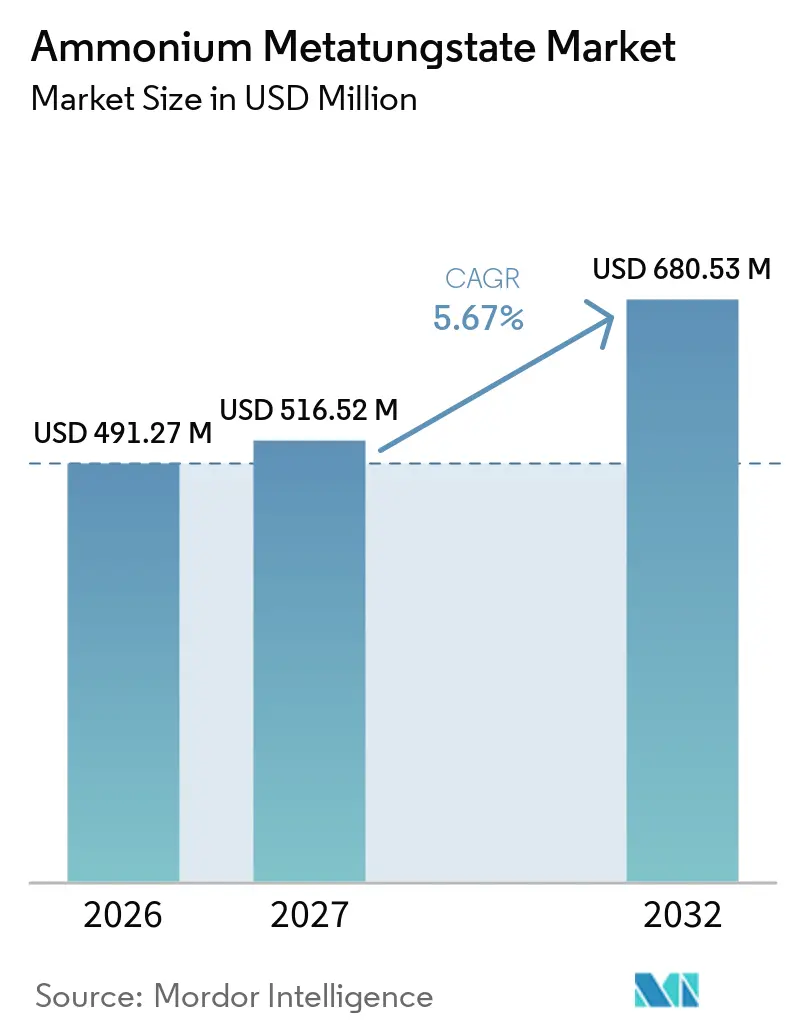
The Ammonium Metatungstate Market size was valued at USD 491.27 million in 2026 and is estimated to grow from USD 516.52 million in 2027 to reach USD 680.53 million by 2032, at a CAGR of 5.67% during the forecast period (2027-2032). Ammonium metatungstate (AMT) is a water-soluble tungsten compound used in catalysts, electronics, and specialty chemical production. Its clean conversion to tungsten trioxide supports use in hydrodesulfurization catalysts and specialized tungsten materials. Demand is supported by clean-fuel rules that require refiners to maintain catalyst inventories and by the need for high-purity materials in semiconductor manufacturing. China’s integrated tungsten supply chain gives domestic suppliers a cost and feedstock advantage, while non-Chinese producers are expanding recycling and traceable supply. The ammonium metatungstate market has opportunities in high-purity grades for semiconductor-related tungsten precursors and in secondary feedstock processing.
Key Report Takeaways
- By raw material route, the virgin ore route held 64.56% of the ammonium metatungstate market share in 2026, while the secondary/recycled route is forecast to advance at a 6.13% CAGR through 2032.
- By form, aqueous solution held 43.12% of the ammonium metatungstate market share in 2026, while powder is forecast to advance at a 6.57% CAGR through 2032.
- By grade, standard grade held 52.83% of the ammonium metatungstate market share in 2026, while high-purity grade is forecast to advance at a 6.54% CAGR through 2032.
- By application, catalysts held 39.27% of the ammonium metatungstate market share in 2026 and are forecast to advance at a 6.78% CAGR through 2032.
- By end-use industry, chemical and petrochemical held 41.78% of the ammonium metatungstate market share in 2026, while electronics is forecast to advance at a 7.09% CAGR through 2032.
- By geography, Asia-Pacific held 45.39% of the ammonium metatungstate market share in 2026 and is forecast to advance at a 6.56% CAGR through 2032.
Note: Market numbers in this report are based on Mordor Intelligence's proprietary estimation framework, which combines nine months of actuals with Q4 projections for base year 2026.
Global Ammonium Metatungstate Market Trends and Insights
Drivers Impact Analysis*
| Driver | (~) % Impact on CAGR Forecast | Geographic Relevance | Impact Timeline |
|---|---|---|---|
| Cleaner-Fuel and Emissions-Control Catalyst Demand | +2.1% | Global; North America, APAC core (China, India), MEA refinery belts | Medium term (2–4 years) |
| Semiconductor, Electronics, and Advanced Materials Expansion | +1.8% | APAC core (China, Japan, South Korea); spillover to North America and Europe | Long term (≥ 4 years) |
| Growth of Specialty Chemical and Metallurgy Applications | +1.0% | Global; North America and APAC core | Medium term (2–4 years) |
| Circular Tungsten Recovery and Recycled Feedstock Adoption | +0.8% | Europe (Germany), North America | Short term (≤ 2 years) |
| Aqueous AMT Routes Enable Lower-Impurity Process Intensification | +0.5% | Global; early gains in Germany and the US, APAC as production base | Short term (≤ 2 years) |
| Source: Mordor Intelligence | |||
Cleaner-Fuel and Emissions-Control Catalyst Demand
Ultra-low-sulfur fuel requirements support the largest source of demand for the ammonium metatungstate market. China’s National VI standard, the European Union’s Euro 7 requirements, and the United States Environmental Protection Agency Tier 3 rules require very low sulfur levels in transportation fuels. Refiners use tungsten-molybdenum sulfide catalysts to remove sulfur, and ammonium metatungstate is an important tungsten precursor in these catalyst systems. New fuel-quality programs in India, Vietnam, and Nigeria create additional catalyst demand as refineries prepare for stricter product specifications. The International Energy Agency expects global refinery throughput to remain above 95 million barrels per day through 2030, which supports replacement demand for hydrodesulfurization catalysts[1].
Semiconductor, Electronics, and Advanced Materials Expansion
The ammonium metatungstate market is gaining from the move toward smaller semiconductor device geometries. High-purity material can be processed into tungsten-containing inputs used for chemical vapor deposition contacts, vias, and barrier layers. These uses require consistent batches and very low trace-metal contamination, which differentiates electronics-grade material from catalyst-grade product. Advanced logic, memory, and display manufacturing in China, Japan, and South Korea support this demand base. High-purity material also supports electrochromic tungsten oxide systems that can be used in smart glazing and automotive displays. A peer-reviewed study reported transmittance modulation above 74% for an ammonium-metatungstate-based electrochromic device.
Growth of Specialty Chemical and Metallurgy Applications
Specialty chemical and metallurgy uses give the ammonium metatungstate market a broader base than refinery catalysts alone. The material is used in glass colorants, ceramic additives, metal-finishing electrolytes, flame-retardant formulations, and tungsten chemical synthesis. Tungsten compounds can help reduce ceramic sintering temperatures and improve grain structure in components used in aerospace, automotive, and industrial equipment. Ammonium-metatungstate-derived tungsten trioxide is also relevant to research on environmental remediation and ammonia decomposition. Japan’s New Energy and Industrial Technology Development Organization (NEDO) supported a project involving Mitsubishi Heavy Industries and Nippon Shokubai to commercialize ammonia decomposition systems[2]. Metallurgy remains a steady outlet because tungsten carbide powder is used in cutting tools, mining equipment, and wear-resistant components. These applications reduce the ammonium metatungstate industry’s exposure to any single end-use cycle.
Circular Tungsten Recovery and Recycled Feedstock Adoption
Circular supply is becoming more important to the ammonium metatungstate market as producers seek feedstock outside primary mining routes. The Plansee Group reported a 91% recycled-content share across 14,300 metric tons of tungsten products in fiscal year 2025/26. H.C. Starck Tungsten GmbH approved an investment of EUR 50 million (approximately USD 54.3 million) for its Goslar recycling expansion. The facility is planned to expand capacity by nearly 50% to 7,000 metric tons per year and is intended to rely almost fully on recycled feedstock by 2028. A 2025 peer-reviewed study found that combined hydrometallurgical and pyrometallurgical processing can recover 92.6% of tungsten from scrap. Recycling improves available feedstock for producers that do not have an integrated mine supply.
Restraints Impact Analysis*
| Restraint | (~) % Impact on CAGR Forecast | Geographic Relevance | Impact Timeline |
|---|---|---|---|
| APT and Tungsten Price Volatility | −2.1% | Global; strongest headwind for non-Chinese buyers in Europe and North America | Short term (≤ 2 years) |
| Technical Complexity and High Barriers to New Production | −1.5% | Global | Long term (≥ 4 years) |
| Batch-Qualification Bottlenecks for High-Purity AMT | −1.0% | APAC (semiconductor hubs), North America | Medium term (2–4 years) |
| Source: Mordor Intelligence | |||
APT and Tungsten Price Volatility
Ammonium paratungstate (APT) price changes create an immediate cost risk for the ammonium metatungstate market. Ammonium paratungstate is a key tungsten intermediate so that higher costs can pass into ammonium metatungstate production. Producers outside China can face greater cost pressure when seaborne supply becomes constrained. Downstream catalyst and specialty chemical customers may resist full price pass-through because they also compete in price-sensitive markets. This can compress margins for producers that have limited feedstock integration. The difference between domestic Chinese pricing and seaborne pricing can also reduce the competitiveness of non-Chinese producers. Supply-chain diversification and recycling can reduce this risk, but neither option removes exposure to tungsten price movements.
Technical Complexity and High Barriers to New Production
Industrial ammonium metatungstate production requires controlled acidification, ion exchange, crystallization, and drying. Each stage can affect purity, particle characteristics, and consistency of the finished material. Catalyst-grade output requires low molybdenum contamination, while electronics-grade material needs stricter control of total trace metals. These standards limit credible production to companies with process knowledge, analytical equipment, and qualified customer relationships. New projects also need dependable tungsten feedstock before they can offer a stable supply. The ammonium metatungstate market, therefore, has high barriers to entry in grades sold to semiconductor and precision-catalyst customers. Customer validation for high-purity material can take 12 to 18 months, which limits the speed at which new capacity can address demand.
*Our forecasts treat driver/restraint impacts as directional, not additive. The impact forecasts reflect baseline growth, mix effects, and variable interactions.
Segment Analysis
By Raw Material Route: Virgin Ore Route Leads, While Secondary/Recycled Route Expands
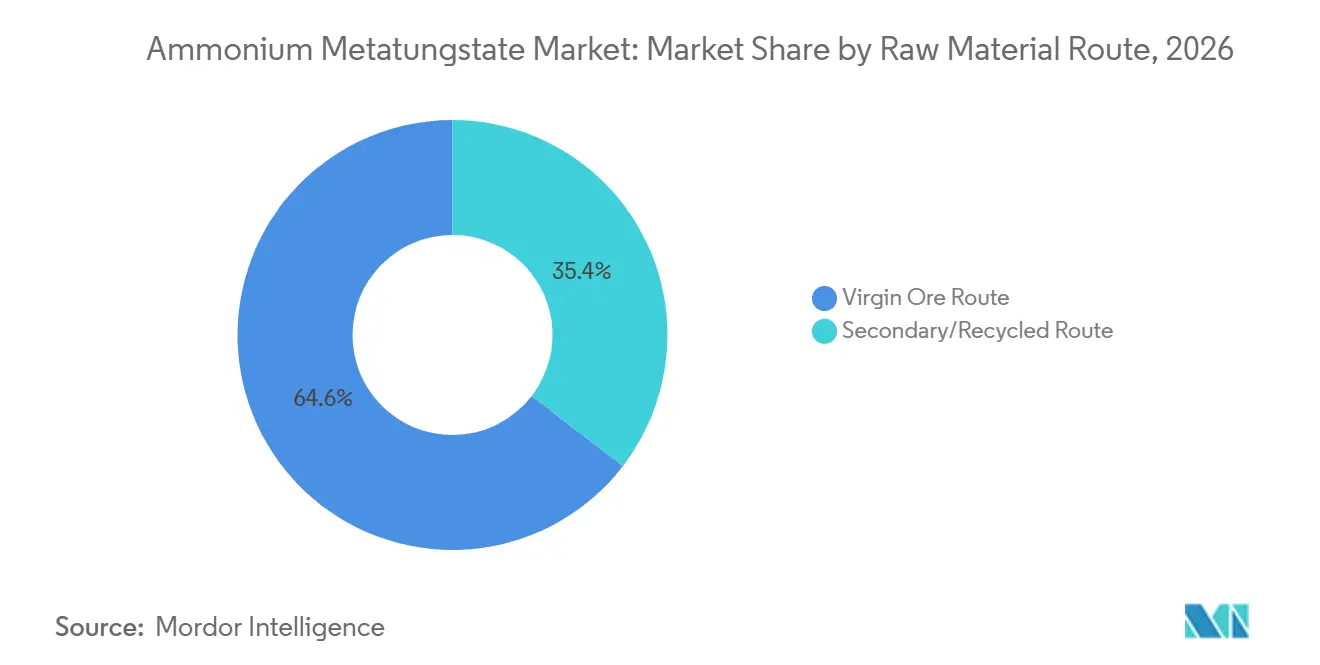
The virgin ore route held a 64.56% share in the ammonium metatungstate market in 2026. This route remains important because primary ore processing is connected to established mine, smelter, and chemical production networks. China’s role in tungsten mining and intermediate processing supports the availability of primary feedstock for domestic producers. Long-standing relationships among mines, ammonium paratungstate producers, and chemical manufacturers also make supplier changes difficult for many buyers. The route is particularly suited to producers that operate close to upstream tungsten assets. Mine output, concentrate conversion, and chemical production can be coordinated within the same supply network. That coordination can improve delivery reliability for buyers who use material in continuous catalyst manufacturing processes. Its leading position reflects the scale of existing infrastructure rather than a lack of interest in recycling. Primary supply remains important where long-term mine contracts and processing capacity are already in place.
The secondary/recycled route is projected to advance at a 6.13% CAGR through 2032. Recycling gives non-Chinese producers an alternative source of tungsten-containing material and can improve supply traceability. H.C. Starck Tungsten GmbH’s Goslar project shows the scale of investment entering this route, with capacity planned to reach 7,000 metric tons per year by 2028. Xiamen Tungsten Co., Ltd. reported that its operations recovered more than 10,000 metric tons of ammonium-paratungstate-equivalent material from scrap each year. It also reported a South Korean facility with 1,500 metric tons per year of tungsten oxide capacity from scrap. This route does not replace primary production in the near term, but it expands choices for the ammonium metatungstate market. It also supports buyers who want verified recycled content in their tungsten supply chains.
By Form: Aqueous Solutions Leads, While Powder Accelerates Fastest
Aqueous solution held a 43.12% share in the ammonium metatungstate market in 2026. This form fits wet-impregnation processes used in industrial catalyst manufacturing. Buyers can add the solution to the catalyst preparation steps without first dissolving a powder. This can simplify plant operations and help maintain consistent solution chemistry. The form remains useful where consistent delivery of active tungsten matters more than the compact shipping profile of a dry material. Its position reflects its fit with established refinery catalyst production methods. Suppliers can tailor concentration, packaging, and quality records to the needs of individual catalyst plants. These service requirements favor producers who understand the operating conditions of established refinery customers.
Powder is projected to advance at a 6.57% CAGR through 2032. Powder supports solid-state catalyst preparation and tungsten carbide sintering applications that need controlled particle characteristics. It can also serve high-purity tungsten chemical production where processors require a dry input. Crystalline material serves laboratory and reagent-grade customers who place value on consistent documentation and controlled batch properties. The different forms allow suppliers to meet process requirements across catalyst, laboratory, metallurgy, and electronics uses. Aqueous, crystalline, and powder products, therefore, address distinct operational needs rather than serving as direct substitutes in every application. The ammonium metatungstate market can support each form because customers select material according to their processing equipment and purity requirements.
By Grade: Standard Grade Leads Revenue, While High-Purity Grade Expands
Standard grade held a 52.83% share in the ammonium metatungstate market in 2026. It serves petroleum refining, petrochemical processing, bulk metallurgy, metal finishing, and glass and ceramic applications. These users need consistent material, but their impurity specifications are less stringent than those required by semiconductor fabrication. Cost control is, therefore, a central purchasing factor for standard-grade buyers. Reagent Grade supports research and development laboratories that require certified impurity profiles and well-documented material. Standard Grade continues to hold the leading position because its addressable applications are broad and established.
High-purity grade is projected to advance at a 6.54% CAGR through 2032. Semiconductor fabrication, precision catalyst development, and medical radiation-shielding uses support this growth. Production can require repeated recrystallization, clean handling practices, and Inductively Coupled Plasma Mass Spectrometry verification. These requirements make a high-purity product more expensive to manufacture than standard material. They also create a long approval cycle before a supplier can qualify with a semiconductor customer. The ammonium metatungstate industry benefits from the higher value associated with this grade, but producers must maintain strong process discipline. High-purity grade is, therefore, a growth area where technical capability is a central competitive factor. The grade also requires close coordination between chemical producers and customers during qualification. A supplier’s ability to repeat the same quality across later deliveries is as important as its initial laboratory result.
By Application: Catalysts Lead in Scale and Growth
Catalysts held a 39.27% share in the ammonium metatungstate market in 2026 and are projected to advance at a 6.78% CAGR through 2032. Ammonium metatungstate is used as a tungsten precursor in hydrodesulfurization, hydrodenitrogenation, and hydrocracking catalyst systems. Refiners use these systems when processing sulfur-containing crude oil and when meeting low-sulfur fuel specifications. Replacement cycles create continuing demand because catalysts lose effectiveness over time. The segment’s leadership shows the continuing importance of refinery operations to the ammonium metatungstate market. Catalyst producers need secure access to tungsten inputs because refinery customers depend on timely changeouts. This creates value for ammonium metatungstate suppliers that can offer reliable quality and delivery schedules.
Catalyst uses are also expanding beyond conventional refinery operations. Ammonium-metatungstate-derived materials are relevant to carbon dioxide utilization, biomass conversion, and ammonia decomposition research. These areas can broaden the role of tungsten-containing catalysts in energy and chemical applications. Metal Finishing uses ammonium metatungstate as a soluble tungsten source for wear-resistant and corrosion-protective electroplating. Pigments, glass, and ceramic production use it for color, mineralizing, and electrochromic functions. X-ray shielding and analytical chemistry offer a stable demand where certified material is needed. This application mix gives producers several outlets, while catalysts remain the largest source of consumption.
By End-Use Industry: Chemical and Petrochemical Leads, While Electronics Has the Highest Growth Rate
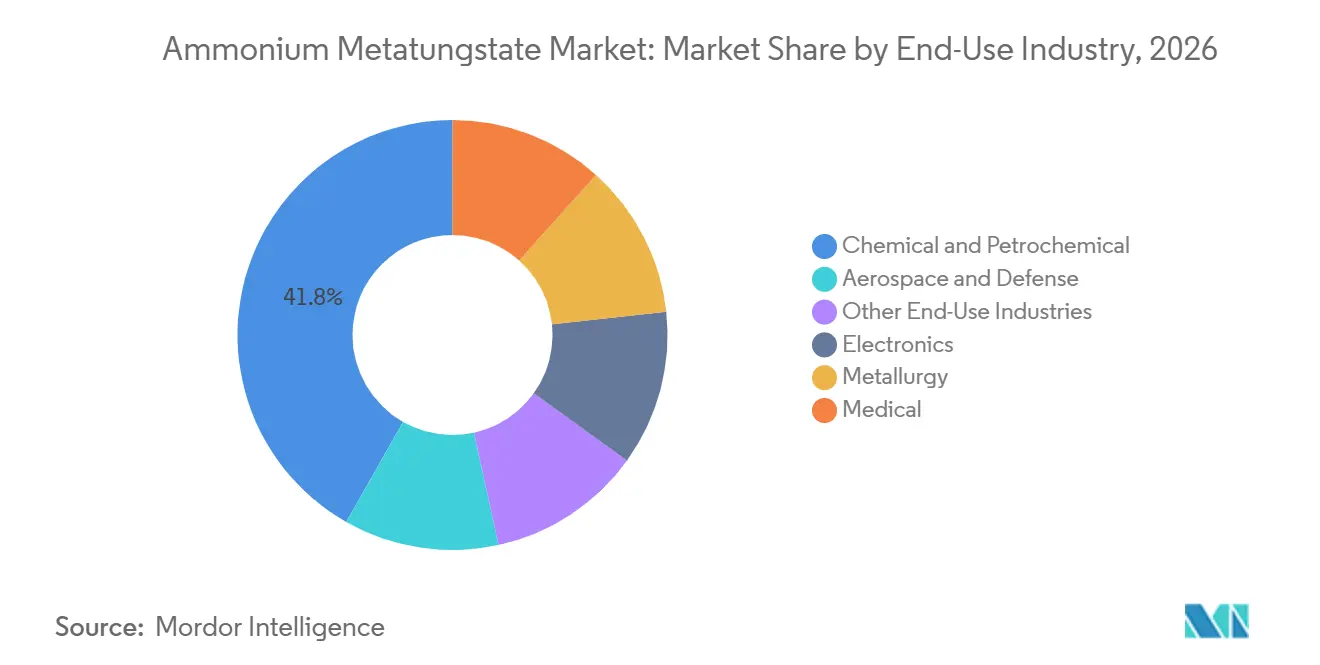
Chemical and petrochemical held a 41.78% share in the ammonium metatungstate market in 2026. Refinery catalyst demand supports the sector’s leading position during the forecast period. Chemical producers use ammonium metatungstate in catalyst preparation and other tungsten chemical processes. Petrochemical customers value a stable precursor that can be integrated into established production systems. This end-use base is linked to fuel-quality rules and refinery maintenance programs.
Electronics is projected to advance at a 7.09% CAGR through 2032. Demand is connected to semiconductor logic, memory, and display components that use tungsten thin films and specialized tungsten precursors. Xiamen Tungsten Co., Ltd. announced a 1,000 metric ton per year tungsten hexafluoride production line that is targeted for completion in 2027. The company stated a long-term tungsten hexafluoride capacity target of 3,000 metric tons per year. Aerospace and Defense demand is linked to traceable supply requirements, while Medical demand includes radiation-shielding equipment. Metallurgy also remains an end-use outlet for tungsten-containing hard materials. The ammonium metatungstate market is, therefore, moving toward a more balanced mix of chemical, electronics, medical, and industrial demand. Electronics customers place more weight on trace-metal control, while chemical customers continue to prioritize dependable catalyst performance. Producers must address both requirements without compromising documentation or product consistency.

Geography Analysis
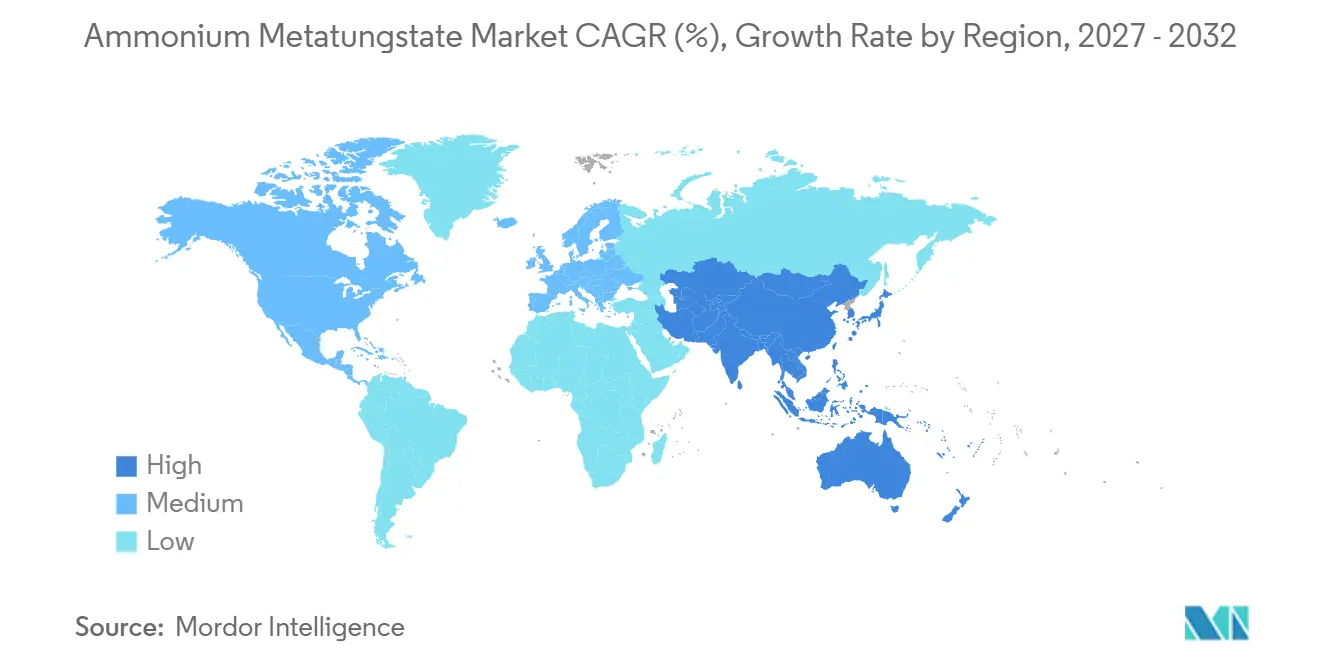
Asia-Pacific held 45.39% share in the ammonium metatungstate market in 2026 and is projected to advance at a 6.56% CAGR through 2032. China is the region’s central production base because of its integrated tungsten mining, intermediate-processing, and chemical manufacturing capacity. This structure supports domestic ammonium metatungstate output and provides supply to customers across the region. Japan and South Korea are important consumers of electronics-grade material because of their semiconductor and advanced-material manufacturing activities. Their procurement requirements place more focus on traceability and consistent quality documentation. India supports demand through refinery upgrades associated with its BS VI (Bharat Stage VI) program.
North America is supported by the United States refining sector and by semiconductor facilities that require high-purity inputs. The region has an incentive to secure traceable tungsten supply through domestic, allied-country, and recycled sources. Global Tungsten & Powders processes tungsten products in Towanda, Pennsylvania, and has expanded its interest in non-Chinese raw material supply. Europe is centered on Germany, where H.C. Starck Tungsten GmbH is increasing recycling capacity in Goslar. The project supports Europe’s role in secondary-route tungsten processing and gives regional buyers an option outside the primary ore supply. France, the United Kingdom, and Nordic countries contribute to specialty chemical demand, but the European supply position is most closely linked to recycling capability.
South America has modest ammonium metatungstate demand that is mainly connected to refinery catalysts, with Brazil as the regional center. A 2025 peer-reviewed study on tungsten recovery from raw and secondary materials indicates continuing technical interest in regional tungsten processing. The Middle East and Africa rely largely on catalyst demand linked to refinery operations and capacity additions. Saudi Arabia, the United Arab Emirates, and South Africa provide the main refinery-related demand centers within this area. Marine fuel sulfur requirements can support the need for advanced hydrodesulfurization catalysts over the medium term. Regional demand is smaller than in Asia-Pacific, North America, and Europe, but it provides additional outlets for catalyst-grade products. The geographical structure of the ammonium metatungstate market remains anchored in Asian production and diversified by recycling, refinery, and electronics demand elsewhere.
Competitive Landscape
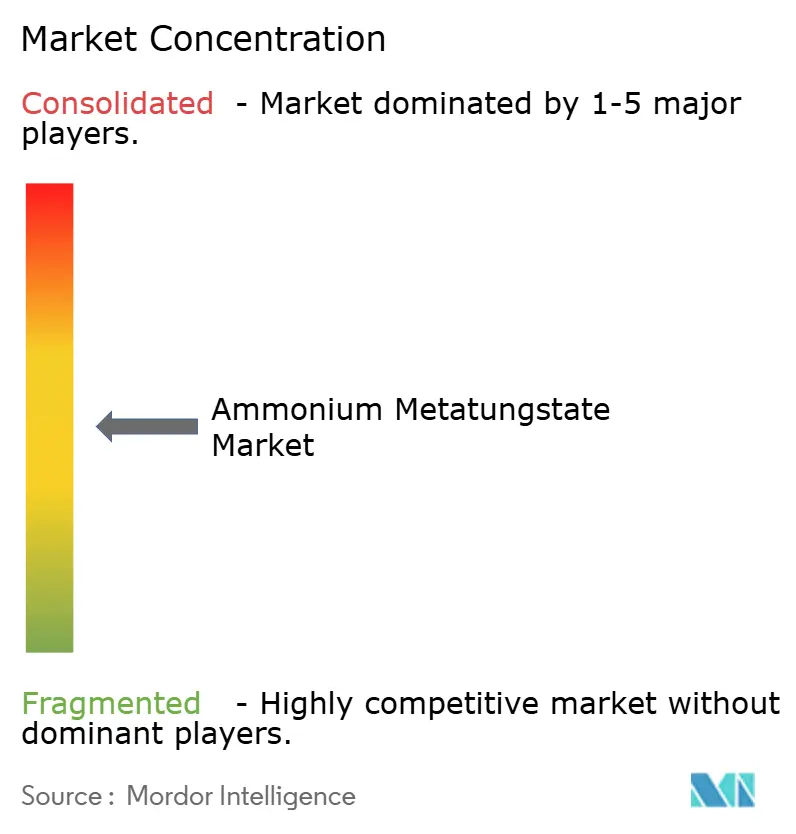
The ammonium metatungstate market is moderately concentrated, with the top five players including H.C. Starck Tungsten GmbH, Global Tungsten & Powders, Masan High-Tech Materials Corporation, Xiamen Tungsten Co., Ltd., and Ganzhou Grand Sea Tungsten Co., Ltd. Competition depends on feedstock security, product purity, customer approvals, and supply-chain traceability. Suppliers serving high-purity applications must demonstrate consistent control of impurities and documentation. The ammonium metatungstate market has room for specialized participants that serve laboratory, electronics, and precision industrial customers.
Xiamen Tungsten Co., Ltd. is strengthening vertical integration by pursuing upstream ore resources and by developing tungsten hexafluoride capacity for semiconductor-related uses. The company also operates a South Korean recycling facility with 1,500 metric tons per year of tungsten oxide capacity from scrap. H.C. Starck Tungsten GmbH is expanding its Goslar recycling site through an investment of EUR 50 million (approximately USD 54.3 million). The project is intended to increase the site’s capacity by nearly 50% and support near-full reliance on recycled feedstock by 2028. Masan High-Tech Materials Corporation reported potential resources of 115 million metric tons of tungsten-polymetallic ore at the Nui Phao Extension and Nui Chiem areas. It also announced an expansion of tungsten oxide capacity to more than 8,000 metric tons of tungsten trioxide per year.
Smaller suppliers can compete where customers need controlled batches, research quantities, detailed certificates, and responsive technical support. High-purity ammonium metatungstate for semiconductor and tungsten hexafluoride precursor uses is an important area because buyers need traceable material and strict impurity control. Process chemistry is also becoming more important as suppliers seek lower chromium content and other tighter impurity specifications. Recycling investments can allow non-Chinese companies to reduce their exposure to the primary feedstock supply. Mine-to-chemical integration can improve security for producers with access to ore resources. Partnerships between raw-material suppliers and processors can also support longer-term delivery commitments. Competition remains shaped by integration, recycling access, production quality, and the ability to support customers with a traceable supply.
Ammonium Metatungstate Industry Leaders
-
H.C. Starck Tungsten GmbH
-
Global Tungsten & Powders
-
Masan High-Tech Materials Corporation
-
Xiamen Tungsten Co., Ltd.
-
Ganzhou Grand Sea Tungsten Co., Ltd.
- *Disclaimer: Major Players sorted in no particular order
Recent Industry Developments
- September 2026: The Elmet Group Co. announced a USD 124.75 million acquisition of a 4.99% equity stake in Masan High-Tech Materials Corporation, alongside long-term supply agreements for mined tungsten and conversion services from the Nui Phao Mine. The agreements support the ammonium metatungstate market by strengthening access to tungsten feedstock and processing capabilities for downstream tungsten chemicals.
- July 2026: H.C. Starck Tungsten GmbH, a subsidiary of Mitsubishi Materials Corporation, approved EUR 50 million (approximately USD 54.3 million) to expand tungsten recycling capacity at its Goslar, Germany, facility by nearly 50% to 7,000 metric tons per year, with completion targeted for 2028. The expansion supports the ammonium metatungstate market by increasing the availability of recycled tungsten feedstock that can be processed into high-purity tungsten chemicals.
Global Ammonium Metatungstate Market Report Scope
Ammonium metatungstate is a water-soluble tungsten compound used as a precursor in the production of tungsten-based materials and specialized chemical formulations. Its high tungsten content and solubility make it suitable for catalyst preparation, analytical applications, and the manufacture of advanced industrial materials.
The Ammonium Metatungstate Market is segmented by raw material route, form, grade, application, end-use industry, and geography. By raw material route, the market is segmented into the virgin ore route and the secondary/recycled route. By form, the market is segmented into aqueous solution, crystalline, and powder. By grade, the market is segmented into standard grade, high-purity grade, and reagent grade. By application, the market is segmented into catalysts, metal finishing, pigments, X-ray shielding, analytical chemistry, glass and ceramic production, and other applications. By end-use industry, the market is segmented into chemical and petrochemical, electronics, metallurgy, medical, aerospace and defense, and other end-use industries. The report also covers the market size and forecasts for ammonium metatungstate across 15 countries. For each segment, the market sizing and forecasts have been done on the basis of value (USD).
| Virgin Ore Route |
| Secondary/Recycled Route |
| Aqueous Solution |
| Crystalline |
| Powder |
| Standard Grade |
| High-Purity Grade |
| Reagent Grade |
| Catalysts |
| Metal Finishing |
| Pigments |
| X-Ray Shielding |
| Analytical Chemistry |
| Glass and Ceramic Production |
| Other Applications |
| Chemical and Petrochemical |
| Electronics |
| Metallurgy |
| Medical |
| Aerospace and Defense |
| Other End-Use Industries |
| Asia-Pacific | China |
| India | |
| Japan | |
| South Korea | |
| ASEAN Countries | |
| Rest of Asia-Pacific | |
| North America | United States |
| Canada | |
| Mexico | |
| Europe | Germany |
| United Kingdom | |
| France | |
| Italy | |
| NORDIC Countries | |
| Rest of Europe | |
| South America | Brazil |
| Argentina | |
| Rest of South America | |
| Middle East and Africa | Saudi Arabia |
| South Africa | |
| Rest of Middle East and Africa |
| By Raw Material Route | Virgin Ore Route | |
| Secondary/Recycled Route | ||
| By Form | Aqueous Solution | |
| Crystalline | ||
| Powder | ||
| By Grade | Standard Grade | |
| High-Purity Grade | ||
| Reagent Grade | ||
| By Application | Catalysts | |
| Metal Finishing | ||
| Pigments | ||
| X-Ray Shielding | ||
| Analytical Chemistry | ||
| Glass and Ceramic Production | ||
| Other Applications | ||
| By End-Use Industry | Chemical and Petrochemical | |
| Electronics | ||
| Metallurgy | ||
| Medical | ||
| Aerospace and Defense | ||
| Other End-Use Industries | ||
| By Geography | Asia-Pacific | China |
| India | ||
| Japan | ||
| South Korea | ||
| ASEAN Countries | ||
| Rest of Asia-Pacific | ||
| North America | United States | |
| Canada | ||
| Mexico | ||
| Europe | Germany | |
| United Kingdom | ||
| France | ||
| Italy | ||
| NORDIC Countries | ||
| Rest of Europe | ||
| South America | Brazil | |
| Argentina | ||
| Rest of South America | ||
| Middle East and Africa | Saudi Arabia | |
| South Africa | ||
| Rest of Middle East and Africa | ||
Key Questions Answered in the Report
What is the size of the ammonium metatungstate market?
The ammonium metatungstate market size was valued at USD 491.27 million in 2026 and is estimated to grow from USD 520.04 million in 2027 to USD 680.53 million by 2032, at a CAGR of 5.67% during 2027-2032.
What is driving demand for ammonium metatungstate?
Low-sulfur fuel requirements support catalyst demand, while semiconductor manufacturing supports demand for high-purity tungsten inputs.
Which raw material route is projected to advance fastest through 2032?
The secondary/recycled route is projected to advance at a 6.13% CAGR through 2032, supported by investments in tungsten recovery.
Which form held the largest share in 2026?
Aqueous solution held a 43.12% share in 2026 because it fits wet-impregnation processes used in industrial catalyst preparation.