
Aluminum Metal Powder Market Size and Share
Market Overview
| Study Period | 2022 - 2032 |
|---|---|
| Market Size (2027) | USD 2.30 Billion |
| Market Size (2032) | USD 2.80 Billion |
| Growth Rate (2027 - 2032) | 4.08 % |
| Fastest Growing Market | Asia-Pacific |
| Largest Market | Asia-Pacific |
| Market Concentration | Medium |
Major Players *Disclaimer: Major Players sorted in no particular order Image © Mordor Intelligence. Reuse requires attribution under CC BY 4.0. | |
Aluminum Metal Powder Market Analysis by Mordor Intelligence
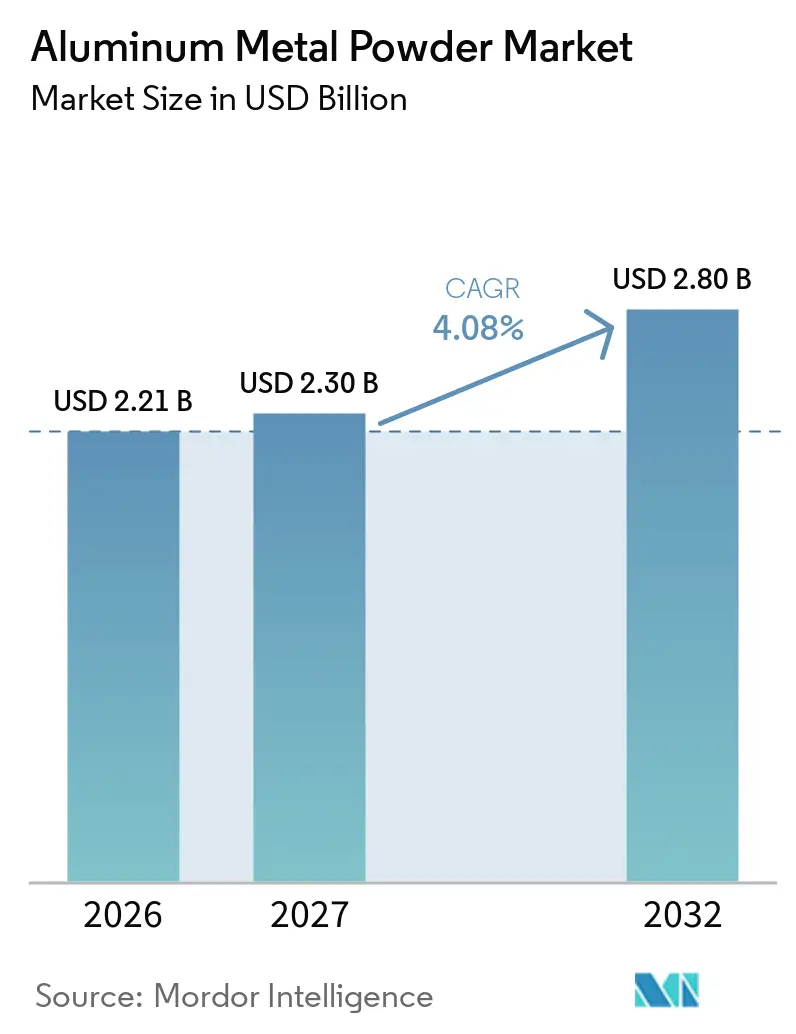
The aluminum metal powder market size was valued at USD 2.21 billion in 2026 and is estimated to grow from USD 2.30 billion in 2027 to USD 2.80 billion by 2032, at a CAGR of 4.08% during the forecast period (2027-2032). The aluminum metal powder market serves construction, coatings, pyrotechnics, powder metallurgy, and additive manufacturing applications. Construction activity in South Asia, Southeast Asia, and the Middle East supports recurring demand for aluminum powder, which is the gas-generating agent used in aerated concrete blocks. Additive manufacturing and electric vehicle thermal systems are driving demand for more precisely specified grades, favoring suppliers capable of managing alloy design, particle control, and qualification requirements. Regional supply chains are also becoming more important as producers assess domestic capacity, feedstock security, and the effect of the 25% US aluminum tariff reinstated in 2025. Energy costs remain a central constraint, as power costs affect primary aluminum production and can be passed through to atomized powder prices.
Key Report Takeaways
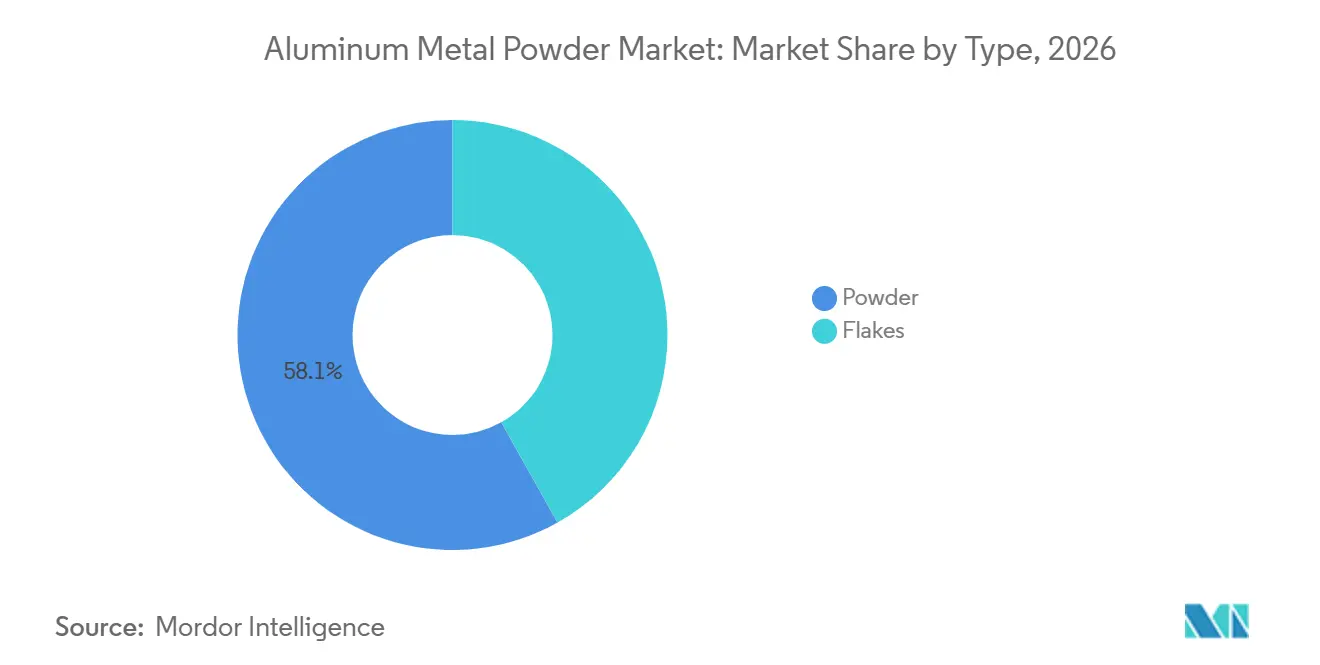
- By type, powder held 58.12% of the aluminum metal powder market share in 2026, while flakes are forecast to grow at a 4.67% CAGR through 2032.
- By process, atomization accounted for 61.45% of the aluminum metal powder market share in 2026, while comminution is forecast to grow at a 4.91% CAGR through 2032.
- By purity, above-99% grades held a 43.78% market share in 2026, while the 98% to 99% bracket is forecast to grow at a 4.84% CAGR through 2032.
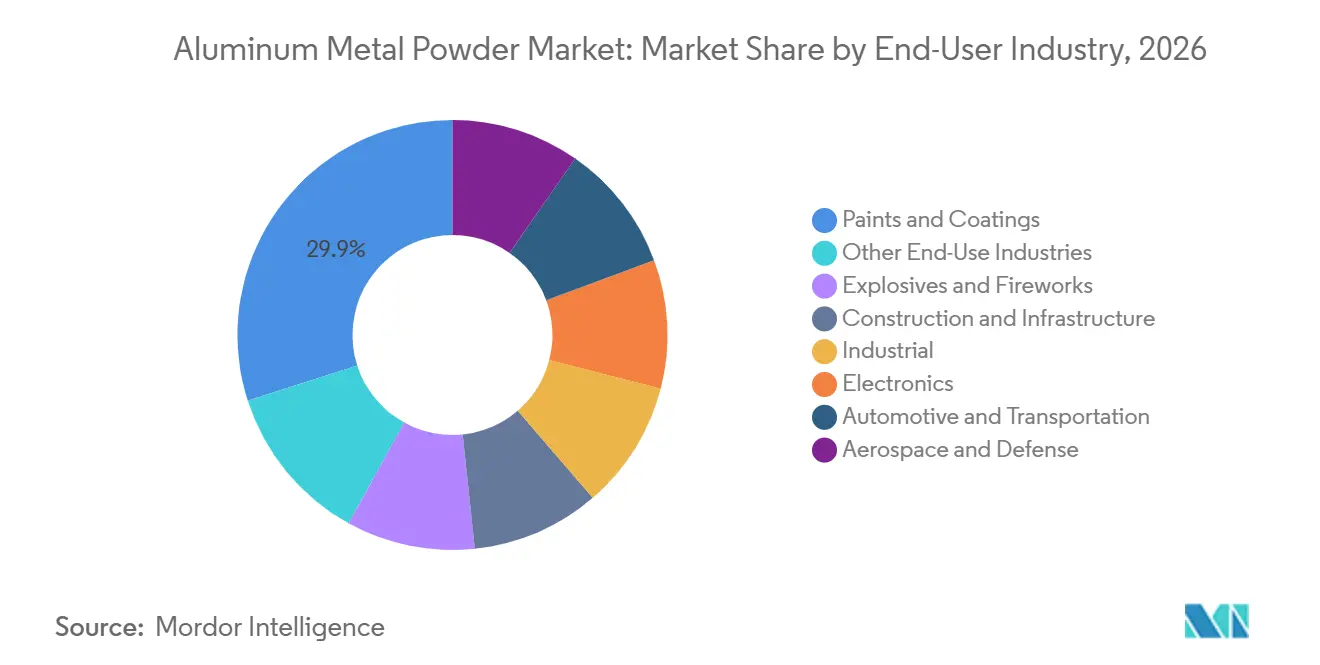
- By end-user industry, paints and coatings held a 29.94% market share in 2026, while aerospace and defense are forecast to grow at a 5.14% CAGR through 2032.
- By geography, Asia-Pacific held a 48.69% market share in 2026 and is forecast to grow at a 5.03% CAGR through 2032.
Note: Market numbers in this report are based on Mordor Intelligence's proprietary estimation framework, which combines nine months of actuals with Q4 projections for base year 2026.
Global Aluminum Metal Powder Market Trends and Insights
Drivers Impact Analysis*
| Drivers | (~) % Impact on CAGR Forecast | Geographic Relevance | Impact Timeline |
|---|---|---|---|
| Construction and Infrastructure Demand for Autoclaved Aerated Concrete (AAC) Blocks | +1.0% | Asia-Pacific core, with spillover to Middle East and Africa (MEA) and South America | Short term (≤ 2 years) |
| Lightweighting and Thermal Management in EVs | +0.8% | Global, with the greatest intensity in China, Germany, and the United States | Medium term (2-4 years) |
| Additive Manufacturing and Powder-Metallurgy Adoption | +0.9% | North America and Europe, with growth in China and Japan | Long term (≥ 4 years) |
| Metallic Pigments for Protective and Decorative Coatings | +0.7% | Global, concentrated in Europe and North America | Short term (≤ 2 years) |
| Custom Alloy Qualification for Serial Production | +0.5% | North America, Europe, Japan, and South Korea | Long term (≥ 4 years) |
| Source: Mordor Intelligence | |||
Construction and Infrastructure Demand for AAC Blocks
Aluminum powder serves as the gas-generating agent in the production of autoclaved aerated concrete (AAC) blocks. This role links the aluminum metal powder market to construction activity in rapidly urbanizing economies across South Asia, Southeast Asia, and the Middle East, where housing delivery and infrastructure work require high quantities of lightweight masonry products. A 2025 study found that aluminum powder can also aerate geopolymer-based non-autoclaved concrete, extending its use beyond the established steam-cured pathway[1]. This application is relevant where producers lack autoclaving infrastructure but still need lightweight concrete materials, as it provides a pathway that does not depend on conventional steam-cured production and can broaden the locations where aluminum-powder aeration is technically applicable. Housing programs in India, Saudi projects including NEOM and the Red Sea Project, and Indonesia's capital relocation support the construction backdrop. In China, pre-dispersed aluminum silver paste is increasingly used in high-specification AAC lines, requiring producers to maintain both powder and paste offerings rather than depend on a single format.
Lightweighting and Thermal Management in EVs
Electric vehicle manufacturers need lighter structures and more effective thermal management, which increases interest in aluminum powders made to defined technical requirements. Equispheres and Martinrea International demonstrated Laser Powder Bed Fusion (LPBF)-produced aluminum e-motor housings with two-phase passive cooling that eliminate the need for external heat-pipe assemblies and improve coolant pressure-drop efficiency. This example illustrates the value of powder bed fusion when a component requires internal forms that cannot be produced by conventional manufacturing routes, such as cooling channels integrated into the component rather than assembled as separate parts. In October 2025, Fraunhofer IWU presented an aluminum foam sandwich battery housing with phase-change material integrated into the foam core. The design absorbs substantial thermal loads without separate cooling hardware, demonstrating the practical value of integrating the thermal function into the component itself rather than building an external assembly around it. These applications make material consistency, alloy selection, and stable powder performance more important than in conventional bulk applications, as the printed part must meet its thermal function through repeatable manufacturing processes without relying on additional cooling hardware.
Additive Manufacturing and Powder-Metallurgy Adoption
The shift of metal additive manufacturing from prototyping to serial production is a key driver for the aluminum metal powder market. North American metal injection molding and additive manufacturing powder shipments declined in 2024 as inventories normalized, and producers surveyed by the Metal Powder Industries Federation expected recovery by 2026. This pattern indicated a temporary adjustment in purchasing rather than a withdrawal of end-use demand, as producers anticipated recovery while inventory levels moved closer to normal operating requirements and customers resumed ordering in line with expected production needs. Qualification work remains important because aerospace and defense buyers require evidence that individual alloy and powder lots perform consistently. A 2025 peer-reviewed study demonstrated the conversion of aluminum scrap from electric vehicle battery packs into gas-atomized AlSi7 powder for selective laser melting. If adopted at scale, this route could reduce the premium on virgin feedstock and change the material-cost basis used for additive manufacturing projects, particularly where buyers assess powder costs alongside the use of recovered material.
Metallic Pigments for Protective and Decorative Coatings
Aluminum flake pigments provide metallic appearance, ultraviolet reflection, and chrome-replacement performance in several coating systems. This makes coatings a consistent source of demand even when broader industrial conditions are uneven, as protective, automotive, and architectural surfaces require a defined appearance and practical resistance to their service environment. Standards Australia's 2025 update for thermoset powder coatings on architectural aluminum reflects the need for coating systems compatible with 180°C-200°C cure cycles. In Europe and aerospace-related primer applications, the replacement of chromate systems supports the use of passivated aluminum flakes for corrosion protection. Non-floating pigment powders benefit from silica encapsulation, which limits gas evolution during electrostatic spraying. These requirements shift competition toward suppliers that can control particle form and surface treatment, not only total output, as coating formulators need predictable behavior during application and curing as well as a metallic appearance that remains consistent across production batches.
Restraints Impact Analysis*
| Restraints | (~) % Impact on CAGR Forecast | Geographic Relevance | Impact Timeline |
|---|---|---|---|
| Ignition, Explosion, and Workplace-Safety Requirements | -0.5% | Global, with the highest compliance cost in the EU and North America | Short term (≤ 2 years) |
| Aluminum Feedstock and Energy-Price Volatility | -0.6% | Global, with a sharp impact in North America and Europe | Short term (≤ 2 years) |
| Qualification Costs and Requalification Cycles for Additive Manufacturing (AM) Grades | -0.4% | North America, Europe, and advanced APAC | Long term (≥ 4 years) |
| Source: Mordor Intelligence | |||
Aluminum Feedstock and Energy-Price Volatility
Electricity accounts for a significant share of primary aluminum production costs, making powder prices sensitive to power-market movements. Electricity accounts for 40% of these costs, meaning shifts in power pricing affect the metal's economics before it reaches the atomization or milling stage. A persistent energy-cost gap between US and Canadian smelters can also shape feedstock choices for North American powder producers. Alumina prices remained elevated through late 2024 and early 2025, adding pressure to downstream atomization margins. The World Bank projected a year-on-year decline in its energy price index for 2025, while trade and geopolitical uncertainty continued to affect aluminum prices. Procurement agreements do not always capture sudden price movements, leaving suppliers and buyers exposed when quarterly arrangements are reset and preventing the full cost change from being absorbed through normal contract mechanisms.
Ignition, Explosion, and Workplace-Safety Requirements
Fine aluminum powder poses a combustible dust risk that requires appropriate facility design, operating controls, and formal safety reviews. The lower explosive limit for particles smaller than 63 µm is 15 g/m³. The National Fire Protection Association (NFPA) 660, introduced in 2024, consolidated prior fire and dust-explosion requirements, including rules relevant to combustible metals. A 2025 study on aluminum powder and paste facilities found that current explosion-mitigation requirements may necessitate equipment modernization rather than routine retrofits[2]. The EU ATEX (Atmosphères Explosibles) framework also requires conformity assessment for equipment used in potentially explosive atmospheres. These obligations impose a relatively heavier burden on smaller producers and can delay new capacity additions. Qualification and requalification costs present an additional barrier for advanced additive manufacturing grades, which must repeatedly demonstrate controlled handling and repeatable performance to customers and relevant approval bodies.
*Our forecasts treat driver/restraint impacts as directional, not additive. The impact forecasts reflect baseline growth, mix effects, and variable interactions.
Segment Analysis
By Type: Powder Supports Core Demand While Flakes Serve Specialty Coatings
Powder accounted for 58.12% of the aluminum metal powder market in 2026. Its position reflects its use as an aerating agent in AAC blocks, where flake morphology cannot create the uniform hydrogen pore structure required by the process. Powder also serves as a metallurgical reductant, an industrial chemical, and a pyrotechnic composition. These applications create high demand across several end uses and reduce dependence on a single customer group. Construction activity in South Asia, the Middle East, and Africa provides a recurring base for powder products, supporting demand even when specialty applications shift more quickly. A 2025 study on recycled battery-pack aluminum showed that gas atomization can produce AlSi7 powder for selective laser melting, identifying a potential circular-feedstock route for additive-manufacturing powders. However, a commercial scale has not yet been established. The aluminum powder market must therefore balance established construction demand with emerging requirements for recycled and qualified feedstocks, while maintaining the particle characteristics required by each end use.
Flakes are forecast to grow at a 4.67% CAGR from 2027 to 2032. Their faster growth reflects demand from chrome-replacement coatings, thin-film automotive metallic finishes, and decorative architectural applications. Platelet geometry gives flakes the layering and reflective effects needed in these applications, distinguishing them from spherical powders designed for flowability in additive manufacturing. Pre-dispersed aluminum-silver paste is gradually replacing dry powder in some high-specification Chinese AAC lines, reducing the addressable dry-powder share on those lines. Producers can respond by maintaining parallel paste and powder portfolios. Improved milling control and silica-encapsulation finishes are also narrowing the performance gap between ball-milled flakes and vacuum-metalized pigments, allowing flake producers to pursue premium chrome-finish applications that previously relied on vapor deposition. This creates a differentiated product path rather than direct competition with the larger powder category, as optical performance, orientation in the coating film, and surface treatment define customer requirements for flakes.

By Process: Atomization Holds Output Leadership While Comminution Serves Pigments
Atomization accounted for 61.45% of the aluminum metal powder market in 2026. The process produces controlled particle-size distributions, high sphericity, and reliable flowability, characteristics important for laser powder bed fusion, metal injection molding, and electronics paste sintering. A single atomization stage can deliver attributes that other routes cannot match as consistently, which explains why atomization retains leadership in both high-value technical applications and broader powder supply. Users can specify particle characteristics more precisely when a process delivers consistent spherical material. A 2025 Scientific Reports study found that adjusting ultrasonic atomization settings improved the additive-manufacturing suitability factor by 21% relative to commercial powder benchmarks, with parameters including vibration amplitude, arc angle, and current intensity. This supports process optimization as a source of technical differentiation, as producers can improve powder suitability through controlled changes in equipment settings rather than relying solely on changes in alloy composition. Electrolysis retains a separate role in producing ultra-high-purity materials for defense energetics and semiconductor applications, but its position does not displace atomization in output terms, as applications requiring exceptionally high purity remain narrower than the combined needs of additive manufacturing, molding, and sintering customers.
Comminution is forecast to grow at a 4.91% CAGR from 2027 to 2032. This route is efficient for producing platelet forms used in metallic pigments, a morphology that gas atomization cannot achieve without a secondary milling stage. Investment in closed-loop inert-atmosphere classification is expanding particle-size options while limiting oxidation. These capabilities are relevant where smooth finish, orientation behavior, and controlled reflectivity determine product performance. Comminution therefore addresses a different technical need from atomization: atomized powders are directed toward spherical-particle applications such as additive manufacturing and injection molding, while comminuted products serve pigment and decorative applications that depend on platelet shape. Because their principal demand pools are structurally distinct, the two processes can expand simultaneously without capacity additions in one creating direct substitution pressure in the other.
By Purity: Above-99% Grades Lead Revenue, While 98% to 99% Grades Grow Faster
Above-99% grades accounted for 43.78% of revenue in 2026, reflecting strict requirements in aerospace laser powder bed fusion, electronics sintering, and high-performance propellants. In these applications, trace impurities can affect oxide-layer thickness, flow behavior, and energy-release characteristics, leading buyers to pay for material that meets narrow quality specifications. This makes the highest-purity band important to overall value even when its output is smaller than that of lower-grade construction material. Stringent performance requirements can lead purchasers to prioritize consistency over lower initial material costs and to rely on predictable behavior throughout storage, handling, printing, sintering, or energetic use, thereby raising the importance of documented lot control even when overall purchase quantities are limited. The 92%-98% range supports AAC production, refractory coatings, and industrial metallurgy, where applications are primarily governed by cost per ton rather than extensive trace-chemistry control. A 2025 Nadcap update strengthened the focus on humidity-sensitive powder handling and inert-gas purity in aerospace additive manufacturing, supporting the elevated quality expectations associated with advanced powders. The aluminum metal powder market must therefore accommodate both premium specifications and large-quantity material needs, as the economics of construction inputs differ substantially from those of aerospace, electronics, and propellant materials.
The 98%-99% bracket is forecast to grow at a 4.84% CAGR from 2027 to 2032. It occupies a practical position between the performance requirements of additive manufacturing and the need to manage material cost. Testing of a lower-cost formulation with thermal properties comparable to conventional alloys for nonstructural additive manufacturing components supports the commercial case for optimized mid-purity material, where a part does not require the highest available specification. Suppliers offering grades above 99% and 98%-99% from a common production line can serve more than one buyer profile, addressing aerospace buyers with narrow requirements as well as service bureaus that prioritize cost-performance balance. A single-grade supplier has less flexibility when customers move between purity bands. Production flexibility can therefore influence customer retention, as a supplier with multiple purity options can respond when a buyer revises a part design, performance target, or material-cost limit without requiring the buyer to locate and qualify a different source. Growth in this segment depends on buyers defining requirements for each application rather than defaulting to the highest-purity grade available.
By End-User Industry: Coatings Lead Revenue While Aerospace and Defense Grow Fastest
Paints and coatings accounted for 29.94% of revenue in the aluminum metal powder market in 2026. Aluminum flakes are used in chrome-replacement finishes, automotive refinishing, and anti-corrosion industrial coatings. These applications combine appearance with functional surface protection, meaning a coatings customer may select an aluminum pigment for multiple performance reasons rather than treating it solely as a decorative addition. Coatings demand spans both architectural and transportation settings, broadening the customer base. Standards for higher-performance powder coatings reinforce the need for pigment materials that remain stable during elevated cure cycles. Electronic applications use aluminum paste for photovoltaic cell metallization, and the continued expansion of module manufacturing capacity supports this use. Construction, fireworks, and industrial applications remain additional outlets. Together, these end uses provide a broad base of utilization for aluminum metal powder suppliers, so a change in one demand stream does not determine utilization across the full production line, and producers can continue serving applications with different purity, shape, and performance requirements.
Aerospace and defense is forecast to grow at a 5.14% CAGR from 2027 to 2032. The segment uses additive manufacturing for structural and thermal components where controlled powder characteristics are important. Valimet's AM 7075 C validation under MIL-DTL-32495A(2) illustrates how suppliers are qualifying products ahead of production awards. Qualification can make supply relationships more durable because material replacement requires additional test work. Automotive and transportation demand is also shifting as laser powder bed fusion thermal interfaces for electric vehicles begin to offset some conventional engine-related applications. The industrial category uses thermite compositions, metal joining agents, and powder-coated treatments, providing an outlet for mid-purity and nonspherical material that falls outside the specifications for additive manufacturing or pigments. This helps producers use a larger share of their output, reducing the need to direct every particle type toward the small number of applications that require the most tightly controlled properties. The end-user mix, therefore, combines stable bulk applications with faster-growing, qualified technical uses, giving producers a reason to maintain standard grades while developing advanced powder portfolios for more demanding customers.
Geography Analysis
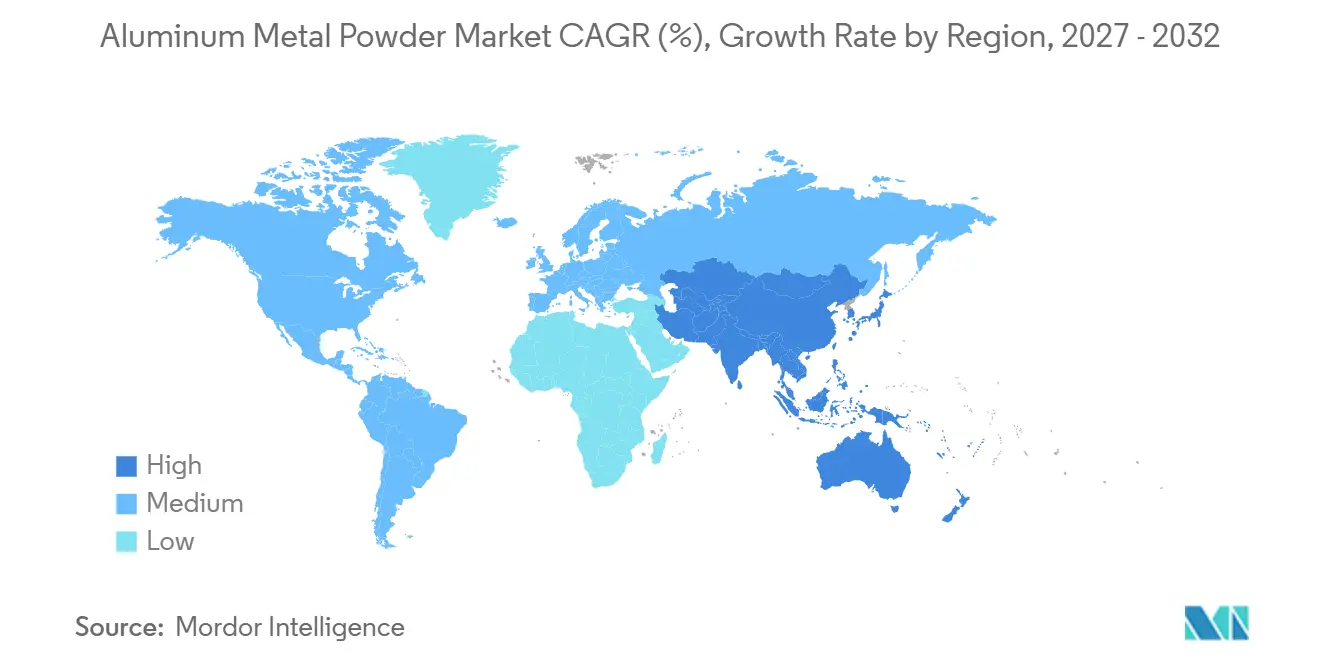
Asia-Pacific held 48.69% of revenue in 2026 and is forecast to grow at a 5.03% CAGR through 2032. The region integrates bauxite mining, smelting, gas atomization, and downstream consumption within closely connected supply chains. This structure provides cost and logistics advantages that are less available in regions with more fragmented production, as material can move through mining, smelting, powder processing, and end use with fewer cross-border handoffs. China leads regional consumption, supported by applications in powder metallurgy and photovoltaic pastes. Chinese powder metallurgy consumption is estimated at 124,000 metric tons in 2025. Demand for photovoltaic paste is increasing by more than 14% annually as solar module production expands. India contributes to demand through electric vehicle production, which exceeded 290,000 units in 2025. Japan and South Korea continue to demand semiconductor packaging pastes and Multilayer Ceramic Capacitor (MLCC) electrode materials. ASEAN economies are emerging as a secondary consumption corridor as electronics and construction manufacturing shift from coastal China.
North America is a high-value market for aluminum powder, driven by demand from aerospace, defense, and additive manufacturing applications. The Metal Powder Industries Federation reported that North American aluminum powder shipments rose 22.6% in 2024 to 26,303 metric tons. This increase preceded current investments in domestic capacity, indicating that demand for technical powders had already strengthened before producers responded by adding local production capacity. Buyers in the region prioritize reliable supply, documented performance, and compatibility with demanding production requirements, which favors suppliers that can provide technical records alongside physical powder availability. U.S. producers face an energy-cost disadvantage relative to Canadian smelters, reinforcing the importance of Canadian feedstock pipelines for some North American powder suppliers, particularly where local smelting economics limit reliance on U.S.-produced primary metal. Europe faces slower industrial demand and higher secondary-aluminum input costs. This environment encourages producers to invest in additive manufacturing and pigment products rather than lower-value commodity output, where defined technical requirements can support value even when broader industrial demand is weak.
South America, the Middle East, and Africa are earlier-stage growth areas where demand for Autoclaved Aerated Concrete (AAC) blocks provides the main entry point for the aluminum metal powder market. Saudi Arabia's Vision 2030 projects, including NEOM, the Red Sea Project, and Diriyah Gate, support demand for lightweight concrete inputs. These projects depend substantially on imports of aluminum powder from Asia, making logistics planning and the continuity of regional trading channels important considerations for projects requiring aerated concrete inputs. Brazil's construction expansion and Argentina's industrial recovery support moderate demand growth in South America. Import reliance and exchange-rate fluctuations can create purchasing risk under multi-year contracts, particularly where project schedules require material availability over extended construction periods, and buyers have limited nearby supply options. RUSAL is expanding aluminum powder and paste capacity at Shelekhov from 1,200 to 2,400 tons annually, with the combined capacity of Shelekhov and Volgograd expected to reach 4,800 tons annually. This additional supply has implications for regions where RUSAL already maintains trading relationships, as increased availability of paste and powder can influence sourcing options for construction and coating customers that rely on imported materials.
Competitive Landscape
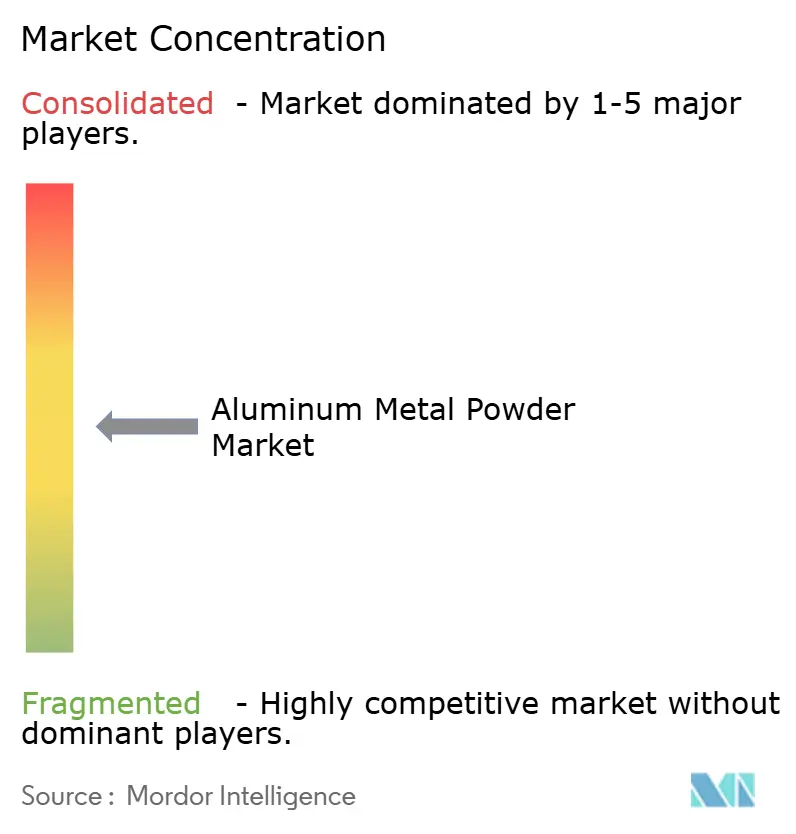
The aluminum powder market is moderately fragmented, with a mix of integrated metal producers, pigment specialists, and qualified powder suppliers serving distinct application requirements. Integrated producers have feedstock advantages, while specialty suppliers compete through qualification portfolios, alloy development, and application-specific engineering. Alcoa uses bauxite-to-powder integration to control feedstock quality at its North American operations. Kymera International combines decorative pigments, pyrotechnic grades, and LPBF-qualified alloys within its portfolio. The competitive landscape is shaped by regional capacity, proprietary alloy development, and surface passivation technology for coating flakes, allowing competitors to hold different positions depending on their upstream access and the applications they serve. Regional capacity is relevant when tariffs and supply security encourage buyers to shorten supply chains, particularly for materials used in aerospace, defense, or applications where replacement may require extensive new testing. Alloy development is important because early qualification can reduce the likelihood of later material replacement, as buyers generally avoid repeating expensive validation once a material has been accepted for a demanding production use. Surface treatment matters where pigment behavior and corrosion resistance determine performance. The aluminum powder market consequently comprises both large integrated producers and specialists with narrower technical expertise.
Valimet illustrates the specialist qualification model through its MIL-DTL-32495A(2)-validated AM 7075 C powder. This approach can create supply relationships that are less exposed to standard commodity price competition because the buyer has already invested time and resources in validating the material for a specific use. Equispheres uses plasma atomization to produce Laser Powder Bed Fusion (LPBF)-grade powder and positions uniformity and energy efficiency as its technical differentiators. Amaero is localizing high-strength aluminum alloy powder for Western aerospace supply chains. These firms compete by addressing material performance and supply assurance rather than output alone, as customers in high-specification applications require proof that the powder can perform consistently across repeat production runs. Recycled aluminum powder from electric vehicle battery material remains a potential competitive space. A 2025 study validated the concept at research scale, but major incumbents have not commercialized it at scale. This leaves an opening for suppliers that can meet both circularity and qualification requirements by combining a recovered-feedstock proposition with the process control needed for reliable particle characteristics and part performance. It also underlines the importance of commercial process development beyond laboratory validation.
RUSAL commissioned a pilot facility for scandium oxide in February 2025 to support the production of aluminum-scandium alloy feedstock for 3D printing applications. This move shows how a primary producer can pursue value in specialty materials rather than focusing solely on primary metal output, combining its upstream metal position with a route into advanced alloy feedstock. APWorks and Equispheres announced a collaboration in April 2025 to establish North American production capacity for Scalmalloy using predominantly locally sourced raw materials. This addresses the need for a regional supply of high-strength aluminum-magnesium-scandium material, reduces reliance on established production locations, and supports local aerospace procurement where access to qualified advanced materials is a consideration. Competitive activity is therefore moving toward specialty alloy availability, qualification evidence, and local manufacturing capability, while integrated producers continue to benefit from control over upstream metal supply and feedstock quality.
Aluminum Metal Powder Industry Leaders
-
TOYO ALUMINIUM K.K.
-
Höganäs AB
-
Kymera International
-
Valimet, Inc.
-
MMP Industries Ltd.
- *Disclaimer: Major Players sorted in no particular order
Recent Industry Developments
- July 2025: AMPAL, Inc., a subsidiary of United States Metal Powders, Inc., inaugurated a new nodular and spherical aluminum metal powder production line at its Palmerton, Pennsylvania facility, targeting defense-qualified additive manufacturing (AM) supplier demand. The investment responded to the 25% US aluminum tariff and the defense industrial base's preference for domestically sourced, NADCAP-compatible AM-grade aluminum metal powder.
- April 2025: APWORKS GmbH, an Airbus subsidiary, and Equispheres announced a collaboration to establish aluminum metal powder production capacity in North America for Scalmalloy, a high-strength aluminum-magnesium-scandium alloy, using predominantly locally sourced raw materials. This collaboration established a North American supply chain for a material previously produced only in Europe and Asia.
Global Aluminum Metal Powder Market Report Scope
Aluminum metal powder is the element aluminum (Al) processed into a fine, silvery-gray granular or flaky powder form, rather than a solid block or sheet. It is produced through various manufacturing processes, including atomization, milling, and chemical reduction, each yielding powders with distinct particle sizes, shapes, and purity levels.
The aluminum metal powder market is segmented by type, process, purity, end-user industry, and geography. By type, the market is segmented into powder and flakes. By process, the market is segmented into atomization, comminution, and electrolysis. By purity, the market is segmented into 92%-98%, 98%-99%, and above 99%. By end-user industry, the market is segmented into paints and coatings, explosives and fireworks, construction and infrastructure, industrial, electronics, automotive and transportation, aerospace and defense, and other end-use industries. The report also covers market sizes and forecasts for the aluminum metal powder across 15 countries in major regions. The market sizes and forecasts are provided in terms of value (USD).
| Powder |
| Flakes |
| Atomization |
| Comminution |
| Electrolysis |
| 92%-98% |
| 98%-99% |
| Above 99% |
| Paints and Coatings |
| Explosives and Fireworks |
| Construction and Infrastructure |
| Industrial |
| Electronics |
| Automotive and Transportation |
| Aerospace and Defense |
| Other End-Use Industries |
| Asia-Pacific | China |
| India | |
| Japan | |
| South Korea | |
| ASEAN Countries | |
| Rest of Asia-Pacific | |
| North America | United States |
| Canada | |
| Mexico | |
| Europe | Germany |
| United Kingdom | |
| France | |
| Italy | |
| NORDIC Countries | |
| Rest of Europe | |
| South America | Brazil |
| Argentina | |
| Rest of South America | |
| Middle East and Africa | Saudi Arabia |
| South Africa | |
| Rest of Middle East and Africa |
| By Type | Powder | |
| Flakes | ||
| By Process | Atomization | |
| Comminution | ||
| Electrolysis | ||
| By Purity | 92%-98% | |
| 98%-99% | ||
| Above 99% | ||
| By End-User Industry | Paints and Coatings | |
| Explosives and Fireworks | ||
| Construction and Infrastructure | ||
| Industrial | ||
| Electronics | ||
| Automotive and Transportation | ||
| Aerospace and Defense | ||
| Other End-Use Industries | ||
| By Geography | Asia-Pacific | China |
| India | ||
| Japan | ||
| South Korea | ||
| ASEAN Countries | ||
| Rest of Asia-Pacific | ||
| North America | United States | |
| Canada | ||
| Mexico | ||
| Europe | Germany | |
| United Kingdom | ||
| France | ||
| Italy | ||
| NORDIC Countries | ||
| Rest of Europe | ||
| South America | Brazil | |
| Argentina | ||
| Rest of South America | ||
| Middle East and Africa | Saudi Arabia | |
| South Africa | ||
| Rest of Middle East and Africa | ||
Key Questions Answered in the Report
What is current market size of Aluminum Metal Powder Market?
The aluminum metal powder market size was valued at USD 2.21 billion in 2026 and is estimated to grow from USD 2.30 billion in 2027 to USD 2.80 billion by 2032, at a CAGR of 4.08% during the forecast period (2027-2032).
Which process is most important for additive manufacturing powders?
Atomization-led process revenue accounted for 61.45% in 2026 because it produces spherical, flowable powder with a controlled particle-size distribution.
Which end-user segment is expected to grow the fastest?
Aerospace and defense is forecast to record the highest growth at a 5.14% CAGR through 2032, supported by qualified additive manufacturing applications.
Which region leads the aluminum metal powder demand?
Asia-Pacific led with 48.69% revenue share in 2026 and is forecast to grow at a 5.03% CAGR through 2032.