
Aluminum Foam Market Size and Share
Market Overview
| Study Period | 2022 - 2032 |
|---|---|
| Market Size (2027) | USD 57.30 Million |
| Market Size (2032) | USD 76.36 Million |
| Growth Rate (2027 - 2032) | 5.91 % |
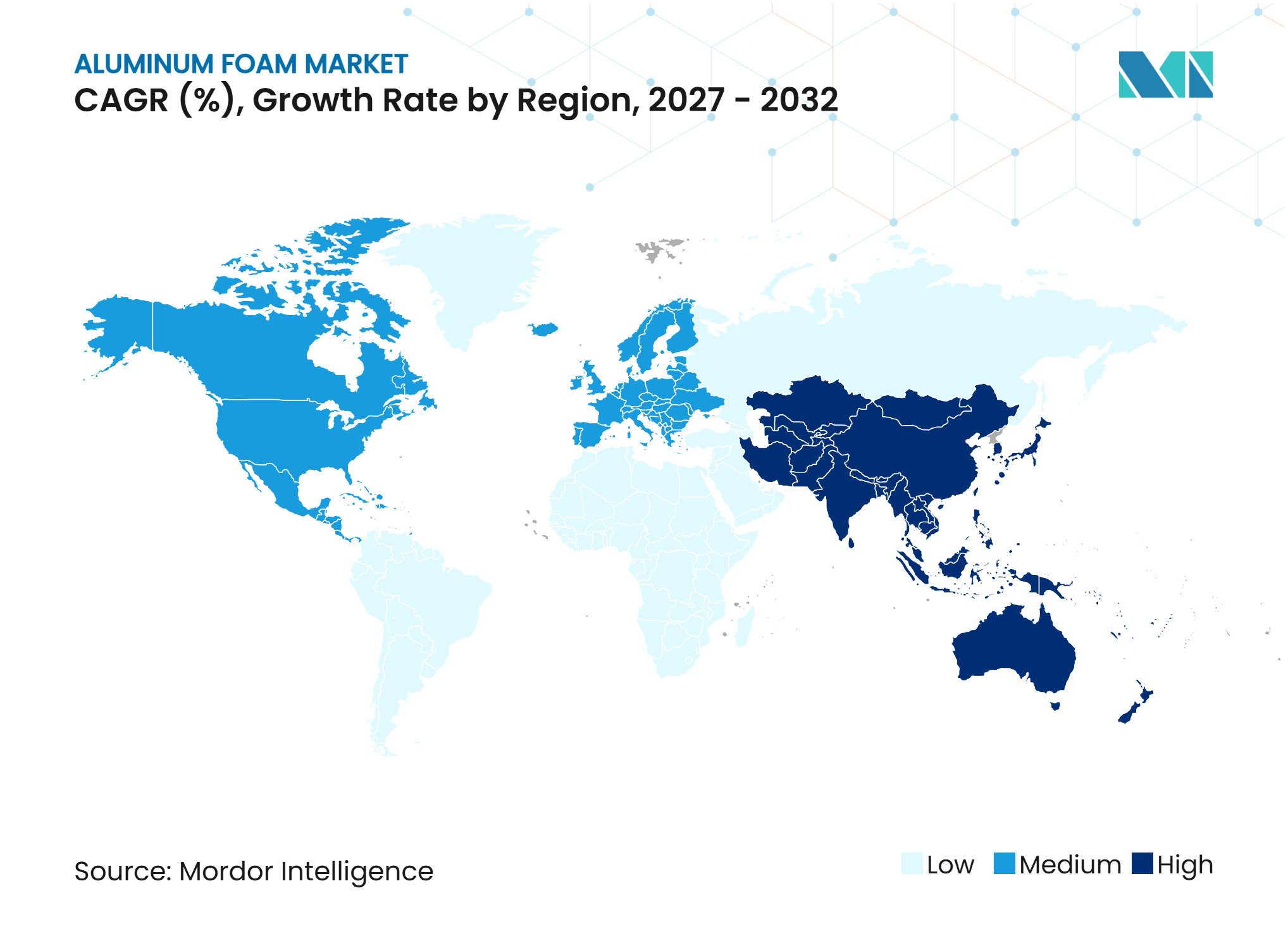
| Fastest Growing Market | Asia-Pacific |
| Largest Market | North America |
| Market Concentration | Low |
Major Players *Disclaimer: Major Players sorted in no particular order Image © Mordor Intelligence. Reuse requires attribution under CC BY 4.0. | |
Aluminum Foam Market Analysis by Mordor Intelligence
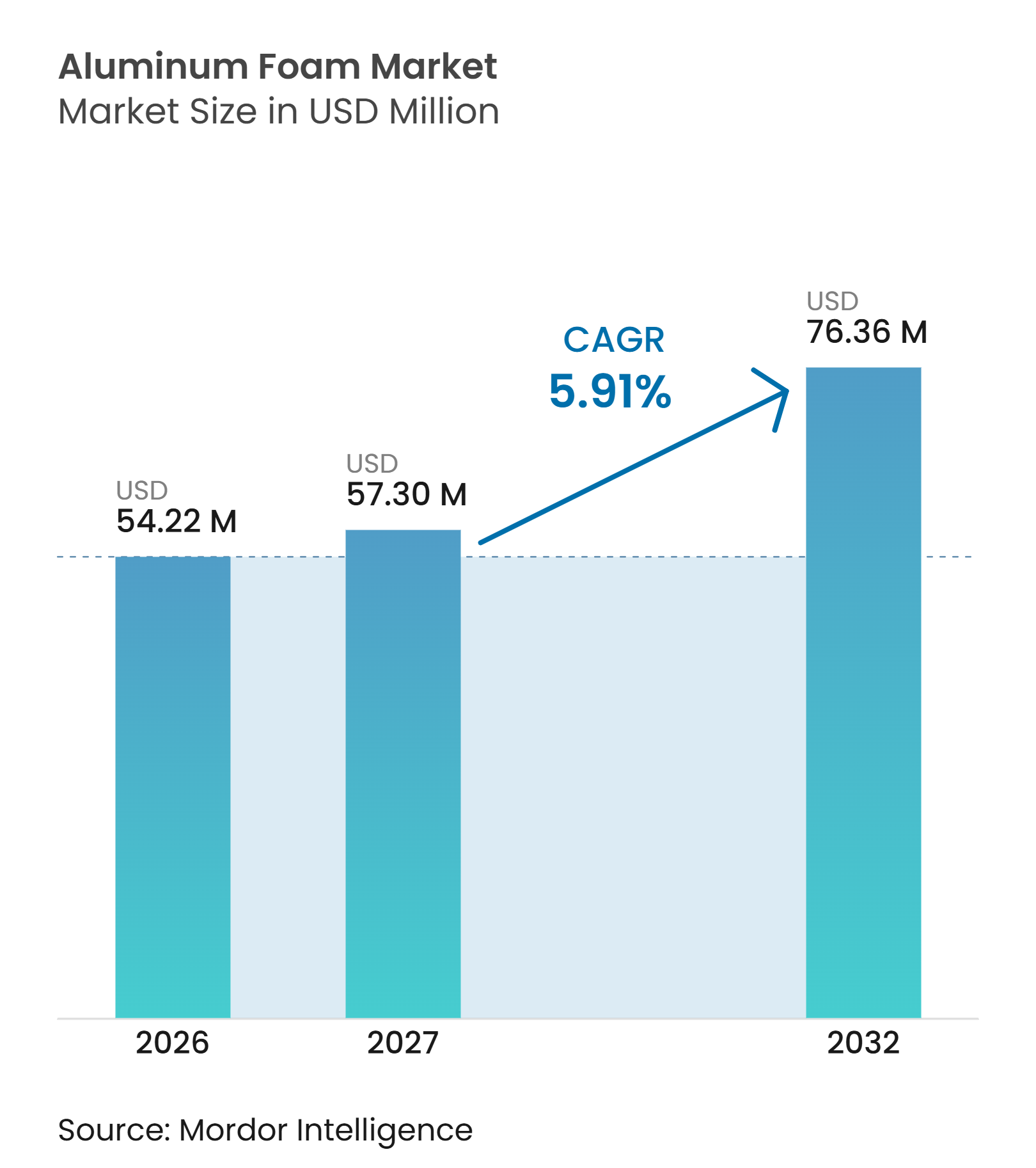
The Aluminum Foam Market size was valued at USD 54.22 million in 2026 and is estimated to grow from USD 57.30 million in 2027 to reach USD 76.36 million by 2032, at a CAGR of 5.91% during the forecast period (2027-2032). Demand comes from vehicle electrification, defense procurement, and green building projects, which have different purchasing cycles and reduce reliance on a single customer group. Materials that combine lower weight with controlled energy absorption are gaining attention as automakers and defense suppliers assess safety, range, and payload requirements. Producers are also moving toward recycled aluminum feedstock because it can lower environmental impacts while preserving mechanical performance. Qualification requirements in aerospace, defense, and automotive programs slow new supplier entry, which supports established producers with validated performance data. Cost pressure from primary aluminum and incomplete design standards continues to limit adoption in high-volume applications.
Key Report Takeaways
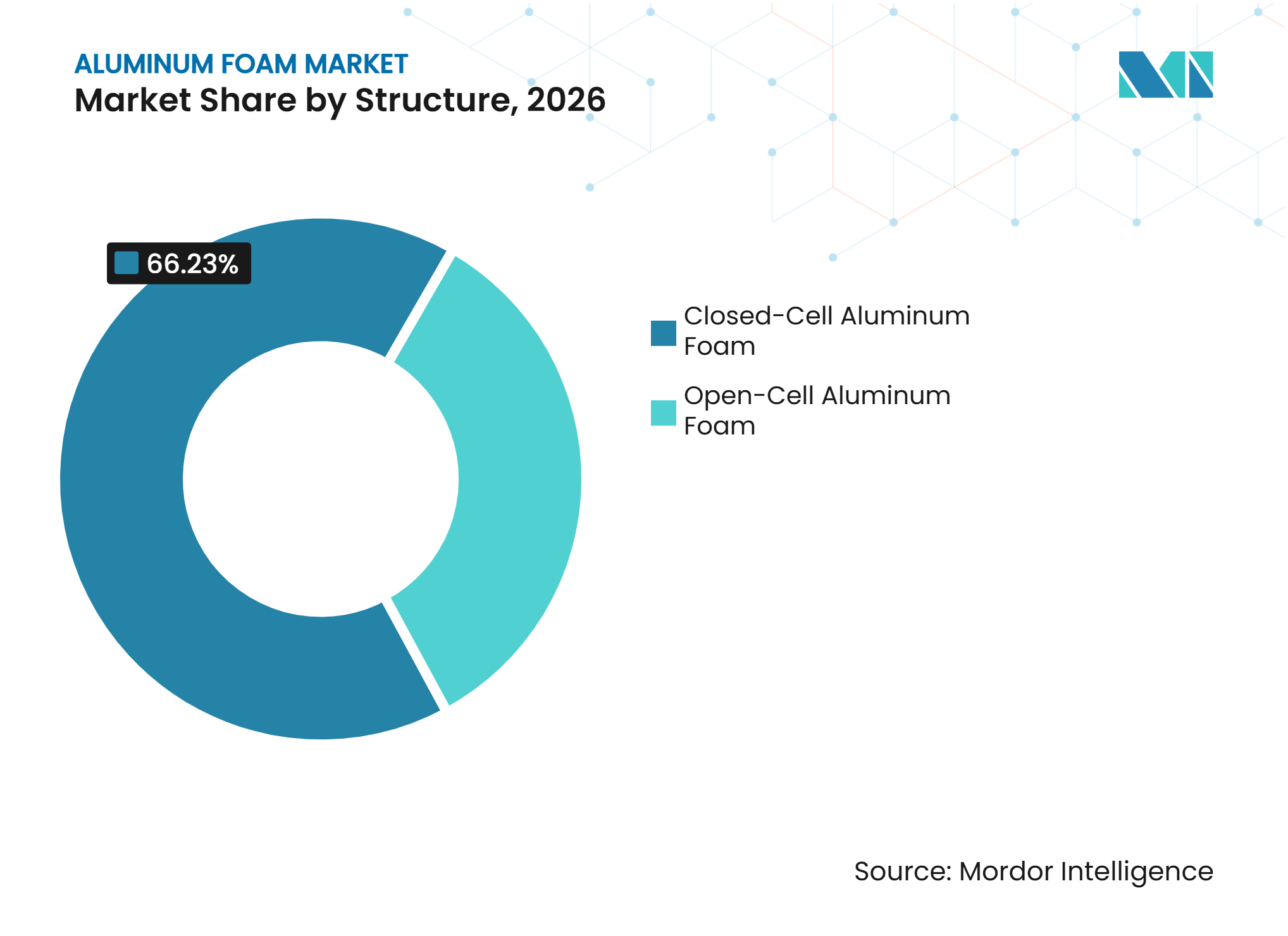
- By structure, closed-cell aluminum foam held 66.23% of the aluminum foam market share in 2026, while open-cell aluminum foam is projected to advance at a 6.67% CAGR through 2032.
- By application, energy absorbers held 34.51% of the aluminum foam market share in 2026, while heat exchangers are projected to advance at a 6.83% CAGR through 2032.
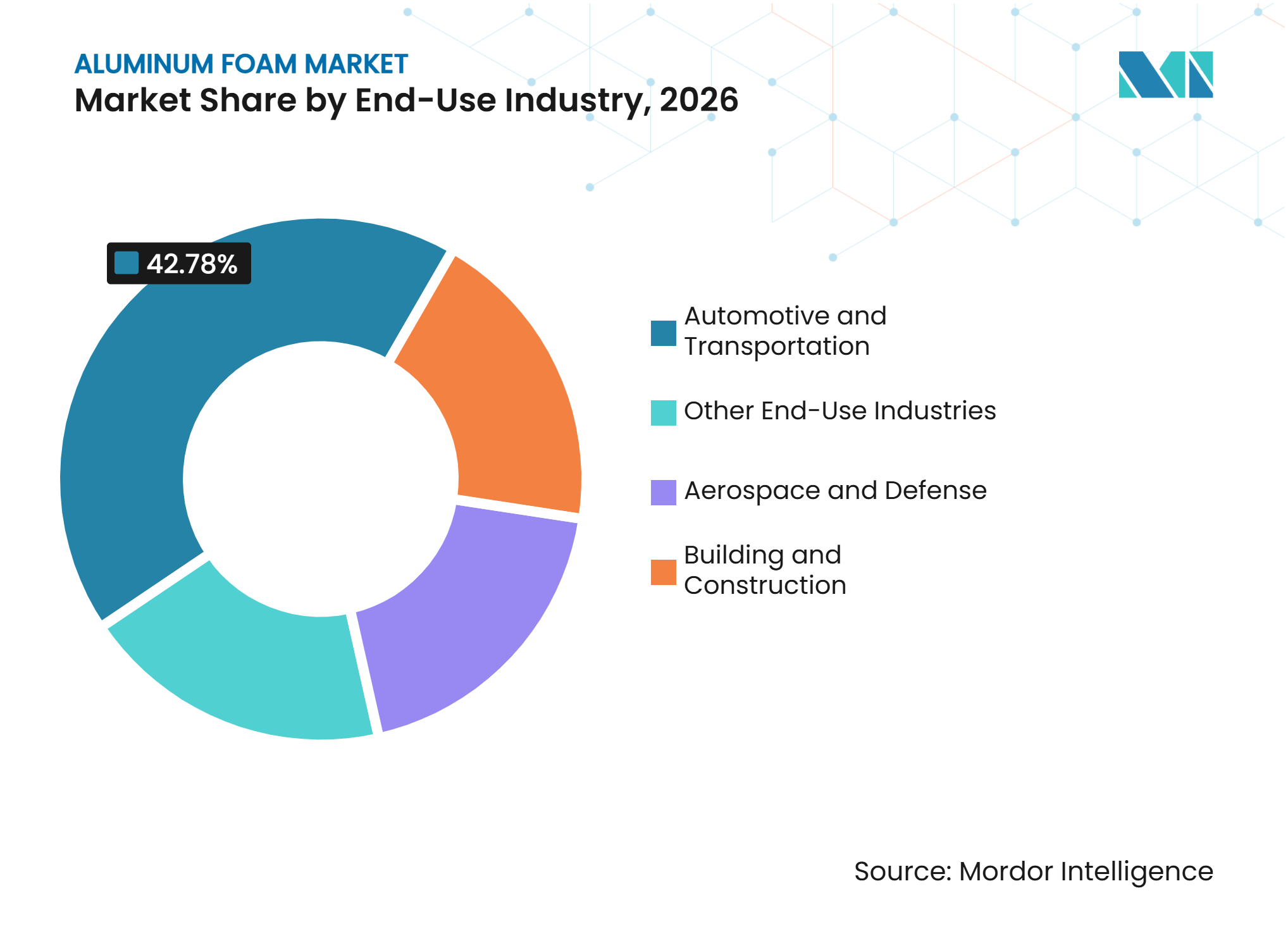
- By end-use industry, automotive and transportation held 42.78% of the aluminum foam market share in 2026, while aerospace and defense are projected to advance at a 7.23% CAGR through 2032.
- By geography, North America held 34.62% of the aluminum foam market share in 2026, while Asia-Pacific is projected to advance at a 7.11% CAGR through 2032.
Note: Market numbers in this report are based on Mordor Intelligence's proprietary estimation framework, which combines nine months of actuals with Q4 projections for base year 2026.
Market Trends and Insights
Drivers Impact Analysis of Aluminum Foam Market*
| Driver | (~) % Impact on CAGR Forecast | Geographic Relevance | Impact Timeline |
|---|---|---|---|
| Automotive Lightweighting and EV Range Extension | +1.5% | Global; highest intensity in China, Germany, United States | Short term (≤ 2 years) |
| EV Battery Enclosure Multifunctionality | +1.3% | Global; highest intensity in China, South Korea, Germany | Short term (≤ 2 years) |
| Aerospace Thermal Management and Energy Absorption | +1.1% | North America and Europe as qualification hubs; APAC as growth frontier | Medium term (2-4 years) |
| Defense and Military Blast-Protection Requirements | +0.9% | North America, Europe (NATO members), APAC defense spenders | Short term (≤ 2 years) |
| Construction Demand for Lightweight, Fire-Resistant Panels | +0.7% | APAC core, spillover to MEA; emerging in EU under revised fire-safety codes | Long term (≥ 4 years) |
| Source: Mordor Intelligence | |||
Automotive Lightweighting and EV Range Extension
Vehicle electrification makes vehicle mass a direct factor in driving range and energy use. Alumobility reported in 2025 that converting selected crossover battery-electric vehicle systems from steel to aluminum can reduce total vehicle weight by 20% at an equivalent or lower manufacturing cost. The aluminum foam market benefits where a component must manage impact loads while also helping lower vehicle mass. This creates opportunities in side sills, door panels, and bumper beams, where predictable deformation is important. The National Highway Traffic Safety Administration proposed fleetwide fuel economy targets near 34.5 miles per gallon for model year 2031, which continues the policy case for lightweight materials in electric and conventional vehicles[1]. European Automobile Manufacturers’ Association policy work on low-carbon aluminum also increases the value of documented recycled content and life cycle data in vehicle supply chains.
EV Battery Enclosure Multifunctionality
Aluminum foam can combine thermal management, crash-energy absorption, and structural support within the battery enclosure, which can reduce component count and mass when compared with separate systems for cooling and protection. The aluminum foam market gains from designs that use one recyclable material system for multiple vehicle functions. Germany’s Federal Ministry for Economic Affairs and Climate Action reported that the COOLBat project used aluminum foam in an electric vehicle battery-housing bottom plate to support thermal management and crash protection, with a targeted 15% reduction in life cycle carbon dioxide emissions. Fraunhofer Institute for Machine Tools and Forming Technology presented a battery-housing demonstrator in 2025 that integrated phase change material into aluminum foam sandwich panels. Regulation (EU) 2023/1542 introduces sustainability and recycling requirements for batteries placed on the European market, supporting interest in recyclable material systems. Federal Motor Vehicle Safety Standard No. 305a requires stronger electric-powertrain integrity documentation, which favors enclosure designs supported by validated crash evidence.
Aerospace Thermal Management and Energy Absorption
Open-cell aluminum foam has an interconnected pore structure that provides high surface area for heat transfer and supports lightweight heat exchangers for aircraft and spacecraft environmental-control systems. The aluminum foam market also benefits from aerospace programs that require lightweight thermal control. ERG Aerospace displayed foam-based heat exchangers, structural energy absorbers, carbon dioxide scrubbers, and flame arrestors for space and aerospace uses in 2025 and 2026. The qualification process often lasts 3 to 5 years, which links current orders to engineering activity started in prior years. Federal Aviation Administration, European Union Aviation Safety Agency, and Aerospace Standard 9100 requirements can preserve a supplier’s position through the production life of a qualified aircraft program.
Defense and Military Blast-Protection Requirements
Controlled cellular collapse allows aluminum foam to absorb blast energy without the mass penalty of conventional armor steel, supporting use in underbody and hull protection where payload and fuel use remain operational concerns. The aluminum foam market has a route to further defense demand as more platforms move from testing into serial procurement. Defense customers place value on validated crush performance because these components must meet defined vehicle-protection requirements. Qualification and integration work can make it difficult to substitute a supplier once a component enters production. Rising defense procurement across North Atlantic Treaty Organization countries and Asia-Pacific can widen demand among suppliers that must meet blast-protection specifications. This demand remains tied to procurement cycles that differ from commercial vehicle programs.
Restraints Impact Analysis of Aluminum Foam Market*
| Restraint | (~) % Impact on CAGR Forecast | Geographic Relevance | Impact Timeline |
|---|---|---|---|
| High Feedstock and Energy Costs | -0.5% | Global; highest cost pressure in Europe and North America | Short term (≤ 2 years) |
| Production Scale-Up and Quality-Consistency Challenges | -0.4% | Global; most acute for smaller producers in China and emerging markets | Medium term (2-4 years) |
| Limited Design Standardization and Customer Awareness | -0.3% | Global; most limiting in construction and industrial end-markets | Long term (≥ 4 years) |
| Source: Mordor Intelligence | |||
High Feedstock and Energy Costs
Primary aluminum production is energy intensive, and conventional aluminum foam processing above 680 °C adds to manufacturing costs. Changes in London Metal Exchange aluminum prices can pass directly into foam producers’ variable costs because aluminum is a major input. Fraunhofer Zukunftsfabrik found that replacing primary aluminum with recycled aluminum in foam sandwich components reduced average environmental impacts by 20.9% and carbon dioxide emissions by 13% while maintaining equivalent mechanical performance. CYMAT Technologies Ltd. entered a commercial agreement with Rio Tinto Alcan Inc. in July 2026 to serve the customers of its aluminum metal matrix composites business, with the stated aim of improving input economics and entering higher-volume applications. The aluminum foam market therefore gives suppliers that can use recycled feedstock an advantage in both cost control and life cycle reporting. Producers relying only on primary metal face simultaneous cost and sustainability pressure.
Production Scale-Up and Quality-Consistency Challenges
Consistent pore geometry and cellular uniformity remain difficult to achieve at larger production volumes. Conventional high-temperature foaming can produce cell-size distributions of ±0.3 mm, which may limit use in automotive structural parts that require precise crash simulations. International Organization for Standardization (ISO) 13314 defines methods for mechanical testing of porous metals, but it does not prescribe manufacturing tolerances. Automotive manufacturers must therefore conduct their own qualification programs, which add development time and engineering cost. Havel metal foam GmbH offers development partnerships from precursor production through the foamed component, helping customers align material development with component qualification. The aluminum foam market remains constrained where suppliers cannot provide repeatable material data and lower-tier suppliers have limited familiarity with the material.
*Our forecasts treat driver/restraint impacts as directional, not additive. The impact forecasts reflect baseline growth, mix effects, and variable interactions.
Aluminum Foam Market Segment Analysis
By Structure:
Closed-Cell Aluminum Foam Leads, While Open-Cell Aluminum Foam ExpandsClosed-cell aluminum foam held 66.23% of the aluminum foam market share in 2026 because its sealed pores provide compressive strength and controlled deformation. Its established role in automotive crash-management components and defense structures supports this position. A 2025 scientific review found that closed-cell foam at 84% porosity and 50% deformation absorbed more than 2.5 MJ/m³ of energy. This performance is relevant in safety-critical applications where structural weight must be minimized. Buyers in these fields value repeatable crush behavior and test data as much as the material’s low density.
Open-cell aluminum foam is projected to advance at a 6.67% CAGR through 2032, supported by heat-exchanger and filtration requirements. Its connected pores provide the fluid flow and surface area that these uses require. ERG Aerospace supplies open-cell foam for air-oil separation, thermal management, energy absorption, and other aerospace applications. Open-cell aluminum foam also has potential in architectural applications where light transmission and acoustic performance are important. The aluminum foam industry gains demand from functional applications, and the aluminum foam market can gain resilience because this broader application base reduces reliance on a single component category.


By Application:
Energy Absorbers Lead, Heat Exchangers AccelerateEnergy absorbers accounted for 34.51% of the aluminum foam market size in 2026. Automotive crash-management systems and military blast-protection applications underpin demand, making energy-absorption performance a core basis for component selection in the aluminum foam market. Foam structures are useful when designers need material that deforms predictably during an impact. Anti-intrusion bars use similar behavior in door and B-pillar applications, where foam sandwich construction can offer a thinner section than steel at comparable energy absorption per unit weight. Rail, industrial, and building uses also support sound absorbers, which benefit from the material’s noncombustible profile and its fit with American Society for Testing and Materials (ASTM) E84 and National Fire Protection Association (NFPA) 285.
Heat exchangers are projected to advance at a 6.83% CAGR through 2032. Aerospace thermal-management programs and electric vehicle battery cooling support this demand from different customer groups. These uses share a porous material platform but follow separate purchasing cycles and compliance requirements, which can reduce the effect of weakness in one end market. Filtration, electromagnetic shielding, catalyst-support structures, hydrogen systems, and data-center cooling add smaller emerging demand streams. The aluminum foam market can benefit as cooling and energy-management systems require lightweight materials with greater surface area.
By End-Use Industry:
Automotive and Transportation Lead, While Aerospace and Defense Sets the PaceAutomotive and transportation held 42.78% of the aluminum foam market share in 2026, reflecting established crash-management use across vehicle platforms. The aluminum foam market depends on automotive demand because vehicle programs remain its largest end-use base. Automotive customers value the material’s ability to combine energy absorption with lower component weight, while battery enclosures add demand for both protection and thermal management. Fraunhofer Institute for Machine Tools and Forming Technology demonstrated 4 aluminum foam sandwich configurations for electric vehicle battery housings in 2025, showing that thermal performance may become as important as passive safety for automotive adoption. Recycled aluminum use can further support procurement requirements linked to life cycle carbon data.
Aerospace and defense are projected to advance at a 7.23% CAGR through 2032. The aluminum foam market can gain from aerospace programs that use the material in structural, thermal-management, and energy-absorption roles. Replacing machined solid-aluminum components can lower operating weight without relying on thinner-gauge sheet in every application. Qualification processes create long sales cycles but can support repeat orders once a component reaches serial production. Building and construction offer a separate outlet through facades, acoustic panels, and fire-resistant cladding, while other end-use industries include industrial machinery, rail, and energy equipment.


Geography Analysis
North America
North America held 34.62% of the aluminum foam market share in 2026. Aerospace and defense qualification infrastructure supports the region, where the aluminum foam market benefits from customers that value validated performance data. CYMAT Technologies Ltd. and ERG Aerospace serve blast-protection and thermal-management applications, while CYMAT Technologies Ltd. signed a July 2026 agreement with Rio Tinto Alcan Inc. that is expected to add USD 7.5 million to USD 10 million in annual revenue when production is commissioned. United States Department of Defense procurement practices and Federal Aviation Administration material requirements can make validated material performance more valuable than price alone. The Safer Affordable Fuel-Efficient (SAFE) Vehicles Rule III also supports lightweighting work across vehicle types through model year 2031.
Asia-Pacific
Asia-Pacific is projected to advance at a 7.11% CAGR through 2032, supported by China’s electric vehicle production, material engineering in Japan and South Korea, and India’s developing aerospace manufacturing base. The aluminum foam market has a strong regional opportunity in vehicle components, sound barriers, and composite panels. The Xinyu foam aluminum new-materials project began construction in Liaoning Province in March 2025 with planned investment of CNY 5.15 billion (USD 710 million), 8 automated continuous-production lines, and 50 three-dimensional printing metal foam production lines for new-energy vehicle components, transportation sound barriers, and foam-aluminum composite panels. India’s Corporate Average Fuel Economy Phase 3 norms incorporate weight-based carbon dioxide thresholds, strengthening policy support for lightweight materials[2].
Europe, South America, Middle East and Africa
Europe remains important because of Germany’s automotive engineering base and specialist producers such as Havel metal foam GmbH, pohltec metalfoam GmbH, and hollomet GmbH, which focus on customized structures for automotive, rail, machinery, and industrial uses. The aluminum foam market in Europe favors suppliers that pair materials with component engineering. Compliance factors include the European Union’s Registration, Evaluation, Authorization and Restriction of Chemicals (REACH) framework and the Ecodesign for Sustainable Products Regulation, which place more attention on material documentation and recyclability. South America has early-stage potential for lightweight fire-resistant construction panels, while the Middle East and Africa offer an entry point for facade products but have limited local production capacity. These mixed regions can reward producers that combine application engineering with local project support.
Competitive Landscape
Market Concentration
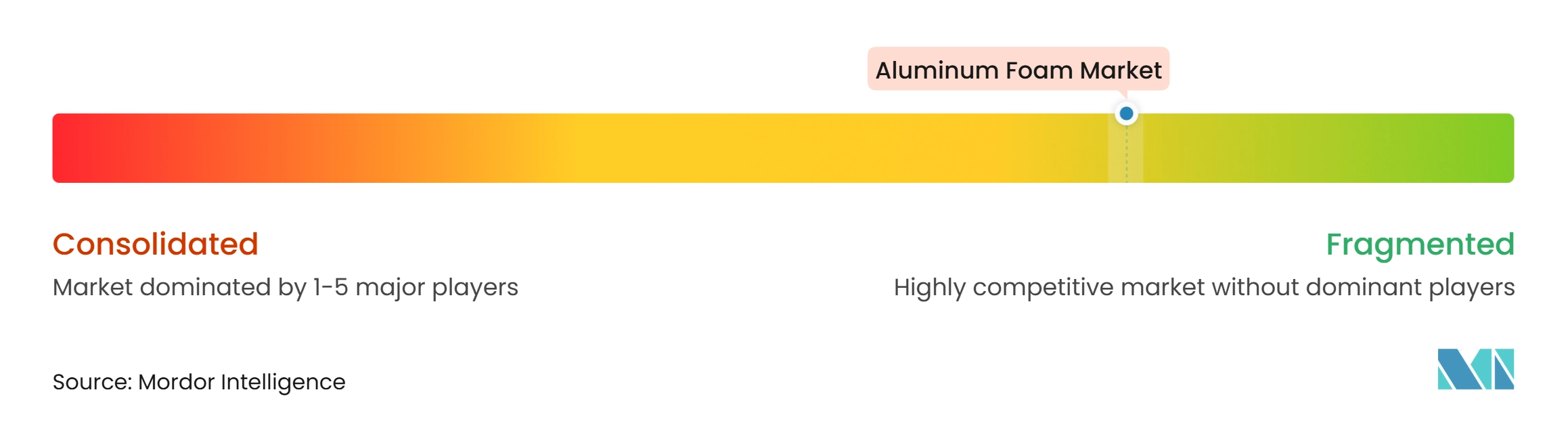
The aluminum foam market is highly fragmented, with top players including ERG Aerospace, CYMAT Technologies Ltd., Havel metal foam GmbH, pohltec metalfoam GmbH, and Aluinvent. CYMAT Technologies Ltd. and ERG Aerospace hold established positions in North America, and ERG Aerospace received United States Patent 12,280,420 B2 in April 2025 for a method of making an inorganic reticulated foam structure. Its 2025 and 2026 aerospace exhibitions placed thermal-management and energy-absorption products before space, defense, and industrial customers. These positions are reinforced by customer qualification processes that can take years.
European suppliers tend to compete through engineered components rather than volume supply. The aluminum foam market allows these suppliers to compete on component design, not only material price. Havel metal foam GmbH offers manufacturing from precursor material through series production, which supports joint component development with original equipment manufacturers. The hollomet GmbH obtained United States Patent 12,617,733 B2 in 2026 with Fraunhofer-Gesellschaft for a method to produce porous metallic or ceramic components.
CYMAT Technologies Ltd.’s July 2026 agreement with Rio Tinto Alcan Inc. combines customer access with an established production opportunity in aluminum metal matrix composites. Competition in construction, transit, and commercial automotive applications often centers on forming speed, price, and the ability to meet project specifications. Data-center cooling is another developing area where porous structures can support heat transfer, and suppliers that reduce feedstock costs while providing engineering data are better placed to convert trials into long-term specifications.
Aluminum Foam Industry Leaders
-
ERG Aerospace
-
CYMAT Technologies Ltd.
-
Havel metal foam GmbH
-
pohltec metalfoam GmbH
-
Aluinvent
- *Disclaimer: Major Players sorted in no particular order
Aluminum Foam Market Companies Covered in this Report
- Alantum
- Aluinvent
- Aluminum Foam Technologies LLC
- Aluminum King Co., Ltd.
- Beihai Composite Materials Co., Ltd.
- Beijing Zhongjin Aluminum Foam Technology Co., Ltd.
- CYMAT Technologies Ltd.
- ERG Aerospace
- Exxentis
- Havel metal foam GmbH
- hollomet GmbH
- Liaoning Rontec Advanced Material Technology Co., Ltd.
- pohltec metalfoam GmbH
- Shanghai Winfay New Material Co., Ltd.
- Shanxi Putai Aluminum Foam Manufacturing Co., Ltd.
Recent Industry Developments in Aluminum Foam Market
- August 2026: Fraunhofer Institute for Machine Tools and Forming Technology (Fraunhofer IWU) developed a recycling approach to manufacture aluminum foam using processed aluminum chips, production scrap, and end-of-life aluminum foam components instead of relying entirely on virgin aluminum alloy powder. The research supported the aluminum foam market through lower raw-material consumption, reduced production costs, and more circular manufacturing processes.
- December 2025: CYMAT Technologies Ltd. secured an order worth approximately USD 1.8 million to supply stabilized aluminum foam (SAF) underbody protection kits for an Asian military vehicle manufacturer. The contract supports the aluminum foam market by demonstrating the adoption of aluminum foam in blast mitigation, vehicle protection, and defense applications.
Global Aluminum Foam Market Report Scope
Aluminum foam is a lightweight cellular material produced by introducing gas bubbles into molten aluminum or aluminum alloys, creating a porous structure with a high strength-to-weight ratio. It offers properties such as energy absorption, sound insulation, thermal management, and impact resistance. These characteristics make aluminum foam suitable for applications requiring lightweight structural components, noise reduction, and enhanced safety.
The Aluminum Foam Market is segmented by structure, application, end-use industry, and geography. By structure, the market is segmented into closed-cell aluminum foam and open-cell aluminum foam. By application, the market is segmented into energy absorbers, anti-intrusion bars, heat exchangers, sound absorbers, and other applications. By end-use industry, the market is segmented into automotive and transportation, aerospace and defense, building and construction, and other end-use industries. The report also covers the market size and forecasts for aluminum foam in 15 countries across major regions. For each segment, the market sizing and forecasts have been done on the basis of value (USD).
Segmentation Overview
| Closed-Cell Aluminum Foam |
| Open-Cell Aluminum Foam |
| Energy Absorbers |
| Anti-Intrusion Bars |
| Heat Exchangers |
| Sound Absorbers |
| Other Applications |
| Automotive and Transportation |
| Aerospace and Defense |
| Building and Construction |
| Other End-Use Industries |
| Asia-Pacific | China |
| India | |
| Japan | |
| South Korea | |
| ASEAN Countries | |
| Rest of Asia-Pacific | |
| North America | United States |
| Canada | |
| Mexico | |
| Europe | Germany |
| United Kingdom | |
| France | |
| Italy | |
| NORDIC Countries | |
| Rest of Europe | |
| South America | Brazil |
| Argentina | |
| Rest of South America | |
| Middle East and Africa | Saudi Arabia |
| South Africa | |
| Rest of Middle East and Africa |
| By Structure | Closed-Cell Aluminum Foam | |
| Open-Cell Aluminum Foam | ||
| By Application | Energy Absorbers | |
| Anti-Intrusion Bars | ||
| Heat Exchangers | ||
| Sound Absorbers | ||
| Other Applications | ||
| By End-Use Industry | Automotive and Transportation | |
| Aerospace and Defense | ||
| Building and Construction | ||
| Other End-Use Industries | ||
| By Geography | Asia-Pacific | China |
| India | ||
| Japan | ||
| South Korea | ||
| ASEAN Countries | ||
| Rest of Asia-Pacific | ||
| North America | United States | |
| Canada | ||
| Mexico | ||
| Europe | Germany | |
| United Kingdom | ||
| France | ||
| Italy | ||
| NORDIC Countries | ||
| Rest of Europe | ||
| South America | Brazil | |
| Argentina | ||
| Rest of South America | ||
| Middle East and Africa | Saudi Arabia | |
| South Africa | ||
| Rest of Middle East and Africa | ||
Key Questions Answered in the Report
What is the size of the aluminum foam market?
The aluminum foam market size was valued at USD 54.22 million in 2026 and is estimated to grow from USD 57.30 million in 2027 to reach USD 76.36 million by 2032, at a CAGR of 5.91% during the forecast period (2027-2032).
Which structure held the largest share in 2026?
Closed-cell aluminum foam held 66.23% of the market share in 2026 because it is widely used in crash-management and defense components.
Which application is expected to grow fastest through 2032?
Heat exchangers are projected to advance at a 6.83% CAGR through 2032, supported by aerospace thermal management and electric vehicle battery cooling.
What is driving demand for aluminum foam in electric vehicles?
Lightweighting, crash protection, thermal management, and battery enclosure integration are supporting automotive demand.