
Alternative Lending Market Size and Share
Market Overview
| Study Period | 2021 - 2032 |
|---|---|
| Market Size (2027) | USD 1.8 Trillion |
| Market Size (2032) | USD 2.70 Trillion |
| Growth Rate (2027 - 2032) | 8.40 % |
| Fastest Growing Market | Asia-Pacific |
| Largest Market | North America |
| Market Concentration | Low |
Major Players *Disclaimer: Major Players sorted in no particular order Image © Mordor Intelligence. Reuse requires attribution under CC BY 4.0. | |
Alternative Lending Market Analysis by Mordor Intelligence
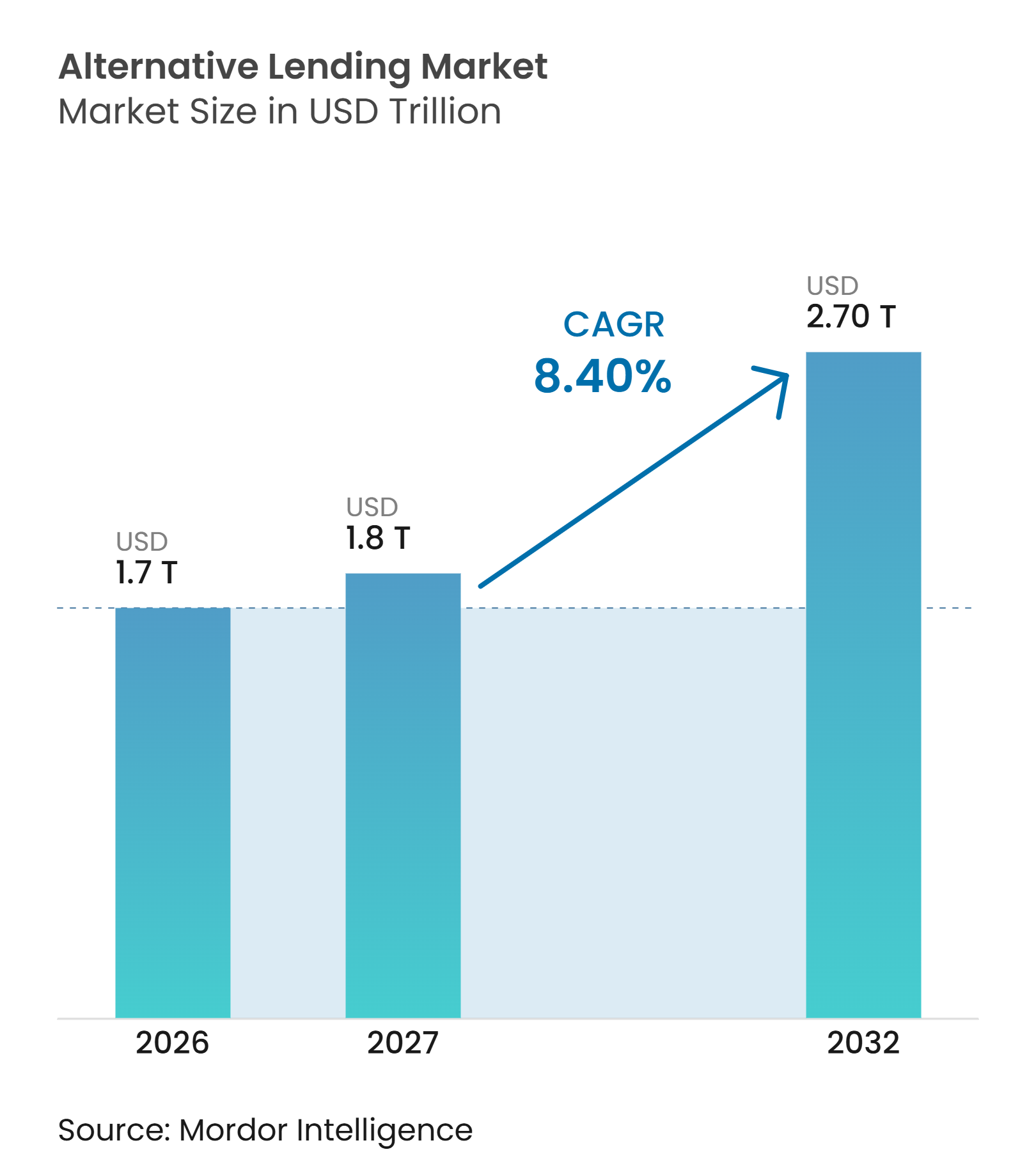
The Alternative Lending Market size is projected to be USD 1.7 trillion in 2026, USD 1.8 trillion in 2027, and reach USD 2.70 trillion by 2032, growing at a CAGR of 8.40% from 2027 to 2032.
The alternative lending market is supported by persistent financing gaps for smaller businesses, while established banks face shorter credit maturities and lower outstanding SME lending relative to gross domestic product in many countries. Private credit is also an important funding base, with USD 2.6 trillion in global assets under management and USD 1.5 trillion in outstanding loans to United States businesses as of Q4 2025. Faster approvals, embedded lending tools, and cash-flow-based assessment are changing how borrowers access credit and how lenders find qualified applicants. At the same time, higher funding costs, rising delinquency risk, and more demanding licensing requirements are shaping lender strategies across the alternative lending market.
Key Report Takeaways
- By lending model, balance-sheet/direct lending captured 64.8% of the alternative lending market share in 2026, while marketplace/platform-facilitated lending is projected to grow at an 11.5% CAGR through 2032.
- By borrower type, medium-sized/mid-market businesses captured 30.4% of the alternative lending market share in 2026, while micro and small businesses are projected to grow at an 11.8% CAGR through 2032.
- By loan or product type, secured business and asset-backed loans captured 32.1% of the alternative lending market share in 2026, while unsecured consumer and personal loans, including BNPL, are projected to grow at a 12.1% CAGR through 2032.
- By distribution channel, direct digital platforms captured 29.6% of the alternative lending market share in 2026, while e-commerce and merchant/embedded platforms are projected to grow at a 13.4% CAGR through 2032.
- By geography, North America captured 36.3% of the alternative lending market share in 2026, while Asia-Pacific is projected to grow at a 12.4% CAGR through 2032.
Note: Market numbers in this report are based on Mordor Intelligence's proprietary estimation framework, which combines nine months of actuals with Q4 projections for base year 2026.
Market Trends and Insights
Drivers Impact Analysis of Alternative Lending Market*
| Driver | (~) % Impact on CAGR Forecast | Geographic Relevance | Impact Timeline |
|---|---|---|---|
| Persistent SME Credit Gaps and Non-Bank Working-Capital Demand | +2.0% | Global, concentrated in Asia-Pacific, Europe, and South America | Medium term (2-4 years) |
| Embedded Lending Through Commerce and Business Software | +1.8% | North America, Europe, and Asia-Pacific | Short term (≤ 2 years) |
| Alternative-Data Underwriting for Underserved Borrowers | +1.2% | Asia-Pacific, Middle East and Africa, South America, and North America | Medium term (2-4 years) |
| Institutional Capital for Private Credit and Non-Bank Originations | +1.5% | Global, with North America and Europe as principal deployment areas | Long term (≥ 4 years) |
| Faster Consumer Credit and Point-of-Sale Financing | +0.9% | North America, Europe, and Asia-Pacific | Short term (≤ 2 years) |
| Digital Cross-Border Lending and Platform Access | +0.7% | Asia-Pacific, Middle East and Africa, and South America | Long term (≥ 4 years) |
| Source: Mordor Intelligence | |||
Persistent SME Credit Gaps and Demand for Non-Bank Working-Capital Finance
Small business borrowing from banks remains limited in many economies, which supports demand across the alternative lending market. OECD reporting shows that borrowing rates remained above pre-pandemic levels in 34 of 39 tracked countries[1]. This environment increases the value of lenders that can assess cash flow quickly and structure credit around business needs. Non-bank products can also suit profitable firms that seek faster decisions rather than borrowers who have been declined by banks. The shift toward flexible working-capital facilities therefore widens the addressable base for the alternative lending market.
Embedded Lending Through E-Commerce, B2B Platforms, and Business-Management Software
Embedded lending places financing within the digital tools that merchants already use for sales, payments, inventory, and accounting. The alternative lending market benefits when platforms use transaction activity, inventory cycles, and buyer return patterns to support credit decisions. This information can reduce the time needed to assess a borrower compared with a review based mainly on financial statements. It also helps platforms offer working-capital products when a merchant has a clear business need. In the United Kingdom, JTL and YouLend launched financing within the JTL ERP environment for German e-commerce merchants in July 2026, with same-day approvals and access for more than 15,000 merchants[2].
Alternative-Data Underwriting for Thin-File Consumers and Underserved SMEs
Cash-flow and transaction records can support lending decisions for borrowers with limited formal credit histories. The alternative lending market can reach thin-file consumers and smaller firms when lenders use sales, expenses, orders, and invoice information alongside conventional records. Indonesia established a framework for alternative credit scoring through OJK Regulation No. 29 of 2024, which covers selected uses of telecom, social media, and digital transaction information[3]. The approach may help lenders assess borrowers who have little bureau coverage, but consent and model transparency remain important requirements. In Europe, high-risk artificial intelligence rules for credit scoring raise compliance needs for platforms operating across several jurisdictions.
Institutional Capital Deployment into Private Credit and Non-Bank Loan Origination
Institutional investors continue to treat private credit as an alternative source of income and diversification. The alternative lending market has grown, with larger pools of capital seeking direct lending, asset-backed finance, and specialty lending opportunities. Private credit lending to medium-sized companies was estimated at USD 1.5 trillion to USD 2 trillion in May 2026[4]. Greater capital availability can improve lender capacity, although it also raises the importance of differentiated underwriting and proprietary borrower access. Platforms that combine strong credit controls with relevant operating data can compete more effectively for this funding.
Restraints Impact Analysis of Alternative Lending Market*
| Restraint | (~) % Impact on CAGR Forecast | Geographic Relevance | Impact Timeline |
|---|---|---|---|
| Rising Delinquencies, Over-Leverage, and Fraud-Driven Credit Losses | -0.8% | North America lower-middle market and Asia-Pacific consumer lending | Short term (≤ 2 years) |
| Higher Funding Costs, Warehouse Constraints, and Refinancing Risk | -0.7% | North America, Europe, and Asia-Pacific | Short term (≤ 2 years) |
| Fragmented Lending Regulation, Licensing, and Compliance Costs | -0.5% | Europe and Asia-Pacific | Medium term (2-4 years) |
| Thin-File Data Gaps, Consent Restrictions, and Limited Explainability | -0.4% | Middle East and Africa, South America, and underserved Asia-Pacific markets | Long-term (≥ 4 years) |
| Source: Mordor Intelligence | |||
Rising Delinquencies, Borrower Over-Leverage, and Fraud-Driven Credit Losses
Credit stress can limit new originations and reduce investor appetite across the alternative lending market. Business development company median non-accrual investments reached 2.75% of total investments at cost in Q2 2026, compared with 1.81% in Q1 2026. Borrowers with limited credit files may be particularly exposed when income weakens, or fraudulent identities enter the application process. Lenders therefore need robust verification, portfolio monitoring, and loss forecasting as they serve higher-risk groups. These controls can increase the cost of extending credit to underserved customers.
Higher Funding Costs, Warehouse-Line Constraints, and Refinancing Risk
Warehouse facilities remain a major funding expense for lenders without deposit funding. Effective warehouse funding costs reached 6.04% in July 2026, with a 2.42% spread to the Secured Overnight Financing Rate. Tighter funding conditions can reduce margins when loan rates fall or when loans remain on a lender's balance sheet for longer. Deposit-funded platforms have an advantage because they can reduce their reliance on warehouse facilities. This funding gap is encouraging more alternative lenders to pursue bank charters or longer-term institutional funding arrangements.
*Our forecasts treat driver/restraint impacts as directional, not additive. The impact forecasts reflect baseline growth, mix effects, and variable interactions.
Alternative Lending Market Segment Analysis
By Lending Model:
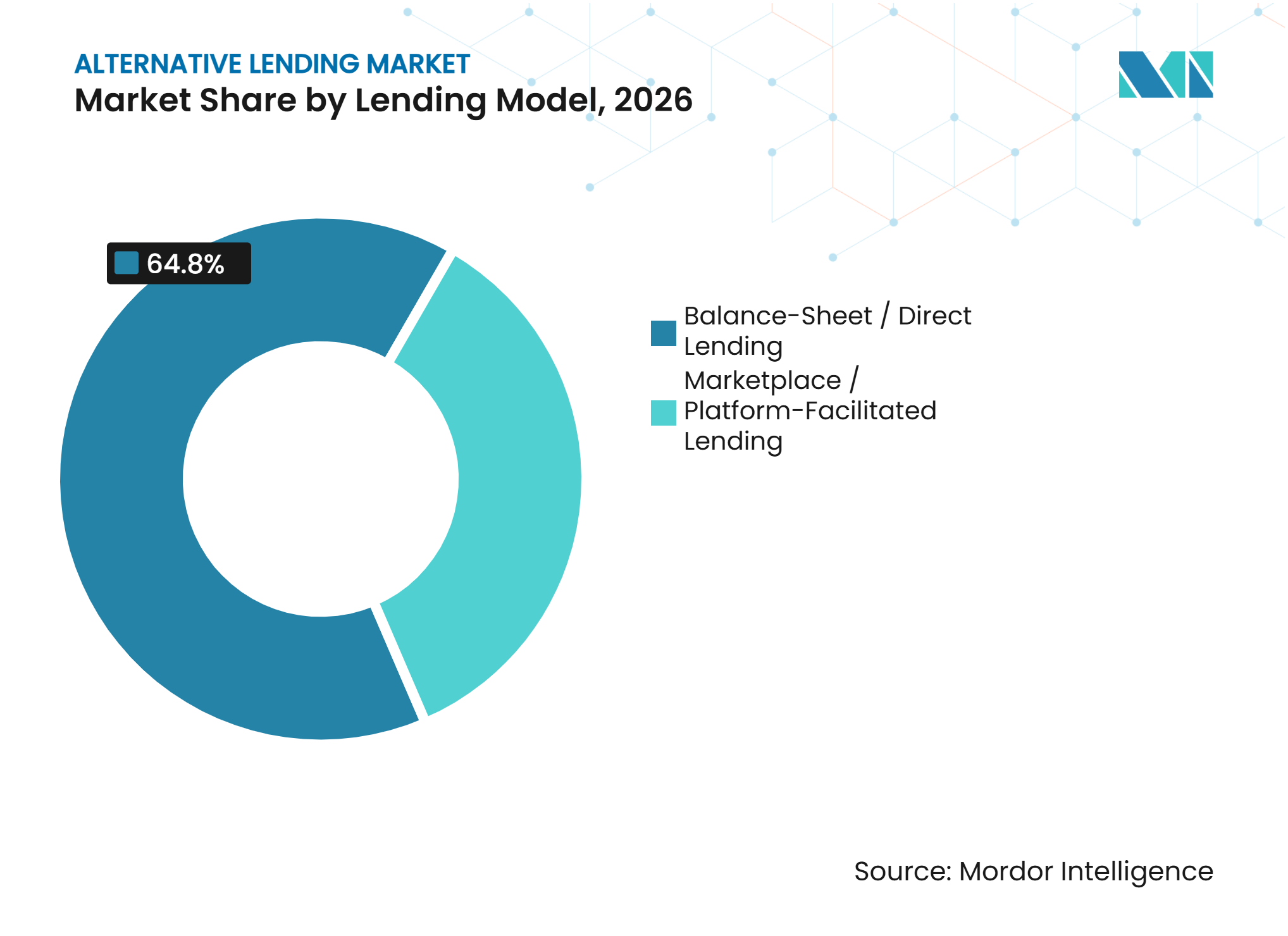
Balance-Sheet Lending Retains Scale as Platforms ExpandBalance-sheet/direct lending held 64.8% of the alternative lending market share in 2026, reflecting investor preference for direct loan ownership and associated yield potential. The model gives lenders control over underwriting standards, portfolio construction, borrower relationships, servicing decisions, and the timing of loan sales. It also aligns with the scale of private credit, which held USD 2.6 trillion in global assets under management as of Q4 2025. Larger originators can retain senior loan exposures while using technology partnerships, specialty finance firms, and referral relationships to increase borrower access. The alternative lending market remains reliant on direct lending because it supports tailored structures for middle-market companies that require more flexibility than standardized bank facilities.
Marketplace/platform-facilitated lending is forecast to expand at an 11.5% CAGR through 2032. These platforms can connect borrowers, investors, and funding partners without retaining every loan exposure on their own balance sheets. Their growth depends on efficient borrower acquisition, reliable underwriting, transparent servicing, and access to institutional capital across market conditions. Platform structures can also help lenders enter new locations or product categories with lower balance-sheet intensity and more flexible capital commitments. As the alternative lending market develops, direct lenders and platforms are likely to use blended funding arrangements that combine retained loans, forward-flow agreements, warehouse facilities, and securitization.


By Borrower Type:
Mid-Market Businesses Lead While Micro and Small Firms AccelerateMedium-sized/mid-market businesses accounted for 30.4% of the alternative lending market size in 2026. These borrowers often need financing that is too small for the largest direct lending transactions and too large for many community-bank exposures. Their needs can include working capital, acquisition funding, equipment purchases, refinancing, inventory management, and expansion into new customer groups. The segment benefits from lenders that can tailor loan terms to business cash flow, collateral, seasonal demand, and planned capital expenditure. Mid-market borrowers also provide a core base for commercial direct lending portfolios because they often require continuing credit support rather than a single short-term facility.
Micro and small businesses are projected to record an 11.8% CAGR through 2032. The alternative lending market is expanding access for these firms through cash-flow assessment, digital application processes, and products designed around everyday operating needs. Faster decisions can be important for businesses managing seasonal inventory, supplier payments, payroll timing, equipment repairs, or short-term customer payment delays. In the United States, 16% of adults used buy now, pay later services in 2025, which also demonstrates greater familiarity with digital credit products. Individual consumers remain important users of unsecured credit, while larger corporates retain direct access to syndicated lending markets and other established sources of institutional financing.
By Loan or Product Type:
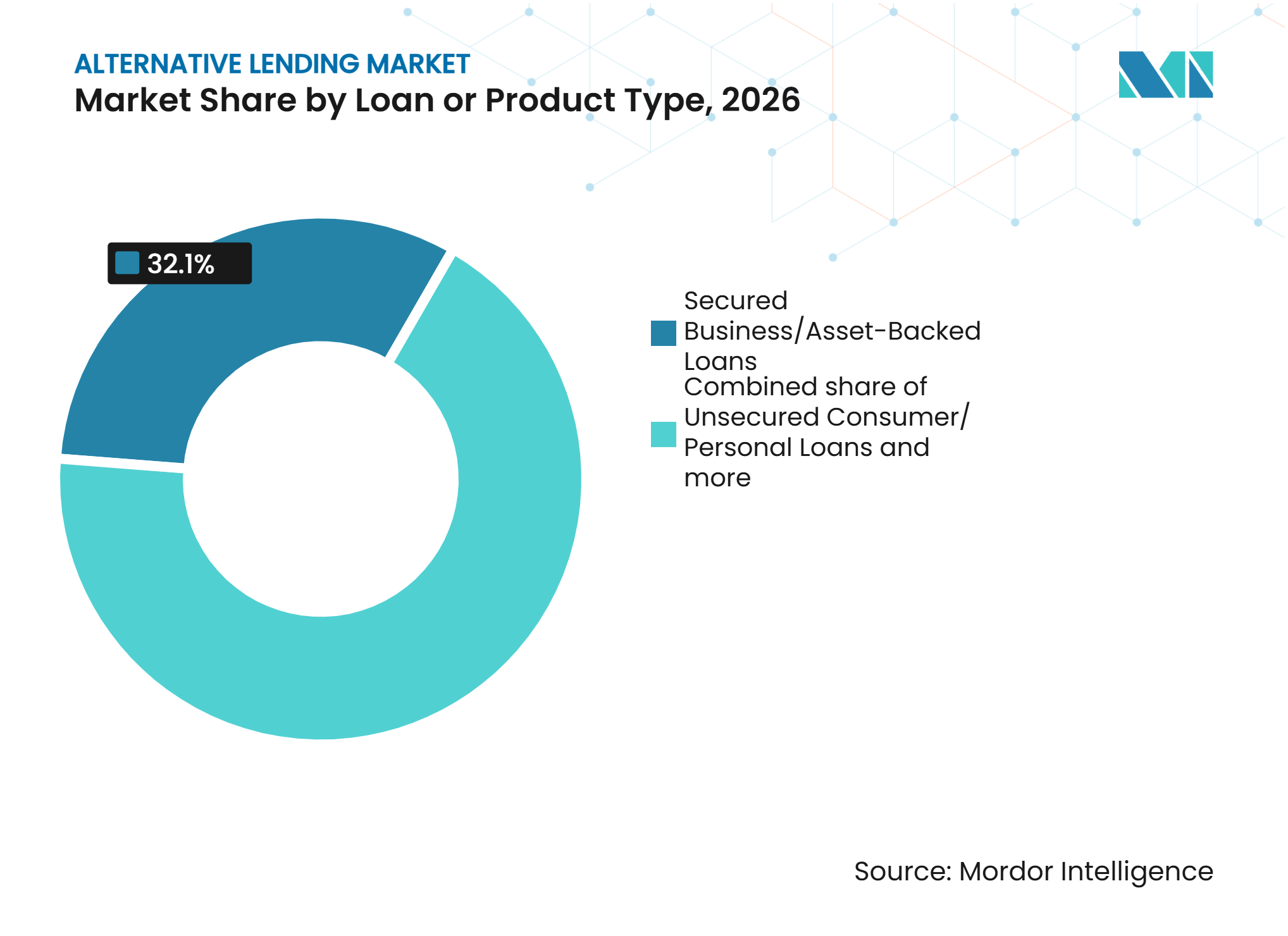
Asset-Backed Lending Leads While Unsecured Consumer Credit GrowsSecured business and asset-backed loans captured 32.1% of the alternative lending market share in 2026. This category includes invoice and receivables finance, equipment lending, commercial real estate financing, and other facilities secured against identifiable assets or contracted cash flows. Collateral can provide an added layer of protection for lenders and institutional funding partners during periods of weaker borrower performance. The product type therefore suits investors seeking clearer security over business assets, receivables, property, or defined payment streams. Its scale also reflects the need for financing structures that support operating assets and commercial activity without requiring businesses to use only traditional bank credit.
Unsecured consumer and personal loans, including BNPL, are forecast to grow at a 12.1% CAGR through 2032. The alternative lending market is using digital interfaces to offer credit at checkout and through direct consumer channels with simplified applications. Fintech lenders originated and serviced 50% of unsecured personal loan debt in the United States during 2025, while banks accounted for 21%. Unsecured consumer asset-backed securities issuance reached USD 25.6 billion in 2025, indicating substantial institutional funding demand for these products. This segment offers broad reach and quicker product delivery, although lenders must maintain suitable affordability checks, fraud controls, collections processes, and loss provisions.

By Distribution Channel:
Direct Digital Platforms Lead While Embedded Models AdvanceDirect Digital Platforms accounted for 29.6% of the alternative lending market size in 2026. These channels use established digital onboarding, underwriting, customer support, and servicing capabilities to reach borrowers directly across multiple loan types. They have created durable infrastructure for fintech and marketplace lenders serving consumers, independent professionals, and businesses with different borrowing profiles. Direct platforms can collect relevant borrower information across the application, disbursement, repayment, and renewal cycle. This capability supports cross-selling, timely risk monitoring, and repeat lending across the alternative lending market when lenders use the information responsibly.
E-Commerce and Merchant/Embedded Platforms are projected to expand at a 13.4% CAGR through 2032. Lending interfaces within commerce and enterprise software can reach borrowers where sales, inventory, supplier payments, and operational decisions already occur. Integrated data can help lenders assess the timing and size of a credit offer using signals related to everyday business performance. Lending marketplaces face pressure when embedded models remove the separate referral step and bring financing closer to a commercial transaction. Brokers remain relevant for complex mid-market borrowing, where borrowers may require tailored advice, lender comparisons, and support through documentation or negotiations.
Geography Analysis
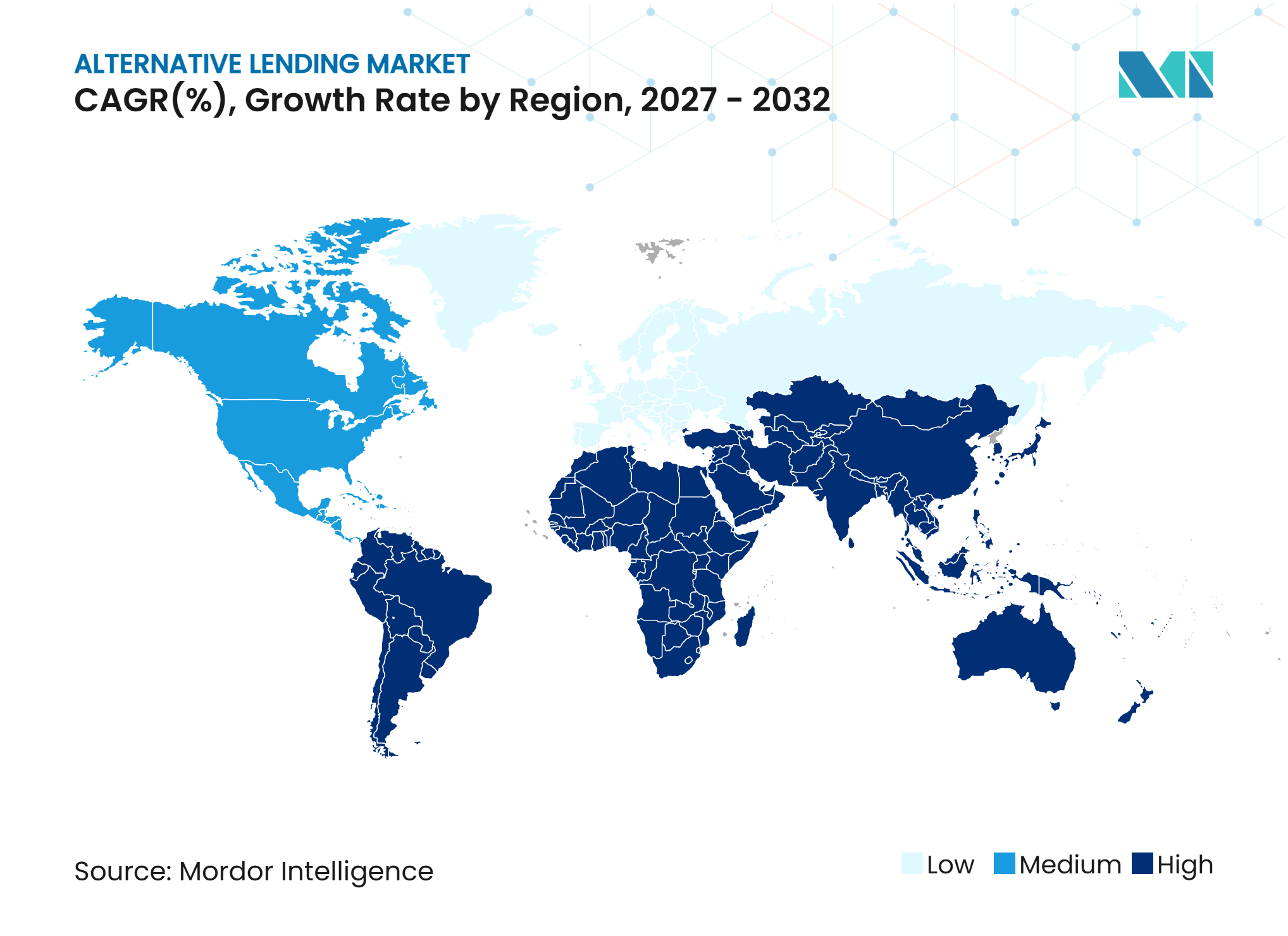
North America accounted for 36.3% of the alternative lending market share in 2026. It has the deepest private credit ecosystem and highly developed asset-backed securities and collateralized loan obligation markets. United States private credit vehicles held USD 1.9 trillion in assets under management as of Q4 2025. These pools of capital support direct lending to businesses, consumer finance platforms, specialty lenders, and structured funding arrangements for fintech originators. Affirm secured a USD 750 million forward-flow loan purchase arrangement with New York Life in October 2025, supporting USD 1.75 billion in annual consumer loan volume.
Asia-Pacific is projected to record a 12.4% CAGR through 2032, the highest regional growth rate in the alternative lending market. The region benefits from mobile adoption, large underbanked populations, growing use of embedded finance, and a wide range of business digitalization levels. Southeast Asia’s digital lending loan book rose to USD 90 billion in 2025 from USD 76 billion in 2024. India attracted USD 2.0 billion in fintech investment across 101 deals in H1 2026. Indonesia’s alternative credit scoring framework and Thailand’s virtual banking activity can support more formal digital credit ecosystems and more consistent product development across parts of the region.
Europe is supported by greater institutional interest in private debt and bank deleveraging. The United Kingdom, Germany, France, and the Nordic countries remain central to regional deal activity and lender deployment. Spain saw deal counts increase 35% year on year in 2025, while Italy’s non-bank financing share of buyout deals reached nearly 50%. South America functions as an emerging market with considerable growth potential, propelled by the increasing demand for merchant and platform-based lending solutions, particularly in contexts where operational performance metrics can enhance credit evaluation methodologies. The Middle East and Africa are undergoing substantial regulatory modernization; nevertheless, inconsistent implementation of open-banking frameworks, constrained availability of financial data, and elevated cost structures for capital acquisition remain significant impediments to comprehensive market expansion.
Competitive Landscape
Market Concentration
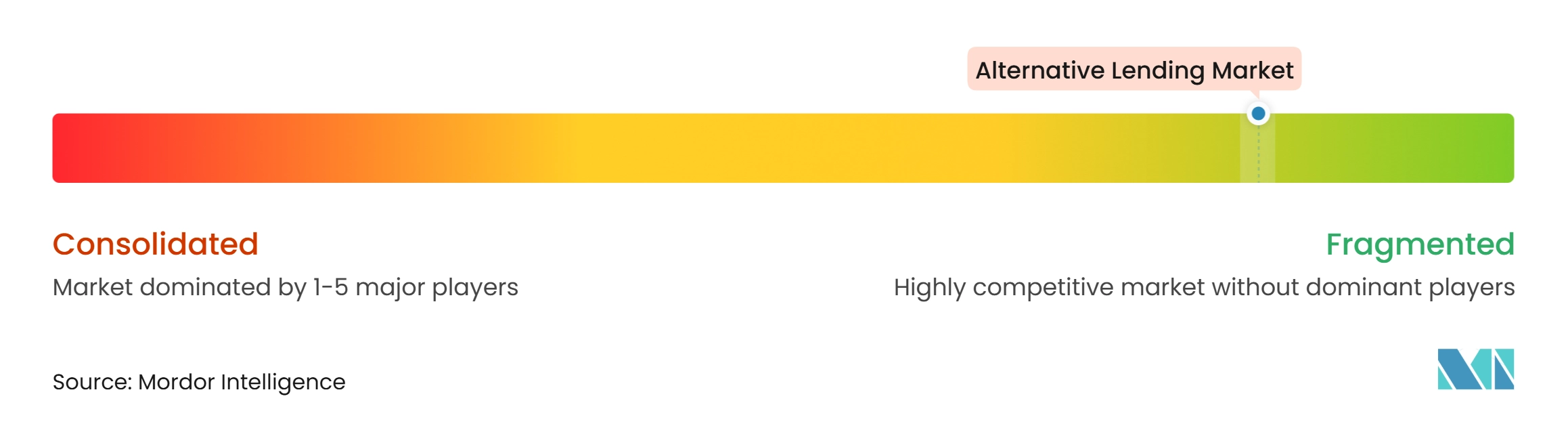
The alternative lending market has a fragmented consumer and SME fintech tier. Large private credit managers benefit from institutional investor relationships, established underwriting teams, proprietary deal access, and the ability to structure complex transactions. Consumer and small business lenders compete more directly on approval speed, funding cost, risk controls, borrower experience, and the quality of their digital applications. This creates different competitive conditions across commercial direct lending, asset-backed finance, point-of-sale credit, and digital consumer finance. Platforms with strong technology and durable funding partnerships are better positioned to operate through changing credit cycles and maintain service quality as they scale.
In 2025 and 2026, several lenders pursued banking capabilities to reduce funding costs and simplify licensing requirements. Affirm filed applications with the OCC and FDIC in January 2026 to form a Nevada industrial loan company. Upstart received conditional OCC approval to establish Upstart Bank in July 2026, which would enable direct originations under a single federal charter. Klarna applied for a Utah-chartered industrial bank license in the United States in July 2026 to bring card-issuing and banking operations in-house. These moves show how alternative lenders are seeking deposit-based funding, a more direct role in product distribution, and less reliance on warehouse financing.
Partnerships also remain a central way to secure origination channels and capital access. Affirm extended its Amazon agreement for five years and partnered with Worldpay to embed installment financing into payment infrastructure for more than 1,000 software-as-a-service companies. SoFi expanded its Loan Platform Business through USD 3.2 billion in agreements in April 2025. These partnerships show that scaled lenders can combine technology, external capital, and distribution relationships to broaden credit access without relying on a single funding channel. The consumer and SME fintech tier remains fragmented, even as leading platforms develop larger funding networks and wider product ranges.
Alternative Lending Industry Leaders
-
LendingClub Corporation
-
Funding Circle Holdings plc
-
Upstart Holdings, Inc.
-
SoFi Technologies, Inc.
-
Ant Group Co., Ltd.
- *Disclaimer: Major Players sorted in no particular order
Alternative Lending Market Companies Covered in this Report
- LendingClub Corporation
- Funding Circle Holdings plc
- Upstart Holdings, Inc.
- SoFi Technologies, Inc.
- Prosper Marketplace, Inc.
- OnDeck (Enova International, Inc.)
- Bluevine, Inc.
- American Express Company
- Avant, LLC
- Zopa Bank Limited
- Affirm Holdings, Inc.
- Klarna Bank AB
- Mercado Crédito (MercadoLibre, Inc.)
- Ant Group Co., Ltd.
- WeBank Co., Ltd.
- auxmoney GmbH
- Fundbox, Inc.
- Lendio, Inc.
- CAN Capital, Inc.
- Tala Mobile, Inc.
Recent Industry Developments in Alternative Lending Market
- May 2026: Affirm piloted Affirm Edge, a white-label BNPL product for banking and credit union apps, with the first Edge-enabled card transactions expected on its network in H1 2027.
- May 2026: SoFi acquired Peach Finance, a loan-servicing software infrastructure company, and launched Small Business Loans with fixed loans up to USD 250,000, expanding from consumer to commercial lending.
- January 2026: Affirm filed applications with the OCC and FDIC to form a Nevada industrial loan company, with the aim of lowering funding costs and diversifying beyond securitization.
- October 2025: Affirm secured a USD 750 million forward-flow loan purchase agreement with New York Life, providing off-balance-sheet funding for USD 1.75 billion in annual consumer loan volume, and expanded its Wayfair partnership to include in-store checkout across all Wayfair brands.
Global Alternative Lending Market Report Scope
Segmentation Overview
| Marketplace / Platform-Facilitated Lending |
| Balance-Sheet / Direct Lending |
| Individual Consumers |
| Micro and Small Businesses |
| Medium-Sized / Mid-Market Businesses |
| Large Corporates |
| Unsecured Consumer / Personal Loans (including BNPL and installment) |
| Secured Consumer / Real-Estate Loans |
| Unsecured Business / Working-Capital Loans |
| Secured Business / Asset-Backed Loans (including invoice and receivables financing, equipment, and commercial real estate) |
| Direct Digital Platforms |
| Lending Marketplaces |
| E-Commerce and Merchant / Embedded Platforms |
| Business Software and Financial Platforms |
| Brokers and Intermediaries |
| North America | United States |
| Canada | |
| Mexico | |
| South America | Brazil |
| Argentina | |
| Rest of South America | |
| Europe | United Kingdom |
| Germany | |
| France | |
| Italy | |
| Spain | |
| Rest of Europe | |
| Asia-Pacific | China |
| India | |
| Japan | |
| Australia | |
| Rest of Asia-Pacific | |
| Middle East & Africa | United Arab Emirates |
| Saudi Arabia | |
| South Africa | |
| Rest of Middle East & Africa |
| By Lending Model | Marketplace / Platform-Facilitated Lending | |
| Balance-Sheet / Direct Lending | ||
| By Borrower Type | Individual Consumers | |
| Micro and Small Businesses | ||
| Medium-Sized / Mid-Market Businesses | ||
| Large Corporates | ||
| By Loan / Product Type | Unsecured Consumer / Personal Loans (including BNPL and installment) | |
| Secured Consumer / Real-Estate Loans | ||
| Unsecured Business / Working-Capital Loans | ||
| Secured Business / Asset-Backed Loans (including invoice and receivables financing, equipment, and commercial real estate) | ||
| By Distribution Channel | Direct Digital Platforms | |
| Lending Marketplaces | ||
| E-Commerce and Merchant / Embedded Platforms | ||
| Business Software and Financial Platforms | ||
| Brokers and Intermediaries | ||
| By Geography | North America | United States |
| Canada | ||
| Mexico | ||
| South America | Brazil | |
| Argentina | ||
| Rest of South America | ||
| Europe | United Kingdom | |
| Germany | ||
| France | ||
| Italy | ||
| Spain | ||
| Rest of Europe | ||
| Asia-Pacific | China | |
| India | ||
| Japan | ||
| Australia | ||
| Rest of Asia-Pacific | ||
| Middle East & Africa | United Arab Emirates | |
| Saudi Arabia | ||
| South Africa | ||
| Rest of Middle East & Africa | ||
Key Questions Answered in the Report
What is the alternative lending market size?
The alternative lending market is projected to expand from USD 1.7 trillion in 2026 to USD 2.7 trillion by 2032, at an 8.4% CAGR.
Which alternative lending model holds the largest share?
Balance-Sheet/Direct Lending holds the largest share at 64.8% in 2026.
Which borrower group is growing fastest in alternative lending?
Micro and Small Businesses are forecast to grow at an 11.8% CAGR through 2032.
Why are embedded lending platforms growing?
Embedded models place credit within commerce and business software, allowing lenders to use operational data and offer financing when borrowers need it.
Which region is growing fastest for alternative lending?
Asia-Pacific is forecast to grow at a 12.4% CAGR through 2032, supported by mobile finance, embedded lending, and underbanked populations.
What are the main risks for alternative lenders?
Important risks include higher funding costs, borrower stress, fraud, fragmented regulation, and constraints on alternative-data access.