
Size and Share of Alternate Fuel and Raw Materials (AFR) Market For Cement Industry
Market Overview
| Study Period | 2021 - 2031 |
|---|---|
| Market Size (2026) | USD 11.32 Billion |
| Market Size (2031) | USD 16.36 Billion |
| Growth Rate (2026 - 2031) | 7.64 % |
| Fastest Growing Market | Asia-Pacific |
| Largest Market | Europe |
| Market Concentration | Medium |
Major Players *Disclaimer: Major Players sorted in no particular order Image © Mordor Intelligence. Reuse requires attribution under CC BY 4.0. | |
Analysis of Alternate Fuel and Raw Materials (AFR) Market For Cement Industry by Mordor Intelligence
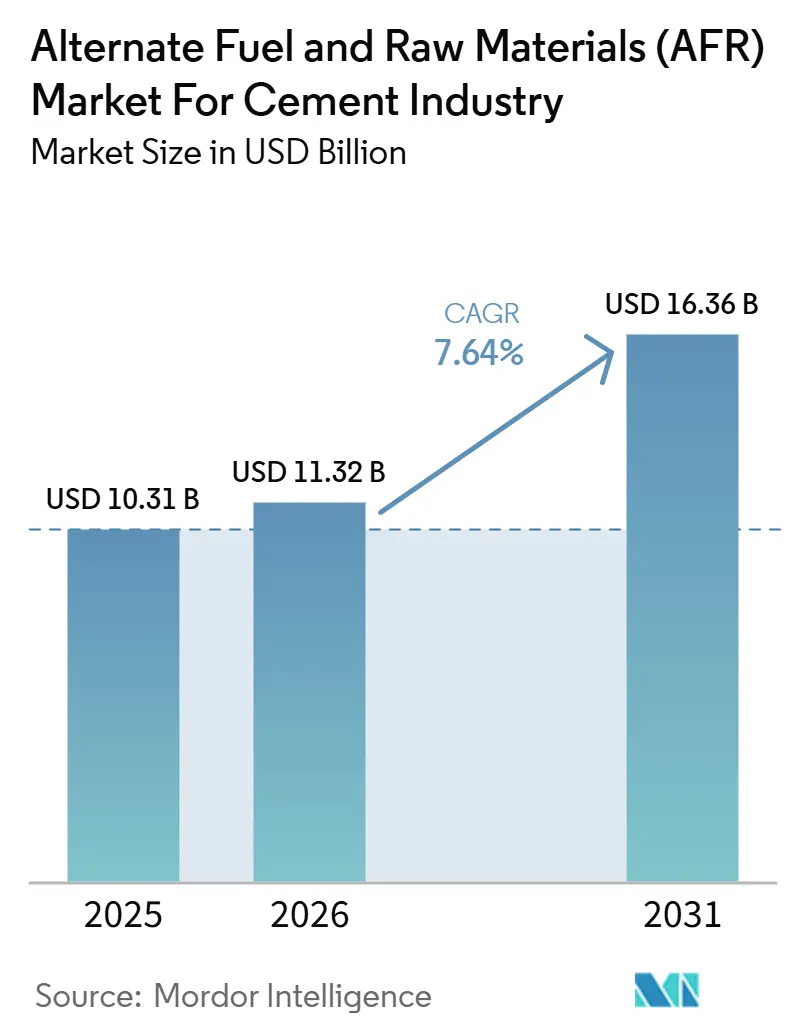
The Alternate Fuel And Raw Materials Market For Cement Industry size is projected to expand from USD 10.31 billion in 2025 and USD 11.32 billion in 2026 to USD 16.36 billion by 2031, at a CAGR of 7.64% between 2026 and 2031. The alternate fuel and raw materials for cement market is being shaped by carbon costs, waste diversion requirements, and the need to reduce fossil fuel use in kilns. Cement producers are placing more weight on fuel quality because high substitution rates require stable combustion and consistent clinker output. This favors suppliers that can provide documented fuel specifications, traceable origins, and reliable long-term deliveries. Waste sorting and pre-processing capacity will determine whether policy targets translate into usable kiln fuel, especially in newer co-processing regions. The alternate fuel and raw materials for cement market also has opportunities where established waste collection systems and cement plants have not yet formed durable supply relationships.
Key Report Takeaways
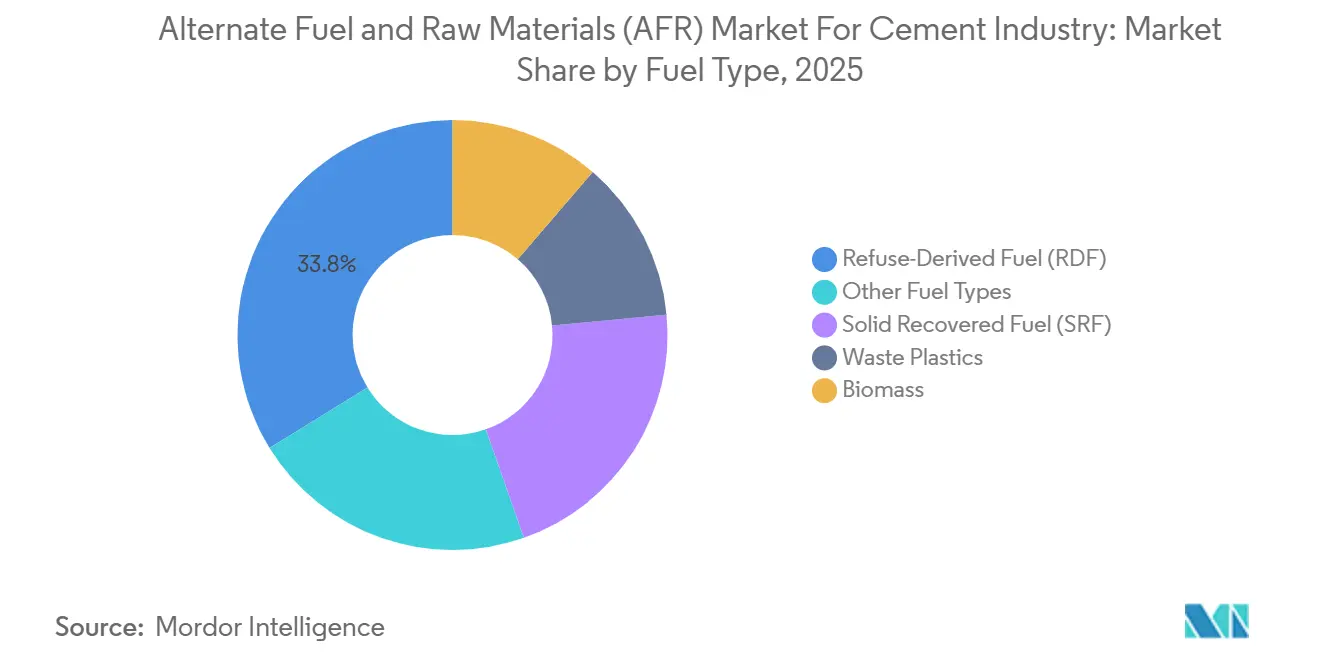
- By fuel type, RDF led with 33.8% revenue share in 2025, while SRF is forecast to expand at an 8.4% CAGR through 2031.
- By raw material type, fly ash held 36.7% revenue share in 2025, while steel slag is forecast to expand at an 8.2% CAGR through 2031.
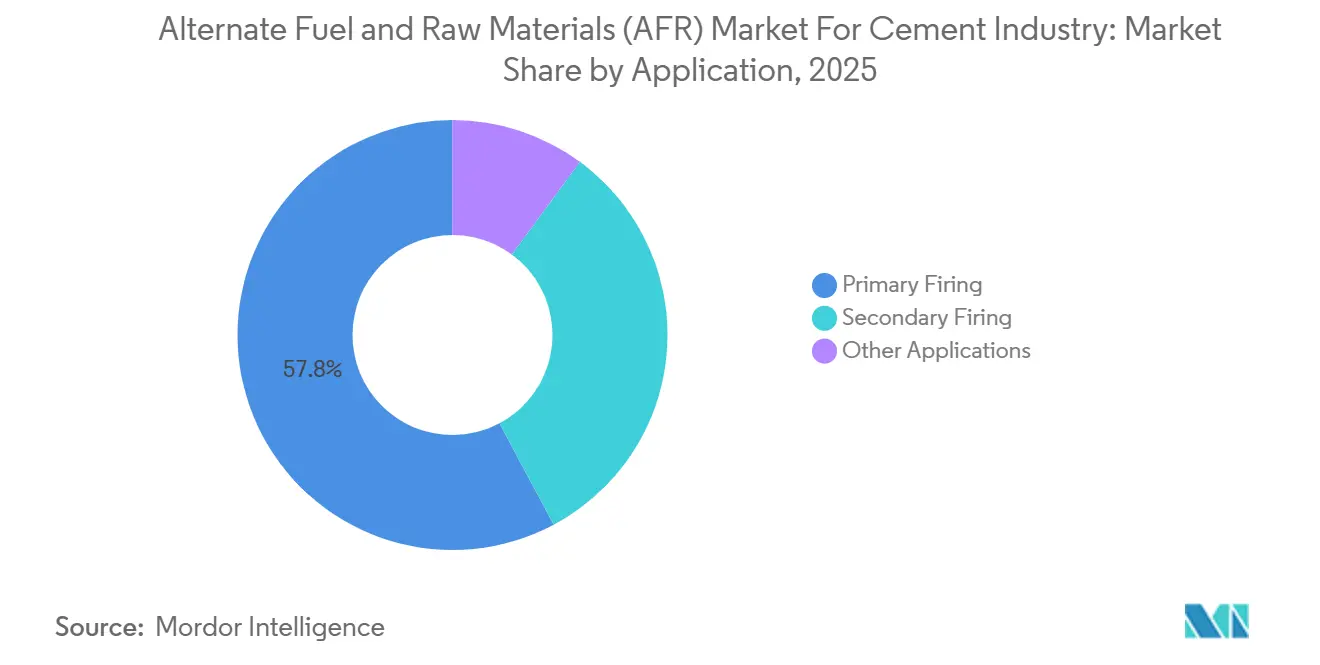
- By application, primary firing accounted for 57.8% revenue share in 2025, while secondary firing is expected to advance at an 8.6% CAGR through 2031.
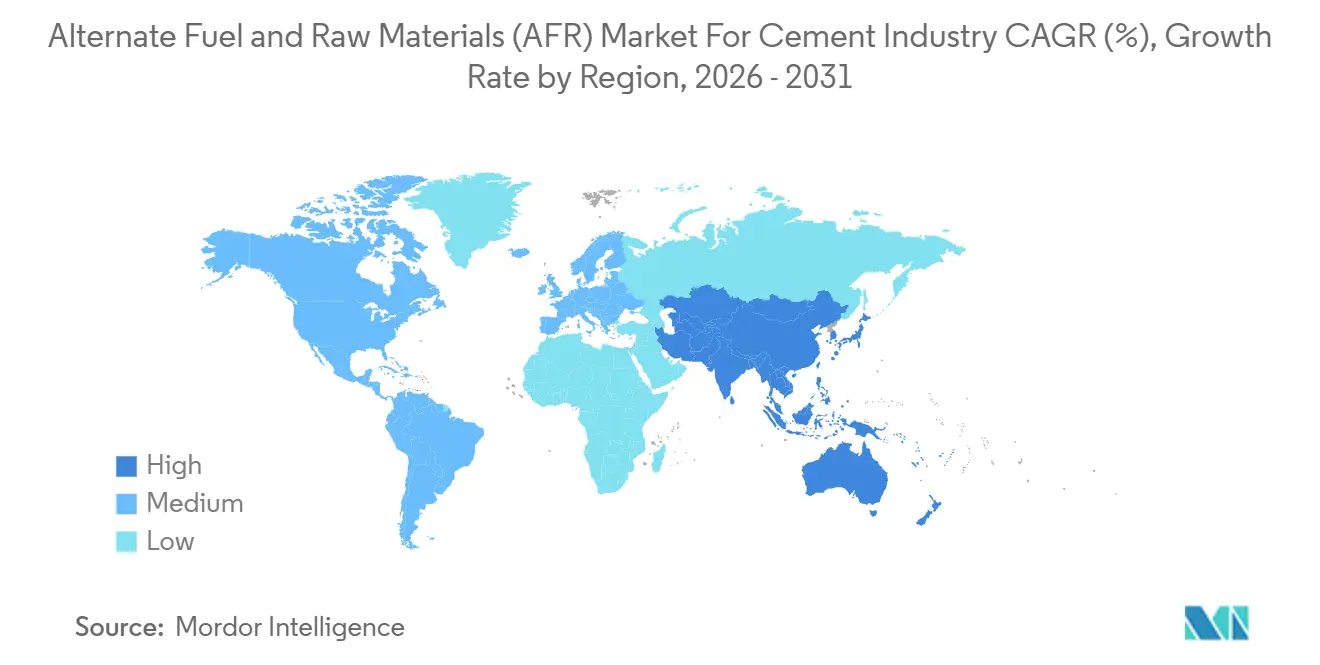
- By geography, Europe held 41.5% revenue share in 2025, while Asia-Pacific is projected to grow at a 9.4% CAGR through 2031.
Note: Market size and forecast figures in this report are generated using Mordor Intelligence’s proprietary estimation framework, updated with the latest available data and insights as of January 2026.
Market Trends and Insights
Drivers Impact Analysis of Alternate Fuel and Raw Materials (AFR) Market For Cement Industry*
| Driver | (~) % Impact on CAGR Forecast | Geographic Relevance | Impact Timeline |
|---|---|---|---|
| Decarbonization Targets and Fossil-Fuel Substitution | +2.10% | Global, intensity concentrated in EU and UK | Short term (≤ 2 years) |
| Landfill Diversion and Circular-Economy Mandates | +1.40% | EU core, spill-over to APAC and South America | Medium term (2-4 years) |
| Industrial Demand for Consistent High-Calorific Fuel | +1.20% | EU, North America, Japan, South Korea | Short term (≤ 2 years) |
| Rising Waste Volumes and Local Resource Recovery | +1.00% | APAC, South America, Middle East and Africa | Medium term (2-4 years) |
| Cement-Kiln Compatibility with Mineral-Rich Waste Streams | +0.80% | Global, early gains in EU, India, China | Medium term (2-4 years) |
| AI-Enabled Sorting and Fuel-Quality Traceability | +0.70% | EU, North America; early-stage in APAC | Medium to long term (2-5 years) |
| Source: Mordor Intelligence | |||
Decarbonization Targets and Fossil-Fuel Substitution
Carbon pricing is changing fuel switching from an environmental objective into a financial operating requirement for cement producers, particularly where carbon allowances influence the relative cost of coal, petcoke, and prepared waste fuels. The alternate fuel and raw materials for the cement market benefit when fossil fuel use carries a higher direct cost at the kiln and when operators can account for the avoided emissions from fuel replacement. The European Union Emissions Trading System and the Carbon Border Adjustment Mechanism raise the commercial importance of lowering fuel-related emissions in European production, which gives procurement teams a clearer financial reason to diversify fuel sources. Cement groups, therefore, have a stronger reason to secure waste-derived fuel volumes before they commit to higher thermal substitution rates, since new burner systems and material handling equipment need dependable feedstock. The Global Cement and Concrete Association reported a global thermal substitution rate below 10%, compared with its 22% target for 2030, leaving substantial room for fuel replacement. Policy direction in India and Southeast Asia is also creating stronger planning signals for cement producers, waste operators, and logistics providers, although each location will need its own collection and pre-processing model.
Landfill Diversion, Waste Volumes, and Resource Recovery
Landfill restrictions redirect residual waste toward recovery pathways and improve the economics of alternative fuel preparation, because disposal options become less attractive for waste holders and municipalities. This supports the alternate fuel and raw materials for cement market, even where carbon prices are limited or absent, since the value of treating and diverting waste can provide a separate economic basis for co-processing. Construction and demolition waste rules in India, which take effect from April 2026, establish recycling targets that rise from 25% in 2025-26 to 100% in 2028-29, increasing the need for practical recovery routes. Europe’s proposed Circular Economy Act would strengthen binding circularity requirements and improve longer-term visibility for waste recovery investments [1]Fraunhofer UMSICHT, “Environmental and Socio-Economic Impacts of the Circular Economy Transition in the EU Cement and Concrete Sector,” Publica, publica.fraunhofer.de.. Vicat recovered 1.7 million metric tons of waste worldwide in 2025, while its European operations reached a 76.1% substitution rate [2]Vicat, “Combustibles Alternatifs en Cimenterie: La Stratégie Vicat,” Vicat, vicat.fr.. Large urban waste volumes create potential supply, but collection, sorting, drying, storage, and transport capacity must be in place before material becomes a dependable kiln input.
Consistent High-Calorific Fuel and Kiln Compatibility
Fuel consistency becomes more important as plants raise their thermal substitution rates, because changes in a fuel’s composition can affect combustion behavior from one delivery to the next. Plants operating above 50% substitution face tighter control requirements for flame stability, nitrogen oxide emissions, and clinker free lime, which makes informal supply specifications less workable. Research on kiln optimization shows that expert systems can improve operational control where process conditions change frequently. The alternate fuel and raw materials for cement market rewards suppliers that can provide predictable calorific value, moisture, ash, and chlorine content through consistent preparation and testing. EN 15359 classification gives SRF an auditable framework that supports long-term agreements, documented fuel quality, and clearer acceptance criteria at the plant gate. Waste plastics and biomass showed active decomposition between 200°C and 600°C, supporting their use in precalciner conditions where the process can accommodate a broader range of feedstocks.
Digital Sorting and Fuel-Quality Traceability
Digital sorting and traceability are becoming more relevant as producers seek higher and more consistent fuel substitution without weakening their control of quality or delivery records. Sorting technology can improve the separation of non-recyclable fractions and reduce unwanted material in prepared fuel streams, although it does not remove the need for sound collection systems. Traceability systems help document the origin, treatment, transport, and specification of SRF, allowing cement customers to assess whether a delivery meets agreed requirements. Geminor’s Gemisoft platform provides documentation on SRF origin, treatment, and transport for cement customers [3]Geminor, “Waste Volumes 2025: Market-Driven Shift in Waste Composition,” Geminor, geminor.no.. These records support customer audits, reduce uncertainty around supply origin, and strengthen confidence in long-term procurement arrangements. The alternate fuel and raw materials for cement market is increasingly affected by the ability to connect physical waste streams with reliable data records, particularly when buyers need proof of fuel quality and handling history.
Restraints Impact Analysis of Alternate Fuel and Raw Materials (AFR) Market For Cement Industry*
| Restraint | (~) % Impact on CAGR Forecast | Geographic Relevance | Impact Timeline |
|---|---|---|---|
| Feedstock Variability and Kiln-Stability Risk | -0.80% | Global, most acute in APAC, South America, MEA | Short to medium term (≤ 4 years) |
| Inconsistent Waste Segregation and Collection Infrastructure | -0.60% | APAC, South America, MEA | Medium to long term (2-5 years) |
| Permitting and Cross-Border Waste-Movement Complexity | -0.40% | EU-to-non-EU corridors, South and Southeast Asia | Medium term (2-4 years) |
| Competition for High-Biogenic Residual Waste | -0.30% | EU core, UK | Short to medium term (≤ 4 years) |
| Source: Mordor Intelligence | |||
Feedstock Variability and Kiln-Stability Risk
Fuel heterogeneity limits the ability of cement plants to increase co-processing rates without additional investment in preparation, storage, and process control. RDF moisture can shift between seasons, while biomass calorific value can change as material sources, weather, and storage conditions change. These variations make it harder to maintain stable combustion using conventional process controls and can require plants to adjust feed rates more often. Chlorine-rich fuel batches can cause cyclone blockages, kiln build-up, corrosion, and declines in clinker quality, which can disrupt production as well as increase maintenance needs. The alternate fuel and raw materials for the cement market faces its greatest operational constraint where fuel preparation is immature, and quality checks are inconsistent. Plants that seek thermal substitution above 30% need greater control over material preparation, storage, dosing, and combustion settings before they can rely on diverse waste streams at scale.
Waste Segregation, Permitting, and Feedstock Competition
Fragmented collection and segregation systems create a persistent gap between policy goals and operational fuel availability, even in locations that generate large volumes of municipal and commercial waste. Mixed municipal waste can produce RDF with uneven calorific value and high moisture, causing repeated rejection at the kiln gate and raising costs for both suppliers and cement plants. This slows investment in dedicated pre-processing plants and weakens confidence in long-term supply contracts, since neither party can be certain that deliveries will consistently meet the specification. Permitting and cross-border movement rules can lengthen project timelines and affect the economics of serving plants with stronger demand, especially where fuel has to move between regions. Competition for high-biogenic residual waste also limits supply, where power generation and other recovery options seek the same material. The alternate fuel and raw materials for the cement market depend on local choices that route residual waste to uses that meet technical, environmental, and logistics requirements.
*Our forecasts treat driver/restraint impacts as directional, not additive. The impact forecasts reflect baseline growth, mix effects, and variable interactions.
Alternate Fuel and Raw Materials (AFR) Market For Cement Industry Segment Analysis
By Fuel Type:
SRF Is Expanding as Cement Producers Seek More Consistent Fuel QualityRDF held 33.8% of the alternate fuel and raw materials for the cement market share in the fuel segment during 2025, reflecting established mechanical and biological treatment capacity in Europe. SRF is forecast to grow at an 8.4% CAGR through 2031, faster than the overall market. This difference indicates that cement operators are seeking fuel grades with clearer quality documentation and more stable operating performance. EN 15359 classification gives SRF a defined framework for calorific value, moisture, ash, and chlorine. The alternate fuel and raw materials for the cement market size for SRF are supported by customer demand for supply arrangements that can be audited and used in financing discussions.
Biomass and waste plastics remain smaller but strategically useful fuel streams. India’s framework for non-recyclable plastic waste identifies cement kiln co-processing as a disposal pathway alongside incineration, expanding the material eligible for co-firing. Scientific work on biomass and industrial wastes supports their compatibility with precalciner conditions because their thermal breakdown occurs within a suitable temperature range. Tire-derived fuel, sewage sludge, and industrial solvents also contribute, where hazardous waste co-processing rules are well established in Germany, Japan, and South Korea. The alternate fuel and raw materials for cement market will continue to use RDF widely, but higher-quality SRF is becoming more important where kilns require predictable combustion behavior.



By Raw Material Type:
Steel Slag Growth Reflects Greater Use of Industrial By-ProductsFly ash held 36.7% of the raw material segment in 2025. Its long-standing role in Portland cement blends has reduced clinker requirements while providing a use for material from coal-fired power generation. Steel slag is forecast to expand at an 8.2% CAGR through 2031. The stronger rate is linked to changes in steel production and a growing need to find value-added uses for industrial by-products. The alternate fuel and raw materials for the cement market size for steel slag are also supported by its potential contribution to lower-clinker cement formulations.
Research published in RSC Advances in 2026 found that combined ultrafine steel slag and fly ash can perform better than either material on its own in ternary cement systems [4]RSC Advances, “Synergistic Ultrafine Steel Slag and Fly Ash for Steel Passivation in Sustainable Ternary Cements,” Royal Society of Chemistry, pubs.rsc.org.. This approach reduces clinker content while using 2 industrial by-products in one formulation. Nature Communications also identified substantial global emissions reduction potential for steel slag and fly ash in alkali-activated materials. Blast furnace slag and foundry sand are more mature materials that are expanding at a steadier pace. The alternate fuel and raw materials for the cement industry are increasingly tied to material provenance because customers and regulators need stronger records of recycled content and product origin.
By Application:
Secondary Firing Is Growing as Precalciner Use Broadens the Feedstock RangePrimary firing held 57.8% of the application segment in 2025. This position reflects years of investment in main-burner fuel handling, precision dosing, and higher-grade alternative fuel supply. Main-burner fuels generally need net calorific values above 14 MJ/kg and moisture below 15% to protect flame stability and clinker quality. These requirements narrow the eligible pool to higher-grade RDF, SRF, and tire-derived fuel. The alternate fuel and raw materials for the cement market remain dependent on main-burner systems, where plants have already invested in dedicated infrastructure.
Secondary firing in the precalciner is forecast to grow at an 8.6% CAGR through 2031. Precalciner temperatures are near 800°C, compared with near 1,500°C at the main burner, allowing lower-calorific and higher-moisture feedstocks to be used more effectively. Agricultural biomass, municipal sludge, and waste plastics can therefore have a broader role in secondary firing. A stair-step precalciner at Jincheng Shanshui Heju Cement in China achieved stable 20% to 25% thermal substitution using biomass waste and RDF pellets, according to the source draft. The alternate fuel and raw materials for cement market has room to grow through precalciner systems because they can accept feedstocks that are unsuitable for direct main-burner injection.
Geography Analysis
Europe Alternate Fuel and Raw Materials (AFR) Market for Cement Industry
Europe held 41.5% of the alternate fuel and raw materials for cement market share in 2025. The region’s role reflects decades of carbon regulation, landfill taxation, waste separation requirements, established co-processing capacity, and commercial arrangements that connect waste treatment facilities with major kiln operators. European cement plants averaged 52% thermal substitution, while Slovakia reached 75% across its cement industry in 2024, according to the source draft. Vicat reported a 76.1% substitution rate in its European operations during 2025. These conditions make Europe a leading location for specification-grade SRF, traceable supply chains, and long-term plant offtake agreements, while also raising the quality and documentation threshold for suppliers that seek to serve major cement groups.
France Alternate Fuel and Raw Materials (AFR) Market for Cement Industry
Heidelberg Materials opened a new kiln line at Airvault, France, in May 2026 after an investment exceeding EUR 350 million (~USD 402.55 million), with the facility designed to use up to 90% alternative fuels. The plant has a dry-process clinker capacity of 1.25 million metric tons per year and is intended to reduce site carbon dioxide intensity by nearly 30%, linking a major capital project with long-term demand for alternative fuels. Such investments establish demand infrastructure that can support alternative fuel suppliers for extended periods. Europe’s forthcoming Circular Economy Act and EN 15359 classification framework will further affect procurement standards and documentation needs. The alternate fuel and raw materials for cement market in Europe is more mature, but it also requires higher fuel quality than less developed co-processing locations.
APAC, the Americas and MEA Alternate Fuel and Raw Materials (AFR) Market for Cement Industry
Asia-Pacific is projected to grow at a 9.4% CAGR through 2031, the fastest rate among regions. India and Southeast Asia combine rising cement demand with policy efforts to improve waste recovery and alternative fuel use, while Japan and Australia are increasing co-processing adoption and demonstrate different stages of waste management maturity. China’s dual-carbon targets and restrictions on new kiln permits are directing attention toward fuel substitution, while Huaxin Cement’s Diwei clinker line achieved substitution above 60% using waste tires, rubber, and textiles, according to the source draft. North America, South America, and the Middle East and Africa need stronger feedstock preparation, while Brazil’s Xambioá plant reached nearly 65% thermal substitution, and Geminor is developing a South African SRF hub with Norad support.

Competitive Landscape
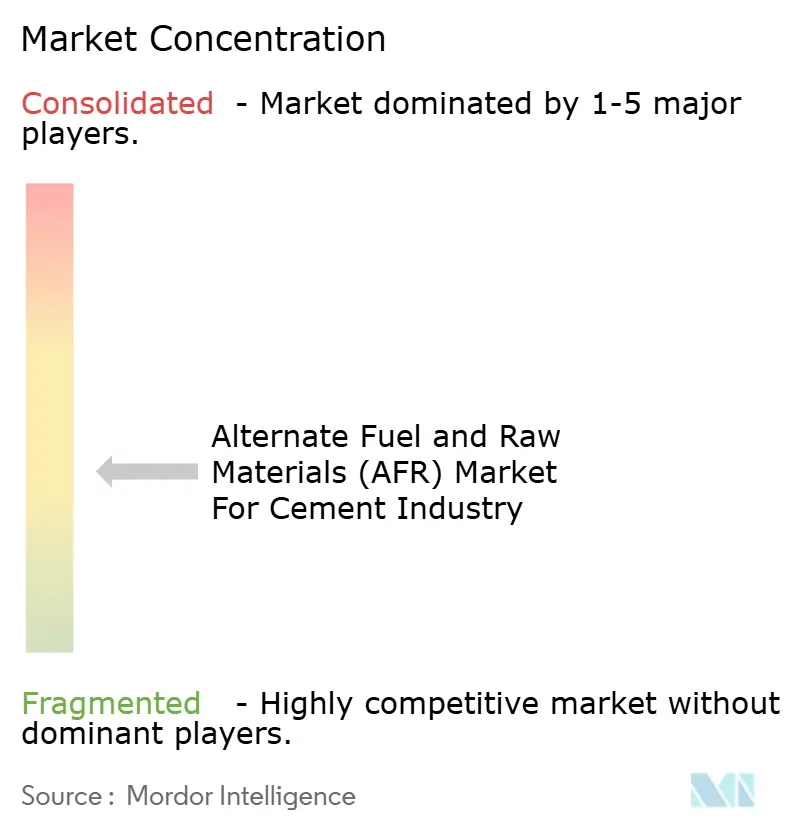
The alternate fuel and raw materials for the cement market have moderate fragmentation because several business models operate alongside one another. Integrated waste management groups such as Veolia, SUEZ, REMONDIS, and PreZero control collection, treatment, and fuel preparation. Specialized traders, including Geminor and Andusia, manage cross-border flows and respond to differences in regional availability, price, and fuel quality. Cement companies, including Holcim through Geocycle, Heidelberg Materials, and Vicat, have built internal co-processing capabilities and direct relationships with plant operations. This creates a competitive setting where access to waste, treatment capacity, transport, kiln offtake, and the ability to manage each link in the supply chain all matter.
Vicat’s recovery of 1.7 million metric tons of waste in 2025 demonstrates an integrated approach between alternative fuel use and cement production. The alternate fuel and raw materials for the cement market also include substantial investment in the waste management layer. The source draft reported acquisitions of Renewi and Biffa during 2025, which may strengthen investment capacity in RDF production infrastructure. Integrated businesses can align waste preparation with cement plant requirements more directly than stand-alone fuel suppliers, including the testing, conditioning, storage, and transport steps that determine whether a fuel is accepted at the kiln gate. This gives scale operators an advantage where fuel quality and continuity are central to plant procurement.
Heidelberg Materials’ Airvault kiln investment is a strategic move because the new line is designed for up to 90% alternative fuel use. Andusia reached 3 million cumulative metric tons of RDF exports in January 2026, highlighting the role of specialized cross-border logistics. The alternate fuel and raw materials for cement market favors companies that can provide certified fuel quality, complete traceability, continuity of supply, and enough operating scale to manage unexpected changes in the availability of suitable residual waste. The source draft also identified operational technology platforms as a further source of differentiation in thermal substitution management.
Leaders of Alternate Fuel and Raw Materials (AFR) Market For Cement Industry
Veolia Environnement S.A.
SUEZ S.A.
Geocycle SA
REMONDIS SE & Co. KG
Biffa Limited
- *Disclaimer: Major Players sorted in no particular order
Alternate Fuel and Raw Materials (AFR) Market For Cement Industry Companies Covered in this Report
- Andusia Recovered Fuels Limited
- Averda International Limited
- BEUMER Group GmbH & Co. KG
- Biffa Limited
- Blue Phoenix Group B.V.
- CEMEX, S.A.B. de C.V.
- DCC Group
- Ecoserv
- EEW Energy from Waste GmbH
- Enva Group Limited
- Fomento de Construcciones y Contratas, S.A.
- Geminor AS
- Geocycle SA
- Heidelberg Materials AG
- Indaver NV
- Komptech GmbH
- PAPREC Group
- PreZero International GmbH
- Ragn-Sells AB
- REMONDIS SE & Co. KG
- Renewi plc
- SARIA SE & Co. KG
- SUEZ S.A.
- Veolia Environnement S.A.
- Vicat SA
- Viridor Limited

Recent Industry Developments in Alternate Fuel and Raw Materials (AFR) Market For Cement Industry
- May 2026: Heidelberg Materials opened its new kiln line at the Airvault cement plant in France, an investment exceeding EUR 350 million, partly funded by the French government. The facility is designed to operate on up to 90% alternative fuels with 1.25 million metric tons per year of dry-process clinker capacity.
- March 2026: Geocycle commissioned a new mineral-waste treatment and recovery platform at Holcim's Martres-Tolosane cement plant in France, scheduled to be fully operational in summer 2026. The facility processes mineral wool, impacted soils, and biomass ash, directly substituting silica and lime as cement raw materials and extending the circular economy model from energy recovery to mineral recovery.
- February 2026: Geminor secured a USD 523,000 grant from Norad to establish an SRF hub in South Africa that converts non-recyclable plastics into kiln-grade fuel.
- January 2026: Andusia crossed the milestone of 3 million cumulative metric tons of RDF exported to Europe, having surpassed 2.5 million metric tons in September 2024. The company held leading exporter positions in Germany, the Netherlands, and Denmark.


Scope of Report on Alternate Fuel and Raw Materials (AFR) Market For Cement Industry
The Global Alternate Fuel and Raw Materials (AFR) Market for the Cement Industry encompasses the worldwide production, processing, supply, and utilization of waste-derived fuels and mineral-based secondary raw materials. These materials replace conventional fossil fuels (such as coal and petroleum coke) and virgin raw materials (such as limestone, clay, and shale) in cement clinker and cement manufacturing. AFR enables cement producers to reduce fuel costs, conserve natural resources, increase thermal substitution rates (TSR), lower greenhouse gas emissions, and support circular economy and sustainable waste management initiatives through the co-processing of industrial, municipal, agricultural, and commercial waste streams.
The Alternative Fuel and Raw Material (AFR) market for the cement industry is segmented by fuel type, raw material type, application, and geography. By fuel type, the market is segmented into refuse-derived fuel (RDF), solid recovered fuel (SRF), biomass, waste plastics, and other fuel types. By raw material type, the market is segmented into fly ash, blast furnace (bf) slag, foundry sand, steel slag, and other raw materials. By application, the market is segmented into primary firing, secondary firing, and other applications. The report also covers the market size and forecasts for the global alternative fuel and raw material (afr) market across 26 countries in key regions. For each segment, the market sizing and forecasts have been provided on the basis of value (USD).
| Refuse-Derived Fuel (RDF) |
| Solid Recovered Fuel (SRF) |
| Biomass |
| Waste Plastics |
| Other Fuel Types |
| Fly Ash |
| Blast Furnace Slag |
| Foundry Sand |
| Steel Slag |
| Other Raw Material Types |
| Primary Firing |
| Secondary Firing |
| Other Applications |
| North America | United States |
| Canada | |
| Mexico | |
| Europe | Germany |
| France | |
| Italy | |
| Spain | |
| United Kingdom | |
| Poland | |
| Russia | |
| Rest of Europe | |
| Asia-Pacific | China |
| India | |
| Japan | |
| South Korea | |
| Australia | |
| Indonesia | |
| Vietnam | |
| Thailand | |
| Rest of Asia-Pacific | |
| South America | Brazil |
| Argentina | |
| Chile | |
| Rest of South America | |
| Middle East | Saudi Arabia |
| United Arab Emirates | |
| Egypt | |
| South Africa | |
| Morocco | |
| Rest of Middle East and Africa |
| By Fuel Type | Refuse-Derived Fuel (RDF) | |
| Solid Recovered Fuel (SRF) | ||
| Biomass | ||
| Waste Plastics | ||
| Other Fuel Types | ||
| By Raw Material Type | Fly Ash | |
| Blast Furnace Slag | ||
| Foundry Sand | ||
| Steel Slag | ||
| Other Raw Material Types | ||
| By Application | Primary Firing | |
| Secondary Firing | ||
| Other Applications | ||
| By Geography | North America | United States |
| Canada | ||
| Mexico | ||
| Europe | Germany | |
| France | ||
| Italy | ||
| Spain | ||
| United Kingdom | ||
| Poland | ||
| Russia | ||
| Rest of Europe | ||
| Asia-Pacific | China | |
| India | ||
| Japan | ||
| South Korea | ||
| Australia | ||
| Indonesia | ||
| Vietnam | ||
| Thailand | ||
| Rest of Asia-Pacific | ||
| South America | Brazil | |
| Argentina | ||
| Chile | ||
| Rest of South America | ||
| Middle East | Saudi Arabia | |
| United Arab Emirates | ||
| Egypt | ||
| South Africa | ||
| Morocco | ||
| Rest of Middle East and Africa | ||


Key Questions Answered in the Report
What is the size of the alternate fuels and raw materials market for cement industry?
The alternate fuels and raw materials market for cement industry stands at USD 11.32 billion in 2026 and is projected to reach USD 16.36 billion by 2031.
Which fuel type leads cement co-processing?
In the alternate fuel and raw materials for cement market, RDF led the fuel segment with 33.8% share in 2025, while SRF is expected to grow faster at an 8.4% CAGR through 2031.
Why is SRF gaining importance in cement kilns?
Within the alternate fuel and raw materials for cement market, SRF offers clearer specifications for calorific value, moisture, ash, and chlorine. These qualities help plants maintain stable combustion at higher substitution rates.
Which raw material is growing fastest in cement formulations?
In the alternate fuel and raw materials for cement market, steel slag is forecast to grow at an 8.2% CAGR through 2031. Research supports its use with fly ash in lower-clinker cement systems.
Why is secondary firing expanding in cement plants?
Secondary firing in the precalciner can use lower-calorific and higher-moisture feedstocks. It is projected to grow at an 8.6% CAGR through 2031.
Which region is growing fastest for cement co-processing?
Asia-Pacific is projected to expand at a 9.4% CAGR through 2031, led by India and Southeast Asia.
Page last updated on:





