
Aloe Vera Juice Market Size and Share
Market Overview
| Study Period | 2022 - 2032 |
|---|---|
| Market Size (2027) | USD 149.95 Million |
| Market Size (2032) | USD 222.78 Million |
| Growth Rate (2027 - 2032) | 8.24 % |
| Fastest Growing Market | Asia-Pacific |
| Largest Market | Asia-Pacific |
| Market Concentration | Medium |
Major Players *Disclaimer: Major Players sorted in no particular order Image © Mordor Intelligence. Reuse requires attribution under CC BY 4.0. | |
Aloe Vera Juice Market Analysis by Mordor Intelligence
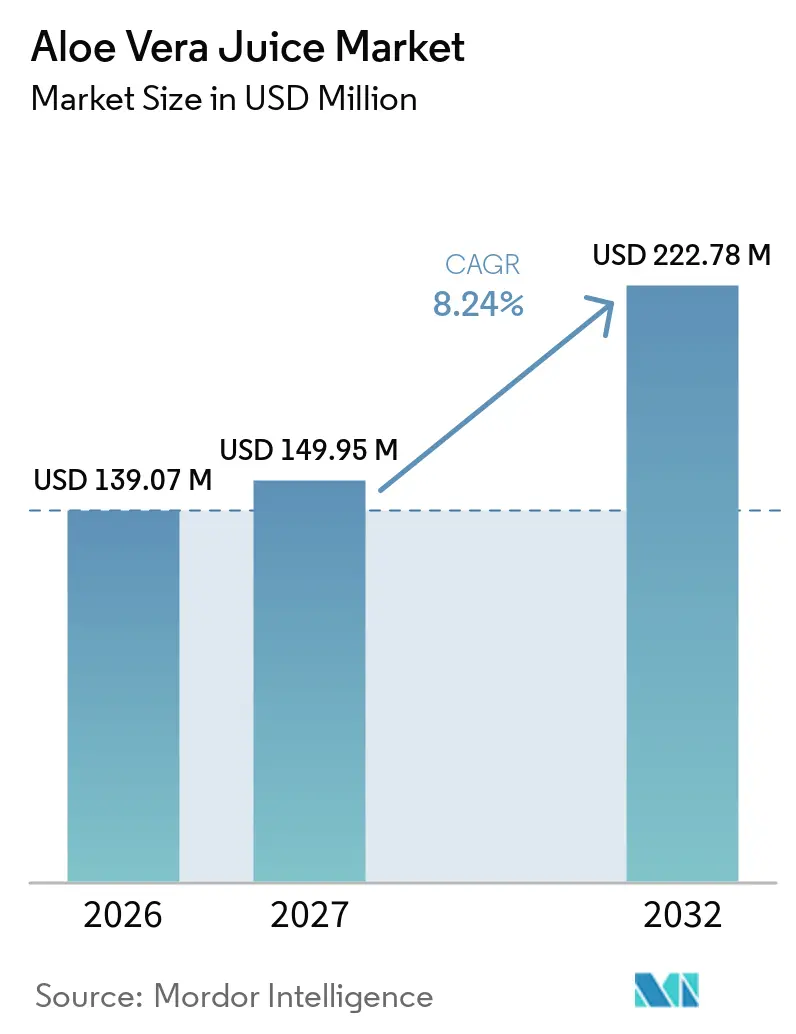
The aloe vera juice market size is expected to grow from USD 139.07 million in 2026 to USD 149.95 million in 2027 and is forecast to reach USD 222.78 million by 2032 at an 8.24% CAGR over 2027-2032. Consumer demand is shifting aloe drinks from a niche wellness purchase to a recurring hydration option across grocery, specialty retail, and online channels. This shift expands the consumption occasions that brands can target, supports broader retail distribution, and creates more frequent purchase opportunities than a supplement-focused proposition. It also increases the importance of clear product education for first-time aloe drink buyers. Demand for lower-sugar, plant-based beverages supports the aloe vera juice market, particularly among consumers seeking hydration and digestive health benefits without complex ingredient lists or unfamiliar serving routines. Producers are responding with flavored products to encourage broader trial, unflavored options for ingredient-conscious consumers, and convenient single-serve formats that support immediate consumption, routine retail purchases, and online replenishment. Compliance with aloin limits, documented inner-leaf processing, and transparent processing credentials is becoming increasingly important for gaining access to regulated and health-focused retail channels.
Key Report Takeaways
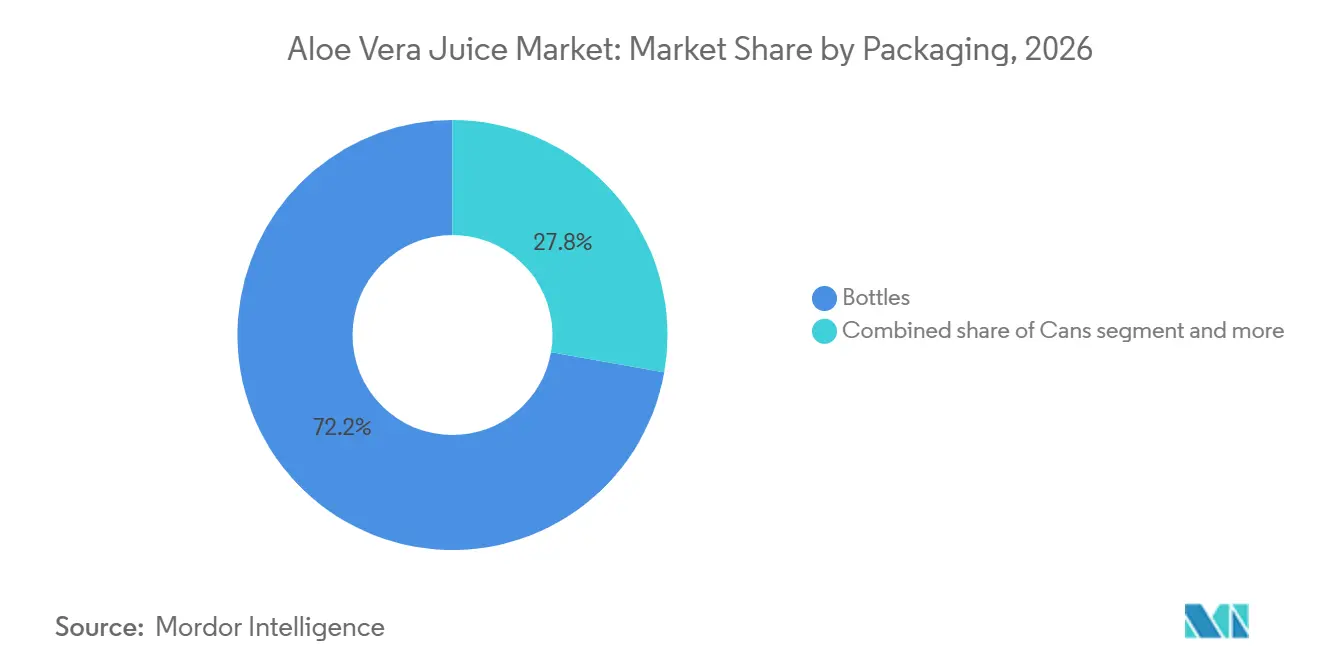
- By packaging, bottles led the aloe vera juice market with a 72.23% share in 2026, while cans is expected to grow at the fastest CAGR of 9.31% during 2027-2032.
- By flavor type, flavored retained a 54.73% share in 2026, while unflavored is anticipated to expand at a 9.72% CAGR through 2032.
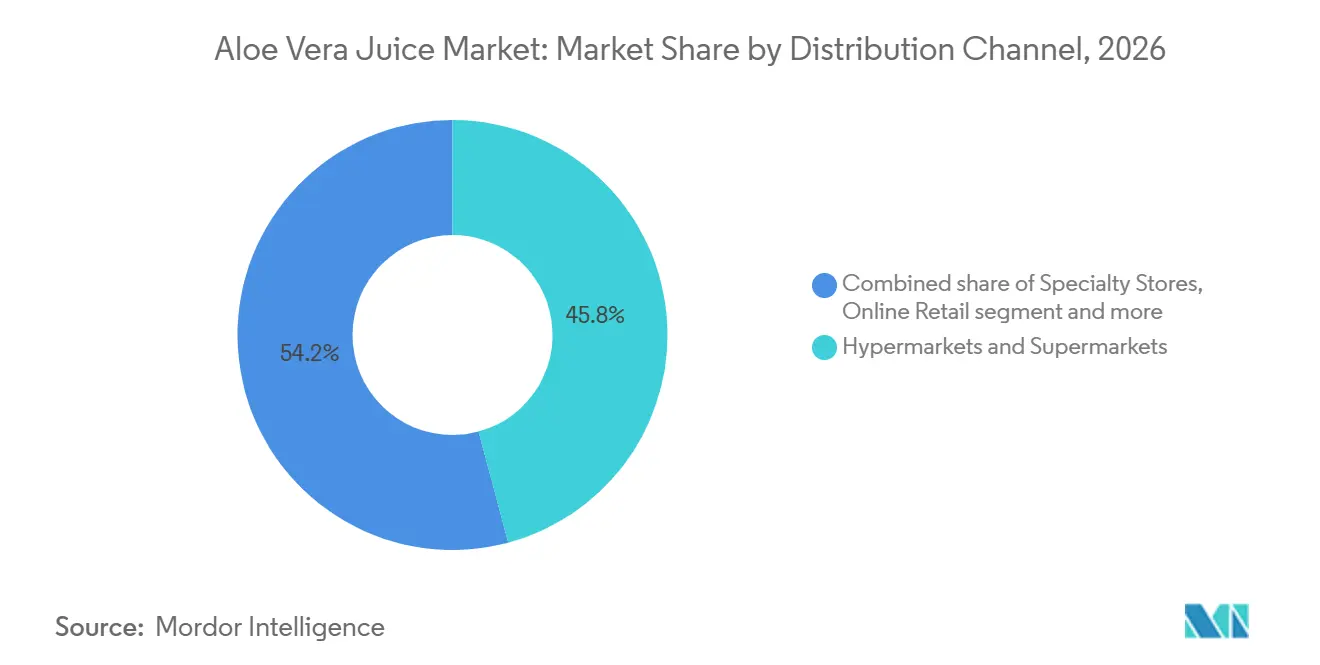
- By distribution channel, hypermarkets and supermarkets led the market with a share of 45.82% in 2026, while online retail is anticipated to register the fastest CAGR of 9.59% during 2027-2032.
- By geography, Asia-Pacific led the aloe vera juice market in 2026 with a 40.12% share, and is expected to grow at a 9.91% CAGR through 2032.
Note: Market numbers in this report are based on Mordor Intelligence's proprietary estimation framework, which combines nine months of actuals with Q4 projections for base year 2026.
Market Trends and Insights
Drivers Impact Analysis of Aloe Vera Juice Market*
| Driver | (~) % Impact on CAGR Forecast | Geographic Relevance | Impact Timeline |
|---|---|---|---|
| Rising consumer preference for health-oriented beverages | +1.8% | Global, strongest in North America and Asia-Pacific | Medium term (2-4 years) |
| Increasing demand for plant-based drinks | +1.5% | Global, with spillover to Middle East and Africa | Long term (≥ 4 years) |
| Product innovation through flavors and juice blends | +1.2% | Asia-Pacific, North America, and Europe | Medium term (2-4 years) |
| Rising demand for convenient ready-to-drink formats | +1.0% | Global, led by India and Southeast Asia | Short term (≤ 2 years) |
| Growing availability through modern retail and e-commerce | +0.8% | Global, particularly Asia-Pacific and North America | Medium term (2–4 years) |
| Increasing product differentiation through organic and reduced-sugar options | +0.7% | North America, Europe, and Asia-Pacific | Long term (≥ 4 years) |
| Source: Mordor Intelligence | |||
Rising Consumer Preference for Health-Oriented Beverages
Consumers increasingly view aloe vera drinks as a daily hydration option rather than solely as therapeutic products for occasional wellness needs. This shift changes brand communication strategies and retail product placement. It expands the potential consumer base, increases beverage purchase occasions, and enables retailers to position aloe vera drinks alongside functional beverages rather than dietary supplements. Retailers and consumers increasingly seek functional benefits, product transparency, clearly defined use occasions, and evidence of suitability for routine consumption before allocating shelf space or making repeat purchases. The aloe vera juice market benefits as consumers increasingly consider these products suitable for regular consumption across routine hydration occasions at home, at work, while traveling, and during everyday grocery shopping.
Increasing Demand for Plant-Based Drinks
Rising demand for plant-based beverages creates opportunities for aloe vera juice as consumers increasingly seek drinks derived from botanical ingredients. According to the United Kingdom Government's Scientific Advisory Committee on Nutrition and Committee on Toxicity, in a report published in July 2025, approximately 10% of participants in the National Diet and Nutrition Survey reported consuming plant-based drinks during the survey period[1]. This consumer interest encourages beverage manufacturers to diversify their portfolios with plant-derived ingredients and alternative beverage formulations. Aloe vera juice manufacturers can capitalize on this broader interest by offering convenient, fruit-blended formulations with clearly labeled ingredients. These offerings can help manufacturers expand their product portfolios and attract consumers seeking alternatives to conventional beverages.
Product Innovation Through Flavors and Juice Blends
Flavors and functional blends enable producers to address taste barriers, encourage repeat purchases, and differentiate products on crowded beverage shelves, where consumers can choose from numerous familiar alternatives. RITA Food & Drink offers contract production options that combine aloe with collagen, adaptogens, and customized flavors for brand owners. These production models reduce entry barriers for companies without in-house beverage manufacturing capabilities and provide flexibility for product testing, pack sizes, and regional flavor preferences. The aloe vera juice market supports both accessible flavored products for mainstream retail and ingredient-focused products with simpler formulations for specialized channels that prioritize processing methods and sourcing.
Increasing Product Differentiation Through Organic and Reduced-Sugar Options
Manufacturers can differentiate aloe vera juice products through organic formulations and reduced-sugar variants, addressing consumer interest in ingredient quality and healthier beverage choices. The United Kingdom Government extends the Soft Drinks Industry Levy to additional high-sugar drinks in November 2025, reinforcing regulatory pressure on beverage manufacturers to reformulate products and reduce sugar content[2]. This policy direction incentivizes aloe vera juice producers to review sugar levels, develop lower-sugar formulations, and clearly communicate ingredient information. Organic options can provide an additional point of differentiation for consumers seeking certified products, while reduced-sugar formulations may help manufacturers meet evolving beverage requirements.
Restraints Impact Analysis of Aloe Vera Juice Market*
| Restraint | (~) % Impact on CAGR Forecast | Geographic Relevance | Impact Timeline |
|---|---|---|---|
| Safety concerns related to aloin and aloe latex | -0.8% | Europe, with compliance spillover to North America and Asia-Pacific | Long term (≥ 4 years) |
| Competition from established beverage alternatives | -0.6% | Global, most acute in North America and Europe | Medium term (2-4 years) |
| High processing and quality-control costs | −0.9% | Global, particularly North America and Europe | Medium term (2–4 years) |
| Short raw-material handling window and supply variability | −0.7% | Global, particularly Asia-Pacific and Latin America | Short term (≤ 2 years) |
| Source: Mordor Intelligence | |||
Safety Concerns Related to Aloin and Aloe Latex
Safety concerns related to aloin and aloe latex may restrain the global aloe vera juice market by increasing the need for purification, product testing, and regulatory compliance. Aloe latex contains hydroxyanthracene derivatives that require careful assessment when manufacturers intend aloe products for oral consumption. In January 2026, the European Food Safety Authority (EFSA) listed its Compendium of Botanicals as a resource for identifying plant substances that may pose potential health concerns[3]. This underscores the need for manufacturers to assess the plant parts used and the processing methods applied to aloe preparations. Consequently, producers may incur additional quality-control requirements and processing costs to ensure their products comply with applicable food-safety standards.
Competition From Established Beverage Alternatives
Coconut water, kombucha, ready-to-drink green tea, and fortified water have broad consumer familiarity, established distribution networks, and clear product expectations reinforced through repeated shelf exposure. These alternatives often secure prominent shelf placement, benefit from prior consumer trials, and use recognizable claims related to hydration, energy, fermentation, or natural ingredients. Therefore, aloe products must offer clear advantages in formulation, taste, convenience, or processing rather than relying on generic health messaging that does not differentiate them from other beverages available in the same store. Transparent sourcing and documented processing practices also help brands compete in specialty retail settings, where staff and consumers expect more detailed product information and visible quality controls. The aloe vera juice market faces greater competitive pressure when products rely solely on botanical positioning without providing consumers with a clear reason to switch from established beverage alternatives.
*Our forecasts treat driver/restraint impacts as directional, not additive. The impact forecasts reflect baseline growth, mix effects, and variable interactions.
Aloe Vera Juice Market Segment Analysis
By Packaging:
Cans Gain Ground While Bottles Remain the Leading FormatBottles accounted for 72.23% of the aloe vera juice market size in 2026, reflecting their established use across mainstream retail channels and their ability to support both premium and value-oriented product lines without limiting producers to a single presentation format. They are suitable for multi-serve supermarket products, single-serve convenience offerings, and products positioned in chilled or ambient retail environments, providing retailers with flexibility in product placement. Glass and PET bottles enable producers to address different price points, visual identities, transportation requirements, and retail specifications while maintaining a recognizable packaging format. Established bottle supply chains also support broad availability in conventional retail channels and enable brands to use familiar pack shapes for consumers who are new to aloe beverages.
Cans are projected to grow at a CAGR of 9.31% through 2032, representing the fastest growth rate among packaging formats in the aloe vera juice market. Their portability aligns with immediate-consumption and on-the-go beverage occasions, particularly when consumers purchase drinks outside the home or during short retail visits. Aseptic filling can extend shelf life without preservatives, supporting producers that seek cleaner labels and broader ambient distribution. Other formats, including cartons and sachets, remain relevant for institutional, export, and price-sensitive applications, although they are not expected to lead consumer-facing growth. Packaging choices will continue to reflect the balance among convenience, price, transportation requirements, retail presentation, and product-quality protection.

By Flavor Type:
Unflavored Products Grow Faster Alongside Flavored ProductsFlavored variants are projected to account for 54.73% of sales in 2026, underscoring the importance of taste accessibility in attracting new consumers to the aloe vera juice market. Flavor profiles make aloe gel’s naturally bitter and astringent taste more approachable for first-time buyers who may otherwise hesitate to try the product or make repeat purchases. Mango, pineapple, and passionfruit are common flavors in commercial product portfolios, allowing brands to position aloe vera beverages within familiar consumption occasions. These flavors also help brands expand shelf presence across refreshment, lunch accompaniment, and impulse-purchase occasions. Flavored products are expected to remain important where broad consumer trial, repeat purchases, and straightforward retail communication are priorities.
Unflavored products are forecast to grow at a CAGR of 9.72% through 2032. This growth reflects demand from consumers who prioritize purity, inner-leaf processing, certification, and shorter ingredient lists over immediate taste accessibility or a highly flavored beverage experience. These consumers may accept a less familiar taste in exchange for formulations that better align with their expectations for transparency and direct use of the core botanical ingredient. Unflavored products are also well suited to health-specialty and direct-to-consumer channels, where brands can more easily communicate detailed sourcing and processing information. The aloe vera juice market supports a dual-portfolio approach, with flavored formats serving broader retail demand and unflavored formats targeting buyers focused on processing, sourcing, and product simplicity.
By Distribution Channel:
Online Retail Changes How Consumers Discover ProductsHypermarkets and supermarkets are projected to account for 45.82% of distribution in 2026, reflecting the Aloe vera juice market’s ability to offer broad accessibility, in-store visibility, and exposure to routine grocery shoppers across local and imported beverage options. Their scale enables brands to secure promotional visibility and chilled placement while reaching consumers during regular grocery trips, when they purchase beverages alongside food and household products. Convenience and grocery stores also support frequent, smaller purchases in Asian markets, particularly for immediate consumption. Specialty stores remain important for premium product launches and offerings with organic or clean-label credentials that require greater consumer education.
Online retail is projected to grow at a CAGR of 9.59% through 2032. Digital product pages can provide more detailed information on sourcing, aloin testing, flavor options, certifications, serving formats, storage requirements, and the differences between flavored and unflavored products than shelf labels. Online channels can also support subscription models that simplify replenishment for repeat buyers and reduce the need for consumers to search for the same product in physical stores. Direct sales provide producers with clearer insights into individual product performance, flavor preferences, customer questions, and the information shoppers require before making repeat purchases. The Aloe vera juice market can leverage online retail to build awareness and communicate product differentiation, while physical stores continue to provide visibility and broad accessibility.
Geography Analysis
APAC Aloe Vera Juice Market
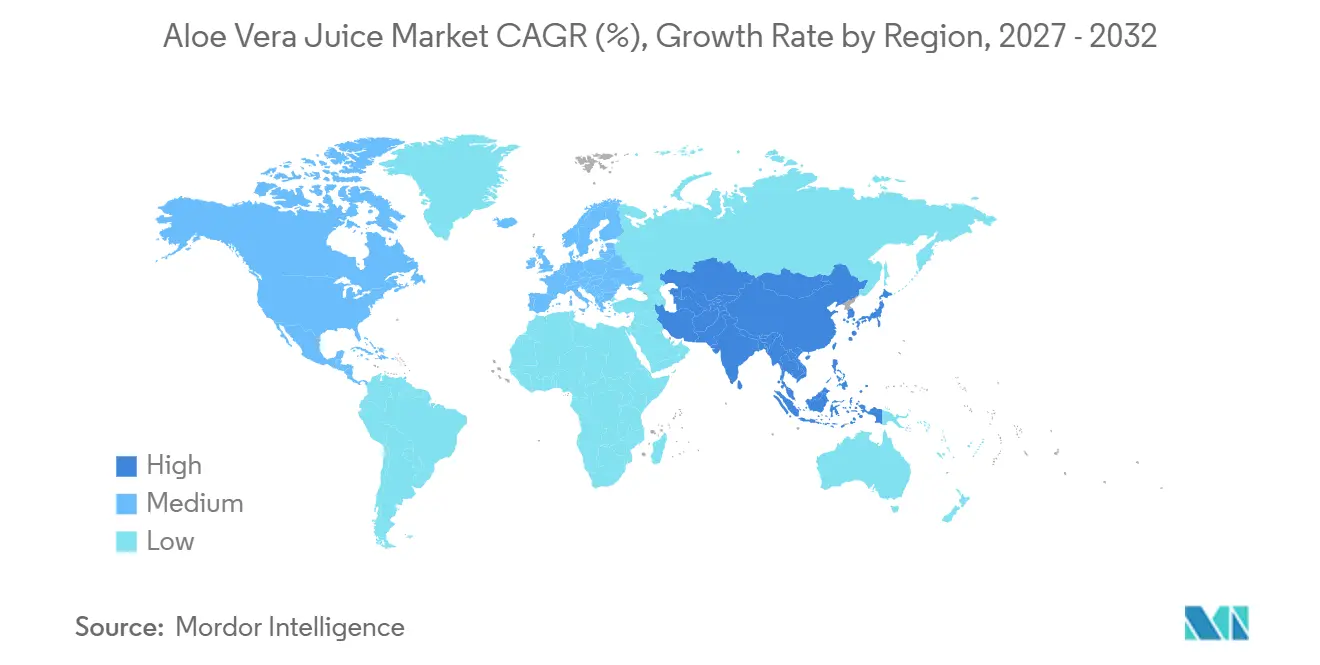
Asia-Pacific holds a 40.12% share of the aloe vera juice market in 2026 and is forecast to grow at a CAGR of 9.91% through 2032. The region combines established consumer familiarity with aloe beverages, a substantial manufacturing base, widespread use of small-format drinks in everyday retail, and the capacity to meet both local and export demand. China supports regional demand through habitual consumption, domestic production, and export activity, which helps sustain a broad range of flavors and formats for diverse consumer groups. India offers growth potential through accessible wellness positioning, a large health-conscious consumer base, demand for convenient packaged drinks, and consumer interest in aloe within established wellness practices.
North America Aloe Vera Juice Market
North America remains a mature yet expanding region in the aloe vera juice market, supported by well-developed grocery distribution networks and a consumer base familiar with wellness-oriented products and open to new formats. In the United States, supermarkets, natural grocery stores, and wellness retailers enable brands to reach both mainstream buyers and consumers who closely evaluate formulation details. Mexico supports domestic demand while supplying raw materials for premium export-oriented products, linking cultivation, ingredient processing, and finished-product supply.
EMEA and South America Aloe Vera Juice Market
Europe remains important to the aloe vera juice market, as health-food retailers and many mainstream grocery channels maintain high ingredient standards and clean-label expectations. Health-food retail channels in Germany, the Netherlands, and the United Kingdom can support premium products that document processing methods, sourcing practices, the use of inner-leaf ingredients, and measures to control aloin levels. Verified low-aloin testing can strengthen retailer confidence in markets with substantial compliance scrutiny, where buyers and consumers closely review product information. South America contributes demand through herbal wellness channels, particularly in Brazil and Argentina, where aloe can be positioned among familiar botanical product offerings. The Middle East and Africa remain earlier-stage regions; however, certified supply from South Africa can support export-oriented brands and products requiring documented raw material credentials.
Competitive Landscape
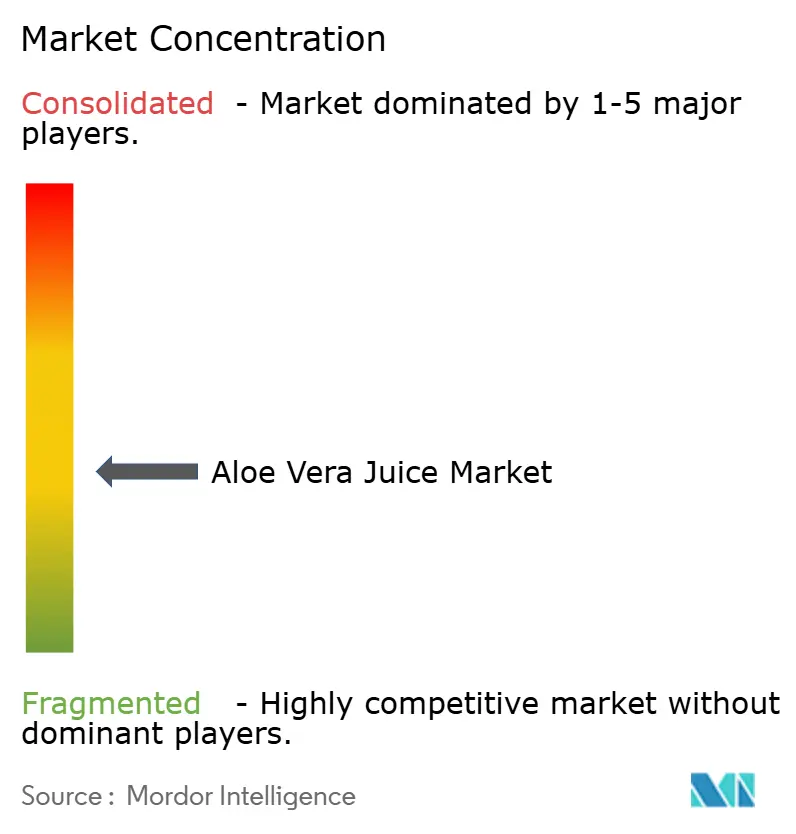
The Aloe vera juice market is moderately fragmented, with regional specialists, contract manufacturers, direct-to-consumer brands, and exporters serving diverse retail and consumer needs. The market indicates limited category-wide pricing power for any single company and highlights the significant role of local brands, particularly in markets where taste preferences and retail structures vary. Large operators hold strong positions in specific aloe drink segments without controlling the overall category or setting prices across all distribution channels, packaging types, and geographies. Forever Living Products maintains a vertically integrated, certified-organic aloe supply base in the Dominican Republic.
Manufacturers in the Aloe vera juice market compete through format selection, flavor development, testing capabilities, sourcing credentials, and access to export channels. Herbalife’s 2025 recognition illustrates how quality testing can support competitive positioning and become an operational requirement for producers selling through regulated channels. Contract manufacturing models allow brand owners to enter the category without owning cultivation or beverage manufacturing assets. These models also support smaller production runs, adapted product concepts, and faster testing of opportunities in specific channels.
The strongest opportunities lie in certified-organic products at more accessible price points and ready-to-drink formats with differentiated formulations that support both everyday and wellness-focused consumption. Companies that can verify inner-leaf processing, low-aloin status, and consistent quality records can reduce a major barrier to retailer acceptance and demonstrate greater readiness for regulated markets. The Aloe vera juice market rewards manufacturers that combine robust compliance practices, practical packaging, clear product communication, appropriate channel selection, and disciplined execution across multiple product formats.
Aloe Vera Juice Industry Leaders
-
OKF Corporation
-
Forever Living Products
-
Tulip International
-
RITA Food & Drink Co.,Ltd
-
Lotte Chilsung Beverage Co Ltd.
- *Disclaimer: Major Players sorted in no particular order
Aloe Vera Juice Market Companies Covered in this Report
- OKF Corporation
- ALO Drink (SPI West-Port)
- Forever Living Products
- Houssy Global
- Lotte Chilsung Beverage Co Ltd.
- Keumkang B&F
- Tulip International
- Aloe Farms
- Grace Foods / GraceKennedy
- Dynamic Health Laboratories
- Simplee Aloe
- RITA Food & Drink Co.,Ltd
- Herbalife Nutrition
- Nature’s Way Products
- Aloecorp, Inc.
- Fruit of the Earth, Inc.
- Suja Life, LLC
- Aloe Drink For Life
- Patanjali Ayurved
- Nam Viet F&B (VINUT)
Recent Industry Developments in Aloe Vera Juice Market
- February 2026: ALO Drink launched two new 100% juice flavors-Passion Fruit & Pulp and Sugarcane & Calamansi-at Natural Products Expo West 2026. The 320 ml products contain no added sugar, colors, flavors, or preservatives. This launch expands the brand’s aloe beverage portfolio through fruit-based flavor innovation and convenient canned formats.
- February 2026: Nutriorg introduced an organic wellness juice combining sea buckthorn, aloe vera, and amla. The launch expanded the aloe vera juice category with a multi-ingredient formulation targeting consumers seeking botanical- and fruit-based wellness beverages.
- November 2025: Del Monte introduced Aloe Vera Fresh, a locally produced beverage containing natural aloe pulp. Castillo Hermanos developed the product, and Distribuidora Maravilla distributes it. The company positions the beverage as a refreshing and hydrating option. This launch expanded the availability of aloe vera beverages in Guatemala, and Del Monte has indicated plans to extend distribution across Central America.
Global Aloe Vera Juice Market Report Scope
Aloe vera juice is a beverage made from the inner gel or processed leaf material of the aloe vera plant (Aloe barbadensis Miller). It is consumed in pure, flavored, and fruit-blended forms and is available in ready-to-drink and concentrated formats.
The aloe vera juice market is segmented by packaging, flavor type, distribution channel, and geography. By packaging, the market is segmented into bottles, cans, pouches, and other packaging formats. By flavor type, the market is segmented into flavored and unflavored. By distribution channel, the market is segmented into hypermarkets and supermarkets, convenience/grocery stores, specialty stores, online retail, and other distribution channels. Geographically, the market is classified into North America, Europe, South America, Asia-Pacific, and the Middle East and Africa. The market forecasts are provided in terms of value (USD).
Segmentation Overview
| Bottles |
| Cans |
| Pouches |
| Other Packaging Formats |
| Flavored |
| Unflavored |
| Hypermarkets and Supermarkets |
| Convenience/Grocery Stores |
| Specialty Stores |
| Online Retail |
| Other Distribution Channels |
| North America | United States |
| Canada | |
| Mexico | |
| Rest of North America | |
| Europe | Germany |
| United Kingdom | |
| Italy | |
| France | |
| Spain | |
| Netherlands | |
| Rest of Europe | |
| Asia-Pacific | China |
| India | |
| Japan | |
| Australia | |
| Indonesia | |
| Thailand | |
| Rest of Asia-Pacific | |
| South America | Brazil |
| Argentina | |
| Rest of South America | |
| Middle East and Africa | South Africa |
| Saudi Arabia | |
| United Arab Emirates | |
| Turkey | |
| Rest of Middle East and Africa |
| By Packaging | Bottles | |
| Cans | ||
| Pouches | ||
| Other Packaging Formats | ||
| By Flavor Type | Flavored | |
| Unflavored | ||
| By Distribution Channel | Hypermarkets and Supermarkets | |
| Convenience/Grocery Stores | ||
| Specialty Stores | ||
| Online Retail | ||
| Other Distribution Channels | ||
| By Geography | North America | United States |
| Canada | ||
| Mexico | ||
| Rest of North America | ||
| Europe | Germany | |
| United Kingdom | ||
| Italy | ||
| France | ||
| Spain | ||
| Netherlands | ||
| Rest of Europe | ||
| Asia-Pacific | China | |
| India | ||
| Japan | ||
| Australia | ||
| Indonesia | ||
| Thailand | ||
| Rest of Asia-Pacific | ||
| South America | Brazil | |
| Argentina | ||
| Rest of South America | ||
| Middle East and Africa | South Africa | |
| Saudi Arabia | ||
| United Arab Emirates | ||
| Turkey | ||
| Rest of Middle East and Africa | ||
Key Questions Answered in the Report
What is the projected size of the aloe vera juice market by 2032?
The aloe vera juice market is projected to grow from USD 139.07 million in 2026 to USD 222.78 million by 2032, after reaching USD 149.95 million in 2027, registering a CAGR of 8.24% during 2027–2032.
Which packaging segment held the largest share of the aloe vera juice market in 2026?
Bottles held the largest market share in 2026, accounting for 72.23% of the aloe vera juice market.
Which flavor type dominated the aloe vera juice market in 2026?
The flavored segment dominated the market in 2026, holding a 54.73% market share.
Which distribution channel held the largest share of the aloe vera juice market in 2026?
Hypermarkets and Supermarkets accounted for the largest share of the market in 2026, representing 45.82% of total revenue.
Which region dominated the aloe vera juice market in 2026?
Asia-Pacific was the leading regional market, accounting for 40.12% of market in 2026.