
Market Overview
| Study Period | 2021 - 2031 |
|---|---|
| Forecast Data Period | 2026 - 2031 |
| Base Year Market Size (2025) | USD 175.50 Billion |
| Market Size (2026) | USD 177.83 Billion |
| Market Size (2031) | USD 189.99 Billion |
| Growth Rate (2026 - 2031) | 1.33 % |
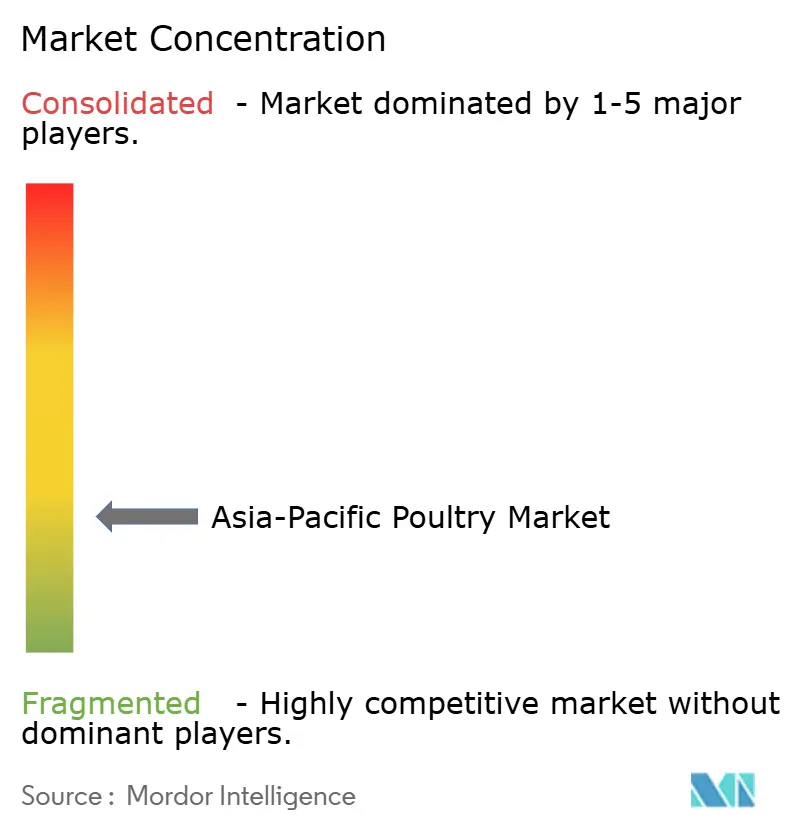
| Market Concentration | Low |
Major Players *Disclaimer: Major Players sorted in no particular order Image © Mordor Intelligence. Reuse requires attribution under CC BY 4.0. | |
Asia-Pacific Poultry Market Analysis by Mordor Intelligence
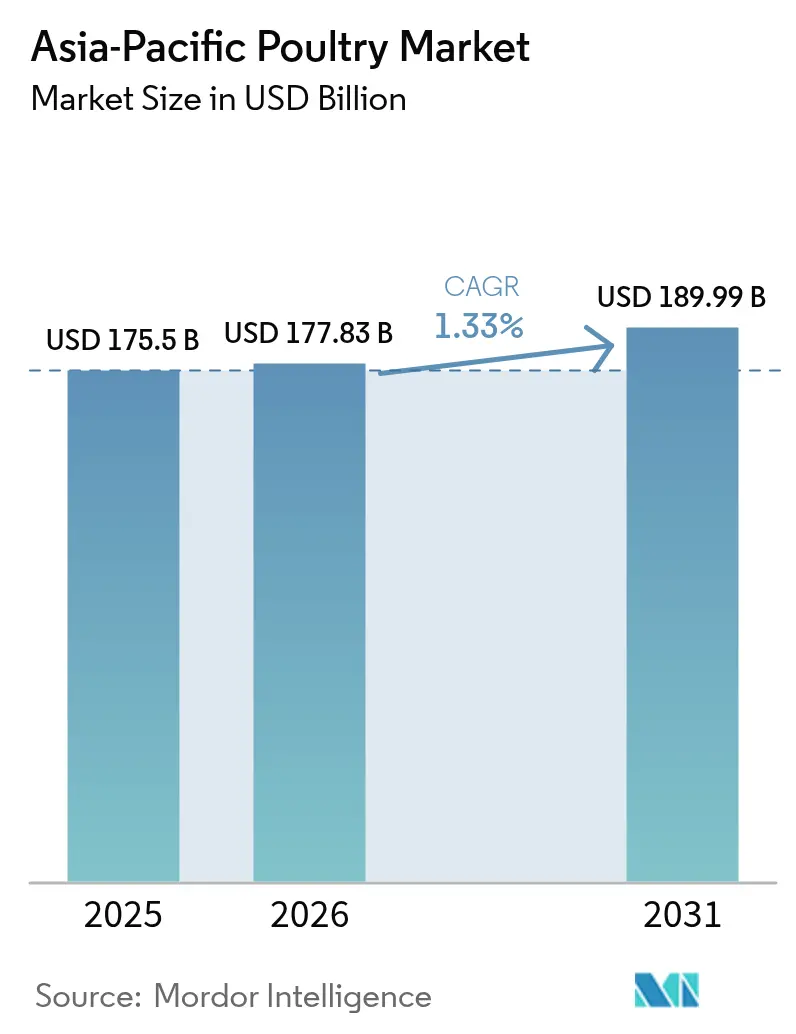
The Asia-Pacific poultry market size is expected to grow from USD 175.50 billion in 2025 to USD 177.83 billion in 2026 and is forecast to reach USD 189.99 billion by 2031 at 1.33% CAGR over 2026-2031. While the overall growth appears slow, there's significant variation across sub-regions. Producers adept at managing feed-cost fluctuations and transitioning to value-added offerings, such as processed, frozen, and antibiotic-free products, are outpacing their commodity-focused counterparts. Chicken remains the dominant choice for consumers, but duck is gaining traction, driven by surging demand for Chinese waterfowl and a growing preference for premium formats in urban retail. The landscape is evolving, with quick-service restaurants (QSRs) expanding, incomes rising, and e-commerce innovations in grocery reshaping the distribution landscape. However, challenges persist, as recurring avian influenza outbreaks and fluctuating grain prices test the resilience of the supply chain. In 2023, Vietnam's Ministry of Industry and Trade highlighted the country's robust food service sector, boasting over 540,000 businesses. As the market evolves, competitive strategies are increasingly centered on automation, traceability, and meeting the demands of QSRs and retailers for standardized cuts and timely cold-chain deliveries.
Key Report Takeaways
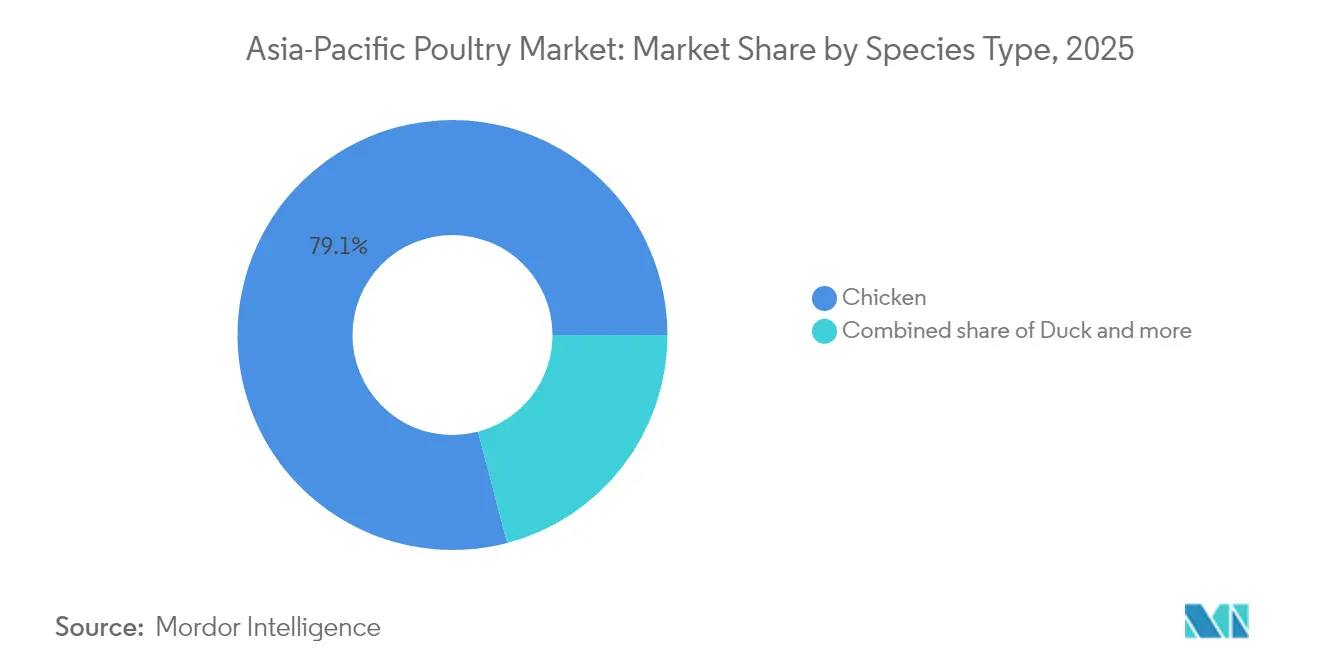
- By Species Type, chicken commanded 79.10% of the Asia-Pacific poultry market share in 2025, whereas duck is growing at a 3.15% CAGR through 2031.
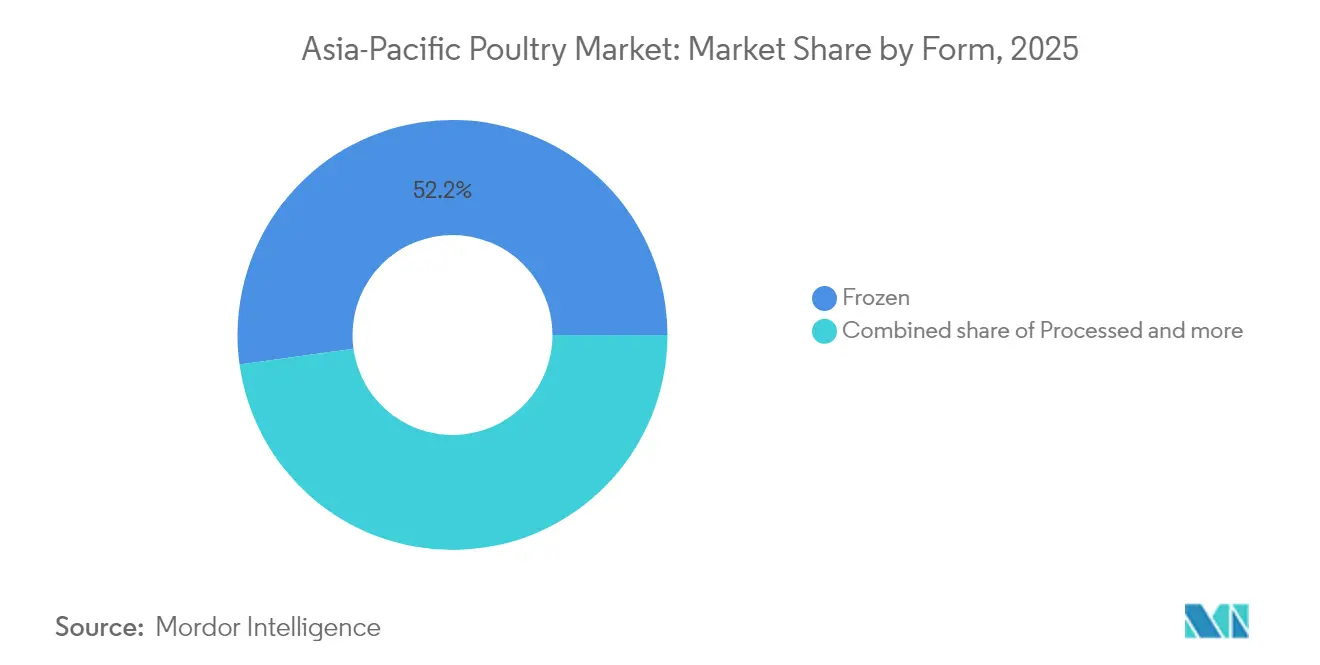
- By Form, processed poultry is advancing at a 2.12% CAGR, but frozen formats still held 52.20% share of the Asia-Pacific poultry market size in 2025.
- Foodservice captured 47.60% of 2025 revenues; however, retail, spurred by e-commerce, posts a 3.89% CAGR to 2031.
- By Geography, China retained a 33.10% value share in 2025, while India is the fastest-growing geography at 2.44% annually.
Note: Market size and forecast figures in this report are generated using Mordor Intelligence’s proprietary estimation framework, updated with the latest available data and insights as of 2026.
Asia-Pacific Poultry Market Trends and Insights
Drivers Impact Analysis*
| Driver | (~) % Impact on CAGR Forecast | Geographic Relevance | Impact Timeline |
|---|---|---|---|
| Rapid urbanization-driven demand for convenient animal protein | +0.35% | China, India, Indonesia, Vietnam, with spillover to tier-2 cities across ASEAN | Medium term (2-4 years) |
| Expansion of QSR chains in tier-2 and tier-3 Asian cities | +0.28% | India, China, Vietnam, Philippines, with early gains in secondary urban clusters | Short term (≤ 2 years) |
| Rising disposable incomes are lifting per-capita egg consumption | +0.22% | India, Vietnam, Indonesia, Bangladesh, with rural-to-urban migration amplifying demand | Long term (≥ 4 years) |
| Adoption of antibiotic-free and traceable poultry for export compliance | +0.18% | Thailand, Vietnam, and Australia, with regulatory influence from the EU and Japan, import standards | Medium term (2-4 years) |
| Government incentives for protein self-sufficiency amid feed volatility | +0.15% | India, Malaysia, and South Korea, with national food-security mandates driving capacity additions | Long term (≥ 4 years) |
| E-commerce grocery growth is improving cold-chain penetration | +0.12% | Singapore, urban China, India metro regions, with last-mile logistics enabling fresh/chilled delivery | Short term (≤ 2 years) |
| Source: Mordor Intelligence | |||
Rapid urbanization-driven demand for convenient animal protein
As Asia-Pacific's urban population grows faster than infrastructure can keep up, there's a rising demand for quick-preparation and shelf-stable protein sources. According to the OECD-FAO Agricultural Outlook, by 2034, poultry is set to make up 45% of global meat protein consumption, a rise from current figures[1]Source: OECD-FAO, “Agricultural Outlook 2024-2033,” oecd.org. This change is largely driven by urban households favoring convenience and affordability over traditional wet-market purchases. In China, this trend is especially evident, with white broilers now constituting over 60% of the country's broiler population, thanks to their efficient feed conversion and compatibility with mechanized processing. Meanwhile, in India, processing capacity is on track to hit 267,800 birds per hour by mid-2026, marking a robust 15.75% annual growth since 2018. This surge is fueled by integrators pouring investments into automated evisceration and chilling lines, all to cater to the urban appetite. Yet, in Vietnam and Indonesia, the enduring presence of live-bird markets hampers the adoption of cold-chain logistics, curtailing the market potential for pre-packaged poultry. Urbanization is also ushering in a wave of premiumization. Consumers in tier-1 cities are now willing to shell out 20-30% more for poultry that's antibiotic-free or carries organic certifications. Processors are keenly tapping into this trend, using it as a strategy to counterbalance shrinking margins in commodity segments.
Expansion of QSR chains in tier-2 and tier-3 Asian cities
Quick-service restaurant (QSR) operators are increasingly targeting secondary cities, drawn by lower real estate costs and reduced competition, after saturating tier-1 metros. Yum China, for instance, has set its sights on operating 20,000 stores by 2026, with a notable focus on tier-3 cities. Here, KFC and Pizza Hut frequently stand out as the inaugural Western-style dining choices. This ambitious expansion not only underscores the growing appetite for Western dining but also drives a heightened demand for specific chicken cuts, like breast fillets, wings, and tenders, that align with franchise standards on size and fat content. Similarly, Jollibee's ventures into Vietnam and China underscore the importance of vertically integrated supply chains, ensuring consistent quality. This approach inherently benefits larger integrators, sidelining fragmented local suppliers. The QSR sector is also championing the use of frozen poultry, a necessity for franchisees aiming to reduce spoilage, especially in regions with sporadic cold-chain facilities. In 2024, South Korea's Ministry of Agriculture, Food and Rural Affairs highlighted a surge in domestic chicken consumption per capita, a trend bolstered by the dominance of fried-chicken chains in the late-night dining arena[2]Source: Korea Ministry of Agriculture, “Livestock Statistics 2024,” mafra.go.kr. Yet, the growth trajectory of QSRs isn't without its challenges. Economic downturns pose a threat, particularly in tier-2 cities where heightened price sensitivity might push consumers back to traditional wet markets during financially uncertain times.
Rising disposable incomes lifting per-capita egg consumption
In South and Southeast Asia, rising incomes are driving a heightened demand for animal protein, with egg consumption leading the way into broader poultry adoption. In 2024-25, India produced 149.11 billion eggs, marking a 4.44% increase from the previous year. Andhra Pradesh, Tamil Nadu, and Telangana together contributed nearly 47% to this national output, as reported by the Government of India. This uptick in production is bolstered by government initiatives, which not only subsidize expansions in layer farms but also offer technical support to enhance biosecurity. The Asian Development Bank highlights a noteworthy trend: per-capita protein consumption in Vietnam and Indonesia is nearing that of Thailand and Malaysia. This convergence hints at a sustained growth trajectory, especially as rural households gradually shift from plant-based diets. Eggs enjoy a unique advantage; they are culturally accepted across various religious and ethnic groups, unlike beef or pork. This broad acceptance positions eggs as a politically neutral choice for nutrition programs. Yet, challenges loom. Price fluctuations, primarily influenced by feed costs, threaten to undermine affordability, especially in Bangladesh and Pakistan, where imports of maize and soybean meal are predominant. As we look ahead to 2030, the balance between rising incomes and feed price dynamics will be crucial in determining the sustainability of this growth trend.
Adoption of antibiotic-free and traceable poultry for export compliance
Producers in Thailand, Vietnam, and Australia, focusing on exports, are shifting towards antibiotic-free systems. This move aligns with tightening import standards from the European Union and Japan, which are clamping down on residues from key antimicrobials. Forecasts from the USDA Foreign Agricultural Service indicate a 2.6% uptick in Thailand's chicken production by 2025, spurred by export demand. This growth comes even as domestic consumption remains tepid, hampered by a scarcity of day-old chicks. In response to the European Union's prohibition on routine antibiotic use, Thai producers are pivoting to alternatives like probiotics and organic acids. While these shifts elevate production costs by 8-12%, they also pave the way for premium pricing in export markets. Echoing this trend, Australia's poultry industry has adopted comprehensive traceability systems, tracking every batch from hatchery to retail. This move caters to Japanese importers' rising demand, emphasizing food safety. Yet, a financial chasm exists: smaller producers in Indonesia and the Philippines can't afford these systems. This disparity has led to a divided market: export-ready facilities operate at near-full capacity, while those catering domestically grapple with oversupply. Compliance standards like ISO 22000 and GLOBALG.A.P. are emerging as essential gateways for premium market segments, further consolidating power among vertically integrated players.
Restraints Impact Analysis*
| Restraint | (~) % Impact on CAGR Forecast | Geographic Relevance | Impact Timeline |
|---|---|---|---|
| Recurring avian-influenza outbreaks causing culling shocks | -0.42% | Vietnam, Australia, Japan, South Korea, with sporadic outbreaks in China and Indonesia | Short term (≤ 2 years) |
| Volatile feed raw-material prices linked to global grain markets | -0.38% | Global, with an acute impact in import-dependent markets like Malaysia, the Philippines, and Bangladesh | Medium term (2-4 years) |
| Fragmented cold-chain logistics in lower-income ASEAN markets | -0.22% | Indonesia, Philippines, Vietnam, and Myanmar, with infrastructure gaps in rural and peri-urban zones | Long term (≥ 4 years) |
| Competition from plant-based protein start-ups targeting flexitarians | -0.15% | Singapore, urban China, India metro regions, with niche adoption in Japan and Australia | Medium term (2-4 years) |
| Source: Mordor Intelligence | |||
Recurring avian-influenza outbreaks causing culling shocks
In June 2024, Australia reported an H7N3 outbreak, leading to the culling of over 1 million birds. Meanwhile, in May 2024, Vietnam dealt with H5N1 cases. Japan, in late 2024, detected multiple instances of H5N1, resulting in localized movement restrictions that delayed shipments to processors and retailers. South Korea's stringent culling protocols, which require the destruction of all birds within a 3-kilometer radius of confirmed cases, create supply shocks. These shocks ripple through integrated supply chains, compelling processors to source from distant regions at higher transport costs. While the World Health Organization, Food and Agriculture Organization, and World Organisation for Animal Health run joint surveillance programs, early-warning systems falter in lower-income markets due to underfunded veterinary infrastructure. The economic repercussions are significant: export bans from importing countries can linger for months post-outbreak containment, leaving producers with surplus inventory. In China and Vietnam, vaccination strategies are on the rise. However, concerns over vaccine efficacy and potential trade repercussions hinder broader adoption in export-centric markets such as Thailand and Australia.
Volatile feed raw-material prices linked to global grain markets
Poultry production costs are heavily influenced by corn and soybean meal, which together account for 60-70% of these expenses. This reliance makes poultry integrators vulnerable to price fluctuations, often driven by weather events, geopolitical tensions, and biofuel mandates. Throughout 2024, the World Bank's commodity price index for grains remained elevated, a trend attributed to ongoing supply constraints from the Black Sea region and adverse weather conditions in South America[3]Source: World Bank, “Commodity Prices Data 2024,” worldbank.org. Similarly, the FAO Food Price Index stayed above pre-2022 levels, putting pressure on producers' margins, especially those unable to swiftly transfer costs to consumers. Markets like Malaysia and the Philippines, which rely on imports, grapple with heightened currency risks. Depreciation against the US dollar further inflates feed costs. In 2024, India's poultry integrators enjoyed a boon from domestic maize surpluses, leading to reduced feed prices. However, this benefit is precarious, hinging on monsoon variability and shifts in export policies. While some integrators are exploring alternative feed ingredients like insect meal and algae, challenges such as regulatory approvals and scalability loom large. Moreover, the absence of futures markets for poultry products in many Asian nations hampers producers' ability to hedge against margin risks, leaving them vulnerable to simultaneous surges in input costs and drops in output prices.
*Our forecasts treat driver/restraint impacts as directional, not additive. The impact forecasts reflect baseline growth, mix effects, and variable interactions.
Segment Analysis
By Species Type: Duck Outpaces Chicken in Growth Velocity
In 2025, chicken secured a commanding 79.10% share of the species-type market, solidifying its status as Asia-Pacific's preferred poultry choice, thanks to its affordability, religious neutrality, and culinary versatility. Meanwhile, duck is making waves, growing at an annual rate of 3.15% through 2031, the fastest among its peers. This surge is largely attributed to China's stronghold on waterfowl production and the escalating appetite for Peking duck in urban locales, as highlighted by the USDA Foreign Agricultural Service. Dominating the scene, China produces over 70% of the world's duck, boasting integrated supply chains that cover breeding, feed milling, and processing. This comprehensive approach gives China a cost advantage that outpaces smaller producers in Vietnam and Thailand. In China, duck meat enjoys a premium status, gracing the menus of upscale restaurants and specialty retailers. Here, it's not just a dish but a symbol of festive celebrations and traditional culinary art, a cultural nuance that shields it from direct price wars with chicken. Vietnam's duck farming is on the rise, buoyed by government initiatives offering subsidized feed and technical training to small farmers. Yet, it's not without hiccups; production faced a setback in May 2024 due to avian influenza outbreaks, as reported by the World Organization for Animal Health.
Turkey and other poultry types occupy a niche segment, sharing the remaining market space. Turkey finds its primary audience among expatriates and Western-style eateries in Singapore, Hong Kong, and Australia. Yet, it struggles to resonate culturally in most Asian markets. Its longer growth cycle and less efficient feed conversion further diminish its competitiveness against chicken. Still, there's a silver lining: Japan and South Korea present niche markets, with health-conscious diners exploring leaner proteins. Australia, too, carves out a space, with local turkey farms catering to holiday festivities. However, challenges loom. The scarcity of turkey breeding stock and a dearth of processing know-how stifle broader market growth. As it stands, chicken and duck are poised to maintain their dominance in the species landscape through 2031.



By Form: Processed Poultry Gains as Convenience Trumps Price
In 2025, frozen poultry captured 52.20% of the market share, thanks to its bulk purchasing appeal, extended shelf life, and seamless integration with cold-chain infrastructure. Meanwhile, processed poultry is on a growth trajectory, expanding at an annual rate of 2.12% through 2031. This surge, the fastest among all forms, is fueled by urbanization and the rise of dual-income households, leading to a heightened demand for ready-to-eat and ready-to-cook products that streamline meal preparation. By mid-2026, India's processing capacity is set to soar to 267,800 birds per hour. This leap is driven by integrators pouring investments into automated marination, breading, and packaging lines, churning out value-added products like chicken nuggets, sausages, and kebabs. These offerings boast gross margins 15-20 percentage points above commodity cuts, enticing producers to pivot towards processed formats, even with the associated capital demands.
Fresh and chilled poultry enjoys a loyal following in markets where consumers prioritize freshness and embrace daily shopping. This behavior is especially prevalent in Southeast Asia's wet markets. Yet, the fresh segment grapples with challenges: food-safety apprehensions and the hassle of frequent shopping trips. These issues tilt the scales in favor of pre-packaged alternatives. Canned poultry, while carving out a niche for emergency rations and in remote areas lacking cold-chain access, is unlikely to capture a significant market share, given the prevailing consumer preference for fresher options. The processed poultry trend dovetails with the expansion of quick-service restaurants. Franchisees seek standardized products that align with their specifications on size, breading thickness, and fat content. Such consistency is a hallmark of large processors, making them indispensable in this evolving landscape.
By Distribution Channel: Retail Surges on E-Commerce Tailwinds
In 2025, foodservice commanded a 47.60% share of the distribution channel, underscoring the stronghold of quick-service restaurants, hotels, and institutional catering in urban areas where dining out is commonplace. Retail channels, however, are on an upward trajectory, expanding at an annual rate of 3.89% through 2031. This growth, the fastest among distribution types, is largely fueled by e-commerce grocery platforms adept at cold-chain logistics and boasting 30-minute delivery windows. In 2024, Singapore's Deliveroo and Sheng Siong rolled out a 30-minute grocery delivery service, with fresh foods making up about 50% of online orders. This model is now gaining traction in urban centers of China and India. Supermarkets and hypermarkets, having invested in omnichannel capabilities, are reaping the rewards of this shift. They offer consumers the flexibility to order online for home delivery or in-store pickup, a convenience that traditional wet markets and convenience stores struggle to provide.
Meanwhile, online retailers are gaining ground by introducing subscription models, ensuring regular deliveries of frozen chicken and eggs. This strategy not only simplifies repeat purchases but also fosters customer loyalty. While specialty stores and butcheries still attract consumers seeking personalized service and premium cuts, their market share is dwindling. Younger shoppers increasingly favor convenience over traditional relationship-based shopping. The foodservice channel's tempered growth can be attributed to saturation in tier-1 cities and economic challenges curbing discretionary dining expenses. Yet, quick-service restaurants are making inroads in tier-2 and tier-3 cities, where their presence is still limited. Looking ahead, retail channels that harness data analytics for inventory optimization and spoilage reduction are poised for success, a feat that remains elusive for traditional foodservice operators.
Geography Analysis
In 2025, China held 33.10% of the regional market, driven by vertically integrated production and strong domestic consumption. In 2023, China consumed over 11.86 billion broilers, equating to 18.876 million tonnes of chicken meat (USDA GAIN Report). White broilers, now over 60% of the population, improved feed-conversion ratios but reduced flavor differentiation, creating opportunities for heritage-breed producers in premium markets. Fujian Sunner, China's third-largest broiler producer, reported a net income drop to CNY 102 million (USD 14 million) in H1 2024 from CNY 426 million (USD 59 million) in H1 2023, due to oversupply and high feed costs. While the government’s protein self-sufficiency mandate drives capacity growth, demand is slowing as urban per-capita consumption nears saturation. Limited export opportunities, due to trade restrictions and competition from Brazil and the U.S., are pushing integrators toward domestic value-added segments like processed poultry and duck products.
India is the fastest-growing market, expanding at 2.44% annually through 2031, supported by rising incomes, government incentives, and cultural acceptance of poultry. Egg production reached 149.11 billion units in 2024-25, up 4.44% year-on-year, with Andhra Pradesh, Tamil Nadu, and Telangana contributing nearly 47% of output (Government of India). Poultry accounts for 49% of India’s meat consumption, expected to grow with rising incomes and better cold-chain infrastructure. However, fragmented production and poor biosecurity practices increase disease risks, while unorganized players limit the branded market. Capital subsidies under the Andhra Pradesh Food Processing Policy are driving consolidation, benefiting major integrators like Suguna Foods and Venky's.
Japan, Australia, Thailand, Vietnam, Indonesia, South Korea, Malaysia, and Singapore account for the remaining market share, each with unique dynamics. Japan’s H5N1 outbreaks in late 2024 delayed shipments and raised prices (Japan Ministry of Agriculture). Australia’s H7N3 outbreak in June 2024 led to the culling of over 1 million birds and export bans (World Organisation for Animal Health). Thailand’s chicken production is forecast to grow 2.6% in 2025, driven by export demand despite limited day-old chick supplies (USDA Foreign Agricultural Service). Vietnam’s duck farming, supported by government programs, faced disruptions from H5N1 outbreaks in May 2024. Indonesia’s processed chicken exports are rising, with Japan as the largest importer. Malaysia’s National Agrofood Policy 2.0 targets 60% poultry self-sufficiency by 2030 with feed mill subsidies (Malaysian Ministry of Agriculture). Singapore’s Deliveroo and Sheng Siong partnership for 30-minute grocery delivery highlights its e-commerce leadership, a model larger markets are adopting.
Regulatory Landscape
Poultry regulation across Asia-Pacific is shaped by national food-safety agencies and veterinary authorities, with Codex Alimentarius-aligned HACCP programs commonly used as a baseline for processing hygiene and control plans. In Australia, Food Standards Australia New Zealand (FSANZ) sets food standards, while the Australian Department of Agriculture, Fisheries and Forestry (DAFF) administers export controls for poultry and eggs, reinforcing the role of formal certification and audit trails for cross-border trade.
Animal health controls and avian-influenza response policies increasingly affect market access through regionalization rather than blanket bans. Examples include DAFF Market Access Advice MAA 2026-04, which supported normalization of trade for egg and poultry products after Australia self-declared HPAI-free status effective 13 June 2025, and bilateral quarantine and sanitary negotiations between Vietnam and South Korea concluded in April 2026 that enabled trade in heat-treated poultry to Vietnam. In Southeast Asia, import requirements and veterinary conditions, including documented guidance from Malaysia's Department of Veterinary Services and SPS notifications in Vietnam, keep biosecurity, residue compliance, and heat-treatment parameters central to cross-border movement of poultry meat and meal.
Competitive Landscape
The Asia-Pacific poultry market is moderately fragmented, with a multitude of small-scale integrators coexisting with industry titans like Charoen Pokphand Foods, Wen's Foodstuff Group, and Suguna Foods. Market concentration varies: China and Thailand enjoy higher consolidation due to economies of scale in feed milling and processing, while India and Indonesia see dominance from unorganized players in rural and peri-urban supply chains. As integrators pour investments into automation, traceability systems, and antibiotic-free production, competitive intensity rises. This shift aims to capture premium segments and adhere to export compliance. In India, Meyn and Marel dominate the processing-equipment installation base, holding 45.9% and 19.6% respectively, underscoring the capital intensity that challenges smaller processors. Opportunities abound in processed poultry and duck farming, where demand outstrips supply, and in e-commerce channels necessitating cold-chain capabilities, a hurdle for traditional wet-market operators.
Plant-based protein disruptors like Green Monday and Growthwell are making inroads, appealing to flexitarian consumers in Singapore and Hong Kong. Yet, their growth is tempered by price premiums and taste preferences. Technology adoption is on the rise, with integrators leveraging AI-driven demand forecasting to fine-tune inventory and minimize spoilage. KPMG's 2024 survey highlights this capability as vital for omnichannel retailers catering to 45% of Asia-Pacific consumers who favor blended shopping experiences. Strategic maneuvers include expanding into tier-2 and tier-3 cities, forging partnerships with quick-service restaurant chains, and acquiring smaller processors to streamline fragmented supply chains.
However, not all players are thriving. Commodity broiler producers in China face significant challenges, with Fujian Sunner's net income plummeting 76% in H1 2024 due to oversupply and margin compression. The competitive landscape is poised for further bifurcation: large integrators are set to dominate premium and export segments, while smaller players vie for price competition in domestic commodity markets.
Asia-Pacific Poultry Industry Leaders
Charoen Pokphand Foods PCL
Wen’s Foodstuff Group Co. Ltd.
Suguna Foods Pvt. Ltd.
NH Foods Ltd.
Baiada Poultry Pty Ltd
- *Disclaimer: Major Players sorted in no particular order

Market Opportunities and Future Outlook
Value-added poultry and vertically integrated supply chains remain the clearest whitespace, supported by active capacity builds and stricter compliance requirements around residues, traceability, and audited food-safety systems, including ISO 22000 and FSSC 22000 adoption referenced by exporters and large processors. A tangible signal is Vietnam, where Hung Nhon Group and De Heus Vietnam commissioned the DHN Tay Ninh 2 broiler complex in Tay Ninh Province in June 2026, designed for five million birds annually, and built around closed-house biosecurity and consistent output needed for standardized retail and foodservice supply.
Trade-policy shifts also open operational opportunities for both exporters and import-dependent markets by reducing disruption from disease events through regionalization frameworks. The Philippines Department of Agriculture actions to manage supply, including lifting poultry import trade restrictions from multiple origins as of August 2025, points to a channel for international suppliers with compliant cold-chain and documentation to serve shortfalls. Separately, tightening domestic residue and antimicrobial controls in major producing markets, including enforcement of GB standards in China under the Ministry of Agriculture and Rural Affairs, increases demand for facility upgrades and audited production systems, pushing integrators toward automation, tunnel-ventilated farms, and end-to-end traceability to protect both domestic brands and export eligibility.
Recent Industry Developments
- May 2026: Charoen Pokphand Foods PCL (CPF) and NH Foods Ltd. commenced production at their joint venture manufacturing facility in Chachoengsao, Thailand, producing processed meat products including poultry for domestic and export markets. The start-up adds regional processed capacity and supports standardized product specifications demanded by modern retail and foodservice. It also strengthens export-readiness by concentrating production in an auditable, industrial facility.
- December 2025: Australia updated its export-control framework for poultry meat and poultry meat products through the Export Control (Poultry Meat and Poultry Meat Products) Rules as in force on 10 December 2025. The rules underpin documentation, certification, and compliance requirements for export supply chains, influencing how processors structure QA systems and traceability. This provides clearer operating conditions for exporters serving import markets with stricter sanitary and residue expectations.
- October 2024: Charoen Pokphand Foods PCL announced a USD 150 million investment to expand integrated poultry operations in Vietnam, including a new feed mill (500,000 tonnes annual capacity) and a processing plant (120,000 birds per day). The project links feed security with processing scale, supporting consistent supply for domestic demand and export channels. It also aligns production with antibiotic-free and certification requirements increasingly applied by high-value importers such as Japan and South Korea.


Research Methodology Framework and Report Scope
Market Definition and Coverage
For this study, the market covers the value of poultry products sold across Asia-Pacific through retail and foodservice channels, counted at the point where poultry meat and eggs are commercially traded in-country.
Scope exclusions: It excludes non-poultry meats, feed, and upstream inputs such as hatchery equipment and veterinary services.
Segmentation Overview
- Species Type
- Chicken
- Duck
- Turkey
- Other Poultry
- Form
- Canned
- Fresh/Chilled
- Frozen
- Processed
- By Distribution Channel
- Foodservice
- Retail
- Supermarkets and Hypermarkets
- Convenience Stores
- Specialty Stores/Butcheries
- Online Retailers
- Other Distribution Channels
- Geography
- China
- India
- Japan
- Australia
- Thailand
- Vietnam
- Indonesia
- South Korea
- Malaysia
- Singapore
- Rest of Asia-Pacific
Data Sources, Market Sizing, and Validation
Desk Research
To build the base data layer, we start with publicly available production, consumption, and trade indicators that describe the scale of poultry flows across Asia-Pacific. Useful sources include FAOSTAT, UN Comtrade, national agriculture and livestock ministries, customs offices, and food safety agencies, along with statistics offices that publish consumer price and household expenditure series.
We then add context from trade associations and multilateral bodies (for example, industry councils, OECD-FAO outlook notes, and food security publications) because they often clarify disease events, import restrictions, and policy shifts that affect supply and pricing. We also review company annual reports, investor presentations, and credible press coverage to understand stated capacity additions, plant utilization commentary, and channel shifts. Where needed, paid subscriptions covering company financials and intelligence, news and financials, and shipment-level trade data are used to cross-check timelines and normalize inconsistent reporting. These desk sources are illustrative only, and we rely on additional public references for collection, validation, and clarification.
Primary Interviews and Surveys
Our analysts interview poultry producers, processors, distributors, foodservice buyers, and trade experts across Asia-Pacific. Discussions and surveys help clarify production levels, retail and foodservice mix, average selling prices, disease effects, and import assumptions, while also addressing gaps in country-level secondary data before the final model is reviewed.
Distribution of primary research fieldwork respondents
| Company type | Respondent position |
|---|---|
| Top tier: 28% | CXOs: 15% |
| Mid tier: 47% | Functional/Unit leaders: 30% |
| Smaller Players: 25% | Managers: 55% |
Market-Sizing & Forecasting
Market sizing starts with a top-down build, where production, net trade, and apparent consumption indicators reconstruct the addressable poultry demand pool by country, then the result is translated into value using price series by form and channel. To keep the totals realistic, we corroborate the outcome with selective bottom-up approximations, such as sampled supplier revenue ranges, observed price bands by pack type, and volume checks from trade and slaughter statistics, before locking the final number.
Key inputs used in the model include poultry meat and egg production volumes, import and export flows, per capita protein consumption indicators, disease and cull events that tighten supply, and consumer price movements that shape short-term value growth. For forecasting, scenario analysis is used because shocks like avian influenza and policy-driven trade restrictions can temporarily distort trend lines, and expert input helps select the scenario that best fits the likely path. If a clean bottom-up number is not available for a smaller country, we bridge gaps using peer-country ratios for consumption per capita and price levels, and then we run a reasonableness check against trade dependence and retail penetration.
Data Validation & Update Cycle
Results are checked through triangulation across independent signals, with close attention to year-on-year jumps that do not align with production, trade, or consumer price movements. If a variance is found, we revisit assumptions, then contact primary respondents again to determine whether the change is structural or temporary.
Before sign-off, a second analyst reviews model logic, input mapping, and unit conversions so errors do not propagate across countries. Reports are refreshed annually, and interim updates are triggered when material events occur, including disease outbreaks, major policy shifts, or abrupt price swings. Right before delivery, we run a final update pass so clients receive the most current view available.
Mordor Intelligence's Aisa Pacific Poultry Market Sizing Compared With Other Published Estimates
Published market values for Asia-Pacific poultry often do not match because the scope can shift between meat-only and meat plus eggs, and because pricing assumptions for fresh, frozen, and processed products vary by channel. Differences also show up when some estimates rely mainly on a single price benchmark, even though pricing can change quickly across countries.
Table eggs are treated as inside Mordor Intelligence's scope for this market, which tends to lift totals versus meat-only counting, particularly in countries with large egg consumption and stronger retail sales.
Benchmark comparison
| Source | Market Size | Gaps in Research Methodology |
|---|---|---|
| Mordor Intelligence | USD 175.50 B (2025) | |
| Industry Publisher A | USD 107.40 B (2025) | Often scoped to poultry meat revenue only, with fewer adjustments for eggs and for the mix shift between fresh/chilled and processed forms across retail and foodservice. |
| Industry Publisher B | USD 55.67 B (2025) | Commonly narrower country coverage and a tighter product definition, and value is sometimes derived from limited price points rather than country-level production and trade consistency checks. |
Taken together, the spread is mainly explained by what is counted as poultry, which countries are included, and how prices are assigned across forms and channels. By keeping the build traceable to production, trade, and country price logic, we can explain each step and reproduce the result when conditions change.


Key Questions Answered in the Report
Which species shows the fastest growth across Asia-Pacific?
Duck leads with a projected 3.15% CAGR through 2031 due to rising Chinese and Vietnamese demand.
Why is processed poultry gaining traction?
Urban households value convenience, and QSRs require standardized cuts, driving a 2.12% CAGR in processed formats.
What factors most threaten supply stability?
Recurring avian-influenza outbreaks and volatile feed-grain prices remain the two largest operational risks.
Which country offers the highest growth opportunity?
India is expanding at a 2.44% CAGR, supported by government processing incentives and increasing protein intake.
How are companies responding to export market requirements?
Leading integrators invest in antibiotic-free production and full traceability to meet EU and Japanese import standards.
Page last updated on:


 Your data is secure and never sold or shared.


