
Aircraft Component MRO Market Size and Share
Market Overview
| Study Period | 2020 - 2032 |
|---|---|
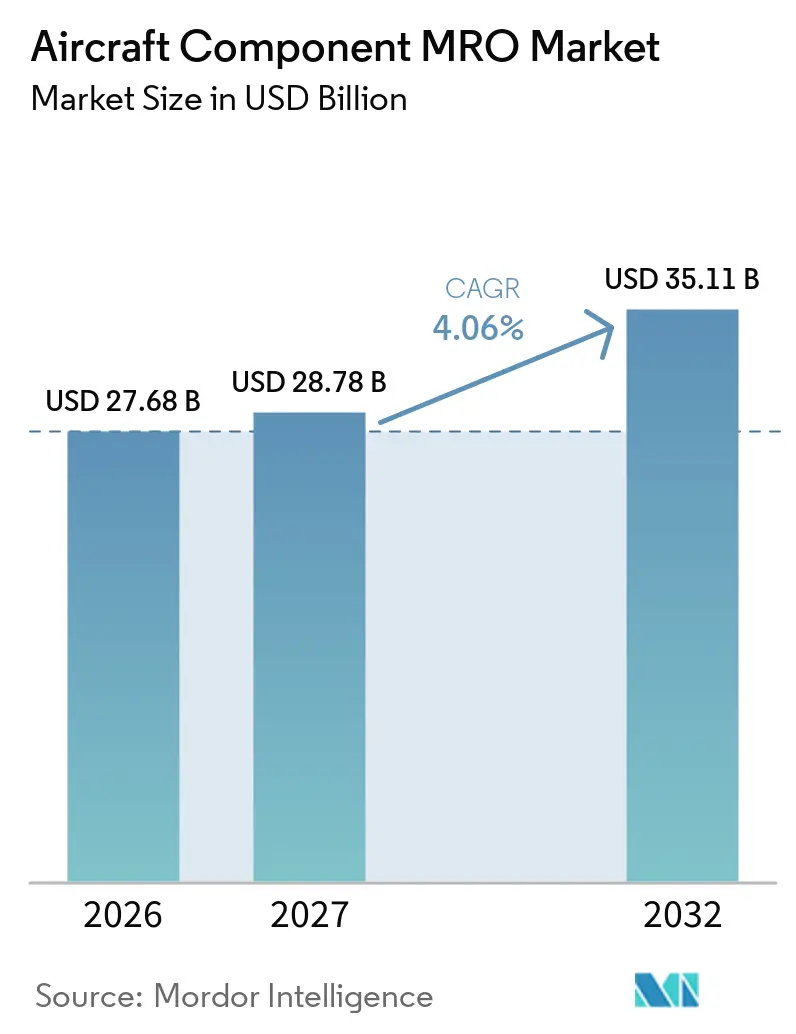
| Market Size (2027) | USD 28.78 Billion |
| Market Size (2032) | USD 35.11 Billion |
| Growth Rate (2027 - 2032) | 4.06 % |
| Fastest Growing Market | Asia-Pacific |
| Largest Market | North America |
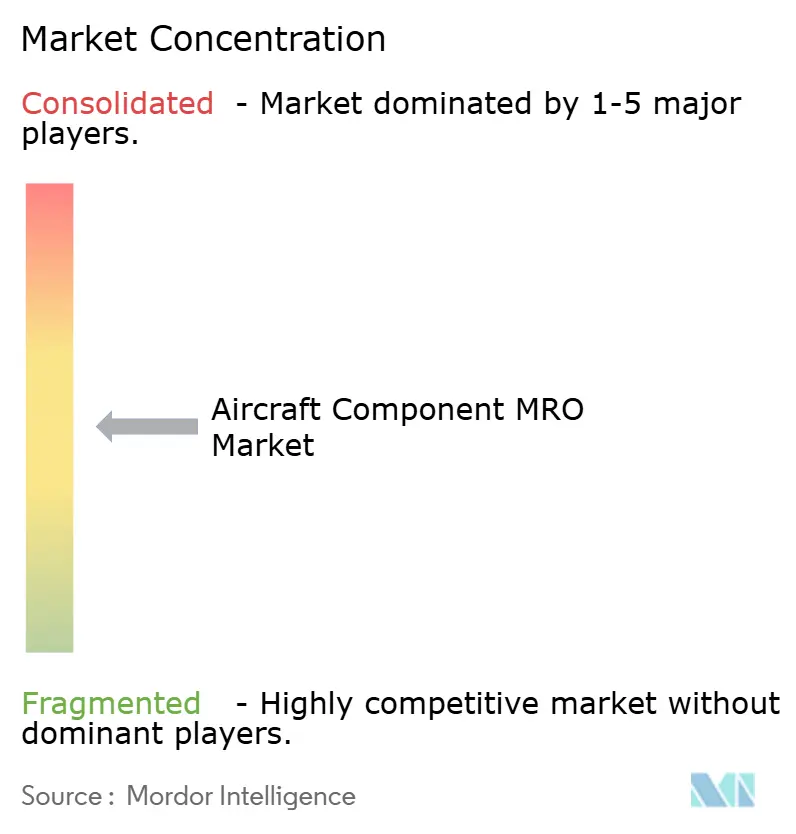
| Market Concentration | Medium |
Major Players *Disclaimer: Major Players sorted in no particular order Image © Mordor Intelligence. Reuse requires attribution under CC BY 4.0. | |
Aircraft Component MRO Market Analysis by Mordor Intelligence
The aircraft component MRO market size was valued at USD 27.68 billion in 2026 and is forecast to grow from USD 28.78 billion in 2027 to reach USD 35.11 billion by 2032, at a 4.06% CAGR during the forecast period (2027-2032). Aircraft delivery constraints keep older fleets in service and raise demand for repair work. IATA reported that the global commercial fleet averaged 15.1 years in mid-2025, while cargo aircraft averaged 19.6 years, increasing the need for planned inspections and repair capacity. Higher utilization also shortens the time between maintenance events and increases pressure on parts availability. Providers are responding through facility investments, digital condition monitoring, and alternative approved material channels. The aircraft component MRO market has opportunities where certified capacity, traceability, and capability align with fleet needs.
Key Report Takeaways
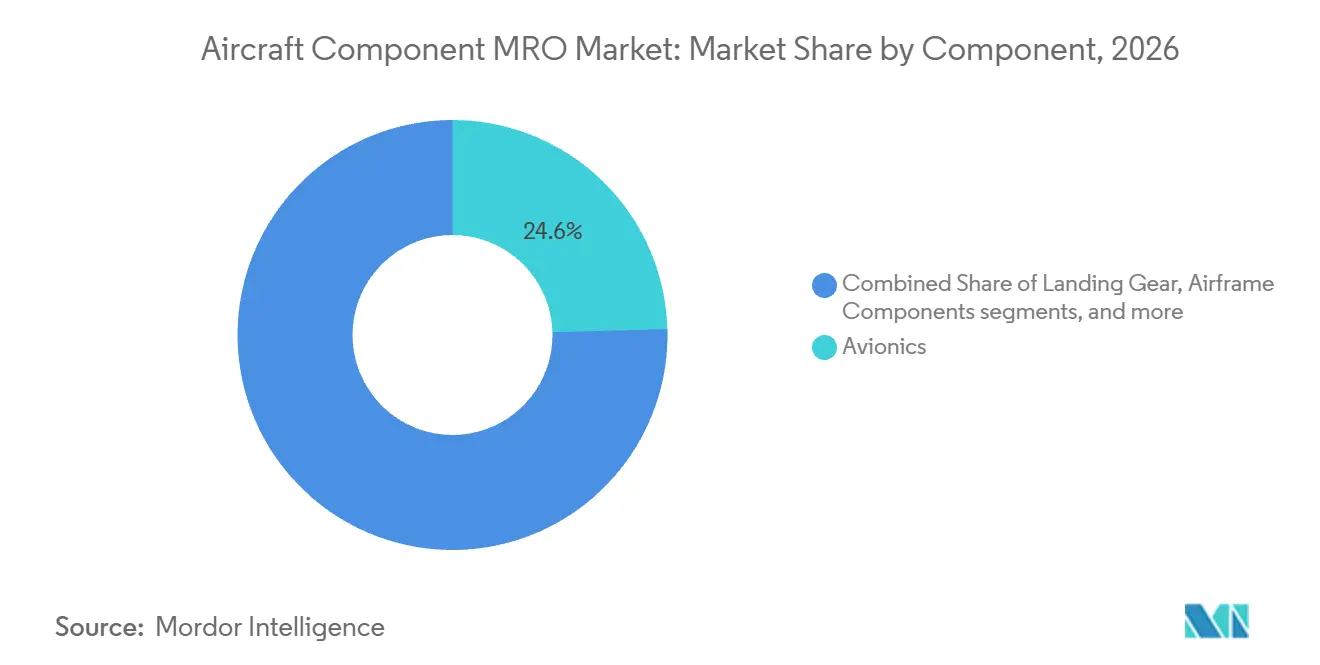
- By component, avionics held 24.56% of aircraft component MRO market share in 2026, while electrical systems are projected to grow at a 5.76% CAGR through 2032.
- By service provider, independent third-party MRO held 43.56% of aircraft component MRO market share in 2026, while OEM-affiliated MRO is projected to grow at a 5.84% CAGR through 2032.
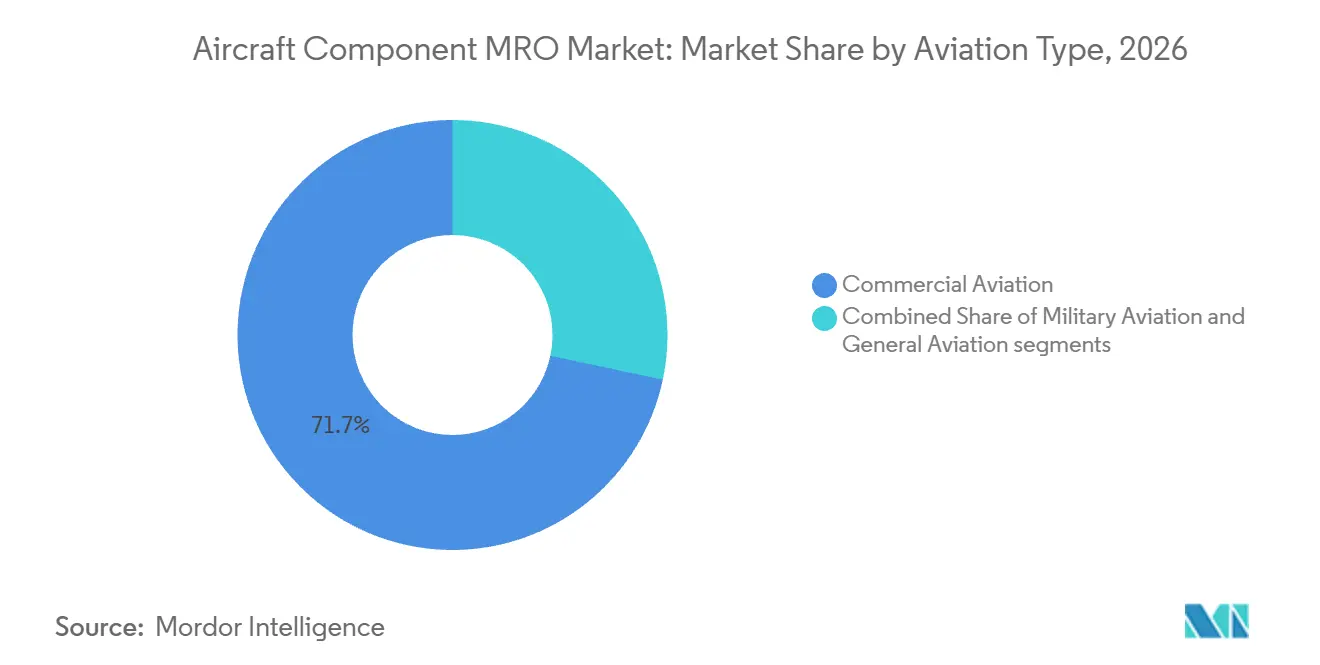
- By aviation type, commercial aviation held 71.67% of aircraft component MRO market share in 2026, while general aviation is projected to grow at a 5.89% CAGR through 2032.
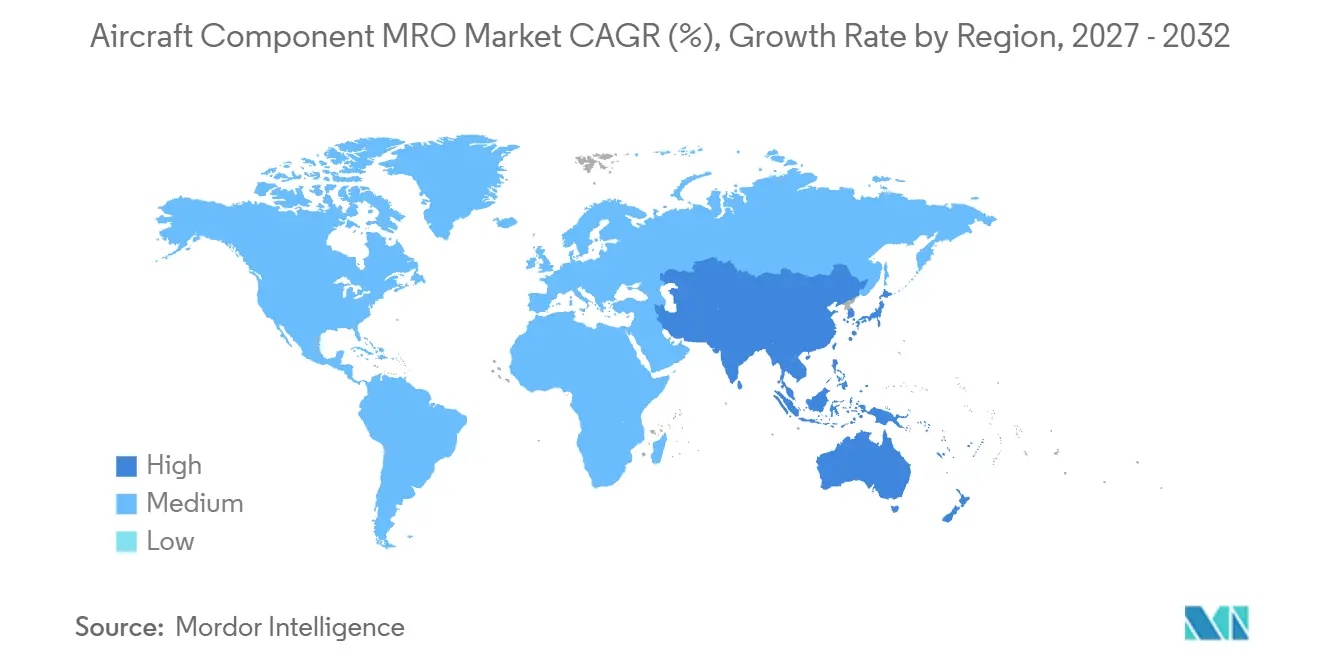
- By geography, North America held 29.56% of aircraft component MRO market share in 2026, while Asia-Pacific is projected to grow at a 5.81% CAGR through 2032.
Note: Market numbers in this report are based on Mordor Intelligence's proprietary estimation framework, which combines nine months of actuals with Q4 projections for base year 2026.
Market Trends and Insights
Drivers Impact Analysis of Aircraft Component MRO Market*
| Driver | (~) % Impact on CAGR Forecast | Geographic Relevance | Impact Timeline |
|---|---|---|---|
| Fleet expansion and aging aircraft | +1.20% | Global, most acute in North America and Europe | Medium term (2-4 years) |
| OEM production backlogs and deferred deliveries | +0.80% | Global, concentrated in North America, EU, and Asia-Pacific core | Short term (≤ 2 years) |
| Passenger traffic recovery and higher aircraft utilization | +0.70% | Asia-Pacific core, spill-over to Middle East and Africa and Latin America | Short term (≤ 2 years) |
| Growing outsourcing of aircraft maintenance and component support | +0.60% | Global, highest incremental growth in Asia-Pacific and Middle East and Africa | Medium term (2-4 years) |
| Parts Manufacturer Approval (PMA) and Used Serviceable Material (USM) adoption for cost and availability | +0.50% | North America and EU, with growing acceptance in Asia-Pacific | Medium term (2-4 years) |
| Certified digital health management for component level decisions | +0.40% | North America and EU, expanding to Asia-Pacific and Middle East and Africa | Long term (≥ 4 years) |
| Source: Mordor Intelligence | |||
Fleet Expansion and Aging Aircraft
IATA reported that the global commercial fleet averaged 15.1 years in mid-2025, with cargo aircraft averaging 19.6 years and widebody passenger aircraft averaging 14.5 years.[1] Older aircraft require recurring inspection and overhaul activity across avionics, landing gear, hydraulic, and structural systems. IATA also identified 2025 airline maintenance costs of USD 3.1 billion and surplus inventory holding costs of USD 1.4 billion, both of which arose from supply chain constraints. Stored aircraft returning to service require additional component work before they can resume operations. These overlapping maintenance events place greater demands on certified repair stations and trained personnel. FAA Part 145 and EASA Part-145 requirements remain important compliance factors because they govern approved maintenance activities and release processes.
OEM Production Backlogs and Deferred Deliveries
Deferred aircraft deliveries extend the operating life of in-service aircraft and increase the number of component repair events required across a fleet. Airbus delivered 793 commercial aircraft in 2025, against its target of 820. IATA stated that supply chain bottlenecks continued to constrain airline fleet renewal and raised airline costs in 2025. Longer operation of existing assets sustains demand for landing gear, avionics, hydraulic components, and related repair services. The effect is more pronounced for frequently operated aircraft because operating cycles lead to earlier removals of life-limited and condition-sensitive components. This setting places additional workload on independent repair facilities when airlines need alternatives to replacement aircraft.
Passenger Traffic Recovery and Higher Aircraft Utilization
Global passenger traffic reached 5 billion passengers in 2025, and the annual passenger load factor reached 83.6%. Higher load factors and frequent aircraft rotations increase the number of operating cycles, which influence component removal schedules. Asia-Pacific recorded 10.9% growth in international RPKs in 2025, placing particular pressure on narrowbody fleets used on short-haul routes. Landing gear, hydraulic actuators, and electrical systems are exposed to more frequent operating cycles under these conditions. Maintenance planning systems must respond to faster use of rotable inventories and shorter time between shop visits. The aircraft component MRO market benefits, as providers can maintain turnaround times without weakening documentation, inspection, or quality controls.
Parts Manufacturer Approval (PMA) and Used Serviceable Material (USM) Adoption
PMA parts and used serviceable material are becoming increasingly relevant as operators face cost pressures and constrained availability of original parts. IATA recommended faster repair approvals and greater use of used serviceable material as responses to supply chain challenges. These materials must meet defined airworthiness and traceability requirements before they are released for aircraft use. FAA approval pathways and EASA Form 1 documentation support the approval of sourcing when records and inspections meet the applicable standards. The aircraft component MRO industry uses these channels to improve material availability without changing its obligation to comply with repair and certification rules. The growing pool of stored aircraft can also support the recovery of eligible serviceable components for certified repair pipelines.
Restraints Impact Analysis of Aircraft Component MRO Market*
| Restraint | (~) % Impact on CAGR Forecast | Geographic Relevance | Impact Timeline |
|---|---|---|---|
| Supply chain disruptions and long lead times for critical aircraft parts | -0.80% | Global | Short term (≤ 2 years) |
| Certified technician and specialized repair capacity shortages | -0.60% | North America and EU, growing concern in Asia-Pacific | Long term (≥ 4 years) |
| OEM IP, material price, and certification cost pressure | -0.50% | Global | Medium term (2-4 years) |
| Cross-border traceability and data security burden | -0.30% | Asia-Pacific core, spill-over to Middle East and Africa | Medium term (2-4 years) |
| Source: Mordor Intelligence | |||
Certified Technician and Specialized Repair Capacity Shortages
The Aviation Technician Education Council reported a 10% shortage of certificated mechanics in 2025 relative to commercial aviation demand.[2] The council projected that the shortage could approach 20%, or 25,000 certificated mechanics, by 2028. Component repair shops need specialized skills for avionics overhaul, landing gear work, and hydraulic repair, which can require longer training than general maintenance tasks. Limited labor availability can restrict shop throughput even when repair demand and material supply are present. The issue is significant in North America and Europe and is becoming more relevant in Asia-Pacific as regional repair capacity expands. Training programs and retention efforts influence how quickly providers can convert facility investment into approved repair output.
OEM IP, Material Price, and Certification Cost Pressure
Independent repair providers can face restricted access to proprietary repair data, specialized materials, and component-level diagnostic information. IATA reported that supply chain constraints were imposing significant cost pressures on airlines and limiting the availability of aircraft parts. Certification activity may require extended technical review before a facility can repair newer or more complex components. FAA and EASA approval processes protect airworthiness, but they can increase the time and cost of adding new repair capabilities. These barriers can preserve the position of OEM-affiliated repair networks in selected component categories. Cross-border releases, records, and data security obligations impose additional administrative demands on repair facilities serving multiple jurisdictions. Material availability may also influence whether independent facilities can quote competitive repair turnaround times.
*Our forecasts treat driver/restraint impacts as directional, not additive. The impact forecasts reflect baseline growth, mix effects, and variable interactions.
Aircraft Component MRO Market Segment Analysis
By Component:
Avionics Leads and Electrical Systems Drive DemandAvionics held 24.56% of the aircraft component MRO market share in 2026, supported by the large number of line replaceable units installed across commercial aircraft fleets. Flight management, communications, navigation, and related systems require approved diagnostics, testing, and repair before service return. Landing gear and airframe components also represent substantial work because operating cycles and aging aircraft drive recurring inspections. Hydraulic, pneumatic, and fuel systems maintain stable demand because maintenance programs and airworthiness requirements mandate scheduled inspections. Aircraft component MRO market size in these categories depends on both fleet utilization and the installed equipment mix. The concentration of electronic equipment in modern aircraft makes the capacity for avionics repair important to airline dispatch reliability. Certified shops must keep test equipment, technical data, and trained personnel aligned with aircraft platform requirements.
Electrical systems are projected to record a 5.76% CAGR through 2032. More-electric aircraft architectures move a greater range of aircraft functions into electrical power and conversion systems. This change increases the need for maintenance capabilities for power conversion modules and related electrical equipment. Safran Electrical & Power opened a dedicated production and maintenance facility in Singapore in December 2025, with approvals from CAAS, EASA, and the FAA.[3] The facility shows that electrical component support requires specialized facilities, approvals, and technical resources. The aircraft component MRO industry is expanding its capabilities as aircraft electrical content becomes more complex. Maintenance providers need the relevant documentation and trained personnel to support these systems.

By Service Provider:
Independent Scale Leads and OEM Channels Gain GroundIndependent third-party MRO providers held 43.56% of the aircraft component MRO market share in 2026. Their position reflects multi-OEM repair capability, cost competitiveness, and flexibility for airlines that do not operate their own component shops. Airline in-house MRO remains relevant for carriers with large fleets and established internal repair organizations. These operators may keep selected component work close to flight operations and inventory planning. Independent facilities compete through turnaround time, repair scope, approved capabilities, and access to serviceable material. The aircraft component MRO market supports several provider models because fleet mix, airline strategy, and component complexity vary widely. This diversity limits the ability of a single-service approach to meet every operator's requirements. It also creates opportunities for specialized facilities serving narrowly defined component needs.
OEM-affiliated MRO is projected to grow at a 5.84% CAGR through 2032. OEM channels can combine repair authorization, proprietary technical information, and condition-monitoring tools within long-term service agreements. Lufthansa Technik and Cathay Group signed a six-year Total Component Maintenance agreement in September 2025 for 72 aircraft, including Aviatar Condition Monitoring and predictive health analytics. Such agreements provide airlines with a single contractual framework for maintenance planning, component support, and data-driven monitoring. They can also make it harder for independent providers to access the diagnostic information needed for condition-based packages. Independent shops remain important for operators seeking multi-platform expertise or alternatives to standard overhaul work. Competitive outcomes depend on whether providers can combine technical capability with timely access to repair data and parts.
By Aviation Type:
Commercial Activity Anchors Revenue and General Aviation Grows FastestCommercial aviation accounted for 71.67% of the aircraft component MRO market share in 2026, reflecting the high volume of aircraft cycles and flight hours in airline operations. IATA reported that B737 variants completed 10.8 million flights in 2025, up 12.0% from the previous year. High narrowbody utilization drives regular demand for the removal of avionics, landing gear, and hydraulic components. Widebody aircraft also contribute to maintenance work as aircraft remain active for longer periods. Military aviation adds more stable workload visibility through planned airworthiness activity and multiyear government support arrangements. Commercial fleets nevertheless set the overall volume base because they operate at much higher frequencies. Airlines also need repair shops to balance capacity, documentation, and fast component turnaround during peak travel periods.
General aviation is projected to expand at a 5.89% CAGR through 2032. The category benefits from rising business aircraft activity and a growing fleet that will progress into more frequent overhaul cycles. GAMA reported 2025 billings of USD 35.7 billion and 854 business jet deliveries, with billings increasing 14.6% and deliveries increasing 11.8%. This fleet includes aircraft that require specialized avionics, systems, and component support. Older business aircraft also create repair demand as owners prioritize continued availability and compliance. The segment does not match commercial aviation in volume, but it provides specialized opportunities for repair providers with relevant approvals and platform experience. The aircraft component MRO market meets this demand through facilities that support diverse fleet types and enable short customer response times.
Geography Analysis
North America
North America held 29.56% of the aircraft component MRO market share in 2026. The region benefits from a large commercial fleet, extensive business aviation activity, and a deep base of FAA-certificated Part 145 repair stations. IATA recorded 890.1 million passenger movements in the United States during 2025, although domestic RPK declined 0.6% from 2024. This pattern makes fleet age and operating cycles important sources of component demand in a mature aviation environment. The technician shortage remains a limiting factor for repair throughput, especially for specialized work. Digital records and condition monitoring are becoming more important as providers manage component traceability and shop planning. FAA maintenance rules remain a central regulatory influence for facilities that support domestic and international aircraft operations.
Asia-Pacific
Asia-Pacific's aircraft component MRO market size is projected to grow at a 5.81% CAGR through 2032. Airbus expects the region to require 19,560 new passenger aircraft through 2044, representing 46% of worldwide demand. The region also recorded 10.9% growth in international RPK and an 84.2% load factor in 2025. These operating conditions place greater demand on repair capacity across Singapore, Hong Kong, China, and other aviation hubs. Safran's Singapore facility illustrates the investment in approved electrical system capability. Growth depends on the availability of trained staff, compliant facilities, and documentation that meets the requirements of CAAS, EASA, FAA, and local authorities.
Europe, Middle East, South America, and Africa
Europe has established component repair capability through large provider networks and close links with aircraft operators. The Middle East is strengthening its role in repairs as airline fleets expand and providers invest in regional capabilities. South America benefits from Brazil’s aviation activity, while Africa relies heavily on European and Middle Eastern providers for certified work. Airbus expects demand for aviation services to grow across regions through 2044. Regional progress will depend on training, repair capacity, and airworthiness oversight. Provider networks must also maintain consistent documentation when components move across national borders.
Competitive Landscape
The aircraft component MRO market is moderately fragmented, with large full-service providers such as Lufthansa Technik AG, RTX Corporation, AAR CORP., Singapore Technologies Engineering Aerospace Ltd., and AIR FRANCE-KLM competing alongside specialized independent repair facilities. Major providers seek long-term agreements that combine component support, material access, and condition-monitoring tools. Independent companies compete on repair scope, cost, turnaround time, and availability of approved alternative parts. Lufthansa Technik's agreement with Cathay Group demonstrates the value of combining total component maintenance with data-led condition monitoring. This model can keep repair planning and technical data within a single provider relationship. At the same time, many airlines require independent shops for multi-OEM capability and component-specific repair needs. Capacity creation remains a key competitive response because certified throughput constrains providers' ability to win new work.
Electrical system support is an important area of competition, as aircraft architectures require greater power conversion and electrical maintenance capabilities. Safran Electrical & Power opened its Singapore facility in December 202,5 with simultaneous approvals from CAAS, EASA, and the FAA. The move demonstrates the capital and certification requirements attached to electrical component capability. Alternative sourcing also changes competitive conditions where PMA parts and used serviceable material meet required approvals. IATA has supported faster repair approvals and wider use of used serviceable material to address supply chain pressure. Providers that meet traceability requirements while improving availability can strengthen their position with cost-sensitive operators. These requirements make reliable technical records an important competitive asset.
The competitive environment also reflects differences between commercial, business, and regional aviation customers. Large airline contracts favor providers with broad inventory resources, established approvals, and data management capability. Specialized providers can compete where their expertise spans high-demand repair categories such as avionics, landing gear, or electrical systems. OEM-linked networks hold advantages when proprietary repair methods and diagnostic data are necessary. Independent providers retain opportunities where airlines need flexibility, alternative material sources, or support across different aircraft platforms. The aircraft component MRO market remains shaped by provider capabilities rather than by a disclosed combined share held by a small group of companies.
Aircraft Component MRO Industry Leaders
-
Lufthansa Technik AG
-
AAR CORP.
-
AIR FRANCE-KLM
-
RTX Corporation
-
Singapore Technologies Engineering Ltd.
- *Disclaimer: Major Players sorted in no particular order
Aircraft Component MRO Market Companies Covered in this Report
- Lufthansa Technik AG
- RTX Corporation
- AAR CORP.
- Singapore Technologies Engineering Ltd.
- AIR FRANCE-KLM
- GE Aerospace (General Electric Company)
- Safran SA
- HAECO Group
- SR Technics Switzerland Ltd.
- Delta TechOps (Delta Air Lines, Inc.)
- Turkish Technic Inc.
- SIA Engineering Company Limited
- The Boeing Company
- Airbus SE
- Honeywell Aerospace Inc.
- StandardAero Inc.
- HEICO Corporation
- C&L Aviation Group
Recent Industry Developments in Aircraft Component MRO Market
- September 2026: Hong Kong Aircraft Engineering Company Limited (HAECO) announced a new landing gear agreement with All Nippon Airways (ANA) through 2030. The agreement covers landing gear overhaul services for ANA's B777-300ER and B777F fleets, to be provided at HAECO's dedicated landing gear facility in Xiamen.
- May 2026: Hong Kong Aircraft Engineering Company Limited (HAECO) announced a component maintenance agreement with Safran Electronics & Defense Actuation Systems to support the A320 and A330 aircraft. Under the agreement, the two companies will collaborate to provide repair and overhaul services for flight control and actuation components, ensuring performance and reliability for operators in the Asia-Pacific region.
- January 2026: Singapore Technologies Engineering Aerospace Ltd. announced the expansion of its partnership with LOT Polish Airlines, securing a five-year nacelle MRO agreement to support the airline's fleet of 15 B787 Dreamliner aircraft.
Global Aircraft Component MRO Market Report Scope
The aircraft component MRO market comprises specialized maintenance, inspection, testing, repair, overhaul, and replacement services that maintain the airworthiness, reliability, and operational performance of aircraft components across commercial, military, and general aviation. The market focuses exclusively on aircraft component maintenance, repair, and overhaul services, excluding aircraft engine and engine-component MRO, complete aircraft maintenance, and standalone airframe maintenance services.
The aircraft component MRO market is segmented by component, service provider, aviation type, and geography. By component, the market is segmented into avionics, landing gear, airframe components, electrical systems, hydraulic systems, pneumatic systems, fuel systems, and others. By service provider, the market is segmented into airline in-house MRO, independent third-party MRO, and OEM-affiliated MRO. By aviation type, the market is segmented into commercial aviation, military aviation, and general aviation. The report also covers the market sizes and forecasts for the aircraft component MRO market in major countries across different regions. For each segment, the market size is provided in terms of value (USD).
Segmentation Overview
| Avionics |
| Landing Gear |
| Airframe Components |
| Electrical Systems |
| Hydraulic Systems |
| Pneumatic Systems |
| Fuel Systems |
| Others |
| Airline In-house MRO |
| Independent Third-Party MRO |
| OEM-Affiliated MRO |
| Commercial Aviation | Narrowbody |
| Widebody | |
| Regional Jets | |
| Military Aviation | Combat |
| Transport | |
| Special Mission | |
| Helicopters | |
| General Aviation | Business Jets |
| Commercial Helicopters |
| North America | United States | |
| Canada | ||
| Mexico | ||
| Europe | United Kingdom | |
| France | ||
| Germany | ||
| Italy | ||
| Russia | ||
| Rest of Europe | ||
| Asia-Pacific | China | |
| India | ||
| Japan | ||
| Singapore | ||
| Australia | ||
| Rest of Asia-Pacific | ||
| South America | Brazil | |
| Rest of South America | ||
| Middle East and Africa | Middle East | United Arab Emirates |
| Saudi Arabia | ||
| Rest of Middle East | ||
| Africa | South Africa | |
| Rest of Africa | ||
| By Component | Avionics | ||
| Landing Gear | |||
| Airframe Components | |||
| Electrical Systems | |||
| Hydraulic Systems | |||
| Pneumatic Systems | |||
| Fuel Systems | |||
| Others | |||
| By Service Providers | Airline In-house MRO | ||
| Independent Third-Party MRO | |||
| OEM-Affiliated MRO | |||
| By Aviation Type | Commercial Aviation | Narrowbody | |
| Widebody | |||
| Regional Jets | |||
| Military Aviation | Combat | ||
| Transport | |||
| Special Mission | |||
| Helicopters | |||
| General Aviation | Business Jets | ||
| Commercial Helicopters | |||
| By Geography | North America | United States | |
| Canada | |||
| Mexico | |||
| Europe | United Kingdom | ||
| France | |||
| Germany | |||
| Italy | |||
| Russia | |||
| Rest of Europe | |||
| Asia-Pacific | China | ||
| India | |||
| Japan | |||
| Singapore | |||
| Australia | |||
| Rest of Asia-Pacific | |||
| South America | Brazil | ||
| Rest of South America | |||
| Middle East and Africa | Middle East | United Arab Emirates | |
| Saudi Arabia | |||
| Rest of Middle East | |||
| Africa | South Africa | ||
| Rest of Africa | |||
Key Questions Answered in the Report
What is the projected value of the aircraft component MRO sector by 2032?
The aircraft component MRO market is projected to reach USD 35.11 billion by 2032, growing from USD 28.78 billion in 2027 at a 4.06% CAGR. Aircraft delivery constraints and longer fleet operation support the need for component repair services across avionics, landing gear, hydraulic systems, and other approved component categories.
Which component category has the highest forecast growth through 2032?
Electrical systems have the highest projected growth, with a 5.76% CAGR through 2032. More-electric aircraft configurations require specialist maintenance for power conversion, electrical distribution, approved test equipment, and related electrical equipment for dependable aircraft operation.
Why is avionics important in aircraft component maintenance?
Avionics held 24.56% of 2026 revenue because aircraft require approved repair and testing of flight management, navigation, and communication equipment. These systems remain important for airline dispatch reliability and regulatory compliance.
Which service provider model held the largest share in 2026?
Independent third-party MRO providers held 43.56% of 2026 revenue, supported by multi-OEM capability and flexible service offerings. They are important for airlines that do not operate their own component repair shops.
Which aviation category drives the largest component repair demand?
Commercial aviation held 71.67% of 2026 revenue because airline fleets operate at high flight-cycle and utilization levels. Frequent narrowbody operations sustain demand for avionics, landing gear, and hydraulic component support.
Which region is expected to grow fastest through 2032?
Asia-Pacific is projected to grow at a 5.81% CAGR through 2032, supported by fleet expansion and high passenger traffic growth. The region also needs trained workers and compliant repair facilities to meet rising demand.