
Aircraft Avionics Market Size and Share
Market Overview
| Study Period | 2020 - 2032 |
|---|---|
| Market Size (2027) | USD 74.84 Billion |
| Market Size (2032) | USD 96.38 Billion |
| Growth Rate (2027 - 2032) | 5.19 % |
| Fastest Growing Market | Asia-Pacific |
| Largest Market | North America |
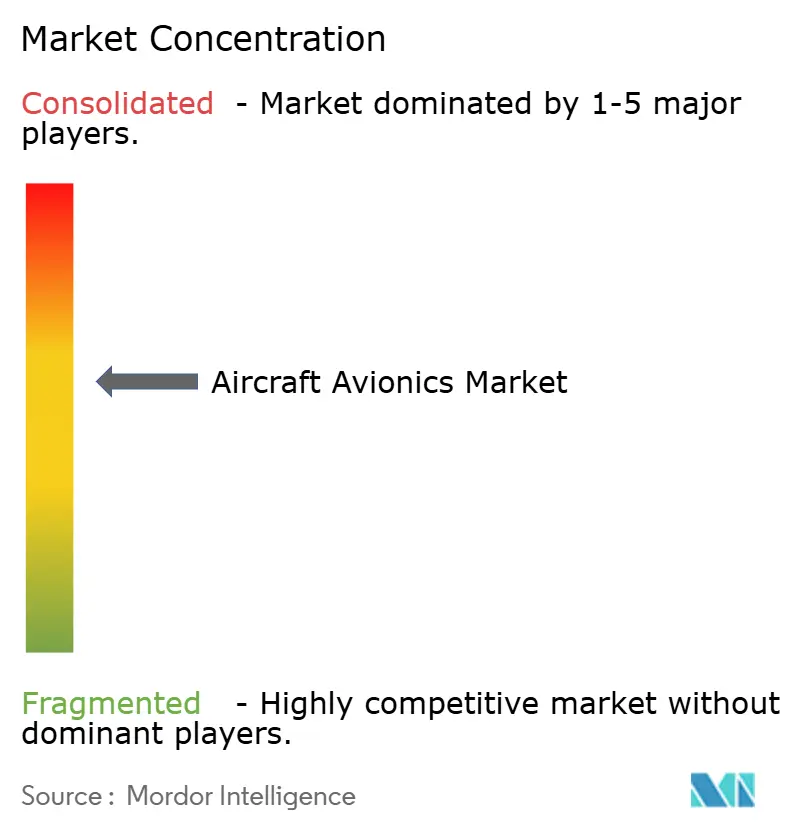
| Market Concentration | Medium |
Major Players *Disclaimer: Major Players sorted in no particular order Image © Mordor Intelligence. Reuse requires attribution under CC BY 4.0. | |
Aircraft Avionics Market Analysis by Mordor Intelligence
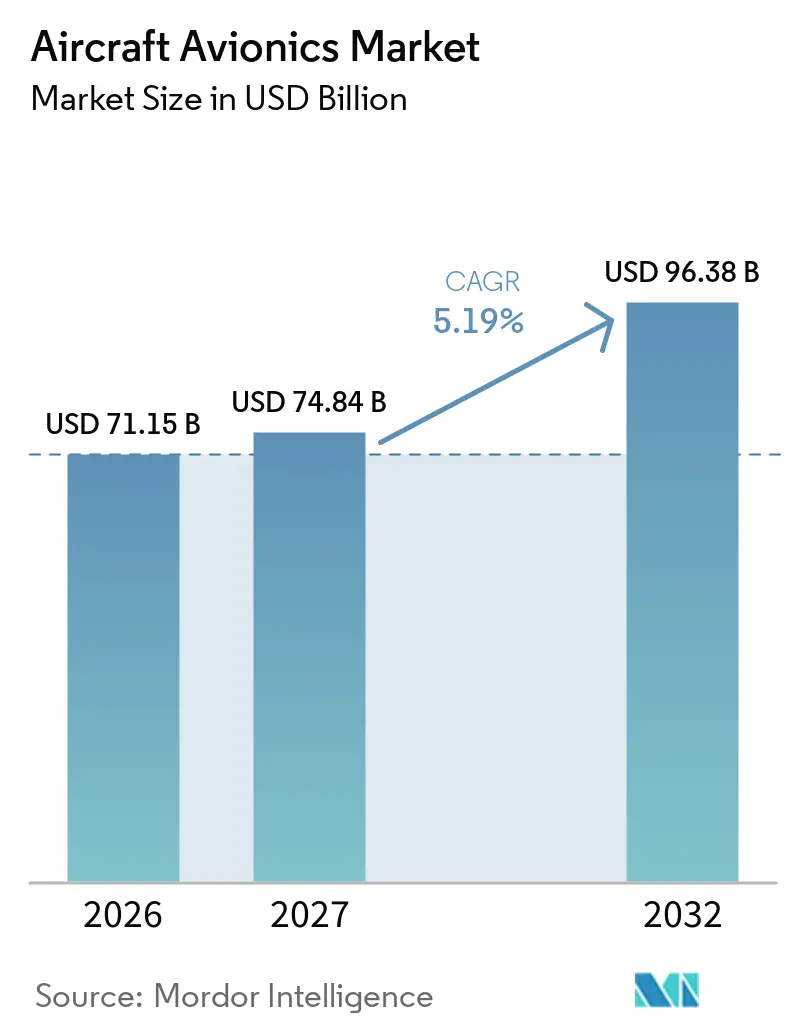
The aircraft avionics market size was valued at USD 71.15 billion in 2026 and is forecast to grow from USD 74.84 billion in 2027 to reach USD 96.38 billion by 2032, at a 5.19% CAGR during the forecast period (2027-2032). The aircraft avionics market is supported by fleet renewal, mandatory navigation and surveillance upgrades, and defense modernization programs. Airbus delivered 793 commercial aircraft in 2025 and ended the year with an 8,754-aircraft backlog, which supports a long delivery pipeline for linefit equipment. Supply constraints are extending aircraft service lives and directing more spending toward maintenance, repair, and upgrade work. Suppliers are also shifting toward integrated systems and recurring service contracts, rather than relying only on equipment sales. Certification requirements and component availability remain important limits on the pace at which the aircraft avionics market can convert demand into deliveries.
Key Report Takeaways
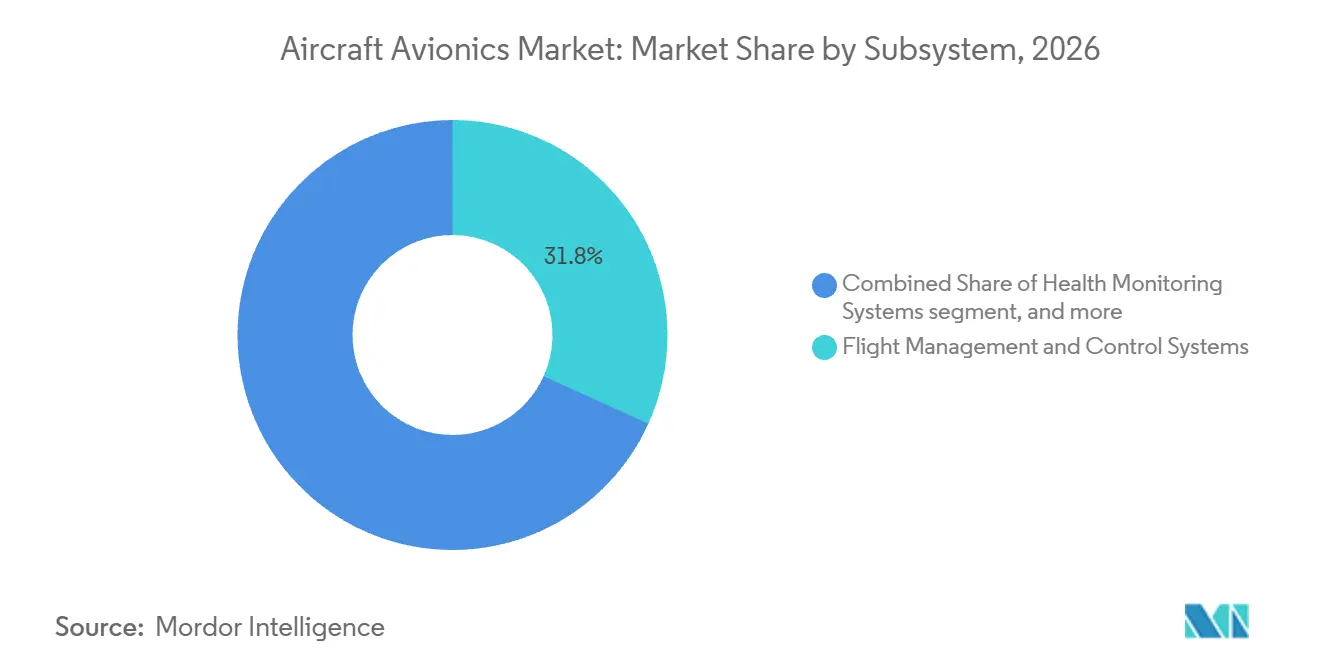
- By subsystem, flight management and control systems held 31.76% of the aircraft avionics market share in 2026, while visualization and display systems are projected to grow at a 7.23% CAGR through 2032.
- By platform, commercial aviation accounted for 60.01% of revenue in 2026, while unmanned aerial systems (UAS) are forecast to grow at a 9.21% CAGR through 2032.
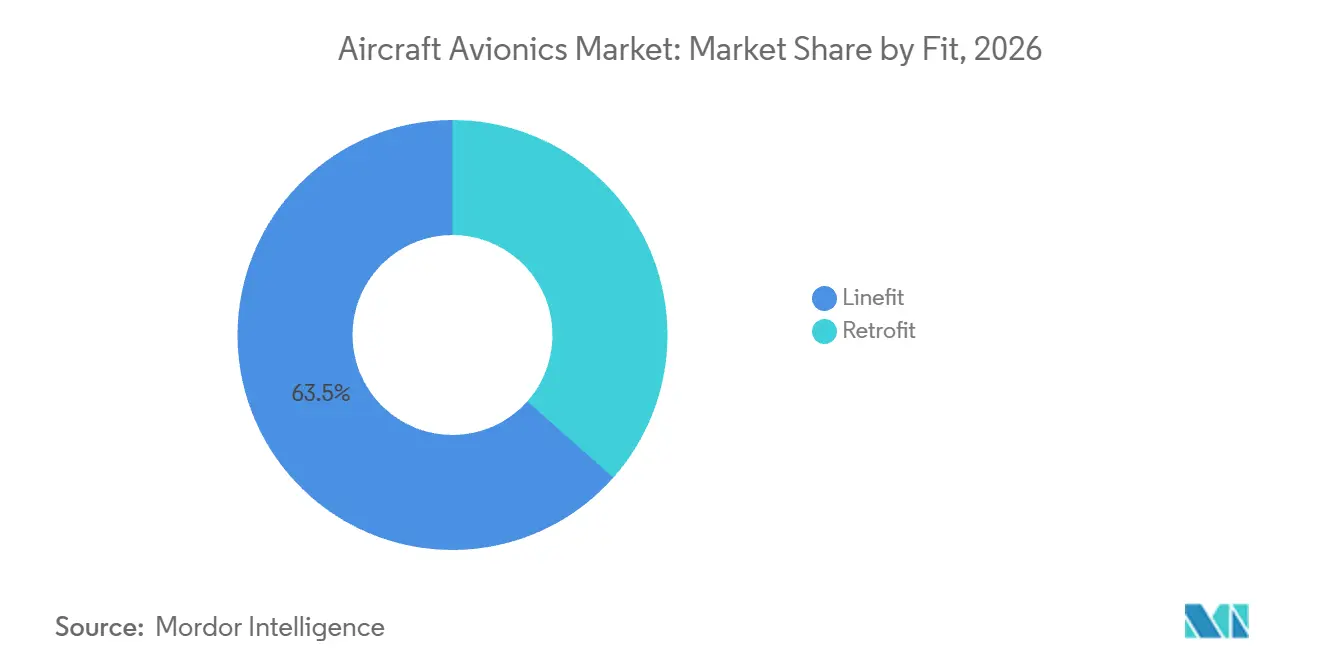
- By fit, linefit held 63.45% of revenue in 2026, while retrofit is forecast to advance at a 7.54% CAGR through 2032.
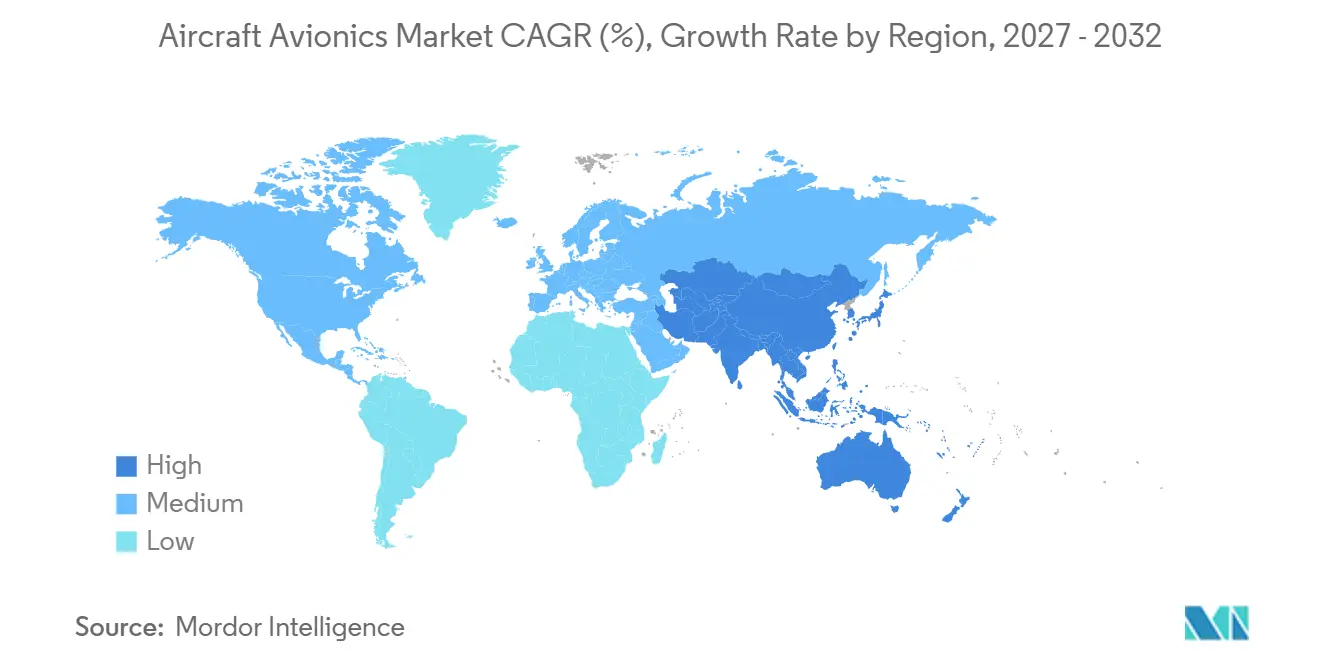
- By geography, North America held 31.98% of revenue in 2026, while Asia-Pacific is forecast to grow at a 7.12% CAGR through 2032.
Note: Market numbers in this report are based on Mordor Intelligence's proprietary estimation framework, which combines nine months of actuals with Q4 projections for base year 2026.
Market Trends and Insights
Drivers Impact Analysis of Aircraft Avionics Market*
| Driver | (~) % Impact on CAGR Forecast | Geographic Relevance | Impact Timeline |
|---|---|---|---|
| Commercial fleet expansion and single-aisle dominance | +1.10% | Global, concentrated in Asia-Pacific and Middle East | Long term (≥ 4 years) |
| Mandated CNS/ATM equipage and surveillance | +0.80% | Global, with FAA and EASA jurisdictions and spillover to Asia-Pacific | Medium term (2-4 years) |
| Predictive maintenance and aircraft health monitoring | +0.60% | North America, Europe, and core Asia-Pacific markets | Medium term (2-4 years) |
| Connected aircraft and cockpit digitalization | +0.70% | Global, with faster adoption in North America and Asia-Pacific | Long term (≥ 4 years) |
| Defense modernization and open-systems procurement | +0.80% | North America, Europe, and Asia-Pacific | Short term (≤ 2 years) |
| Delivery backlogs shifting demand to retrofit and MRO | +0.50% | Global, concentrated in North America and Europe | Short term (≤ 2 years) |
| Source: Mordor Intelligence | |||
Commercial Fleet Expansion and Single-Aisle Dominance
Airbus ended 2025 with an 8,754-aircraft commercial backlog and delivered 793 aircraft, reinforcing the order pipeline that supports the aircraft avionics market. The A320neo family represented 656 of Airbus’s 1,000 gross orders in 2025, placing single-aisle aircraft at the center of future linefit demand. Airlines increasingly specify more systems during production because later installation can interrupt operations and require separate approvals. Honeywell’s July 2026 selection by IndiGo to equip 810 A320neo family aircraft shows the scale of new aircraft demand in India. Higher lease rates also make comprehensive aircraft specifications at delivery more attractive than later retrofit work. These conditions sustain demand for equipment across long production cycles.
Mandated CNS/ATM Equipage and Surveillance
Mandatory communications, navigation, surveillance, and air traffic management upgrades provide a recurring demand base for the aircraft avionics market. EASA's CS-ETSO Amendment 18 added revised Mode S transponder standards, an ACAS Xa/Xo standard, and 5G-immune ADS-B Out specifications in September 2025.[1] Such requirements affect both new aircraft and existing fleets because operators must remain compliant throughout the aircraft's service life. FAA performance-based navigation requirements also trigger replacements for legacy operators. Each upgrade campaign generates demand for removed equipment, spare units, exchanges, and repair capacity. These recurring service needs make regulatory activity relevant to both equipment suppliers and MRO providers. The aircraft avionics market therefore benefits from requirements that are less discretionary than airline capital spending.
Defense Modernization and Open-Systems Procurement
Defense modernization is creating near-term opportunities in the aircraft avionics market through new architectures and fleet upgrade programs. The US DoD released its MOSA Implementation Guidebook in February 2025, formalizing modular open systems requirements for new programs and technology refreshes. Collins Aerospace received a USD 80 million contract in March 2025 to deploy its Mosarc open-architecture platform on US Army Black Hawk helicopters. Open standards can enable qualified module providers to compete for capability inserts without having to replace an entire aircraft system. This shifts part of procurement from proprietary platforms toward interoperable components. Allied modernization activity extends this requirement beyond the US. The resulting demand supports both large established suppliers and specialized subsystem providers.
Connected Aircraft, Health Monitoring, and Retrofit Demand
Connected systems, health monitoring, and retrofit work are broadening the aircraft avionics market beyond original equipment supply. Collins Aerospace joined the Airbus Digital Alliance for Aviation in April 2025, connecting aircraft system data with predictive maintenance capabilities. Airbus expects demand for digital and connectivity services to rise from USD 9 billion in 2025 to USD 26 billion by 2044. Delivery backlogs encourage operators to keep existing aircraft in service and upgrade their capabilities. Garmin’s G5000 PRIME introduced faster connectivity and an all-touchscreen flight deck for Part 25 transport aircraft in June 2025.[2] Longer aircraft use supports recurring work in monitoring, connectivity, displays, and compliance upgrades. These activities also create longer service relationships between suppliers and operators.
Restraints Impact Analysis of Aircraft Avionics Market*
| Restraint | (~) % Impact on CAGR Forecast | Geographic Relevance | Impact Timeline |
|---|---|---|---|
| Certification and airworthiness approval backlogs | -0.40% | Global, led by FAA and EASA queues with spillover to CASA and CAAC | Medium term (2-4 years) |
| Semiconductor and specialized-component constraints | -0.30% | Global, concentrated in North America, Europe, and Taiwan supply bases | Short term (≤ 2 years) |
| Legacy-aircraft power, cooling, and wiring limits | -0.20% | Global, with greater exposure in markets operating older fleets | Long term (≥ 4 years) |
| Cybersecurity assurance and software traceability burden | -0.20% | Global, with greater compliance density in North America and Europe | Medium term (2-4 years) |
| Source: Mordor Intelligence | |||
Certification, Cybersecurity, and Airworthiness Approval Backlogs
Certification backlogs limit the speed at which the aircraft avionics market can introduce new systems. EASA’s September 2025 CS-ETSO Amendment 18 included 15 modified or new technical standards, which illustrates the workload involved in maintaining approval frameworks. Flight-critical software must also meet established standards such as DO-178C, especially when a system includes novel digital functions. The FAA published special conditions for a Universal Avionics digital architecture connected to external networks in March 2025. These approval paths can extend development schedules and increase the cost of market entry. Cybersecurity guidance adds further documentation and traceability requirements for connected aircraft. Smaller developers can face greater delays than suppliers with established certification resources.
Semiconductor Constraints and Legacy Integration Limits
Specialized components and limitations in legacy aircraft can delay production and retrofit activities in the aircraft avionics market. Flight-certified assemblies use approved components, and replacing a part with an equivalent alternative can require recertification. IATA estimated that supply chain disruption would cost airlines more than USD 11 billion in 2025, while surplus inventory holding costs reached USD 1.40 billion. These conditions can delay airline spending decisions and equipment deliveries. Older aircraft may also lack the power, cooling, or wiring capacity needed for newer systems. The Aerospace Industries Association has highlighted cybersecurity and counterfeit-component risk in civil aviation supply chains. Suppliers must therefore manage qualification, sourcing, and installation constraints together.
*Our forecasts treat driver/restraint impacts as directional, not additive. The impact forecasts reflect baseline growth, mix effects, and variable interactions.
Aircraft Avionics Market Segment Analysis
By Subsystem:
Flight Management Anchors Revenue, Displays AccelerateFlight management and control systems accounted for 31.76% of the aircraft avionics market in 2026. The segment integrates trajectory optimization, performance calculation, and flight-envelope protection within certified system architectures. Communication and Navigation is another major subsystem group because regulatory upgrades require new equipment across active fleets. EASA’s 2025 standard update added an ACAS Xa/Xo standard and revised ADS-B Out specifications, which support replacement needs. Health monitoring systems are increasingly relevant as operators extend service lives and seek earlier maintenance warnings. Collins Aerospace had Ascentia deployed on nearly 1,300 active aircraft by April 2025. Cockpit systems, electronic flight bag integration, and audio management complete the broader subsystem mix.
Visualization and display systems are forecast to grow at a 7.23% CAGR through 2032, the highest rate among subsystems. The aircraft avionics industry is moving toward integrated display layouts that replace some legacy switch-panel functions. Garmin launched G5000 PRIME in June 2025 with edge-to-edge displays, four times the memory, and connectivity that is 100 times faster than its prior generation. Synthetic and enhanced vision are also expanding from business aviation toward regional and narrowbody applications. Thales Group was selected in February 2026 to supply head-up displays as part of an integrated avionics package for Cathay Group aircraft. The transition raises the importance of display performance, software integration, and data capacity. It also supports replacement work as aircraft operators modernize cockpit interfaces.

By Platform:
Commercial Scale Leads, UAS Reshapes the ForecastCommercial aviation accounted for 60.01% of the aircraft avionics market share in 2026. Narrowbody production drives the largest volume of avionics demand because these aircraft account for a large share of airline fleet growth. Airbus received 656 A320neo family orders in 2025, providing suppliers with visibility into future linefit demand. Widebody aircraft often carry more avionics content due to longer missions and additional display requirements. Cathay Group selected Thales equipment for 30 A330neo aircraft in February 2026, covering multiple cockpit and connectivity systems. Regional jets use increasingly modular architectures derived from mainline aircraft systems. General aviation adds steady demand where avionics spending per delivered aircraft can be high.
UAS is projected to grow at a 9.21% CAGR through 2032. Defense ISR support is driving demand for more capable UAS. Expanding BVLOS operations also requires certified capabilities in navigation, communications, and control. The aircraft avionics industry is adapting to open standards that can support integration across military and unmanned platforms. The DoD MOSA framework formalizes requirements for modular approaches in relevant programs. Collins Aerospace’s H-60M program illustrates the use of open-architecture avionics in military rotorcraft.[3] Early certification experience can help suppliers compete as UAS operating frameworks mature. The segment therefore creates opportunities for both established firms and qualified specialist providers.
By Fit:
Linefit Dominates, Retrofit Gains MomentumLinefit represented 63.45% of revenue in 2026, making it the leading fit category. OEMs and operators prefer installation at the time of manufacture because type certification, engineering work, and system integration are managed together. Honeywell’s 2026 IndiGo agreement covers avionics and auxiliary power units for 810 new A320neo family aircraft. These contracts can include future support, extending commercial relationships beyond delivery. Airbus delivered 793 commercial aircraft in 2025, representing a major annual linefit installation base. Aircraft manufacturers and avionics suppliers benefit when equipment is selected before production. This route can reduce operational disruption for airlines.
Retrofit is projected to grow at a 7.54% CAGR through 2032, faster than linefit. The aircraft avionics market size for retrofit activity is supported by delivery constraints, higher lease rates, and mandatory compliance upgrades. IATA reported that lease rates had risen 20% to 30% since 2019, encouraging operators to preserve and modernize existing assets. Regulatory upgrades can create fleetwide replacement campaigns for radio altimeters, navigation systems, and displays. Thales’s 5G-immune radio altimeter exchange approach shows how retrofit work can reduce grounding periods. This segment supports both service revenue and equipment sales.
Geography Analysis
North America accounted for 31.98% of the aircraft avionics market's revenue in 2026. The region combines a large commercial fleet, extensive MRO infrastructure, and substantial defense aviation procurement. The US DoD's MOSA guidance supports modular technology upgrades across applicable programs. FAA rulemaking also creates compliance-driven replacement cycles for civil operators. Long aircraft delivery timelines lead airlines to upgrade systems on in-service fleets. South America adds demand through Brazil's regional aviation base and continued E-Jet operations. These factors support equipment and aftermarket work across the Americas.
Europe is supported by active EASA rules that cover commercial and general aviation, as well as communications systems. EASA's 2025 CS-ETSO Amendment 18 is a recent example of regulatory changes requiring avionics suppliers and operators to update certified equipment. France and Germany remain important production centers through programs by Thales, Safran, and Airbus. The UK's PYRAMID Phase 2 offered up to GBP 3 million (USD 4 million) for open-architecture defense avionics modernization in 2025. The Middle East and Africa also support demand through widebody fleet operations and new aircraft orders. Gulf carrier orders and fleet life-extension programs create both linefit and upgrade requirements. The regional mix favors suppliers that can serve original equipment and long-term support contracts.
Asia-Pacific is forecast to grow at a 7.12% CAGR through 2032, the fastest rate among regions. The region's airlines are expanding their fleets and investing in connected, integrated cockpit systems. Airbus projects that the global commercial fleet will nearly double to more than 49,000 aircraft by 2044, with Asia-Pacific representing a major source of demand. Honeywell’s selection for 810 IndiGo A320neo family aircraft highlights the scale of linefit requirements in India. Thales Group also signed an 11-year maintenance agreement supporting more than 1,200 IndiGo aircraft in 2025. This combination supports linefit, maintenance, and retrofit activity.
Competitive Landscape
The aircraft avionics market is moderately consolidated among tier-1 suppliers with established OEM relationships and type-certificate positions. Honeywell Aerospace Inc., Collins Aerospace (RTX Corporation), Thales Group, L3Harris Technologies, Inc., and Garmin Ltd. compete through integrated suites, software capabilities, certification resources, and global support networks. The aircraft avionics market favors suppliers that can reduce integration work for airframers and airlines. Thales Group signed an 11-year avionics maintenance agreement with IndiGo for more than 1,200 aircraft in September 2025. The agreement was managed through a Gurugram MRO facility in India and included an Avionics-By-The-Hour model. Such arrangements turn equipment sales into longer service relationships. Competition, therefore, depends on support capacity as well as on original product performance.
Open-system requirements are changing the competitive structure in military aviation and UAS applications. The DoD’s 2025 MOSA guidance supports more modular procurement approaches. Collins Aerospace responded with its Mosarc open-architecture deployment for US Army Black Hawk helicopters. These standards can enable qualified tier-2 suppliers to provide capability inserts independently. UAS avionics also offers room for new entrants as operating and certification frameworks evolve. Data security is becoming a differentiator for connected aircraft systems. EUROCAE issued aviation data security guidance in July 2025, emphasizing the importance of compliant system design. Suppliers with certification experience and data-security capability may be better placed to pursue these opportunities.
Garmin demonstrates the importance of sustained product refresh cycles in the civilian aircraft avionics market. It introduced the G5000 PRIME in June 2025, G3000 PRIME in March 2025, and G2000 PRIME in July 2026. The company also expanded its TXi touchscreen display range in July 2025. Honeywell’s IndiGo agreement and Thales’s Cathay Group program show that large airline selections increasingly cover several avionics functions in one package. Pricing remains relevant, but certification depth and integrated support shape major platform decisions.
Aircraft Avionics Industry Leaders
-
Honeywell Aerospace Inc.
-
Collins Aerospace (RTX Corporation)
-
Thales Group
-
L3Harris Technologies, Inc.
-
Garmin Ltd.
- *Disclaimer: Major Players sorted in no particular order
Aircraft Avionics Market Companies Covered in this Report
- Honeywell Aerospace Inc.
- Collins Aerospace (RTX Corporation)
- Thales Group
- Garmin Ltd.
- L3Harris Technologies, Inc.
- GE Aerospace (General Electric Company)
- BAE Systems plc
- Safran SA
- Northrop Grumman Corporation
- Lockheed Martin Corporation
- Leonardo S.p.A.
- Elbit Systems Ltd.
- Curtiss-Wright Corporation
- Moog Inc.
- Teledyne Technologies Incorporated
- CMC Electronics Inc.
- Diehl Stiftung & Co. KG
- Universal Avionics Systems Corporation
- Avidyne Corporation
- Becker Avionics GmbH
Recent Industry Developments in Aircraft Avionics Market
- August 2026: The US Army awarded Collins Aerospace (RTX Corporation) a contract worth up to USD 472 million to provide engineering services supporting the modernization and sustainment of the CH-47 Chinook fleet. The engineering services will deliver avionics upgrades to integrate new capabilities, address obsolescence, and strengthen the aircraft's avionics architecture to support continued mission readiness in an evolving operational environment.
- July 2026: Honeywell Aerospace announced that IndiGo, India's largest airline, had selected its avionics and power systems for an order of 810 new A320neo family aircraft.
- February 2026: Curtiss-Wright Corporation has been selected by The Boeing Company to provide mission computer technology for the US Air Force's C-17 Globemaster III Flight Deck Obsolescence and Technology Refresh program. This avionics upgrade is designed to extend the operational life and capability of one of the military's most critical airlift platforms. It will support cockpit upgrades for the global strategic airlift fleet.
Global Aircraft Avionics Market Report Scope
The aircraft avionics market comprises electronic systems and integrated technologies that support aircraft flight operations, navigation, communication, surveillance, monitoring, and control across commercial, military, and general aviation, as well as unmanned aerial systems (UAS). The scope includes avionics systems supplied for new aircraft production and retrofit programs, including those integrated into commercial aircraft, military fixed-wing aircraft and rotorcraft, business jets, light aircraft, commercial helicopters, and unmanned aerial platforms.
The aircraft avionics market is segmented by subsystem, platform, fit, and geography. By system, the market is segmented into health monitoring systems, flight management and control systems, communication and navigation, cockpit systems, visualization and display systems, and other subsystems. By platform, the market is segmented into commercial aviation, military aviation, general aviation, and unmanned aerial systems (UAS). Commercial aviation includes narrowbody aircraft, widebody aircraft, and regional jets. By fit, the market is segmented into linefit and retrofit. The report also covers market sizes and forecasts for the aircraft avionics market in major countries across the regions. For each segment, the market size is provided in terms of value (USD).
Segmentation Overview
| Health Monitoring Systems |
| Flight Management and Control Systems |
| Communication and Navigation |
| Cockpit Systems |
| Visualization and Display Systems |
| Other Subsystems |
| Commercial Aviation | Narrowbody | |
| Widebody | ||
| Regional Jets | ||
| Military Aviation | Fixed-Wing Aircraft | Combat Aircraft |
| Multi-role Aircraft | ||
| Training Aircraft | ||
| Transport Aircraft | ||
| Others | ||
| Rotorcraft | Multi-Mission Helicopter | |
| Transport Helicopter | ||
| Others | ||
| General Aviation | Business Jets | |
| Light Aircraft | ||
| Commercial Helicopters | ||
| Unmanned Aerial Systems (UAS) | ||
| Linefit |
| Retrofit |
| North America | United States | |
| Canada | ||
| Mexico | ||
| Europe | United Kingdom | |
| France | ||
| Germany | ||
| Italy | ||
| Russia | ||
| Rest of Europe | ||
| Asia-Pacific | China | |
| India | ||
| Japan | ||
| South Korea | ||
| Australia | ||
| Rest of Asia-Pacific | ||
| South America | Brazil | |
| Rest of South America | ||
| Middle East and Africa | Middle East | Saudi Arabia |
| United Arab Emirates | ||
| Rest of Middle East | ||
| Africa | South Africa | |
| Rest of Africa | ||
| By Subsystem | Health Monitoring Systems | ||
| Flight Management and Control Systems | |||
| Communication and Navigation | |||
| Cockpit Systems | |||
| Visualization and Display Systems | |||
| Other Subsystems | |||
| By Platform | Commercial Aviation | Narrowbody | |
| Widebody | |||
| Regional Jets | |||
| Military Aviation | Fixed-Wing Aircraft | Combat Aircraft | |
| Multi-role Aircraft | |||
| Training Aircraft | |||
| Transport Aircraft | |||
| Others | |||
| Rotorcraft | Multi-Mission Helicopter | ||
| Transport Helicopter | |||
| Others | |||
| General Aviation | Business Jets | ||
| Light Aircraft | |||
| Commercial Helicopters | |||
| Unmanned Aerial Systems (UAS) | |||
| By Fit | Linefit | ||
| Retrofit | |||
| By Geography | North America | United States | |
| Canada | |||
| Mexico | |||
| Europe | United Kingdom | ||
| France | |||
| Germany | |||
| Italy | |||
| Russia | |||
| Rest of Europe | |||
| Asia-Pacific | China | ||
| India | |||
| Japan | |||
| South Korea | |||
| Australia | |||
| Rest of Asia-Pacific | |||
| South America | Brazil | ||
| Rest of South America | |||
| Middle East and Africa | Middle East | Saudi Arabia | |
| United Arab Emirates | |||
| Rest of Middle East | |||
| Africa | South Africa | ||
| Rest of Africa | |||
Key Questions Answered in the Report
What is the projected value of the aircraft avionics market by 2032?
The aircraft avionics market is projected to reach USD 96.38 billion by 2032, from USD 74.84 billion in 2027, at a 5.19% CAGR.
Which aircraft platform is expanding fastest?
The UAS is the fastest growing platform, with a projected 9.21% CAGR through 2032, supported by defense missions and developing BVLOS operations.
Which avionics subsystem is growing fastest?
Within the aircraft avionics market, visualization and display systems is forecast to grow at a 7.23% CAGR through 2032 as digital cockpit layouts gain adoption.
Why are retrofit programs growing faster than linefit installations?
In the aircraft avionics market, retrofit is projected to grow at a 7.54% CAGR because delivery constraints, high lease rates, and regulatory upgrades encourage airlines to modernize active fleets.
Which region has the strongest growth outlook?
Asia-Pacific is forecast to grow at a 7.12% CAGR through 2032, supported by airline fleet expansion and large avionics contracts in India and elsewhere.
What limits the adoption of new avionics systems?
Certification approvals, specialized-component constraints, cybersecurity requirements, and legacy aircraft integration limitations can extend product and installation timelines. These constraints can affect supplier schedules, airline retrofit planning, and the availability of certified equipment across worldwide fleet programs.