
Airborne Fire Control Radar Market Size and Share
Market Overview
| Study Period | 2020 - 2032 |
|---|---|
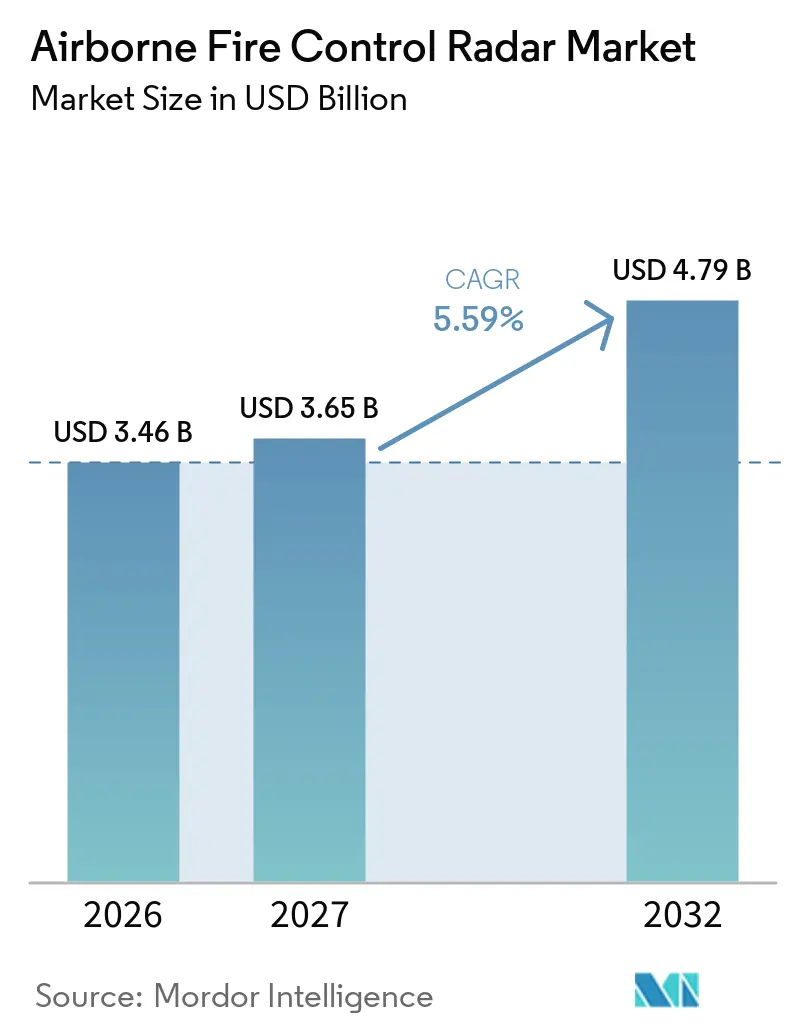
| Market Size (2027) | USD 3.65 Billion |
| Market Size (2032) | USD 4.79 Billion |
| Growth Rate (2027 - 2032) | 5.59 % |
| Fastest Growing Market | Asia-Pacific |
| Largest Market | North America |
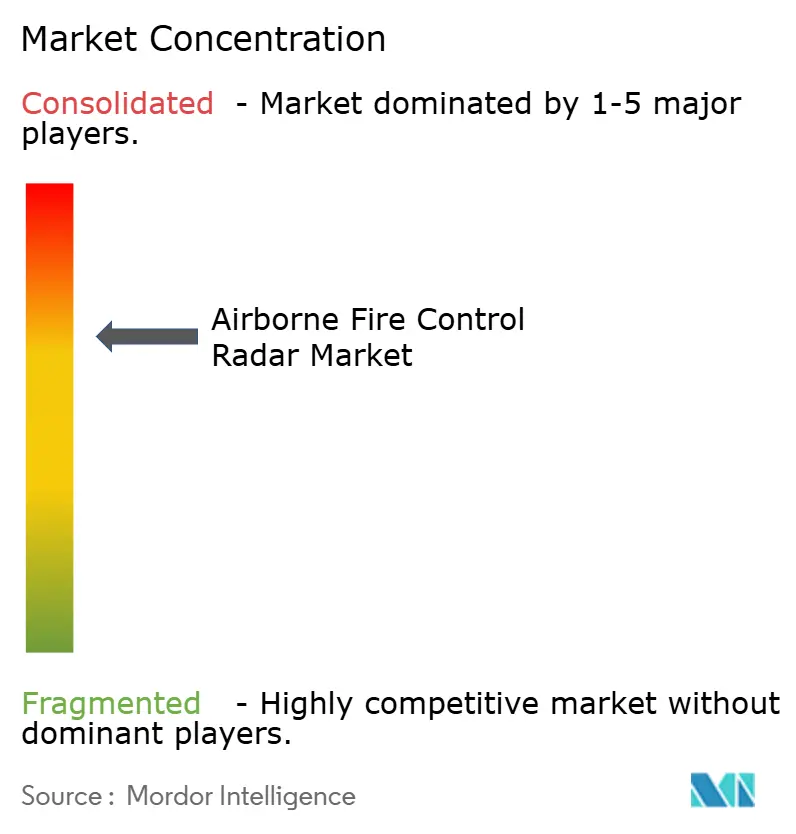
| Market Concentration | Medium |
Major Players *Disclaimer: Major Players sorted in no particular order Image © Mordor Intelligence. Reuse requires attribution under CC BY 4.0. | |
Airborne Fire Control Radar Market Analysis by Mordor Intelligence
The airborne fire control radar market size was valued at USD 3.46 billion in 2026 and is forecast to grow from USD 3.65 billion in 2027 to reach USD 4.79 billion by 2032, at a 5.59% CAGR during the forecast period (2027-2032). Fighter modernization programs are sustaining demand because radar replacement is central to extending the operational relevance of established combat fleets. Procurement is also shifting toward systems that can track targets, map terrain, and support EW through one aperture. Demand from unmanned combat aircraft is widening the customer base beyond traditional fighter programs. Export limits and local technology policies are encouraging India, South Korea, and Turkey to build domestic radar capabilities. These conditions favor suppliers that can combine radar hardware, software support, and integration services over long program cycles.
Key Report Takeaways
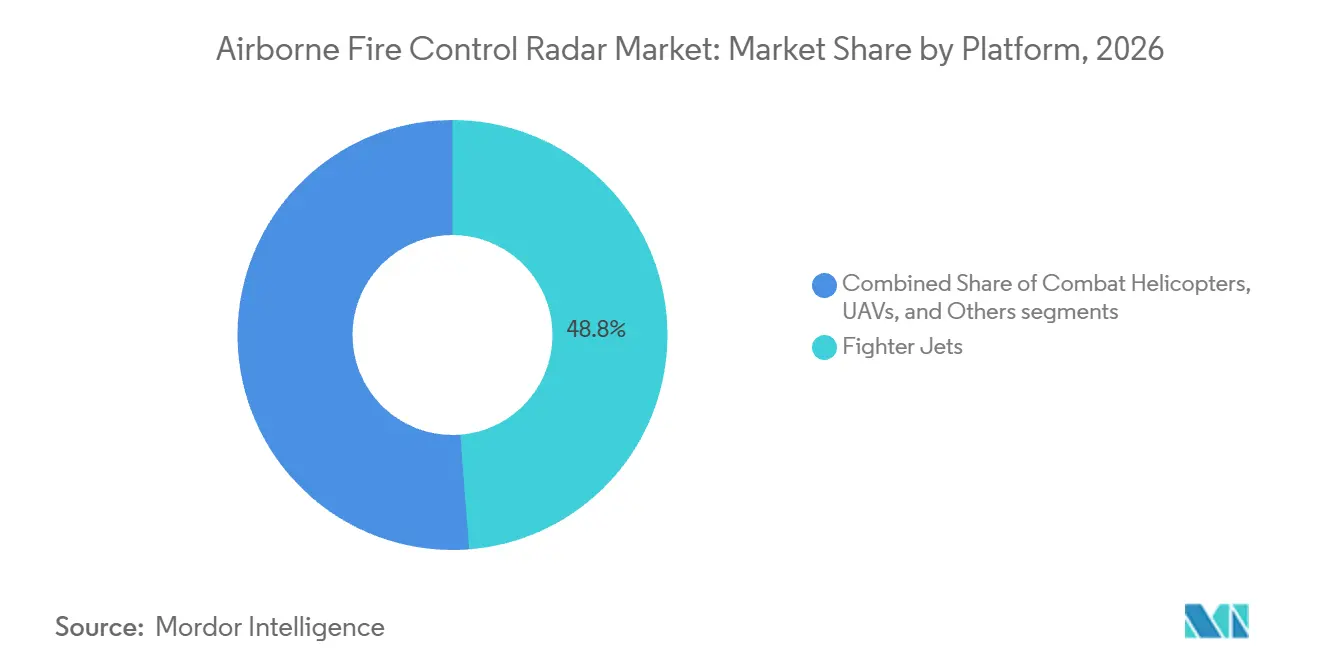
- By platform, fighter jets held 48.76% of the airborne fire control radar market share in 2026, while UAVs are forecast to grow at an 8.85% CAGR through 2032.
- By frequency band, X-band held 56.78% of the airborne fire control radar market share in 2026, while Ku/K/Ka-band is forecast to grow at a 7.21% CAGR through 2032.
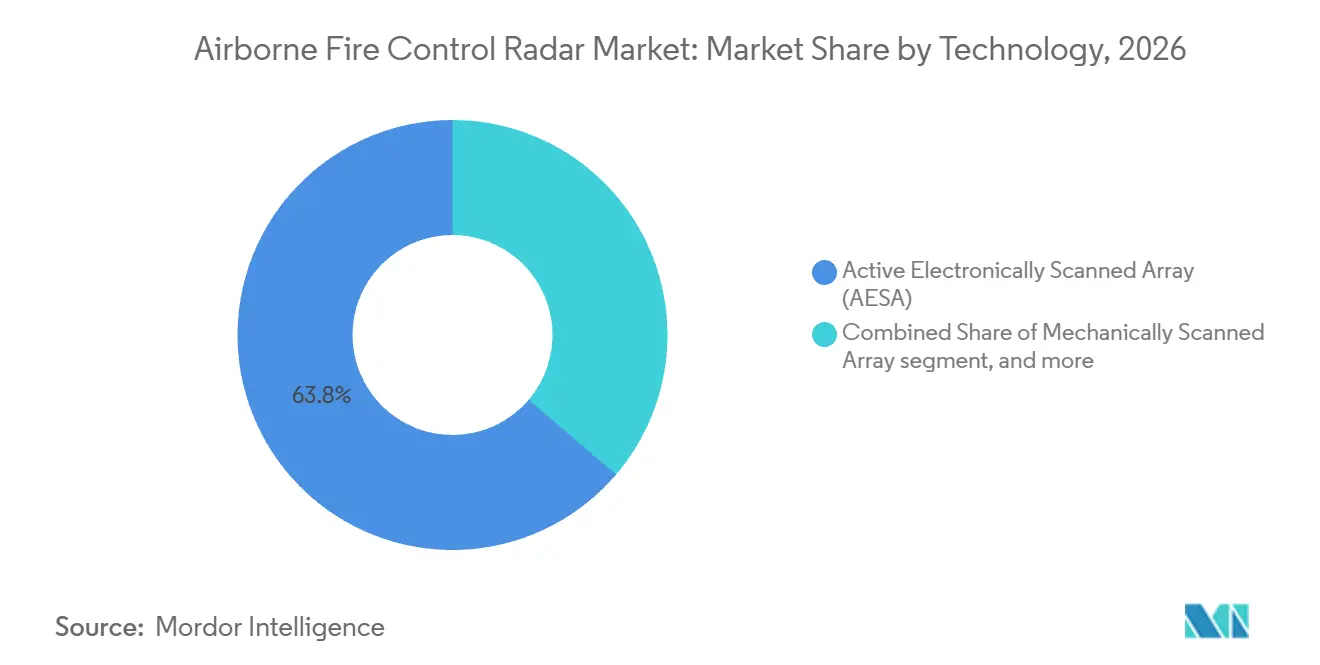
- By technology, the active electronically scanned array (AESA) accounted for 63.76% of revenue in 2026, while digital beamforming radar is forecast to grow at a 7.86% CAGR through 2032.
- By application, air-to-air held 46.94% revenue share in 2026, while air-to-ground is forecast to grow at a 6.91% CAGR through 2032.
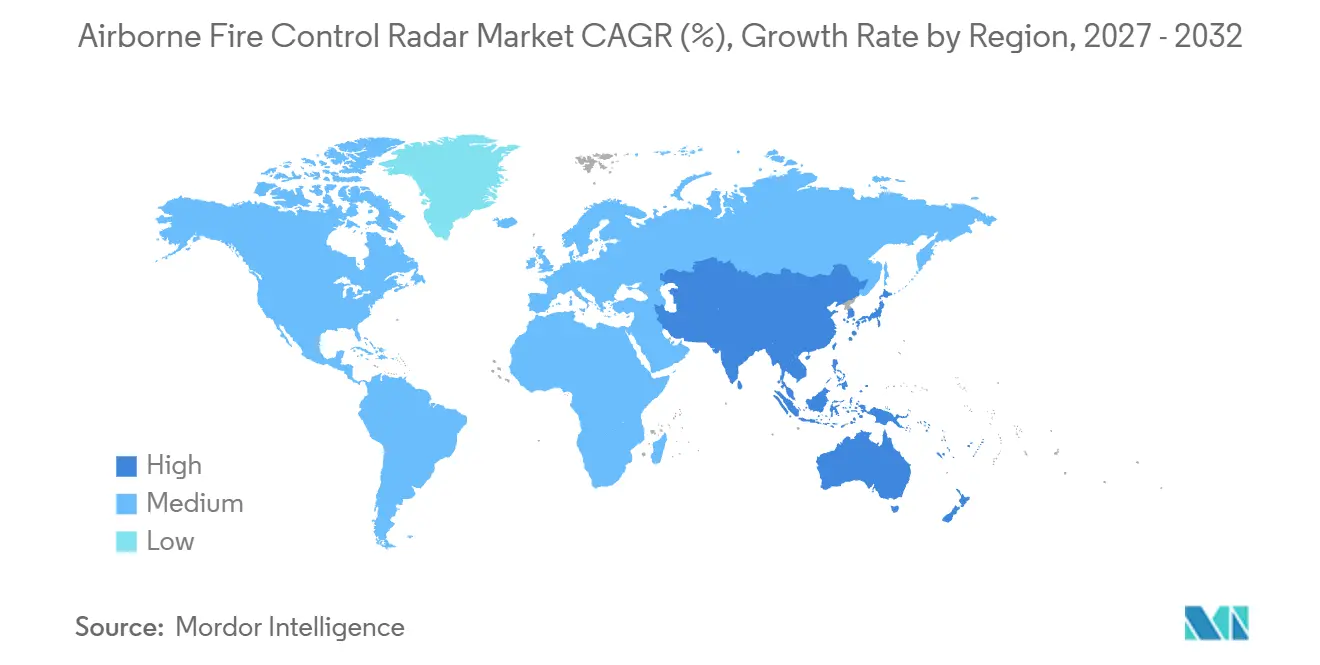
- By geography, North America held a 35.89% revenue share in 2026, while Asia-Pacific is forecast to grow at a 7.13% CAGR through 2032.
Note: Market numbers in this report are based on Mordor Intelligence's proprietary estimation framework, which combines nine months of actuals with Q4 projections for base year 2026.
Market Trends and Insights
Drivers Impact Analysis of Airborne Fire Control Radar Market*
| Driver | (~) % Impact on CAGR Forecast | Geographic Relevance | Impact Timeline |
|---|---|---|---|
| Fighter fleet modernization and radar retrofit programs | +1.50% | Global, concentrated in North America and Europe | Short term (≤ 2 years) |
| AESA adoption for multi-target tracking and precision engagement | +1.20% | Global | Medium term (2-4 years) |
| Increasing demand for network-centric and multi-domain operations | +0.90% | Global, led by Asia-Pacific, Middle East and Africa, and Europe | Medium term (2-4 years) |
| Growth of combat UAV and unmanned combat aircraft procurement | +0.70% | Global, led by the US and NATO allies | Medium term (2-4 years) |
| GaN-based radar upgrades for higher range and EW resilience | +0.60% | North America and Europe | Medium term (2-4 years) |
| Modular radar architectures for extending legacy aircraft service lives | +0.40% | Global | Long term (≥ 4 years) |
| Source: Mordor Intelligence | |||
Fighter Fleet Modernization and Radar Retrofit Programs
Fighter modernization drives demand in the airborne fire control radar market because fleets need sensing and EW capabilities without having to replace aircraft. Germany approved EUR 3.75 billion (USD 4.20 billion) for 20 Tranche 5 Eurofighters with E-Scan AESA radars in October 2025, alongside EUR 1.13 billion (USD 1.27 billion) for EW upgrades. The UK committed GBP 453 million (USD 608 million) for the ECRS Mk2 radar program for 40 Typhoon aircraft in January 2026. These awards show that upgrades are phased programs with long production schedules. Northrop Grumman Corporation delivered its 1,000th AN/APG-83 SABR radar in May 2026, confirming the F-16 modernization pipeline. Such programs keep demand active when combat aircraft orders slow.
AESA Adoption for Multi-Target Tracking and Precision Engagement
AESA adoption reinforces the airborne fire control radar market, as a single system can support tracking, mapping, and EW during missions. Individually controlled modules let the radar manage tasks without the mode changes required by earlier systems. RTX Corporation introduced the APG-82(V)X in September 2025 as a GaN-powered AESA radar with air-to-air, air-to-ground, and EW capabilities.[1] HENSOLDT AG received a contract extension in February 2025 to continue work on the Eurofighter ECRS Mk1 E-Scan radar for Germany and Spain.[2] The move to AESA increases the importance of software because mission changes can be managed through updates rather than physical replacement. The airborne fire control radar market needs durable software and integration capacity alongside aperture manufacturing.
Growth of Combat UAV and Unmanned Combat Aircraft Procurement
Combat UAV procurement is expanding the airborne fire-control radar market because unmanned platforms require compact systems that meet SWaP and cooling constraints. These requirements encourage designs built around GaN efficiency and smaller apertures rather than copies of fighter radar hardware. Raytheon Technologies Inc. (RTX Corporation) completed the first flight test of PhantomStrike in May 2025, presenting a fully air-cooled radar for UAVs, light-attack aircraft, and helicopters. The company stated that the system combines long-range detection with lower cost and weight than conventional AESA radar. India approved 87 armed MALE drones in October 2026, signaling demand for airborne sensing and targeting capabilities. The shift opens opportunities for suppliers that adapt radar performance to smaller platforms without sacrificing mission capability.
GaN-Based Radar Upgrades for Higher Range and EW Resilience
GaN upgrades support the airborne fire control radar market by improving power density and radar performance within aircraft space and power limits. RTX Corporation states that GaN devices provide three to five times the power density of earlier GaAs devices. This capability matters for aircraft and unmanned platforms that cannot support larger apertures or more cooling equipment. The US Navy awarded Northrop Grumman Corporation a USD 24.20 million delivery order in September 2025 for multi-function active radar systems supporting a persistent maritime unmanned aircraft program. South Korea also reported domestic progress in the production of GaN radar components in 2025. Broader production capacity could diversify supply, although competing defense programs may continue to pressure component availability.
Restraints Impact Analysis of Airborne Fire Control Radar Market*
| Restraint | (~) % Impact on CAGR Forecast | Geographic Relevance | Impact Timeline |
|---|---|---|---|
| High integration, qualification, and lifecycle support costs | -0.50% | Global | Short term (≤ 2 years) |
| Export controls and sovereign technology restrictions | -0.40% | Global | Short term (≤ 2 years) |
| Limited GaN semiconductor capacity and specialized cooling constraints | -0.30% | North America and Europe supply chain | Medium term (2-4 years) |
| Radar performance degradation in dense EW environments | -0.20% | Global | Medium term (2-4 years) |
| Source: Mordor Intelligence | |||
High Integration, Qualification, and Lifecycle Support Costs
Integration costs restrain the airborne fire control radar market because a new radar requires aircraft certification, weapons testing, software acceptance, and long-term support. The process commonly lasts 4 to 8 years and can cost several times the price of the radar hardware itself. National airworthiness authorities and military certification rules make these activities necessary before an aircraft enters operational service. Budget-constrained programs in South America and parts of Southeast Asia can defer upgrades or divide work into phases. India’s Super-30 program is valued at INR 65,000 crore (USD 7.80 billion) for upgrades to 84 Su-30MKI aircraft, including the Virupaksha AESA radar. This scale of investment illustrates why many air forces must balance radar ambition against available technical capacity, funding, and schedule tolerance.
Export Controls and Sovereign Technology Restrictions
Export controls limit the airborne fire control radar market by restricting the transfer of advanced systems and extending approval timelines for some customers. The US Department of State finalized targeted ITAR revisions that took effect in September 2025 and addressed aircraft equipped with AESA fire control radars. Related controls also cover airborne radar functions that maintain the positional state of objects in received signals. Countries using FMS or formal government arrangements can have more reliable access to controlled technology. Other buyers may face longer lead times or need alternate suppliers. The restrictions are encouraging India, Turkey, and South Korea to invest in local AESA development. Over time, this can reduce export opportunities for established Western suppliers in emerging defense markets.
*Our forecasts treat driver/restraint impacts as directional, not additive. The impact forecasts reflect baseline growth, mix effects, and variable interactions.
Airborne Fire Control Radar Market Segment Analysis
By Platform:
Fighter Jets Anchor Revenue, UAVs Drive the Next Growth CurveFighter jets accounted for 48.76% of the airborne fire control radar market in 2026, reflecting the high value of avionics installed on combat aircraft. Programs for the F-35, Eurofighter Typhoon, Rafale, and KF-21 Boramae create radar demand across multiple countries. Their radar systems support air combat, targeting, navigation support, and EW requirements. Fighter fleets also need upgrades as older aircraft remain in service beyond their original operating plans. Northrop Grumman Corporation’s AN/APG-83 program demonstrates how mature fighter radar designs can sustain demand through retrofit activity. Combat helicopters provide steadier demand from close air support and maritime patrol missions. Their systems usually have narrower bandwidth and lower power requirements than fighter radars. Other platforms include maritime patrol aircraft, bombers, and EW aircraft, which support incremental demand through specialized missions.
UAVs are forecast to grow at an 8.85% CAGR through 2032, making them the fastest-growing platform group within the airborne fire control radar market. Their radar needs differ from those of fighters because payload limits constrain weight, power consumption, and cooling. PhantomStrike illustrates systems designed for UAVs and light-attack aircraft. India’s approval of armed drones sends a regional signal for future integrated sensing requirements. Suppliers are adapting proven algorithms and functions from larger combat aircraft to smaller airframes. Open system standards can make that transfer easier by supporting common interfaces. The airborne fire control radar market is likely to face stronger competition in UAV systems. Incumbents cannot rely only on fighter programs to maintain their position.

By Frequency Band:
X-Band Holds Structural Lead, Ku/K/Ka-Band Opens New Mission SpaceX-band accounted for 56.78% of the airborne fire control radar market size by frequency in 2026. It remains important because it balances angular resolution, target discrimination, and propagation performance for fighter missions. Designers have also built established component and signal-processing supply chains around this band. Hanwha Systems Co., Ltd. has supplied the AESA radar for the KF-21, which uses X-band technology and has approximately 1,000 transmit and receive modules per array. This design reflects the performance standard sought by modern fighter programs. S-band remains relevant for maritime patrol and airborne early warning missions. Those missions can prioritize longer propagation and resistance to precipitation over the fine resolution needed in fighter engagements. The frequency mix therefore remains linked to platform roles and mission objectives.
Ku/K/Ka-band systems are forecast to grow at a 7.21% CAGR through 2032, driven by the need for high-resolution imaging and precision targeting. These bands can support synthetic aperture radar imaging and ground-moving target indication in complex terrain. Their utility is increasing as aircraft conduct more strike and reconnaissance missions in a single sortie. Such arrangements can reduce system weight and help manage the aircraft’s radar signature. Spectrum coordination remains important because Ka-band users share a limited operating environment. Military operators need reliable allocations in demanding EW conditions. The airborne fire control radar market will therefore retain X-band as its core, while higher bands gain specialized mission roles.
By Technology:
AESA Dominates, Digital Beamforming Accelerates the Software PivotAESA held 63.76% of the airborne fire control radar market in 2026, continuing the shift away from mechanically scanned and PESA systems. The technology supports simultaneous modes and provides crews with greater resistance to jamming than earlier radar approaches. GaN modules further improve range, electronic attack capability, and power efficiency without requiring a larger aperture. PESA and mechanically scanned radars still serve established fleets, especially in emerging markets. However, their role in new aircraft deliveries is declining. The airborne fire control radar market is now centered on systems that combine sensing, EW, and software support.
Digital beamforming radar is forecast to grow at a 7.86% CAGR through 2032, the highest rate among technology segments. It can create multiple independent beams from a single aperture and steer the beams via digital processing. This can speed mode changes and improve the use of available radar resources. SDR complements this approach because mission functions can be refreshed through software. The US DoD supports open system approaches that help separate software upgrades from proprietary hardware interfaces. These developments make software capability more central to radar competition. They also favor suppliers that can sustain secure updates and integrate processing functions with the wider aircraft mission system.
By Application:
Air-to-Air Leads, Air-to-Ground Reflects Multi-Role ImperativeAir-to-air applications accounted for 46.94% of the airborne fire control radar market in 2026. Fighter procurement still depends on the ability to detect, track, and guide weapons against several airborne threats. Interleaved tracking modes support multiple missile guidance channels while maintaining awareness of other targets. South Korea expanded the KF-21 radar program to include air-to-ground and air-to-sea modes in February 2026, following earlier air-to-air validation. Air-to-sea applications add demand from maritime patrol and naval aviation programs. These roles require detection and tracking against surface targets in varied weather conditions. The persistent maritime unmanned aircraft radar order also reflects this specialized application demand. Air-to-air work nevertheless remains the core reference point for fire control radar performance.
Air-to-ground applications are forecast to grow at a 6.91% CAGR through 2032, supported by the broad use of multi-role aircraft. Air forces increasingly need a single radar to manage airborne threats and precision-strike missions in the same operation. RTX Corporation’s APG-82(V)X combines air-to-ground targeting with air-to-air and EW functions. India’s Su-30MKI modernization plan also links radar upgrades to a broader expansion of air-to-ground capabilities. This overlap reduces the practical separation among air-to-air, air-to-ground, and EW functions. Multi-mode AESA systems are becoming a baseline requirement for new combat radar programs. Suppliers must prove that their systems can maintain reliable mission performance across all of these uses.
Geography Analysis
North America accounted for 35.89% of regional revenue in 2026, supported by US defense spending and a radar supply base. NATO estimated the US's equipment spending at 29.22% of core defense expenditure in 2025 and 28.31% in 2026.[3] Northrop Grumman Corporation delivered its 1,000th AN/APG-83 SABR system in May 2026. The region supports radar design, semiconductor work, manufacturing, and signal processing. Programs operate across the Air Force, Navy, Marine Corps, and the Special Operations Forces. Canada adds an equipment spending base. Its ratio is forecast at 24.99% in 2026. This environment gives North America a lead in the airborne fire control radar market.
Europe is supported by Eurofighter upgrade activity and increased defense priorities among NATO allies. Germany approved the Tranche 5 Eurofighter package and EW upgrades in October 2025. The UK also contracted the ECRS Mk2 production and integration program in January 2026. HENSOLDT AG's ECRS Mk1 work for Germany and Spain adds further regional demand. France's 2026 equipment spending ratio stands at 34.08%. Italy and Spain also participate in the Eurofighter radar framework. Eastern European countries are accelerating sensor decisions as air defense needs become more immediate. European programs consequently offer work across development, integration, production, and long-term support.
Asia-Pacific is forecast to grow at a 7.13% CAGR through 2032, the fastest regional rate in the airborne fire control radar market. South Korea is advancing KF-21 AESA deliveries and broader operating modes. India is pursuing the Virupaksha radar as part of the Su-30MKI upgrade program and has approved the procurement of armed drones. Japan is funding indigenous AESA development for its next-generation fighter. Australia is increasing defense equipment allocations. China's aviation radar programs support the regional outlook, although open-source visibility is limited. South America remains smaller, focused on maintenance, and constrained in upgrade activity. The Middle East and Africa combine Gulf platform purchases with Israeli radar development and exports. The region supports recurring radar upgrades and maintenance work.
Competitive Landscape
The airborne fire control radar market is moderately consolidated among large defense suppliers with established capabilities in radar, semiconductors, software, and aircraft integration. Northrop Grumman Corporation and RTX Corporation anchor the US supply base. Leonardo S.p.A. and Thales Group cover important European programs. Each combat aircraft family tends to create a long-running procurement stream for a specific supplier or consortium. This limits direct competition within an existing aircraft program. Competition is stronger when an air force selects radar systems for new aircraft or retrofit work. Northrop Grumman’s 1,000th APG-83 delivery in May 2026 illustrates the scale that major suppliers can use to sustain research and production. The competitive position of each company increasingly depends on software support and mission-system integration, not only on aperture performance.
RTX Corporation introduced the APG-82(V)X in September 2025, adding a GaN radar that combines fire control, ground targeting, and EW functions. HENSOLDT AG expanded its Eurofighter ECRS Mk1 work through the 2025 contract extension with Germany and Spain. Northrop Grumman Corporation’s APG-83 delivery milestone reflects a third approach, extending a mature radar across fleet modernization programs. These moves combine new product development with established production lines. RTX Corporation’s PhantomStrike addresses a gap in compact UAV radar capability. These positions make supplier relationships and integration experience important competitive assets.
Domestic developments are changing competitive conditions in the airborne fire control radar market. The airborne fire control radar market remains contested as national programs advance. Hanwha Systems Co., Ltd., supports the KF-21 program with a domestically produced AESA radar. India’s Virupaksha program is also intended to reduce dependence on imported radar technology. These programs may use partnerships in the near term while pursuing more local capability. Software-defined apertures and digital beamforming are raising the value of software and signal-processing expertise. The Georgia Tech Research Institute demonstrated a polarization-diverse X-band AESA testbed in July 2025. Research activity continues to shape advanced radar architectures. These shifts increase competitive pressure on established suppliers in selected national programs.
Airborne Fire Control Radar Industry Leaders
-
Northrop Grumman Corporation
-
RTX Corporation
-
Thales Group
-
Leonardo S.p.A.
-
Israel Aerospace Industries Ltd.
- *Disclaimer: Major Players sorted in no particular order
Airborne Fire Control Radar Market Companies Covered in this Report
- Northrop Grumman Corporation
- RTX Corporation
- Thales Group
- Leonardo S.p.A.
- Israel Aerospace Industries Ltd.
- HENSOLDT AG
- Saab AB
- Indra Sistemas S.A.
- Lockheed Martin Corporation
- SRC, Inc.
- ASELSAN A.Ş.
- Mitsubishi Electric Corporation
- Hanwha Systems Co., Ltd.
Recent Industry Developments in Airborne Fire Control Radar Market
- October 2026: LONGBOW LLC, a joint venture between Lockheed Martin Corporation and Northrop Grumman Corporation, received a USD 419.6 million contract from the US Army for fire-control radar systems and post-production support for AH-64D/E Apache attack helicopters.
- August 2026: RTX Corporation secured a sole-source indefinite-delivery/indefinite-quantity (IDIQ) contract valued at up to USD 603 million from the US Air Force for the B-52 Stratofortress fleet.
- February 2025: HENSOLDT AG received a contract extension for the Eurofighter Mk1 radar, valued at EUR 350 million (USD 392.23 million). The Eurofighter ECRS Mk1 is an AESA fire control radar designed for combat aircraft.
Global Airborne Fire Control Radar Market Report Scope
The airborne fire control radar market comprises radar systems designed to detect, track, identify, and support the engagement of airborne, ground-based, and maritime targets across military aviation platforms. The scope includes airborne fire control radar systems supplied for new aircraft production, fleet modernization, radar upgrades, and retrofit programs to enhance situational awareness, targeting accuracy, and combat effectiveness across air-to-air, air-to-ground, and air-to-sea engagements.
The airborne fire control radar market is segmented by platform, frequency band, technology, application, and geography. By platform, the market is segmented into fighter jets, combat helicopters, unmanned aerial vehicles (UAVs), and others. By frequency band, the market is segmented into X-band, S-band, and Ku/K/Ka-band. By technology, the market is segmented into active electronically scanned array (AESA), passive electronically scanned array (PESA), mechanically scanned array, digital beamforming radar, and software-defined radar (SDR). By application, the market is segmented into air-to-sea, air-to-air, and air-to-ground. The report also covers market sizes and forecasts for the airborne fire control radar market in major countries across the regions. For each segment, the market size is provided in terms of value (USD).
Segmentation Overview
| Fighter Jets |
| Combat Helicopters |
| Unmanned Aerial Vehicles (UAVs) |
| Others |
| X-band |
| S-band |
| Ku/K/Ka-band |
| Active Electronically Scanned Array (AESA) |
| Passive Electronically Scanned Array (PESA) |
| Mechanically Scanned Array |
| Digital Beamforming Radar |
| Software-Defined Radar (SDR) |
| Air-to-Sea |
| Air-to-Air |
| Air-to-Ground |
| North America | United States | |
| Canada | ||
| Mexico | ||
| Europe | United Kingdom | |
| France | ||
| Germany | ||
| Italy | ||
| Spain | ||
| Russia | ||
| Rest of Europe | ||
| Asia-Pacific | China | |
| India | ||
| Japan | ||
| South Korea | ||
| Australia | ||
| Rest of Asia-Pacific | ||
| South America | Brazil | |
| Argentina | ||
| Rest of South America | ||
| Middle East and Africa | Middle East | United Arab Emirates |
| Saudi Arabia | ||
| Israel | ||
| Rest of Middle East | ||
| Africa | South Africa | |
| Rest of Africa | ||
| By Platform | Fighter Jets | ||
| Combat Helicopters | |||
| Unmanned Aerial Vehicles (UAVs) | |||
| Others | |||
| By Frequency Band | X-band | ||
| S-band | |||
| Ku/K/Ka-band | |||
| By Technology | Active Electronically Scanned Array (AESA) | ||
| Passive Electronically Scanned Array (PESA) | |||
| Mechanically Scanned Array | |||
| Digital Beamforming Radar | |||
| Software-Defined Radar (SDR) | |||
| By Application | Air-to-Sea | ||
| Air-to-Air | |||
| Air-to-Ground | |||
| By Geography | North America | United States | |
| Canada | |||
| Mexico | |||
| Europe | United Kingdom | ||
| France | |||
| Germany | |||
| Italy | |||
| Spain | |||
| Russia | |||
| Rest of Europe | |||
| Asia-Pacific | China | ||
| India | |||
| Japan | |||
| South Korea | |||
| Australia | |||
| Rest of Asia-Pacific | |||
| South America | Brazil | ||
| Argentina | |||
| Rest of South America | |||
| Middle East and Africa | Middle East | United Arab Emirates | |
| Saudi Arabia | |||
| Israel | |||
| Rest of Middle East | |||
| Africa | South Africa | ||
| Rest of Africa | |||
Key Questions Answered in the Report
What is the 2026 value of airborne fire control radar demand?
The airborne fire control radar market is valued at USD 3.46 billion in 2026 and is forecast to reach USD 4.79 billion by 2032.
What is driving demand for airborne fire control radar systems?
Fighter fleet modernization, AESA adoption, unmanned combat aircraft procurement, and GaN upgrades are key demand factors.
Which platform leads airborne fire control radar demand?
Fighter jets lead with 48.76% revenue share in 2026, supported by new-build programs and fleet upgrade activity.
Which airborne fire control radar technology is growing fastest?
Digital beamforming radar is forecast to grow at a 7.86% CAGR through 2032.
Which region is growing fastest for airborne fire control radar?
Asia-Pacific is forecast to grow at a 7.13% CAGR through 2032, supported by programs in South Korea, India, and Japan.
Why are AESA radars important for combat aircraft?
AESA systems can support tracking, mapping, targeting, and EW functions through one aperture.