
Airbag Control Unit Market Size and Share
Market Overview
| Study Period | 2020 - 2032 |
|---|---|
| Market Size (2027) | USD 5.71 Billion |
| Market Size (2032) | USD 7.35 Billion |
| Growth Rate (2027 - 2032) | 5.18 % |
| Fastest Growing Market | Asia-Pacific |
| Largest Market | Asia-Pacific |
| Market Concentration | High |
Major Players *Disclaimer: Major Players sorted in no particular order Image © Mordor Intelligence. Reuse requires attribution under CC BY 4.0. | |
Airbag Control Unit Market Analysis by Mordor Intelligence
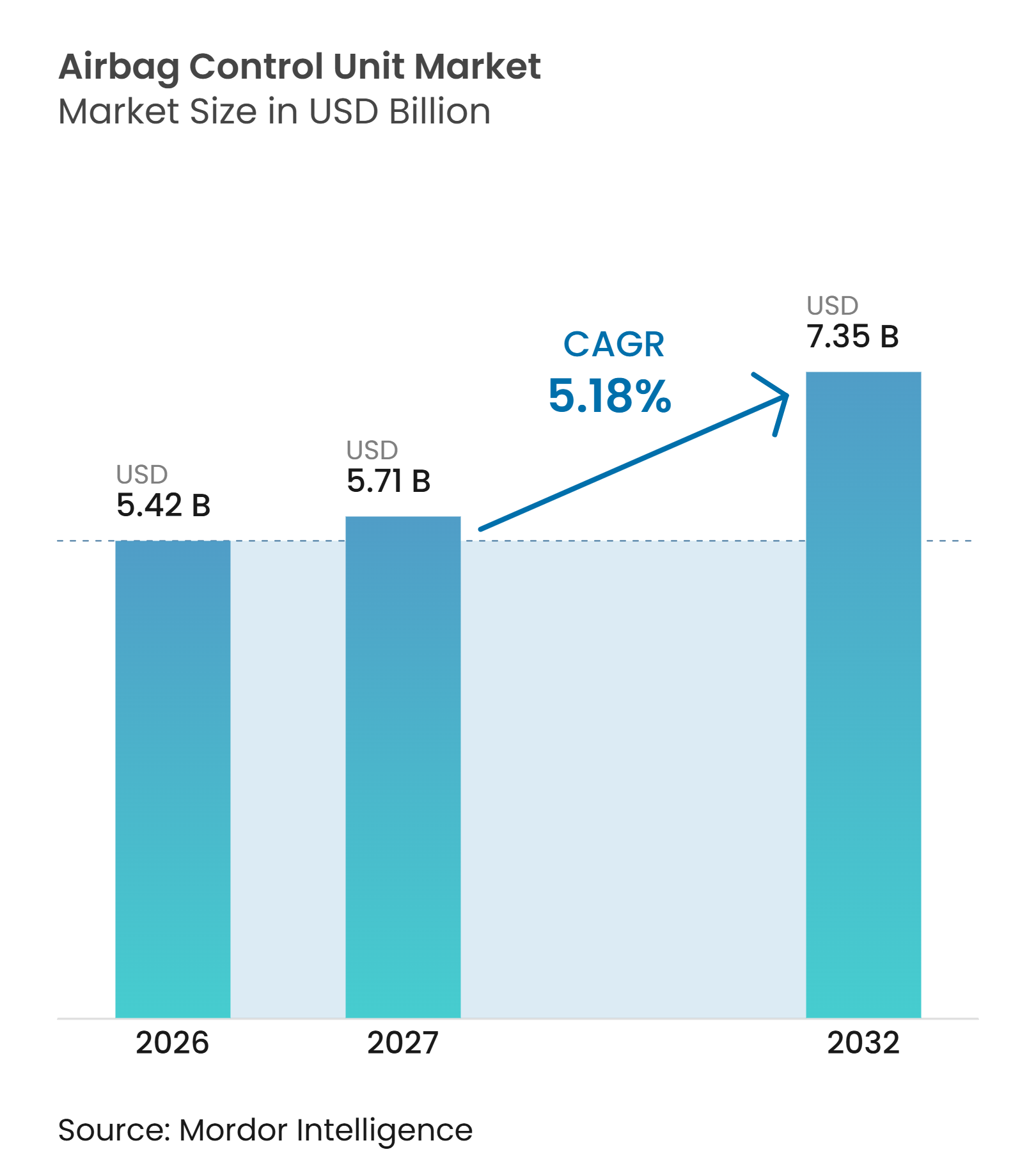
The airbag control unit market size was valued at USD 5.42 billion in 2026 and is expected to grow from USD 5.71 billion in 2027 to USD 7.35 billion by 2032, at a CAGR of 5.18% during 2027-2032. The airbag control unit market is gaining value as crash-rating programs require more precise restraint control across a wider range of crash conditions and occupant types. Electric vehicle programs also add high-voltage battery isolation and post-crash communication functions to the controller’s role. These requirements raise the value of electronics and embedded software in each vehicle, even where vehicle output is under pressure. The airbag control unit market also faces longer validation cycles and higher development costs, which favor suppliers with mature functional-safety capabilities. Established suppliers are responding through local engineering, integrated safety architectures, and closer work with vehicle manufacturers.
Key Report Takeaways
- By component, microcontrollers held a 33.17% share in 2026, while software is forecast to expand at an 8.45% CAGR through 2032.
- By vehicle type, passenger cars held an 83.25% share in 2026, while medium and heavy commercial vehicles are forecast to expand at a 7.13% CAGR through 2032.
- By propulsion, ICE vehicles held a 72.50% share in 2026, while electric vehicles are forecast to expand at a 9.80% CAGR through 2032.
- By sales channel, OEM held an 87.12% share in 2026, while aftermarket is forecast to expand at a 5.96% CAGR through 2032.
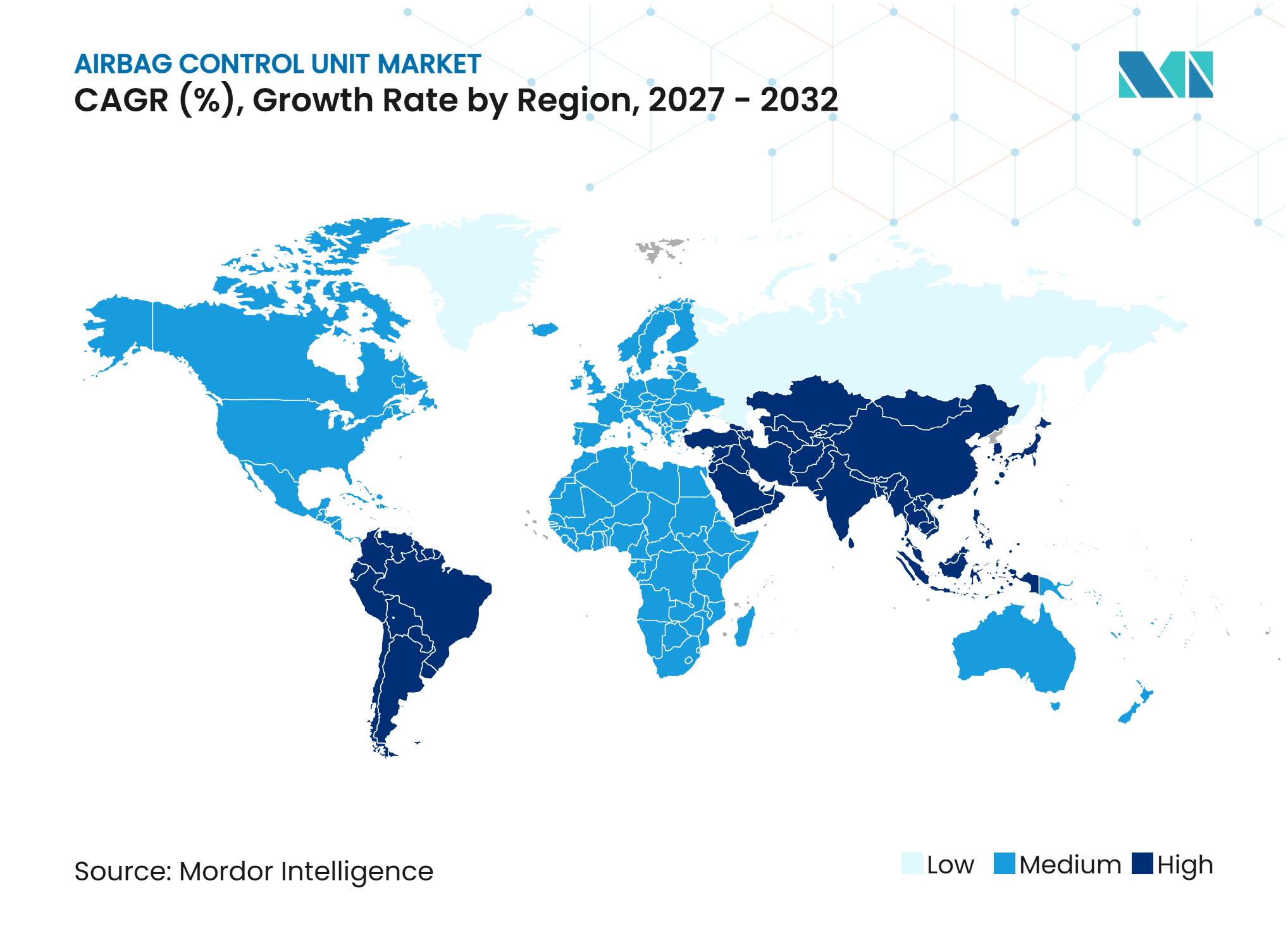
- By geography, Asia-Pacific held a 48.05% share in 2026 and is forecast to expand at a 6.33% CAGR through 2032.
Note: Market numbers in this report are based on Mordor Intelligence's proprietary estimation framework, which combines nine months of actuals with Q4 projections for base year 2026.
Market Trends and Insights
Drivers Impact Analysis of Airbag Control Unit Market*
| Driver | (~) % Impact on CAGR Forecast | Geographic Relevance | Impact Timeline |
|---|---|---|---|
| Electric Vehicle Crash-Isolation and High-Voltage Safety Requirements | +1.2% | Asia-Pacific, with spillover to Europe and North America | Medium term (2–4 years) |
| Rising Airbag Count and Lateral-Protection Content | +1.0% | Global, with the highest relevance in China, South Korea, and Europe | Short term (≤ 2 years) |
| Stricter NCAP Occupant-Protection Scoring | +0.8% | Global, with early gains in Europe, India, and South America | Medium term (2–4 years) |
| Sensor-Rich Integrated Restraint Control Demand | +0.7% | North America, Europe, and South Korea | Long term (≥ 4 years) |
| Safety Feature Penetration in Emerging Vehicle Markets | +0.6% | India, Brazil, Southeast Asia, and Middle East and Africa | Medium term (2–4 years) |
| Scalable ACU Architectures for Multi-Platform Vehicle Programs | +0.5% | Global | Long term (≥ 4 years) |
| Source: Mordor Intelligence | |||
Electric Vehicle Crash-Isolation and High-Voltage Safety Requirements
Electric vehicles give the airbag control unit a second safety role beyond occupant restraint deployment. Pyrotechnic battery disconnect devices use the same squib-initiated approach as restraint systems to separate high-voltage conductors within milliseconds of a crash. The restraint controller can act as the decision point for airbag deployment and high-voltage isolation. This architecture adds channels, power-management needs, and software logic that conventional vehicle programs do not require. Euro NCAP’s post-crash requirements and ANCAP’s testing of high-voltage system integrity in battery-electric vehicle variants reinforce the need for this capability. The airbag control unit market gains higher content value from electric platforms because safety performance cannot be reduced without affecting compliance.
Rising Airbag Count and Lateral-Protection Content
The airbag control unit market benefits when airbag content rises faster than vehicle production. Honda Accord and Honda Civic models in the 2025-2026 period use 10-airbag configurations, while Chery’s TIGGO8 combines 10 airbags with a driver far-side airbag [1]. Each added airbag zone can require more squib-driver channels, satellite sensors, and software branches in the controller. Lateral protection also requires the controller to interpret crash direction and trigger the proper restraint sequence quickly. This content increase supports airbag control unit market revenue even when total vehicle shipments are not rising at the same pace.
Stricter NCAP Occupant-Protection Scoring
Euro NCAP uses four independently scored stages in its 2026 assessment framework, covering safe driving, crash avoidance, crash protection, and post-crash safety[2]. The crash protection criteria assess restraint performance across a broader set of occupant body types, including children and older adults. This requires vehicle manufacturers to use controllers that can select airbag deployment patterns for different occupants and impact conditions. Euro NCAP also requires electric vehicles to manage high-voltage isolation and provide post-crash information, adding functions that affect controller software and sensor inputs. Latin NCAP’s 2026 protocol adds a biofidelic dummy and raises the side-impact test speed to 60 km/h with a 1,400 kg barrier. The airbag control unit market therefore benefits when safety ratings become a practical design requirement for vehicle programs.
Sensor-Rich Integrated Restraint Control Demand
The airbag control unit market is moving toward tighter integration of sensors, firing loops, power management, and software. PSI5 supports power and crash-data transmission on a two-wire connection, with data rates of 125-189 kbit/s and error checking [3]. Bosch’s CG902 integrates two PSI5 channels and eight firing loops, illustrating how airbag ASICs combine sensor interfaces and squib drivers on one device. These devices support compact designs that can be adapted across vehicle platforms with different restraint configurations. Occupant classification and rollover detection increase the value of sensor fusion and adaptive crash algorithms. ISO/SAE 21434 cybersecurity work is also relevant where safety settings are software-defined and updated over the air, creating another reason for suppliers to build reusable, validated controller architectures.
Restraints Impact Analysis of Airbag Control Unit Market*
| Restraint | (~) % Impact on CAGR Forecast | Geographic Relevance | Impact Timeline |
|---|---|---|---|
| Semiconductor Qualification and Functional-Safety Supply Bottlenecks | -1.1% | Global, concentrated in Asia-Pacific and European fabrication ecosystems | Medium term (2–4 years) |
| Rising ECU Complexity and Validation Costs | -0.8% | Global | Long term (≥ 4 years) |
| Post-Crash Repair, Calibration, and Counterfeit Replacement Risk | -0.4% | North America, Australia, and emerging markets | Short term (≤ 2 years) |
| Low-Volume Commercial-Vehicle Fitment and Fragmented Homologation Costs | -0.3% | Asia-Pacific, Middle East and Africa, and South America | Medium term (2–4 years) |
| Source: Mordor Intelligence | |||
Semiconductor Qualification and Functional-Safety Supply Bottlenecks
The airbag control unit market depends on safety-grade microcontrollers, power-management ICs, and memory devices with rigorous qualification records. Infineon’s SEMPER NOR Flash family received ISO 26262:2018 ASIL-D functional-safety certification in May 2025 after an independent review by SGS-TÜV. Such qualification requires substantial product safety documentation and external assessment. Infineon also partnered with UL Solutions in 2025 to help customers work toward ISO 26262 compliance across selected microcontrollers, power-management ICs, and sensors. Limited audit capacity and detailed documentation can slow design-in schedules when demand for ASIL-D devices rises. These conditions give suppliers with established safety cases an advantage over new entrants.
Rising ECU Complexity and Validation Costs
The airbag control unit market faces rising development costs as controllers must distinguish a wider set of crash events and occupant conditions. Euro NCAP’s wider evaluation of adult and child body types requires more simulation work and validation of the controller’s safety case. STMicroelectronics and HighTec are working on Rust support for software-defined vehicles to reduce certain memory-safety defects that otherwise need testing. Low-volume commercial platforms and fragmented regional requirements can also limit the ability to spread validation costs across many units. These pressures are most difficult for suppliers without large platform programs or established compliance processes.
*Our forecasts treat driver/restraint impacts as directional, not additive. The impact forecasts reflect baseline growth, mix effects, and variable interactions.
Airbag Control Unit Market Segment Analysis
By Component:
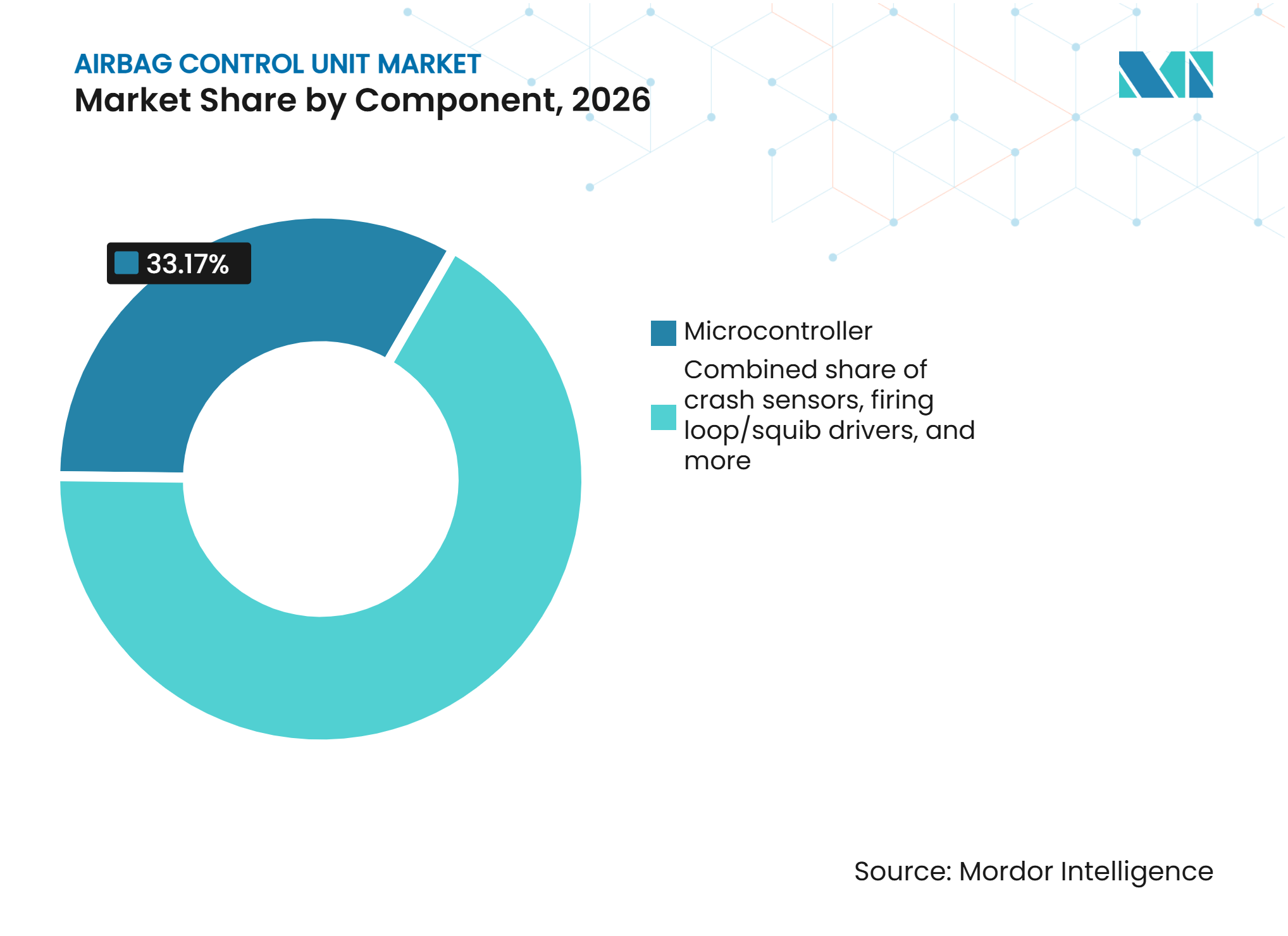
Software-Defined Functions Reshape ACU Revenue MixMicrocontrollers held a 33.17% share in 2026 because each controller requires a central processing element regardless of vehicle type or propulsion. The processor manages crash algorithms, sensor inputs, diagnostic functions, and firing decisions. Infineon positions its AURIX TC4x family for airbag control applications with enhanced fault tolerance and safety mechanisms. Crash sensors form another important hardware category because multi-axis inertial clusters can identify rollover and oblique-impact events more effectively than earlier sensor designs. Firing-loop and squib-driver ICs are also becoming more integrated. Power supply ICs have added importance in electric vehicle systems because the controller must sustain its low-voltage functions while managing a high-voltage disconnect event. This combination makes the component mix more dependent on software and system integration.
Others (Software) is forecast to expand at an 8.45% CAGR through 2032, making it the fastest-growing component category in the airbag control unit industry. The category includes embedded crash algorithms, occupant-classification firmware, post-crash diagnostics, and over-the-air update infrastructure. Software enables different deployment behavior based on occupant position, crash geometry, and vehicle status. It also supports the post-crash functions increasingly considered in vehicle safety assessments. More code requires deeper validation, but it can also allow suppliers to update safety logic without replacing the controller hardware. The airbag control unit market is therefore moving toward higher software content per unit.



By Vehicle Type:
Commercial Vehicle Safety Mandates Narrow the Passenger Car GapPassenger cars held an 83.25% share in 2026, supported by their large production base and established safety fitment practices. Passenger-car programs continue to increase restraint content through side, curtain, far-side, and knee airbag options. Bharat NCAP 2.0, proposed in November 2025 for implementation from October 2027, makes curtain airbags compulsory for any model seeking a star rating. This raises the number of channels and software decisions needed in the controller. Vehicle manufacturers also use occupant classification to adjust the deployment logic for smaller occupants and rear-facing child seats. These needs make passenger-car controller designs more sophisticated even in high-volume vehicle lines. Long vehicle programs and strict validation requirements reinforce supply relationships between OEMs and established restraint suppliers.
Medium and heavy commercial vehicles are forecast to grow at a 7.13% CAGR through 2032 within the airbag control unit industry. The rise reflects the gradual extension of safety expectations to truck and bus platforms that historically used less complex restraint electronics. Fleet operators and bus body builders are adding driver airbags and crash-sensing electronics to newer truck and bus platforms, which increases the need for scalable controllers. Light commercial vehicles are also seeing more safety content as delivery fleets and passenger vans adopt newer designs. Suppliers can use scalable controller designs to support these vehicles without building a separate electronics architecture for each platform. However, lower production volumes and varied homologation requirements can raise per-unit validation costs.
By Propulsion:
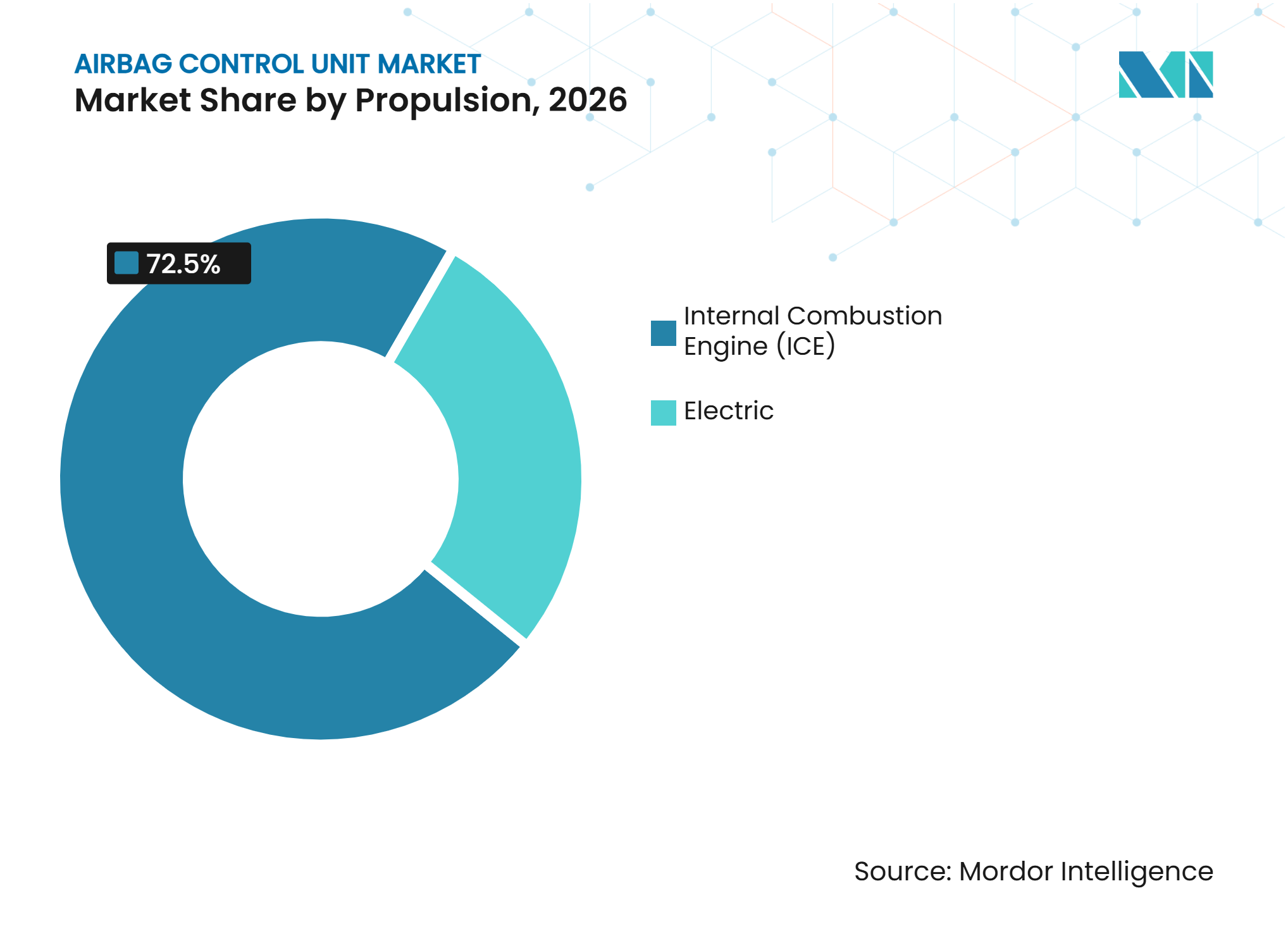
Electric Vehicles Carry the Highest Per-Unit ACU ContentICE vehicles held a 72.50% share in 2026 because conventional vehicles still dominate the installed base and current production in many countries. Their controller configurations are mature, with established squib-driver arrangements and validated crash logic. This creates stable demand for replacement designs and platform updates. Manufacturers continue to add side and curtain protection to ICE vehicles, which supports content growth even without a fundamental architecture change. Yet ICE systems do not need the same high-voltage isolation function as battery-electric vehicles. Their safety-domain design is therefore less complex in that respect.
Electric vehicles are forecast to advance at a 9.80% CAGR through 2032 and carry the highest per-unit controller content. The controller must coordinate high-voltage battery isolation alongside airbag deployment, which can require additional firing channels, a second validated power domain, and more software logic. ANCAP assessed battery integrity and high-voltage system safety through additional tests on the Toyota HiLux BEV in 2026. These tests show why electric vehicle safety cannot rely on restraint functions alone. The airbag control unit market gains engineering value from the link between occupant protection and electrical hazard management. Cybersecurity requirements become more relevant when safety functions and vehicle settings can be updated through software. Electric platforms thus matter disproportionately to suppliers seeking higher-value controller programs.

By Sales Channel:
OEM Lock-In Is Structural, Aftermarket Risk Is RealOEMs held an 87.12% share in 2026. The share reflects long vehicle-platform development cycles and the cost of changing a validated safety controller. Replacing an established unit can require a new set of crash-algorithm checks and functional-safety documentation. OEM programs also favor suppliers that can coordinate hardware, software, sensors, and production quality at scale. These relationships can last throughout a vehicle model’s lifecycle. The airbag control unit market therefore remains strongly tied to original-equipment design wins. Tier-one suppliers with broad system capabilities have a clear advantage in this channel.
Aftermarket is forecast to grow at a 5.96% CAGR through 2032 as fleets age and collision repairs increase. This channel serves genuine replacement demand, especially in countries where vehicle ownership is expanding. It also has greater exposure to counterfeit modules and poorly documented replacement parts. The Automotive Anti-Counterfeiting Council reported that the counterfeit airbag modules it evaluated did not deploy correctly. Legitimate suppliers can differentiate through traceable functional-safety documentation and recognized local certifications, including INMETRO in Brazil and BIS in India. However, authorized dealer programs and counterfeit supply both limit the ease of independent aftermarket expansion. The airbag control unit market must balance replacement demand with safety and liability controls.
Geography Analysis
Asia-Pacific
Asia-Pacific held a 48.05% share in 2026 and is forecast to grow at a 6.33% CAGR through 2032. The region combines large vehicle output with rising requirements for airbag content and electronic safety systems. China remains important because local vehicle manufacturers are developing new platforms quickly and are seeking local engineering support. AUMOVIO began series supply of integrated airbag control units and crash satellite sensors from Changchun for Leapmotor’s B10 and B05 models in February 2026. The company stated that development time was reduced significantly compared with traditional cycles. India adds demand as safety expectations broaden, while Japan and South Korea provide depth in semiconductor, sensor, and automotive electronics supply. Bharat NCAP proposals also raise the importance of curtain-airbag-capable controller designs for OEMs seeking stronger safety ratings. The combination of local manufacturing, rapid EV development, and compliance changes makes Asia-Pacific a major source of airbag control unit market growth.
Europe
Euro NCAP’s 2026 framework is a central regulatory influence on the European airbag control unit market. The framework evaluates safe driving, crash avoidance, crash protection, and post-crash safety as separate stages. European OEMs must therefore account for near-side, far-side, and pole-impact conditions across different occupant profiles. This supports demand for multi-channel controllers and adaptive deployment algorithms. Germany remains an important engineering base because Bosch, ZF Friedrichshafen, Infineon, and other automotive suppliers maintain substantial development activity there. ISO 26262 assessment capability also creates a compliance advantage for suppliers already experienced in ASIL-D development. Suppliers are also aligning local manufacturing and engineering capacity with the needs of vehicle programs launched in the region.
North America, South America, and Middle East and Africa
North America is supported by FMVSS No. 208 occupant protection rules and an aging vehicle fleet that can create replacement demand after collisions. The region also faces counterfeit restraint-system risk in repair channels, which supports the case for documented replacement parts. In South America, Brazil’s safety requirements and Latin NCAP’s 2026 protocol increase the importance of side-impact protection. Argentina and Colombia follow related safety paths through their smaller assembly operations. In the Middle East and Africa, GCC markets benefit from imports of newer European and Asian vehicles with higher airbag counts. South Africa acts as a regional supply and regulatory gateway, while lower-cost markets remain sensitive to vehicle price. Suppliers serving this mixed group can reduce complexity by using global controller platforms that require fewer region-specific variants.
Competitive Landscape
Market Concentration
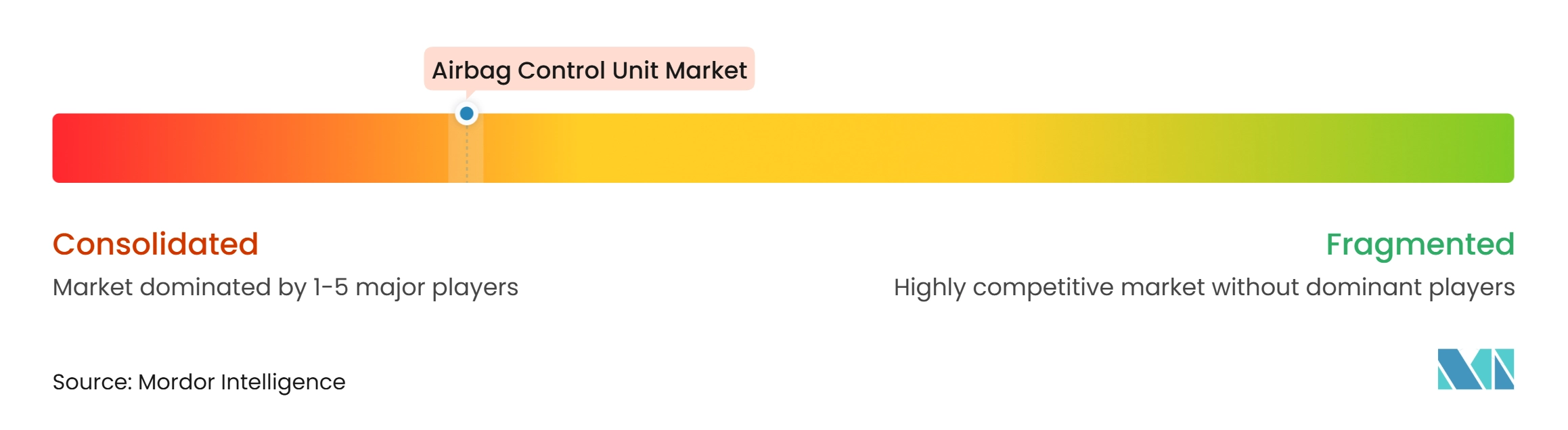
The airbag control unit market is consolidated at the system level. Robert Bosch, AUMOVIO, ZF Friedrichshafen, DENSO, Hyundai Mobis, and Aptiv compete for design wins that can extend across a vehicle generation. Their advantage comes from the ability to combine restraint-system knowledge, electronics development, software validation, and manufacturing quality. At the semiconductor layer, a small group of suppliers such as Bosch, Infineon, NXP, STMicroelectronics, and Analog Devices provides most airbag-specific ICs. This two-level structure makes control of both controller integration and safety-grade semiconductor supply important. ISO 26262 requirements add a barrier because suppliers must establish credible ASIL-D development and documentation processes before vehicle makers can select them.
Local development speed is becoming a competitive tool in the airbag control unit market. Infineon’s 2025 partnership with UL Solutions sought to help automotive customers advance ISO 26262 work across selected microcontrollers, power-management ICs, and sensors. STMicroelectronics and HighTec are also developing Rust support for software-defined vehicle architectures to reduce memory-safety defects that require testing. These actions show that suppliers are seeking access to growing vehicle programs while retaining control of validated safety technology. Fast adaptation to OEM platform requirements can matter as much as component pricing. Established regional production networks also reduce the risk of delays in new model launches.
Electric vehicle safety functions are increasing the value of integrated safety-domain designs. Suppliers that can combine occupant protection, crash sensing, and battery isolation may reduce the need for separate modules, cut integration interfaces for OEM engineering teams, and simplify system-level testing during platform development. This can improve packaging and enable more coordinated safety decisions after a crash. It also requires more comprehensive functional-safety and cybersecurity work, which favors companies with large engineering resources.
Airbag Control Unit Industry Leaders
-
Robert Bosch GmbH
-
ZF Friedrichshafen AG
-
AUMOVIO SE
-
DENSO Corporation
-
Hyundai Mobis Co., Ltd.
- *Disclaimer: Major Players sorted in no particular order
Airbag Control Unit Market Companies Covered in this Report
- Robert Bosch GmbH
- AUMOVIO SE
- ZF Friedrichshafen AG
- DENSO Corporation
- Aptiv PLC
- Hyundai Mobis Co., Ltd.
- Infineon Technologies AG
- NXP Semiconductors N.V.
- STMicroelectronics N.V.
- Analog Devices, Inc.
- Texas Instruments Incorporated
- Murata Manufacturing Co., Ltd.
- Renesas Electronics Corporation
- Magna International Inc.
- Marelli Holdings Co., Ltd.
- Mitsubishi Electric Corporation
Recent Industry Developments in Airbag Control Unit Market
- October 2026: Chery awarded AUMOVIO a contract to supply airbag control units for vehicles Chery will build in Europe, with production at AUMOVIO's plant in Timișoara, Romania.
- April 2026: AUMOVIO India produced its 10-millionth airbag control unit at its Bengaluru plant and launched an Integrated Safety Control Module.
- February 2026: AUMOVIO began series supply of integrated airbag control units and crash satellite sensors, produced in Changchun, for Leapmotor's B10 and B05 models.
- January 2026: Euro NCAP's 2026 rating protocols took effect, assessing vehicles across safe driving, crash avoidance, crash protection, and post-crash safety.
Global Airbag Control Unit Market Report Scope
The Airbag Control Unit Market is segmented by Component, Vehicle Type, Propulsion, Sales Channel, and Geography. By Component, the market is segmented into Microcontroller, Crash Sensors, Firing Loop/Squib Drivers, Power Supply ICs, and Others (Software). By Vehicle Type, the market is segmented into Passenger Cars, Light Commercial Vehicles, and Medium and Heavy Commercial Vehicles. By Propulsion, the market is segmented into Internal Combustion Engine (ICE) and Electric. By Sales Channel, the market is segmented into OEM and Aftermarket. By Geography, the market is segmented into North America (United States, Canada, and Rest of North America), Europe (Germany, United Kingdom, France, Italy, Spain, Sweden, Russia, and Rest of Europe), Asia-Pacific (China, Japan, India, South Korea, Thailand, Indonesia, Australia, and Rest of Asia-Pacific), South America (Brazil, Argentina, Chile, Colombia, and Rest of South America), and Middle East and Africa (Saudi Arabia, United Arab Emirates, Turkey, Israel, South Africa, Egypt, Morocco, and Rest of Middle East and Africa). Market forecasts are provided in terms of Value (USD) and Volume (Units).
Segmentation Overview
| Microcontroller |
| Crash Sensors |
| Firing Loop/Squib Drivers |
| Power Supply ICs |
| Others (Software) |
| Passenger Cars |
| Light Commercial Vehicles |
| Medium and Heavy Commercial Vehicles |
| Internal Combustion Engine (ICE) |
| Electric |
| OEM |
| Aftermarket |
| North America | United States |
| Canada | |
| Rest of North America | |
| Europe | Germany |
| United Kingdom | |
| France | |
| Italy | |
| Spain | |
| Sweden | |
| Russia | |
| Rest of Europe | |
| Asia-Pacific | China |
| Japan | |
| India | |
| South Korea | |
| Thailand | |
| Indonesia | |
| Australia | |
| Rest of Asia-Pacific | |
| South America | Brazil |
| Argentina | |
| Chile | |
| Colombia | |
| Rest of South America | |
| Middle East and Africa | Saudi Arabia |
| United Arab Emirates | |
| Turkey | |
| Israel | |
| South Africa | |
| Egypt | |
| Morocco | |
| Rest of Middle East and Africa |
| By Component | Microcontroller | |
| Crash Sensors | ||
| Firing Loop/Squib Drivers | ||
| Power Supply ICs | ||
| Others (Software) | ||
| By Vehicle Type | Passenger Cars | |
| Light Commercial Vehicles | ||
| Medium and Heavy Commercial Vehicles | ||
| By Propulsion | Internal Combustion Engine (ICE) | |
| Electric | ||
| By Sales Channel | OEM | |
| Aftermarket | ||
| By Geography | North America | United States |
| Canada | ||
| Rest of North America | ||
| Europe | Germany | |
| United Kingdom | ||
| France | ||
| Italy | ||
| Spain | ||
| Sweden | ||
| Russia | ||
| Rest of Europe | ||
| Asia-Pacific | China | |
| Japan | ||
| India | ||
| South Korea | ||
| Thailand | ||
| Indonesia | ||
| Australia | ||
| Rest of Asia-Pacific | ||
| South America | Brazil | |
| Argentina | ||
| Chile | ||
| Colombia | ||
| Rest of South America | ||
| Middle East and Africa | Saudi Arabia | |
| United Arab Emirates | ||
| Turkey | ||
| Israel | ||
| South Africa | ||
| Egypt | ||
| Morocco | ||
| Rest of Middle East and Africa | ||
Key Questions Answered in the Report
What is the projected growth rate for airbag control units through 2032?
The airbag control unit market is forecast to grow at a 5.18% CAGR from 2027 to 2032, reaching USD 7.35 billion in 2032.
Why do electric vehicles need more advanced airbag control units?
Electric vehicles need the controller to manage airbag deployment and high-voltage battery isolation after a crash, which raises per-vehicle electronics and software content.
Which vehicle type is the largest user of airbag control units?
Passenger cars led with 83.25% share in 2026, supported by their large production base and wide use of restraint systems.
Which region leads demand for airbag control units?
Asia-Pacific held 48.05% share in 2026 and is projected to grow at a 6.33% CAGR through 2032.