
Air Sports Equipment Market Size and Share
Market Overview
| Study Period | 2022 - 2032 |
|---|---|
| Market Size (2027) | USD 23.97 Billion |
| Market Size (2032) | USD 34.72 Billion |
| Growth Rate (2027 - 2032) | 7.69 % |
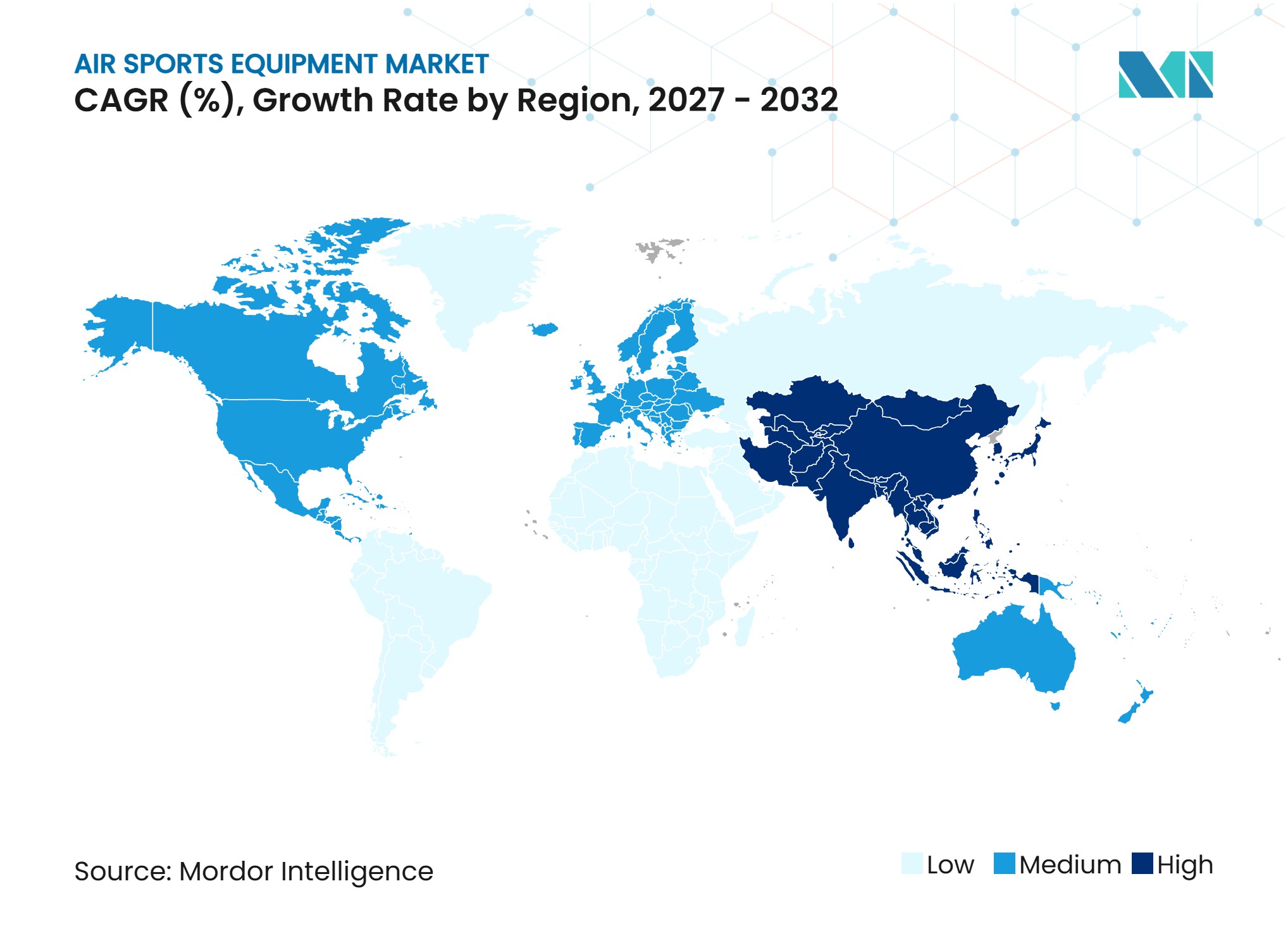
| Fastest Growing Market | Asia-Pacific |
| Largest Market | North America |
| Market Concentration | Low |
Major Players *Disclaimer: Major Players sorted in no particular order Image © Mordor Intelligence. Reuse requires attribution under CC BY 4.0. | |
Air Sports Equipment Market Analysis by Mordor Intelligence
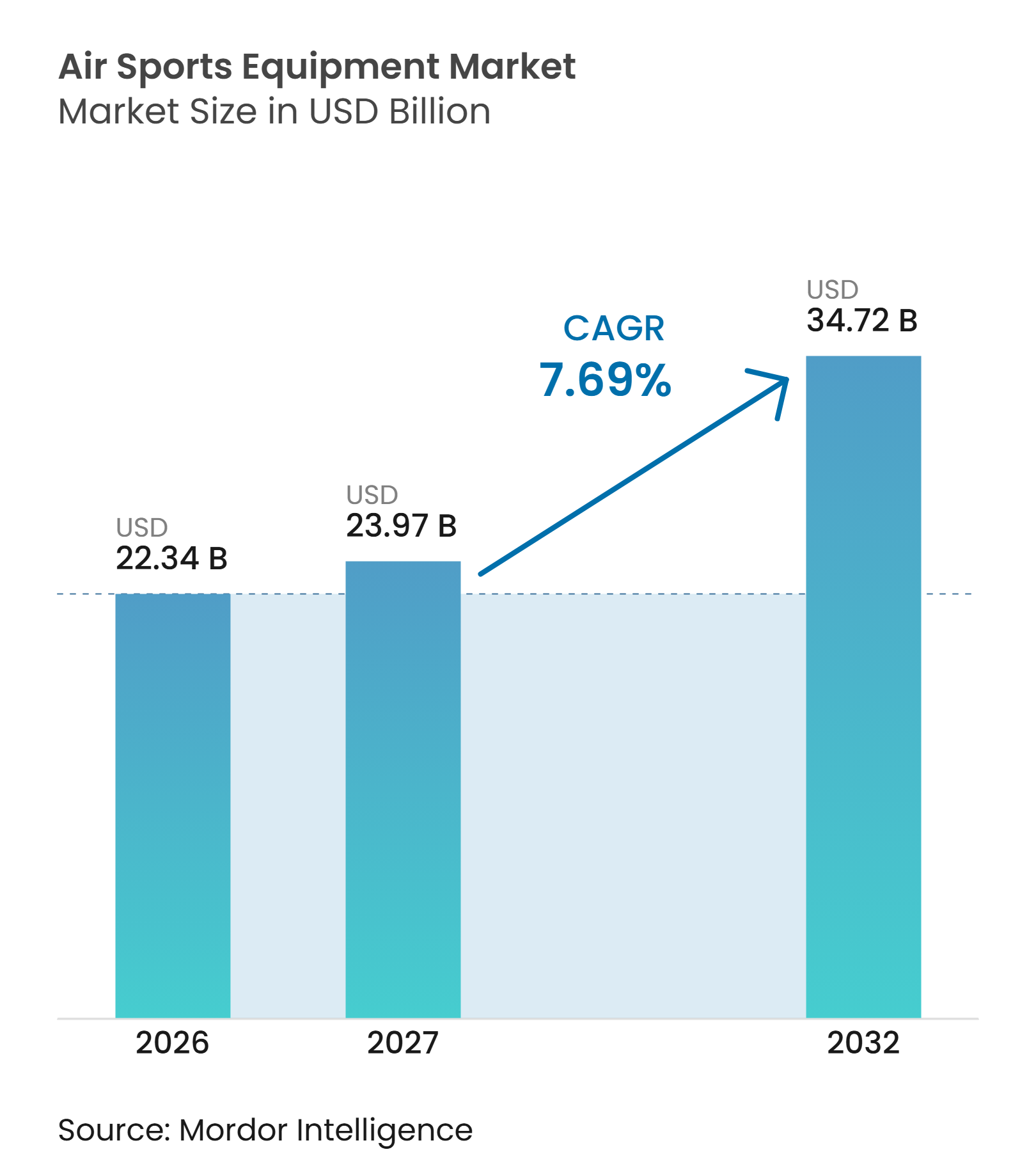
The air sports equipment market size was valued at USD 22.34 billion in 2026 and is estimated to grow from USD 23.97 billion in 2027 to reach USD 34.72 billion by 2032, at a CAGR of 7.69% during the forecast period (2027-2032). Growing participation in skydiving and free flight is expanding the customer base, while established participants are completing more jumps and upgrading equipment more frequently. Operator fleets and certified training programs are emerging as important purchasing channels, particularly in regions where adventure tourism is expanding. Manufacturers are responding by using lighter materials, integrating safety features, offering digital configuration tools, and engaging more closely with pilot communities. Regulation also plays a key role, as aviation reforms can increase participation in recreational flying and broaden the potential user base for related equipment.
Key Report Takeaways
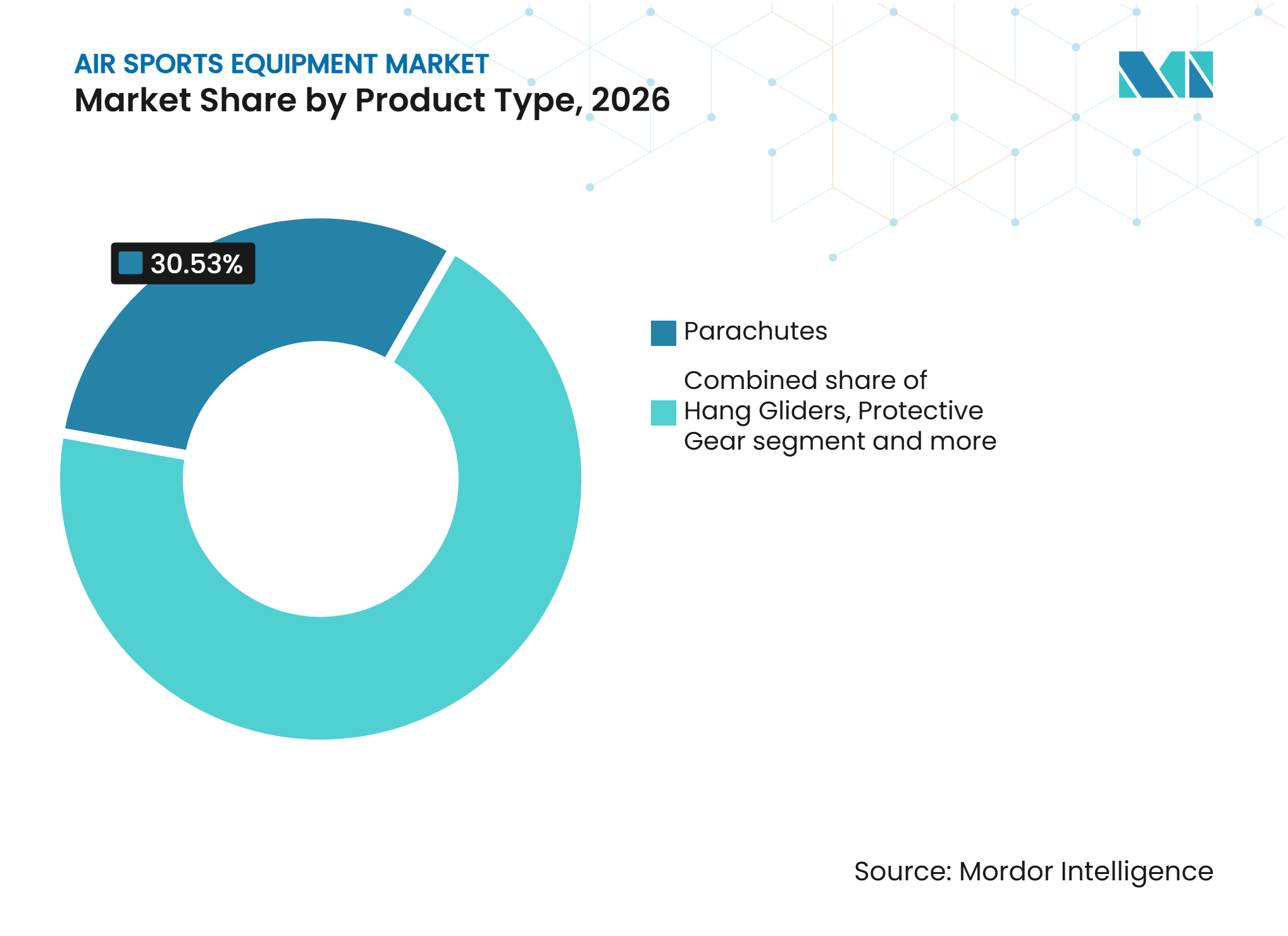
- By product type, parachutes dominated the air sports equipment market with a share of 30.53% in 2026, while paragliders and canopies are forecast to grow at a CAGR of 8.89% during 2027-2032.
- By end user, recreational users accounted for the largest market share of 56.32% in 2026, while training institutions are forecast to grow at a CAGR of 8.81% during 2027-2032.
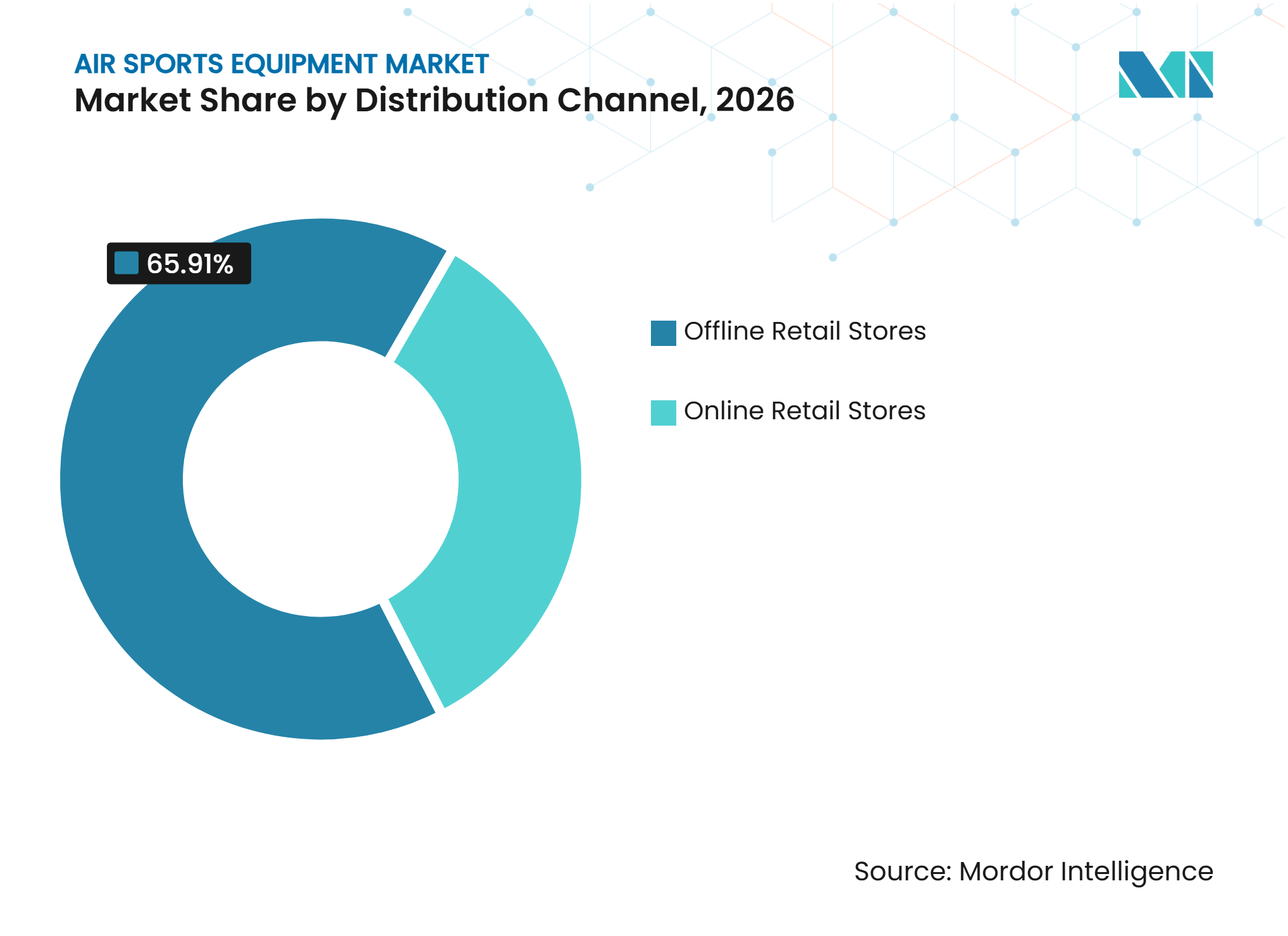
- By distribution channel, offline retail stores led the market with a share of 65.91% in 2026, while online retail stores are forecast to grow at a CAGR of 9.23% during 2027-2032.
- By geography, North America dominated the air sports equipment market with a share of 41.68% in 2026, while Asia-Pacific is forecast to grow at a CAGR of 8.84% during 2027-2032.
Note: Market numbers in this report are based on Mordor Intelligence's proprietary estimation framework, which combines nine months of actuals with Q4 projections for base year 2026.
Market Trends and Insights
Drivers Impact Analysis of Air Sports Equipment Market*
| Driver | (~) % Impact on CAGR Forecast | Geographic Relevance | Impact Timeline |
|---|---|---|---|
| Rising participation in recreational and competitive air sports | +2.1% | Global, strongest in North America and Europe | Short term (≤ 2 years) |
| Expansion of adventure tourism and aerial recreational activities | +1.9% | Asia-Pacific core, with spillover to Middle East and Africa and South America | Medium term (2-4 years) |
| Increasing demand for advanced safety and protective equipment | +0.8% | Global, with compliance factors strongest in North America and the European Union | Medium term (2-4 years) |
| Technological advancements in lightweight and high-performance equipment | +1.0% | Europe and North America, with manufacturing hubs in Germany and France | Medium term (2-4 years) |
| Growth in air sports training and professional certification | +0.6% | Asia-Pacific and North America | Medium term (2-4 years) |
| Government support for air sports infrastructure and development | +0.4% | China, Saudi Arabia, and India | Long term (≥ 4 years) |
| Source: Mordor Intelligence | |||
Rising Participation in Recreational and Competitive Air Sports
The air sports equipment market is benefiting from increased participation in recreational and competitive flying activities. According to a November 2026 report by the United States Parachute Association, skydivers completed 3.65 million jumps in 2025, compared with 2.8 million in 2023, and the association also issued 4,088 new A-licenses in 2025[1]. These metrics indicate that experienced skydivers are participating more frequently while new entrants continue to join the sport. The World Air Sports Federation Contest attracted 3,606 paraglider pilots in 2025, representing a 30% year-over-year increase, with participation growth from Brazil, Switzerland, and Alpine Europe in October 2025[2]. New pilots increasingly compare performance using shared flight footage, encouraging both equipment upgrades and first-time purchases. This trend supports recurring demand for safety systems, wings, harnesses, and replacement components.
Expansion of Adventure Tourism and Aerial Recreational Activities
Adventure travel is expanding the reach of the air sports equipment market among a broader base of travelers and commercial operators. China is developing low-altitude tourism through supportive policies. A paragliding base in Zhejiang reported that visitor numbers increased from fewer than 10,000 in 2019 to more than 100,000. The Civil Aviation Administration of China stated that the low-altitude economy reached CNY 1.5 trillion in 2025 and CNY 3.5 trillion by 2035. India also recorded double-digit growth in adventure tourism bookings in 2025, with 60-65% of Gen Z travelers planning to include air sports in their next trip. Consequently, tandem operators require durable fleet equipment and increasingly influence purchasing patterns in high-growth destinations.
Increasing Demand for Advanced Safety and Protective Equipment
Stringent safety requirements are increasing the importance of certified protective systems in the air sports equipment market. European and German certification standards require independent load and collapse testing for paragliders and harnesses, enabling operators and training institutions to exclude uncertified products. Automatic activation devices, GPS-integrated altimeters, and airbag systems are transitioning from specialist applications to standard equipment configurations. These developments are prompting manufacturers to invest in advanced safety technologies and integrated equipment solutions, strengthening demand for premium certified products and reducing the reliance on low-cost commodity equipment.
Technological Advancements in Lightweight and High-Performance Equipment
Advancements in materials are reshaping competitive dynamics in the air sports equipment market. Manufacturers are using Porcher Skytex 38, Dominico DOKDO fabrics, Dyneema-reinforced ripstop nylon, and advanced structural components to reduce weight while maintaining durability. In September 2025, Ozone Gliders Ltd. introduced the Alpina 5, which features a 6.07 aspect ratio and weighs 3.75 kg, extending two-liner architecture beyond competition equipment. These innovations are narrowing the gap between recreational and competition specifications, enabling buyers to access higher performance without transitioning entirely to specialist equipment categories. Furthermore, improvements in fabric strength, aerodynamic efficiency, and structural design are supporting longer equipment lifecycles and encouraging upgrades among experienced pilots.
Restraints Impact Analysis of Air Sports Equipment Market*
| Restraint | (~) % Impact on CAGR Forecast | Geographic Relevance | Impact Timeline |
|---|---|---|---|
| High initial cost of air sports equipment | -1.5% | Emerging markets in Asia-Pacific, South America, and Middle East and Africa, plus price-sensitive segments globally | Medium term (2-4 years) |
| Risk of accidents and safety-related concerns | -0.9% | Global, with greater effect where regulatory oversight is limited | Long term (≥ 4 years) |
| Weather dependency and seasonal operating limitations | -0.5% | Europe and mountainous regions globally | Short term (≤ 2 years) |
| Limited availability of suitable air sports locations | -0.4% | Urban-dense markets including Japan, South Korea, and Western Europe | Medium term (2-4 years) |
| Source: Mordor Intelligence | |||
High Initial Cost of Air Sports Equipment
The high cost of a complete setup remains a major barrier for new users in the air sports equipment market. A full paragliding setup includes a wing, harness, reserve parachute, and helmet, while ultralight configurations typically command a 15-30% premium. This level of expenditure can restrict purchases in the fastest-growing product category to experienced pilots and institutions. In Southeast Asia, South America, and parts of the Middle East and Africa, the initial cost can equal several months of median income. Consequently, second-hand equipment and rental models serve as important substitutes in these regions. Rental operators typically purchase fewer units designed for intensive use, supporting equipment value but potentially constraining unit sales volumes.
Risk of Accidents and Safety-Related Concerns
The risk of accidents associated with paragliding, hang gliding, skydiving, and other aerial activities remains a significant restraint on the air sports equipment market. Equipment malfunctions, inadequate flight control, line entanglement, adverse weather conditions, and challenging landing environments can cause serious injuries or fatalities, discouraging participation, particularly among inexperienced users. According to the New Zealand Civil Aviation Authority’s 2024-2025 Annual Report, published in 2025, the adventure aviation sector recorded four accidents during the reporting period, involving three paragliders and one tandem parachute[3]. Two individuals sustained serious injuries. Such incidents reinforce concerns about the risks associated with aerial activities, increase the need for specialized safety training and certified equipment, and may deter potential participants from entering the market.
*Our forecasts treat driver/restraint impacts as directional, not additive. The impact forecasts reflect baseline growth, mix effects, and variable interactions.
Air Sports Equipment Market Segment Analysis
By Product Type:
Parachutes Lead as Paragliders Redefine GrowthParachutes accounted for 30.53% of the air sports equipment market size in 2026, making them the leading product category. Skydiving requires both main and reserve canopies, while reserve repacking schedules generate recurring demand beyond purchases by new users. This replacement cycle supports sales even when participant growth slows. Containers, harnesses, and protective gear also play a central role, as they are essential for fitting, protecting, and supporting pilots. Protective equipment is gaining importance as operators adopt airbag-integrated harnesses and helmet systems designed for more demanding use.
Paragliders and canopies are forecast to expand at a CAGR of 8.89% through 2032, supported by launch flexibility and lower dependence on aircraft. Their design suits both recreational newcomers and commercial adventure operators serving varied terrain. Two-liner architecture is reshaping the product mix by bringing competition-oriented designs to more accessible models. Paragliders are also attracting new entrants because they are more compact and easier to transport. Wingsuits create a later-stage demand pathway, with participants required to complete a First Flight Course before participation.



By End User:
Recreational Spending Dominates, Training Institutions Signal the Next WaveRecreational users accounted for 56.32% of the air sports equipment market share in 2026, reflecting the segment's broad base of individual participants. These users typically make relatively high-value purchases and replace equipment every 3-5 years as fabric porosity changes and new technologies become available. Tandem tourism operators, club members, and cross-country pilots upgrade equipment for different reasons. Recreational users often prioritize improvements in weight, handling, safety, and packability. Although professional athletes represent lower direct purchase volumes, they significantly influence product development and market direction.
Training institutions are projected to expand at a CAGR of 8.81% through 2032, making them the fastest-growing end-user segment. Certified flight schools, club programs, and adventure tourism academies require durable equipment fleets for student use. In April 2025, Niviuk introduced its Red Bull X-Alps kit, which combined the 2.85 kg Klimber 3 P wing, Rocket P harness, and Expe Race rucksack into a 5 kg system. These competition-driven solutions can shape the expectations of flight schools and enthusiasts over successive product cycles. Institutional buyers place greater emphasis on durability, warranty coverage, service support, and standardized fleet management.
By Distribution Channel:
Physical Retail Holds Ground, Online Channels Gain AltitudeOffline Retail Stores accounted for 65.91% of the air sports equipment market size in 2026, as many products require expert fitting and setup. Paraglider sizing, harness adjustments, and reserve system integration often require direct technical support. Specialist retailers and drop-zone stores therefore serve as both sales outlets and practical advisers. This model is particularly important for first-time buyers who need assistance selecting suitable equipment. High-value containers and reserve systems also often include dealer services that cannot be easily replicated through purely online transactions.
Online Retail Stores are projected to grow at a CAGR of 9.23% through 2032, driven by access to buyers without a local specialist dealer. Aerodyne introduced a 3D configurator for custom ICON containers, providing real-time design visualization and manufacturing-ready documentation. This approach demonstrates how digital systems can support complex, safety-critical product decisions. While this channel can expand product availability, fitting requirements limit its role in certain premium categories.

Geography Analysis
North America
North America accounted for 41.68% of the air sports equipment market share in 2026, supported by a dense network of commercial drop zones and specialist retailers. The United States hosts manufacturing clusters in DeLand, Florida, including container manufacturers United Parachute Technologies, LLC and Aerodyne, as well as canopy specialist Performance Designs, Inc. The Federal Aviation Administration's Modernization of Special Airworthiness Certification (MOSAIC) rule took effect in October 2025, removing prescriptive weight limits for the Light Sport Aircraft category. The rule also expanded sport pilot privileges and permitted electric-propulsion aircraft under the designation. Canadian communities governed by the Canadian Sport Parachuting Association maintain certification practices that closely align with established United States standards.
Asia-Pacific
Asia-Pacific is forecast to grow at a CAGR of 8.84% through 2032, making it the fastest-growing region in the air sports equipment market. Public infrastructure priorities, rising tourism demand, and expanding operator fleets support this growth. In India, development initiatives are supporting the establishment of air sports hubs, training facilities, and certified operating infrastructure, creating additional demand for paragliders, parachutes, harnesses, and protective equipment. In Australia, helicopter flight bookings increased by 92.9%, according to the Big Red Group Autumn 2025 Seasonal Experiences Index. Indonesia, Thailand, and Singapore are also developing certified adventure tourism ecosystems, driving institutional purchases of equipment.
Europe, South America, and the Middle East and Africa
Europe benefits from a well-established air sports ecosystem, favorable mountain and coastal flying locations, organized clubs, and strong participation in paragliding, hang gliding, and parachuting across France, Germany, Switzerland, Italy, and the United Kingdom. South America benefits from established paragliding and hang-gliding destinations in Brazil, Argentina, and Colombia. Meanwhile, the Middle East and Africa region is developing through investments in adventure tourism, commercial skydiving experiences, and specialized recreational aviation facilities in countries such as the United Arab Emirates, Saudi Arabia, and South Africa.
Competitive Landscape
Market Concentration
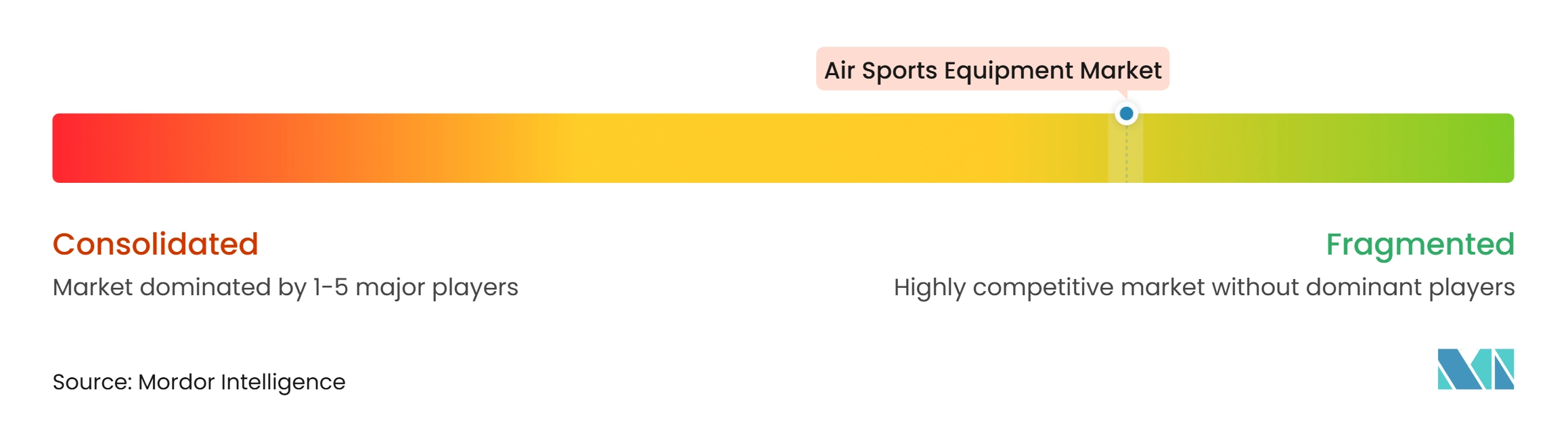
The air sports equipment market is fragmented, with no manufacturer holding a dominant position across the full product range. European manufacturers, including Ozone Gliders Ltd., Niviuk, Bruce Goldsmith Design (BGD) GmbH, and Skywalk GmbH and Co. KG, compete in the paragliding segment through technical design, certification, and ultralight construction. North American specialists, such as Performance Designs, Inc., Aerodyne, and United Parachute Technologies, LLC support the skydiving supply chain through established relationships with the United States Parachute Association and related user communities. Phoenix-Fly operates in the wingsuit segment, while Bonehead Composites addresses demand for specialized helmets. As a result, the air sports equipment industry comprises distinct centers of expertise rather than a single dominant cross-category supplier.
A product launch planned for 2025 demonstrated that design cycles are a key competitive factor in the air sports equipment market. Niviuk launched the Roamer 2 P, incorporating lightweight materials and structural technologies for hike-and-fly pilots. Such developments indicate that manufacturers are addressing specialist requirements while integrating advanced features into broader product lines. The air sports equipment market rewards companies that effectively balance certification, performance, reliability, and weight reduction.
Digital capabilities and institutional positioning are emerging as additional competitive tools in the air sports equipment market. Performance Designs, Inc. hosted Operation VK Dynamic Flow in November 2025, bringing together 36 elite canopy pilots from more than 14 countries for a formation canopy piloting event. The event facilitated direct engagement with the professional pilot community and reinforced the brand's technical positioning. Training schools in China, India, and Southeast Asia represent an untapped opportunity, as no supplier has established a strong position across these expanding networks. Suppliers that combine fleet pricing, training support, and local service may be better positioned to address this demand.
Air Sports Equipment Industry Leaders
-
Apco Aviation Ltd.
-
Atair d.o.o.
-
Dudek Paragliders
-
Gin Gliders
-
Aerodyne
- *Disclaimer: Major Players sorted in no particular order
Air Sports Equipment Market Companies Covered in this Report
- ADVANCE Thun AG
- Aerodyne
- Apco Aviation Ltd.
- Atair d.o.o.
- Bruce Goldsmith Design (BGD) GmbH
- Bonehead Composites
- Dudek Paragliders
- Gin Gliders
- Intrudair Ltd.
- Mirage Systems, Inc.
- Niviuk
- Ozone Gliders Ltd.
- Performance Designs, Inc.
- Phoenix-Fly
- Skywalk GmbH and Co. KG
- Sun Path Products, Inc.
- Supair SAS
- Swing Paragliders
- United Parachute Technologies, LLC
- U-Turn GmbH
Recent Industry Developments in Air Sports Equipment Market
- September 2026: Ozone Gliders Ltd. launched Vapor as its first publicly released paraglider wing. The product featured a three-line design and a dedicated bridle system, allowing pilots to adjust its flight characteristics.
- August 2026: Bruce Goldsmith Design (BGD) GmbH introduced the Kiss 2, a lightweight mountain paraglider that converts into a parakite via its specialized riser system.
- February 2026: Neo launched the Race Up performance harness, which incorporated an aerodynamic fairing, a lightweight construction, and 8 cm of Koroyd impact protection.
- October 2025: Niviuk released the Skin 4 P single-skin wing for extreme alpine conditions, the Artik R 2 EN-C two-liner, and new Konvers 3 at 3.37 kg and Kooper P harnesses at Coupe Icare.
Global Air Sports Equipment Market Report Scope
Air Sports Equipment refers to specialized gear, devices, and accessories designed for recreational and competitive aerial activities, including paragliding, skydiving, hang gliding, paramotoring, and wingsuit flying. The air sports equipment market is segmented by product type, end user, distribution channel, and geography. By product type, the market is segmented into paragliders and canopies, parachutes, hang gliders, protective gear, containers and harnesses, wingsuits, and other equipments. By end user, the market is segmented into recreational users, professional athletes, and training institutions. By distribution channel, the market is segmented into offline retail stores and online retail stores. Based on geography, the market is classified into North America, Europe, Asia-Pacific, South America, and the Middle East and Africa. The market forecasts are provided in terms of value (USD).
Segmentation Overview
| Paragliders and Canopies |
| Parachutes |
| Hang Gliders |
| Protective Gear |
| Containers and Harnesses |
| Wingsuits |
| Other Equipments |
| Recreational Users |
| Professional Athletes |
| Training Institutions |
| Offline Retail Stores |
| Online Retail Stores |
| North America | United States |
| Canada | |
| Mexico | |
| Rest of North America | |
| Europe | Germany |
| United Kingdom | |
| Italy | |
| France | |
| Spain | |
| Poland | |
| Belgium | |
| Netherlands | |
| Rest of Europe | |
| Asia-Pacific | China |
| India | |
| Japan | |
| Australia | |
| Indonesia | |
| Thailand | |
| Singapore | |
| Rest of Asia-Pacific | |
| South America | Brazil |
| Argentina | |
| Peru | |
| Colombia | |
| Rest of South America | |
| Middle East and Africa | South Africa |
| Saudi Arabia | |
| United Arab Emirates | |
| Egypt | |
| Turkey | |
| Rest of Middle East and Africa |
| By Product Type | Paragliders and Canopies | |
| Parachutes | ||
| Hang Gliders | ||
| Protective Gear | ||
| Containers and Harnesses | ||
| Wingsuits | ||
| Other Equipments | ||
| By End User | Recreational Users | |
| Professional Athletes | ||
| Training Institutions | ||
| By Distribution Channel | Offline Retail Stores | |
| Online Retail Stores | ||
| By Geography | North America | United States |
| Canada | ||
| Mexico | ||
| Rest of North America | ||
| Europe | Germany | |
| United Kingdom | ||
| Italy | ||
| France | ||
| Spain | ||
| Poland | ||
| Belgium | ||
| Netherlands | ||
| Rest of Europe | ||
| Asia-Pacific | China | |
| India | ||
| Japan | ||
| Australia | ||
| Indonesia | ||
| Thailand | ||
| Singapore | ||
| Rest of Asia-Pacific | ||
| South America | Brazil | |
| Argentina | ||
| Peru | ||
| Colombia | ||
| Rest of South America | ||
| Middle East and Africa | South Africa | |
| Saudi Arabia | ||
| United Arab Emirates | ||
| Egypt | ||
| Turkey | ||
| Rest of Middle East and Africa | ||
Key Questions Answered in the Report
What is the current size and future growth outlook of the air sports equipment market?
The air sports equipment market was valued at USD 22.34 billion in 2026 and is estimated to reach USD 23.97 billion in 2027. The market is projected to grow to USD 34.72 billion by 2032, registering a CAGR of 7.69% during 2027–2032.
Which product type held the largest share of the air sports equipment market in 2026?
Parachutes was the largest product type segment in 2026, accounting for 30.53% of the air sports equipment market.
Which end-user segment dominated the air sports equipment market in 2026?
Recreational users dominated the market in 2026, accounting for 56.32% of the total market share.
Which region held the largest share of the air sports equipment market in 2026?
North America dominated the air sports equipment market in 2026, accounting for 41.68% of the total market share.