
Air Cargo Ground Handling Services Market Size and Share
Market Overview
| Study Period | 2021 - 2032 |
|---|---|
| Market Size (2027) | USD 20.86 Billion |
| Market Size (2032) | USD 29.27 Billion |
| Growth Rate (2027 - 2032) | 7.01 % |
| Fastest Growing Market | Asia-Pacific |
| Largest Market | North America |
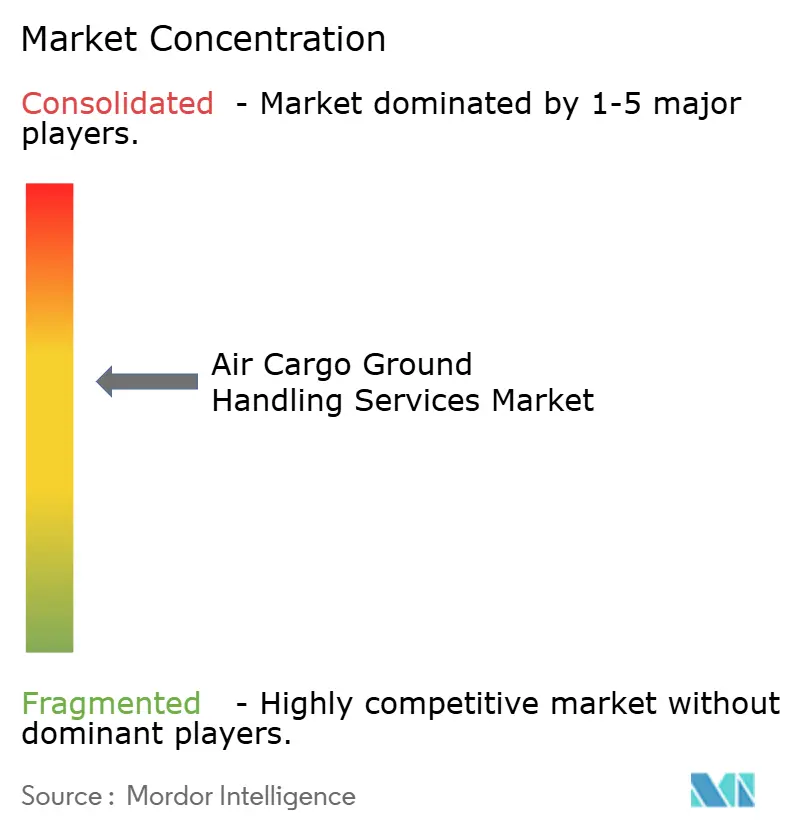
| Market Concentration | Medium |
Major Players *Disclaimer: Major Players sorted in no particular order Image © Mordor Intelligence. Reuse requires attribution under CC BY 4.0. | |
Air Cargo Ground Handling Services Market Analysis by Mordor Intelligence
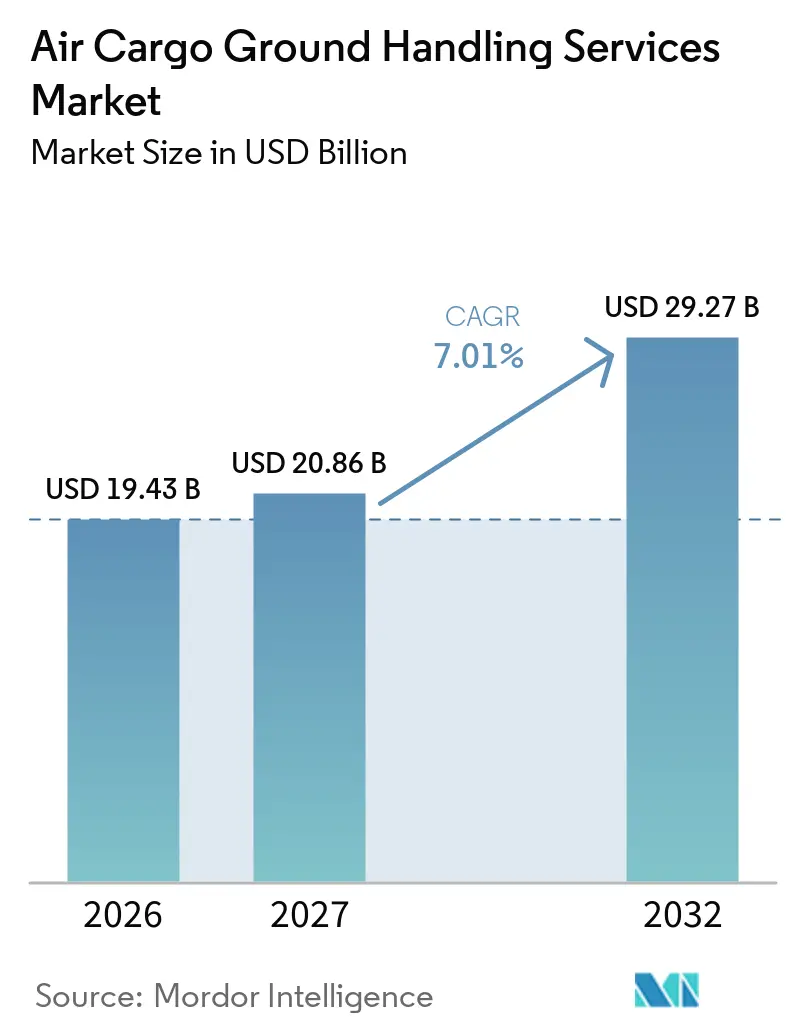
The air cargo ground handling services market size is projected to expand from USD 19.43 billion in 2026 and USD 20.86 billion in 2027 to USD 29.27 billion by 2032, registering a CAGR of 7.01% between 2027 and 2032.
Cargo demand grew 3.4% in cargo ton-kilometers during 2025, while international activity grew 4.2%, supporting terminal activity across ramp, screening, documentation, and temperature-controlled services.[1] Changes to low-value parcel rules in the United States and European Union are raising documentation needs and handling complexity for cross-border shipments. E-commerce and pharmaceutical traffic are reshaping service requirements because handlers must process more time-sensitive and specialized consignments. Longer operating contracts, commonly lasting 5 to 15 years, provide some revenue stability when trade volumes shift between routes. The air cargo ground handling services market also faces labor shortages, congested aprons, and uneven trade patterns across major hubs. The air cargo ground handling services market is shaped by the ability of each station to protect turnaround reliability during trade volatility.
Key Report Takeaways
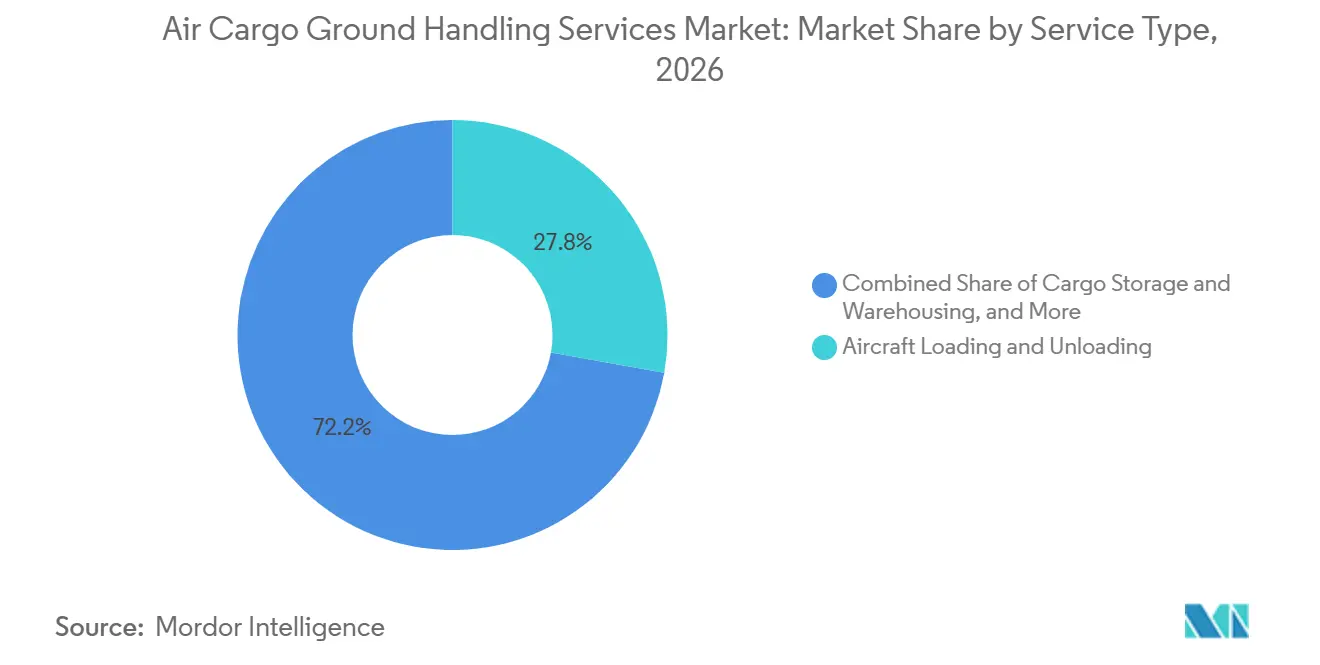
- By service type, aircraft loading and unloading held 27.80% of the air cargo ground handling services market share in 2026, while cargo screening and security handling are forecast to grow at a 7.50% CAGR through 2032.
- By cargo type, general cargo held 42.35% of the air cargo ground handling services market size in 2026, while e-commerce is forecast to expand at an 8.39% CAGR through 2032.
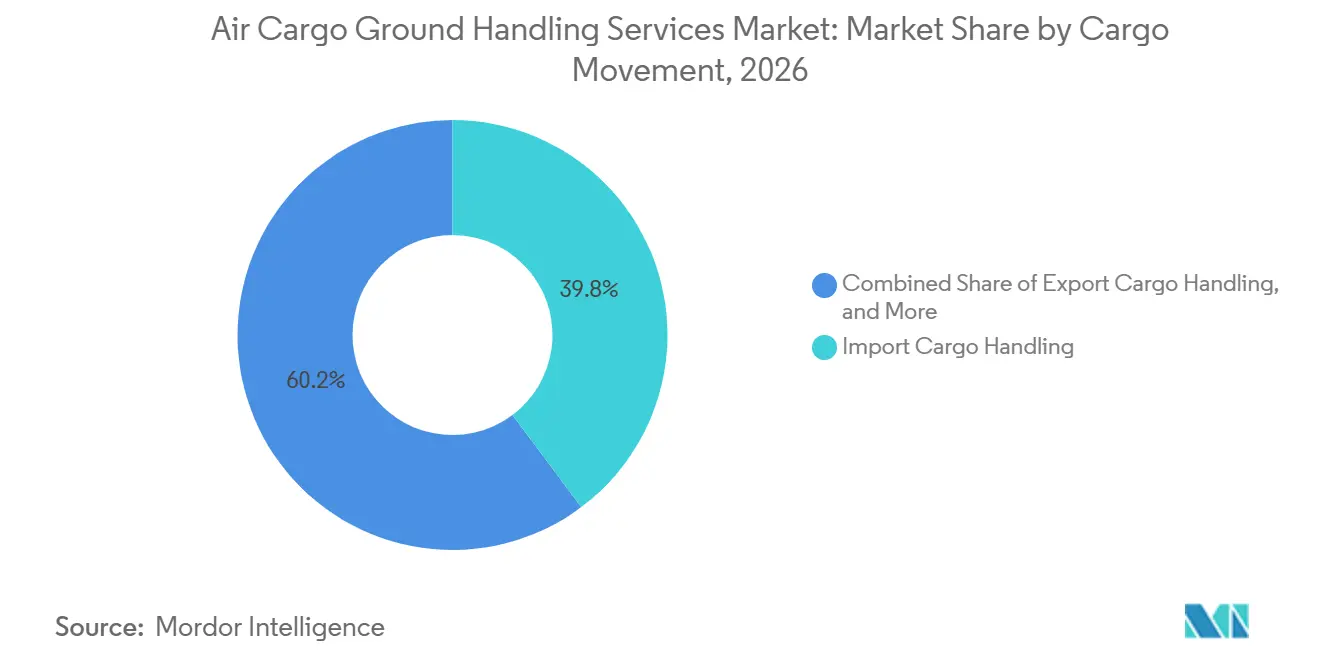
- By cargo movement, import cargo handling held 39.77% of the air cargo ground handling services market share in 2026, while transit and transfer cargo handling is forecast to expand at a 7.62% CAGR through 2032.
- By end user, freight forwarders held 30.29% of the air cargo ground handling services market size in 2026, while integrators and express carriers are forecast to expand at a 7.88% CAGR through 2032.
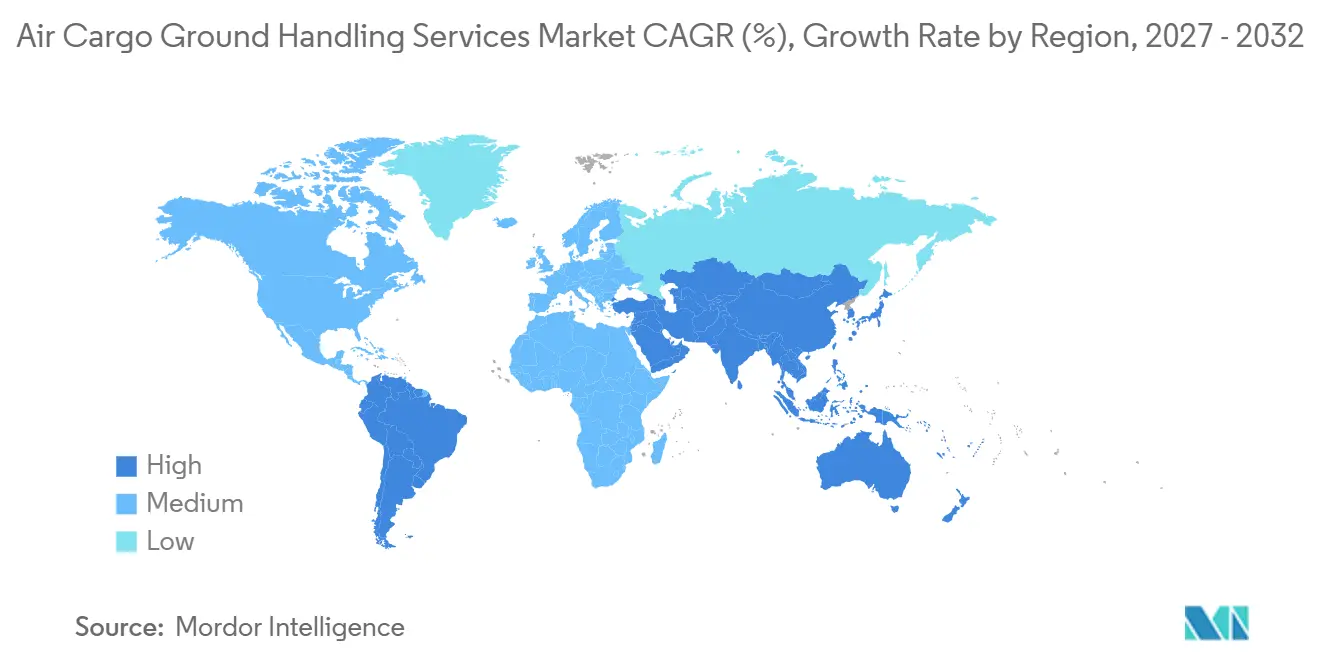
- By geography, North America held a 33.20% of the air cargo ground handling services market share in 2026, while Asia-Pacific is forecast to expand at a 7.57% CAGR through 2032.
Note: Market numbers in this report are based on Mordor Intelligence's proprietary estimation framework, which combines nine months of actuals with Q4 projections for base year 2026.
Market Trends and Insights
Drivers Impact Analysis of Air Cargo Ground Handling Services Market*
| Driver | (~) % Impact on CAGR Forecast | Geographic Relevance | Impact Timeline |
|---|---|---|---|
| Cross-Border E-Commerce and Time-Critical Shipment Growth | +1.5% | Asia-Pacific, North America, EU | Short term (≤ 2 years) |
| Expansion of Pharmaceutical and Temperature-Sensitive Air Cargo | +1.2% | Global, strongest in North America and EU | Medium term (2-4 years) |
| Cargo-Terminal Automation and Digital Visibility Requirements | +1.0% | Global, APAC and EU leading adoption | Long term (≥ 4 years) |
| Airline and Airport Outsourcing of Specialized Handling Operations | +0.9% | Global, North America and MEA gaining pace | Short term (≤ 2 years) |
| Expansion of Dedicated Freighter Hubs and Belly-Cargo Networks | +0.8% | Asia-Pacific, Middle East, North America | Medium term (2-4 years) |
| Under-Utilized Night-Time Airport Capacity and 24/7 Handling Demand | +0.5% | Asia-Pacific, EU, North America | Medium term (2-4 years) |
| Source: Mordor Intelligence | |||
Cross-Border E-Commerce and Time-Critical Shipment Growth
E-commerce has become a central demand source for the air cargo ground handling services market because parcels require fast acceptance, traceability, and accurate dimensioning. IATA states that cross-border e-commerce is projected to account for close to 30% of air cargo volumes by 2027, compared with 20% currently.[2] Platforms are diversifying logistics corridors as trade rules change in the United States and the European Union. Xiamen exported more than 30 million cross-border e-commerce parcels through its Sao Paulo air route after that corridor opened. Zhengzhou Airport Economy Zone processed more than 470,000 tons of international cargo in 2025, while Henan cross-border e-commerce exports rose 106.2% during the first 3 quarters. Parcel-heavy traffic raises demands on intake lines, ULD build-up, customs documentation, and loading plans, particularly when freight has irregular dimensions or low density. The air cargo ground handling services market relies on these stations to process growing parcel flows without weakening shipment control.
Expansion of Pharmaceutical and Temperature-Sensitive Air Cargo
Pharmaceutical traffic supports specialist handling demand because biologics, cell therapies, and vaccines need a controlled chain from acceptance to aircraft transfer. WHO published updated international vaccine packaging and shipping guidance in July 2025, describing air freight as the primary transport mode for vaccines.[3] The guidance identifies ramp and handling activity as high-risk points for temperature excursions. IATA CEIV Pharma requirements support validated temperature-controlled environments, monitoring, and documented procedures at major hubs. American Airlines Cargo extended 24/7 live monitoring for active temperature-controlled units in its ExpediteTC service during September 2025. Higher-value, smaller-volume shipments can raise revenue per handled kilogram faster than weight throughput, making certified handling capacity important for the air cargo ground handling services market. The air cargo ground handling services market gains value when these shipments receive uninterrupted temperature control.
Cargo-Terminal Automation and Digital Visibility Requirements
Digital data exchange is becoming an operating requirement for handlers that serve major airline and forwarder networks. Cathay Cargo became the first carrier to use IATA ONE Record in day-to-day exchanges with forwarders in February 2025. ONE Record gives stakeholders access to a common shipment record in real time. IATA’s 2026 technology survey rated real-time visibility platforms, connected IoT devices, and RFID as very high-impact technologies. Automated dimensioning can capture cargo measurements without stopping freight flow, which supports acceptance and build-up productivity. European customs requirements and ONE Record adoption are pushing handlers to connect older cargo systems through APIs or risk weaker airline and forwarder relationships. The air cargo ground handling services market is, therefore, moving toward common, accessible shipment records.
Airline and Airport Outsourcing of Specialized Handling Operations
Airlines and airports are transferring more specialized handling work to third-party providers as labor costs, safety obligations, and cargo complexity rise. Schiphol began a tender process in December 2025 to reduce its handler pool from 6 companies to 3. The airport selected KLM, dnata, and Viggo for 7-year contracts that start in 2027. Long-term service agreements increasingly include certification, dangerous-goods competence, and technology requirements. Operators holding CEIV certifications, accredited dangerous-goods programs, and compatible data links are better placed to compete for these contracts. This concentration of capability places pressure on uncertified providers that work mainly at secondary airports and in lower-value service areas. The air cargo ground handling services market gives certified providers wider access to specialized contracts.
Restraints Impact Analysis of Air Cargo Ground Handling Services Market*
| Restraint | (~) % Impact on CAGR Forecast | Geographic Relevance | Impact Timeline |
|---|---|---|---|
| Skilled Airside Labor Shortages and High Turnover | -0.8% | Global, Americas most acute | Short term (≤ 2 years) |
| Fragmented Airport-System Integration and Legacy Data Interfaces | -0.6% | Global, emerging markets most exposed | Long term (≥ 4 years) |
| High Compliance Burden for Dangerous Goods, Pharma and Live Animals | -0.4% | Global | Medium term (2-4 years) |
| Airside Congestion, Apron Constraints and Peak-Period Bottlenecks | -0.4% | North America, Europe, APAC peak hubs | Medium term (2-4 years) |
| Source: Mordor Intelligence | |||
Skilled Airside Labor Shortages and High Turnover
Airside workforce shortages limit cargo throughput in the Americas, Europe, and parts of Asia-Pacific while cargo demand is growing. The United States GAO reported in August 2025 that airport service workers faced economic and occupational pressures that affected recruitment and retention. Cargo ramp jobs also require technical skills as ground support equipment becomes more electrified and digitally connected. IATA’s Ground Operations Training Passport allows qualified staff to move between employers without repeating equivalent training.[4] The program was developed with Lufthansa Group, but wider adoption remained limited. Automation cannot fully replace skilled work in irregular cargo, live animal logistics, and hazardous-material acceptance, leaving labor availability as a capacity limit for the air cargo ground handling services market.
Fragmented Airport-System Integration and Legacy Data Interfaces
Handlers continue to operate across proprietary cargo systems, aging Port Community Systems, and Cargo-IMP messages. This mix raises data reconciliation costs, slows shipment handoffs, and increases the risk of errors in multi-handler journeys. IATA identified more than 1,200 state and operator variations in dangerous-goods handling requirements by early 2026. Each variation adds mapping work for operators serving multiple jurisdictions. Regional handlers and emerging-market operators can struggle to finance system redevelopment alongside physical expansion. Customs pre-information requirements, including EU Import Control System 2 and the United States Advance Cargo Information rules, add more obligations before API-first systems become widespread.
*Our forecasts treat driver/restraint impacts as directional, not additive. The impact forecasts reflect baseline growth, mix effects, and variable interactions.
Air Cargo Ground Handling Services Market Segment Analysis
By Service Type:
Security Handling Gains Ground as Regulatory Pressure IntensifiesAircraft loading and unloading held 27.80% of the air cargo ground handling services market share in 2026 because every cargo movement needs physical ramp transfer. The service remains labor-intensive and equipment-intensive across narrowbody and widebody aircraft. Its position reflects the large volume of freight that passes through the ramp regardless of origin, destination, or cargo category. A 17.5% increase in dangerous-goods volumes during 2025, largely linked to lithium battery consignments, supported this demand. IATA’s 2026 Dangerous Goods Regulations add stricter lithium-ion battery charge limits, shipper checklists, and formal names for hybrid-powered vehicles. These requirements expand the role of screening staff, compliant documentation, and specialist acceptance procedures. Security handling therefore gains importance as handlers manage cargo that carries greater safety and compliance risk. The air cargo ground handling services industry needs consistent training and documented controls at stations serving these flows.
Cargo screening and security handling registered a 7.50% CAGR from 2027 to 2032. IATA launched DG Digital in March 2026 to digitize dangerous-goods declarations from submission to API-based transmission. Japanese trials recorded a 0.5% dangerous-goods rejection rate, compared with a 4.5% global average for paper-based processes. Cargo acceptance and documentation benefits from these data improvements because documents can move faster between shippers, airlines, and handlers. Cargo build-up and breakdown also benefits when dimensioning data is captured at the point of acceptance. Automated systems can reduce manual touches and support more consistent pallet formation. Cargo storage and warehousing expands with pharmaceutical cold-chain development and e-commerce import holding needs. CEIV programs and ICAO Annex 18 standards continue to influence equipment purchases, process design, and staff qualifications. The air cargo ground handling services market, therefore, rewards providers that can combine physical capacity with secure digital records. Service portfolios are shifting toward higher-control activities that are harder to provide through basic ramp labor alone.

By Cargo Type:
E-Commerce Disrupts the General Cargo BaselineGeneral cargo retained 42.35% of the air cargo ground handling services market size in 2026, supported by industrial materials, consumer goods, and standard commercial freight. These shipments provide a stable base for international airline cargo operations. Their handling needs are generally more predictable than parcel-heavy or temperature-sensitive traffic. Shippers are separating time-critical and economy tiers, which creates more demand for differentiated service levels. China-EU e-commerce volumes grew 29% year-over-year in late 2025 after the United States removed de minimis exemptions, even as China-United States flows declined. This pattern shows that policy changes can redirect air handling demand between corridors rather than remove it. E-commerce requires parcel sorting, accurate data capture, rapid customs handling, and reliable transfer processes. These requirements are changing operating priorities throughout the air cargo ground handling services market.
E-commerce registered an 8.39% CAGR from 2027 to 2032. Healthcare and pharmaceuticals are growing in strategic importance because temperature control can fail during ramp and ground handling. WHO guidance published in 2025 identified these stages as sensitive points in the vaccine shipment chain. Fresh produce and perishable goods also depends on certified cold-chain handling, especially on South-North trade routes from Africa and South America. Electronics and high-tech cargo includes server equipment, semiconductor components, and data-storage units. IATA reported that more than two-thirds of global AI infrastructure-related goods by value moved by air during 2025. This traffic can require secure handling, rapid connections, and low damage rates. Industrial goods remains an important base, especially when automotive manufacturers use airfreight for urgent parts replenishment. The cargo mix calls for handlers to balance high-volume general freight with specialist processes for sensitive and time-critical consignments. The air cargo ground handling services market benefits when stations can switch capacity between these cargo requirements. This mix also broadens the value of certified storage, screening, and documentation services.
By Cargo Movement:
Transit Handling Emerges as the Growth PivotImport cargo handling held 39.77% of the air cargo ground handling services market share in 2026, reflecting strong inbound demand in North America and Europe for products sourced from Asia-Pacific manufacturing hubs. Import processing involves deconsolidation, documentation, sorting, and coordination with downstream distribution networks. These activities take place within short delivery windows and require both labor and systems capacity. Airline network changes and deeper hub-and-spoke structures are increasing the amount of cargo that moves through intermediate stations. Asia-Pacific cargo ton-kilometers rose 10.5% year-over-year in April 2026, while Africa grew 7.7% and the global average was 4.0%. These flows reinforce the role of hubs in Asia and the Middle East. The air cargo ground handling services market needs faster ULD cross-transfers and better coordination between arrival and departure windows.
Transit and transfer cargo handling registered a 7.62% CAGR from 2027 to 2032. Transit flows also require bonded facilities that can support cargo before destination customs clearance. Real-time slot coordination becomes important when arriving and departing flights have narrow connection windows. Handlers need to maintain cargo integrity while they move consignments between aircraft, warehouses, and customs-controlled zones. A missed connection can add costs for airlines, forwarders, and cargo owners. The air cargo ground handling services market relies on timed transfers to protect service quality across hub networks. Export cargo handling has a smaller share, but manufacturing diversification across Southeast Asia and India is creating additional outbound corridors. These corridors link local production bases with European and Middle Eastern destinations. New routes require local teams that understand export documentation, security controls, and airline-specific procedures. The air cargo ground handling services industry, therefore, benefits from stations that can manage imports, exports, and transit traffic through a common operating platform. Operators with multi-hub networks can redirect staff and equipment where trade lanes grow faster.
By End User:
Integrators Accelerate as Forwarder Relationships EvolveFreight forwarders held 30.29% of the air cargo ground handling services market size in 2026 because they act as commercial intermediaries between cargo owners and airline capacity. They rely on handlers for physical processing, storage, and documentation support at airport terminals. Forwarder relationships are evolving toward bundled offerings that include consolidation, ready-for-carriage preparation, and electronic customs links. This approach moves the relationship beyond individual handling transactions. Their time-definite shipments require an operating model that controls cargo from origin through transfer and delivery. Ground handlers play a central role because each transfer can determine whether a promised delivery time is met. Express networks also need consistent scanning, sorting, security, and ramp performance across gateway airports. The air cargo ground handling services market is increasingly linked to these tightly managed express workflows. These requirements support more integrated contracts in the air cargo ground handling services market.
Integrators and express carriers registered a 7.88% CAGR from 2027 to 2032. Dedicated cargo airlines are expanding freighter networks and hub infrastructure, which creates demand for ramp and warehouse services that differ from belly-cargo work. Freighters can need specialized equipment, larger warehouse staging areas, and different turnaround procedures. Passenger airlines with belly cargo remain the largest source of cargo volume by flight count. Etihad Cargo expanded belly-hold capacity across more than 1,000 weekly passenger flights by March 2026. Airport authorities and terminal operators are developing direct handling capabilities to capture traffic at newer cargo airports. This is evident at greenfield developments in Asia-Pacific where cargo capacity is being added to wider airport projects. The air cargo ground handling services industry faces more varied buyer requirements as airlines, forwarders, integrators, and airports seek different service combinations. Providers that can adapt procedures while maintaining common quality standards have a stronger basis for long-term relationships.
Geography Analysis
North America held 33.20% of the revenue share in 2026, supported by cargo density at JFK, Miami, Chicago O’Hare, Dallas-Fort Worth, and Los Angeles. Air cargo enabled USD 157 billion in the United States imports during Q1 2025, representing 82% of the total increase in the United States imports during that period. This front-loaded trade created short periods of intensive demand for gateway handling capacity. The FAA imposed summer 2026 scheduling reductions at Chicago O’Hare after planned peak-day volumes rose 14.9% above summer 2025 levels. Canada recorded 8% cargo tonnage growth in 2025, while Mexico declined more than 4%, producing uneven station-level demand across the region. JFK’s New Terminal One project signals continued investment in airport capacity and long-term operator licenses.
Europe holds an important position in the air cargo ground handling services market through Frankfurt, Amsterdam Schiphol, Paris Charles de Gaulle, and London Heathrow. European carriers recorded 2.9% cargo ton-kilometer growth in 2025, while the Europe-Asia lane grew 10.3%. Schiphol’s decision to consolidate handlers from 6 to 3 providers reflects a policy focus on service standards and working conditions. Fraport signed a February 2026 lease with Kuhne+Nagel for a new cargo warehouse at Frankfurt Airport. DHL Global Forwarding opened a 24,500 m² hub at Frankfurt in June 2025 with annual capacity of up to 300,000 metric tons. Africa recorded 7.7% cargo ton-kilometer growth year-over-year in April 2026, supporting the region’s role as a transit gateway. South America is building additional connections to European markets through dedicated cargo routes.
Asia-Pacific is forecast to expand at a 7.57% CAGR from 2027 to 2032, supported by intra-regional trade, added cargo capacity, and redirected e-commerce flows. Asia-Pacific airlines recorded 8.4% cargo ton-kilometer growth during 2025, the highest rate among regions. Within-Asia traffic grew 10.0%, while Asia-Europe traffic grew 10.3% during that year. Air India SATS Airport Services began operations at Noida International Airport under a 37-year concession. AISATS held 70% market share in India’s ground handling sector and announced to invest INR 1,500 crore (USD 180 million) in terminals and logistics zones. Shenzhen Airport opened China’s first 24/7 customs-clearance international cargo terminal during April 2025. These developments strengthen the region’s role in the air cargo ground handling services market. The air cargo ground handling services market gains further capacity as these facilities connect trade lanes and local distribution networks.
Competitive Landscape
The air cargo ground handling services market is moderately concentrated worldwide, with internationally scaled operators competing for major airport licenses while regional and airport-affiliated providers retain positions at constrained local airports. Swissport expanded into mainland China through the Shanghai Pudong Digital and Intelligent International Cargo Terminal. It also began operations at 13 Saudi airports in June 2025 and pursued cargo investments in Colombia and Morocco. The company also secured a Lufthansa Group contract at London Heathrow. Menzies Aviation acquired G2 Secure Staff for USD 305 million, doubling its United States presence to 108 locations. It also secured a 15-year license at Bengaluru International Airport and added operations in Belgium and Angola. dnata opened an automated cargo facility at Amsterdam Schiphol with a EUR 70 million (USD 82.34 million) investment and 600,000-ton annual capacity. These actions show a preference for portfolio expansion, long-term airport rights, and stations with high entry barriers.
Digital capability is becoming a key factor in tenders because airlines and forwarders need reliable shipment data across multiple locations. Menzies Aviation’s MACH system operates at 46 stations and processes 55% of its global cargo tonnage. This platform supports real-time visibility and more consistent operating processes across the network. Worldwide Flight Services, a SATS company, operates e-commerce and freight forwarder handling facilities at 17 European airports. Its acquisition of Aviapartner Cargo NV at Brussels during March 2026 strengthened its Belgian presence. Qatar Airways Cargo introduced its Ramp Offload and Load Supervision tool during February 2026 to replace paper loading instructions with digital ramp workflows. Certified operators can use these capabilities to meet airline and forwarder requirements across several countries.
IATA CEIV certifications for pharmaceutical products, lithium batteries, perishables, and live animals are concentrating specialty volumes with qualified handlers. This dynamic separates globally scaled providers from smaller regional operators with fewer certified sites. Airport license terms, cargo terminal capacity, labor availability, and data integration limit easy entry at major hubs. Regional specialists still retain value where local airport knowledge and access rights are important. Airport-affiliated companies can also hold protected positions through their operating relationships and infrastructure access. Long-duration contracts help international operators build recurring revenue once they secure a location. Competition remains active because airlines and airports can use tenders to reset provider pools and service standards.
Air Cargo Ground Handling Services Industry Leaders
-
SATS Ltd.
-
Swissport International AG
-
Emirates Group
-
Menzies Aviation
-
Fraport AG
- *Disclaimer: Major Players sorted in no particular order
Air Cargo Ground Handling Services Market Companies Covered in this Report
- Swissport International AG
- Emirates Group (dnata)
- SATS Ltd.
- Menzies Aviation
- Fraport AG
- Celebi Aviation Holding
- Aviapartner
- Qatar Airways Group
- TAV Airports Holding
- Goldair Handling
- Airline Assistance Switzerland
- Cardig Aero Services
- Unifi Aviation
- Saudi Ground Services Company
- PrimeFlight Aviation Services
- DHL Group
- PT Jasa Angkasa Semesta
- Bangkok Flight Services
- AOT Ground Aviation Services
- Alliance Ground International
Recent Industry Developments in Air Cargo Ground Handling Services Market
- September 2026: Swissport International and Etihad Airways signed a memorandum of understanding to expand their global ground handling and cargo partnership from 30 to 40 airports, adding 10 locations across Africa, Europe, North America, the Middle East, and Asia.
- September 2026: Menzies Aviation won a new contract with JetSMART to provide full-suite ground handling services at 11 airports across Colombia, more than doubling its Colombian network and extending an established relationship from Chile.
- July 2026: Swissport launched a new full-service ground handling and cargo partnership with Hainan Airlines at Auckland International Airport, coinciding with the opening of Swissport’s new Auckland Cargo Centre, where Hainan Airlines was named the facility’s first airline customer.
- June 2026: WFS, a SATS company, was awarded a 5-year contract by Geodis for freight forwarder handling services at Brussels Airport, expanding its E-Commerce and Freight Forwarder Handling network to 17 European airports.
Global Air Cargo Ground Handling Services Market Report Scope
Segmentation Overview
| Cargo Acceptance and Documentation |
| Cargo Screening and Security Handling |
| Cargo Build-Up and Breakdown |
| Aircraft Loading and Unloading |
| Cargo Storage and Warehousing |
| Others |
| General Cargo |
| Fresh Produce and Perishable Goods |
| Industrial Goods (Automotive Parts and Components, etc.) |
| E-Commerce |
| Healthcare and Pharmaceuticals |
| Electronics and High-Tech |
| Others |
| Import Cargo Handling |
| Export Cargo Handling |
| Transit and Transfer Cargo Handling |
| Passenger Airlines with Belly Cargo |
| Dedicated Cargo Airlines |
| Freight Forwarders |
| Integrators and Express Carriers |
| Airport Authorities and Terminal Operators |
| Other Logistics and Cargo Service Providers |
| North America | United States |
| Canada | |
| Mexico | |
| South America | Brazil |
| Argentina | |
| Peru | |
| Chile | |
| Rest of South America | |
| Europe | Germany |
| United Kingdom | |
| France | |
| Italy | |
| Spain | |
| Russia | |
| Nordics (Denmark, Finland, Iceland, Norway, and Sweden) | |
| Rest of Europe | |
| Asia-Pacific | China |
| India | |
| Japan | |
| South Korea | |
| Australia | |
| Southeast Asia (ASEAN) | |
| Rest of Asia-Pacific | |
| Middle East and Africa | Saudi Arabia |
| United Arab Emirates | |
| Qatar | |
| South Africa | |
| Nigeria | |
| Egypt | |
| Rest of Middle East and Africa |
| By Service Type | Cargo Acceptance and Documentation | |
| Cargo Screening and Security Handling | ||
| Cargo Build-Up and Breakdown | ||
| Aircraft Loading and Unloading | ||
| Cargo Storage and Warehousing | ||
| Others | ||
| By Cargo Type | General Cargo | |
| Fresh Produce and Perishable Goods | ||
| Industrial Goods (Automotive Parts and Components, etc.) | ||
| E-Commerce | ||
| Healthcare and Pharmaceuticals | ||
| Electronics and High-Tech | ||
| Others | ||
| By Cargo Movement | Import Cargo Handling | |
| Export Cargo Handling | ||
| Transit and Transfer Cargo Handling | ||
| By End User | Passenger Airlines with Belly Cargo | |
| Dedicated Cargo Airlines | ||
| Freight Forwarders | ||
| Integrators and Express Carriers | ||
| Airport Authorities and Terminal Operators | ||
| Other Logistics and Cargo Service Providers | ||
| By Geography | North America | United States |
| Canada | ||
| Mexico | ||
| South America | Brazil | |
| Argentina | ||
| Peru | ||
| Chile | ||
| Rest of South America | ||
| Europe | Germany | |
| United Kingdom | ||
| France | ||
| Italy | ||
| Spain | ||
| Russia | ||
| Nordics (Denmark, Finland, Iceland, Norway, and Sweden) | ||
| Rest of Europe | ||
| Asia-Pacific | China | |
| India | ||
| Japan | ||
| South Korea | ||
| Australia | ||
| Southeast Asia (ASEAN) | ||
| Rest of Asia-Pacific | ||
| Middle East and Africa | Saudi Arabia | |
| United Arab Emirates | ||
| Qatar | ||
| South Africa | ||
| Nigeria | ||
| Egypt | ||
| Rest of Middle East and Africa | ||
Key Questions Answered in the Report
What is the 2026 value of air cargo ground handling services?
The sector is valued at USD 19.43 billion in 2026 and is forecast to reach USD 29.27 billion by 2032.
What is the forecast growth rate through 2032?
The forecast CAGR is 7.01% from 2027 to 2032.
Which service type has the largest share?
Aircraft loading and unloading holds the largest share at 27.80% in 2026.
Which cargo type is growing fastest?
E-commerce is the fastest-growing cargo type, with an 8.39% CAGR through 2032.
Which region has the largest share?
North America holds the largest regional share at 33.20% in 2026.
Which region is growing fastest?
Asia-Pacific is forecast to grow at a 7.57% CAGR from 2027 to 2032.