
Air Cargo Charter Services Market Size and Share
Market Overview
| Study Period | 2021 - 2032 |
|---|---|
| Market Size (2027) | USD 26.06 Billion |
| Market Size (2032) | USD 35.07 Billion |
| Growth Rate (2027 - 2032) | 6.12 % |
| Fastest Growing Market | Asia-Pacific |
| Largest Market | Asia-Pacific |
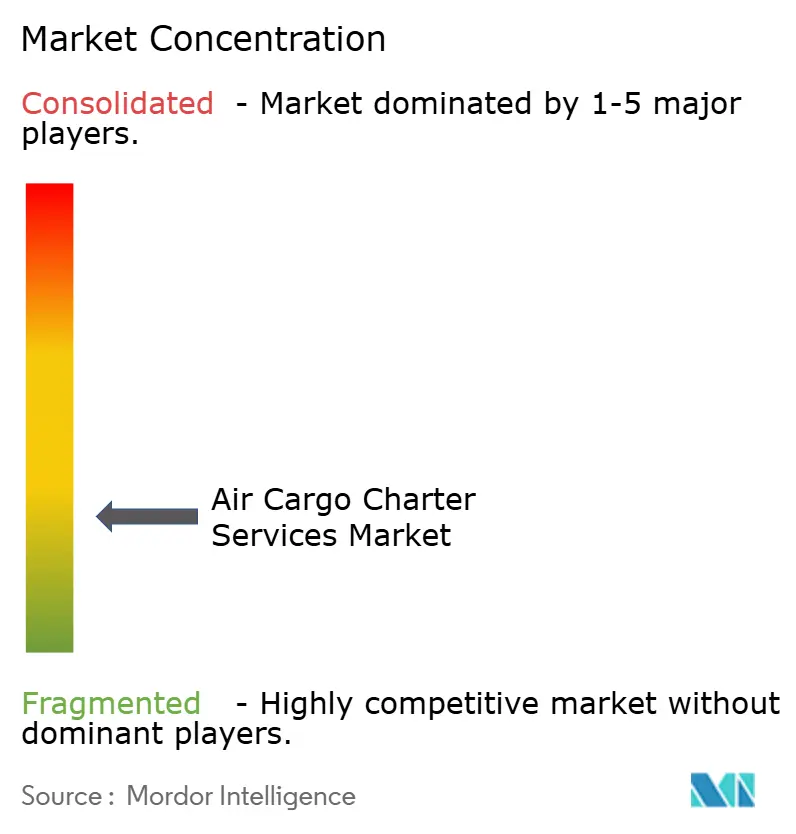
| Market Concentration | Low |
Major Players *Disclaimer: Major Players sorted in no particular order Image © Mordor Intelligence. Reuse requires attribution under CC BY 4.0. | |
Air Cargo Charter Services Market Analysis by Mordor Intelligence
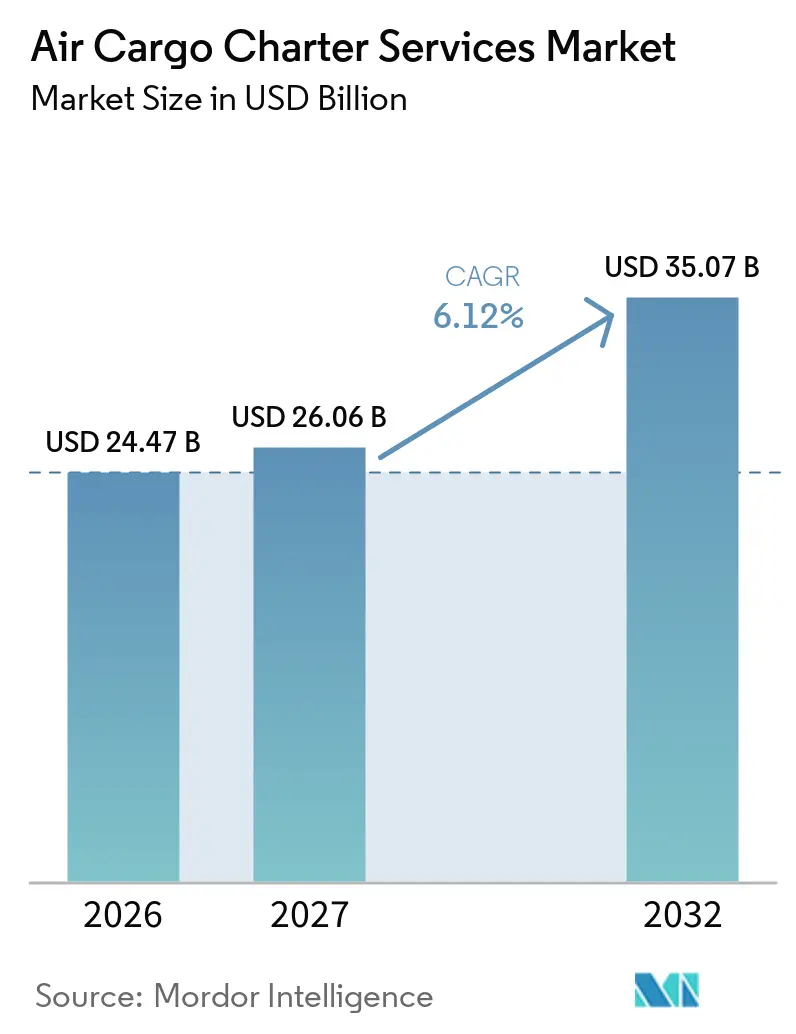
The air cargo charter services market size is valued at USD 24.47 billion in 2026 and is estimated to grow from USD 26.06 billion in 2027 to reach USD 35.07 billion by 2032, at a CAGR of 6.12% during the forecast period (2027-2032).
The air cargo charter services market is becoming a regular part of logistics planning rather than a service used only during emergencies. Demand comes from pharmaceutical shipments, urgent industrial cargo, e-commerce overflow, and humanitarian operations, which reduces reliance on a single customer group. Dedicated capacity is more valuable where scheduled freight networks have limited space or cannot provide assured departure times. Operators with suitable freighter aircraft, traffic rights, and compliant handling networks can protect their position on complex international routes. Higher fuel costs, limited widebody freighter availability, customs procedures, and dangerous-goods requirements remain material limits on the air cargo charter services market.
Key Report Takeaways
- By service type, on-demand full aircraft charter held 35.80% of the air cargo charter services market share in 2026, while dedicated/blocked capacity charter is forecast to expand at a 7.65% CAGR through 2032.
- By destination, international charter accounted for 67.50% of the air cargo charter services market size in 2026, while domestic charter is forecast to advance at a 7.81% CAGR through 2032.
- By product category, industrial goods held 23.10% of the air cargo charter services market share in 2026, while e-commerce is forecast to expand at an 8.12% CAGR through 2032.
- By geography, Asia-Pacific held 31.60% of total revenue in 2026, while Asia-Pacific is forecast to register at a 7.95% CAGR through 2032.
Note: Market numbers in this report are based on Mordor Intelligence's proprietary estimation framework, which combines nine months of actuals with Q4 projections for base year 2026.
Global Air Cargo Charter Services Market Trends and Insights
Drivers Impact Analysis*
| Driver | (~) % Impact on CAGR Forecast | Geographic Relevance | Impact Timeline |
|---|---|---|---|
| Rapid Growth in E-Commerce and Time-Critical Delivery Requirements | +1.2% | Global, concentrated in Asia-Pacific, North America, and Western Europe | Short term (≤ 2 years) |
| Growing Demand for Pharmaceutical, Biologics, and Temperature-Controlled Air Freight | +0.9% | Global, strongest in North America, Europe, and Asia-Pacific | Medium term (2-4 years) |
| Supply-Chain Resilience and Diversification of Freight Transport | +0.8% | Global, with early gains in North America, Europe, and Southeast Asia | Medium term (2-4 years) |
| Expansion of Cross-Border Manufacturing and High-Value Industrial Shipments | +0.7% | Global, strongest in Asia-Pacific, Middle East and Africa, and Europe | Medium term (2-4 years) |
| Increasing Requirements for Emergency, Humanitarian, and Defense Airlift | +0.6% | Global, concentrated in Middle East and Africa, South America, and Southeast Asia | Short term (≤ 2 years) |
| Digitalization of Charter Procurement and Real-Time Capacity Matching | +0.5% | Global, with early adoption in North America and Western Europe | Long term (≥ 4 years) |
| Source: Mordor Intelligence | |||
Rapid Growth in E-Commerce and Time-Critical Delivery Requirements
Cross-border e-commerce supports the air cargo charter services market when scheduled line-haul capacity is full or disrupted. Low-value parcels from China have moderated after regulatory changes in the United States and Europe. Demand is moving toward higher-value platform orders for consumer electronics, luxury goods, and specialty health products that have guaranteed delivery requirements. IATA states that 80% of cross-border e-commerce goods move by air, which keeps air transport central to this trade[1]. Vietnam, Thailand, and Malaysia are becoming important fulfillment origins as sourcing broadens across Southeast Asia. This shift creates new charter corridors before scheduled freight networks fully adjust to the new origin locations.
Growing Demand for Pharmaceutical, Biologics, and Temperature-Controlled Air Freight
Pharmaceutical and biologic shipments are a high-value part of the air cargo charter services market because they need controlled handling and reliable delivery. Cell and gene therapies, mRNA-based vaccines, and clinical-trial materials can require temperatures between 2 °C and 8 °C or cryogenic conditions. Patient-specific shipments also have delivery windows that make standard freight services unsuitable on many routes. DHL expanded its airfreight cold-chain network in February 2026, including a temperature-controlled Brussels to Cincinnati corridor and a EUR 2 billion (USD 2.35 billion) investment in health logistics infrastructure[2]. Dedicated charter capacity supports the documented handling and chain-of-custody requirements expected for sensitive healthcare cargo. Growth in biologics production in India, Singapore, and Brazil also supports demand on routes with limited GDP-compliant scheduled freighter options.
Supply-Chain Resilience and Diversification of Freight Transport
The air cargo charter services market benefits as companies move from single-source purchasing toward supply chains with more than one origin. Charter aircraft serve as an emergency bridge when road, sea, or scheduled air routes fail. Manufacturers can face high costs when a production line stops because a needed component does not arrive. This has encouraged freight forwarders to use longer-term dedicated freighter agreements instead of relying only on spot procurement. Red Sea disruptions, Middle East airspace restrictions, and European road transport blockades in 2025 and 2026 reinforced the need for alternative freight capacity. More regular agreements can make charter volumes steadier across the year and reduce dependence on seasonal demand.
Expansion of Cross-Border Manufacturing and High-Value Industrial Shipments
High-value industrial cargo strengthens the air cargo charter services market because delivery delays can interrupt production or trigger contractual penalties. Automotive parts, aerospace assemblies, semiconductor equipment, and data-center hardware often need fixed delivery times. Some loads also have dimensions or handling needs that are difficult to accommodate on standard freight services. Nippon Express Holdings created a Global Charter Desk in July 2026 to coordinate urgent automotive, semiconductor, and aerospace requirements across its network[3]. The development shows that large logistics groups are treating charter procurement as a managed capability rather than an occasional transaction. Manufacturing expansion in Southeast Asia, the Middle East, and Africa also creates component flows on routes with limited established freighter service.
Restraints Impact Analysis*
| Restraint | (~) % Impact on CAGR Forecast | Geographic Relevance | Impact Timeline |
|---|---|---|---|
| Volatile Aviation Fuel Prices and High Aircraft Operating Costs | -1.4% | Global, most acute in Middle East and Asia-Pacific | Short term (≤ 2 years) |
| Geopolitical Uncertainty, Airspace Restrictions, and Extended Flight Routes | -0.9% | Global, concentrated in Middle East, Eastern Europe, and Central Asia | Short term (≤ 2 years) |
| Complex Regulatory, Customs, and Dangerous-Goods Compliance Requirements | -0.5% | Global, heightened on Middle East and Africa and Asia-Pacific cross-border lanes | Medium term (2-4 years) |
| Limited Availability of Suitable Freighter Aircraft and Payload Capacity | -0.7% | Global, most acute on transatlantic and transpacific widebody routes | Medium term (2-4 years) |
| Source: Mordor Intelligence | |||
Volatile Aviation Fuel Prices and High Aircraft Operating Costs
Fuel is a major near-term cost for the air cargo charter services market. IATA reported that fuel represented 31.4% of airline operating costs in 2026, compared with 25.4% in 2025[4]. Charter operators are exposed to spot fuel costs more directly than carriers that use broad hedging programs. Shorter quotation windows and fuel surcharges are, therefore, becoming common in charter contracts. Pharmaceutical and defense customers can usually absorb higher charges more readily than discretionary industrial shippers. Sustained cost pressure also gives newer aircraft better relative economics, including the Airbus A350F.
Geopolitical Uncertainty, Airspace Restrictions, and Extended Flight Routes
Airspace restrictions raise fuel use, crew costs, and planning complexity across the air cargo charter services market. Closures over Iran, Iraq, Jordan, and Israel in June 2025 forced operators to use longer routes through Turkey, Azerbaijan, and Central Asia. This added transit time on affected East-West routes and complicated aircraft positioning. Operators can also face lower payloads when extra fuel is required, disruption at alternative hubs, and higher war-risk insurance costs. Scheduled carriers may impose embargoes on affected routes, which can create temporary charter demand but do not remove the added operating costs. Continued disruption can lead shippers to lower inventory exposure and use different supply routes over time.
*Our forecasts treat driver/restraint impacts as directional, not additive. The impact forecasts reflect baseline growth, mix effects, and variable interactions.
Segment Analysis
By Service Type: Dedicated Capacity Models Gain Structural Momentum
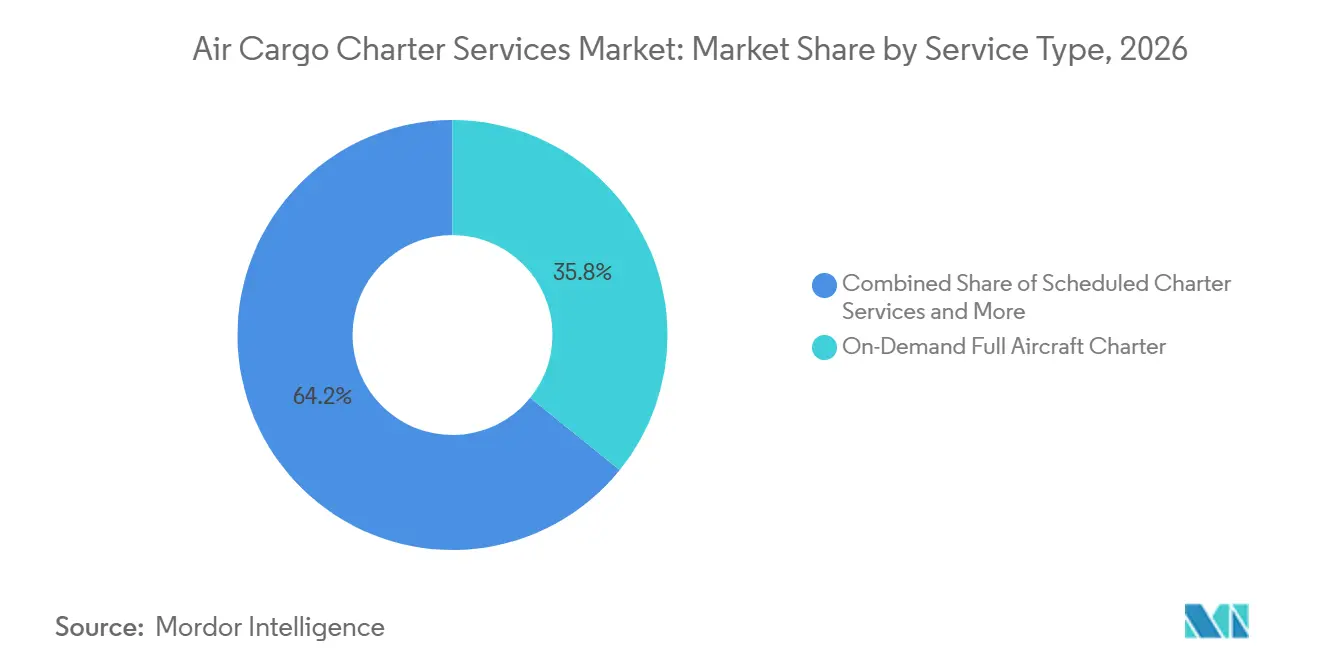
On-demand full aircraft charter held 35.80% of the air cargo charter services market share in 2026. It serves unplanned requirements that arise from production stoppages, humanitarian emergencies, and geopolitical disruptions. The model can accommodate many cargo types, routes, and schedules when other freight options are unavailable. This flexibility makes it an important option for urgent logistics decisions. Part or split charter serves mid-weight shipments that do not fill a complete aircraft but cannot wait for scheduled freight. Pharmaceutical distributors use this model for smaller consignments on established lanes. Automotive suppliers also use it when just-in-time inventory gaps require immediate action. Scheduled charter services serve high-volume transpacific and transatlantic lanes where customers need regular frequency. These services can offer routing flexibility outside conventional airline freight contracts.
Dedicated/blocked capacity charter is the fastest-growing service type, with a projected CAGR of 7.65% through 2032. Its growth reflects the value of assured aircraft availability for frequent shippers in a constrained freighter fleet. Pre-committed capacity reduces spot-market availability risk when shipments cannot be delayed. This approach changes charter from a transactional purchase into a planned supply-chain resource. Long-term agreements can provide more predictable costs and route access for freight forwarders. Fleet constraints also increase the value of contracts that secure aircraft time before an urgent requirement occurs. The air cargo charter services industry is moving toward these recurring capacity arrangements where volume and urgency justify the commitment. The model remains most suitable for companies that can forecast recurring critical movements. It does not replace on-demand charter for irregular or emergency shipments.

By Destination: Domestic Charter Accelerates on Infrastructure Gaps and Emergency Demand
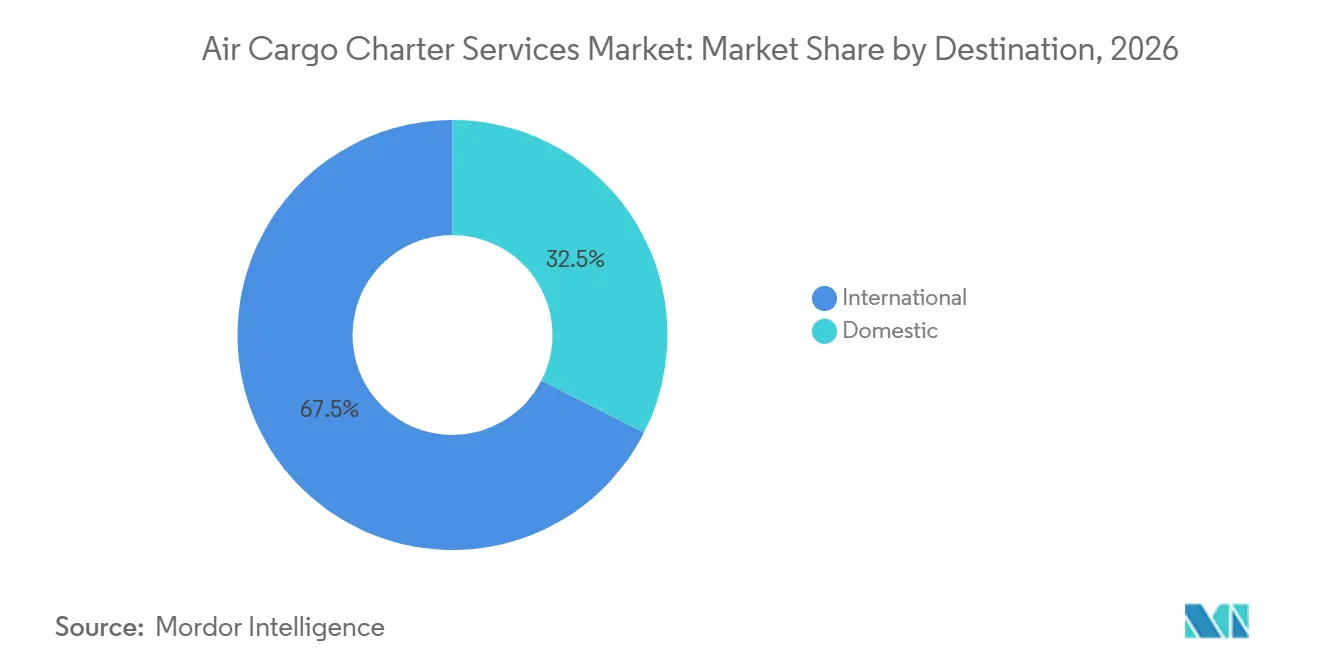
International charter accounted for 67.50% of the air cargo charter services market size in 2026. Intercontinental lanes produce high revenue per aircraft utilization on Asia to North America, Asia to Europe, and the Middle East to Europe routes. Pharmaceuticals, automotive parts, and data-center hardware can justify the cost of premium international freight. International routes require operators to manage customs rules, airspace administration, ground handling, and documentation across several jurisdictions. These requirements favor established operators with dependable local relationships. The resulting barriers can support the pricing position of incumbent providers. Intercontinental charter demand is also less sensitive to price where cargo delays have substantial operational costs. This gives international activity a relatively stable base in rate-sensitive conditions. It also makes regulatory capability an important part of service quality.
Domestic charter is forecast to expand at a 7.81% CAGR through 2032. Growth is linked to healthcare distribution, emergency airlift, and e-commerce delivery needs that exceed surface transport capacity in large countries. The grounding of the MD-11 fleet in late 2025 prompted United States integrators to seek replacement capacity from partner carriers on domestic routes. India and Brazil need faster connections to secondary cities where road and rail networks do not always support urgent healthcare or fulfillment requirements. Australia also has persistent demand for medical supplies, mining equipment, and industrial components destined for remote locations. Domestic networks can address cargo needs that do not require international customs procedures. They remain particularly useful when infrastructure gaps increase the cost of transport delays. The air cargo charter services market can, therefore, gain from local logistics constraints as well as cross-border trade. The service is most relevant where time-sensitive cargo has limited viable alternatives.
By Product Category: Industrial Goods Lead by Share, E-Commerce and High-Tech Drive Forward Growth
Industrial goods held 23.10% of the air cargo charter services market share in 2026. Just-in-time manufacturing gives this category a strong economic case because a missing component can halt a production line. Automotive components, aerospace items, and specialized production equipment often carry delivery deadlines that outweigh charter costs. European automotive networks create recurring requirements when weather, labor actions, or infrastructure failures interrupt cross-border component flows. Fresh produce and other perishables provide steady charter revenue on routes from South America, Africa, and Southeast Asia to Europe and Gulf markets. Shelf-life limits make slower surface transport unsuitable for these cargoes. Healthcare and pharmaceutical cargo is also reshaping handling standards through demand for reliable cold-chain performance. Each category requires operators to match aircraft, handling, and routing to the cargo profile. This breadth of needs supports diverse revenue sources for providers.
E-commerce is the fastest-growing product category, with a projected CAGR of 8.12% through 2032. Policy changes in the United States and Europe have reduced the role of very low-value parcel flows. Higher-value and lower-volume orders are becoming more important for charter demand. Electronics manufacturing in Vietnam, Thailand, and Malaysia is creating new routes that scheduled networks do not yet fully serve. High-tech equipment also needs reliable capacity where production or installation schedules cannot change. The Others category includes energy cargo, satellite equipment, and government defense shipments. These shipments provide a noncyclical revenue base that is less tied to consumer demand. This mix can reduce revenue swings in the air cargo charter services industry. It also requires providers to maintain specialized operational and compliance capabilities.
Geography Analysis
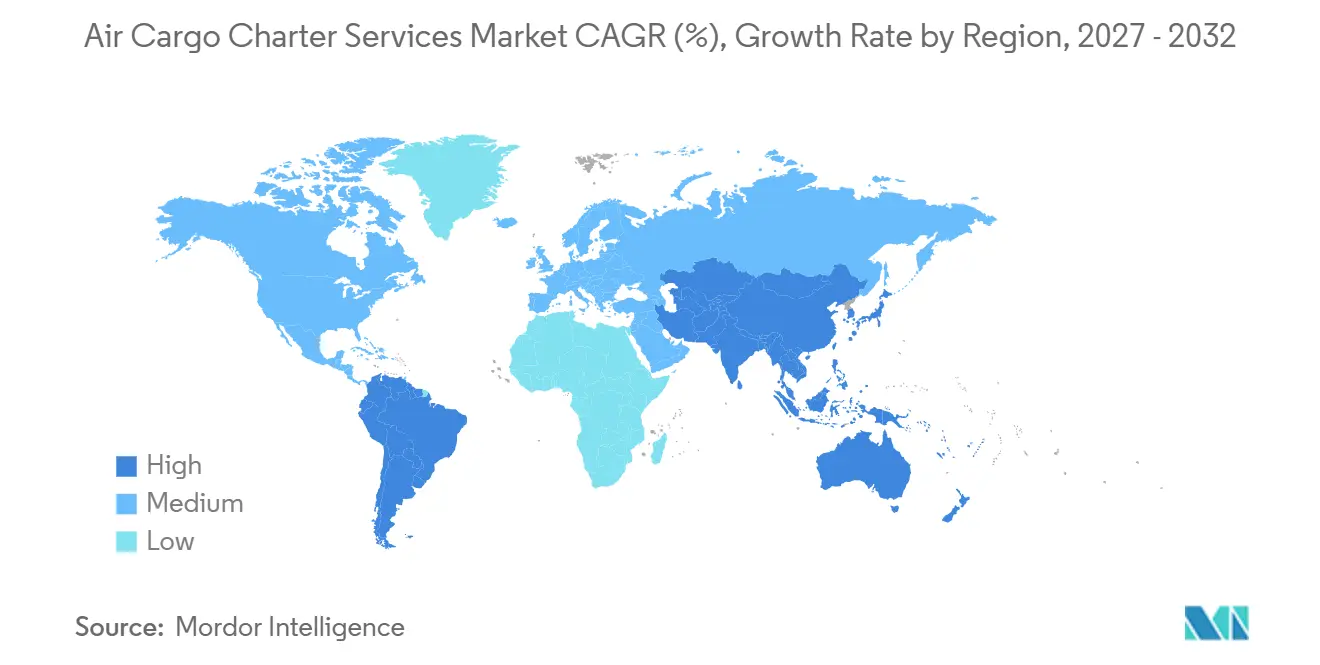
Asia-Pacific held 31.60% of the air cargo charter services market share in 2026 and is expected to register a 7.95% CAGR through 2032. The region concentrates high-urgency cargo such as advanced chips from Taiwan, AI server components from South Korea, Southeast Asian assembly hubs, and pharmaceutical active ingredients from India. These loads have limited tolerance for delivery uncertainty. Middle East disruption has also redirected traffic through Asian airspace corridors. Vietnam, Thailand, and Malaysia are gaining importance as technology companies diversify their sourcing. North America is the second-largest geography because of its pharmaceutical clusters, automotive supply chains, and the United States integrator demand. The late-2025 MD-11 grounding increased the need for replacement capacity across domestic and international operations.
Europe supports the air cargo charter services market through pharmaceutical supply chains and automotive production networks. Healthcare shippers use dedicated charters when scheduled freight cannot meet GDP-compliant handling needs for biologics, vaccines, and temperature-sensitive therapies. The Middle East and Africa have a divided regional profile. Gulf carriers use central hubs to connect Europe, Asia, and Africa through extensive cargo networks. African markets generate demand for humanitarian, pharmaceutical, and resource-sector airlift, where infrastructure constraints limit other urgent transport options. Airspace disruption in 2025 raised rerouting costs and put pressure on schedule reliability for Gulf operators. Demand remained high, but the operational burden limited the benefit of additional volumes.
South America is gaining importance as a cargo origin and a humanitarian airlift destination. Brazil is expanding domestic charter requirements for healthcare and e-commerce distribution to secondary cities. Chile, Peru, and Argentina generate perishables traffic to Europe and the Middle East markets during defined harvest periods. These harvest windows support predictable seasonal charter movements on transatlantic lanes. Colombia and Peru received emergency airlift after natural disasters in 2025 and 2026. Argentina also creates project-cargo demand from energy and mining operations. These needs are less dependent on consumer spending patterns. Direct charter connections with Asian and European markets are developing gradually. This can reduce reliance on North American hubs for regional exporters. It can also improve route options for time-sensitive cargo.
Competitive Landscape
The air cargo charter services market is moderately fragmented among full-freighter operators and more fragmented among brokers, freight forwarders, and technology platforms. Operators with widebody fleets, global traffic rights, and broad route coverage have the strongest position. The new large freighter supply is limited, which raises the value of aircraft access and supports charter yields. Atlas Air Worldwide ordered 20 Airbus A350F freighters in March 2026, securing delivery positions from 2029 through 2034. The aircraft is also designed to meet the International Civil Aviation Organization’s 2027 CO₂ emissions standards. The order strengthens Atlas Air’s long-term fleet position in a supply-constrained market. Emirates SkyCargo expanded its freighter destination network from 40 to more than 60 locations within 1 year, strengthening its geographic reach.
Freight forwarders are building dedicated freighter programs through long-term agreements with carriers. This gives them greater control over high-volume routes and can reduce the spot business available to independent brokers. Digital platforms are also shortening quotation and capacity-matching processes. Cargojet integrated a dedicated charter management application in March 2025, which reduced charter request processing time by roughly two-thirds. This type of workflow tool can make charter procurement easier for customers while reducing the value of manual brokerage. Cargojet later expanded its Canada to Europe network with a mid-week Liege service in September 2026. The company described the service as part of its One Network strategy across domestic overnight, ACMI, and international charter operations. These moves show how established providers are combining aircraft access, network coverage, and operating systems.
Open opportunities remain in pharmaceutical cold-chain services on emerging-market routes, humanitarian airlift in sub-Saharan Africa and South Asia, and domestic networks in economies with infrastructure gaps. Providers need compliant handling, reliable aircraft access, and strong local coordination to serve these areas. Competition is expected to remain shaped by fleet availability, contracted capacity, and the ability to manage operational disruption.
Air Cargo Charter Services Industry Leaders
-
FedEx Corporation
-
United Parcel Service, Inc.
-
DHL Group
-
Emirates SkyCargo
-
Atlas Air Worldwide Holdings, Inc.
- *Disclaimer: Major Players sorted in no particular order
Recent Industry Developments
- September 2026: Cargojet Inc. launched a new mid-week Wednesday service to Liege, Belgium, expanding its Canada-Europe capacity and advancing its One Network strategy, integrating domestic overnight, ACMI, and international charter operations across an expanding global network.
- July 2026: Nippon Express Holdings launched its "Global Charter Desk," a centralized air charter management hub consolidating NX Group demand to provide economies of scale and coordinated rapid responses across automotive, semiconductor, and aerospace verticals.
- July 2026: Challenge Group launched three-times-weekly Boeing 777-300ERSF services from Liege to Shanghai Pudong and simultaneously upgraded its Liege–Mumbai route from 767 to 777-300ERSF operations, delivering a material uplift in Asia-Europe cargo capacity from its Belgian hub.
- June 2026: Kuehne+Nagel added Frankfurt to its transatlantic B747-8F rotation connecting Chicago, Frankfurt, and Atlanta under a long-term Atlas Air charter agreement, strengthening pharmaceutical and industrial goods connectivity between two major transatlantic hubs.
Global Air Cargo Charter Services Market Report Scope
| On-Demand Full Aircraft Charter |
| Part / Split Charter |
| Scheduled Charter Services |
| Dedicated / Blocked Capacity Charter |
| Domestic |
| International |
| Fresh Produce and Perishable Goods |
| Industrial Goods (Automotive Parts and Components, etc.) |
| E-Commerce |
| Healthcare and Pharmaceuticals |
| Electronics and High-Tech |
| Others |
| North America | United States |
| Canada | |
| Mexico | |
| South America | Brazil |
| Argentina | |
| Peru | |
| Chile | |
| Rest of South America | |
| Europe | Germany |
| United Kingdom | |
| France | |
| Italy | |
| Spain | |
| Russia | |
| Nordics (Denmark, Finland, Iceland, Norway, and Sweden) | |
| Rest of Europe | |
| Asia-Pacific | China |
| India | |
| Japan | |
| South Korea | |
| Australia | |
| Southeast Asia (ASEAN) | |
| Rest of Asia-Pacific | |
| Middle East and Africa | Saudi Arabia |
| United Arab Emirates | |
| Qatar | |
| South Africa | |
| Nigeria | |
| Egypt | |
| Rest of Middle East and Africa |
| By Service Type | On-Demand Full Aircraft Charter | |
| Part / Split Charter | ||
| Scheduled Charter Services | ||
| Dedicated / Blocked Capacity Charter | ||
| By Destination | Domestic | |
| International | ||
| By Product Category | Fresh Produce and Perishable Goods | |
| Industrial Goods (Automotive Parts and Components, etc.) | ||
| E-Commerce | ||
| Healthcare and Pharmaceuticals | ||
| Electronics and High-Tech | ||
| Others | ||
| By Geography | North America | United States |
| Canada | ||
| Mexico | ||
| South America | Brazil | |
| Argentina | ||
| Peru | ||
| Chile | ||
| Rest of South America | ||
| Europe | Germany | |
| United Kingdom | ||
| France | ||
| Italy | ||
| Spain | ||
| Russia | ||
| Nordics (Denmark, Finland, Iceland, Norway, and Sweden) | ||
| Rest of Europe | ||
| Asia-Pacific | China | |
| India | ||
| Japan | ||
| South Korea | ||
| Australia | ||
| Southeast Asia (ASEAN) | ||
| Rest of Asia-Pacific | ||
| Middle East and Africa | Saudi Arabia | |
| United Arab Emirates | ||
| Qatar | ||
| South Africa | ||
| Nigeria | ||
| Egypt | ||
| Rest of Middle East and Africa | ||
Key Questions Answered in the Report
What is the projected value of air cargo charter services by 2032?
The sector is projected to reach USD 35.07 billion by 2032, growing at a 6.12% CAGR from 2027 to 2032.
Which service type is growing fastest in air cargo charter services?
Dedicated or blocked capacity charter is projected to grow at a 7.65% CAGR through 2032 because frequent shippers value guaranteed aircraft access.
Why do pharmaceutical companies use dedicated cargo charters?
Sensitive therapies and clinical materials need temperature control, documented handling, and dependable delivery times that scheduled freight may not provide.
Which destination segment has the largest share?
International charter held 67.50% of revenue in 2026, supported by high-value intercontinental cargo.
Which product category is forecast to grow fastest?
E-commerce is forecast to grow at an 8.12% CAGR through 2032 as higher-value, time-sensitive orders become more important.
What are the main constraints on charter operators?
Higher fuel costs, longer routes caused by airspace restrictions, compliance needs, and limited widebody freighter availability can increase operating costs and reduce capacity.