
AI-Based Defect Detection Software Market Size and Share
Market Overview
| Study Period | 2020 - 2031 |
|---|---|
| Market Size (2026) | USD 1.24 Billion |
| Market Size (2031) | USD 2.26 Billion |
| Growth Rate (2026 - 2031) | 12.76 % |
| Fastest Growing Market | Africa |
| Largest Market | North America |
| Market Concentration | Medium |
Major Players *Disclaimer: Major Players sorted in no particular order Image © Mordor Intelligence. Reuse requires attribution under CC BY 4.0. | |
AI-Based Defect Detection Software Market Analysis by Mordor Intelligence
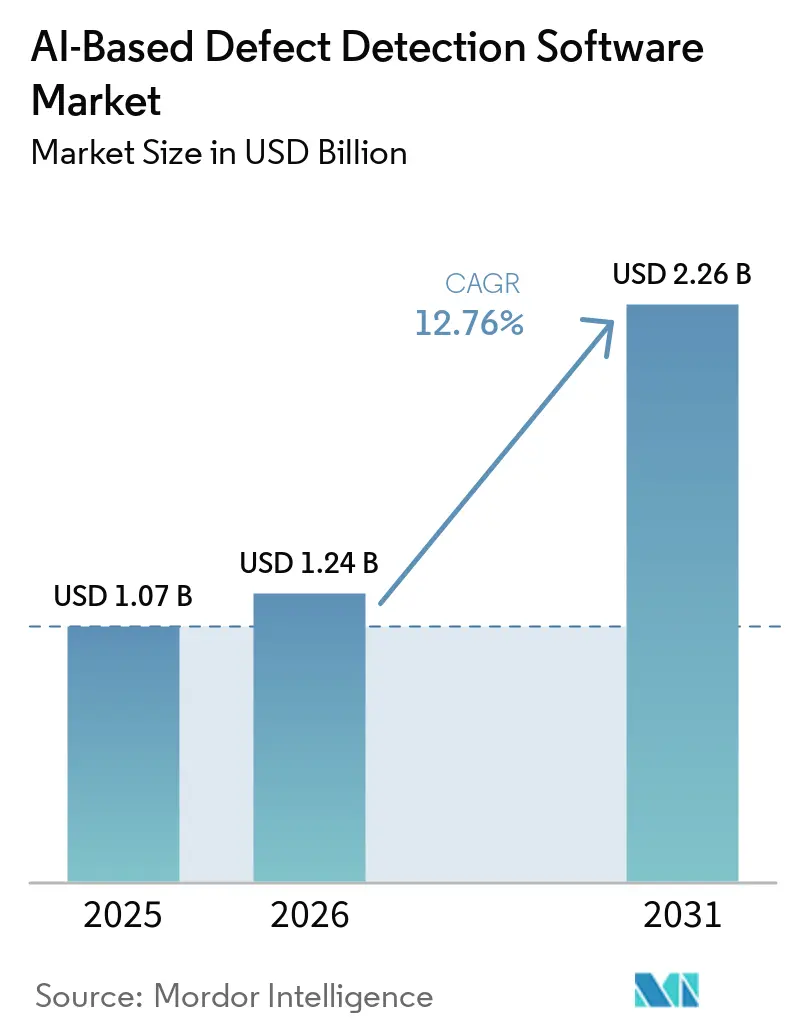
The AI-based defect detection software market size was USD 1.07 billion in 2025, and USD 1.24 billion in 2026, and is forecast to reach USD 2.26 billion by 2031, growing at a CAGR of 12.76% over 2026-2031. The AI-based defect detection software market is moving from separate pilot projects to wider deployment across production sites, making centralized model management and reliable integration more important. Manufacturers are placing greater value on software that links visual inspection results with quality records and operating decisions. Demand is strongest where missed defects carry high yield, safety, or compliance costs, especially in electronics, semiconductors, EVs, and batteries. Established suppliers are combining cameras, computing, software, and support, while newer vendors focus on hardware-neutral deployment and simpler model training. This creates opportunities for suppliers that can reduce validation work without weakening inspection performance, especially when quality teams must document decisions for internal review and external audits.
Key Report Takeaways
- By commercial form factor, integrated AI vision systems held 36.57% of the AI-based defect detection software market share in 2025, while AI vision platforms and APIs are projected to expand at a 15.64% CAGR through 2031.
- By deployment architecture, edge and embedded AI held 39.28% of the AI-based defect detection software market share in 2025, while cloud and SaaS are projected to expand at a 16.02% CAGR through 2031, as manufacturers seek a practical way to govern growing fleets of inspection models across facilities.
- By component, software held 76.07% revenue share in 2025 and is projected to grow at a 13.32% CAGR through 2031 in the AI-based defect detection software market.
- By application, defect detection accounted for 26.41% of revenue in 2025 in the AI-based defect detection software market, while assembly verification is projected to expand at a 15.27% CAGR through 2031.
- By end-user industry, electronics and semiconductor held 25.47% revenue share in 2025, while EV and battery manufacturing is projected to expand at a 16.86% CAGR through 2031 in the AI-based defect detection software market.
- By geography, North America held 33.12% revenue share in 2025, while Africa is projected to expand at a 14.37% CAGR through 2031 in the AI-based defect detection software market.
Note: Market size and forecast figures in this report are generated using Mordor Intelligence’s proprietary estimation framework, updated with the latest available data and insights as of January 2026.
Market Trends and Insights
Drivers Impact Analysis of AI-Based Defect Detection Software Market*
| DRIVER | (~) % IMPACT ON CAGR FORECAST | GEOGRAPHIC RELEVANCE | IMPACT TIMELINE |
|---|---|---|---|
| Deep Learning Accuracy and Classification Gains | +3.8% | Global | Short term (≤ 2 years) |
| EV and Battery Manufacturing Quality Requirements | +2.9% | Global, with APAC core and spill-over to Europe and North America | Short term (≤ 2 years) |
| Labor Shortages in Quality Inspection | +2.1% | North America, Europe, Japan | Medium term (2-4 years) |
| Digital Factory and Industry 4.0 Investment | +1.7% | Global | Medium term (2-4 years) |
| Synthetic Defect Data Reducing Rare-Fault Bottlenecks | +1.1% | Global | Medium term (2-4 years) |
| Air-Gapped Inspection for Sovereign Quality Data | +0.7% | North America, Europe, Middle East | Long term (≥ 4 years) |
| Source: Mordor Intelligence | |||
Deep Learning Accuracy and Classification Gains
The AI-based defect detection software market benefits as transformer and foundation-model approaches improve recognition of complex defect shapes, especially in variable production environments. A 2026 review found that transformer models can use broader image context for complex geometries, while convolutional neural networks retain value for local feature extraction, and YOLO variants support high-speed lines with performance tradeoffs. A semiconductor inspection study reported 98.7% overall accuracy and a 93.5% F1-score using decision-level fusion, while reducing inspection time from 17.7 seconds to 1.5 seconds per unit. These results move buyer attention beyond basic detection accuracy toward training efficiency, deployment time, and stability across changing production conditions in the AI-based defect detection software market. Cognex made OneVision generally available in May 2026, and customers reported higher yield, fewer false rejections, and faster project completion after using centrally managed models. NIST identifies heterogeneous sensing and control integration, trustworthy behavior, and explainability as continuing priorities for smart-manufacturing AI.[1]
EV and Battery Manufacturing Quality Requirements
Battery production requires inspection at each stage, from electrode fabrication through cell assembly and final testing. A 2026 review of NDE 4.0 concluded that in-line AI vision is the method capable of supporting complete inspection coverage at production-line cycle times. BMW has described AI-supported quality checks at every production stage in its Neue Klasse battery program, including inspection of each battery pack at the end of the line. LG Energy Solution states that it uses AI-based quality control and prepares for standards before customers formally require them. Atlas Copco reported AI-based in-line verification in battery assembly that triggers corrective action for missing or misaligned components before batteries move downstream. This raises the value of systems that combine image-based decisions with traceable quality records and production workflows, rather than treating visual inspection as a stand-alone machine function.
Labor Shortages in Quality Inspection
Labor shortages are making manual inspection harder to sustain across continuous production schedules. In a 2025 survey, 70% of U.S. respondents and 72% of U.K. respondents reported labor shortages, while 88% and 90%, respectively, said the shortage had affected product or service quality. A ZEISS survey of more than 1,100 U.S. manufacturing professionals found that 47% identified a lack of skilled personnel as a top challenge.[2] The same pressure makes automated defect spotting a practical application because it can reduce repetitive review work and provide more consistent decisions across shifts. Quality teams can then focus on exception handling, root-cause analysis, and model validation rather than routine visual checks, where their process knowledge can have a greater operational effect. The AI-based defect detection software market therefore gains where buyers need to maintain output without expanding specialized inspection teams, particularly in plants operating continuous schedules with limited experienced labor.
Digital Factory and Industry 4.0 Investment
The AI-based defect detection software market is supported by investment in connected factory systems that collect, exchange, and use production data, improving the practical case for linked inspection workflows in the AI-based defect detection software market. More than 90% of respondents to a 2026 Manufacturing Leadership Council survey planned to maintain or increase smart-factory and production-technology investment during the year. Connected factories need inspection outputs that fit into the same data environment as equipment status, quality records, and process controls. That need favors integrated vision systems when factories seek validated connections to their existing automation platforms. It also supports platform software that manages models across lines and sites without requiring each location to work separately. Cybersecurity investment remains important because connected inspection expands the number of systems exchanging production information, including images, quality records, model versions, and equipment status.
Restraints Impact Analysis of AI-Based Defect Detection Software Market*
| RESTRAINT | (~) % IMPACT ON CAGR FORECAST | GEOGRAPHIC RELEVANCE | IMPACT TIMELINE |
|---|---|---|---|
| Labeled Data and Model Validation Burden | -1.8% | Global | Short term (≤ 2 years) |
| Legacy MES, ERP, and SCADA Integration Complexity | -1.4% | North America and Europe | Medium term (2-4 years) |
| Cybersecurity and Intellectual-Property Exposure | -1.1% | Global | Long term (≥ 4 years) |
| False-Reject Economics in High-Mix Production | -0.8% | Global | Medium term (2-4 years) |
| Source: Mordor Intelligence | |||
Labeled Data and Model Validation Burden
Many manufacturers lack enough labeled images of rare defects to train and validate a production-ready inspection model, a constraint that can delay adoption in the AI-based defect detection software market. A 2025 review identified limited, costly, and difficult-to-obtain labeled data as a major barrier to manufacturing AI, and assessed generative, diffusion, and physics-based approaches as responses. This problem is acute in low-volume, high-mix production, where defect rates can fall below 0.1% and each part variant needs its own coverage in the AI-based defect detection software market. NIST also identifies validation for trustworthy and reliable AI as a key issue in high-stakes industrial settings. A 2025 battery-weld study found that a classifier trained on synthetic images achieved 0.94 precision and 0.98 recall. Synthetic data can reduce the initial bottleneck, but buyers still need evidence that models work under actual lighting, material, and process conditions, including normal variation between shifts and sites.
Legacy MES, ERP, and SCADA Integration Complexity
Inspection models are only part of a working deployment because their decisions must be integrated into operational systems used for quality, production, and reporting. Manufacturers often need connections among programmable logic controllers, SCADA systems, manufacturing execution systems, enterprise resource planning systems, and historians. UnitX designed FleX to support more than 20 industrial protocols, illustrating the need for software that operates across fragmented installed environments. A defect label or confidence score may not match the fixed codes used by legacy scrap-accounting processes. This can create a review state that the receiving system cannot handle without configuration work, requiring operations, quality, and information-technology teams to agree on decisions before the line enters routine production. Smaller manufacturers and sites with older controls can face longer implementation periods and greater service needs before the software delivers value, even when the visual model itself is straightforward to train on.
*Our forecasts treat driver/restraint impacts as directional, not additive. The impact forecasts reflect baseline growth, mix effects, and variable interactions.
AI-Based Defect Detection Software Market Segment Analysis
By Commercial Form Factor:
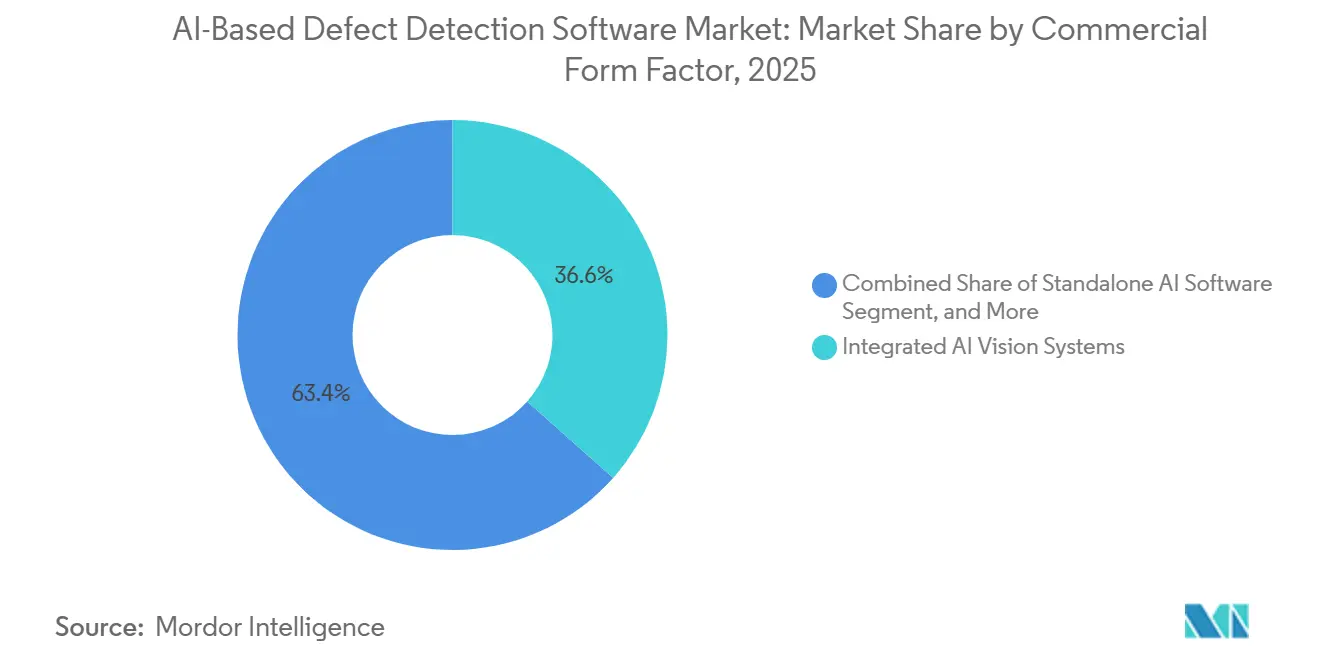
Platform APIs Reduce Dependence on Bundled HardwareIntegrated AI Vision Systems held 36.57% revenue share in 2025. Their position reflects a long-established base in electronics and automotive plants, where suppliers such as Cognex, Keyence, and SICK offer validated combinations of cameras, software, and industrial connectivity. These systems give buyers one accountable provider and reduce uncertainty during initial deployment, an advantage when the line cannot tolerate extensive testing after installation. They are especially relevant when high-speed operation, lighting control, and protocol support must work together from the start. The established suppliers also benefit from familiarity with plant engineering teams and acceptance procedures, which can reduce coordination work during commissioning and later maintenance across the AI-based defect detection software market.
AI Vision Platforms and APIs are projected to grow at a 15.64% CAGR through 2031, which makes them the fastest-growing commercial form factor in the AI-based defect detection software market. These offerings allow model training and deployment on existing camera infrastructure, reducing dependence on a single hardware ecosystem and protecting prior investments in suitable optical equipment. Cognex uses OneVision to manage models from cloud to edge across its hardware base. This helps manufacturers adapt inspection capacity to their own production layout rather than replace every device at once.[3] UnitX offers a central-edge design, an open software development kit, and broad protocol support for varied camera environments. Standalone software and inspection services remain relevant where manufacturers need an algorithm upgrade, model development, retraining, or validation support, particularly when internal teams lack machine-vision specialists or formal documentation resources.

By Deployment Architecture:
Edge Systems Keep Inspection Close to ProductionEdge and Embedded AI held 39.28% of revenue in 2025, making it the largest deployment architecture in the AI-based defect detection software market. Manufacturers use edge systems for predictable, low-latency decisions on high-speed production lines, where a delayed response can turn a minor process issue into more scrap. Local processing also keeps images and quality data on-site, which can help meet data-residency requirements. This architecture is suited to applications where a delayed decision can allow a defective product to proceed to the next production step, creating avoidable rework and complicating root cause analysis for production teams, especially when defects cannot be corrected after assembly. It is also appropriate where network access is restricted or not permitted, allowing local teams to retain direct control over sensitive images and inspection decisions.
Cloud and SaaS are projected to expand at a 16.02% CAGR through 2031, as manufacturers seek a practical way to govern growing fleets of inspection models across facilities. Its role is strongest in image labeling, model version control, training, governance, and the management of models across many facilities, providing central teams with a consistent way to compare performance. Cognex offers cloud-to-edge model management through OneVision, while Landing AI uses its platform to support development and deployment on customer hardware. On-premise servers and hybrid edge-and-cloud systems serve facilities where centralized processing is useful but local inspection response remains necessary. Defense-adjacent electronics and critical infrastructure may require cloud-free arrangements because of contractual and cybersecurity obligations, which makes architecture selection a commercial requirement rather than a simple technical preference.
By Component:
Software Concentrates the Value of Inspection WorkflowsSoftware accounted for 76.07% of the AI-based defect detection software market size in 2025 and is forecast to grow at a 13.32% CAGR through 2031. This reflects the importance of algorithms, model lifecycle management, integration, and analysis across multiple lines and shifts. Software licenses can also support recurring revenue when customers need retraining, maintenance, and expanded deployment, particularly after product changes or process adjustments alter inspection conditions. The component holds the main workflow value because inspection performance depends on how images are interpreted, reviewed, stored, and linked to actions, rather than on image capture alone. This creates a stronger role for suppliers that can manage a full model lifecycle instead of supplying only a camera or compute unit, including retraining after materials, lighting, or product designs change.
Hardware remains important when new lines are commissioned, particularly in battery plants and semiconductor facilities. Smart cameras, edge computing units, and industrial lighting provide the image quality and processing capacity on which the software depends. Hardware faces more pressure where camera options become widely available, and software operates across multiple brands, shifting buyer attention toward compatibility, performance, and total implementation effort. Services cover model development, system integration, validation, and ongoing support, and they remain important for high-mix producers and newer adopters, because each site may require tailored image collection, acceptance testing, and operator training. A VDMA panel identified available data, stable image acquisition, and clear acceptance criteria as practical conditions for successful visual-inspection deployments.[4] Those requirements sustain demand for implementation expertise alongside the AI-based defect detection software industry’s software-led revenue model, because a well-designed algorithm still depends on stable imaging and clearly agreed inspection rules.
By Application:
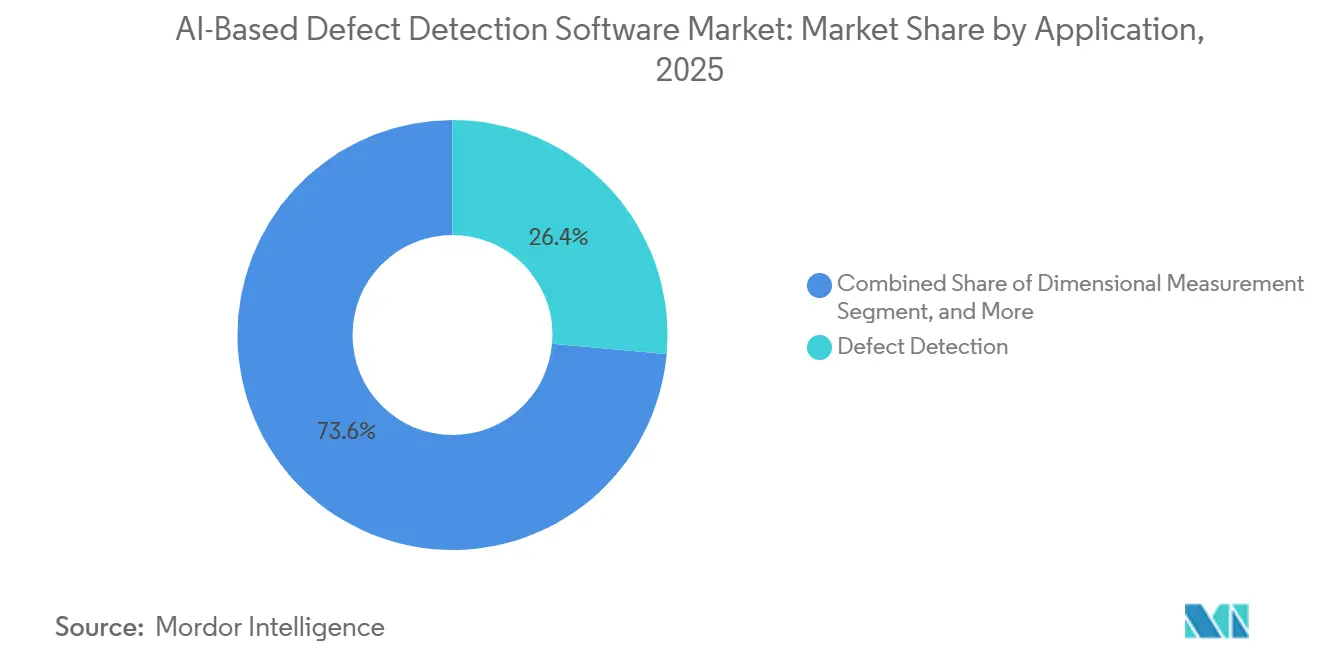
Defect Detection Holds Scale While Assembly Verification Gains GroundDefect Detection held 26.41% of revenue in 2025. It is widely used for surface checks in electronics, metal forming, and injection molding, where variable defect appearance can limit rule-based vision. A 2025 study reported AUROC scores of 97.4-98.3% for SuperSimpleNet across standard surface-defect benchmarks, with 9.5-millisecond inference time and throughput of 262 images per second. This combination of speed and detection performance supports use on production lines where inspection cannot slow throughput, while helping quality teams identify subtle patterns that fixed rules can miss in variable materials and changing surface conditions. The segment remains central because surface defects occur across many material types and manufacturing processes, allowing suppliers to apply their tools across factories that otherwise have very different equipment and products.
Assembly Verification is projected to grow at a 15.27% CAGR through 2031. EV and electronics producers are extending inspection from exterior surfaces to checks for connector seating, torque presence, solder quality, and component orientation, often before later assembly steps make a defect more difficult and costly to correct. The work often requires several decisions within one production sequence rather than a single pass-fail check, which increases the importance of reliable image handling and clear decision logic. Dimensional Measurement supports aerospace and precision automotive parts that require tight geometry control. Surface Inspection addresses metals, glass, and film substrates, while Packaging Inspection supports foreign-object detection and label verification in regulated consumer-product settings. Other applications, including optical character recognition and barcode verification, support component-level traceability across batches, helping manufacturers associate inspection outcomes with individual components, lots, and downstream quality records.
By End-User Industry:
Electronics Leads While EV and Battery Production AcceleratesElectronics and Semiconductor held 25.47% end-user industry share in 2025. Wafer yield pressure, advanced packaging, and new fabrication capacity increase the need for reliable inspection at several process points. Siemens completed its acquisition of Canopus AI in January 2026 and added AI-driven wafer and mask metrology to its Caliber computational lithography portfolio. The transaction targets tighter process control and faster yield ramp at advanced technology nodes, where small measurement differences can have material consequences for production results. Electronics manufacturers also use inspection for bare-board optical checks and post-reflow solder verification, where escaped defects can increase rework and yield losses, and where frequent product changes make adaptable models particularly valuable.
EV and Battery Manufacturing is projected to grow at a 16.86% CAGR through 2031, reinforcing its importance to the AI-based defect detection software market. OEM zero-defect requirements and safety-focused quality procedures increase the need for in-line verification throughout cell and pack production. Automotive manufacturing needs systems that can manage many product variants with limited retraining effort, because frequent component and configuration changes can otherwise create repeated engineering work. Pharmaceutical and medical-device buyers require formal validation, which can extend procurement but support deeper vendor relationships. Food and beverage manufacturers focus on contamination, packaging integrity, and label quality, where traceable checks can support internal quality procedures and required product information. Aerospace and defense applications often need air-gapped operation because of restricted data environments and program requirements, which gives vendors with secure local deployment options a clearer route into these projects.
Geography Analysis
North America AI-Based Defect Detection Software Market
North America held 33.12% of revenue in 2025. The region combines a high concentration of inspection suppliers with established semiconductor, automotive, and medical-device demand. Semiconductor construction supported by the CHIPS and Science Act increases need for wafer and packaging inspection from early facility design. FDA Computer Software Assurance guidance adds validation needs for life-sciences production and quality software, which makes documented testing and change control important parts of vendor selection. This favors suppliers that can provide documented validation methods and audit trails, helping procurement and quality teams assess the system’s use in regulated production settings. UnitX completed its first production deployments in Mexico in 2025, showing growing adoption in nearshoring automotive supply chains.
APAC AI-Based Defect Detection Software Market
Asia-Pacific is the largest manufacturing base for the AI-based defect detection software market’s two fastest-growing end-user areas, electronics and semiconductor production, and EV and battery manufacturing. China’s battery plants, South Korea’s cell makers, Japan’s precision supply chains, Taiwan’s semiconductor capacity, and India’s electronics zones create varied inspection requirements. LG Energy Solution has embedded AI-based quality control into production and works under IATF, VDA, and AIAG quality frameworks. Fraunhofer IZM demonstrated vision-language-model use in surface-mount-device inspection, which can reduce labeling work where product variety is high.[5]
EMEA and South America AI-Based Defect Detection Software Market
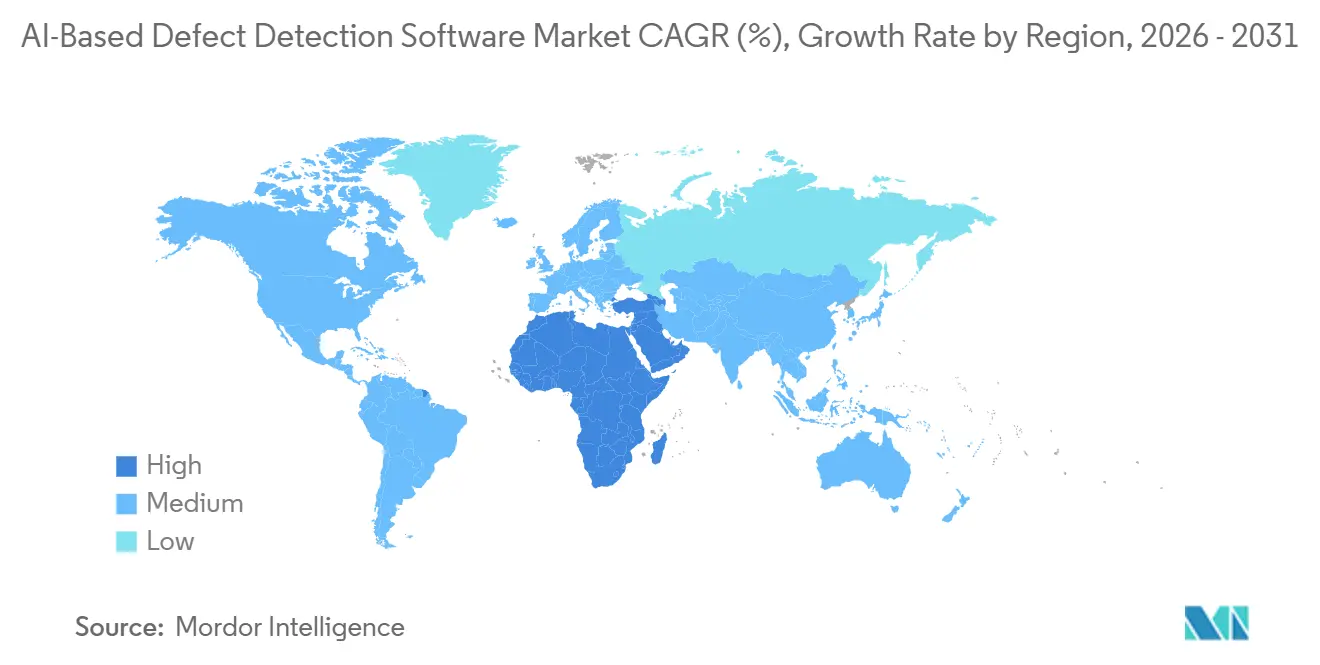
Africa is projected to expand at a 14.37% CAGR through 2031, the fastest regional rate in the AI-based defect detection software market. New manufacturing sites can adopt automated inspection without replacing a large base of legacy vision equipment, allowing quality requirements to be considered as part of initial line design. Europe remains a key research and supplier center, led by Germany’s machine-vision ecosystem and standards work. VDI, VDE, and VDMA guidance shapes acceptance criteria and responsibilities for machine-vision projects in European manufacturing. South America and the Middle East are smaller markets where industrial diversification supports early deployments in food, beverage, and petrochemical-adjacent operations.
Competitive Landscape
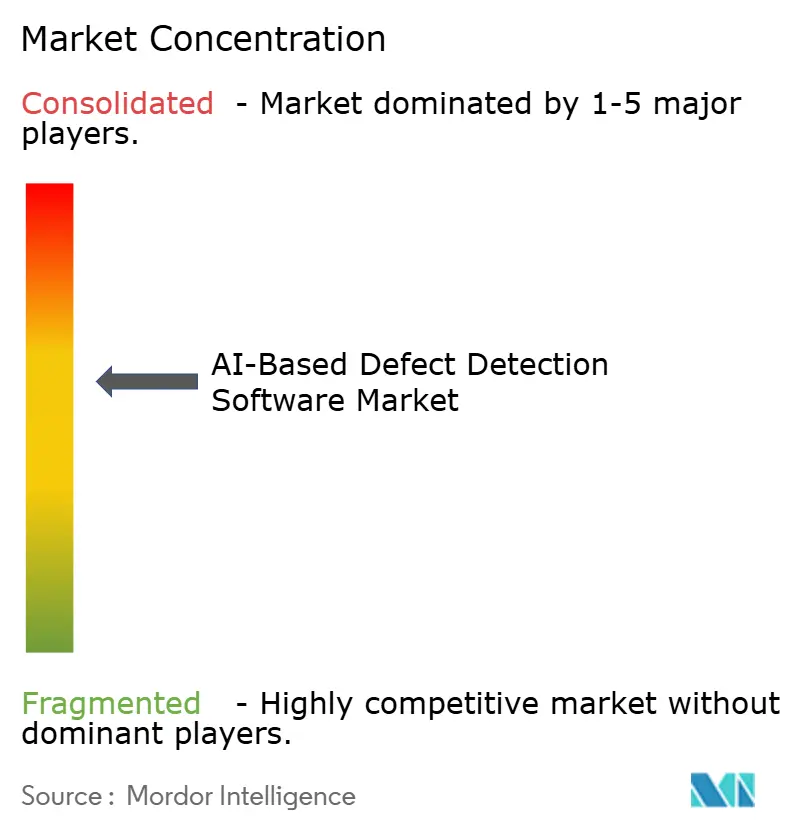
The AI-based defect detection software market is moderately consolidated among broad platform suppliers but remains fragmented across applications and regions. Cognex, Keyence, SICK, Siemens, and Omron have advantages from installed equipment, industrial-automation knowledge, and established customer relationships. Their offerings can connect cameras, software, and plant controls within a validated system, which is valuable when buyers seek a single operational view across equipment and quality workflows. Cognex launched the In-Sight 6900 Vision Controller in April 2026 with up to 157 TOPS of AI processing. In May 2026, it launched the In-Sight 3900 to support 25-megapixel inspection without external PC infrastructure.
Siemens strengthened its semiconductor position by acquiring Canopus AI in January 2026 and linking AI-driven metrology to its computational lithography portfolio. The move connects process simulation, measurement, and inspection for advanced-node fabs. Toshiba Digital Solutions released a new version of its AI Image Inspection Package in December 2025 with a patented method intended to suppress false positives while preserving inspection sensitivity. These investments address false-reject costs, which matter when many product variants pass through the same line and unnecessary rejection can disrupt output, rework, and material planning.
Software-focused suppliers compete by offering faster deployment, hardware flexibility, and lower training burdens. UnitX launched the DeteX smart camera in June 2026 and stated that it can be deployed in 1 minute without vision-engineering expertise. Landing AI, Matroid, and MVTec offer no-code or low-code environments that help quality teams build detectors on existing camera hardware. High-mix, low-volume producers and smaller manufacturers in emerging regions remain an opening because they need fewer labeling, integration, and skills requirements before a system can produce useful results. Vision-language-model tools may reduce labeling needs, although latency at high-speed lines remains a technical constraint that suppliers must resolve before using them in the fastest inspection environments.
AI-Based Defect Detection Software Industry Leaders
-
Cognex Corporation
-
Keyence Corporation
-
Siemens AG
-
Omron Corporation
-
Teledyne Technologies Incorporated
- *Disclaimer: Major Players sorted in no particular order
AI-Based Defect Detection Software Market Companies Covered in this Report
- Cognex Corporation
- Keyence Corporation
- Siemens AG
- Omron Corporation
- Teledyne Technologies Incorporated
- Basler AG
- Datalogic S.p.A.
- ABB Ltd.
- SICK AG
- Landing AI
- Matroid, Inc.
- UnitX Labs
- MVTec Software GmbH
- ISRA VISION GmbH
- Zebra Technologies Corporation
- LMI Technologies Inc.
- Pleora Technologies Inc.
- Radiant Vision Systems LLC
- Advantech Co., Ltd.
- NEC Corporation
- Intelgic Private Limited
- GFT Technologies SE
- Instrumental, Inc.
- Neurala, Inc.
Recent Industry Developments in AI-Based Defect Detection Software Market
- June 2026: UnitX Labs launched DeteX, an ecosystem-agnostic AI smart camera deploying in one minute without vision engineering expertise. The camera combines 8 MPixel resolution, pixel-level segmentation, multi-class classification, OCR, and dimensional measurement at 0.1 mm accuracy. It bridges the gap between basic presence sensors and complex enterprise vision systems, targeting 100% in-line automotive inspection and medical-device assembly. UnitX reports its platforms currently inspect more than USD 15 billion in products annually across more than 190 manufacturing facilities worldwide.
- May 2026: Cognex announced the general availability of OneVision, its cloud-to-edge collaborative AI vision development platform. Since its June 2025 beta launch, more than 100 global customers have used OneVision to accelerate AI vision development, with many scaling from single-line applications to multi-site rollouts in days rather than months. Schneider Electric reported doubled yield and reduced false rejections; Essity completed a year-long vision project in under one day using the platform.
- May 2026: Cognex launched the In-Sight 3900 Vision System powered by Qualcomm Dragonwing platforms, delivering high-resolution embedded AI inspection for packaging, automotive, electronics, and consumer goods manufacturing. The system supports up to 25 megapixel capture and eliminates the traditional tradeoff between inspection depth and line speed through fully embedded compute.
- January 2026: Siemens finalized the acquisition of Canopus AI, a Grenoble, France, AI and ML-enhanced semiconductor wafer and mask metrology company. Canopus AI's inspection and measurement technology integrates with Siemens' Calibre portfolio for computational lithography, targeting sub-nanometer process control and accelerated yield ramp at advanced semiconductor technology nodes.
Global AI-Based Defect Detection Software Market Report Scope
The AI-Based Defect Detection Software Market comprises software solutions that leverage artificial intelligence, deep learning, and machine learning algorithms to automatically identify, classify, and predict defects in products, materials, and industrial assets. These solutions analyze visual, sensor, and operational data to detect anomalies that may be difficult for traditional rule-based systems or human inspectors to identify. AI-based defect detection software is widely used in manufacturing, semiconductor production, automotive assembly, textiles, and infrastructure inspection to improve detection accuracy, reduce false positives, and support continuous quality assurance.
The AI-Based Defect Detection Software Market Report is Segmented by Commercial Form Factor (Integrated AI Vision Systems, Standalone AI Software, AI Vision Platform and API, and AI Inspection Services), Deployment Architecture (Edge and Embedded AI, On-Premise Server and Workstation, Cloud and SaaS, and Hybrid Edge and Cloud), Component (Software, Hardware, and Services), Application (Defect Detection, Dimensional Measurement, Surface Inspection, Assembly Verification, Packaging Inspection, and Other Applications), End-User Industry (Electronics and Semiconductor, EV and Battery Manufacturing, Automotive Manufacturing, Pharmaceutical and Medical Devices, Food and Beverage, Aerospace and Defense, and Other End-user Industries), and Geography (North America, South America, Europe, Asia-Pacific, Middle East, and Africa). The Market Forecasts are Provided in Terms of Value (USD).
| Integrated AI Vision Systems |
| Standalone AI Software |
| AI Vision Platform and API |
| AI Inspection Services |
| Edge and Embedded AI |
| On-Premise Server and Workstation |
| Cloud and SaaS |
| Hybrid Edge and Cloud |
| Software |
| Hardware |
| Services |
| Defect Detection |
| Dimensional Measurement |
| Surface Inspection |
| Assembly Verification |
| Packaging Inspection |
| Other Applications |
| Electronics and Semiconductor |
| EV and Battery Manufacturing |
| Automotive Manufacturing |
| Pharmaceutical and Medical Devices |
| Food and Beverage |
| Aerospace and Defense |
| Other End-user Industries |
| North America | United States |
| Canada | |
| Mexico | |
| South America | Brazil |
| Argentina | |
| Rest of South America | |
| Europe | Germany |
| United Kingdom | |
| France | |
| Italy | |
| Spain | |
| Russia | |
| Rest of Europe | |
| Asia-Pacific | China |
| Japan | |
| South Korea | |
| India | |
| Taiwan | |
| Australia | |
| Rest of Asia-Pacific | |
| Middle East | Saudi Arabia |
| United Arab Emirates | |
| Israel | |
| Türkiye | |
| Rest of Middle East | |
| Africa | South Africa |
| Rest of Africa |
| By Commercial Form Factor | Integrated AI Vision Systems | |
| Standalone AI Software | ||
| AI Vision Platform and API | ||
| AI Inspection Services | ||
| By Deployment Architecture | Edge and Embedded AI | |
| On-Premise Server and Workstation | ||
| Cloud and SaaS | ||
| Hybrid Edge and Cloud | ||
| By Component | Software | |
| Hardware | ||
| Services | ||
| By Application | Defect Detection | |
| Dimensional Measurement | ||
| Surface Inspection | ||
| Assembly Verification | ||
| Packaging Inspection | ||
| Other Applications | ||
| By End-User Industry | Electronics and Semiconductor | |
| EV and Battery Manufacturing | ||
| Automotive Manufacturing | ||
| Pharmaceutical and Medical Devices | ||
| Food and Beverage | ||
| Aerospace and Defense | ||
| Other End-user Industries | ||
| By Geography | North America | United States |
| Canada | ||
| Mexico | ||
| South America | Brazil | |
| Argentina | ||
| Rest of South America | ||
| Europe | Germany | |
| United Kingdom | ||
| France | ||
| Italy | ||
| Spain | ||
| Russia | ||
| Rest of Europe | ||
| Asia-Pacific | China | |
| Japan | ||
| South Korea | ||
| India | ||
| Taiwan | ||
| Australia | ||
| Rest of Asia-Pacific | ||
| Middle East | Saudi Arabia | |
| United Arab Emirates | ||
| Israel | ||
| Türkiye | ||
| Rest of Middle East | ||
| Africa | South Africa | |
| Rest of Africa | ||
Key Questions Answered in the Report
What is the AI-based defect detection software market size?
The AI-based defect detection software market size was USD 1.07 billion in 2025, and USD 1.24 billion in 2026, and is forecast to reach USD 2.26 billion by 2031, growing at a CAGR of 12.76% over 2026-2031.
Which deployment model leads AI-based defect detection software?
Edge and Embedded AI led with 39.28% revenue share in 2025 because manufacturers need low-latency inspection and local data processing.
Why are EV and battery plants adopting AI inspection?
The segment is projected to grow at a 16.86% CAGR through 2031 as manufacturers need in-line quality checks across cell and pack production.
Which application is expanding fastest?
Assembly Verification is projected to grow at a 15.27% CAGR through 2031 as manufacturers verify component presence, orientation, and assembly quality.
What makes AI visual-inspection projects difficult to deploy?
Labeled defect data, production validation, and integration with legacy MES, ERP, and SCADA systems can extend deployment time.
Which region leads demand for AI-based defect detection software?
North America held 33.12% revenue share in 2025, supported by mature semiconductor, automotive, and medical-device manufacturing demand.