
AI Autonomous Software Engineer Platform Market Size and Share
Market Overview
| Study Period | 2020 - 2031 |
|---|---|
| Market Size (2026) | USD 14.35 Billion |
| Market Size (2031) | USD 56.81 Billion |
| Growth Rate (2026 - 2031) | 31.68 % |
| Fastest Growing Market | Asia-Pacific |
| Largest Market | North America |
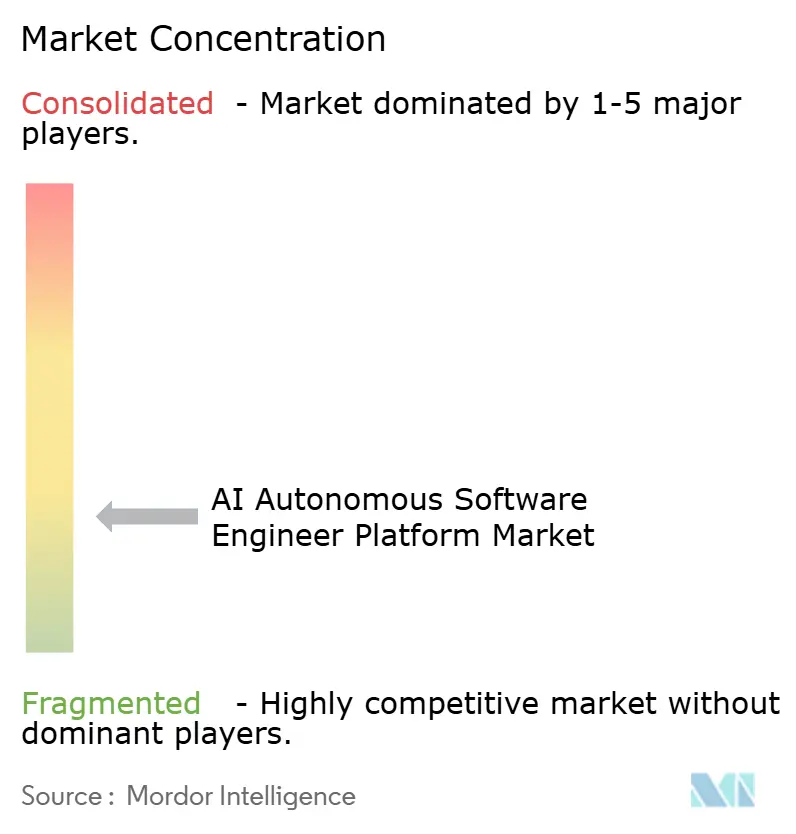
| Market Concentration | Low |
Major Players *Disclaimer: Major Players sorted in no particular order Image © Mordor Intelligence. Reuse requires attribution under CC BY 4.0. | |
AI Autonomous Software Engineer Platform Market Analysis by Mordor Intelligence
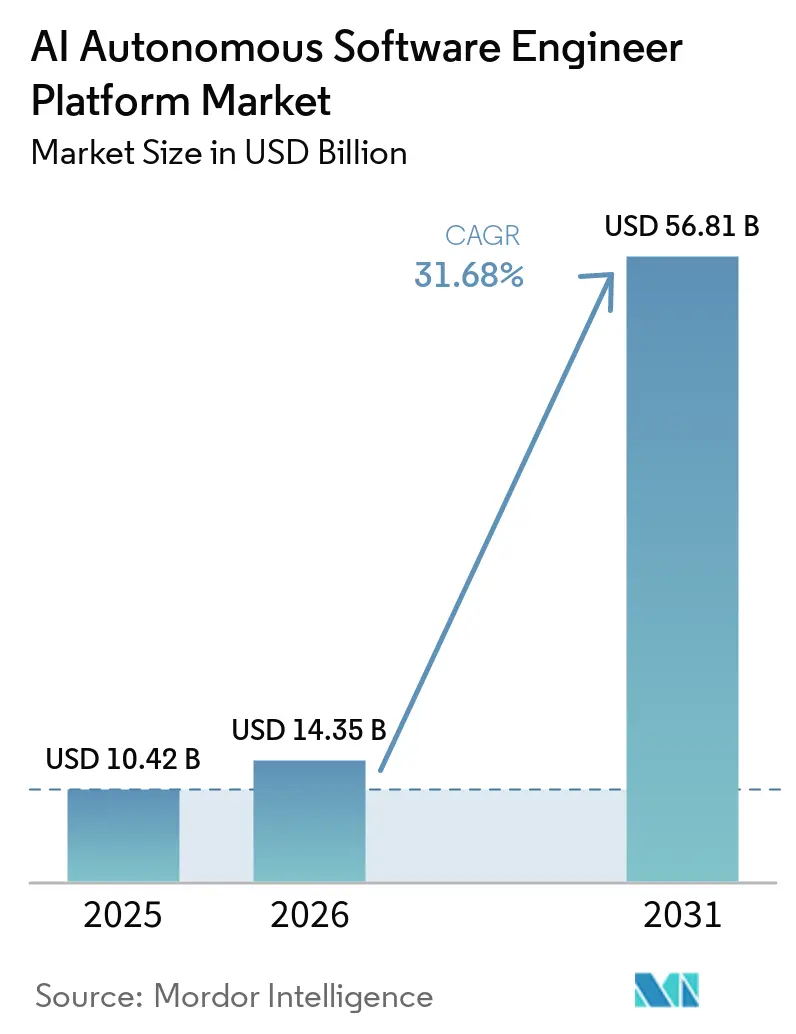
The AI autonomous software engineer platform market size is expected to grow from USD 10.42 billion in 2025 to USD 14.35 billion in 2026, and is forecast to reach USD 56.81 billion by 2031, at a 31.68% CAGR over 2026-2031. Enterprise buyers are moving beyond limited coding pilots and are integrating autonomous tools into production development work. The shortage of AI and engineering talent is making software automation increasingly important for organizations seeking to maintain delivery capacity. Demand is also moving toward platforms that can coordinate planning, coding, testing, security checks, and deployment. Vendors are responding through deeper integration with existing development tools, cloud services, and governance controls. The AI autonomous software engineer platform market is, therefore, becoming more closely tied to enterprise modernization programs and managed technology services.
Key Report Takeaways
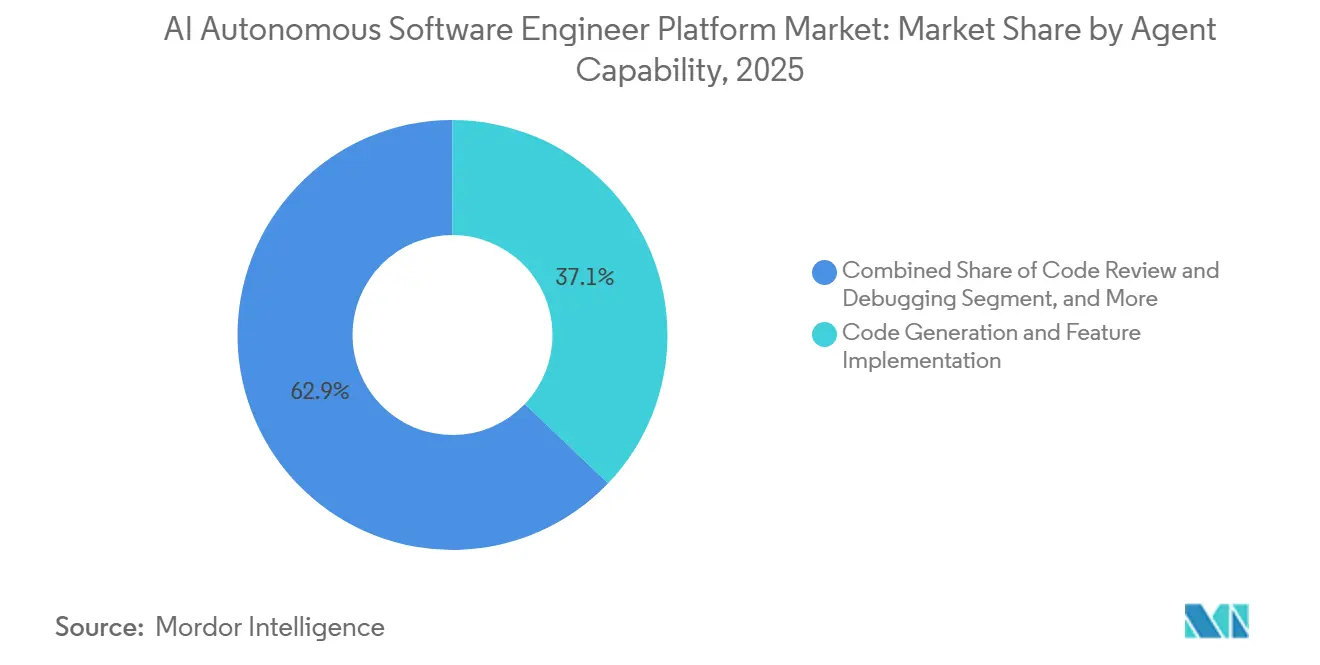
- By agent capability, Code Generation and Feature Implementation accounted for 37.12% of the AI autonomous software engineer platform market share in 2025, while Code Review and Debugging is projected to record the highest growth with a CAGR of 32.68% through 2031.
- By deployment environment, IDE-Integrated Platforms accounted for 46.81% of the AI autonomous software engineer platform market share in 2025, while Cloud CI/CD Pipeline Platforms are expected to see the fastest growth with a CAGR of 32.48% through 2031.
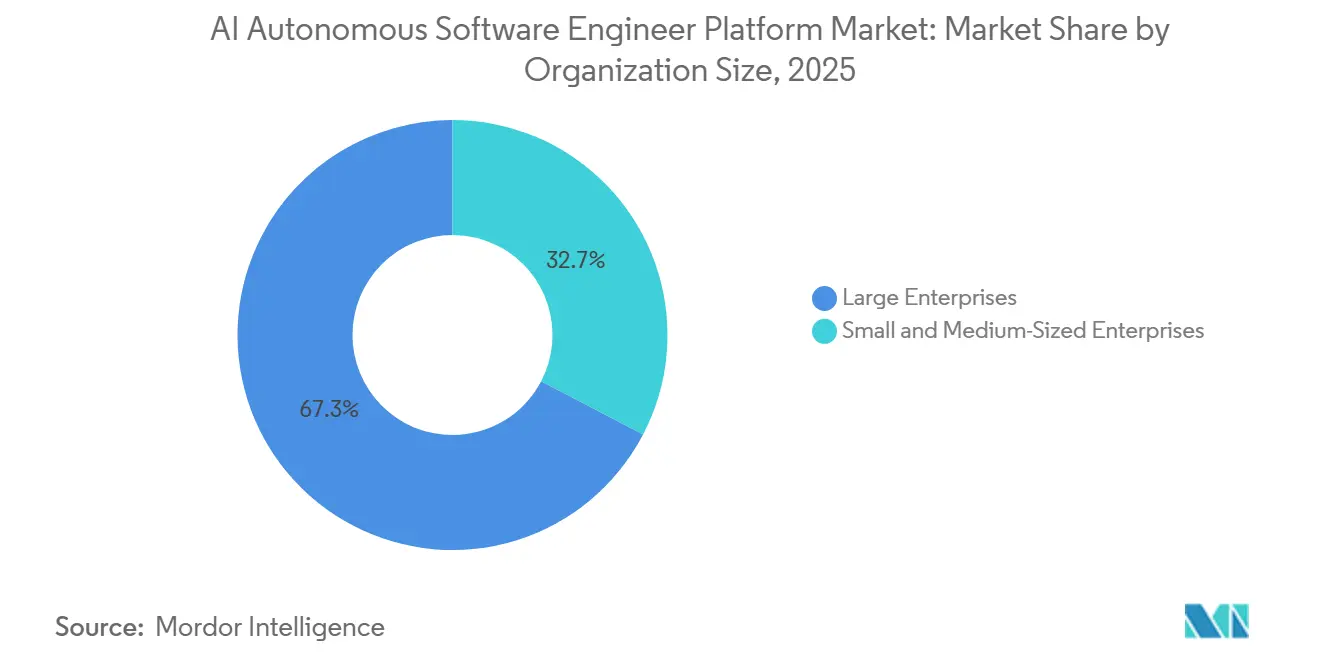
- By organization size, Large Enterprises accounted for 67.34% of revenue in 2025, while Small and Medium-Sized Enterprises are projected to experience the highest growth with a CAGR of 32.07% through 2031.
- By end user, Enterprise Software Teams represented the largest segment with a share of 46.57% in 2025, while System Integrators and Technology-Service Providers are projected to expand at a 32.61% CAGR through 2031.
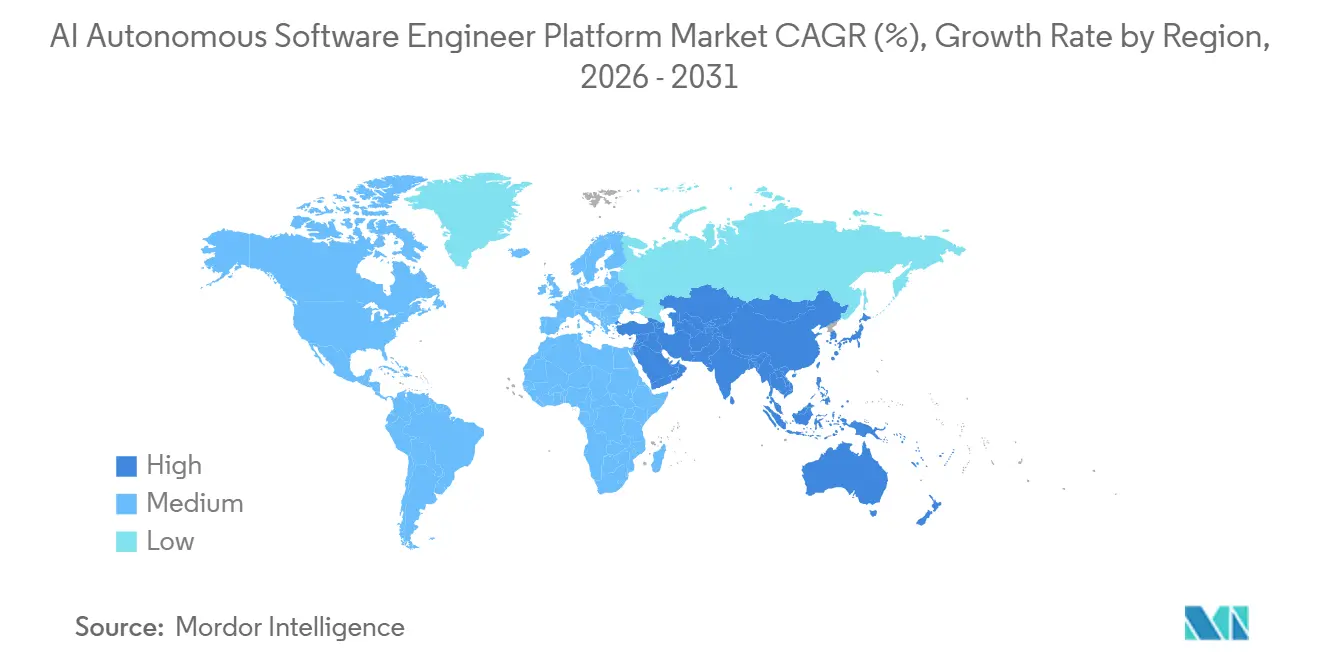
- By geography, North America accounted for 41.19% of revenue in 2025, while Asia-Pacific is projected to record the highest CAGR of 32.73% through 2031.
Note: Market size and forecast figures in this report are generated using Mordor Intelligence’s proprietary estimation framework, updated with the latest available data and insights as of January 2026.
Market Trends and Insights
Drivers Impact Analysis of AI Autonomous Software Engineer Platform Market*
| Driver | (~) % Impact on CAGR Forecast | Geographic Relevance | Impact Timeline |
|---|---|---|---|
| Foundation-Model Reasoning and Tool-Use Improvements | +9.2% | Global, strongest in North America and East Asia | Short term (≤ 2 years) |
| Persistent Developer Shortages and Engineering Capacity Gaps | +7.8% | Global, acute in Germany, France, the United Kingdom, and Japan | Medium term (2-4 years) |
| Enterprise Demand for End-to-End SDLC Productivity | +6.4% | North America and Europe, with Asia-Pacific spillover | Medium term (2-4 years) |
| Cloud-Native and CI/CD Modernization | +4.1% | North America, Western Europe, and East Asia | Short term (≤ 2 years) |
| Rising Demand for Private and Governed AI Development | +3.6% | Europe, Japan, and regulated sectors globally | Long term (≥ 4 years) |
| Standardization of Agent Interoperability Protocols | +2.8% | Global, with early traction in North America | Medium term (2-4 years) |
| Source: Mordor Intelligence | |||
Foundation-Model Reasoning and Tool-Use Improvements
Foundation-model reasoning is supporting the AI autonomous software engineer platform market by enabling platforms to address longer, more connected engineering tasks. Anthropic stated that Claude Opus 5 could support codebase-scale migrations across hundreds of thousands of lines of code, using existing test suites as an acceptance measure.[1]Anthropic, “Introducing Claude Opus 5,” Anthropic, anthropic.com This capability moves autonomous tools beyond isolated code suggestions and toward work that spans planning, implementation, testing, and revision. It also reduces the value of standalone code-generation features when several vendors can access capable models. Buyers are placing more weight on how a platform assigns tasks, manages context, applies controls, and records each action. The AI autonomous software engineer platform market consequently favors vendors that can turn model capability into reliable development workflows.
Persistent Developer Shortages and Engineering Capacity Gaps
Persistent skill gaps are increasing interest in the AI autonomous software engineer platform market across both large organizations and service providers. ManpowerGroup reported in 2026 that AI model and application development was cited by 20% of employers as a hard-to-find skill, while engineering skills were cited by 19%. The same survey reported hiring difficulty rates of 83% in Germany, 74% in France, and 73% in the United Kingdom. The gap extends beyond programming because organizations also need people who can manage security, monitoring, and quality controls around AI systems. Autonomous platforms can increase the output of existing teams, but they do not remove the need for review and accountable oversight. Demand therefore favors products that combine automation with approval gates, policy enforcement, and audit records.
Enterprise Demand for End-to-End SDLC Productivity
Enterprise demand is shifting from basic coding assistance to tools that support the wider software delivery lifecycle. IBM stated that its Bob platform expanded from an internal pilot of 100 developers in June 2025 to more than 80,000 IBM employees by April 2026. IBM also reported an average user-reported productivity gain of 45% across modernization, security, and new development work. This direction matters because a large share of enterprise software spending is tied to maintenance and modernization rather than new applications. Platforms that support legacy refactoring can address a broader range of workloads than tools focused solely on feature creation. The AI autonomous software engineer platform market is thus seeing demand from buyers who need shorter delivery cycles and lower technical debt costs. Vendors that connect code generation to testing, modernization, and production readiness have a clearer value proposition for these buyers.
Cloud-Native and CI/CD Modernization
Cloud-native delivery practices are creating a practical path for deploying autonomous engineering agents at scale. GitHub introduced Agentic Workflows, which allow repository tasks to run via GitHub Actions using workflows written in Markdown and executed by coding agents. This approach places agent activity inside the build, test, and deployment environment rather than in a separate developer tool. It allows organizations to automate recurring repository tasks while maintaining the controls already in place for source code and releases. The change is increasing interest in cloud CI/CD pipeline platforms as an execution layer for autonomous tasks. It also increases the need for observability, as errors can propagate through delivery pipelines quickly when controls are weak. The AI autonomous software engineer platform market benefits when vendors can integrate these functions without creating separate operational processes.
Restraints Impact Analysis of AI Autonomous Software Engineer Platform Market*
| Restraint | (~) % Impact on CAGR Forecast | Geographic Relevance | Impact Timeline |
|---|---|---|---|
| Security, Reliability, and Unauthorized-Action Risk | -4.2% | Global, most acute in financial services, healthcare, and government | Short term (≤ 2 years) |
| Unpredictable Inference Economics and Agent-Usage Costs | -3.6% | Global, particularly among cost-sensitive SMEs and mid-market enterprises | Medium term (2-4 years) |
| Intellectual-Property and Code-Provenance Uncertainty | -2.4% | North America and Europe, where IP litigation risk is high | Long term (≥ 4 years) |
| Legacy-System Integration and Weak Enterprise ROI Visibility | -2.1% | Global, most severe in markets with dense legacy estates and regulated verticals | Long term (≥ 4 years) |
| Source: Mordor Intelligence | |||
Security, Reliability, and Unauthorized-Action Risk
Security and reliability concerns remain a material restraint for the AI autonomous software engineer platform market, especially in regulated organizations. Microsoft disclosed in June 2026 that the Claude Code GitHub Action could expose CI/CD workflow secrets when it processed untrusted GitHub content.[2]Microsoft, “Securing CI/CD in an Agentic World: Claude Code GitHub Action Case,” Microsoft Security Blog, microsoft.com The case shows how an agent can create exposure when it receives access to repositories, secrets, or deployment tools without tight controls. Enterprises are responding by requiring human approval points, restricted permissions, prompt isolation, and records of agent actions. These requirements can lengthen procurement and implementation cycles, particularly in finance, healthcare, and government. They also create an opening for vendors that offer strong security practices built into the product rather than as an optional add-on. Reliable controls will remain necessary as autonomous agents receive broader authority across the software lifecycle.
Unpredictable Inference Economics and Agent-Usage Costs
Variable model usage costs can slow adoption, as autonomous agents may require many reasoning steps, tool calls, and retries for a single task. This cost structure differs from traditional software subscriptions, where spending is often linked to a fixed number of users. Organizations need clearer information on the cost of each task before they expand from controlled pilots to broad production use. The issue is more difficult for small and mid-sized teams that have limited capacity to manage usage budgets. It has increased demand for model routing, prompt reuse, spending limits, and reporting that identifies costly workflows. The AI autonomous software engineer platform market will reward providers that can link cost controls to measurable software delivery outcomes.
*Our forecasts treat driver/restraint impacts as directional, not additive. The impact forecasts reflect baseline growth, mix effects, and variable interactions.
AI Autonomous Software Engineer Platform Market Segment Analysis
By Agent Capability:
Code Generation Leads While Review Becomes a Core Value AreaCode Generation and Feature Implementation held 37.12% of revenue in 2025 and remained the largest capability segment. Its early adoption reflected a direct connection between the product and visible development output, including completed feature requests and code changes. Code Completion and Inline Editing remained common entry points because they fit familiar programming work into the code editor. Automated Test Generation and Maintenance accounted for a smaller share of the mix but gained importance as autonomous code volumes increased.
Code Review and debugging are expected to be the fastest-expanding capabilities with a CAGR of 32.68% through 2031. It addresses a constraint because faster code generation can increase the volume of changes that teams must test, validate, and approve. Review tools can identify defects, explain changes, and direct attention toward decisions that need human judgment. The AI autonomous software engineering platform industry is moving toward combined systems in which generation, testing, and validation are part of a single workflow.



By Deployment Environment:
IDEs Lead While CI/CD Pipelines Become the Execution LayerIDE-Integrated Platforms accounted for 46.81% of revenue in 2025 and remained the leading deployment environment. Developers prefer these products because they bring AI functions into the tools used for writing, editing, and reviewing software. IDE deployment also lets teams gradually introduce autonomy before assigning broader tasks. Cursor redesigned its product around parallel agents in April 2026, reflecting a move from individual suggestions to coordinated agent work in the developer workspace.
Cloud CI/CD Pipeline Platforms are expected to have the fastest CAGR, at 32.48%, expanding the deployment environment through 2031. They allow agents to execute tasks asynchronously through the same workflows that build, test, and release software. The model can reduce repetitive developer work, but it raises the importance of permissions and monitoring. Private cloud and on-premises configurations are becoming more relevant for buyers with data residency or audit requirements. The AI autonomous software engineer platform market is supported when vendors deliver integration without adding separate operational processes.
By Organization Size:
Large Enterprises Lead While SMEs Expand AccessLarge Enterprises accounted for 67.34% of revenue in 2025, supported by broad engineering workforces, larger technology budgets, and stringent governance requirements. These organizations can fund integration across repositories, identity systems, security processes, and delivery pipelines. IBM's internal deployment of Bob across more than 80,000 employees demonstrated how adoption can scale once appropriate controls are in place. Large buyers also have substantial legacy estates, creating demand for automated refactoring and modernization.
Small and Medium-Sized Enterprises are expected to record the highest expansion with a CAGR of 32.07% through 2031. Usage-based pricing reduces upfront commitments and lets smaller teams scale consumption as needed. Low-code and no-code interfaces can make autonomous features available to teams without dedicated platform engineering staff. Smaller buyers are likely to favor tools that provide safeguards by default and present clear cost controls. The AI autonomous software engineer platform market can widen as vendors simplify implementation without weakening control over repositories and production environments.
By End User:
Enterprise Software Teams Lead While System Integrators AccelerateEnterprise Software Teams represented the largest end-user segment with a share of 46.57% in 2025. These teams maintain proprietary applications where labor costs, release schedules, and quality outcomes are easy to measure. Autonomous platforms can support feature work, modernization, maintenance, testing, and documentation across those applications. Independent Software Vendors, open-source communities, government agencies, and research institutions form other user groups with different buying needs.
System Integrators and Technology-Service Providers are projected to expand at a 32.61% CAGR through 2031, making them the fastest-expanding end-user group. They are embedding autonomous tools into client delivery work and increasingly linking commercial terms to outcomes rather than engineering headcount. In Japan, SHIFT signed a Master Partner Agreement with Cognition AI for its Devin platform in October 2025. Service providers can become a major route to market because they bring established client relationships and delivery processes. Their expansion will depend on proving that automated work is secure, traceable, and suitable for client environments.
Geography Analysis
North America AI Autonomous Software Engineer Platform Market
North America held 41.19% of revenue in 2025 and remained the largest regional market. The region combines AI-native vendors, established cloud infrastructure, and large enterprise technology budgets. The United States had 519,000 AI development workers as of March 2026, according to CSET Georgetown.[3]CSET Georgetown, “Identifying the AI Development Workforce,” CSET Georgetown, cset.georgetown.edu Canada and Mexico add software ecosystems and cross-border procurement activity. The AI autonomous software engineer platform market size in North America is also supported by companies moving from seat-based pricing toward usage-based arrangements.
EMEA and South America AI Autonomous Software Engineer Platform Market
Europe is distinct because data sovereignty, privacy, and compliance influence deployment choices. The EU AI Act and GDPR enforcement are strengthening demand for private-cloud, hybrid, and on-premises configurations. Germany, France, and the United Kingdom face high hiring difficulty, which supports demand for tools that can extend engineering capacity. The United Kingdom has attracted vendor research and development activity, whereas Germany, the Netherlands, and France have stronger data residency requirements. South America, the Middle East, and Africa remain earlier-stage markets, with Brazil's outsourcing sector and digital programs in the United Arab Emirates and Saudi Arabia supporting adoption.
APAC and Africa AI Autonomous Software Engineer Platform Market
Asia-Pacific is expected to be the fastest-growing region, with a CAGR of 32.73% through 2031. China has a domestic ecosystem shaped by data-localization rules and procurement preferences for local software. Alibaba held 47.6% of China's AI coding market in 2025, according to Qoder. Japan is adopting tools through systems integrators, while India supports domestic and global use through its large developer base. South Africa, Nigeria, and Egypt are earlier in adoption but are seeing increased activity across technology sectors and startup ecosystems.

Competitive Landscape
The AI autonomous software engineer platform market is fragmented among application providers, although infrastructure and distribution channels are consolidating. Anysphere, Cognition AI, and Replit have strong visibility among pure-play autonomous coding providers. Large cloud, developer tool, and DevOps vendors are also placing autonomous features inside products that many software teams already use. This makes it harder for standalone products to compete solely on code generation. Quality assurance, code review, modernization, and governance remain important areas for differentiation.
Tricentis acquired Tabnine on July 30, 2026, bringing Tabnine's Enterprise Context Engine into its Agentic Quality Engineering Platform. IBM released multi-agent capabilities and specialized modernization workflows for IBM Bob in July 2026. Sourcegraph launched Code Finder in July 2026 as an MCP-native code-search agent for coding agents. These moves show that context, quality engineering, modernization, and repository intelligence are central to vendor strategy. CodeRabbit, Qodo, and All Hands AI are also focused on the quality and governance layer between generated code and production deployment.
Vendor selection is increasingly tied to a platform's ability to provide reliable controls across the delivery process. Enterprise buyers want proof that agents can work within approved permissions, preserve code provenance, and support review before deployment. Specialized platforms such as Factory AI, Cosine AI, Augment Computing, and Mutable are addressing modernization, large-codebase refactoring, and event-driven automation. ISO/IEC 42001 and EU AI Act requirements are becoming relevant to procurement in regulated sectors.
AI Autonomous Software Engineer Platform Industry Leaders
Cognition AI, Inc.
Replit, Inc.
Poolside SAS AI
Augment Computing, Inc.
Cursor (Anysphere, Inc.)
- *Disclaimer: Major Players sorted in no particular order
AI Autonomous Software Engineer Platform Market Companies Covered in this Report
- Cognition AI, Inc.
- Anysphere, Inc.
- Replit, Inc.
- Poolside SAS AI
- Augment Computing, Inc.
- Sourcegraph, Inc.
- Tabnine Ltd.
- Qodo Ltd.
- Magic AI, Inc.
- Factory AI, Inc.
- Lovable Technologies AB
- StackBlitz, Inc.
- CodeRabbit, Inc.
- Cosine AI, Inc.
- All Hands AI, Inc.
- Pythagora, Inc.
- Mutable, Inc.
- Refact AI, Inc.
- BLACKBOX AI, Inc.
- Bito Technologies, Inc.

Recent Industry Developments in AI Autonomous Software Engineer Platform Market
- July 2026: Tricentis acquired Tabnine on July 30, 2026, integrating Tabnine's Enterprise Context Engine into the Tricentis Agentic Quality Engineering Platform. Organizations using Tabnine's technology reported up to a 2-times improvement in AI accuracy and up to 80% reduction in token consumption, capabilities Tricentis will leverage to strengthen its position in enterprise quality assurance for autonomous coding workflows.
- July 2026: IBM announced major updates to IBM Bob on July 9, 2026, including new multi-agent capabilities, built-in AI cost and use analytics, and pre-built specialized workflows for Java modernization, IBM Z, and IBM i environments. The Premium Packages for Java Modernization include migration to Java 25 and large-scale refactoring built on decades of IBM domain experience.
- May 2026: CodeRabbit launched Change Stack, a fundamentally redesigned code review interface built for agent-generated code, and became available through the Anthropic Claude Marketplace, enabling Anthropic enterprise customers to apply existing spend commitments toward CodeRabbit subscriptions.
- April 2026: IBM launched IBM Bob globally on April 28, 2026, following an internal pilot that scaled from 100 developers in June 2025 to more than 80,000 IBM employees. The platform reported an average 45% user-stated productivity gain and was adopted by Ernst and Young for global tax-platform modernization.


Global AI Autonomous Software Engineer Platform Market Report Scope
The AI Autonomous Software Engineer Platform market comprises software platforms and associated services that use artificial intelligence, machine learning, generative AI, large language models, and autonomous or agentic AI capabilities to perform, coordinate, and automate software engineering tasks with limited human intervention. These platforms can interpret natural-language requirements, understand software repositories and development contexts, generate and modify code, identify and resolve defects, create tests, review code, and execute or orchestrate development workflows across the software development lifecycle.
The AI Autonomous Software Engineer Platform Market Report is Segmented by Agent Capability (Code Generation and Feature Implementation, Code Completion and Inline Editing, Code Review and Debugging, Automated Test Generation and Maintenance, and Other Agent Capabilities), Deployment Environment (IDE-Integrated Platforms, Cloud CI/CD Pipeline Platforms, Standalone Web Application Platforms, and Other Deployment Environments), Organization Size (Large Enterprises, and Small and Medium-Sized Enterprises), End User (Enterprise Software Teams, Independent Software Vendors, System Integrators and Technology-Service Providers, Open-Source and Development Communities, and Other End Users), and Geography (North America, South America, Europe, Asia-Pacific, Middle East, and Africa). The Market Forecasts are Provided in Terms of Value (USD).
| Code Generation and Feature Implementation |
| Code Completion and Inline Editing |
| Code Review and Debugging |
| Automated Test Generation and Maintenance |
| Other Agent Capabilities |
| IDE-Integrated Platforms |
| Cloud CI/CD Pipeline Platforms |
| Standalone Web Platforms |
| Other Deployment Environments |
| Large Enterprises |
| Small and Medium-Sized Enterprises |
| Enterprise Software Teams |
| Independent Software Vendors |
| System Integrators and Technology-Service Providers |
| Open-Source Development Communities |
| Other End Users |
| North America | United States |
| Canada | |
| Mexico | |
| South America | Brazil |
| Argentina | |
| Colombia | |
| Chile | |
| Rest of South America | |
| Europe | United Kingdom |
| Germany | |
| France | |
| Netherlands | |
| Rest of Europe | |
| Asia-Pacific | China |
| India | |
| Japan | |
| South Korea | |
| Rest of Asia-Pacific | |
| Middle East | United Arab Emirates |
| Saudi Arabia | |
| Turkey | |
| Rest of Middle East | |
| Africa | South Africa |
| Nigeria | |
| Egypt | |
| Rest of Africa |
| By Agent Capability | Code Generation and Feature Implementation | |
| Code Completion and Inline Editing | ||
| Code Review and Debugging | ||
| Automated Test Generation and Maintenance | ||
| Other Agent Capabilities | ||
| By Deployment Environment | IDE-Integrated Platforms | |
| Cloud CI/CD Pipeline Platforms | ||
| Standalone Web Platforms | ||
| Other Deployment Environments | ||
| By Organization Size | Large Enterprises | |
| Small and Medium-Sized Enterprises | ||
| By End User | Enterprise Software Teams | |
| Independent Software Vendors | ||
| System Integrators and Technology-Service Providers | ||
| Open-Source Development Communities | ||
| Other End Users | ||
| By Geography | North America | United States |
| Canada | ||
| Mexico | ||
| South America | Brazil | |
| Argentina | ||
| Colombia | ||
| Chile | ||
| Rest of South America | ||
| Europe | United Kingdom | |
| Germany | ||
| France | ||
| Netherlands | ||
| Rest of Europe | ||
| Asia-Pacific | China | |
| India | ||
| Japan | ||
| South Korea | ||
| Rest of Asia-Pacific | ||
| Middle East | United Arab Emirates | |
| Saudi Arabia | ||
| Turkey | ||
| Rest of Middle East | ||
| Africa | South Africa | |
| Nigeria | ||
| Egypt | ||
| Rest of Africa | ||


Key Questions Answered in the Report
What is the size of the AI autonomous software engineer platform market?
The AI autonomous software engineer platform market was valued at USD 10.42 billion in 2025, is estimated at USD 14.35 billion in 2026, and is forecast to reach USD 56.81 billion by 2031 at a 31.68% CAGR.
What is driving adoption of autonomous software engineering platforms?
Persistent shortages in AI and engineering skills, demand for software modernization, and the need to automate work across the delivery lifecycle are increasing adoption.
Which agent capability leads the AI autonomous software engineer platform market?
Code Generation and Feature Implementation led with 37.12% of revenue in 2025, while Code Review and Debugging is expected to record the highest expansion through 2031.
Which deployment environment is most widely used for autonomous coding tools?
IDE-Integrated Platforms led with 46.81% of revenue in 2025 because they place AI tools inside the developer workspace. Cloud CI/CD Pipeline Platforms are expected to record the highest expansion.
Which organizations are adopting autonomous coding platforms most rapidly?
Large Enterprises held 67.34% of revenue in 2025, while Small and Medium-Sized Enterprises are expected to record the highest expansion as flexible pricing and simpler interfaces improve access.
Which region leads adoption of autonomous software engineering platforms?
North America held 41.19% of revenue in 2025, supported by a strong vendor base, cloud infrastructure, and high enterprise technology spending. Asia-Pacific is expected to record the highest expansion through 2031.
Page last updated on:





