
Agency Management Services Market Size and Share
Market Overview
| Study Period | 2020 - 2031 |
|---|---|
| Market Size (2026) | USD 2.82 Billion |
| Market Size (2031) | USD 4.01 Billion |
| Growth Rate (2026 - 2031) | 7.31 % |
| Fastest Growing Market | Asia-Pacific |
| Largest Market | North America |
| Market Concentration | Medium |
Major Players *Disclaimer: Major Players sorted in no particular order Image © Mordor Intelligence. Reuse requires attribution under CC BY 4.0. | |
Agency Management Services Market Analysis by Mordor Intelligence
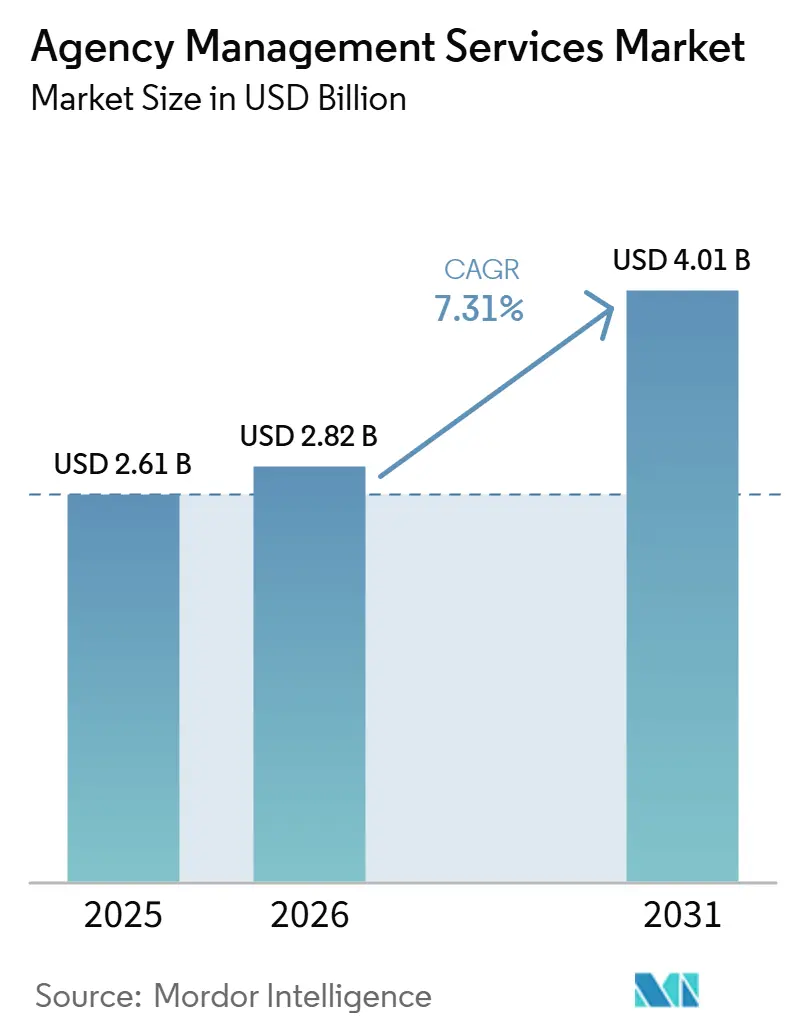
The Agency Management Services Market size was valued at USD 2.61 billion in 2025 and estimated to grow from USD 2.82 billion in 2026 to reach USD 4.01 billion by 2031, at a CAGR of 7.31% during the forecast period (2026-2031). The Agency Management Services Market is moving away from broad agency-of-record arrangements toward specialized, outcome-linked assignments that connect media, content, measurement, and customer data. Clients are consolidating some budgets with larger networks while also moving selected assignments to independent providers during a holding-company restructuring, creating active competition for individual accounts. Demand increasingly depends on an agency’s ability to connect campaign delivery, customer data, measurement, compliance processes, and the client’s own in-house teams. Privacy rules and requirements for transparency in AI-generated content are also changing the scope of managed work, particularly where brands serve multiple regulated markets. These conditions create room for providers that can support marketing execution and operational controls, demonstrate commercial outcomes, and avoid adding complexity for clients.
Key Report Takeaways
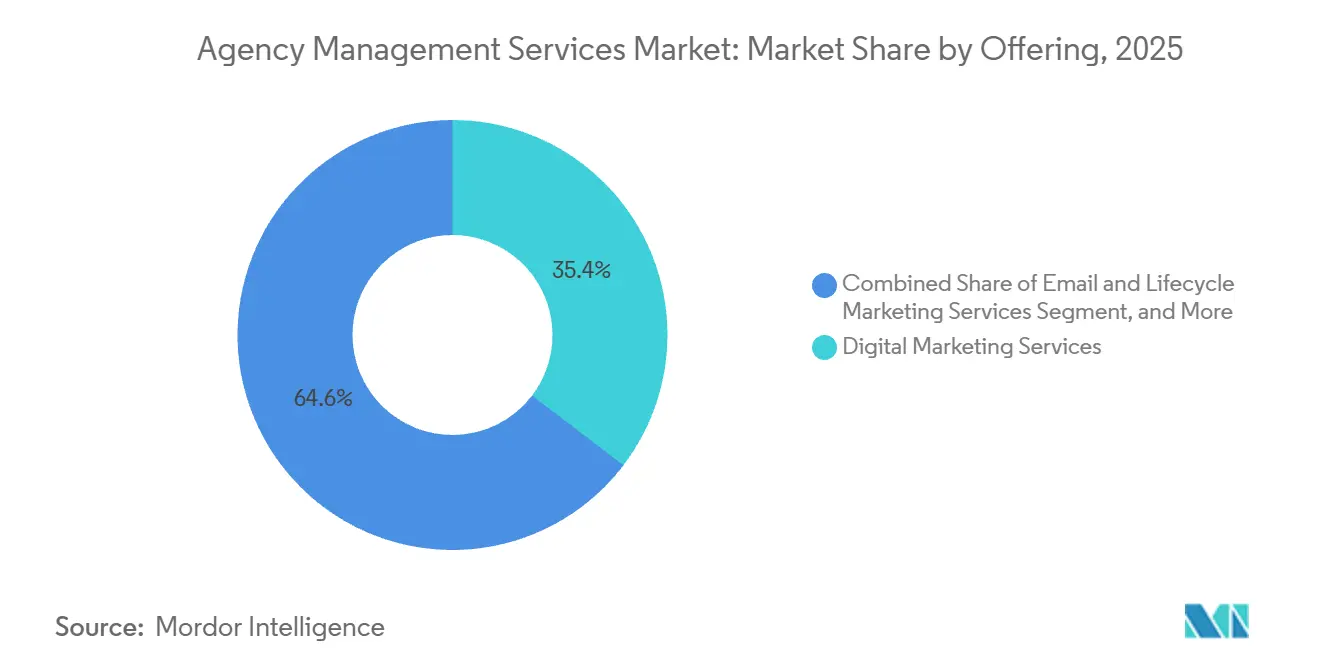
- By offering, digital marketing services held 35.36% of the Agency Management Services Market share in 2025, while email and lifecycle marketing services are projected to expand at a 7.52% CAGR through 2031.
- By services, campaign management held 29.32% of agency management services revenue in 2025, while analytics and optimization are projected to expand at an 8.32% CAGR through 2031.
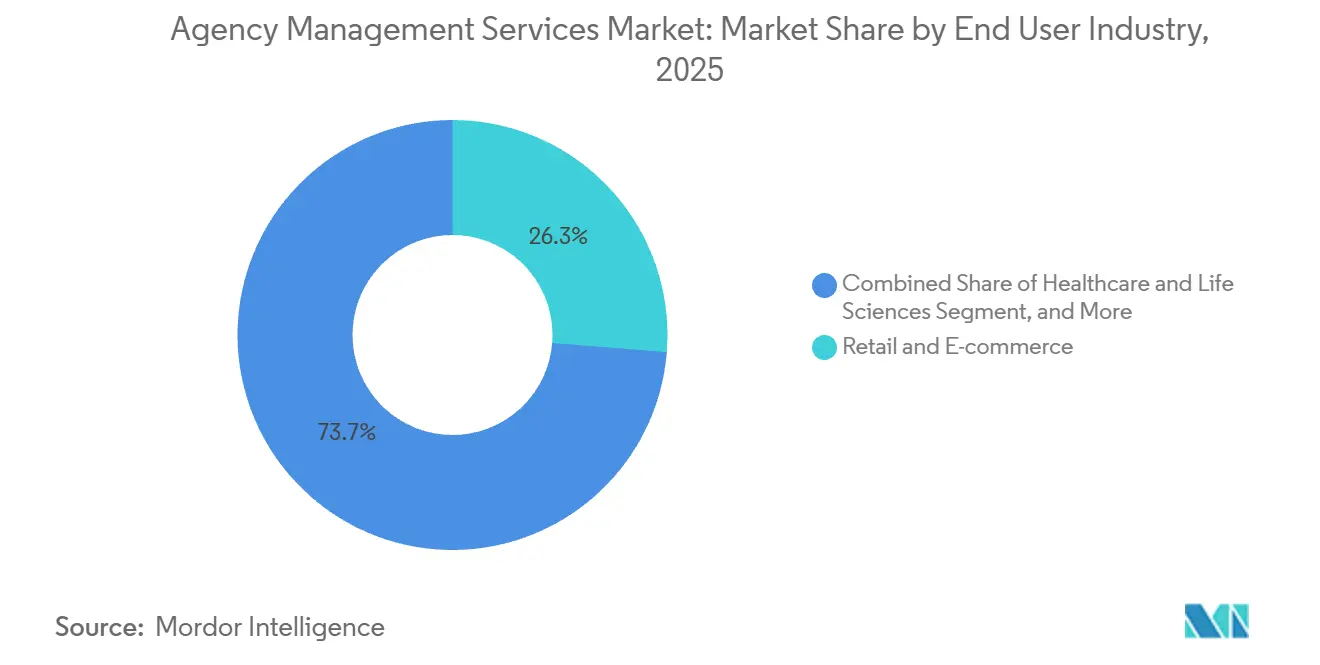
- By end-user industry, retail and e-commerce held 26.27% of agency management services revenue in 2025, while healthcare and life sciences are projected to expand at an 8.94% CAGR through 2031.
- By geography, North America held 34.36% of agency management services revenue in 2025, while Asia-Pacific is projected to expand at a 9.21% CAGR through 2031.
Note: Market size and forecast figures in this report are generated using Mordor Intelligence’s proprietary estimation framework, updated with the latest available data and insights as of January 2026.
Global Agency Management Services Market Trends and Insights
Drivers Impact Analysis*
| Driver | (~) % Impact on CAGR Forecast | Geographic Relevance | Impact Timeline |
|---|---|---|---|
| Rising Demand for Omnichannel Campaign Orchestration | +2.1% | Global, concentrated in North America and Europe | Short term (≤ 2 years) |
| Growth in Retail Media and Commerce Media Spend | +1.8% | North America and Asia-Pacific core, spill-over to Europe | Short term (≤ 2 years) |
| Rising Need for Measurable ROI and Outcome-Based Fees | +1.4% | Global, with early concentration in North America and Western Europe | Medium term (2-4 years) |
| SME Outsourcing of Full-Funnel Marketing Execution | +0.9% | Global, strongest in Asia-Pacific and South America | Medium term (2-4 years) |
| Privacy-Safe First-Party Data Activation | +0.6% | North America and the EU core, expanding to Asia-Pacific | Medium term (2-4 years) |
| AI Governance and Synthetic Content Traceability | +0.5% | The EU and North America, with early compliance gains in South Korea | Long term (≥ 4 years) |
| Source: Mordor Intelligence | |||
Rising Demand for Omnichannel Campaign Orchestration
The move from channel-specific activity to coordinated customer journeys is a major driver for the Agency Management Services Market. Brands now manage paid search, retail media, connected television, email, social activity, websites, and in-store touchpoints simultaneously, often with separate platform rules and reporting formats. This work requires agencies to coordinate timing, audience rules, creative assets, frequency, spending decisions, and reporting across channels to manage activity as a connected program. Adobe introduced Journey Optimizer B2B Edition in January 2025, extending campaign orchestration to account-based marketing journeys across email, web, LinkedIn, and paid channels.[1]Adobe Inc., “Adobe Announces Adobe Journey Optimizer B2B Edition,” Adobe, adobe.com Agencies must either use comparable technology or integrate these tools into their delivery model. Once a client’s data structures and workflow rules are embedded in an agency process, changing providers can involve much more than negotiating a lower fee.
Growth in Retail Media and Commerce Media Spend
Retail media is creating a distinct source of managed-service demand within the Agency Management Services Market. Brands need support to plan activity across retailer-owned advertising environments and broader commerce media channels, where available inventory, shopper signals, and campaign metrics can vary by network. This work calls for separate capabilities in network planning, audience selection, campaign management, measurement, creative adaptation, and commercial coordination with retailer partners. Large platforms require deep operating knowledge, while smaller networks add further coordination work and make it harder to establish a consistent view of results. The resulting mix can make it difficult for brand teams to manage all activity internally, especially when the same product line runs across several commerce environments. Agencies that bring retail media planning together with shopper analysis and creative delivery can support clients across a wider range of commerce programs.
Rising Need for Measurable ROI and Outcome-Based Fees
Marketing accountability has become a procurement requirement for many large clients in the Agency Management Services Market. Finance leaders increasingly ask agencies to link work to acquisition cost, pipeline contribution, incremental return on ad spend, customer retention, or other revenue-related measures that can be reviewed with business leaders. This expectation places greater value on closed-loop reporting, data quality, and a shared definition of what constitutes a successful campaign. Customer.io reported in 2025 that 83% of marketing teams viewed email as a proven ROI channel.[2]Customer.io, “Lifecycle Marketing Trends 2026: What’s Changing,” Customer.io, customer.io Litmus reported a 22% year-over-year increase in the use of multichannel attribution and pipeline contribution as email reporting measures. Agencies that can demonstrate outcomes may have a stronger case for performance-linked fees, client trust, and continued investment in measurement.[3]Litmus, “State of Email Reports,” Litmus, litmus.com
SME Outsourcing of Full-Funnel Marketing Execution
Small and medium-sized enterprises are using agency partners when managing a full set of marketing channels becomes difficult to sustain internally. A business must coordinate paid search, lifecycle email, programmatic activity, search engine optimization, creative production, content calendars, and attribution across a shared plan. AI tools can reduce the work required for individual tasks, but they can also make the overall operating model harder to manage because teams must decide where automation fits and how to measure results. This supports demand in the Agency Management Services Market for agencies that bring together strategy, execution, reporting, and practical channel expertise without requiring a large permanent internal team. Stagwell reported USD 171 million in net new business during the second quarter of 2026, alongside USD 786 million in revenue and 11% year-over-year growth. Its account wins included IBM, Adobe, Mondelez, and Heineken, showing that external demand spans enterprise and mid-sized client needs.[4]Stagwell Inc., “Stagwell Reports Q2 2026 Results,” Stagwell, stagwellglobal.com
Restraints Impact Analysis*
| Restraint | (~) % Impact on CAGR Forecast | Geographic Relevance | Impact Timeline |
|---|---|---|---|
| In-House Team Expansion at Large Enterprises | -1.5% | North America and the EU concentrated, spill-over to Asia-Pacific | Short term (≤ 2 years) |
| Fee Compression and Procurement-Led Commoditization | -1.2% | Global, highest pressure in North America and Western Europe | Medium term (2-4 years) |
| Fragmented Attribution Across Privacy-Restricted Walled Gardens | -0.7% | North America and the EU core, emerging in Asia-Pacific | Medium term (2-4 years) |
| Talent Retention Challenges in Specialized Roles | -0.5% | Global, concentrated in high-cost markets | Long term (≥ 4 years) |
| Source: Mordor Intelligence | |||
In-House Team Expansion at Large Enterprises
In-house team expansion limits the scope of external work at some large accounts in the Agency Management Services Market. The shift is selective, rather than a complete replacement of agency relationships, because internal teams do not always have the same specialist technology, global operating reach, or capacity for complex regulated assignments. Routine production, basic campaign execution, and high-volume work are more likely to move inside the client organization. Pfizer built internal SEO and AI search capabilities in 2025, while Brandtech Group reported that 8 global clients had brought AI discoverability functions in-house over 9 months. Nestlé also streamlined its marketing operations through shared services, reducing the number of brands it supported from more than 400 in early 2024 to 150 by 2026. These changes leave agencies with a clearer need to provide specialist technology, regulated marketing, global coordination, and work that client teams cannot easily replicate.
Fee Compression and Procurement-Led Commoditization
Procurement-led fee pressure is a restraint on the Agency Management Services Market, especially for providers without a clear data or specialist service advantage. Large clients often compare agencies using standardized rate cards and formal tender processes, even when the work spans multiple channels and requires more than a basic execution model. This approach can treat campaign execution as a comparable service even when delivery capabilities differ. Pressure is particularly strong for agencies with USD 100 million to USD 500 million in revenue. These firms face enterprise procurement standards but may not have the data assets of major holding companies or the specialist pricing of smaller boutiques. Providers that lack proprietary attribution systems, workflow platforms, or first-party data capabilities may face lower margins and a greater risk that parts of their work are purchased as software-supported services.
*Our forecasts treat driver/restraint impacts as directional, not additive. The impact forecasts reflect baseline growth, mix effects, and variable interactions.
Segment Analysis
By Offering: Digital Channels Hold the Largest Position While Lifecycle Services Expand
Digital marketing services held 35.36% of the Agency Management Services Market share in 2025. The segment benefits from client demand for performance-oriented planning across search, social platforms, connected television, and commerce channels. Digital delivery remains central because it links media activity with more immediate measurement, optimization, audience management, creative adaptation, and reporting. Traditional marketing services and creative and content production remain relevant in consumer goods and financial services, where brand consistency is important, although generative AI is reducing the time and cost required to produce routine assets. This places pressure on the billable-hours model for standard creative work.
Email and lifecycle marketing services are projected to grow at a 7.52% CAGR through 2031, making them the fastest-growing offering. The Agency Management Services Market size for this offering reflects the growing importance of owned customer relationships as third-party cookies become less useful. Klaviyo reported more than 165,000 paying accounts and processed more than 60 billion data points each month in the second quarter of 2026. This scale shows how AI-supported segmentation has become more available to mid-sized brands, while platforms can simplify basic execution. Agencies retain a role in audience design, program migration, message sequencing, customer architecture, and cross-channel integration.



By Services: Campaign Management Anchors Revenue While Analytics Changes Agency Value
Campaign management held 29.32% of agency management services revenue in 2025. The segment is supported by the practical difficulty of coordinating activity across retail media, social, search, and programmatic inventory with different audiences, creative requirements, budgets, and reporting schedules. The IAB documented the continued scale of U.S. internet advertising revenue in its 2024 Internet Advertising Revenue Report. This scale supports demand for teams that can manage campaign delivery across multiple environments, while media management remains closely linked to campaign management. Platform consolidation can reduce some manual work, but it does not remove the need for coordinated delivery.
Analytics and optimization are projected to grow at an 8.32% CAGR through 2031, the fastest rate among service categories. The Agency Management Services Market size for analytics and optimization is growing as measurement shifts from a back-office task to a visible part of agency selection. Strategy and consulting can generate high value when clients need help deciding which functions to retain in-house and which to outsource. When agency methods are incorporated into a reporting stack, changing providers may require more operational change than replacing a standard vendor. That dynamic can extend client relationships even when price competition remains active.
By End-User Industry: Retail and E-Commerce Leads While Healthcare and Life Sciences Grows Fastest
Retail and e-commerce held 26.27% of agency management services revenue in 2025. Retailers and consumer brands need support with retail media planning, commerce network activity, shopper marketing, and campaign measurement across environments with varying reporting practices and campaign tools. The Agency Management Services Market benefits when brands need coordinated execution rather than isolated campaign buying. Media and entertainment also create substantial demand through franchise promotion, streaming releases, and creator partnerships. Consumer goods companies continue to use external agencies for specialized channel work as they adjust internal marketing structures.
Healthcare and life sciences are projected to grow at an 8.94% CAGR through 2031, the highest rate among end-user industries. Digital health use, direct-to-patient communication, and omnichannel engagement with healthcare professionals support this demand. FDA requirements in the United States and European regulatory requirements make compliance a central part of campaign delivery and can support premium fees for experienced providers. Travel and hospitality are also rebuilding managed marketing programs around loyalty, retargeting, dynamic pricing communication, and demand generation. The broader move toward retention and lifecycle work is increasing the value of more complex client relationships.
Geography Analysis
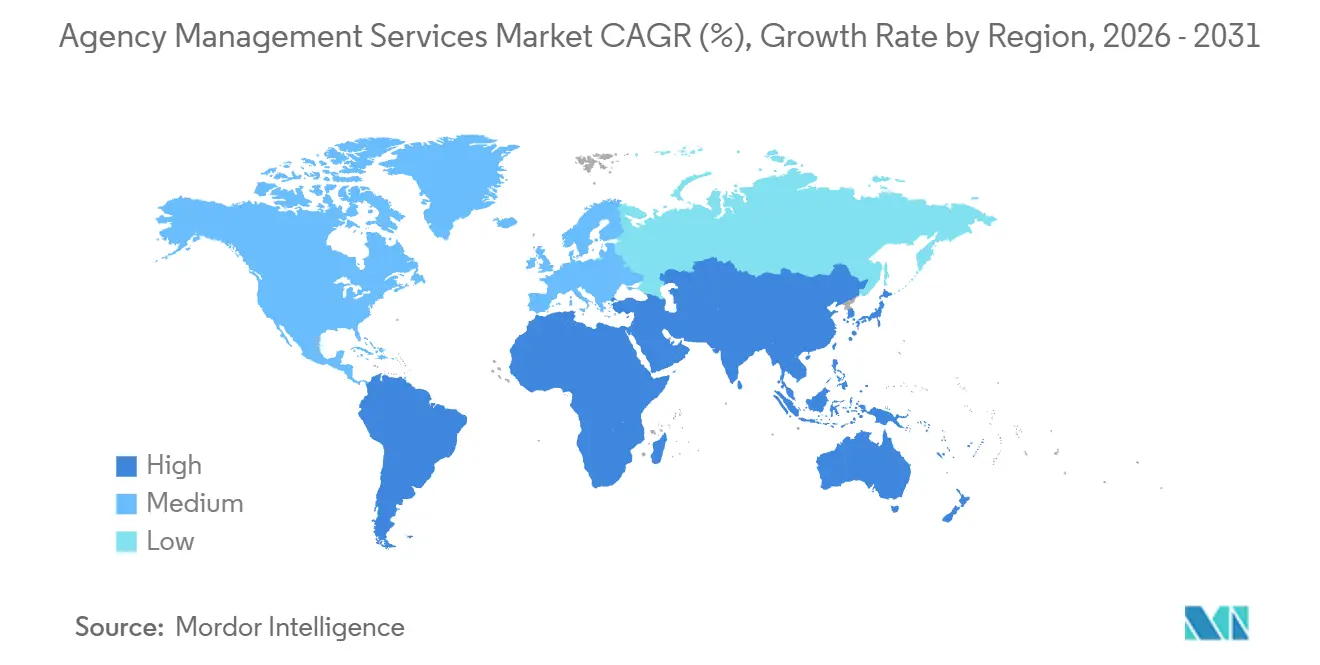
North America held 34.36% of agency management services revenue in 2025. The region benefits from mature programmatic systems, high agency retainer values, and the presence of major advertising holding companies. Omnicom completed its acquisition of Interpublic on November 26, 2025, creating a combined company with pro forma revenue above USD 25 billion. WPP reported 2025 revenue of GBP 13,550 million, equivalent to USD 17,344 million, while its like-for-like revenue declined by 3.6%. Its Elevate28 plan targets GBP 500 million (USD 640 million) in gross annual cost savings by 2028.
Europe has a substantial presence in the Agency Management Services Market, led by the United Kingdom, Germany, and France. Agencies in the region face a specific compliance need under Article 50 of the EU AI Act, whose transparency obligations took effect on August 2, 2026. These obligations address the disclosure of AI-generated or manipulated content, creating a need for Agency Management Services Market providers to document content origins and apply disclosure processes for work reaching EU audiences. Agencies that support content review, provenance metadata, and disclosure workflows can help clients manage these requirements. South America remains smaller in value, but Brazil anchors demand for managed marketing services alongside developing digital-service activity in Colombia.
Asia-Pacific is projected to grow at a 9.21% CAGR through 2031, making it the fastest-growing regional segment. The Agency Management Services Market's growth is driven by a large base of small- and medium-sized advertisers, varied local media systems, and expanding digital marketing activity. China’s super-app and retail media structures create a different operating environment from North America, and lower retainer values mean expansion is more dependent on client volume than on growth within existing accounts. The Middle East, led by the United Arab Emirates and Saudi Arabia, is attracting investment from holding companies and independent agencies in national development programs and sports sponsorships. Africa remains at an earlier stage, although Nigeria and South Africa show increasing demand as mobile-first advertising systems mature.

Competitive Landscape
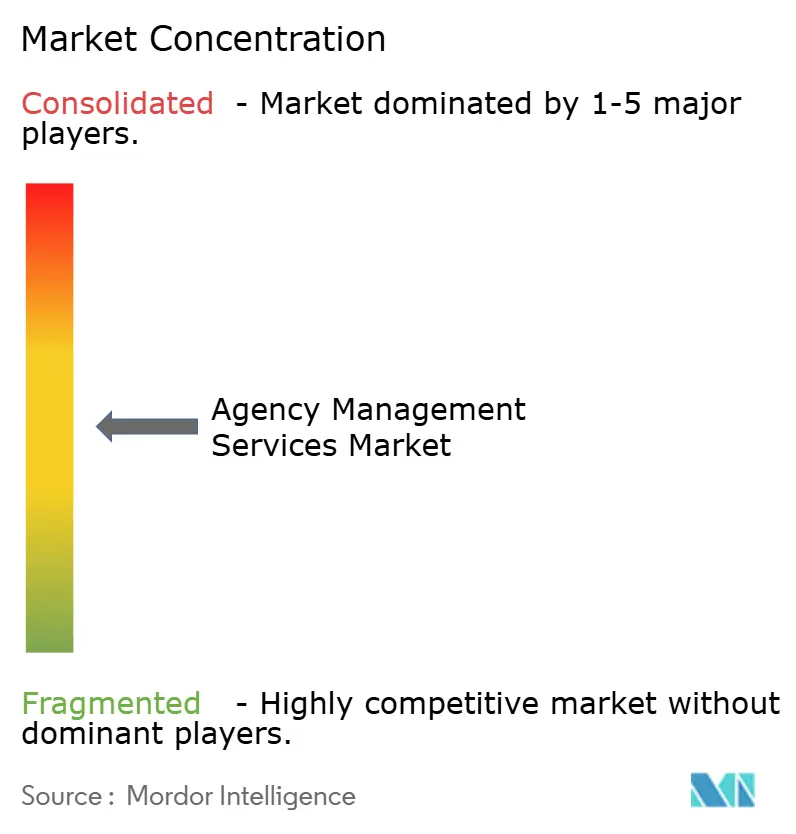
The Agency Management Services Market is moderately concentrated among large holding companies, led by Omnicom, Publicis, WPP, and Dentsu, but remains fragmented across mid-sized and independent providers, including an active challenger tier of Stagwell and Havas. Competition increasingly centers on data infrastructure, identity resolution, privacy-safe collaboration, and measurement systems. Publicis announced in May 2026 that it would acquire LiveRamp for a total enterprise value of USD 2.16 billion in an all-cash transaction at USD 38.50 per share. The transaction is intended to strengthen data co-creation for AI-supported marketing workflows, while WPP’s acquisition of InfoSum and Omnicom’s access to Acxiom increase the importance of privacy-safe data capabilities.
The Agency Management Services Market has an opening where compliance technology and campaign delivery meet. Mid-sized clients may need help with AI-generated content audits, disclosure procedures, and campaign execution, but may not have the internal capacity to build those processes. Traditional holding companies also compete with consulting-backed agencies that connect marketing technology to enterprise systems. Stagwell launched The Media Machine in June 2026, a full-lifecycle agentic media operating system with more than 20 intelligent agents. The platform was developed by GALE, Assembly, and Stagwell Media Platform to automate optimization, improve media-investment efficiency, and manage audience engagement across platforms.
Recent account changes show that data platforms can influence client decisions in the Agency Management Services Market. Publicis took over Microsoft’s global media account from Dentsu in March 2026 after a 12-year relationship. Publicis also agreed in April 2026 to acquire 160over90 and integrate it with Publicis Sports, following its 2025 acquisitions of Adopt and Bespoke. WPP is reorganizing into WPP Media, WPP Creative, WPP Production, and WPP Enterprise Solutions as part of its Elevate28 plan. Providers that combine specialist execution with data, governance, and measurable outcomes are likely to be better positioned than firms relying on routine campaign production alone.
Agency Management Services Industry Leaders
Omnicom Group Inc.
WPP plc
Publicis Groupe S.A.
Dentsu Group Inc.
Havas N.V.
- *Disclaimer: Major Players sorted in no particular order

Recent Industry Developments
- July 2026: Stagwell Inc. reported Q2 2026 revenue of USD 786 million, up 11% year-on-year, with a record USD 171 million in net new business and Adjusted EBITDA of USD 109 million, up 15%. The company raised its full-year adjusted EPS guidance to USD 1.03-USD 1.17 and reiterated total net revenue growth of 8%-12%, driven by 18% organic growth in its Digital Transformation segment and wins including IBM, Adobe, Mondelez, and Heineken.
- July 2026: Stagwell announced the acquisition of QStrauss Consulting, a Colombia-based Adobe implementation and consulting firm, adding it to the Code and Theory Network. The acquisition extends Stagwell’s global Adobe solution capabilities in the MENA region and South America, building on Code and Theory’s prior acquisitions in the Middle East.
- June 2026: Stagwell launched The Media Machine, a full-lifecycle agentic media operating system comprising over 20 intelligent agents that automate optimization, maximize media investment efficiency, and manage high-quality audience engagement across platforms. The platform was co-developed by GALE, Assembly, and Stagwell Media Platform.
- May 2026: Publicis Groupe announced the acquisition of LiveRamp, a global data collaboration platform, for a total enterprise value of USD 2.167 billion in an all-cash transaction at USD 38.50 per share. The deal is expected to close before year-end 2026 and positions Publicis to lead in data co-creation for agentic AI-driven marketing workflows, prompting the company to raise its 2027-2028 net revenue growth target to 7%-8%.


Global Agency Management Services Market Report Scope
The agency management services market refers to the ecosystem of professional services provided by external agencies to help businesses plan, execute, and optimize their marketing, advertising, and communications strategies. This market encompasses a broad range of offerings, including digital and traditional marketing, public relations, creative and content production, brand strategy, and email lifecycle marketing. Delivered through specialized functional services such as strategic consulting, creative design, campaign and media management, and analytics and optimization, these solutions serve organizations across diverse industries, including retail, media, healthcare, and consumer goods. By leveraging agency management services, businesses can access specialized external expertise, flexibly scale their marketing efforts, and drive brand growth and customer engagement without overburdening their internal resources.
The Agency Management Services Market Report is Segmented by Offering (Digital Marketing Services, Traditional Marketing Services, Public Relations and Communications, Creative and Content Production, Brand Strategy and Consulting, and Email and Lifecycle Marketing Services), Services (Strategy and Consulting, Creative Services, Campaign Management, Media Management, Analytics and Optimization, and Other Services), End User Industry (Retail and E-commerce, Media and Entertainment, Healthcare and Life Sciences, Travel and Hospitality, Consumer Goods, and Other End User Industries (BFSI, Education, Automotive, and IT and Telecom amongst Others)), and Geography (North America, South America, Europe, Asia-Pacific, Middle East, and Africa). The Market Forecasts are Provided in Terms of Value (USD).
| Digital Marketing Services |
| Traditional Marketing Services |
| Public Relations and Communications |
| Creative and Content Production |
| Brand Strategy and Consulting |
| Email and Lifecycle Marketing Services |
| Strategy and consulting |
| Creative services |
| Campaign management |
| Media management |
| Analytics and optimization |
| Other Services |
| Retail and E-commerce |
| Media and Entertainment |
| Healthcare and Life Sciences |
| Travel and Hospitality |
| Consumer Goods |
| Other End User Industries (BFSI, Education, Automotive, and IT and Telecom amongst Others) |
| North America | United States |
| Canada | |
| Mexico | |
| South America | Brazil |
| Argentina | |
| Chile | |
| Rest of South America | |
| Europe | Germany |
| United Kingdom | |
| France | |
| Italy | |
| Spain | |
| Rest of Europe | |
| Asia-Pacific | China |
| Japan | |
| India | |
| South Korea | |
| Australia | |
| Rest of Asia-Pacific | |
| Middle East | United Arab Emirates |
| Saudi Arabia | |
| Qatar | |
| Rest of Middle East | |
| Africa | South Africa |
| Egypt | |
| Nigeria | |
| Rest of Africa |
| By Offering | Digital Marketing Services | |
| Traditional Marketing Services | ||
| Public Relations and Communications | ||
| Creative and Content Production | ||
| Brand Strategy and Consulting | ||
| Email and Lifecycle Marketing Services | ||
| By Services | Strategy and consulting | |
| Creative services | ||
| Campaign management | ||
| Media management | ||
| Analytics and optimization | ||
| Other Services | ||
| By End User Industry | Retail and E-commerce | |
| Media and Entertainment | ||
| Healthcare and Life Sciences | ||
| Travel and Hospitality | ||
| Consumer Goods | ||
| Other End User Industries (BFSI, Education, Automotive, and IT and Telecom amongst Others) | ||
| By Geography | North America | United States |
| Canada | ||
| Mexico | ||
| South America | Brazil | |
| Argentina | ||
| Chile | ||
| Rest of South America | ||
| Europe | Germany | |
| United Kingdom | ||
| France | ||
| Italy | ||
| Spain | ||
| Rest of Europe | ||
| Asia-Pacific | China | |
| Japan | ||
| India | ||
| South Korea | ||
| Australia | ||
| Rest of Asia-Pacific | ||
| Middle East | United Arab Emirates | |
| Saudi Arabia | ||
| Qatar | ||
| Rest of Middle East | ||
| Africa | South Africa | |
| Egypt | ||
| Nigeria | ||
| Rest of Africa | ||


Key Questions Answered in the Report
What is the size of the Agency Management Services Market?
The Agency Management Services Market is estimated at USD 2.82 billion in 2026 and is forecast to reach USD 4.01 billion by 2031.
What is driving demand for agency management services?
Demand is supported by omnichannel campaign coordination, retail and commerce media activity, outcome-based fees, and outsourcing by small and medium-sized enterprises.
Which offering leads agency management services?
Digital marketing services led with a 35.36% share in 2025, supported by client demand for measurable digital-channel execution.
Which service is expected to grow fastest through 2031?
Analytics and optimization are projected to grow at an 8.32% CAGR through 2031 as clients place more weight on attribution and measurement.
Which end-user sector is expanding fastest?
Healthcare and life sciences are projected to grow at an 8.94% CAGR through 2031 because regulated communications require specialized support.
Which region is expected to grow fastest?
Asia-Pacific is projected to grow at a 9.21% CAGR through 2031, supported by expanding digital marketing activity and varied local media systems.
Page last updated on:





