
Africa 5G Device Market Size and Share
Market Overview
| Study Period | 2020 - 2031 |
|---|---|
| Forecast Data Period | 2026 - 2031 |
| Base Year Market Size (2025) | 0.43 Billion units |
| Market Volume (2026) | 0.5 Billion units |
| Market Volume (2031) | 0.91 Billion units |
| Growth Rate (2026 - 2031) | 12.72 % |
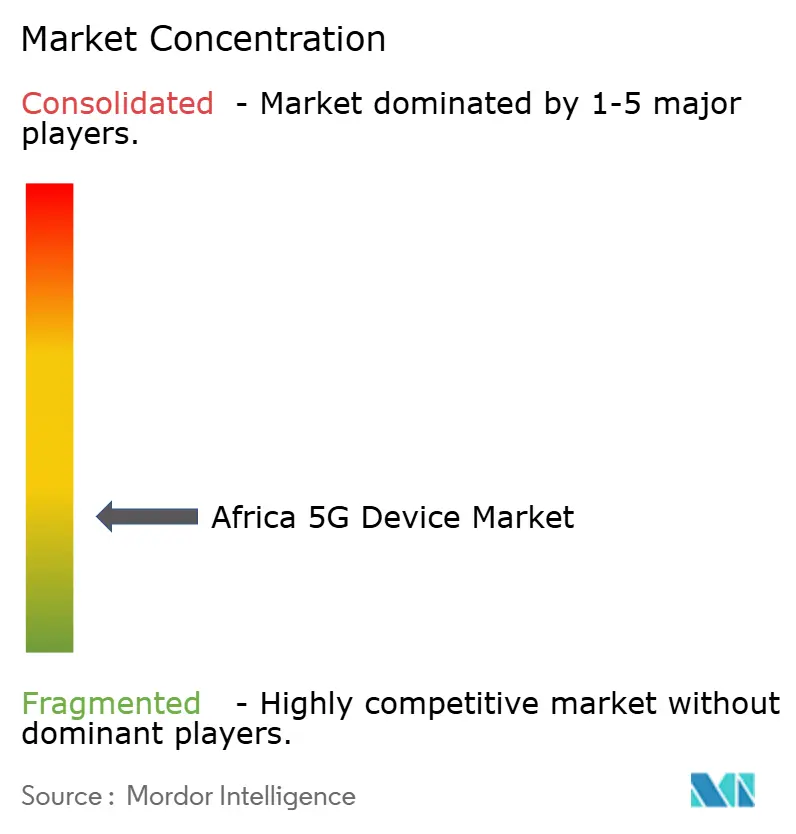
| Market Concentration | Low |
Major Players *Disclaimer: Major Players sorted in no particular order Image © Mordor Intelligence. Reuse requires attribution under CC BY 4.0. | |
Africa 5G Device Market Analysis by Mordor Intelligence
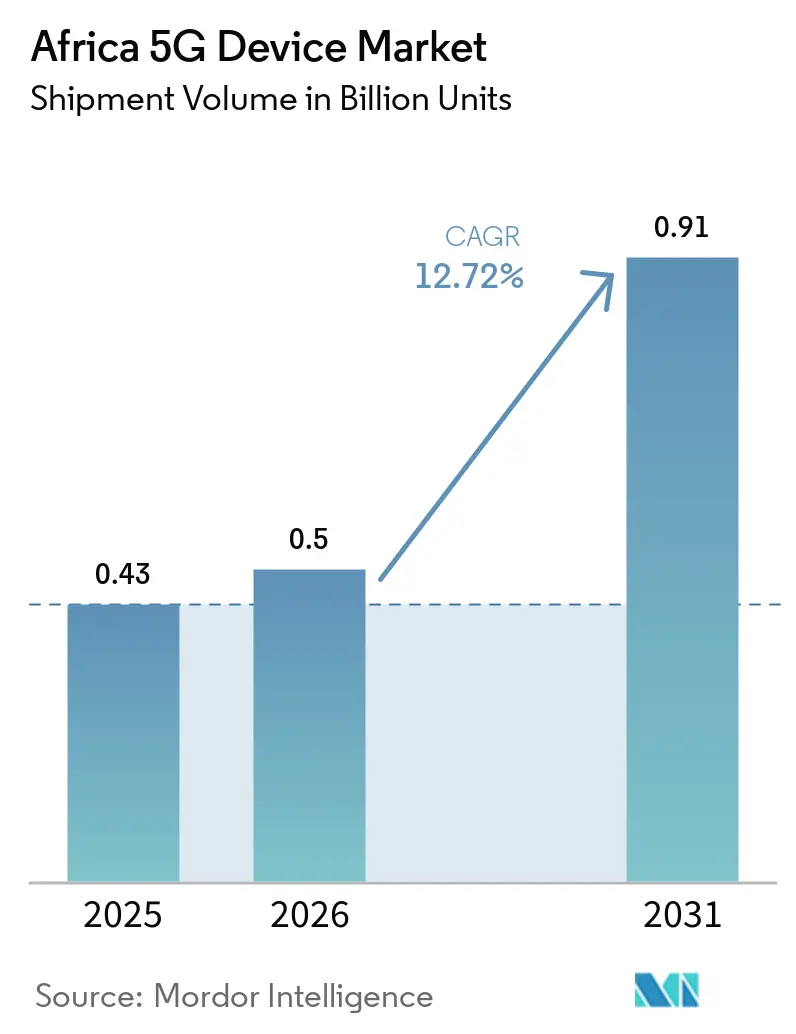
The Africa 5G device market size in terms of shipment volume is projected to be 0.43 billion units in 2025, 0.5 billion units in 2026, and reach 0.91 billion units by 2031, growing at a CAGR of 12.72% from 2026 to 2031. Early deployments in South Africa, Nigeria, and Kenya laid the foundation for the African 5G device market. Handset financing, broader deployment of fixed wireless access, and more midrange 5G phones are increasing the number of devices that consumers and businesses can adopt. The installed base of 5G devices remained limited in 2025, leaving substantial room for network users to move from feature phones and 4G handsets to 5G devices. Operators are pairing devices with data plans and home broadband offers, which shifts demand beyond conventional handset replacement. Price pressure on entry-level devices remains a constraint, especially where inflation, import costs, and income levels limit affordability.
Key Report Takeaways
- By form factor, smartphones accounted for 72.21% of Africa's 5G device market volume share in 2025, while customer-premises equipment is projected to grow at a 14.11% CAGR through 2031.
- By spectrum support, sub-6 GHz devices held 69.98% of Africa's 5G device market volume share in 2025, while hybrid (sub-6 GHz and mmWave) devices are projected to expand at a CAGR of 13.89% through 2031.
- By end-user industry, consumer electronics accounted for 70.21% of Africa's 5G device market volume share in 2025, while enterprise and commercial devices are projected to expand at a CAGR of 13.85% through 2031.
- By application, enhanced mobile broadband (eMBB) held 62.32% of Africa's 5G device market volume share in 2025, while fixed wireless access is projected to expand at a CAGR of 14.35% through 2031.
- By country, the rest of Africa accounted for 54.40% of Africa's 5G device market volume share in 2025, while Nigeria is projected to expand at a 13.90% CAGR through 2031.
Note: Market size and forecast figures in this report are generated using Mordor Intelligence’s proprietary estimation framework, updated with the latest available data and insights as of January 2026.
Africa 5G Device Market Trends and Insights
Drivers Impact Analysis*
| Driver | (~) % Impact on CAGR Forecast | Geographic Relevance | Impact Timeline |
|---|---|---|---|
| Subsidized 5G Handset Financing Expands First-Time Adoption | +3.8% | South Africa, Nigeria, Kenya, Uganda, Tanzania | Short term (≤ 2 years) |
| FWA-Centric 5G Rollouts Pull Device Demand Beyond Urban Smartphones | +3.1% | Sub-Saharan Africa, including South Africa, Nigeria, Kenya, Tanzania, and Ghana | Medium term (2-4 years) |
| Local Assembly and Tax Optimization Reduce Device Landed Cost | +2.2% | Nigeria, Kenya, Egypt, Algeria | Long term (≥ 4 years) |
| 5G-Ready Midrange Android Portfolio Expansion Improves Addressable Volume | +1.6% | Pan-Africa, with early gains in South Africa, Nigeria, Kenya, and Ethiopia | Short term (≤ 2 years) |
| Operator Bundling of Devices With Data Plans Accelerates Conversion | +1.1% | South Africa, Nigeria, Kenya | Short term (≤ 2 years) |
| Enterprise Private Network Pilots Increase Demand for Routers and Modules | +0.8% | South Africa, Nigeria, Morocco | Medium term (2-4 years) |
| Source: Mordor Intelligence | |||
Subsidized 5G Handset Financing Expands First-Time Adoption
Device financing has become a central near-term demand lever in the Africa 5G device market by reducing the initial payment required for a handset. It helps consumers who have traditionally stayed on feature phones or lower-priced 4G devices due to the cost of buying a smartphone outright. MTN MoMo launched its Handset Rent-to-Own program in South Africa in July 2025, offering 4G and 5G devices for ZAR 10 (USD 0.55) per day, with no credit checks. Vodacom's Easy2Own program had connected 18.8 million smartphones by May 2025, and smartphone penetration across the group reached 68.6%. Its financing arrangement totaled ZAR 3.75 billion (USD 201 million), supporting the wider distribution of financed devices. MTN Nigeria also partnered with Intelligra and Stanbic IBTC across more than 200 outlets to expand financing options for 5G device purchases.
FWA-Centric 5G Rollouts Pull Device Demand Beyond Urban Smartphones
Fixed wireless access is changing device demand in the Africa 5G device market because it requires customer-premises equipment as well as mobile handsets. As of May 2026, 40 of Africa's 61 commercial 5G networks offered fixed wireless access services. The continent had just under 1 million 5G fixed wireless access connections by mid-2026, while the connection base is expected to exceed 3.5 million by 2030. Ericsson expected Africa to record the fastest regional fixed wireless access CAGR at 15.06% through 2031.[1]Ericsson, “Fixed Wireless Access Outlook,” Ericsson Mobility Report, ERICSSON.COM MTN Group identified Nigeria and Ghana as priority home-broadband investment markets in its H1 2026 results, and it noted that additional mid-band spectrum was important for fixed wireless access in Ghana. In locations without established copper or fiber networks, a 5G customer-premises device can provide a household's first fixed broadband connection.
Local Assembly and Tax Optimization Reduce Device Landed Cost
Import duties, value-added tax, logistics costs, and currency movements have historically raised the landed cost of devices across Africa. Local assembly can reduce some of these cost layers and can make device pricing more manageable for operators and original equipment manufacturers. Nigeria introduced NCC-backed incentives in June 2026, including tax holidays and simplified customs procedures for local smartphone and device manufacturing. The program included locally assembled smartphones, routers, and MiFi devices as part of digital inclusion programs. Kenya also maintained a duty-remission approach that allowed device assembly inputs to enter duty-free through mid-2026. Egypt combined higher tariffs on finished devices with tax concessions for imported components under its Egypt Makes Electronics initiative. Vivo opened an assembly facility in Algeria in 2024 with an initial capacity of 2,000 units per day, with the potential to reach 6,000 units per day.
Midrange 5G Android Portfolio Expansion Improves Addressable Volume
The availability of 5G phones below USD 200 is important for broad adoption in the Africa 5G device market. Samsung Electronics West Africa launched the Galaxy A57 5G and Galaxy A37 5G in Nigeria in May 2026, extending Galaxy AI features into the midrange 5G category. Infinix launched the NOTE Edge in Kenya in February 2026 with the MediaTek Dimensity 7100 5G platform. The phone was priced from KES 32,999 (USD 254) and used Android 16. TECNO launched the POVA Curve 2 5G in Kenya in July 2026 for KES 59,999 (USD 462), featuring an 8,000 mAh battery designed for markets with inconsistent grid power. Wider adoption of MediaTek Dimensity and Qualcomm Snapdragon 4 Gen platforms could lower component costs and support further reductions in 5G handset prices.
Restraints Impact Analysis*
| Restraint | (~) % Impact on CAGR Forecast | Geographic Relevance | Impact Timeline |
|---|---|---|---|
| High Effective Device Cost Versus Disposable Income | -2.4% | Continental, most acute in West and Central Africa | Short term (≤ 2 years) |
| Uneven Spectrum Assignment Slows Device Ecosystem Readiness | -1.8% | Rest of Africa, with 19 of 54 countries yet to complete 5G spectrum assignment | Medium term (2-4 years) |
| Imported Handset Dependency Exposes Market to FX and Supply Disruptions | -1.2% | Sub-Saharan Africa, particularly Nigeria, Ethiopia, and the Democratic Republic of Congo | Medium term (2-4 years) |
| Weak Rural Backhaul Limits End-User Perception of 5G Value | -0.7% | East Africa rural corridors, Central Africa, and inland West Africa | Long term (≥ 4 years) |
| Source: Mordor Intelligence | |||
High Device Cost Relative to Disposable Income
The entry-level 5G smartphone in Africa remained above USD 100 in 2026, which was more than a month's income for many potential users. This price level restricted the ability of financing programs to reach all consumers. The sub-USD 100 smartphone segment declined 34% year over year in Q2 2026 as higher memory prices forced manufacturers to raise prices or reduce device configurations. MTN Group reported that rising chipset costs were affecting handset affordability and that it was assessing operator financing as a longer-term response. The GSMA and six African operators signed a memorandum of understanding at MWC Barcelona 2026 to pilot entry-level smartphones priced between USD 30 and USD 40 across six countries. The initiative recognized that the existing device cost floor limited mass adoption of 5G-capable handsets.
Uneven Spectrum Assignment Slows Device Ecosystem Readiness
Different spectrum policies across Africa's 54 countries slow the development of a consistent 5G device ecosystem. Manufacturers need a sufficient base of harmonized bands before they can justify Africa-specific device designs at high volumes. By mid-2026, 35 countries had allocated 5G spectrum, mainly in the 3.5 GHz band, while mmWave frameworks remained limited outside South Africa and North Africa. ICASA published South Africa's National Radio Frequency Plan 2026 in July 2026, designating the upper 6 GHz band for IMT use and issuing draft plans across nine frequency bands from 1,710 MHz to 71 GHz.[2]Independent Communications Authority of South Africa, “National Radio Frequency Plan 2026,” Government Gazette, ICASA.ORG.ZA Nigeria published its Spectrum Roadmap 2026-2030, although 55.4% of Lagos remained without 5G coverage in Q4 2025. Device type approval requirements for equipment operating in the 3.8-4.2 GHz and 5.9-6.4 GHz bands can also delay commercial availability of new device categories.
*Our forecasts treat driver/restraint impacts as directional, not additive. The impact forecasts reflect baseline growth, mix effects, and variable interactions.
Segment Analysis
By Form Factor: Smartphones Lead Volume While Customer-Premises Equipment Gains Momentum
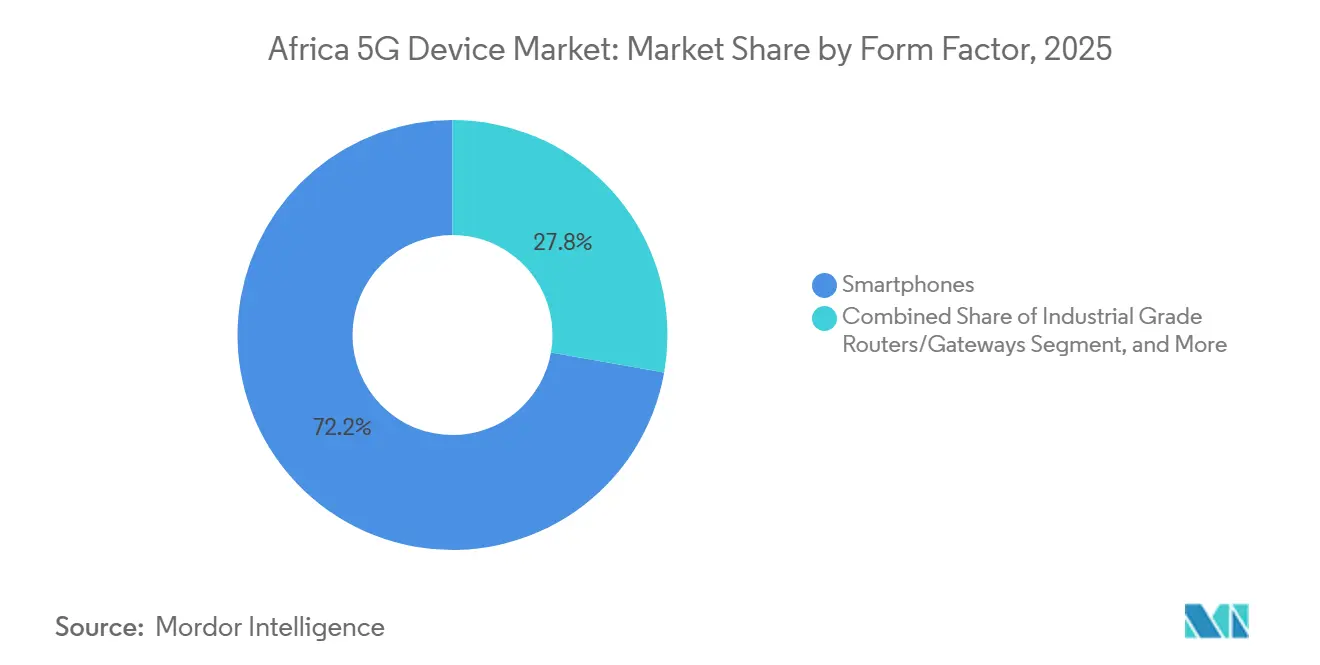
Smartphones accounted for 72.21% of Africa's 5G device market volume in 2025 and remained the leading form factor, as handsets are the principal internet access device across much of the continent. Transsion brands TECNO, Infinix, and itel accounted for 48% of Africa's smartphone shipments in 2025, while Samsung led the 5G-capable tier as 5G smartphone shipments increased 19% year over year in Q1 2026. Industrial routers, gateways, modules, laptops, tablets, hotspots, wearables, and XR devices were used for smaller, specialized applications. They supported mining automation, enterprise mobility, and early private-network deployments. Smartphone demand remained tied to consumer replacement cycles, financing availability, and a wider choice of midrange devices.
Customer-premises equipment is projected to expand at a CAGR of 14.11% from 2026 to 2031, the highest rate among form factors. The Africa 5G device market size for customer-premises equipment benefits from fixed wireless access where fiber is unavailable or difficult to extend, and MTN South Africa had reached 344,000 home broadband connections by H1 2025. The African 5G fixed wireless access base was just under 1 million connections by mid-2026. Equipment priced below USD 80 and operator bundles improved the economics of household broadband offers. Nigeria and Ghana were MTN's priority markets for fixed wireless access and fiber home broadband, making customer-premises equipment a practical way to monetize network investment beyond mobile subscriptions.



By Spectrum Support: Sub-6 GHz Supports Coverage While Hybrid Devices Serve Enterprise Use Cases
Sub-6 GHz devices accounted for 69.98% of the African 5G device market in 2025. Their stronger long-distance propagation is valuable in low-density areas, where coverage economics carry more weight than peak-speed positioning. Rain South Africa and Huawei launched a multi-thousand-site sub-1 GHz Massive MIMO 5G network in July 2026. The deployment reported a 5 dB uplink coverage improvement and capacity up to 3x higher than conventional 4T4R configurations, expanding the addressable base for compatible devices. mmWave devices remained limited in volume because they were concentrated in dense settings, although MTN Nigeria and Huawei completed a 25 Gbps full-duplex microwave link in April 2026 to support high-capacity wireless backhaul.
Hybrid Sub-6 GHz and mmWave devices are projected to expand at a CAGR of 13.89% from 2026 to 2031. The Africa 5G device market size for hybrid equipment is driven by private networks, industrial sites, and dense business locations that require both broad coverage and localized capacity. ICASA's July 2026 spectrum plan provided a clearer framework for mmWave IMT use in bands from 24.25 GHz to 48.2 GHz. This clarity supports planning for dual-mode customer-premises equipment and routers. MTN Zambia's five-band LampSite indoor 5G deployment in May 2026 illustrated the use of hybrid capabilities in commercial real estate and industrial facilities.
By End-User Industry: Consumer Electronics Leads While Enterprise and Commercial Adoption Advances
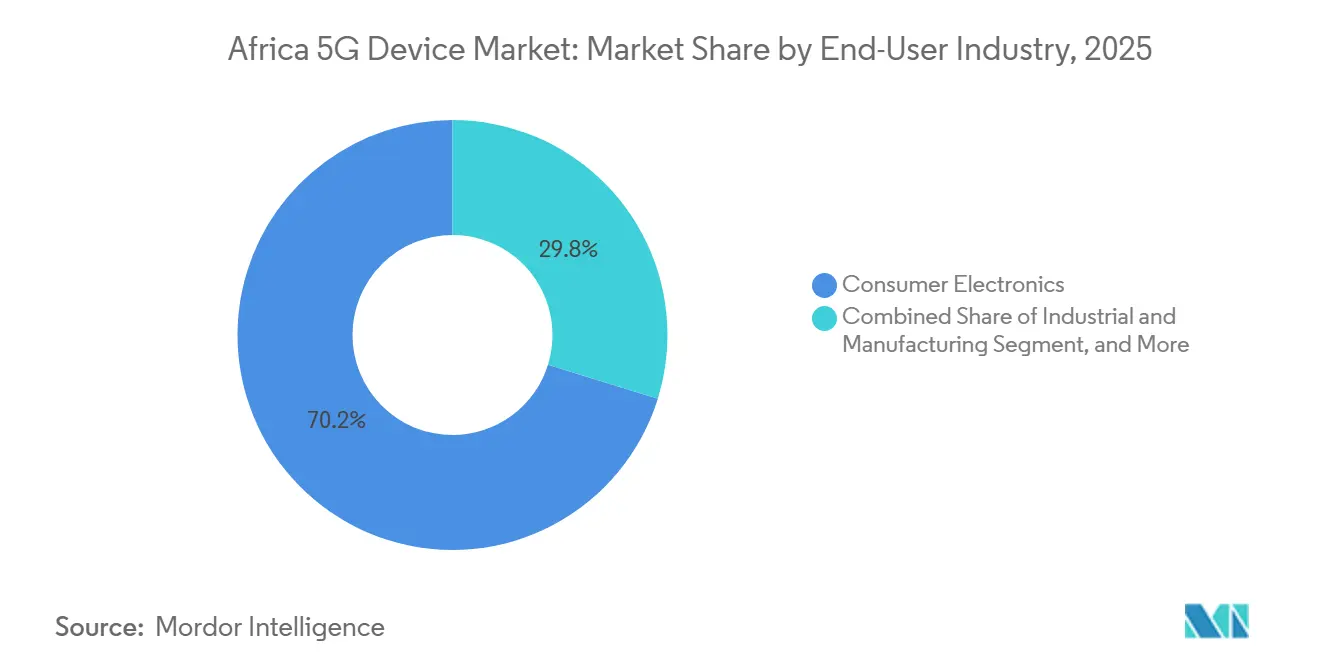
Consumer electronics accounted for 70.21% of the volume of Africa's 5G device market in 2025, supported by smartphone replacement demand and operator financing. Safaricom's 5G device base increased 55.5% to 1.64 million in its FY2026 results, while its 4G device base reached 29.15 million. Industrial and manufacturing use cases were developing in port logistics, mining, utilities, and oil and gas operations. Airtel Congo deployed a private telecom network at the Banga Kayo oil field in Congo-Brazzaville during 2025. Automotive, transportation, healthcare, and energy and utilities deployments remained at proof-of-concept or early rollout stages.
Enterprise and commercial devices are projected to expand at a CAGR of 13.85% from 2026 to 2031. The Africa 5G device industry is developing a second demand channel, in addition to handset replacement, through fleet purchases of routers, modules, and private-network endpoints. MTN South Africa's private 5G work in mining and manufacturing included contracts valued between USD 5 million and USD 20 million per site. Its Enterprise Business Unit generated more than ZAR 20 billion (USD 1.1 billion) annually. Inwi deployed Morocco's first private industrial 5G network at a 52-hectare factory in the Nador West Med hub in April 2026, where enterprise equipment can remain in service for longer cycles than consumer devices.
By Application: Enhanced Mobile Broadband Leads Volume While Fixed Wireless Access Expands Faster
Enhanced mobile broadband accounted for 62.32% of application volume in 2025, supported by mobile video, social commerce, and streaming services. MTN Group reported average data use of 14.8 GB per Nigerian customer each month in H1 2026, and group-wide data traffic reached 14,338 petabytes. These usage levels supported continued investment in network capacity and connected devices. URLLC and mMTC remained early-stage applications for pilots in ports, logistics hubs, and agricultural IoT projects. Vehicle-to-everything connectivity was also in its early stages, while ZTE and MTN conducted a 5G-Advanced Integrated Sensing and Communication trial in Hout Bay, South Africa, in September 2025.
Fixed wireless access is projected to expand at a CAGR of 14.35% from 2026 to 2031, the fastest growth rate among applications. Operators prioritize it because it can provide home and business broadband without extending fiber to every location and can generate higher revenue per connection than mobile broadband. The Middle East and Africa accounted for 30% of global 2024 fixed wireless access customer-premises equipment shipments, with equipment designed for local climate conditions and power volatility. MAPPLCOM launched a 5G fixed wireless access and fiber-to-the-premises network in 2025, targeting 500,000 households in Kenya and neighboring East African markets. Household broadband adoption can support more persistent equipment demand than cycles driven only by smartphone replacement.
Geography Analysis
South Africa retained the most mature operator environment in sub-Saharan Africa during 2025. Vodacom deployed 6,160 new 5G sites and 3,041 new 4G sites in its FY2026 period, supported by capital expenditure of ZAR 23.6 billion (USD 1.28 billion).[3]Vodacom Group Limited, “FY2026 Annual Results,” Vodacom Group, VODACOM.COM South Africa's smartphone shipments increased 17% year over year in Q2 2026 while broader Africa declined 7%, supported by operator financing and demand for higher-tier devices. ICASA's July 2026 spectrum plan designated the upper 6 GHz band for IMT and covered nine frequency bands from 1,710 MHz to 71 GHz. Rain South Africa and Huawei expanded wide-area 5G coverage through their sub-1 GHz Massive MIMO deployment.
Nigeria is projected to expand at a CAGR of 13.90% from 2026 to 2031, the fastest rate among countries. The NCC reported 14% 5G penetration and coverage across 27 states after more than 730 additional sites were deployed in 2026. Operators invested NGN 2.13 trillion (USD 1.35 billion) in network upgrades during 2025, and tower companies added NGN 373.8 billion (USD 237 million) in incremental spending. Airtel Africa committed USD 1.1 billion in capital expenditure for 2026 across its 14 African markets, with fiber and spectrum as core areas of focus. The NCC's 2026-2030 roadmap supports planning around 3.5 GHz TDD, 6 GHz, and 26 GHz mmWave assignments, although 55.4% of Lagos did not have 5G coverage in Q4 2025.
The rest of Africa accounted for 54.40% of the African 5G device market volume in 2025. This group includes Morocco's licensed 5G ecosystem and Central and West African locations where 4G remained the practical ceiling for many users, while Safaricom nearly doubled Kenya's 5G sites to 1,700 during 2025 and extended population coverage beyond 30%. Kenya's 5G device base increased 55.5% to 1.64 million users. Morocco issued 20-year licenses in November 2025 to Maroc Telecom, Orange Maroc, and inwi, while the Digital Morocco 2030 plan targeted MAD 80 billion (USD 7.84 billion) in ICT investment through 2035, and Vodacom Tanzania had deployed 370 5G sites by 2025.
Competitive Landscape
The Africa 5G device market is fragmented among manufacturers but more concentrated among operators that control network access, financing, and bundled offers. Transsion, through TECNO, Infinix, and itel, held 47% of Africa's total smartphone shipment volume in Q1 2026, largely driven by devices priced below USD 150, where mass 5G adoption remained limited. Samsung, HONOR, Xiaomi, OPPO, and vivo competed in the USD 150-400 range, where 5G adoption was more active. HONOR's shipments increased 101% year over year in Q1 2026, supported by carrier-financing partnerships in South Africa and Nigeria. Nokia and ZTE were more active in customer-premises equipment and enterprise routers, while the Casablanca Trade Court restricted sales of TECNO and itel 4G and 5G smartphones in Morocco during July 2026, following a standard-essential-patent ruling.
Operators influence the Africa 5G device market by determining which devices receive financing, distribution support, and data-plan bundles. Vodacom completed its USD 2.1 billion acquisition of the Kenyan government's stake in Safaricom on June 30, 2026, creating a platform for regional device procurement and financing. MTN Group set out plans to develop distributed AI computing capabilities across its tower estate, in partnership with NVIDIA, Cisco, Nokia, Ericsson, and ORAN Development Company. This approach could support demand for AI-enabled 5G endpoints in enterprise settings. Rain South Africa and Huawei expanded the coverage base for compatible devices through their multi-thousand-site sub-1 GHz 5G network, while MTN Nigeria and Huawei demonstrated high-capacity backhaul through their commercial 25 Gbps full-duplex microwave link.
Affordable indoor customer-premises equipment remains an open area in second-tier cities where fiber is limited and 5G coverage is improving. Enterprise IoT modules for agriculture and utilities are another area without a single supplier with broad distribution across African countries. Manufacturers need to balance low prices with components that work across varied power and network conditions, while operators can use financing and service bundles to reduce the upfront price barrier. The Africa 5G device market remains shaped by consumer smartphones, but customer-premises equipment and enterprise endpoints broaden the competitive field.
Africa 5G Device Industry Leaders
Samsung Electronics Co., Ltd.
Transsion Holdings Limited
Xiaomi Corporation
HUAWEI Technologies Co., Ltd.
TECNO Mobile Limited
- *Disclaimer: Major Players sorted in no particular order

Recent Industry Developments
- August 2026: Samsung Electronics launched the Galaxy S26 FE in Kenya at KES 103,100 (USD 793), powered by the Exynos 2600 chipset and offering 7 years of software support.
- July 2026: Infinix launched the HOT 70 Pro 5G in Nigeria with a programmable Active Matrix Cube LED back panel, an IP68 rating, and a 50 MP Sony camera.
- July 2026: TECNO launched the POVA Curve 2 5G in Kenya at KES 59,999 (USD 462), featuring a 7.4 mm curved-display form factor and an 8,000 mAh battery.
- May 2026: Samsung Electronics West Africa launched the Galaxy A57 5G and Galaxy A37 5G in Nigeria, adding Galaxy AI features at midrange prices.


Africa 5G Device Market Report Scope
The Africa 5G device market volume is measured by the annual shipment of 5G devices (in units), including smartphones, customer-premises equipment, routers, gateways, modules, laptops, tablets, hotspots, and wearables, across sub-6 GHz, mmWave, and hybrid spectrum configurations for applications such as enhanced mobile broadband (eMBB), ultra-reliable low-latency communications (URLLC), massive machine-type communications (mMTC), fixed wireless access (FWA), and vehicle-to-everything (V2X).
The Africa 5G device market report is segmented by form factor (smartphones, customer-premises equipment (indoor/outdoor), industrial grade routers/gateways, modules, laptops/tablets, hotspots, and wearables and XR devices), spectrum support (sub-6 GHz, mmWave, and hybrid (sub-6 GHz and mmWave)), end user industry (consumer electronics, industrial and manufacturing, automotive and transportation, healthcare, energy and utilities, and enterprise/commercial), application (enhanced mobile broadband (eMBB), ultra-reliable low-latency comms (URLLC), massive machine-type comms (mMTC), fixed wireless access, and vehicle-to-everything (V2X)), and country (South Africa, Nigeria, and Rest of Africa). The market forecasts are provided in terms of volume (units).
| Smartphones |
| Customer-Premises Equipment (Indoor/Outdoor) |
| Industrial Grade Routers/Gateways |
| Modules |
| Laptops/Tablets |
| Hotspots |
| Wearables and XR Devices |
| Sub-6 GHz |
| mmWave |
| Hybrid (Sub-6 GHz and mmWave) |
| Consumer Electronics |
| Industrial and Manufacturing |
| Automotive and Transportation |
| Healthcare |
| Energy and Utilities |
| Enterprise/Commercial |
| Enhanced Mobile Broadband (eMBB) |
| Ultra-Reliable Low-Latency Comms (URLLC) |
| Massive Machine-Type Comms (mMTC) |
| Fixed Wireless Access |
| Vehicle-to-Everything (V2X) |
| South Africa |
| Nigeria |
| Rest of Africa |
| By Form Factor | Smartphones |
| Customer-Premises Equipment (Indoor/Outdoor) | |
| Industrial Grade Routers/Gateways | |
| Modules | |
| Laptops/Tablets | |
| Hotspots | |
| Wearables and XR Devices | |
| By Spectrum Support | Sub-6 GHz |
| mmWave | |
| Hybrid (Sub-6 GHz and mmWave) | |
| By End-User Industry | Consumer Electronics |
| Industrial and Manufacturing | |
| Automotive and Transportation | |
| Healthcare | |
| Energy and Utilities | |
| Enterprise/Commercial | |
| By Application | Enhanced Mobile Broadband (eMBB) |
| Ultra-Reliable Low-Latency Comms (URLLC) | |
| Massive Machine-Type Comms (mMTC) | |
| Fixed Wireless Access | |
| Vehicle-to-Everything (V2X) | |
| By Country | South Africa |
| Nigeria | |
| Rest of Africa |


Key Questions Answered in the Report
What is the Africa 5G device market size?
The Africa 5G device market was 0.43 billion units in 2025 and is estimated to reach 0.91 billion units by 2031, at a CAGR of 12.72% from 2026 to 2031.
Which form factor leads 5G device adoption in Africa?
Smartphones led with 72.21% of volume in 2025, while customer-premises equipment is projected to expand fastest at a CAGR of 14.11% through 2031.
Why is fixed wireless access important for 5G device demand in Africa?
Fixed wireless access can provide home and business broadband where fiber is limited, creating demand for customer-premises equipment and routers.
Which African country is expected to see the fastest 5G device adoption?
Nigeria is projected to expand at a CAGR of 13.90% from 2026 to 2031, supported by wider deployment, spectrum planning, and operator investment.
What limits 5G device adoption across Africa?
High entry-level handset prices, uneven spectrum assignment, imported handset dependence, and weak rural backhaul limit broader adoption.
Which application has the highest projected CAGR through 2031?
Fixed wireless access is projected to expand at a CAGR of 14.35% from 2026 to 2031, ahead of other listed applications.
Page last updated on:





