
Aerospace Robotics Market Size and Share
Market Overview
| Study Period | 2020 - 2032 |
|---|---|
| Market Size (2027) | USD 5.10 Billion |
| Market Size (2032) | USD 9.46 Billion |
| Growth Rate (2027 - 2032) | 13.15 % |
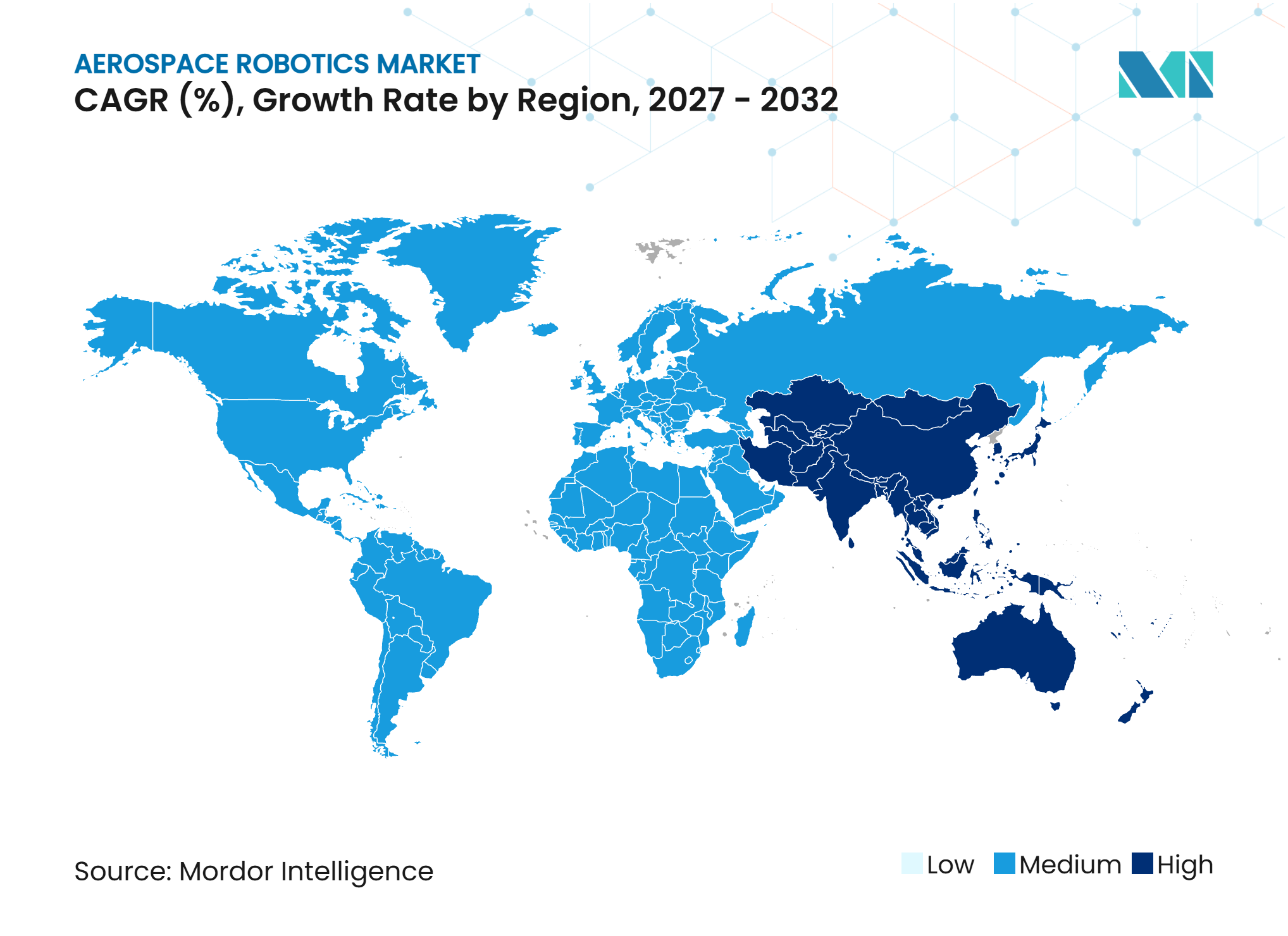
| Fastest Growing Market | Asia-Pacific |
| Largest Market | North America |
| Market Concentration | Medium |
Major Players *Disclaimer: Major Players sorted in no particular order Image © Mordor Intelligence. Reuse requires attribution under CC BY 4.0. | |
Aerospace Robotics Market Analysis by Mordor Intelligence
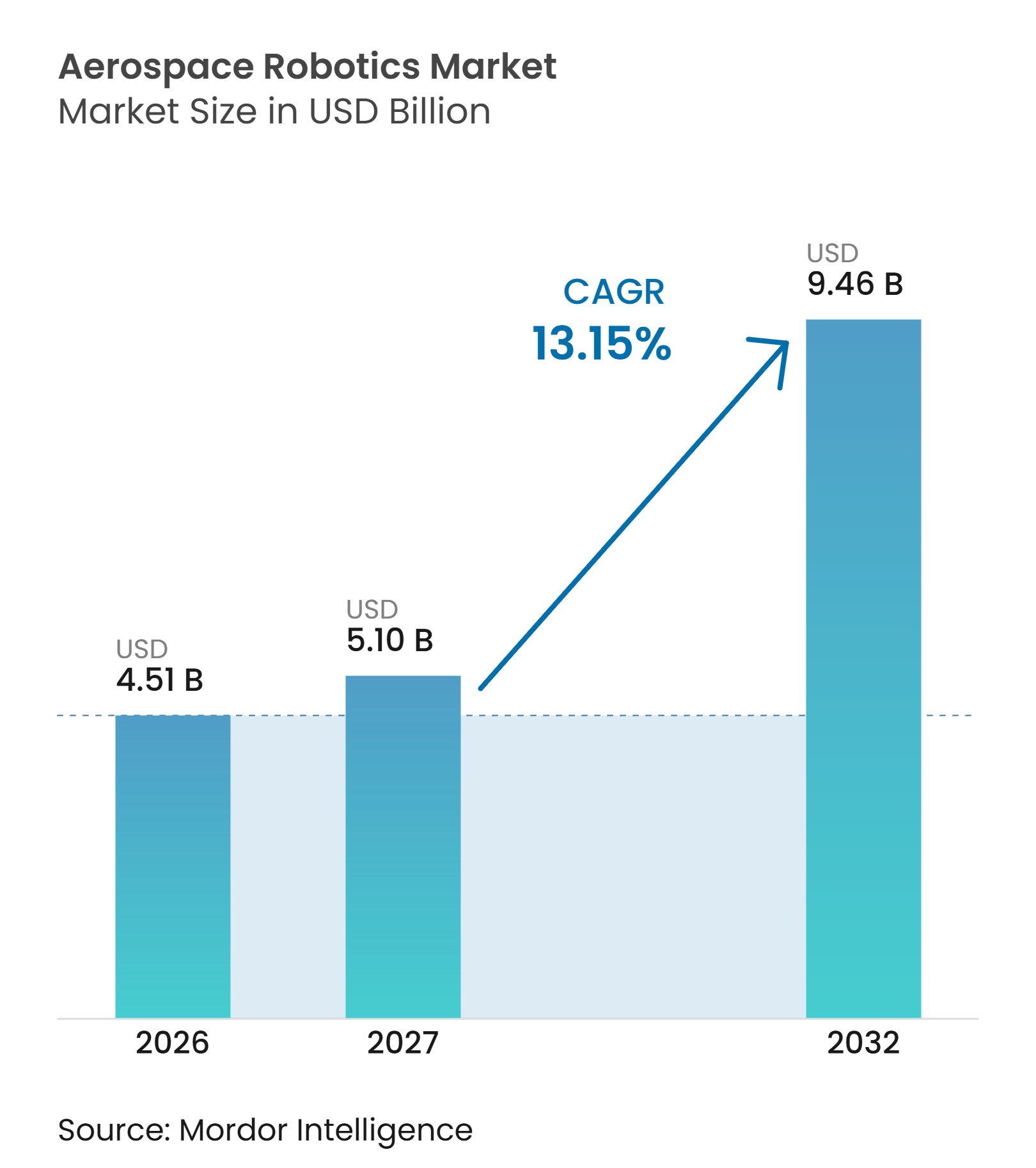
The aerospace robotics market size was valued at USD 4.51 billion in 2026 and is forecast to grow from USD 5.10 billion in 2027 to reach USD 9.46 billion by 2032, at a 13.15% CAGR during the forecast period (2027-2032). Airbus reported an order backlog of 8,754 commercial aircraft at the end of 2025, while Boeing reported an order book of nearly 6,100 aircraft, keeping pressure on manufacturers to raise output through automation. Robotics is becoming part of production planning because shortages of skilled technicians limit the ability to add labor at the required pace. Manufacturers are also directing investment toward inspection, maintenance, and reconfigurable assembly systems that can work across several aircraft programs. Government-led space servicing programs broaden opportunities beyond factory floors and toward orbital operations. Vendors with aerospace validation experience and strong certification support are better placed to serve this demand.
Key Report Takeaways
- By robot type, traditional robots held 76.24% of the aerospace robotics market share in 2026, while collaborative robots are forecast to grow at a 16.45% CAGR through 2032.
- By component, controllers accounted for 27.65% revenue share in 2026, while arm processors are forecast to expand at a 17.56% CAGR through 2032.
- By payload capacity, robots with 10 kg to less than 50 kg capacity accounted for 37.89% of revenue share in 2026 and are projected to grow at a 16.89% CAGR through 2032.
- By application, inspection and maintenance accounted for 39.24% revenue share in 2026, while space and on-orbit operations are forecast to grow at an 18.01% CAGR through 2032.
- By geography, North America held 37.85% of the aerospace robotics market share in 2026, while Asia-Pacific is forecast to expand at a 16.86% CAGR through 2032.
Note: Market numbers in this report are based on Mordor Intelligence's proprietary estimation framework, which combines nine months of actuals with Q4 projections for base year 2026.
Market Trends and Insights
Drivers Impact Analysis of Aerospace Robotics Market*
| Driver | (~) % Impact on CAGR Forecast | Geographic Relevance | Impact Timeline |
|---|---|---|---|
| Commercial aircraft production backlog and rate ramp-up | +2.50% | North America and Europe, with spillover to Asia-Pacific MRO hubs | Short term (≤ 2 years) |
| Aerospace workforce shortages and skilled labor constraints | +2.20% | Global, with strong exposure in North America and Europe | Medium term (2-4 years) |
| Demand for high precision, repeatable aircraft assembly | +2.00% | North America and Europe OEM assembly lines | Medium term (2-4 years) |
| Expansion of robotic inspection and smart MRO | +1.80% | Global, with faster adoption in Asia-Pacific | Medium term (2-4 years) |
| Shift toward flexible automation for low volume, high complexity production | +1.50% | North America, Europe, and emerging Asia-Pacific | Long term (≥ 4 years) |
| Robotics adoption in space servicing and in-orbit operations | +1.40% | North America, Europe, Japan, and Australia | Long term (≥ 4 years) |
| Source: Mordor Intelligence | |||
Commercial Aircraft Production Backlog Accelerates Robotic Investment
Airbus held a backlog of 8,754 aircraft at the end of 2025, and Boeing reported nearly 6,100 commercial airplanes in its order book. This combined queue supports sustained production activity across assembly tiers and makes throughput a central operating issue. Airbus demonstrated an in-house robotic drilling cell for A320 pre-assembly in June 2025, featuring a FANUC M-800iA/60 robot, an integrated drilling unit, and a mobile platform. The installation shows that airframers are building internal expertise rather than relying solely on turnkey systems. That approach may reduce the addressable work available to generalist integrators while raising demand for suppliers with validated aerospace applications. The aerospace robotics market, therefore, favors vendors that can support production-rate goals, process qualification, and long operating cycles.
Aerospace Workforce Shortages Drive Structural Automation Demand
Human-robot collaboration can be hindered by organizational readiness, even when tasks are technically suitable for automation. The finding is relevant to aerospace plants because experienced technicians are difficult to replace and assembly tasks often require long training periods. Manufacturers can use robotics to reduce dependence on scarce skills in repetitive drilling, fastening, inspection, and material movement. Collaborative systems are particularly useful where technicians must remain close to the process or work in constrained aircraft interiors. The value case is strongest where production teams cannot recruit enough trained operators to meet scheduled output. This supports wider deployment of aerospace robotics across North American and European suppliers, where labor availability and production commitments must be managed simultaneously.
Demand for High-Precision, Repeatable Aircraft Assembly Reshapes Robot Specifications
Industrial robots that use vision and AI can achieve sub-millimeter precision in drilling, riveting, and inspection of aerospace structures. Aircraft assembly requires consistent fastener-hole placement, composite layup angles, and sealing work, which increases the value of repeatable motion control. These requirements limit the use of basic automation in safety-sensitive applications. Vision systems, force sensing, and adaptive control help robots respond to part variation without interrupting the production flow. Lower rework can release capacity that would otherwise be used for correction cycles. The aerospace robotics market benefits when manufacturers treat quality assurance and output improvement as linked operational goals rather than separate investments.
Expansion of Robotic Inspection and Smart MRO Creates Recurring Revenue Streams
GE Aerospace deployed its AI-enabled Blade Inspection Tool at more than 12 maintenance facilities in 2025, cutting turbine blade inspection time by half compared with standard borescope inspections.[1] The NCMS Orion system demonstrated ultrasonic inspection speeds of up to 40 inches per second at 0.08-inch data collection intervals and was deployed with Bell Flight at Technology Readiness Level 7.[2] These applications support maintenance work that continues even when aircraft delivery rates soften. That integration can shorten maintenance cycles and improve the consistency of scheduled checks. The aerospace robotics market can gain from recurring service demand alongside original equipment manufacturing activity.
Restraints Impact Analysis of Aerospace Robotics Market*
| Restraint | (~) % Impact on CAGR Forecast | Geographic Relevance | Impact Timeline |
|---|---|---|---|
| High initial capital expenditure and integration costs | -0.80% | Global, with greater exposure among tier-2 and tier-3 suppliers in Asia-Pacific and South America | Short term (≤ 2 years) |
| Certification, validation, and traceability requirements for safety critical automation | -0.60% | North America and Europe | Medium term (2-4 years) |
| Legacy equipment, software, and protocol interoperability gaps | -0.50% | Global, with acute exposure in established OEM and MRO facilities | Medium term (2-4 years) |
| Cybersecurity and data governance exposure in connected robotic systems | -0.40% | Global, with elevated exposure in defense-related applications | Long term (≥ 4 years) |
| Source: Mordor Intelligence | |||
High Initial Capital Expenditure Constrains Adoption Across Supplier Tiers
Aerospace robotic projects require funding for equipment, customized tooling, facility changes, training, and process validation before they can support regular production. These requirements are more difficult for tier-2 and tier-3 suppliers that produce low-volume, complex parts with limited investment flexibility. Integration can be especially costly where maintenance sites use older equipment and bespoke engineering is needed to connect new systems. The US Government Accountability Office noted that providers of in-space robotic arms can depend on a small number of government contracts for sustained capital. This can create a divide between large prime contractors, which can justify full automation programs, and smaller suppliers, which face longer payback periods. The aerospace robotics market may therefore develop unevenly across the supply chain despite strong demand from major manufacturers.
Certification and Traceability Requirements Add Complexity to Safety-Critical Automation
Certification requirements lengthen deployment schedules for robotics used in safety-critical production and maintenance work. The Aerospace Industries Association has described how DO-178C software assurance principles apply according to the consequences of software failure. AS9100D quality management requirements also increase the need for traceable processes across robotic cells. NCMS identified airworthiness, nondestructive evaluation, and material traceability as barriers to the automation of robotic directed energy deposition for aircraft maintenance. Older production systems can introduce additional interface and validation work, while connected cells require stronger data governance. These factors shape demand in the aerospace robotics market for providers that can document controls, secure interfaces, and help customers manage compliance throughout deployment.
*Our forecasts treat driver/restraint impacts as directional, not additive. The impact forecasts reflect baseline growth, mix effects, and variable interactions.
Aerospace Robotics Market Segment Analysis
By Robot Type:
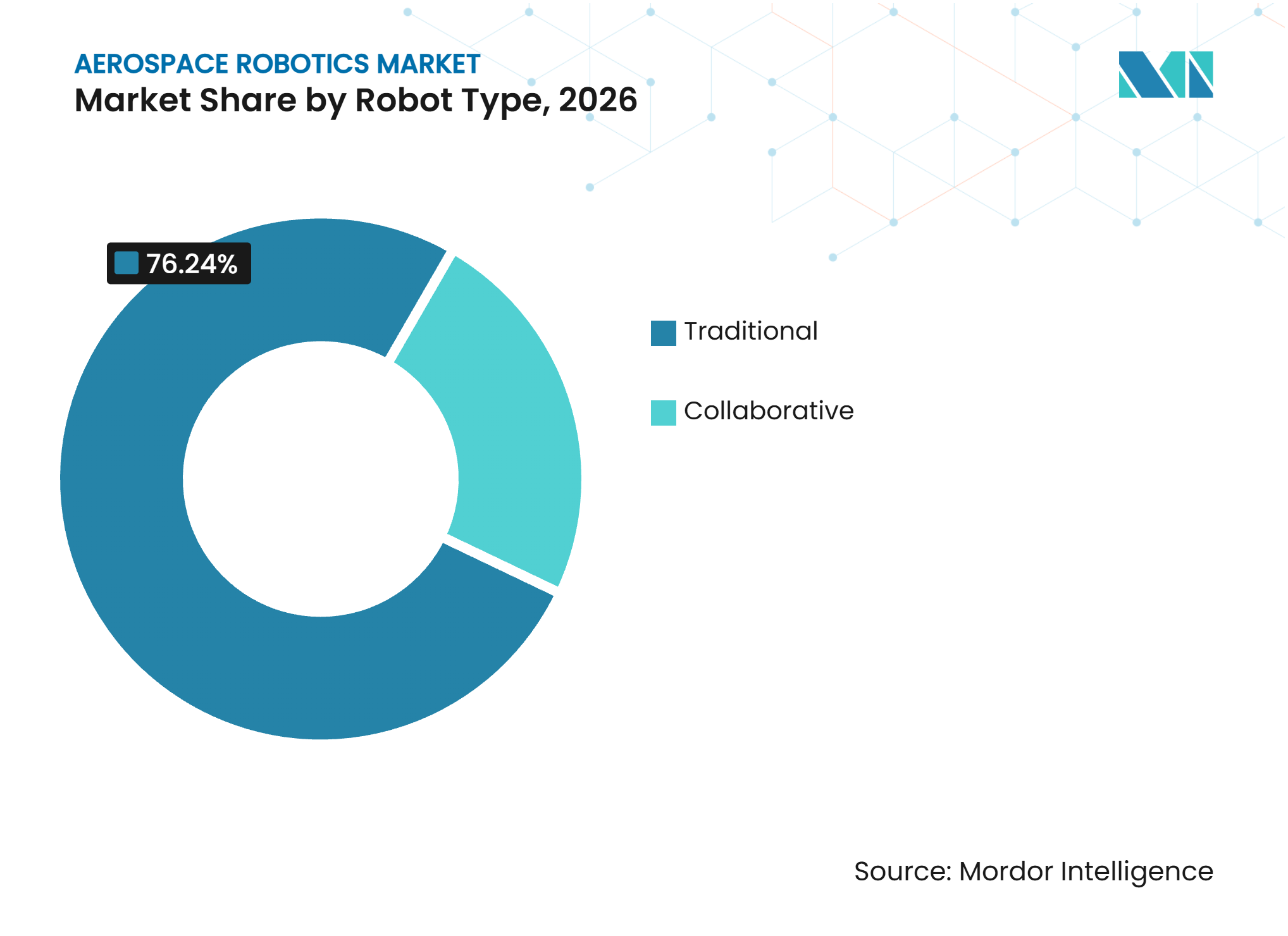
Traditional Systems Dominate, Collaborative Robots Gain in High-Mix EnvironmentsTraditional industrial robots held a 76.24% revenue share in 2026 because their payload, rigidity, and repeatability suit structural assembly, composite work, and paint application. These systems have a long history in fixed, high-volume production cells where the aircraft configuration changes slowly. Their use in drilling and riveting reflects the need for stable performance over extended programs. Collaborative robots are projected to expand at a 16.45% CAGR through 2032 as suppliers seek more flexible tools for cabin work, close-tolerance fastening, and confined fuselage spaces. FANUC demonstrated CRX collaborative robots in 2025 for welding, deburring, and material handling, featuring IP67 housings and hand-guided programming.[3] The aerospace robotics market will see gradual adoption rather than a rapid replacement of conventional systems.
Collaborative robots equipped with vision and force-torque sensing can enhance adaptability while reducing ergonomic strain in aerospace assembly. This makes them useful where fixture-less production is a practical goal, and workers need to share the cell. Collaborative formats can support frequent changeovers across aircraft programs without extensive programming work. Traditional systems retain an advantage when a dedicated line must maximize throughput for a single product family. The aerospace robotics industry is therefore likely to use both formats depending on production volume, part accessibility, and safety requirements. Suppliers that offer compatible controls and validated end effectors can better serve this mixed operating model.



By Component:
Controllers Hold Largest Share, Arm Processors Fastest Growing on AI MomentumControllers accounted for 27.65% of revenue share in 2026 because they connect mechanical equipment with production, quality, and safety systems. They coordinate movement, collect operating data, and support repeatable work across robotic cells. Arm processors are forecast to grow at a 17.56% CAGR through 2032 as real-time processing is embedded closer to motion control hardware. This capability supports faster path correction and adaptive grip adjustment without external data processing. Sensors and vision systems extend this function by identifying defects and variations in parts during production. The component structure supports aerospace robotics market demand for systems that combine mechanical reliability with embedded intelligence.
Drives, motion systems, end effectors, and tool changers remain important because robotic cells increasingly switch between drilling, fastening, sealant application, and inspection. Their design must meet the tolerance and traceability requirements of aerospace work. Inbolt launched a Robot Control platform in 2026 that runs across Fanuc America Corporation, KUKA SE & Co. KGaA, ABB Ltd., Comau S.p.A., Yaskawa America, Inc., and Universal Robots A/S. Cross-brand software can reduce the burden of managing several installed robot platforms. AS9100D compliance also increases demand for audit-ready records from sensors and controllers. The aerospace robotics market offers component suppliers an opportunity to combine interoperability with evidence supporting qualified processes.
By Payload Capacity:
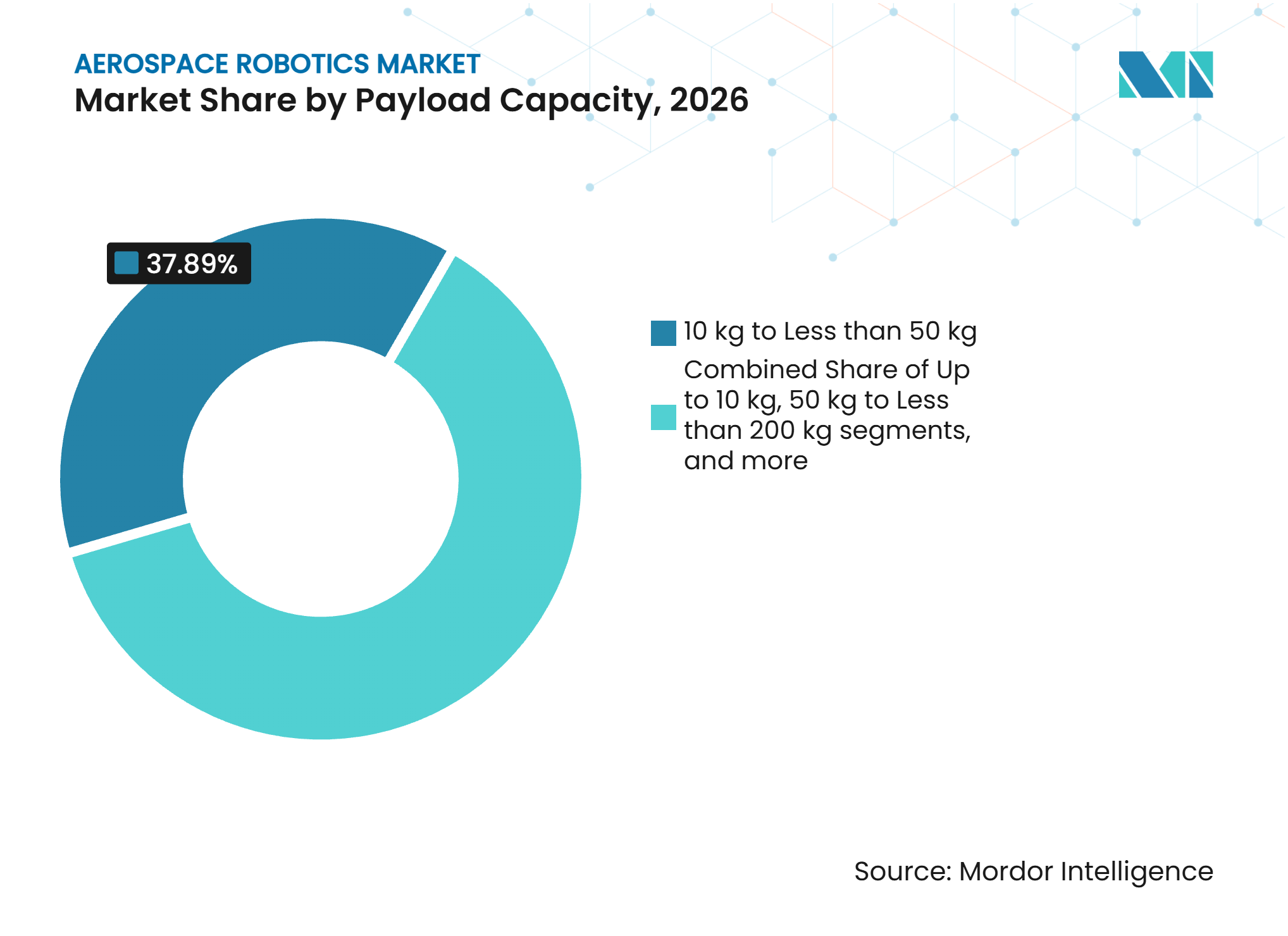
Mid-Range Category Anchors Both Assembly and Inspection DemandRobots with a payload capacity of 10 kg to less than 50 kg accounted for 37.89% of revenue in 2026 and are projected to grow at a 16.89% CAGR through 2032. This range is suitable for fuselage panel drilling, spar assembly, cabin fitting, and nondestructive inspection using sensor-equipped tools. It supports both conventional industrial robots and semi-collaborative equipment used in pre-assembly and maintenance hangars. The category can meet common aerospace tasks without the footprint or cost of the largest robot systems. Its growth also reflects increasing automation of inspection work that needs reach, repeatability, and a manageable payload. This balance makes the aerospace robotics market relevant across aircraft manufacturing and aftermarket operations.
Robots with up to 10 kg capacity are useful for inspection and cabin tasks where technicians work in limited space. The 50 kg to less than 200 kg category is used for landing gear handling, engine installation, and large-panel positioning. Fanuc America Corporation presented its R-2000iC/270F with a 270 kg payload and 2,655 mm reach at the Paris Air Show in 2025 for heavy aerospace handling applications. Loop Technology also used FANUC M-2000 series robots in its FibreLINE composite preform automation system. Lighter systems are used in more standardized applications, while heavy systems remain specialized and command higher system value. This division sustains demand across several payload classes.

By Application:
Inspection Leads Revenue, Space and On-Orbit Operations Drive Fastest GrowthInspection and maintenance accounted for 39.24% of the aerospace robotics market in 2026, as safety, asset availability, and documentation drive spending decisions. GE Aerospace’s Blade Inspection Tool was deployed at more than 12 facilities and reduced turbine blade inspection time by half compared with standard borescope methods. The NCMS Orion platform showed high-speed ultrasonic inspection for aircraft structures. Material handling, logistics, surveillance, and security also benefit from more autonomous movement and sensing. Inspection remains the leading application because it directly supports maintenance timing and defect detection. Its broad use across fleets and production facilities provides a stable demand base.
Space and on-orbit operations are forecast to grow at an 18.01% CAGR through 2032, the fastest application growth in the aerospace robotics market. The US DoD and NASA have spent more than USD 2 billion on in-space servicing, assembly, and manufacturing demonstrations over the preceding decade. The same report counted more than 11,000 active satellites in orbit in March 2025 and identified more than 18,000 planned launches through 2030. Servicing, inspection, refueling, and debris-related missions necessitate reliable robotic tools beyond Earth.
Geography Analysis
North America: Command of Supply Chain and Defense Programs Anchors Market Leadership
North America held a 37.85% regional revenue share in 2026, supported by commercial airframe and engine production, defense programs, and specialized automation suppliers. Fanuc America Corporation announced a USD 90 million Michigan investment in March 2026 for an 840,000-square-foot manufacturing facility that is planned to create 225 jobs. Electroimpact’s progression from riveting equipment to automated wing panel assembly reflects the region’s specialized capability. Federal certification requirements and AS9100D quality systems shape supplier selection. Canada adds an aerospace robotics market space robotics dimension through MDA Space Ltd. and Canadarm3 programs. This breadth of activity keeps the aerospace robotics market tied to manufacturing, defense, and public space infrastructure.
MDA Space Ltd. received a CAD 688 million (USD 492.31 million) contract from the Canadian Space Agency in June 2026 for an advanced SAR satellite. The company also advanced Canadarm3 work under a CAD 1 billion (USD 0.72 billion) Phase C and D contract for Lunar Gateway. These programs keep robotic capabilities tied to public-space infrastructure and aircraft production. North American providers benefit from close relationships with aircraft, defense, and space customers. The region also faces strict software assurance and security expectations under DO-178C and related aviation frameworks. That compliance environment can slow new entrants, but it supports vendors with established validation records.
Asia-Pacific: Multi-Vector Investment in Manufacturing and Space Drives Fastest Growth
Asia-Pacific is forecast to grow at a 16.86% CAGR through 2032, making it the fastest-growing regional aerospace robotics market. Growth is supported by aircraft manufacturing activity in China, India, Japan, and South Korea, as well as expanding national space programs. JETRO reported that Japan accounted for an estimated 46% of global industrial robot production and aims for a JPY 8 trillion (USD 51 billion) domestic space industry by 2030. Astroscale Japan received a JPY 1 billion (USD 6.30 million) contract from the MoD in January 2026 to develop a gripping mechanism for satellite capture. This points to a larger role for robotic servicing in national security planning. Local production capability also provides the region with a practical basis for investment in aerospace automation.
India is developing new capacity through aerospace component production and defense-focused automation. Jeh Aerospace announced a USD 50 million Mach 2 facility in Hyderabad for flight-critical aeroengine and aerostructure components, designed to be operational in 2026. China is expanding robotics investment and satellite production, which increases competitive pressure on international suppliers. Japan’s policy support provides an additional route for space robotics development. Regional companies must still meet export controls, airworthiness requirements, and customer quality standards when serving global programs. These compliance factors can favor partners with validated aerospace processes. The aerospace robotics market gains a broader demand base from the mix of manufacturing growth and space investment.
Divergent Trajectories Across Europe, South America, and Middle East and Africa
Europe relies on established aerospace infrastructure around Airbus, Safran, and Leonardo, with specialized suppliers serving aerostructure and cleanroom applications. The European Innovation Council allocated EUR 50 million (USD 56.09 million) in 2025 for innovative in-space servicing, space robotics, and resilient European space infrastructure. The aerospace robotics market size in Europe is supported by production programs in Germany, France, and the United Kingdom. Sanctions have reduced Russia’s role in civil aerospace robotics and redirected some procurement toward other European suppliers. Europe’s certification rules and space funding create a structured environment for qualified robotics providers.
South America remains an emerging opportunity, driven by Brazil’s Embraer supplier base and growing interest in maintenance automation. The Middle East and Africa are developing demand through defense-related smart maintenance programs in Saudi Arabia and the United Arab Emirates. Sovereign aviation programs under Vision 2030 frameworks can attract investment in robotic assembly and inspection from international partners. These regions have smaller installed bases than North America, Europe, and Asia-Pacific, but they provide openings for targeted systems and service partnerships. Local requirements can favor modular equipment that can be trained, maintained, and qualified with limited specialist resources. Suppliers need to consider national procurement rules, security expectations, and local maintenance capacity. The combined regions add geographic diversity to the aerospace robotics market without changing the leadership of the larger aerospace centers.
Competitive Landscape
Market Concentration

The aerospace robotics landscape is moderately fragmented across the total market but more concentrated within distinct technical niches. ABB Ltd., Fanuc America Corporation, Yaskawa America, Inc., Kawasaki Heavy Industries, Ltd., and KUKA SE & Co. KGaA compete on controls, payload flexibility, and integration with customer systems. Electroimpact Inc., Broetje-Automation GmbH, Loxin 2002, S.L., and Comau S.p.A. hold specialized positions through tooling knowledge and long-standing OEM relationships. These qualifications can take years to establish because aerospace programs demand validated processes and consistent documentation. Universal Robots worked with NVIDIA and Inbolt in 2025 to demonstrate vision-enabled robot programming for high-mix component handling. The strategic focus is increasingly on software, sensor integration, and the ability to work across changing production conditions.
Space and on-orbit robotics have different competitive conditions because government access and mission readiness strongly influence contract opportunities. Redwire reported Q1 2026 revenue of USD 97 million, a 57.9% year-over-year increase, and a contracted backlog of USD 411.2 million. MDA Space Ltd. and Astroscale Holdings Inc. are building positions around servicing, inspection, and robotic manipulation. Open opportunities include autonomous inspection for satellite constellations, refueling interfaces, and common end effector standards. The GAO has highlighted the benefits and challenges associated with in-space servicing, assembly, and manufacturing. Established relationships with public customers can provide an advantage as these missions move from demonstration toward operations.
Compliance remains part of competitive positioning for terrestrial and orbital systems. DO-326A and DO-356A security standards are becoming more relevant to audits of connected aerospace software. This requirement adds value to suppliers that can show documented controls and clear responsibility for software updates. Airbus’s use of a FANUC-based robotic drilling cell shows how customers can develop proprietary production knowledge internally. FANUC’s planned Michigan manufacturing facility also reflects a strategy to add production capacity close to North American customers. Competition in the aerospace robotics market therefore spans robot hardware, qualified applications, software assurance, and customer-specific process experience.
Aerospace Robotics Industry Leaders
-
ABB Ltd.
-
KUKA SE & Co. KGaA
-
Kawasaki Heavy Industries, Ltd.
-
Yaskawa America, Inc.
-
Fanuc America Corporation
- *Disclaimer: Major Players sorted in no particular order
Aerospace Robotics Market Companies Covered in this Report
- ABB Ltd.
- Airbus SE
- The Boeing Company
- Fanuc America Corporation
- KUKA SE & Co. KGaA
- Kawasaki Heavy Industries, Ltd.
- Yaskawa America, Inc.
- Comau S.p.A.
- Stäubli International AG
- Universal Robots A/S
- Electroimpact Inc.
- Broetje-Automation GmbH
- Loxin 2002, S.L.
- Oliver Crispin Robotics Ltd.
- Boston Dynamics, Inc.
- Northrop Grumman Corporation
- Lockheed Martin Corporation
- Astroscale Holdings Inc.
- Rocket Lab Limited
- MDA Space Ltd.
Recent Industry Developments in Aerospace Robotics Market
- May 2026: Rocket Lab Corporation announced the completion of its acquisition of Motiv Space Systems, a California-based company specializing in space robotics and precision mechanisms for spacecraft. The deal positions Rocket Lab to offer launch services, spacecraft, software, and robotics for Mars missions and other space applications.
- January 2026: Chinese robotics firm UBTech signed a deal with Airbus to supply robots for use in aviation manufacturing. Airbus has already purchased UBTech's latest industrial humanoid robot, and the two parties plan to jointly expand the use of humanoid robots in aerospace manufacturing.
- June 2025: Comau S.p.A. and Roboze have announced a collaboration to address market demand for affordable automation in advanced, on-demand manufacturing applications. The partnership targets multiple sectors, including automotive, aerospace, energy, and racing. The combined expertise and technologies of both companies enable them to offer customers solutions that integrate automation, robotics, and additive manufacturing.
Global Aerospace Robotics Market Report Scope
The aerospace robotics market comprises robotic systems and associated technologies designed to support automated manufacturing, assembly, inspection, maintenance, material handling, surveillance, and space operations across the aerospace and defense industries. The scope includes robotic systems supplied for new aerospace manufacturing and automation installations, modernization of existing production facilities, aircraft inspection and maintenance operations, material handling and logistics, surveillance and security, and space and on-orbit operations.
The aerospace robotics market is segmented by robot type, component, payload capacity, application, and geography. By robot type, the market is segmented into traditional robots and collaborative robots. By component, the market is segmented into controllers, arm processors, sensors and vision systems, drives and motion systems, and end effectors and tool changers. By payload capacity, the market is segmented into up to 10 kg, 10 kg to less than 50 kg, 50 kg to less than 200 kg, and 200 kg and above. By application, the market is segmented into inspection and maintenance, material handling and logistics, space and on-orbit operations, and surveillance and security. The report also covers the market sizes and forecasts for the aerospace robotics market in major countries across different regions. For each segment, the market size is provided in terms of value (USD).
Segmentation Overview
| Traditional |
| Collaborative |
| Controllers |
| Arm Processors |
| Sensors and Vision Systems |
| Drives and Motion Systems |
| End Effectors and Tool Changers |
| Up to 10 kg |
| 10 kg to Less than 50 kg |
| 50 kg to Less than 200 kg |
| 200 kg and Above |
| Inspection and Maintenance |
| Material Handling and Logistics |
| Space and On-Orbit Operations |
| Surveillance and Security |
| North America | United States | |
| Canada | ||
| Mexico | ||
| Europe | United Kingdom | |
| Germany | ||
| France | ||
| Italy | ||
| Russia | ||
| Rest of Europe | ||
| Asia-Pacific | China | |
| India | ||
| Japan | ||
| South Korea | ||
| Australia | ||
| Rest of Asia-Pacific | ||
| South America | Brazil | |
| Rest of South America | ||
| Middle East and Africa | Middle East | Saudi Arabia |
| United Arab Emirates | ||
| Rest of Middle East | ||
| Africa | South Africa | |
| Rest of Africa | ||
| By Robot Type | Traditional | ||
| Collaborative | |||
| By Component | Controllers | ||
| Arm Processors | |||
| Sensors and Vision Systems | |||
| Drives and Motion Systems | |||
| End Effectors and Tool Changers | |||
| By Payload Capacity | Up to 10 kg | ||
| 10 kg to Less than 50 kg | |||
| 50 kg to Less than 200 kg | |||
| 200 kg and Above | |||
| By Application | Inspection and Maintenance | ||
| Material Handling and Logistics | |||
| Space and On-Orbit Operations | |||
| Surveillance and Security | |||
| By Geography | North America | United States | |
| Canada | |||
| Mexico | |||
| Europe | United Kingdom | ||
| Germany | |||
| France | |||
| Italy | |||
| Russia | |||
| Rest of Europe | |||
| Asia-Pacific | China | ||
| India | |||
| Japan | |||
| South Korea | |||
| Australia | |||
| Rest of Asia-Pacific | |||
| South America | Brazil | ||
| Rest of South America | |||
| Middle East and Africa | Middle East | Saudi Arabia | |
| United Arab Emirates | |||
| Rest of Middle East | |||
| Africa | South Africa | ||
| Rest of Africa | |||
Key Questions Answered in the Report
What is the projected value of aerospace robotics by 2032?
The aerospace robotics market is forecast to reach USD 9.46 billion by 2032, growing from USD 5.10 billion in 2027 at a 13.15% CAGR.
Which robot type leads aerospace manufacturing automation?
Traditional industrial robots led with 76.24% share in 2026 because they fit high-payload, repeatable structural assembly work.
Why are collaborative robots gaining adoption in aerospace?
Collaborative robots are forecast to grow at a 16.45% CAGR through 2032 because they suit confined spaces, frequent changeovers, and worker-adjacent tasks.
Which application has the highest growth outlook?
Space and on-orbit operations are projected to grow at an 18.01% CAGR through 2032, supported by servicing and satellite infrastructure needs.
Which region is growing fastest for aerospace automation systems?
Asia-Pacific is forecast to grow at a 16.86% CAGR through 2032, supported by aircraft production and national space programs.
What limits adoption of robotic systems in aerospace facilities?
Upfront integration costs, certification, traceability requirements, legacy equipment interfaces, and cybersecurity requirements can delay deployment.