
Aerospace Cold Forgings Market Size and Share
Market Overview
| Study Period | 2022 - 2032 |
|---|---|
| Market Size (2027) | USD 5.63 Billion |
| Market Size (2032) | USD 8.11 Billion |
| Growth Rate (2027 - 2032) | 7.57 % |
| Fastest Growing Market | Asia-Pacific |
| Largest Market | North America |
| Market Concentration | Medium |
Major Players *Disclaimer: Major Players sorted in no particular order Image © Mordor Intelligence. Reuse requires attribution under CC BY 4.0. | |
Aerospace Cold Forgings Market Analysis by Mordor Intelligence
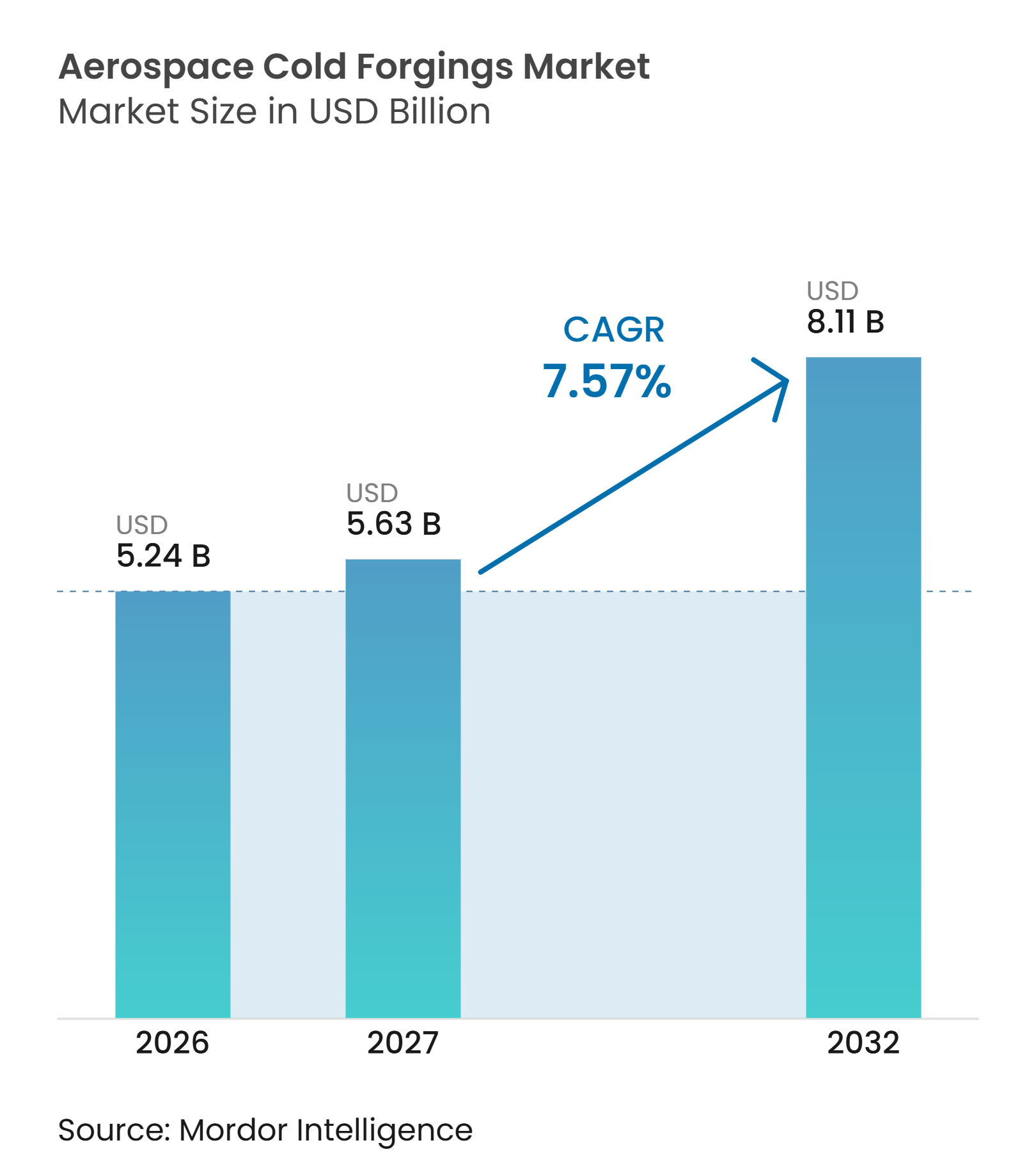
The Aerospace Cold Forgings Market size was valued at USD 5.24 billion in 2026 and is estimated to grow from USD 5.63 billion in 2027 to USD 8.11 billion by 2032, at a CAGR of 7.57% during the forecast period (2027-2032). Cold forging remains important for safety-critical fasteners, landing gear hardware, and near-net-shape engine parts due to its ability to provide controlled dimensions, grain flow, and fatigue performance. Certification requirements keep the approved supplier base narrow and slow the addition of new capacity. Aircraft production schedules, engine replacement needs, and defense procurement continue to shape purchasing decisions for aerospace forgings. The aerospace cold forgings market also benefits as aircraft manufacturers seek lighter structural components and more reliable material traceability. Capacity investments are likely to favor suppliers that can meet program qualification requirements, control specialty-metal inputs, and support long-term production agreements.
Key Report Takeaways
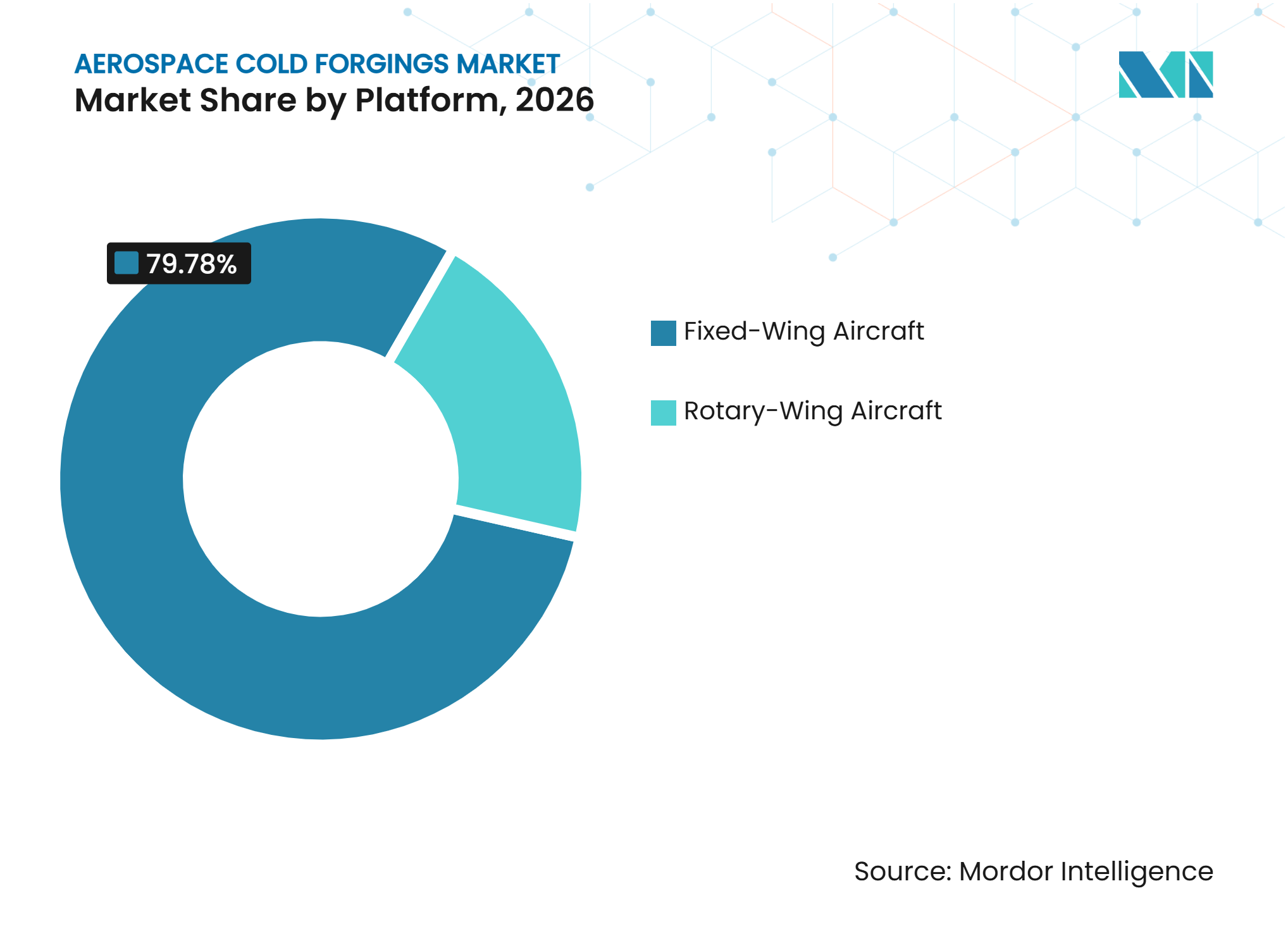
- By platform, Fixed-Wing Aircraft held 79.78% of the Aerospace Cold Forgings Market share in 2026 and is forecast to grow at an 8.45% CAGR through 2032.
- By aircraft type, Commercial Aviation accounted for 55.67% of the Aerospace Cold Forgings Market size in 2026, while Military Aviation is forecast to grow at an 8.67% CAGR through 2032.
- By application, Landing Gear represented 32.04% of the Aerospace Cold Forgings Market share in 2026, while Engine Components are forecast to grow at a 9.34% CAGR through 2032.
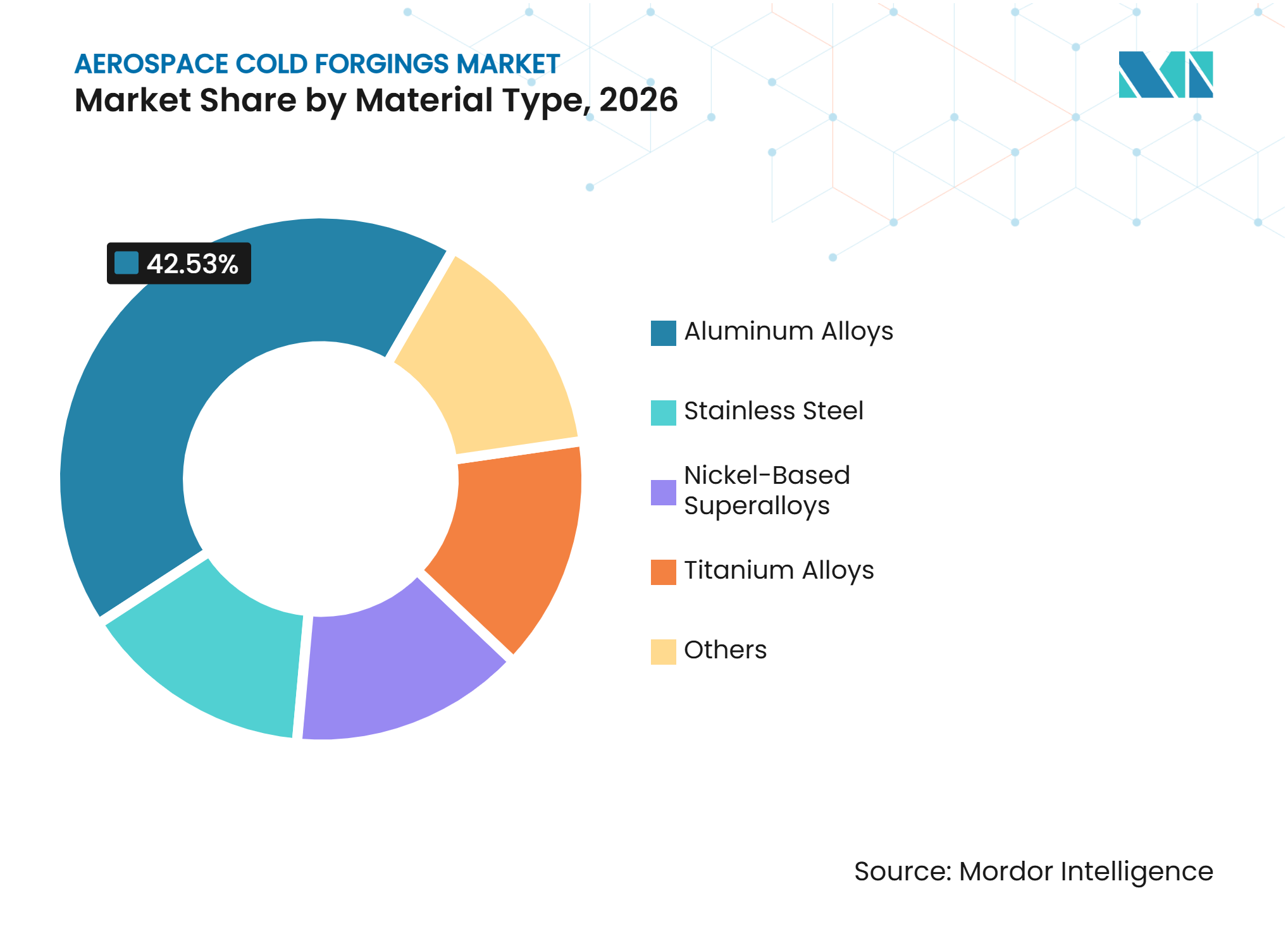
- By material type, Aluminum Alloys held 42.53% of the market in 2026, while Titanium Alloys are forecast to grow at a 9.08% CAGR through 2032.
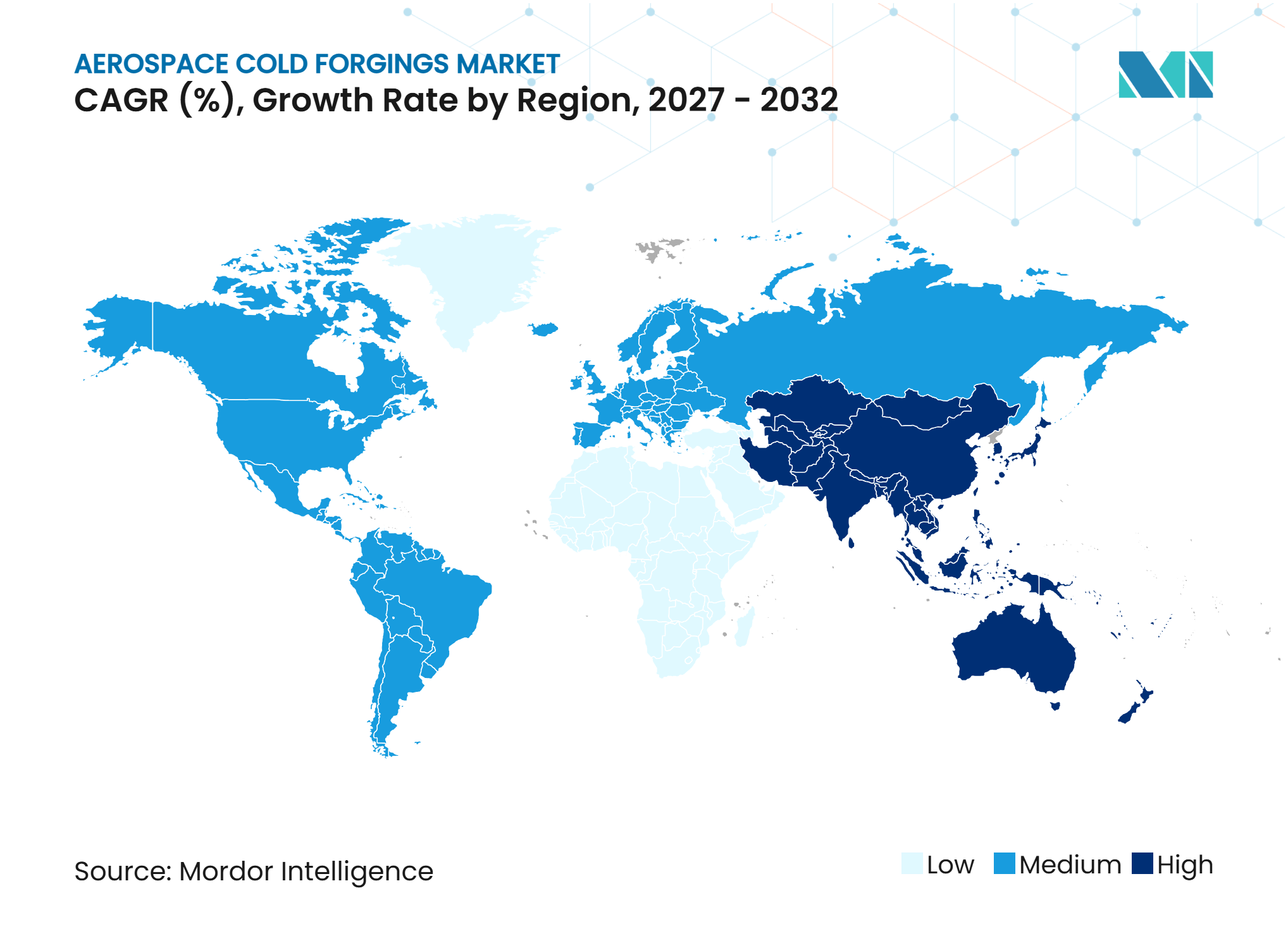
- By geography, North America held 35.21% of the market in 2026, while Asia-Pacific is forecast to grow at a 9.12% CAGR through 2032.
Note: Market numbers in this report are based on Mordor Intelligence's proprietary estimation framework, which combines nine months of actuals with Q4 projections for base year 2026.
Market Trends and Insights
Drivers Impact Analysis of Aerospace Cold Forgings Market*
| Drivers | (~) % Impact on CAGR Forecast | Geographic Relevance | Impact Timeline |
|---|---|---|---|
| Commercial Aircraft Backlog and Production Ramp-Up | +2.1% | Global, concentrated in North America and Europe | Medium term (2-4 years) |
| Fleet Modernization and Engine Replacement Programs | +1.5% | Global, with Asia-Pacific core and spillover to Middle East and Africa | Medium term (2-4 years) |
| Lightweighting Through Aluminum and Titanium Alloy Adoption | +1.3% | Global, with early gains in Asia-Pacific and North America | Long term (≥ 4 years) |
| Defense, Unmanned Aerial Vehicle (UAV), and Space Procurement | +1.0% | North America and Europe | Short term (≤ 2 years) |
| Digitally Controlled Cold Forging and In-Line Inspection | +0.6% | North America and Europe, with early gains in Germany and Japan | Long term (≥ 4 years) |
| Source: Mordor Intelligence | |||
Commercial Aircraft Backlog and Production Ramp-Up
Boeing and Airbus backlogs provide aerospace forgers with a clear production signal that extends beyond annual aircraft delivery cycles. Boeing closed 2025 with a USD 682 billion backlog, including more than 6,100 commercial aircraft. Airbus reported a year-end backlog of 8,754 aircraft, including 1,124 widebody aircraft. These order books support demand for forged fasteners, structural fittings, and landing gear components across narrow-body and widebody programs. New facilities require 24-48 months of process validation to meet customer and aviation approval requirements before they can produce qualified parts. This delayed supply response can keep forging capacity constrained while aircraft makers increase monthly output.
Boeing reached a 737 MAX production rate of 42 aircraft per month in 2026 following regulatory approval, while Airbus is targeting an A320 family rate of 70-75 aircraft per month by the end of 2027. Aircraft programs use many cold-forged components, particularly in fittings, joints, fasteners, and landing gear assemblies. The scale of the backlog gives suppliers greater confidence to invest in presses, tooling, quality systems, and long-term material agreements. It also encourages aircraft makers to secure approved capacity through multi-year supply contracts. This supports the Aerospace Cold Forgings Market, as order visibility is stronger than in shorter-cycle industrial applications.
Fleet Modernization and Engine Replacement Programs
Fleet modernization increases demand for forged components in both new engines and maintenance programs. Safran delivered 1,802 LEAP engines in 2025, a 28% increase from the prior year. New engine production and replacement activity compete for the same specialized forging capacity, particularly for disks, rings, and high-strength hardware. This competition can lengthen lead times for isothermal and specialty-alloy forgings. The higher workload also makes process consistency more important for each approved supplier. Engine makers are responding by investing closer to their upstream component base.
Engine manufacturers are increasingly focusing on upstream component capacity as demand for replacement parts grows. This reflects the operational importance of forged disks, rings, and other critical components. Replacement programs sustain demand when new-aircraft production rates fluctuate and support recurring component needs through overhaul and maintenance cycles. This provides a second demand channel for the Aerospace Cold Forgings Market. Suppliers with established engine qualifications are positioned to address this demand.
Lightweighting Through Aluminum and Titanium Alloy Adoption
Aircraft manufacturers use aluminum and titanium alloys where lower weight, strength, corrosion resistance, and thermal performance are required. Aluminum forgings remain common in airframe fittings, wing structures, engine mounts, and nacelle hardware. Titanium is used more often in landing gear structures, engine pylons, and high-strength fittings where aluminum cannot meet operating requirements. These materials increase the value of process knowledge, as alloy-specific heat treatment and traceability are central to part approval. The shift toward more specialized material grades also narrows the pool of suppliers capable of meeting customer specifications, which benefits qualified forgers that can maintain repeatable quality controls.
Arconic commissioned a USD 57.5 million expansion at Davenport Works in September 2025 to increase high-purity aluminum production for aerospace and defense applications. The project received USD 45.5 million in Defense Production Act Title III support[1]. This capacity supports the material base used in U.S. aerospace and defense supply chains. Aluminum-lithium designs on newer platforms add further emphasis to material control and documentation. FAA requirements for heat treatment and airworthiness controls add cost to qualification but also limit entry by suppliers without established systems. The Aerospace Cold Forgings Market can therefore benefit from lightweighting trends without reducing the need for process discipline.
Defense, UAV, and Space Procurement
Defense aircraft, rotorcraft, unmanned systems, and space programs require durable forged hardware for demanding operating conditions. These programs often require titanium, aluminum, steel, and nickel-alloy parts that meet strict quality standards. Military procurement can provide multi-year demand even when commercial aviation programs adjust production schedules. The United States included funding for aircraft procurement and research within its FY2026 defense appropriations. Defense activity also supports demand for rotor heads, gearbox components, structural fittings, and engine hardware, giving specialized suppliers another route to build long-term production output.
The FY2026 appropriations bill included funding for aircraft procurement, research, and major defense aviation programs. Defense procurement supports demand for structural components, rotor systems, and engine hardware. UAV programs can add demand for precision components without requiring the same output profile as commercial aircraft. Defense buyers also favor traceability and approved manufacturing processes, which reinforces the importance of certification. This demand supports aerospace cold forging suppliers that already serve qualified defense programs and can extend work across military, rotorcraft, and unmanned applications.
Restraints Impact Analysis of Aerospace Cold Forgings Market*
| Restraints | (~) % Impact on CAGR Forecast | Geographic Relevance | Impact Timeline |
|---|---|---|---|
| Specialty-Metal Supply Concentration and Export Controls | -1.2% | Global, with North America and Europe most exposed | Short term (≤ 2 years) |
| Long Qualification Cycles and Certification Cost | -0.9% | Global | Long term (≥ 4 years) |
| High-Tonnage Press, Tooling, and Skilled-Labor Constraints | -0.7% | North America and Europe | Medium term (2-4 years) |
| Source: Mordor Intelligence | |||
Specialty-Metal Supply Concentration and Export Controls
Aerospace forging depends on a concentrated supply base for titanium, specialty aluminum, nickel, and related feedstock. Export controls on critical minerals can add lead time and sourcing risk for manufacturers that rely on imports. The International Energy Agency reported that export controls introduced in 2025 intensified the risk of supply concentration for critical minerals[2]. These conditions are relevant to cold forging because material availability and chemistry control affect both production scheduling and part qualification. Limited access to billet or sponge can interrupt press utilization even when end-market demand remains strong. Buyers are therefore placing greater weight on supply security when selecting suppliers.
Titanium sourcing has become a strategic concern for Western aerospace supply chains. US forging customers and suppliers are examining domestic, Japanese, and Indian sources more closely to reduce concentration risk. This shift requires time because aerospace material sources must be qualified for individual programs. The transition can increase procurement complexity and delay the realization of new capacity benefits. It may also encourage greater recycling and more disciplined inventory planning in the aerospace cold forgings market. Material diversification is therefore a longer-term response rather than an immediate solution.
Long Qualification Cycles and Certification Cost
Aerospace customers apply demanding qualification requirements because forged components often perform safety-critical functions. Nadcap, AS9100D, and FAA or European Union Aviation Safety Agency (EASA) production approval processes require suppliers to demonstrate consistent quality before orders begin. These requirements protect program quality but make it difficult for new facilities to respond quickly to increased demand. Approved suppliers must demonstrate control across the forging value chain. Qualification costs are especially significant for smaller companies that must finance the costs of presses, testing, documentation, and audits before program revenue is secured.
The FAA issued Airworthiness Directive 2025-04-12 after identifying CFM LEAP low-pressure turbine disks made from forgings with nonconforming grain size. The directive required affected disks to be removed and replaced. Events such as this explain why aircraft and engine manufacturers maintain conservative qualification procedures. New tooling sets and presses require first-article inspection and customer approval before regular production begins. The cost and time involved can limit the number of suppliers available for critical applications. At the same time, these barriers help established manufacturers retain their positions once approval has been earned.
*Our forecasts treat driver/restraint impacts as directional, not additive. The impact forecasts reflect baseline growth, mix effects, and variable interactions.
Aerospace Cold Forgings Market Segment Analysis
By Platform:
Fixed-Wing Aircraft Anchors Market PerformanceFixed-wing aircraft held 79.78% of the Aerospace Cold Forgings Market share in 2026 and is projected to grow at an 8.45% CAGR through 2032. This category includes commercial narrow-body aircraft, widebody aircraft, regional jets, fighters, and other fixed-wing platforms. Narrow-body programs generate high unit output for forged fittings, landing gear bushings, and fastener sets. Boeing stabilized 737 MAX production at 42 aircraft per month in 2026 after receiving approval to increase output. Airbus is continuing the A320 family ramp, targeting 70-75 aircraft per month by the end of 2027. These programs sustain steady demand for precision components that can be produced economically at scale.
Widebody production adds lower-output but technically demanding work. Boeing is targeting eight 787 deliveries per month, while Airbus is pursuing an A350 rate of 12 aircraft per month by 2028. Fighter aircraft add a smaller but higher-value demand stream for titanium and nickel-alloy hardware. Fixed-wing suppliers must support different part types but operate under similar requirements for reliable grain flow, controlled dimensions, and documentation. Rotary-wing aircraft account for the remaining market share, supported by activity in both civil and defense fleets. Their requirement for rotor-head and gearbox forgings maintains a specialized demand base. The broad program mix makes the fixed-wing segment central to the Aerospace Cold Forgings Market.



By Aircraft Type:
Commercial Aviation Sets the Demand FloorCommercial aviation accounted for 55.67% of the Aerospace Cold Forgings Market in 2026. Commercial aircraft require forged parts throughout the airframe, engine installation, landing gear, fasteners, and flight-control systems. Aluminum structural fittings, landing gear subcomponents, and fastener sets account for much of this content. The large global order backlog provides commercial forgers with a continuing demand base. Airbus reported 8,754 aircraft in its 2025 backlog, while Boeing reported more than 6,100 commercial aircraft in its backlog. This scale allows manufacturers to plan material purchases and press investments over longer periods.
Military aviation is the fastest-growing aircraft type and is forecast to register an 8.67% CAGR through 2032. Procurement programs in North America and Europe support demand for airframe and engine hardware with stringent certification requirements, driven by fighter and rotorcraft procurement. General aviation benefits from business-jet activity and a growing need for UAV components. The other category includes space launch platforms that require specialized titanium- and nickel-forged rings and disks. Each aircraft type has different output and material requirements, but all require demonstrated quality and traceability. The Aerospace Cold Forgings Market therefore serves a mix of programs that reduce dependence on any single aircraft category.
By Application:
Engine Demand Reshapes Application PrioritiesLanding gear held 32.04% of the Aerospace Cold Forgings Market share in 2026. Main and nose gear systems use cold-forged trunnions, cylinders, axles, fittings, and related hardware due to the required strength and fatigue performance. Safran Landing Systems reported a 9% increase in A320 landing gear deliveries to 657 units in 2025, as well as a 59% increase in 787 landing gear deliveries. The company opened facilities in Molsheim, France, in June 2025 to increase landing and braking system production and maintenance capacity. This activity supports demand for high-performance forged subcomponents.
Engine components are projected to grow at a 9.34% CAGR through 2032, the fastest rate among all applications. FAA Airworthiness Directive 2025-04-12 reinforced the importance of grain-size control in forged turbine components. The response to nonconforming parts has been tighter process control rather than reduced reliance on forgings. Fasteners and bolts remain a high-output application, as dimensional consistency is essential for aircraft assembly. Airframe and nacelle components are supported by the same aircraft production ramp that drives demand for engines and landing gear. Buyers are increasingly requesting traceability to individual billet heats in first-article packages. These requirements raise the value of established quality systems across the Aerospace Cold Forgings Market.
By Material Type:
Aluminum Alloys Lead While Titanium Gains GroundAluminum alloys held 42.53% of the market in 2026, reflecting their broad use in fuselage frames, wing ribs, engine mounts, nacelle structures, and other aircraft components. The 7xxx series, including 7075 and 7050, offers a combination of strength, weight efficiency, and machinability for structural forgings. Arconic's high-purity aluminum expansion at Davenport Works doubled domestic capacity for aerospace and defense applications, demonstrating the strategic importance of material supply for US aerospace production. Aluminum forgings continue to serve high-output structural needs across commercial aircraft programs.
Titanium alloys are forecast to grow at a 9.08% CAGR through 2032. Their use is increasing in landing gear structures, engine pylons, and high-strength fittings where the material's strength supports weight reduction. Advanced grades such as Ti-5553 and Beta-C are gaining qualification for landing gear applications. Supply concentration has encouraged aerospace customers to diversify titanium sponge and billet sources, a transition that requires qualification and can take several years across a program supply chain. Stainless steel serves demanding landing-gear and fastener applications, while nickel-based superalloys remain necessary for engine hot-section disks and rings. The aerospace cold forgings industry must therefore manage a more complex material mix while maintaining strict part traceability.

Geography Analysis
North America
North America held 35.21% of the aerospace cold forgings market share in 2026. The region has a dense base of aircraft manufacturing, engine production, defense programs, and qualified forging suppliers. Boeing's backlog reached USD 682 billion in 2026, including more than 6,100 commercial aircraft. Howmet Aerospace reported USD 8.3 billion in revenue in 2025, up 11% from the prior year, with its Engineered Structures third-party sales rising 8%, supported by defense aerospace. This base enables manufacturers to convert demand from aircraft and defense programs into forging orders. NADCAP and AS9100D standards reinforce process requirements, while FAA oversight influences airworthiness and production controls. New suppliers face long qualification periods, which limit rapid capacity growth.
Capital spending is focused on press capacity, materials, and production control. Howmet invested USD 453 million in capital expenditure during 2025 and reported 21% growth in defense aerospace revenue. Arconic's aluminum expansion also strengthens the regional feedstock base. Digital forging lines and in-line inspection are becoming more relevant where buyers require repeatable material control. The region remains exposed to titanium sourcing risks, which encourages supplier diversification. Its established certification base remains a meaningful advantage in the aerospace cold forgings market.
Asia-Pacific
Asia-Pacific is forecast to grow at a 9.12% CAGR through 2032. Indigenous aircraft programs, defense modernization, passenger traffic growth, and regional supply chain investment support this expansion. GE Aerospace plans to nearly double its in-country supplier spending in India to USD 400 million by 2030 and has invested USD 55 million in its Pune facility since 2024 to expand automation and precision manufacturing. These investments support a more capable regional supply base and align aircraft and engine demand with locally available manufacturing capability.
India is adding qualified aerospace capacity through supplier development and new manufacturing investments. Japan and South Korea contribute advanced titanium and nickel forging capacity linked to global engine programs. NADCAP accreditation and AS9100D certification remain important compliance factors for exporters. The region's combination of demand growth and expanding approved capacity supports its role in the aerospace cold forgings market. Industrial investment is also increasing regional suppliers' ability to pursue complex component work, which can broaden the approved supplier base over time.
Europe, South America, Middle East, and Africa
Europe has a substantial aerospace forging base built around Airbus, Safran, OTTO FUCHS KG, Farinia Group, Doncasters Group, Mettis Aerospace, and Forged Solutions Group. Airbus production activity supports demand for A320neo and A350 components, while European defense programs provide an additional source of orders. Safran's 2025 Molsheim expansion illustrates continued investment in landing and braking systems. The European Union's Critical Raw Materials Act is influencing efforts to reduce dependence on imported raw materials through recycling and domestic production. In 2025, OTTO FUCHS presented work on digital twins and Integrated Computational Materials Engineering for aerospace forgings, an approach that can improve development processes and grain-flow optimization for qualified parts.
South America's aerospace forging activity is centered on Brazil and Embraer's commercial and defense programs. The Middle East and Africa are emerging as demand centers, driven by fleet expansion and aerospace manufacturing plans. Gulf carrier fleet growth supports demand through OEM and maintenance channels, even where local forging capacity is limited. Saudi Arabian industrial plans also create long-term supplier development opportunities. Across these regions, MRO requirements drive demand for replacement forgings independently of new aircraft build cycles. The aerospace cold forgings market can benefit as suppliers seek more geographically diverse approved sources.
Competitive Landscape
Market Concentration
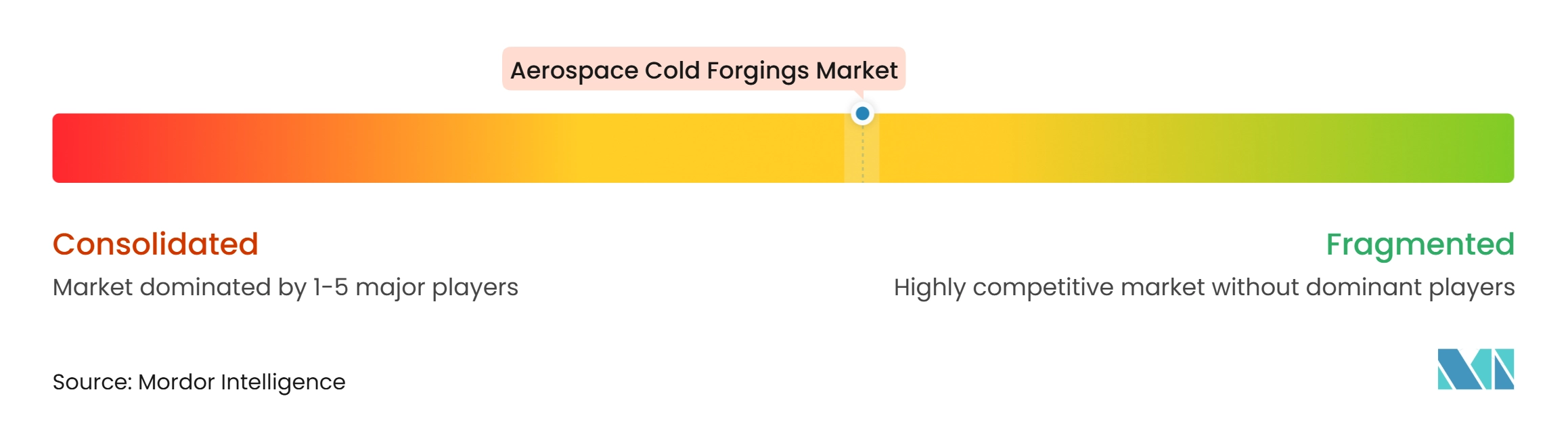
The aerospace cold forgings market is moderately fragmented. Precision Castparts Corp., Howmet Aerospace, and ATI Inc. form an upper tier with large press capacity, deep materials knowledge, and long-standing customer relationships. Entry is difficult because a new supplier requires capital equipment, qualified materials, approved processes, and program-specific testing. NADCAP Metallic Materials Manufacturing accreditation and AS9100D certification are key requirements for commercial and defense supply programs. Precision Castparts announced a USD 380 million investment in Wyman-Gordon sites for two new isothermal presses focused on nickel-superalloy aerospace forgings. Howmet deployed USD 453 million in capital expenditure in 2025 and expanded its defense aerospace revenue by 21%. These investments indicate that large producers strengthened capacity and technology around high-value parts.
ATI reported that precision forgings, castings, and components accounted for 40% of its High Performance Materials & Components (HPMC) segment revenue in FY2025, up from 36% in FY2024. The company also indicated that lead times for some isothermal forging work extended into 2027. In October 2025, Forged Solutions Group extended its supply agreement with Kawasaki Heavy Industries for Rolls-Royce Trent aero-engine rings and cases beyond 2030. It also added a multi-year shaft supply agreement with Safran Aero Boosters in June 2025. Long-term agreements reduce reliance on spot purchasing and tie capacity to specific aircraft and engine programs. They also make supplier qualification and delivery performance critical competitive factors.
Digital process control is emerging as an additional point of differentiation. OTTO FUCHS presented its use of Integrated Computational Materials Engineering and digital twins for aerospace forging development at AeroMat 2025. SMS Group commissioned an automated forging line at Perryman Company in Pennsylvania with in-line measurement and process optimization capabilities. These systems can reduce development time and improve control of material properties. Mid-sized companies have opportunities where customers require secure regional sources for fasteners and structural fittings. Indian forging groups are also expanding their aerospace capabilities as qualification levels improve.
Aerospace Cold Forgings Industry Leaders
-
Precision Castparts Corp.
-
ATI Inc.
-
Howmet Aerospace
-
Arconic
-
Bharat Forge
- *Disclaimer: Major Players sorted in no particular order
Aerospace Cold Forgings Market Companies Covered in this Report
- Arconic
- ATI Inc.
- Bharat Forge
- Doncasters Group
- ELLWOOD Group Inc.
- Farinia Group
- Forged Solutions Group
- Howmet Aerospace
- Mettis Aerospace Limited
- OTTO FUCHS Kommanditgesellschaft
- Pacific Forge, Inc.
- PJSC VSMPO-AVISMA Corporation
- Precision Castparts Corp.
- Safran
- Scot Forge Company
Recent Industry Developments in Aerospace Cold Forgings Market
- May 2026: Bharat Forge Ltd. entered into a long-term contract with Embraer for the manufacturing and supply of cold forgings for landing gear components across commercial and defense aircraft programs. Bharat Forge became the first Indian supplier in Embraer's global aerospace supply chain for forged components, establishing India as a source for safety-critical structural cold forgings in South American programs.
- February 2026: Pratt & Whitney announced a USD 200 million investment to install an additional isothermal forging press at its Columbus, Georgia facility. The expansion targets a 30% increase in cold-forged component output for commercial Geared Turbofan (GTF) and military F135 engine programs, addressing supply chain constraints for forged disks and rings.
Global Aerospace Cold Forgings Market Report Scope
Aerospace cold forgings are precision metal components shaped and deformed at room temperature, or near room temperature, using high mechanical pressure rather than thermal heating. They are manufactured specifically for use in aircraft, spacecraft, and defense systems.
The aerospace cold forgings market is segmented by platform, aircraft type, application, material type, and geography. By platform, the market is segmented into fixed-wing aircraft and rotary-wing aircraft. By aircraft type, the market is segmented into commercial aviation, military aviation, general aviation, and others. By application, the market is segmented into airframe, landing gear, nacelle, engine components, fasteners and bolts, and others. By material type, the market is segmented into aluminum alloys, titanium alloys, stainless steel, nickel-based superalloys, and others. The report also covers market sizes and forecasts for aerospace cold forgings across 15 countries in major regions. The market sizes and forecasts are provided in terms of value (USD).
Segmentation Overview
| Fixed-Wing Aircraft | Narrow-Body Aircraft |
| Regional Jets | |
| Widebody Aircraft | |
| Fighter Jets | |
| Rotary-Wing Aircraft | Helicopters |
| Commercial Aviation |
| Military Aviation |
| General Aviation |
| Others |
| Airframe |
| Landing Gear |
| Nacelle |
| Engine Components |
| Fasteners and Bolts |
| Others |
| Aluminum Alloys |
| Titanium Alloys |
| Stainless Steel |
| Nickel-Based Superalloys |
| Others |
| Asia-Pacific | China |
| India | |
| Japan | |
| South Korea | |
| ASEAN Countries | |
| Rest of Asia-Pacific | |
| North America | United States |
| Canada | |
| Mexico | |
| Europe | Germany |
| United Kingdom | |
| France | |
| Italy | |
| NORDIC Countries | |
| Rest of Europe | |
| South America | Brazil |
| Argentina | |
| Rest of South America | |
| Middle East and Africa | Saudi Arabia |
| South Africa | |
| Rest of Middle East and Africa |
| By Platform | Fixed-Wing Aircraft | Narrow-Body Aircraft |
| Regional Jets | ||
| Widebody Aircraft | ||
| Fighter Jets | ||
| Rotary-Wing Aircraft | Helicopters | |
| By Aircraft Type | Commercial Aviation | |
| Military Aviation | ||
| General Aviation | ||
| Others | ||
| By Application | Airframe | |
| Landing Gear | ||
| Nacelle | ||
| Engine Components | ||
| Fasteners and Bolts | ||
| Others | ||
| By Material Type | Aluminum Alloys | |
| Titanium Alloys | ||
| Stainless Steel | ||
| Nickel-Based Superalloys | ||
| Others | ||
| By Geography | Asia-Pacific | China |
| India | ||
| Japan | ||
| South Korea | ||
| ASEAN Countries | ||
| Rest of Asia-Pacific | ||
| North America | United States | |
| Canada | ||
| Mexico | ||
| Europe | Germany | |
| United Kingdom | ||
| France | ||
| Italy | ||
| NORDIC Countries | ||
| Rest of Europe | ||
| South America | Brazil | |
| Argentina | ||
| Rest of South America | ||
| Middle East and Africa | Saudi Arabia | |
| South Africa | ||
| Rest of Middle East and Africa | ||
Key Questions Answered in the Report
What is current market size of Aerospace Cold Forgings Market?
The Aerospace Cold Forgings Market size was valued at USD 5.24 billion in 2026 and is estimated to grow from USD 5.63 billion in 2027 to USD 8.11 billion by 2032, at a CAGR of 7.57% during the forecast period (2027-2032).
Which aerospace cold forging application has the strongest growth outlook?
Engine Components is forecast to expand at a 9.34% CAGR through 2032, supported by engine production and tighter process-control requirements.
Why are titanium forgings becoming more important in aircraft programs?
Titanium supports high-strength, weight-sensitive uses in landing gear, pylons, and structural fittings, and Titanium Alloys is forecast to grow at a 9.08% CAGR.
Which region has the fastest growth in aerospace cold forging?
Asia-Pacific is forecast to grow at a 9.12% CAGR through 2032 as India and other regional suppliers expand aerospace production capability.