
Aerospace Avionics Market Size and Share
Market Overview
| Study Period | 2020 - 2032 |
|---|---|
| Market Size (2027) | USD 82.46 Billion |
| Market Size (2032) | USD 108.46 Billion |
| Growth Rate (2027 - 2032) | 5.63 % |
| Fastest Growing Market | Asia-Pacific |
| Largest Market | North America |
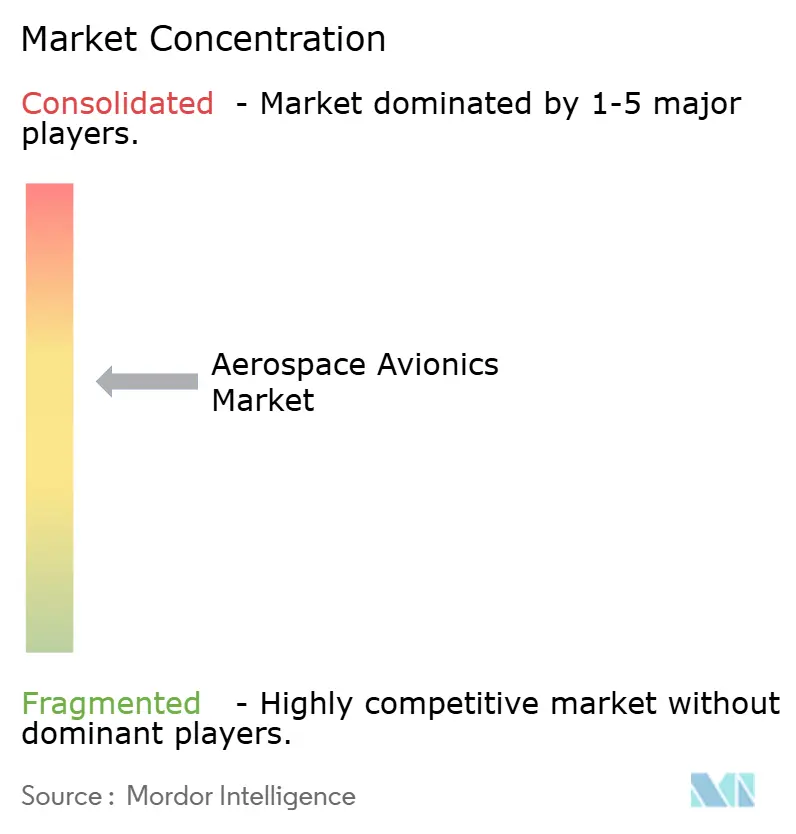
| Market Concentration | Medium |
Major Players *Disclaimer: Major Players sorted in no particular order Image © Mordor Intelligence. Reuse requires attribution under CC BY 4.0. | |
Aerospace Avionics Market Analysis by Mordor Intelligence
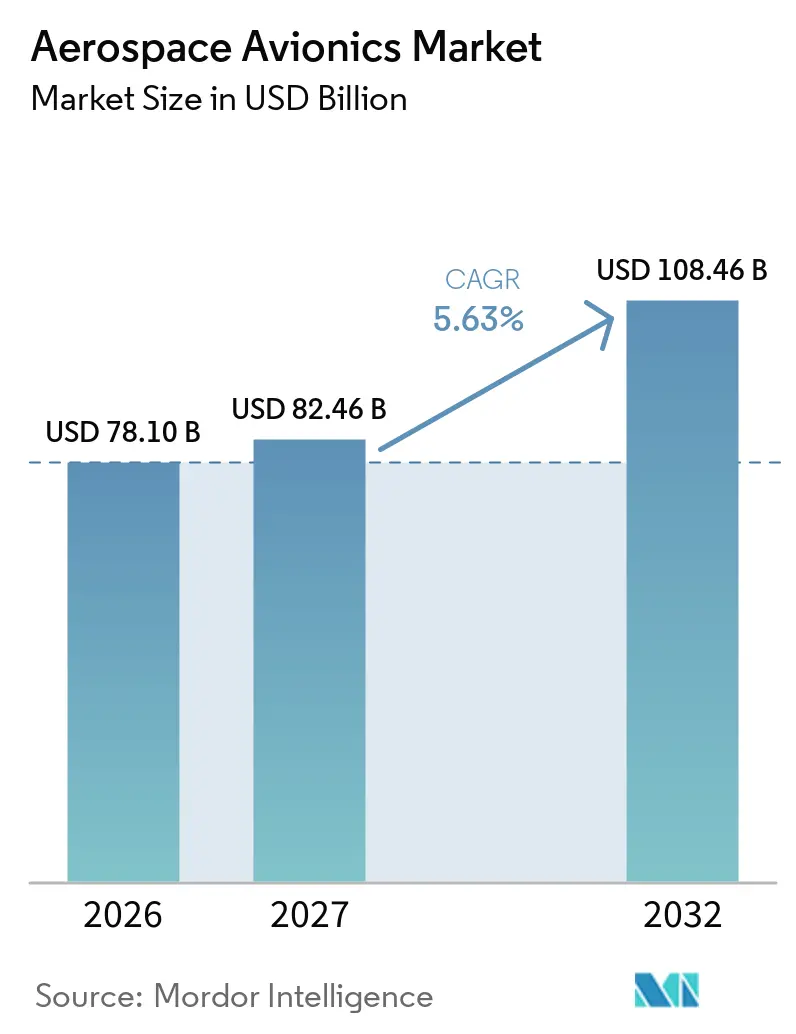
The aerospace avionics market size was valued at USD 78.10 billion in 2026 and is forecast to grow from USD 82.46 billion in 2027 to reach USD 108.46 billion by 2032, at a 5.63% CAGR during the forecast period (2027-2032). Commercial aircraft delivery programs and defense modernization are sustaining demand for certified cockpit, communications, and flight-management equipment. Airbus delivered 793 commercial aircraft in 2025 and reported an order backlog of 8,754 aircraft at year-end, while targeting 870 deliveries in 2026. Engine supply constraints can redirect airline spending toward retrofits and connectivity upgrades, which supports more stable aftermarket demand. Cybersecurity certification and engineering shortages lengthen development schedules for connected architectures. The aerospace avionics market therefore favors suppliers that balance linefit programs with long-term service and upgrade work.
Key Report Takeaways
- By subsystem, communication and navigation systems held 33.42% of the aerospace avionics market share in 2026 and are forecast to expand at a 7.54% CAGR through 2032.
- By platform, commercial aviation held a 54.68% share in 2026, while unmanned aerial systems (UAS) are forecast to grow at a 9.21% CAGR through 2032.
- By fit, linefit held a 64.01% share in 2026, while retrofit is projected to grow at a 7.21% CAGR through 2032.
- By geography, North America held a 34.56% share in 2026, while Asia-Pacific is forecast to grow at a 7.45% CAGR through 2032.
Note: Market numbers in this report are based on Mordor Intelligence's proprietary estimation framework, which combines nine months of actuals with Q4 projections for base year 2026.
Market Trends and Insights
Drivers Impact Analysis of Aerospace Avionics Market*
| Driver | (~) % Impact on CAGR Forecast | Geographic Relevance | Impact Timeline |
|---|---|---|---|
| Rising commercial aircraft production and fleet expansion | +1.50% | Global, concentrated in North America, Europe, and Asia-Pacific | Medium term (2-4 years) |
| Accelerating aircraft connectivity and data-enabled operations | +1.00% | Global, with early uptake in North America and Europe and rapid expansion in Asia-Pacific | Long term (≥ 4 years) |
| Defense modernization and unmanned aircraft adoption | +0.90% | North America and Europe, with spillover to the Middle East and Asia-Pacific | Medium term (2-4 years) |
| Software-defined cockpit upgrades for long-life aircraft | +0.60% | North America, Europe, and Asia-Pacific | Medium term (2-4 years) |
| Resilient navigation demand from GNSS interference and airspace complexity | +0.70% | Global, especially the Baltic region, Eastern Mediterranean, and conflict-adjacent airspace | Short term (≤ 2 years) |
| Expanding satellite constellations and demand for advanced spaceborne avionics | +0.50% | Global | Long term (≥ 4 years) |
| Source: Mordor Intelligence | |||
Rising Commercial Aircraft Production and Fleet Expansion
Commercial aircraft production is a direct source of linefit demand in the aerospace avionics market. Airbus delivered 793 aircraft in 2025, and its 8,754-aircraft backlog represented a substantial production pipeline. Each delivery requires certified navigation, communication, flight management, and display equipment before entry into service. Boeing forecasts that the global single-aisle fleet will exceed 36,000 aircraft by 2045. Common avionics architectures across narrowbody variants shorten supplier qualification work and support production scale. Fleet expansion also creates future demand for maintenance, upgrades, and replacement equipment. These conditions keep the aerospace avionics market linked to OEM output while extending its aftermarket opportunity.
Accelerating Aircraft Connectivity and Data-Enabled Operations
Aircraft connectivity is becoming a core operating capability rather than a passenger service feature in the aerospace avionics market. Boeing and United Airlines completed flight tests in 2025 for Internet Protocol Suite standards supporting flight-deck and air traffic control communications. Collins Aerospace activated ACARS over IP on Thai Airways A321neo aircraft in February 2026. These systems can support real-time maintenance data, flight operations, and communications. Airbus forecasts Asia-Pacific digital and connectivity aviation services to rise from USD 2.90 billion in 2025 to USD 11.20 billion in 2044. Long-term managed service agreements enable equipment suppliers to maintain customer relationships after installation.
Defense Modernization and Unmanned Aircraft Adoption
Defense spending and the adoption of certified unmanned systems are expanding the aerospace avionics market beyond conventional commercial programs. Collins Aerospace received a USD 80 million contract in March 2025 for MOSA-compliant avionics on US Army Black Hawk helicopters. The work supports quicker integration of future capabilities across manned and unmanned rotorcraft. The UK MoD committed GBP 204.6 million (USD 272.64 million) to the production and integration of the ECRS Mk2 radar for Eurofighter Typhoon aircraft. UAS certification frameworks also increase requirements for navigation, collision avoidance, and encrypted communications. Open architecture rules reduce dependence on proprietary interfaces over the life of defense platforms. This shift can broaden access to upgrades across the aerospace avionics market.
Resilient Navigation Demand from GNSS Interference and Airspace Complexity
GNSS disruption is increasing demand for resilient navigation equipment in the aerospace avionics market. IATA recorded more than 1 million GPS signal-loss events between August 2021 and June 2025 across 24.60 million processed flights.[1] The European Commission reported 2,732 GPS interference cases in Poland during January 2025 and more than 1,000 cases in Lithuania during one month. ICAO introduced 2025 standards that included Advanced Receiver Autonomous Integrity Monitoring (ARAIM) for precision navigation.[2] Airlines and maintenance providers need multi-constellation receivers, inertial backups, and integrity monitoring. These needs provide a practical basis for demand across commercial, military, and general aviation fleets.
Restraints Impact Analysis of Aerospace Avionics Market*
| Restraint | (~) % Impact on CAGR Forecast | Geographic Relevance | Impact Timeline |
|---|---|---|---|
| Aviation cybersecurity compliance and certification burden | -0.60% | Global, strongest in North America and Europe | Medium term (2-4 years) |
| Shortage of avionics software, systems engineering, and cybersecurity talent | -0.50% | Global, most acute in the US, the UK, and Germany | Long term (≥ 4 years) |
| Legacy-system integration and certification constraints | -0.40% | Global, elevated in Southeast Asia and South America | Medium term (2-4 years) |
| Specialized component shortages and extended avionics equipment lead times | -0.30% | Global, with semiconductor bottlenecks in Taiwan and Japan | Short term (≤ 2 years) |
| Source: Mordor Intelligence | |||
Aviation Cybersecurity Compliance and Certification Burden
Cybersecurity requirements create a material delivery constraint for connected products in the aerospace avionics market. RTCA DO-326A and EUROCAE ED-202A require security risk management throughout avionics development. The FAA issued special conditions for Universal Avionics in March 2025 covering electronic system security protection from unauthorized external access. The conditions addressed systems that connect with satellite communications, operator networks, and electronic flight bags. New software changes may require updated security analysis, testing, and residual risk documentation. This burden can weigh more heavily on smaller suppliers without dedicated security teams. Legacy fleet integration and specialized component availability further increase schedule risk when upgrades require certification and replacement hardware simultaneously.
Shortage of Avionics Software, Systems Engineering, and Cybersecurity Talent
Specialist workforce gaps can delay programs across the aerospace avionics market. Boeing forecasts demand for 710,000 maintenance technicians through 2044, with replacement needs accounting for nearly two-thirds of the requirement. Avionics software and systems roles are difficult to replace because certification knowledge and defense clearances take time to develop. Suppliers also compete with defense electronics, autonomous systems, and commercial aerospace employers for the same skills. The shortage can extend certification work and constrain field support for installed systems. Component shortages may compound the problem when program teams must redesign around long lead times. These factors favor firms with established engineering depth, repair capacity, and long-term supplier relationships.
*Our forecasts treat driver/restraint impacts as directional, not additive. The impact forecasts reflect baseline growth, mix effects, and variable interactions.
Aerospace Avionics Market Segment Analysis
By Subsystem:
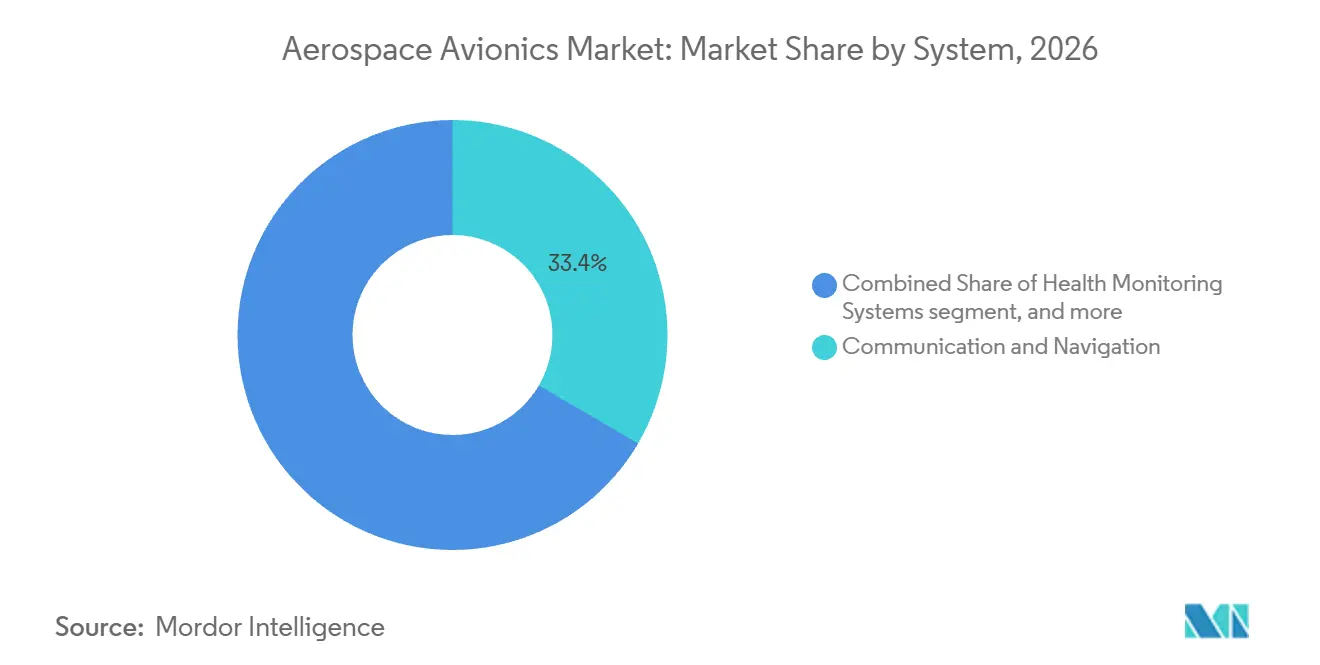
Communication and Navigation Leads Demand Through Compliance and ResilienceCommunication and navigation held 33.42% of the aerospace avionics market share in 2026 and is forecast to grow at a 7.54% CAGR through 2032. Its scale reflects mandatory CNS/ATM compliance work and demand for more resilient navigation systems. ICAO introduced new air-navigation standards in 2025, including ARAIM provisions for precision navigation. European GNSS disruption has reinforced demand for multi-constellation receivers and inertial backup systems. The European Commission identifies Galileo OSNMA as an authentication service designed to help counter spoofing. Communication and navigation therefore remain central to the aerospace avionics market as regulations and operational risk converge.
Flight management and control systems remain important because every commercial aircraft requires certified control and planning functions. Cockpit, visualization, and display systems are moving from older cathode-ray tube panels toward LCD and emerging OLED configurations. Honeywell Aerospace Inc. describes Primus Epic 3.0 as a next-generation cockpit program intended to address avionics obsolescence.[3] Health monitoring systems are supported by predictive-maintenance service contracts. Collins Aerospace secured 20-year FlightSense and Dispatch agreements with China Airlines in September 2025. Other subsystems maintain demand through the carriage of required equipment and fleet replacement cycles. Together, these categories give the aerospace avionics industry a mix of linefit and recurring service work.

By Platform:
Commercial Aviation Leads Scale While UAS Expands FastestCommercial aviation held 54.68% of the aerospace avionics market in 2026, while UAS is forecast to expand at a 9.21% CAGR through 2032. Commercial demand is supported by narrowbody output and the higher avionics content of widebody aircraft. Airbus delivered 607 A320 Family aircraft during 2025 and is pursuing a rate of 75 aircraft per month by the end of 2027. UAS applications need certified navigation, collision avoidance, and encrypted communications as operating rules evolve. Military aviation benefits from readiness programs and modular open architecture requirements. Space platforms also create early demand for radiation-hardened equipment. These platforms need to diversify the aerospace avionics market beyond commercial delivery cycles.
Unmanned Aerial Systems (UAS) growth is supported by regulatory frameworks that increasingly reflect manned-aircraft safety expectations. The FAA and EASA are advancing requirements that raise the value of established avionics capabilities. Military fixed-wing aircraft, transport fleets, training platforms, and rotorcraft need adaptable systems throughout long service lives. Collins Aerospace’s Black Hawk program demonstrates how MOSA can support common upgrade paths across manned and unmanned fleets. Regional aircraft and general aviation also drive retrofit activity. Garmin received FAA certification in August 2025 for a complete Citation CJ1 avionics modernization program. The mix broadens the supplier base serving the aerospace avionics industry.
By Fit:
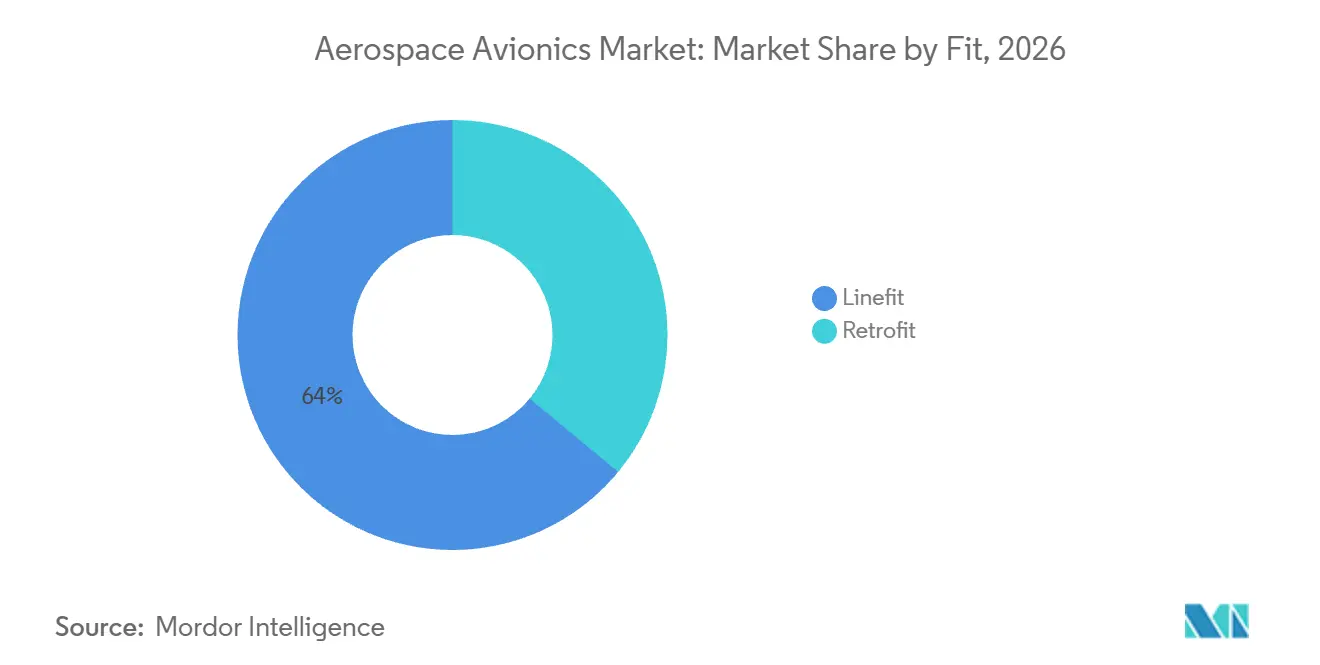
Linefit Leads While Retrofit Gains From Fleet ModernizationLinefit held 64.01% of the aerospace avionics market in 2026, while Retrofit is forecast to grow at a 7.21% CAGR through 2032. New aircraft deliveries require factory-installed communication, navigation, flight-management, display, and surveillance systems. Airbus’s planned A320 production ramp and the B737 recovery support continued linefit demand. However, fleet age and compliance schedules are creating more retrofit work. Airbus expects Asia-Pacific modifications and upgrades services to increase from USD 3.80 billion in 2025 to USD 6.20 billion in 2044. The aerospace avionics market size for retrofit work benefits when airlines combine multiple upgrades during a single maintenance visit.
ADS-B, CPDLC, connectivity, and display modernization can be scheduled together when aircraft enter maintenance. Universal Avionics upgraded Widerøe’s Dash 8-100/200 fleet in June 2025 with InSight displays and connected avionics applications. The upgrade enabled LPV and RNP approaches to 0.10 nm precision and replaced obsolete display equipment. Linefit suppliers remain exposed to delivery delays caused by engine or semiconductor supply constraints. Retrofit activity can offset some of that exposure through aftermarket demand. Suppliers with positions in both channels are better placed to manage production volatility. This balance remains important within the aerospace avionics market.
Geography Analysis
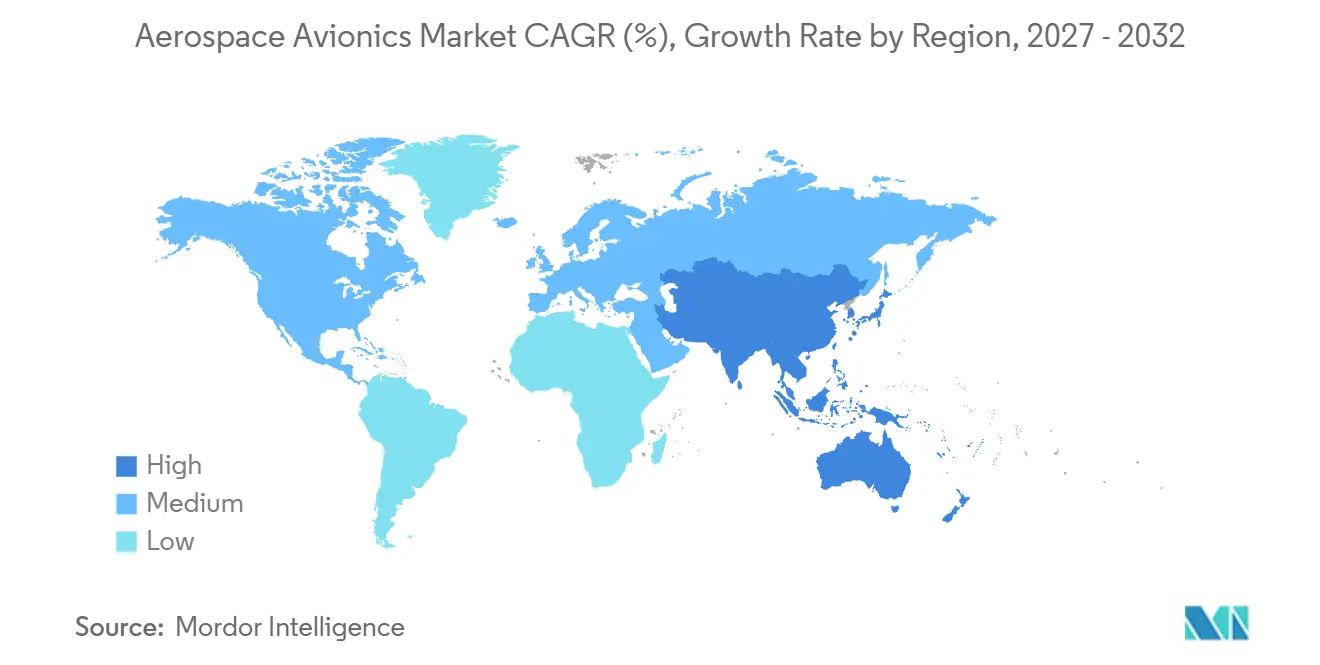
North America held 34.56% of the aerospace avionics market in 2026, supported by a large commercial fleet, defense procurement, and established suppliers. The FAA DataComm program provides infrastructure for digital air traffic control to pilot communications. This program supports continuing demand for installed communications equipment across US airline fleets. Boeing’s Internet Protocol Suite flight tests also show the region’s role in next-generation data-link development. Canada supports regional retrofit activity through avionics suppliers and maintenance programs. Mexico’s growing MRO activity adds regional service capacity. These conditions maintain North America’s broad role in the aerospace avionics market.
Asia-Pacific is forecast to grow at a 7.45% CAGR through 2032, the fastest pace among the geographic segments. IATA expects regional passenger traffic to increase 7.30% year over year in 2026. Airbus expects the region to receive 19,560 new commercial aircraft during the next 20 years. Honeywell was selected in July 2026 to supply avionics and power systems for IndiGo’s 810 A320neo Family aircraft order. The agreement covered long-term aftermarket support. China’s fleet expansion and defense spending also create demand, although export controls affect supplier choices.
Europe has Airbus production sites, defense programs, and substantial engineering capability across avionics product lines. The UK committed GBP 204.6 million (USD 272.64 million) to the production and integration of the Typhoon ECRS Mk2 radar. GNSS disruption in Baltic and Mediterranean airspace is accelerating interest in resilient equipment.
South America, the Middle East, and Africa have distinct demand profiles across fleet renewal, widebody expansion, and retrofit services. Brazil benefits from regional aircraft activity, while Saudi Arabia and the UAE support advanced long-haul fleet requirements. African operators increasingly need retrofit support for aging turboprops. These regions extend the aerospace avionics market through different combinations of new aircraft, defense, and maintenance demand.
Competitive Landscape
The aerospace avionics market is moderately consolidated among Honeywell Aerospace Inc., Collins Aerospace (RTX Corporation), L3Harris Technologies, Inc., Garmin Ltd., and Thales Group. Their positions reflect deep commercial and military platform integration agreements that are difficult to displace during active programs. General Electric Company, Northrop Grumman Corporation, BAE Systems plc, and Safran S.A. compete strongly in defense and surveillance applications. Universal Avionics Corporation, CMC Electronics Inc., Astronautics Corporation of America, Avidyne Corporation, Dynon Avionics, Curtiss-Wright Corporation, and Becker Avionics GmbH serve general aviation, regional aircraft, and specialty applications. Competition differs sharply by subsystem, platform, and certification capability. These features keep the aerospace avionics market concentrated at the top tier but diverse below it.
Large suppliers are adding digital services to equipment portfolios. Honeywell Aerospace Inc. and NXP expanded their partnership in January 2025 to develop next-generation aviation technology using Honeywell Anthem avionics and high-performance computing. Collins Aerospace activated its GlobalConnect FOMAX service on Thai Airways A321neo aircraft during February 2026. Its FlightSense contracts with China Airlines and Japan Airlines extend component, maintenance, and analytics relationships over long periods. These arrangements make long-term service capability a meaningful competitive factor in the aerospace avionics market.
Aerospace Avionics Industry Leaders
-
Honeywell Aerospace Inc.
-
Collins Aerospace (RTX Corporation)
-
Thales Group
-
Garmin Ltd.
-
L3Harris Technologies, Inc.
- *Disclaimer: Major Players sorted in no particular order
Aerospace Avionics Market Companies Covered in this Report
- Honeywell Aerospace Inc.
- Collins Aerospace (RTX Corporation)
- Thales Group
- Garmin Ltd.
- L3Harris Technologies, Inc.
- Safran SA
- GE Aerospace (General Electric Company)
- BAE Systems plc
- Leonardo S.p.A.
- Northrop Grumman Corporation
- Elbit Systems Ltd.
- Curtiss-Wright Corporation
- Teledyne Technologies Incorporated
- CMC Electronics Inc.
- Astronautics Corporation of America
- Universal Avionics Corporation
- Avidyne Corporation
- Dynon Avionics
- Becker Avionics GmbH
Recent Industry Developments in Aerospace Avionics Market
- September 2026: GE Aerospace signed an agreement with FL Technics Indonesia, an independent MRO provider, to support avionics systems services for the B737 and A320 aircraft at FL Technics Indonesia's facilities in Jakarta and Bali.
- June 2026: AP Satellite secured a contract to develop and deliver the Onboard Computer (OBC) for South Korea's GEO-KOMPSAT-5 geostationary weather and space weather satellite.
- May 2026: Japan Airlines (JAL) signed a 10-year maintenance and overhaul agreement with GE Aerospace to cover avionics systems support for its B787 fleet. The agreement was signed at GE Aerospace's facility in Brisbane, Australia.
Global Aerospace Avionics Market Report Scope
The aerospace avionics market comprises electronic systems and integrated technologies designed to support flight operations, navigation, communication, monitoring, control, and mission-critical functions across aviation and space platforms. The scope includes avionics systems supplied for new platform production and retrofit programs, including those integrated into commercial aircraft, military fixed-wing aircraft and rotorcraft, business jets, light aircraft, commercial helicopters, unmanned aerial systems (UAS), satellites, and spacecraft.
The aerospace avionics market is segmented by system, platform, fit, and geography. By system, the market is segmented into health monitoring systems, flight management and control systems, communication and navigation, cockpit systems, visualization and display systems, and other subsystems. By platform, the market is segmented into commercial aviation, military aviation, general aviation, unmanned aerial systems (UAS), and space platforms. By fit, the market is segmented into linefit and retrofit. The report also covers market sizes and forecasts for the aerospace avionics market in major countries across the regions. For each segment, the market size is provided in terms of value (USD).
Segmentation Overview
| Health Monitoring Systems |
| Flight Management and Control Systems |
| Cockpit Systems |
| Communication and Navigation |
| Visualization and Display Systems |
| Other Subsystems |
| Commercial Aviation | Narrowbody | |
| Widebody | ||
| Regional Jets | ||
| Military Aviation | Fixed-Wing Aircraft | Combat Aircraft |
| Multi-role Aircraft | ||
| Training Aircraft | ||
| Transport Aircraft | ||
| Others | ||
| Rotorcraft | Multi-Mission Helicopter | |
| Transport Helicopter | ||
| Others | ||
| General Aviation | Business Jets | |
| Light Aircraft | ||
| Commercial Helicopters | ||
| Unmanned Aerial Systems (UAS) | ||
| Space Platforms | ||
| Linefit |
| Retrofit |
| North America | United States | |
| Canada | ||
| Mexico | ||
| Europe | United Kingdom | |
| France | ||
| Germany | ||
| Italy | ||
| Russia | ||
| Rest of Europe | ||
| Asia-Pacific | China | |
| India | ||
| Japan | ||
| South Korea | ||
| Australia | ||
| Rest of Asia-Pacific | ||
| South America | Brazil | |
| Rest of South America | ||
| Middle East and Africa | Middle East | Saudi Arabia |
| United Arab Emirates | ||
| Rest of Middle East | ||
| Africa | South Africa | |
| Rest of Africa | ||
| By System | Health Monitoring Systems | ||
| Flight Management and Control Systems | |||
| Cockpit Systems | |||
| Communication and Navigation | |||
| Visualization and Display Systems | |||
| Other Subsystems | |||
| By Platform | Commercial Aviation | Narrowbody | |
| Widebody | |||
| Regional Jets | |||
| Military Aviation | Fixed-Wing Aircraft | Combat Aircraft | |
| Multi-role Aircraft | |||
| Training Aircraft | |||
| Transport Aircraft | |||
| Others | |||
| Rotorcraft | Multi-Mission Helicopter | ||
| Transport Helicopter | |||
| Others | |||
| General Aviation | Business Jets | ||
| Light Aircraft | |||
| Commercial Helicopters | |||
| Unmanned Aerial Systems (UAS) | |||
| Space Platforms | |||
| By Fit | Linefit | ||
| Retrofit | |||
| By Geography | North America | United States | |
| Canada | |||
| Mexico | |||
| Europe | United Kingdom | ||
| France | |||
| Germany | |||
| Italy | |||
| Russia | |||
| Rest of Europe | |||
| Asia-Pacific | China | ||
| India | |||
| Japan | |||
| South Korea | |||
| Australia | |||
| Rest of Asia-Pacific | |||
| South America | Brazil | ||
| Rest of South America | |||
| Middle East and Africa | Middle East | Saudi Arabia | |
| United Arab Emirates | |||
| Rest of Middle East | |||
| Africa | South Africa | ||
| Rest of Africa | |||
Key Questions Answered in the Report
What is the aerospace avionics market value forecast through 2032?
The aerospace avionics market is forecast to reach USD 108.46 billion by 2032 from USD 82.46 billion in 2027, at a 5.63% CAGR.
Which subsystem leads aerospace avionics demand?
Communication and navigation leads with 33.42% share in 2026 and is projected to grow at a 7.54% CAGR through 2032.
Which platform is growing fastest in aerospace avionics?
Unmanned aerial systems (UAS) is the fastest-growing platform, with a projected 9.21% CAGR through 2032.
Why are avionics retrofits increasing?
Compliance deadlines, connectivity needs, and cockpit obsolescence encourage airlines to bundle upgrades during maintenance visits.
Which region is growing fastest for aerospace avionics?
Asia-Pacific is forecast to grow at a 7.45% CAGR through 2032, supported by fleet expansion and passenger traffic growth.
What are the main constraints on avionics suppliers?
Cybersecurity certification, shortages of specialized engineering talent, legacy integration, and component lead times can delay programs.