
Aerospace and Defense Radar Systems Market Size and Share
Market Overview
| Study Period | 2020 - 2032 |
|---|---|
| Market Size (2027) | USD 18.92 Billion |
| Market Size (2032) | USD 26.29 Billion |
| Growth Rate (2027 - 2032) | 6.80 % |
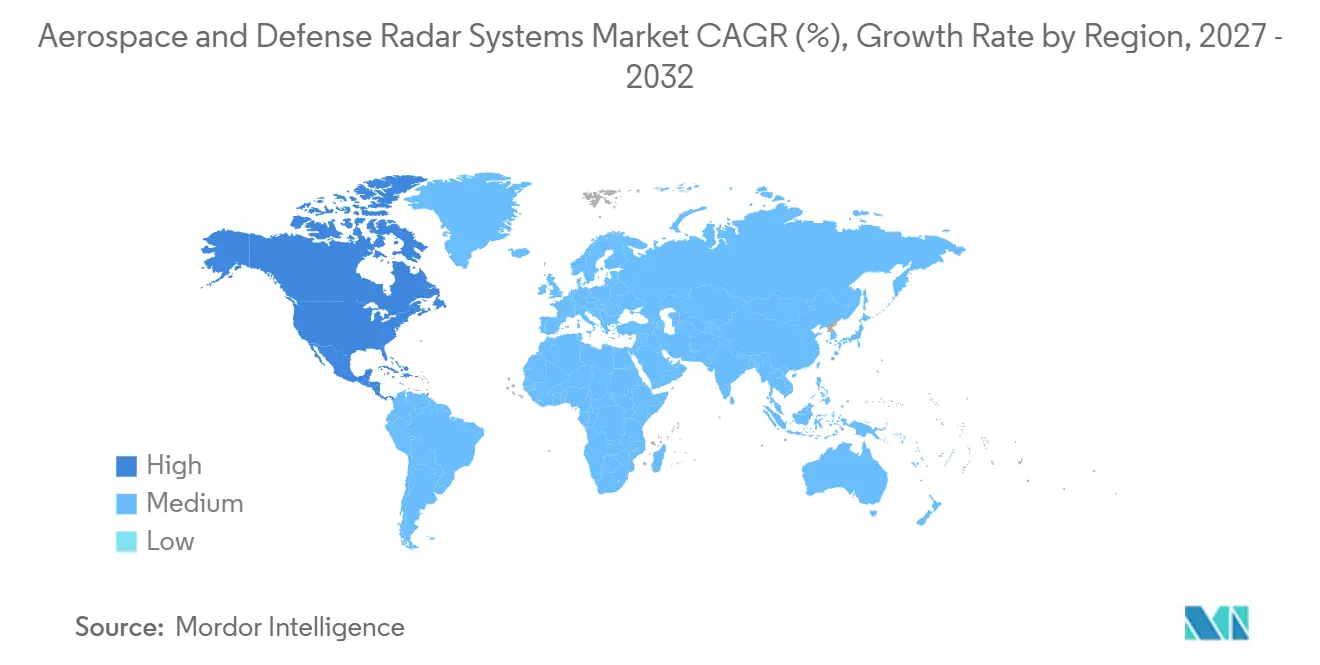
| Fastest Growing Market | North America |
| Largest Market | North America |
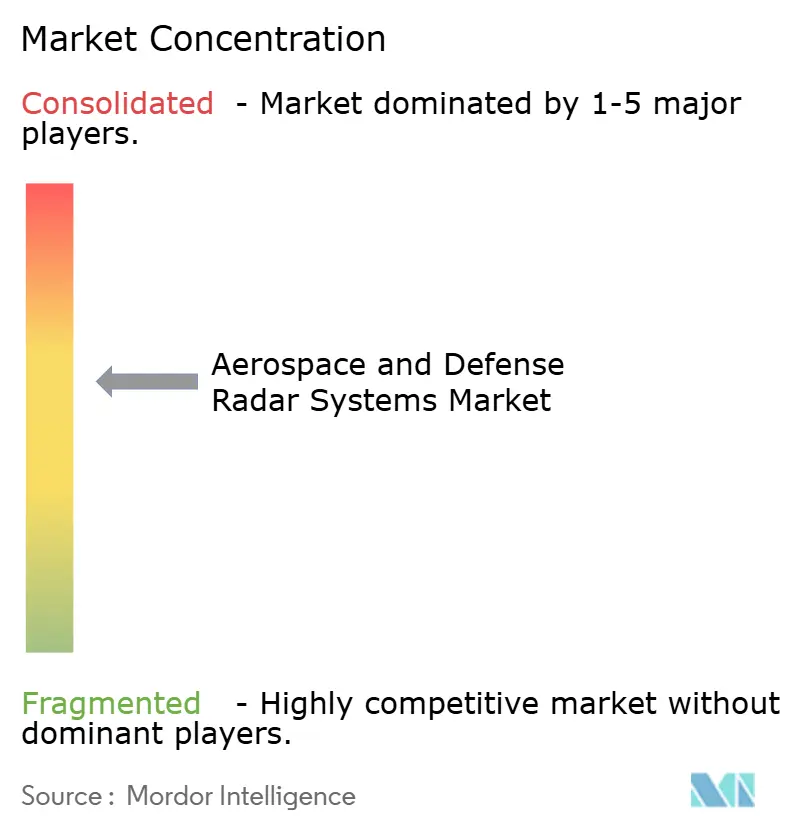
| Market Concentration | Medium |
Major Players *Disclaimer: Major Players sorted in no particular order Image © Mordor Intelligence. Reuse requires attribution under CC BY 4.0. | |
Aerospace and Defense Radar Systems Market Analysis by Mordor Intelligence
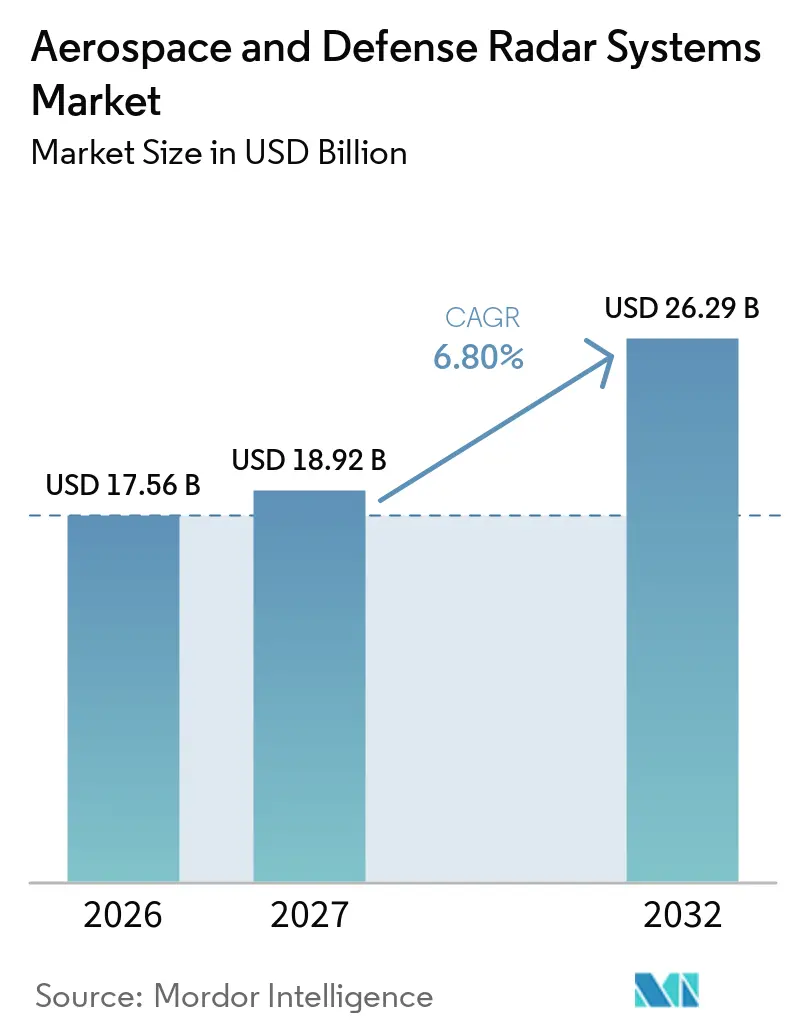
The aerospace and defense radar systems market size was valued at USD 17.56 billion in 2026 and is forecast to grow from USD 18.92 billion in 2027 to reach USD 26.29 billion by 2032, at a 6.80% CAGR during the forecast period (2027-2032). The aerospace and defense radar systems market is supported by military modernization, the replacement of civil air traffic control systems, and a growing need to monitor space. Global military spending reached USD 2,887 billion in 2025, up 41% from 2016, supporting longer procurement cycles for surveillance and tracking systems. Software-defined designs and sensor digitization are changing how radar capabilities, integration, and upgrades are assessed. Vendors with proven architectures can benefit from certification and interoperability requirements, as these extend replacement cycles. However, spectrum access restrictions, export controls, and high ownership costs may delay purchases by smaller defense customers.
Key Report Takeaways
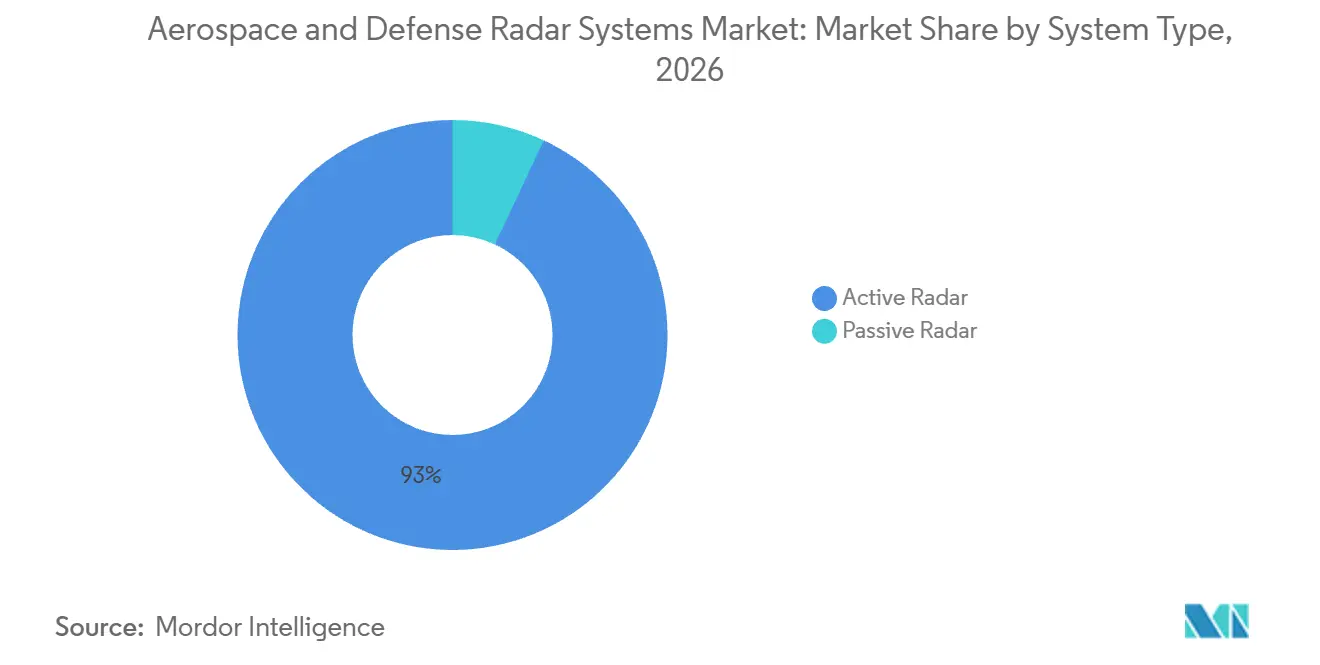
- By system type, active radar held 93.02% of the aerospace and defense radar systems market share in 2026, and is projected to grow at a 6.89% CAGR through 2032.
- By component, antennas accounted for 32.85% of revenue in 2026, while others are projected to grow at a 10.15% CAGR through 2032.
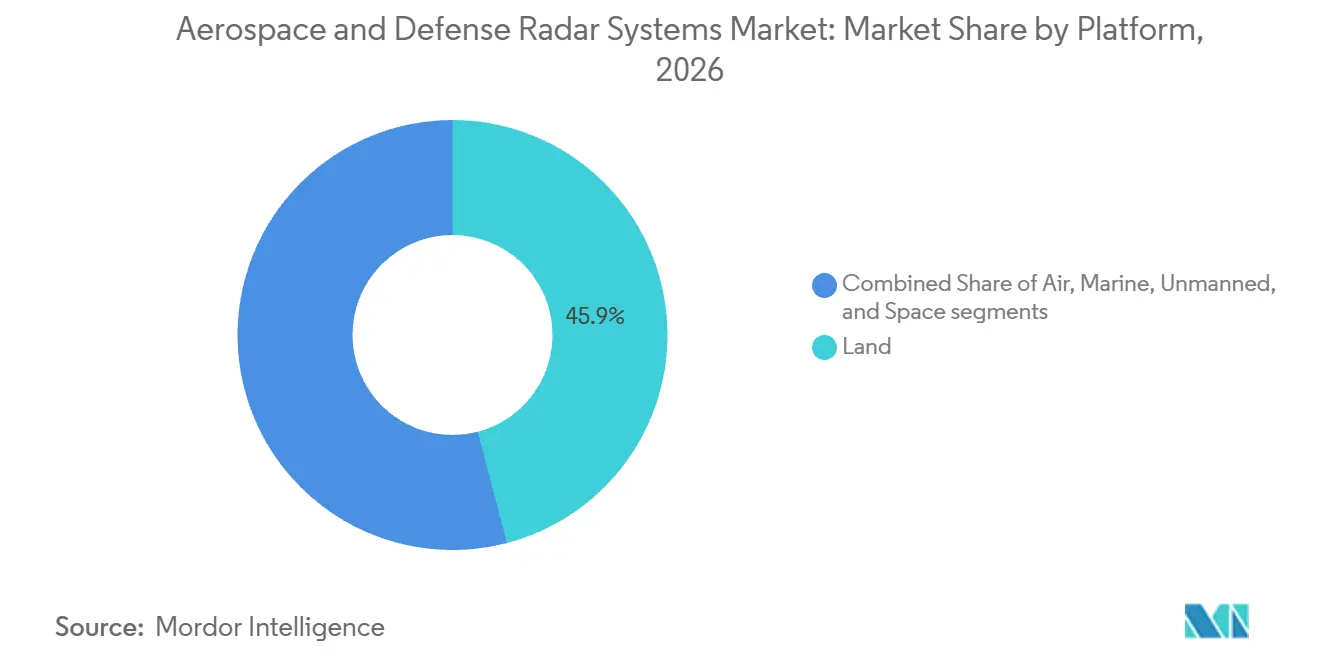
- By platform, land held 45.93% of revenue in 2026, while space is forecast to expand at a 17.37% CAGR through 2032.
- By end-user, military and law enforcement accounted for 84.48% of revenue in 2026, and are projected to grow at a 6.88% CAGR through 2032.
- By frequency band, single band held 59.47% of revenue in 2026, while multi-band is forecast to advance at an 8.28% CAGR through 2032.
- By geography, North America held 32.70% of revenue in 2026 and is forecast to expand at a 7.43% CAGR through 2032.
Note: Market numbers in this report are based on Mordor Intelligence's proprietary estimation framework, which combines nine months of actuals with Q4 projections for base year 2026.
Global Aerospace and Defense Radar Systems Market Trends and Insights
Drivers Impact Analysis*
| Driver | (~) % Impact on CAGR Forecast | Geographic Relevance | Impact Timeline |
|---|---|---|---|
| Rising defense budgets and multi-domain threat detection | +2.50% | Global, strongest in North America and Europe | Short term (≤ 2 years) |
| Proliferation of UAVs, loitering munitions, and low-altitude threats | +1.30% | Global, with early intensity in Europe, Middle East, and Asia-Pacific | Short term (≤ 2 years) |
| Phased-array, GaN, and SDR advances | +1.00% | North America, Europe, Asia-Pacific | Medium term (2-4 years) |
| Growing space domain awareness demand from orbital congestion and proliferated LEO | +0.70% | The US, the UK, Australia, Japan, India, and South Korea | Medium term (2-4 years) |
| Networked sensor fusion and integrated battle-management architectures | +0.60% | NATO members, Gulf states, and Asia-Pacific allies | Long term (≥ 4 years) |
| ATC and weather surveillance radar modernization | +0.50% | North America, Europe, and Asia-Pacific | Medium term (2-4 years) |
| Source: Mordor Intelligence | |||
Rising Defense Budgets and Multi-Domain Threat Detection
European NATO members and Canada increased defense spending by nearly 20% in real terms during 2025, adding more than USD 90 billion. The aerospace and defense radar systems market gains from this funding because air surveillance, missile defense, and battlefield detection are core priorities. In June 2025, NATO members agreed to target 5% of gross domestic product by 2035, with 3.5% directed to core defense needs. Germany spent USD 114 billion in 2025, up 24% from 2024, and reached 2% of gross domestic product for defense for the first time since 1990. India also placed two Bharat Electronics Limited radar contracts in 2025, reinforcing domestic programs. Certification and frequency coordination can slow awards but support long-term service demand.
Proliferation of UAVs, Loitering Munitions, and Low-Altitude Threats
There is increased demand for small UAVs and for radars that detect low, slow, and small targets. In April 2025, the US Army issued a USD 2 million funding opportunity for passive low-altitude detection systems that can alert personnel within 3 minutes of a UAV incursion between 0 and 6,000 feet. This requirement favors compact systems with low SWaP needs. The aerospace and defense radar systems market also benefits from demand for sensors that work within layered air defense. High-altitude and space nodes provide a wider field of view than terrain-limited ground systems. Rapid deployment and target classification are becoming more important.
Phased-Array, GaN, and SDR Advances
GaN technology provides five times the radio-frequency output power of GaAs technology, making it a more capable replacement.[1] This can support greater search volume, longer detection range, or smaller radar form factors. RTX Corporation completed PhantomStrike's first flight test in May 2025, demonstrating terrain mapping and multi-target tracking in an air-cooled system. The aerospace and defense radar systems market is affected because buyers can seek capable fire-control systems for unmanned and lighter platforms. HENSOLDT AG signed an agreement to supply 900,000 GaN components through 2030, indicating that the supply of transmitters and receivers has become strategic. Software-defined radio capabilities also enable common hardware to transition among surveillance, counter-drone, and battle-management tasks.
Growing Space Domain Awareness Demand from Orbital Congestion and Proliferated LEO
Space domain awareness is more important, as LEO holds more satellites and counterspace systems. The UK Space Command stated in 2025 that more than 200 active counterspace systems operate in LEO. The aerospace and defense radar systems market is responding through demand for persistent tracking, launch monitoring, and debris cataloging. The US, UK, and Australia are developing the Deep Space Advanced Radar Capability. Northrop Grumman's Site 2 work reached a cumulative value of USD 495.40 million by August 2026. LeoLabs received a USD 4 million Space Force award in June 2025 for Scout-class S-band radar development. Commercial service models now compete with prime contractors for some tracking tasks. This creates pricing pressure and gives governments additional options.
Restraints Impact Analysis*
| Restraint | (~) % Impact on CAGR Forecast | Geographic Relevance | Impact Timeline |
|---|---|---|---|
| High acquisition, integration, and lifecycle sustainment costs | -0.50% | Global, most acute in South America, Africa, and Southeast Asia | Long term (≥ 4 years) |
| Spectrum congestion and export-control complexity | -0.30% | Global, highest friction in the US and Europe programs | Medium term (2-4 years) |
| Calibration, data quality, and interoperability bottlenecks in distributed radar networks | -0.20% | NATO theaters and multinational coalitions | Medium term (2-4 years) |
| Cybersecurity and electromagnetic-warfare exposure in networked radar architectures | -0.20% | Global, highest concern in command-and-control networked theaters | Long term (≥ 4 years) |
| Source: Mordor Intelligence | |||
High Acquisition, Integration, and Lifecycle Sustainment Costs
A modern AESA radar requires spending beyond the initial platform purchase. Integration with battle-management systems, frequency licensing, software refreshes, and support can double or triple the original outlay over a 20-to-30-year service life. This is strongest for buyers in South America, Africa, and Southeast Asia with limited engineering budgets. The aerospace and defense radar systems market may therefore shift toward smaller fixed-site systems, government-financed sales, or platforms with lower upfront costs. RTX Corporation positioned PhantomStrike for light-attack and unmanned aircraft at nearly half the cost of a conventional AESA radar. Lower purchase prices do not remove the need for software support, specialized operators, and spare components. Export licensing can add 12 to 18 months to projects using US and European technology, increasing cost pressures.
Spectrum Congestion and Export-Control Complexity
Defense radars depend heavily on the 2-18 gigahertz range, which also faces demand from mobile broadband and satellite communications. The US government has identified the S-band, X-band, and Ku-band as important for radar and communications missions.[2] The aerospace and defense radar systems market faces delays when operators balance sensitivity needs with changing spectrum rules. DARPA planned compact radio-frequency filter demonstrations across 3 system types by mid-to-late 2026, but operational adoption remains uncertain. Export controls add difficulty when programs combine US-origin GaN equipment with European processors. Distributed networks also need consistent calibration, common data standards, and secure links to avoid tracking errors. Electromagnetic warfare exposure becomes more serious as more sensors exchange data. These limits can reduce procurement speed even where demand is strong.
*Our forecasts treat driver/restraint impacts as directional, not additive. The impact forecasts reflect baseline growth, mix effects, and variable interactions.
Segment Analysis
By System Type: Active Architecture Entrenches Market Dominance
Active radar held 93.02% of revenue in 2026 and is projected to grow at a 6.89% CAGR through 2032. Its position reflects demand for range resolution, all-weather tracking, fire-control functions, and connection to battle-management networks. Pulsed-wave systems are widely used for land-based air defense and long-range surveillance. Continuous-wave systems increasingly support short-range counter-drone missions and vehicle-related military sensing. The aerospace and defense radar systems market size for active radar benefits from new AESA installations. These systems can combine air defense, ballistic-missile tracking, and electronic-attack roles within a single broader architecture. This capability explains why active platforms remain central to high-value mission requirements.
Passive radar uses non-cooperative signals from broadcast FM, digital television, and 5G sources. It can support intelligence, surveillance, and reconnaissance tasks without emitting its own signal. HENSOLDT AG demonstrated its Twinvis passive system with a 250 km instrumental range at MSPO 2025 and linked it with TRML-4D in the Twinsens configuration. The approach supports hybrid deployments in which passive sensors extend situational awareness and active radars provide accurate tracking. Passive technology does not offer the same independent time-on-target performance as an active radar. This limitation restricts standalone adoption in fire-control roles. It also creates an ongoing need for integration in active radar architectures. The aerospace and defense radar systems industry, therefore, remains structured around active systems, while passive systems add capabilities in select deployments.

By Component: Antennas Drive Revenue While Integration Hardware Grows Fastest
Antennas accounted for 32.85% of component revenue in 2026, as phased-array apertures integrate multiple transmit and receive modules with precision beam-steering equipment, making them costly to develop and difficult to source outside established manufacturers. Transmitters and receivers remain important as GaN designs raise performance requirements across land and naval systems. Duplexers allow transceivers to use a common antenna aperture. Active circulator GaN front ends can provide more than 50 decibels of transmit-to-receive isolation, increasing pressure on conventional duplexer designs. The aerospace and defense radar systems market relies on these subsystems to balance range, electronic protection, and platform size. Component choices also affect repairability and the ability to upgrade installed systems.
The others category is forecast to grow at a 10.15% CAGR through 2032. It includes signal processors, embedded computing boards, cooling systems, and system-level integration software. Networked radar systems increasingly compete on processing quality and data management rather than transmit power alone. This change gives more value to the component set that supports software-defined operations. HENSOLDT AG invested more than EUR 1 million (USD 1.12 million) in an anechoic chamber for SPEXER antenna characterization at its Ulm facility in 2025.[3] The investment reflects pressure on testing capacity as production increases. IEC 62368-1 and MIL-STD-461 requirements can further limit sourcing flexibility for compact airborne and unmanned modules.
By Platform: Land Base Leads While Space Commands the Growth Horizon
Land-based platforms accounted for 45.93% of the aerospace and defense radar systems market in 2026. Fixed systems support strategic surveillance and national air sovereignty requirements. Mobile and portable systems provide coverage for expeditionary forces and temporary deployments. The US Army awarded Lockheed Martin Corporation a potential USD 2.99 billion contract for Sentinel A4 production and engineering services in June 2026, with work extending through June 2031. Land programs often include command systems, launchers, and several sensor types, which increases integration value. Airborne radars form another major category and include weather systems, fighter fire-control systems, and surveillance equipment. Demand for marine radar is also driven by naval modernization and commercial navigation requirements.
Space is forecast to expand at a 17.37% CAGR through 2032, the strongest rate among platform categories. The segment is supported by debris tracking, missile warning, foreign-launch monitoring, and space domain awareness. Australia committed USD 174 million in February 2025 for up to 14 multi-mission phased-array radars from CEA Technologies. Commercial operators are also investing in expeditionary S-band systems. This activity brings established defense contractors into closer competition with commercially funded providers. Unmanned air, ground, and surface platforms add demand for compact sensors with strict SWaP limits. The aerospace and defense radar systems market therefore depends on a mix of durable land programs and higher-growth space opportunities.
By End-User: Military Dominance is Structural, Commercial Verticals Deliver Incremental Demand
Military and law enforcement accounted for 84.48% of revenue in 2026 and are projected to grow at a 6.88% CAGR through 2032. Air and missile defense is the highest-value military application because it requires capable detection and tracking systems. ISR platforms are changing quickly as signal processing improves revisit rates and target recognition. Battlefield surveillance and search-and-rescue operations drive demand for rugged, portable, and vehicle-mounted radars. The aerospace and defense radar systems market remains closely tied to sovereign budgets and procurement schedules. These buyers typically seek long service lives, secure supply chains, and proven interoperability. The military segment consequently produces larger contract values than commercial uses, even though its approval processes can be lengthy.
Commercial end-users held 15.52% of 2026 revenue and include weather monitoring, air traffic management, vehicle detection, border security, and space domain awareness. The FAA's BNATCS program plans 612 radar deployments and 44 airport surface movement radar replacements. Space domain awareness combines public funding with commercial operating models. Government contracts can provide revenue visibility for specialized operators that develop tracking services. Civil customers may place more emphasis on availability, lifecycle cost, and compliance than military customers. This creates an opportunity for vendors with certified systems and maintenance capacity. The aerospace and defense radar systems market can therefore draw incremental demand from civil modernization while defense remains its main source of revenue.
By Frequency Band, Single Band Dominates but Multi-Band Reshapes Mission Economics
Single-band systems held 59.47% of revenue in 2026 because they are efficient for a defined task. L-band systems can support long-range air surveillance, while X-band systems are commonly used for fire-control requirements. A focused design can reduce the cost and complexity of a radar installation. The aerospace and defense radar systems market continues to use these systems across military and civil missions. However, spectrum competition is increasing in some commonly used bands. The 3.1-3.45 gigahertz S-band is valued for 3D surveillance, but it faces pressure from commercial 5G deployments in the US and Europe. This may increase interest in designs that can operate across multiple frequency ranges.
Multi-band systems are forecast to grow at an 8.28% CAGR through 2032. They can cover surveillance, tracking, fire control, weather, and command functions in a single configuration or a coordinated network. The US Air Force's multi-band, multifunction tactical radar effort seeks a deployable radar capable of supporting air traffic surveillance, C2, counter-drone operations, and weather sensing. Multi-band capability can also complicate adversary jamming because it requires broader-spectrum electronic attack resources. Sweden selected the Thales Group SMART-L MM/F and Saab AB Giraffe 4A systems for air defense, demonstrating how multiple frequency bands can be integrated through networked systems. Manufacturers must manage increasing integration and sustainment requirements. The aerospace and defense radar systems industry is therefore balancing proven single-band systems against a growing need for broader mission flexibility.
Geography Analysis
North America held 32.70% of revenue in 2026 and is projected to grow at a 7.43% CAGR through 2032. The region combines military platform upgrades, air traffic control renewal, and space surveillance spending at a scale few other regions can match. The aerospace and defense radar systems market size in North America is reinforced by the FAA's USD 12.50 billion BNATCS appropriation and its planned deployment of 612 radars. US procurement also covers tactical counter-UAV systems, land-based air defense, naval radars, and space tracking. Allied demand broadens the regional installed base and the need for support services.
The aerospace and defense radar systems market in Europe is accelerating after a long period of lower defense investment. European NATO members spent USD 864 billion on defense in 2025, a 14% real-terms increase from 2024, while Germany spent USD 114 billion. Germany has committed to reach 3.5% of GDP for defense by 2029. HENSOLDT AG is expanding Ulm production capacity toward 1,000 radar units annually from 2027. The UK approved USD 260 million for ECRS Mk2 radar work, and regional demand supports domestic production and the development of NATO-compatible systems.
The aerospace and defense radar systems market in Asia-Pacific has diverse procurement needs. India is using indigenous content rules to expand domestic radar production. The Indian MoD signed a USD 344 million contract for the Ashwini low-level transportable radar in March 2025, followed by a USD 237 million air-defense fire-control radar contract in July 2025. Japan's selection of the SPY-7 and South Korea's investments in fighter and naval systems indicate high-end demand across the region. Southeast Asian funding cycles and Australia's industrial participation rules can extend timelines. At the same time, the Middle East, Africa, and South America create targeted opportunities in drone detection, border security, and maritime surveillance.
Competitive Landscape
The aerospace and defense radar systems market is moderately concentrated among Lockheed Martin Corporation, RTX Corporation, Northrop Grumman Corporation, Leonardo S.p.A., and HENSOLDT AG. These companies win major programs through established waveform libraries, certification records, and the ability to integrate complete systems. Lockheed Martin Corporation is active across Space Fence support, SPY-7 naval exports, and Sentinel A4 land-based air defense.
The market also offers opportunities for specialists, particularly in applications that require compact designs, high-speed performance, and low SWaP requirements. Counter-UAV radar and commercial space tracking are important areas for these firms. Domestic companies benefit from domestic procurement requirements, including Bharat Electronics Limited, which falls under India’s indigenous procurement category.
Strategic moves focus on capacity, GaN supply, and software-driven capability. HENSOLDT AG expanded capacity for TRML-4D and SPEXER systems, while RTX Corporation completed the PhantomStrike flight test in May 2025 for unmanned and light-attack platforms. Software functions, digital beamforming, and export-control compliance are increasingly important in supplier selection. The aerospace and defense radar systems market will favor suppliers that can manage technology agreements, long-term support, and production schedules.
Aerospace and Defense Radar Systems Industry Leaders
-
Lockheed Martin Corporation
-
RTX Corporation
-
Leonardo S.p.A.
-
Northrop Grumman Corporation
-
HENSOLDT AG
- *Disclaimer: Major Players sorted in no particular order
Recent Industry Developments
- August 2026: Northrop Grumman Corporation received a USD 215.90 million contract modification from the US DoD for its DARC program. The modification expands a previously awarded contract for DARC Site 2 and covers pre-construction long-lead items, antenna hardware, antenna manufacturing, and pre-construction tasks for the radar system.
- July 2026: Raytheon, an RTX Corporation business, was awarded a USD 1.80 billion contract extension for SPY-6 radars for the US Navy, building on the initial hardware production and sustainment contract awarded in March 2022.
- July 2026: Lockheed Martin Corporation secured a potential USD 2.90 billion contract from the US Army to manufacture Sentinel A4 radar systems. The contract covers continued work on the Sentinel A4 radar program. The award covers production and engineering services through mid-2031. Sentinel A4 is the Army's next-generation radar designed to detect a broader range of airborne and missile threats.
- May 2026: Saab AB and Scania France signed a deal with the French DGA. Under the agreement, the French Armed Forces will receive 17 Giraffe 1X radars, along with spare parts, training, and support. One radar will be used for testing, while the remaining 16 will be mounted on Scania V3P tactical vehicles produced by Scania France and its SPAD unit in Angers, France. The two companies have also established a joint consortium for the duration of the contract. Deliveries are scheduled for 2026 and 2027.
Global Aerospace and Defense Radar Systems Market Report Scope
Aerospace and defense radar systems use advanced radio wave technologies to detect, locate, track, and identify objects such as aircraft and missiles in military and aviation applications. These systems support defense, aviation, weather forecasting, navigation, and disaster management.
The aerospace and defense radar systems market is segmented by system type, component, platform, end user, frequency band, and geography. By system type, the market is segmented into active radar and passive radar. By component, the market is segmented into antennas, transmitters, receivers, duplexers, and others. By platform, the market is segmented into air, land, marine, unmanned, and space. By end user, the market is segmented into military and law enforcement, and commercial. By frequency band, the market is segmented into single-band and multi-band systems. The report also covers market sizes and forecasts for the aerospace and defense radar systems market across major countries in major countries across different regions. For each segment, the market size is provided in terms of value (USD).
| Active Radar | Pulsed-Wave Radar |
| Continous-Wave Radar | |
| Passive Radar |
| Antenna |
| Transmitters |
| Receiver |
| Duplexer |
| Others |
| Air | Commercial Aircraft |
| Military Aircraft | |
| Land | Fixed Radar |
| Portable Radar | |
| Mobile Radar | |
| Marine | Commercial Vessels |
| Military Vessels | |
| Unmanned | Unmanned Aerial Vehicles (UAVs) |
| Unmanned Ground Vehicles (UGVs) | |
| Unmanned Surface Vehicles (USVs) | |
| Space | Satellites |
| Spacecraft |
| Military and Law Enforcement | Air and Missile Defense |
| Intelligence, Surveillance, and Reconnaissance (ISR) | |
| Battlefield Surveillance | |
| Search and Rescue | |
| Commercial | Weather Monitoring |
| Air-Traffic Monitoring | |
| Vehicle Detection, ADAS, and Autonomous Driving | |
| Border, Perimeter, and Critical-Infrastructure Security | |
| Space Domain Awareness |
| Single Band |
| Multi-Band |
| North America | United States | |
| Canada | ||
| Mexico | ||
| Europe | United Kingdom | |
| Germany | ||
| France | ||
| Italy | ||
| Rest of Europe | ||
| Asia-Pacific | China | |
| India | ||
| Japan | ||
| South Korea | ||
| Rest of Asia-Pacific | ||
| South America | Brazil | |
| Rest of South America | ||
| Middle East and Africa | Middle East | Saudi Arabia |
| United Arab Emirates | ||
| Rest of Middle East | ||
| Africa | South Africa | |
| Rest of Africa | ||
| By System Type | Active Radar | Pulsed-Wave Radar | |
| Continous-Wave Radar | |||
| Passive Radar | |||
| By Component | Antenna | ||
| Transmitters | |||
| Receiver | |||
| Duplexer | |||
| Others | |||
| By Platform | Air | Commercial Aircraft | |
| Military Aircraft | |||
| Land | Fixed Radar | ||
| Portable Radar | |||
| Mobile Radar | |||
| Marine | Commercial Vessels | ||
| Military Vessels | |||
| Unmanned | Unmanned Aerial Vehicles (UAVs) | ||
| Unmanned Ground Vehicles (UGVs) | |||
| Unmanned Surface Vehicles (USVs) | |||
| Space | Satellites | ||
| Spacecraft | |||
| By End-User | Military and Law Enforcement | Air and Missile Defense | |
| Intelligence, Surveillance, and Reconnaissance (ISR) | |||
| Battlefield Surveillance | |||
| Search and Rescue | |||
| Commercial | Weather Monitoring | ||
| Air-Traffic Monitoring | |||
| Vehicle Detection, ADAS, and Autonomous Driving | |||
| Border, Perimeter, and Critical-Infrastructure Security | |||
| Space Domain Awareness | |||
| By Frequency Band | Single Band | ||
| Multi-Band | |||
| By Geography | North America | United States | |
| Canada | |||
| Mexico | |||
| Europe | United Kingdom | ||
| Germany | |||
| France | |||
| Italy | |||
| Rest of Europe | |||
| Asia-Pacific | China | ||
| India | |||
| Japan | |||
| South Korea | |||
| Rest of Asia-Pacific | |||
| South America | Brazil | ||
| Rest of South America | |||
| Middle East and Africa | Middle East | Saudi Arabia | |
| United Arab Emirates | |||
| Rest of Middle East | |||
| Africa | South Africa | ||
| Rest of Africa | |||
Key Questions Answered in the Report
What is the projected value of aerospace and defense radar systems by 2032?
The aerospace and defense radar systems market is projected to reach USD 26.29 billion by 2032, growing from USD 18.75 billion in 2027 at a 6.80% CAGR.
Which platform is expected to grow the fastest through 2032?
Space platforms are projected to grow at a 17.37% CAGR because of demand for debris tracking, missile warning, and space domain awareness.
Why do active radar systems dominate demand?
Active radar held 93.02% of 2026 revenue because it supports search, tracking, fire control, and battle-management functions.
What is driving demand for counter-drone radar systems?
Small drones and loitering munitions require compact radar systems that can detect low, slow, and small targets quickly.
Which region is growing the fastest?
North America is projected to grow at a 7.43% CAGR through 2032, supported by defense procurement, air traffic control renewal, and space surveillance investment.
What limits adoption by smaller defense buyers?
High acquisition, integration, licensing, and lifecycle support costs can delay purchases, particularly where local engineering resources are limited.