
Advanced Magnetic Materials Market Size and Share
Market Overview
| Study Period | 2021 - 2031 |
|---|---|
| Market Size (2026) | USD 30.36 Billion |
| Market Size (2031) | USD 42.87 Billion |
| Growth Rate (2026 - 2031) | 7.14 % |
| Fastest Growing Market | Asia-Pacific |
| Largest Market | Asia-Pacific |
| Market Concentration | Low |
Major Players *Disclaimer: Major Players sorted in no particular order Image © Mordor Intelligence. Reuse requires attribution under CC BY 4.0. | |
Advanced Magnetic Materials Market Analysis by Mordor Intelligence
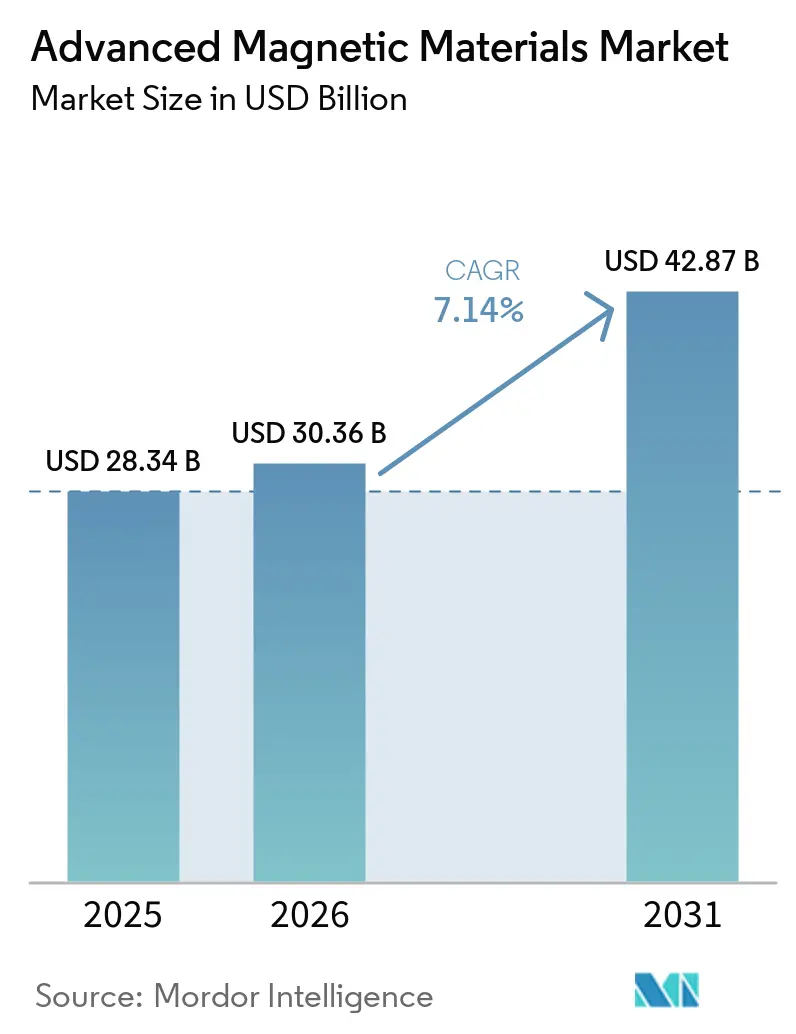
The Advanced Magnetic Materials Market size was valued at USD 28.34 billion in 2025 and is estimated to grow from USD 30.36 billion in 2026 to reach USD 42.87 billion by 2031, at a CAGR of 7.14% during the forecast period (2026-2031). The advanced magnetic materials market is supported by demand from electric vehicle traction motors, direct-drive wind generators, industrial motors, and power converters. These applications depend on permanent magnets or low-loss soft magnetic cores that are difficult to replace without affecting performance. Demand is also shifting toward materials that can operate at higher switching frequencies in compact power equipment. Supply concentration in China continues to influence procurement, capacity planning, and technology choices across the advanced magnetic materials market. Manufacturers outside China are responding through regional production, supply agreements, recycling plans, and development of rare-earth-free materials.
Key Report Takeaways
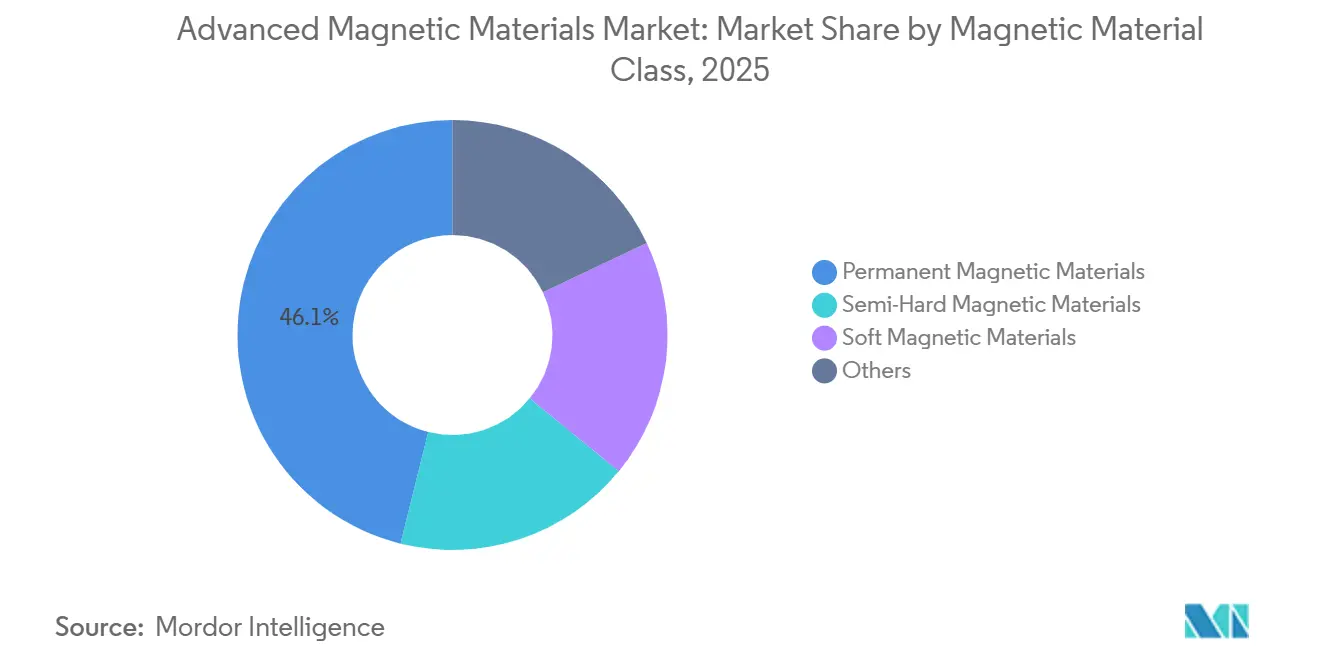
- By magnetic material class, permanent magnetic materials held 46.12% of the advanced magnetic materials market share in 2025, while soft magnetic materials are projected to advance at a 7.87% CAGR through 2031.
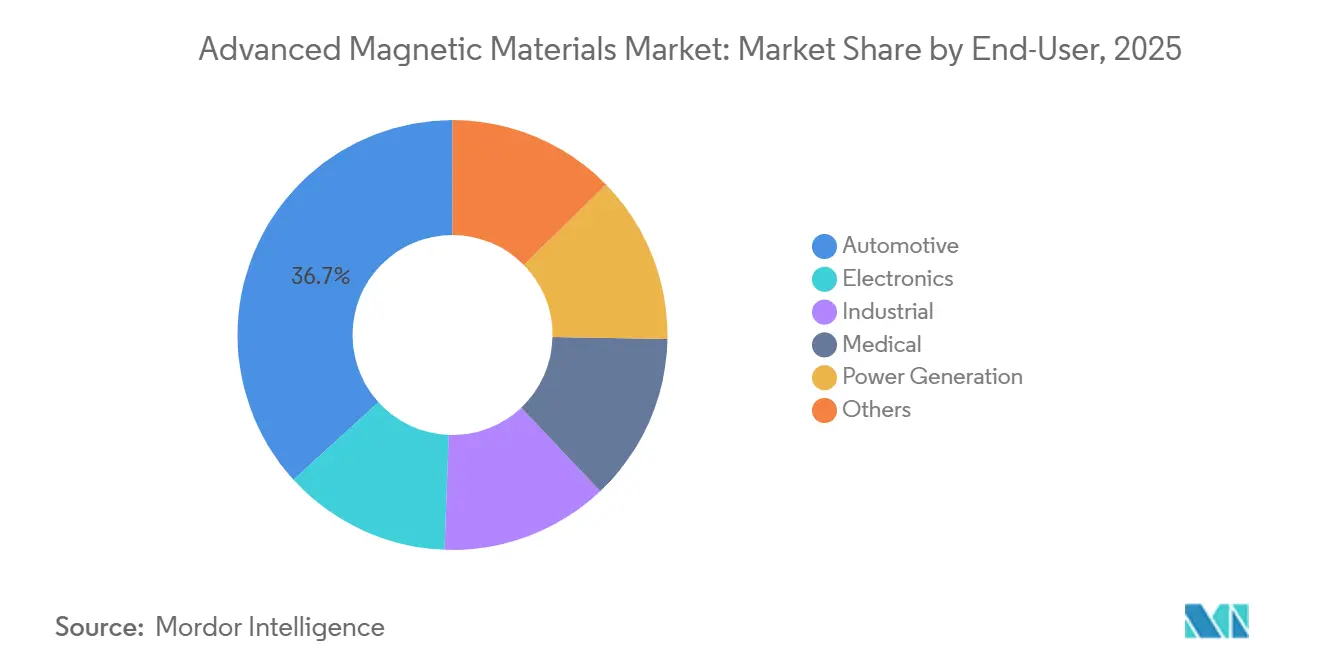
- By end-user, automotive held 36.75% of the advanced magnetic materials market share in 2025, while electronics is projected to advance at an 8.13% CAGR through 2031.
- By geography, Asia-Pacific held 52.42% of the advanced magnetic materials market share in 2025 and is projected to advance at an 8.04% CAGR through 2031.
Note: Market size and forecast figures in this report are generated using Mordor Intelligence’s proprietary estimation framework, updated with the latest available data and insights as of January 2026.
Global Advanced Magnetic Materials Market Trends and Insights
Drivers Impact Analysis*
| Driver | (~) % Impact on CAGR Forecast | Geographic Relevance | Impact Timeline |
|---|---|---|---|
| Electric Vehicle and Hybrid Vehicle Motor Electrification | +2.3% | Global (China, Europe, North America) | Short term (≤ 2 years) |
| Renewable Energy Generator Deployment | +1.8% | Global (APAC core, EU, spillover to MEA) | Medium term (2–4 years) |
| Industrial Automation and Robotics Adoption | +1.2% | APAC core (China, Japan, South Korea), spillover to North America & EU | Medium term (2–4 years) |
| Miniaturization and High-Frequency Power Electronics | +0.8% | Global (APAC core, North America) | Short term (≤ 2 years) |
| Rare-Earth-Free Material Commercialization | +0.5% | North America & EU | Long term (≥ 4 years) |
| Source: Mordor Intelligence | |||
Electric Vehicle and Hybrid Vehicle Motor Electrification
Battery-electric vehicles use permanent-magnet synchronous motors because they can achieve peak efficiencies above 96%. This makes rare earth magnets an established choice for manufacturers that compete on driving range and thermal performance. China produced 9.5 million electric vehicles in 2025, which absorbed a large share of domestic sintered-magnet output and tightened supply for overseas purchasers. European vehicle platforms using 800 V architectures require high-coercivity neodymium-iron-boron grades that can resist thermal demagnetization. Those specifications can raise dysprosium loading and direct demand toward premium permanent magnetic materials. Automotive manufacturers set coercivity and remanence requirements years before vehicle production, which makes a mid-program supplier change difficult in the advanced magnetic materials market.
Renewable Energy Generator Deployment
Wind power remains a magnet-intensive energy application, especially where direct-drive generator designs are used. Offshore turbines above 10 megawatts require 2,000–3,000 kg of neodymium-iron-boron magnets per unit, while onshore turbines typically use 600 kg per megawatt of capacity. Larger turbine ratings increase material demand per installation and favor high-performance magnet grades. The move from 12–16-megawatt platforms in 2025 toward planned 18–25-megawatt models from 2027 will therefore raise the magnet requirement of each offshore project. More than 90% of permanent magnets used in the European Union were sourced from China, which makes wind deployment sensitive to supply-chain changes. This dependency strengthens the case for new refining, magnet production, and recycling capacity in regions expanding offshore wind.
Industrial Automation and Robotics Adoption
The installed base of industrial robots reached 4.664 million units globally in 2024, and installations reached approximately 575,000 units in 2025[1]. Servo motors, sensors, and positioning equipment in these systems use both permanent and soft magnetic materials. The resulting demand is spread across factories rather than concentrated in one equipment category. Robotics also requires materials that can deliver precision and repeated performance in compact assemblies. Automation investment in China, Japan, South Korea, North America, and Europe, therefore, supports the advanced magnetic materials market across industrial motor and sensor applications. The demand base is strengthened by the continued use of collaborative robots in production and handling tasks.
Miniaturization and High-Frequency Power Electronics
Power electronics are moving from kilohertz-range switching toward megahertz-range operation in electric vehicle inverters, data center power supplies, and onboard chargers. Conventional silicon-steel laminations experience high core losses at these frequencies. Amorphous, nanocrystalline, and soft magnetic composite materials can reduce these losses while supporting compact component designs. A 2025 study reported nanocrystalline soft magnetic alloys with low core losses for high-frequency power converters. Research published in 2026 also reported iron-based nanocrystalline powder cores with ultra-low loss of 265 mW/cm³ at 0.1 T and 100 kHz. These requirements explain why soft magnetic materials are expanding faster than the overall advanced magnetic materials market.
Restraints Impact Analysis*
| Restraint | (~) % Impact on CAGR Forecast | Geographic Relevance | Impact Timeline |
|---|---|---|---|
| Rare-Earth Supply Concentration and Price Volatility | -1.5% | Global | Short term (≤ 2 years) |
| High Processing Complexity and Qualification Costs | -0.8% | North America & EU (most acute) | Long term (≥ 4 years) |
| Environmental Compliance for Mining and Magnet Manufacturing | -0.5% | China, Global OECD | Medium term (2–4 years) |
| Source: Mordor Intelligence | |||
Rare-Earth Supply Concentration and Price Volatility
China supplied 60% of global mining output for magnet rare earths in 2024 and controlled 91% of refining output and 94% of sintered permanent magnet production. This concentration can turn geopolitical friction into an immediate issue for manufacturers. China imposed export controls on 7 heavy rare earth elements and related compounds in April 2025, which disrupted automotive supply chains in the United States and Europe. The controls also exposed the difference between Chinese domestic pricing and European prices for dysprosium and terbium. An 18-month Chinese rare earth restriction scenario could reduce United States output by 0.3% - 0.6%, with automotive and electronics facing much of the effect. The advanced magnetic materials market, therefore, remains exposed to changes in export policy, material availability, and procurement costs.
High Processing Complexity and Qualification Costs
Sintered neodymium-iron-boron magnet production requires controlled alloy composition, pressing, vacuum sintering, and protective coating. Small changes in the process can affect coercivity, corrosion resistance, and customer specifications. The United States Department of Energy noted that China’s share of the supply chain increased from 58% of global rare earth mining in 2020 to 92% of magnet production, where value addition is highest[2]. Automotive qualification includes thermal cycling, vibration testing, and Failure Mode and Effects Analysis validation. This process can take 2-4 years after a material specification is set. New suppliers and rare-earth-free alternatives must complete this work before they can generate meaningful sales in the advanced magnetic materials market.
*Our forecasts treat driver/restraint impacts as directional, not additive. The impact forecasts reflect baseline growth, mix effects, and variable interactions.
Segment Analysis
By Magnetic Material Class: Permanent Magnetic Materials Lead, While Soft Magnetic Materials Gain Momentum
Permanent magnetic materials held 46.12% of the market revenue in 2025. Neodymium-iron-boron and samarium-cobalt compounds are used in electric vehicle traction motors, direct-drive wind generators, and industrial servo systems. Their position reflects the performance requirements of applications that need high energy density and stable operation. Automotive programs also create durable demand because magnet properties are specified well before production begins. Semi-hard magnetic materials serve data storage, magnetic recording, and security uses such as anti-theft tags. Other materials, including bonded magnets and flexible magnetic strips, are used in consumer appliances, packaging, and signage, where cost remains important.
Soft magnetic materials are projected to advance at a 7.87% CAGR through 2031. The advanced magnetic materials market size for this class benefits from the growing use of high-frequency transformer cores, electric vehicle onboard chargers, and power conversion equipment. Amorphous and nanocrystalline alloys offer lower core loss and high saturation flux density at switching frequencies where silicon steel is less effective. A 2025 technical review described the use of low-loss soft magnetic materials in power electronics. Work published in 2026 on nanocrystalline composites for megahertz chip inductors also linked these materials to artificial intelligence hardware, 5.5G and 6G infrastructure, micro-robots, and drones. This performance requirement is shifting attention toward soft magnetic materials in the advanced magnetic materials market.

By End-User: Automotive Leads Revenue While Electronics Expands Faster
Automotive accounted for 36.75% of the advanced magnetic materials market size in 2025. Electric vehicle drivetrains use multi-kilogram neodymium-iron-boron magnet loadings, while power steering, active suspension, and thermal management systems add further demand. The segment also benefits from the difficulty of replacing qualified magnet suppliers during a vehicle program. Medical applications use magnetic materials in magnetic resonance imaging systems, magnetic particle imaging, and implantable devices. Power generation demand is linked to wind turbine generators, where larger offshore platforms need more magnetic material per unit. Industrial users provide a separate base of demand through servo motors, conveyors, and factory automation systems.
Electronics is projected to advance at an 8.13% CAGR through 2031. Smaller devices, artificial intelligence server power needs, and 5G and 6G chipset deployment support demand for compact inductors and efficient power modules. Soft magnetic ferrites and nanocrystalline powder cores are important in these applications because they can manage higher switching frequencies. Industrial demand remains supported by motors and automation equipment, including collaborative robots. The mix of automotive, electronics, industrial, medical, power generation, and other users limits reliance on a single demand source. This breadth supports continued expansion across the advanced magnetic materials market.
Geography Analysis
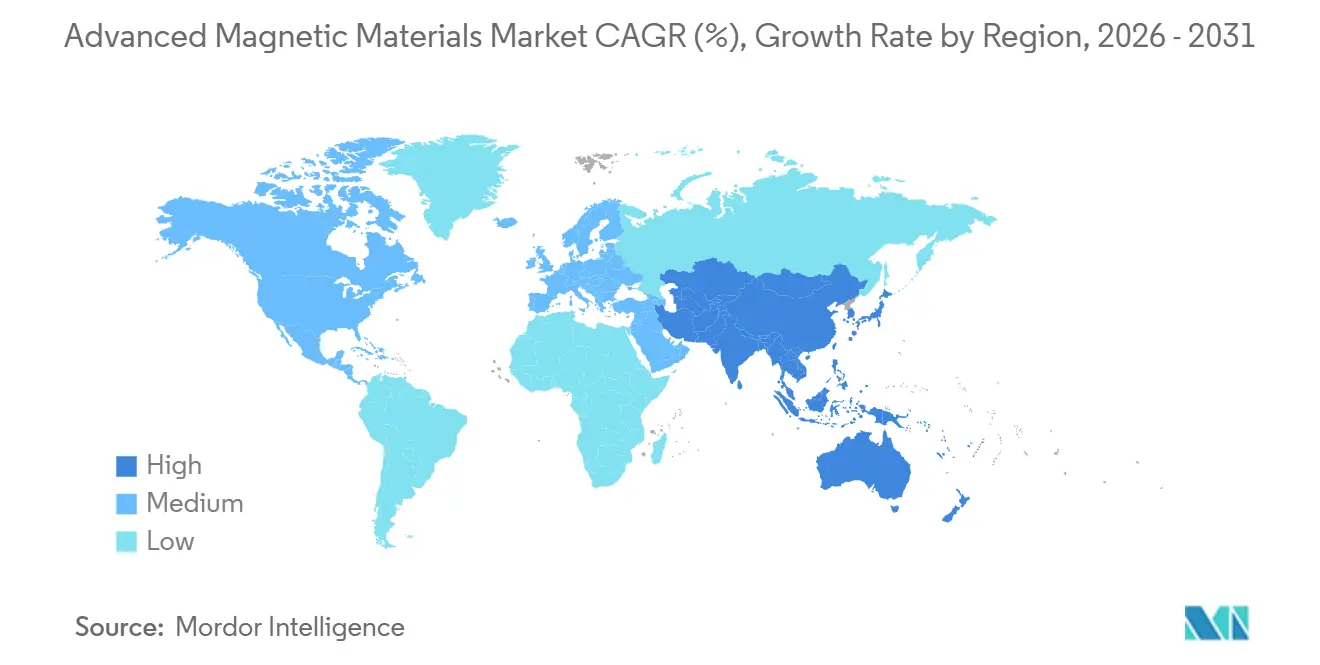
Asia-Pacific held 52.42% of the market revenue in 2025 and is projected to advance at an 8.04% CAGR through 2031. The region’s revenue leadership reflects its integrated chain from rare earth mining and separation to alloying and sintering. China’s domestic production structure provides scale across mining, refining, and magnet manufacturing. This position influences costs, material availability, and customer access for producers in other regions. India is becoming a relevant production location through new investment in sintered neodymium-iron-boron magnets and amorphous metals. Proterial, Ltd. began construction of an amorphous metal facility in Tirupati, Andhra Pradesh, in January 2026 through a 74:26 joint venture with Shirdi Sai Electricals Ltd., with an initial capacity of 30,000 metric tons per year.
North America is building manufacturing capability through industrial policy and private investment. Niron Magnetics broke ground on a 1,500-metric-ton-per-year iron nitride permanent magnet facility in Sartell, Minnesota, supported by a USD 52.2 million Section 48C Advanced Energy Project tax credit. The company identified Stellantis, Samsung, Allison Transmission, and Magna as commercial partners. In May 2026, the United States Department of Energy proposed support for work by ABB Inc. on manganese-bismuth non-rare-earth magnets for industrial motor applications. Canada and Mexico also support the regional outlook through electric vehicle assembly and motor manufacturing. These developments could create a continental supply corridor for automotive-grade permanent magnets.
Europe is responding to supply concentration through regulation, recycling, and production investment. The European Union’s Critical Raw Materials Act established 2030 benchmarks of 10% extraction, 40% processing, and 25% recycling for strategic raw materials. Neo Performance Materials reached commercial production at its Narva, Estonia, facility in September 2026, with Phase 1A capacity of 2,000 metric tons per year and Phase 1B expansion to 5,000 metric tons underway. South America and the Middle East and Africa remain smaller contributors in the forecast period. Brazil’s rare earth deposits could support supply diversification, while Saudi Arabia’s automation activity and South Africa’s rare earth potential create separate demand and supply opportunities.
Competitive Landscape
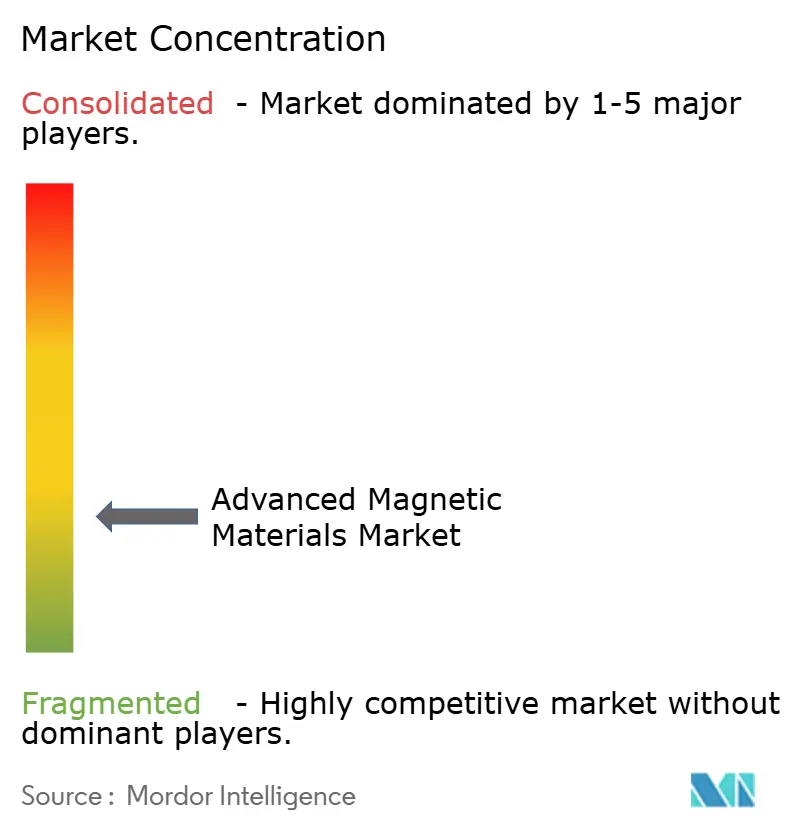
The advanced magnetic materials market is highly fragmented, with the top five players including Proterial, Ltd., TDK Corporation, Shin-Etsu Chemical Co., Ltd., VACUUMSCHMELZE GmbH and Co. KG, and Ningbo Yunsheng Co., Ltd. DMEGC Magnetics Co., Ltd. and Ningbo Yunsheng Co., Ltd. represent the scale of Chinese capacity in magnetic materials. Japanese suppliers such as TDK Corporation and Proterial, Ltd. compete through precision grades, amorphous and nanocrystalline soft magnetics, and established original equipment manufacturer qualifications. VACUUMSCHMELZE GmbH and Co. KG focuses on high-performance materials for aerospace, medical, and energy conversion applications. These positions create different competitive approaches within the advanced magnetic materials market.
Supply security is central to competitive strategy. Manufacturers are pursuing upstream agreements, regional facilities, and faster customer qualification for automotive and wind programs. Neo Performance Materials started commercial production at its European permanent magnet facility in September 2026 and began shipping rare earth sintered magnets to a Tier 1 electric vehicle traction motor customer. Niron Magnetics marked steel raising at its Sartell facility in September 2026 and announced an investment from Honda Motor Co., Ltd. The company’s facility is intended to produce 1,500 metric tons per year of iron nitride rare-earth-free permanent magnets. These projects show that the advanced magnetic materials market is developing new supply options outside the established Chinese production base.
The remaining opportunity areas are ex-China refining of dysprosium and terbium, rare-earth-free magnets for suitable motor applications, and closed-loop recycling of neodymium-iron-boron production waste and end-of-life magnets. Recycling rules will influence where magnet scrap is processed and reused. The number and maturity of original equipment manufacturer-approved programs will shape access to future vehicle and wind demand. Suppliers with qualified products across several applications will be better placed to serve the advanced magnetic materials market as demand grows. Competitive activity, therefore, combines cost, material performance, supply resilience, and qualification status.
Advanced Magnetic Materials Industry Leaders
-
Proterial, Ltd.
-
TDK Corporation
-
Shin-Etsu Chemical Co., Ltd.
-
VACUUMSCHMELZE GmbH and Co. KG
-
Ningbo Yunsheng Co., Ltd.
- *Disclaimer: Major Players sorted in no particular order
Recent Industry Developments
- September 2026: Midwest Energy announced an INR 250 crore (approximately USD 26.1 million) investment to establish India’s first sintered NdFeB magnet manufacturing plant in Hyderabad, with an initial capacity of 500 metric tons per year. The facility expands domestic production of high-performance rare-earth permanent magnets used in electric motors, electronics, renewable energy, and other advanced applications.
- February 2026: MP Materials selected Northlake, Texas, for its planned USD 1.25 billion-plus “10X” rare-earth magnet manufacturing campus, expected to reach approximately 10,000 metric tons per year of NdFeB magnet capacity. The project expands U.S. production of advanced permanent magnets for robotics, AI data centers, electrification, and advanced semiconductor applications.
Global Advanced Magnetic Materials Market Report Scope
Advanced magnetic materials are engineered materials designed to provide specific magnetic properties such as high magnetic strength, controlled permeability, low energy loss, and magnetic responsiveness. They are used in applications requiring precise magnetic performance, energy conversion, sensing, and electromagnetic control.
The Advanced Magnetic Materials Market is segmented by magnetic material class, end-user, and geography. By magnetic material class, the market is segmented into permanent magnetic materials, semi-hard magnetic materials, soft magnetic materials, and others. By end-user, the market is segmented into automotive, electronics, industrial, medical, power generation, and others. The report also covers the market size and forecasts for advanced magnetic materials across 15 countries. For each segment, the market sizing and forecasts have been done on the basis of value (USD).
| Permanent Magnetic Materials |
| Semi-Hard Magnetic Materials |
| Soft Magnetic Materials |
| Others |
| Automotive |
| Electronics |
| Industrial |
| Medical |
| Power Generation |
| Others |
| Asia-Pacific | China |
| India | |
| Japan | |
| South Korea | |
| ASEAN Countries | |
| Rest of Asia-Pacific | |
| North America | United States |
| Canada | |
| Mexico | |
| Europe | Germany |
| United Kingdom | |
| France | |
| Italy | |
| NORDIC Countries | |
| Rest of Europe | |
| South America | Brazil |
| Argentina | |
| Rest of South America | |
| Middle East and Africa | Saudi Arabia |
| South Africa | |
| Rest of Middle East and Africa |
| By Magnetic Material Class | Permanent Magnetic Materials | |
| Semi-Hard Magnetic Materials | ||
| Soft Magnetic Materials | ||
| Others | ||
| By End-User | Automotive | |
| Electronics | ||
| Industrial | ||
| Medical | ||
| Power Generation | ||
| Others | ||
| By Geography | Asia-Pacific | China |
| India | ||
| Japan | ||
| South Korea | ||
| ASEAN Countries | ||
| Rest of Asia-Pacific | ||
| North America | United States | |
| Canada | ||
| Mexico | ||
| Europe | Germany | |
| United Kingdom | ||
| France | ||
| Italy | ||
| NORDIC Countries | ||
| Rest of Europe | ||
| South America | Brazil | |
| Argentina | ||
| Rest of South America | ||
| Middle East and Africa | Saudi Arabia | |
| South Africa | ||
| Rest of Middle East and Africa | ||
Key Questions Answered in the Report
What is the size of the advanced magnetic materials market?
The advanced magnetic materials market stands at USD 30.36 billion in 2026 and is projected to reach USD 42.87 billion by 2031.
What is driving demand for advanced magnetic materials?
Electric vehicle motors, wind generators, industrial automation, and high-frequency power electronics support demand.
Which magnetic material class held the largest share in 2025?
Permanent magnetic materials held 46.12% of the market share in 2025, supported by use in electric vehicles, wind turbines, and industrial systems.
Which end-user is projected to advance fastest through 2031?
Electronics is projected to advance at an 8.13% CAGR through 2031, driven by compact power modules, artificial intelligence hardware, and communications equipment.