
Additive Masterbatch Market Size and Share
Market Overview
| Study Period | 2022 - 2032 |
|---|---|
| Market Size (2027) | USD 3.44 Billion |
| Market Size (2032) | USD 4.43 Billion |
| Growth Rate (2027 - 2032) | 5.18 % |
| Fastest Growing Market | Asia-Pacific |
| Largest Market | Asia-Pacific |
| Market Concentration | Medium |
Major Players *Disclaimer: Major Players sorted in no particular order Image © Mordor Intelligence. Reuse requires attribution under CC BY 4.0. | |
Additive Masterbatch Market Analysis by Mordor Intelligence
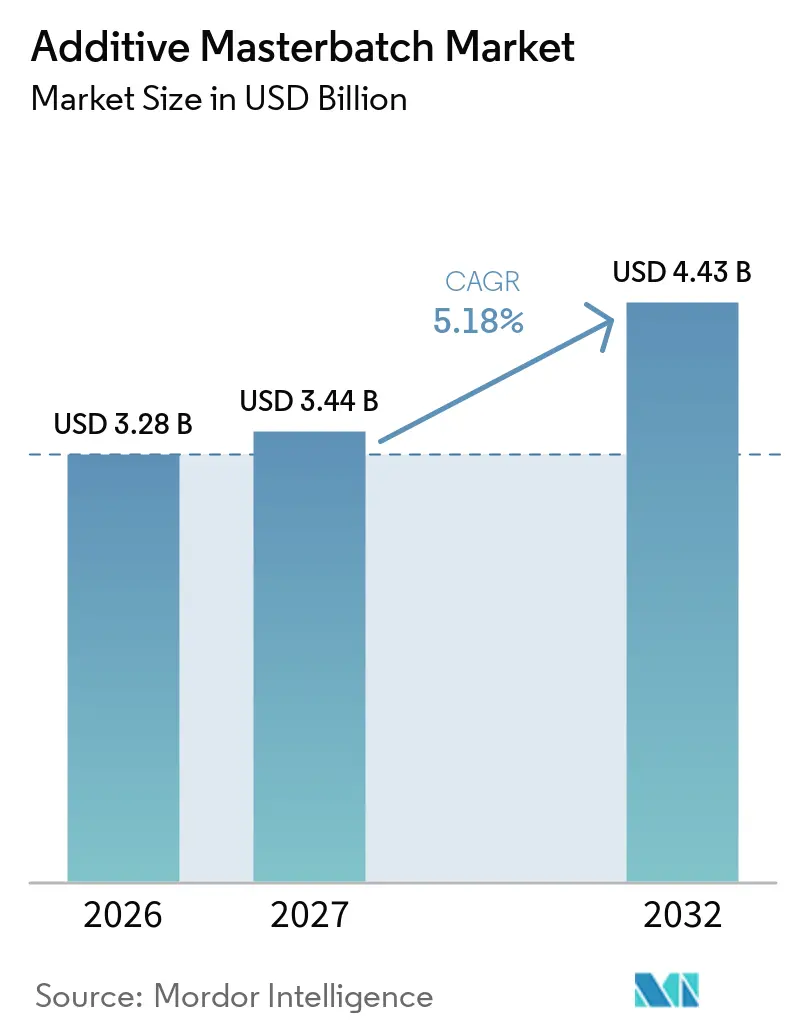
The Additive Masterbatch Market size was valued at USD 3.28 billion in 2026 and is estimated to grow from USD 3.44 billion in 2027 to reach USD 4.43 billion by 2032, at a CAGR of 5.18% during the forecast period (2027-2032). Packaging remains the central demand base because food, beverage, pharmaceutical, and consumer-product converters need polymers that protect products and run reliably on high-speed equipment. The additive masterbatch market is also benefiting from a broader shift toward materials that meet shelf-life, fire-safety, lightweighting, and hygiene requirements without adding complexity to conversion processes. Recycling policy is changing the commercial role of additives, as antioxidants, compatibilizers, and optical brighteners are increasingly used to help recycled polymers meet performance requirements. Suppliers that can combine material performance data, regulatory support, and customized formulations are likely to be better placed with large converters. Input-cost changes remain an important risk because the carrier resin and specialty chemical costs can move before contracts allow producers to recover higher prices.
Key Report Takeaways
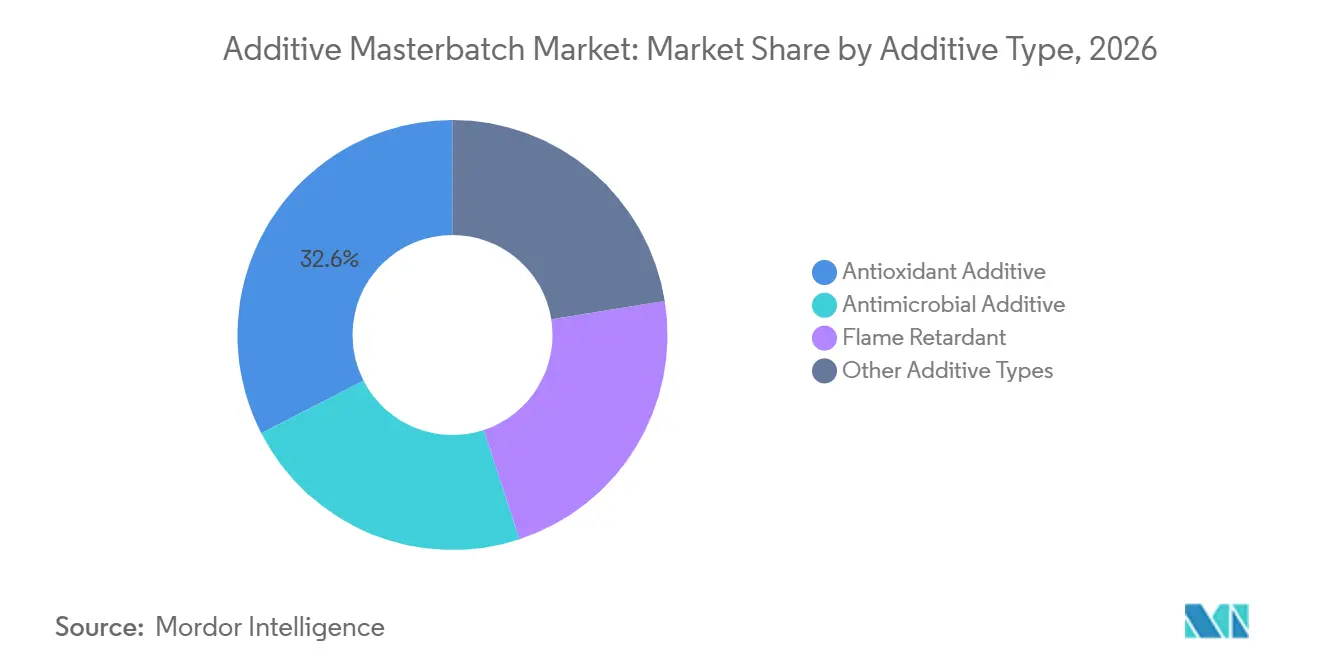
- By additive type, antioxidant additive held 32.56% of the additive masterbatch market share in 2026, while flame retardant is forecast to advance at a 5.67% CAGR through 2032.
- By carrier resin, polypropylene held 38.11% of the additive masterbatch market share in 2026, while polyethylene terephthalate is forecast to advance at a 5.73% CAGR through 2032.
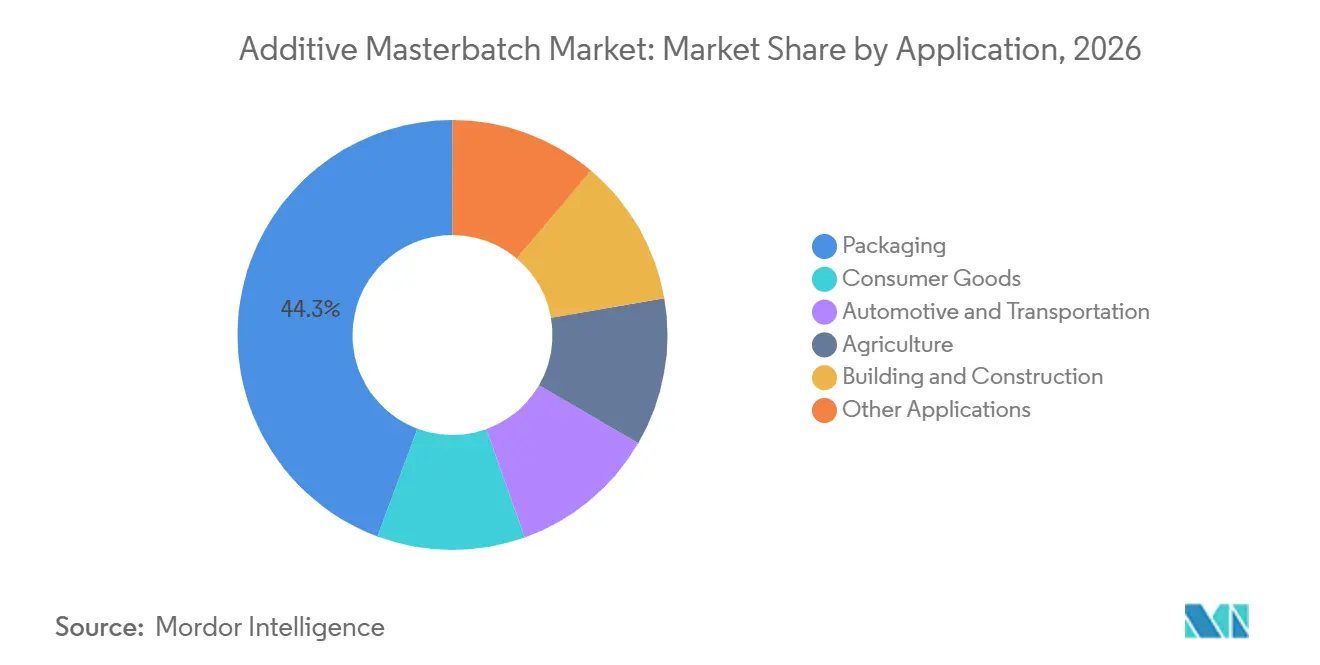
- By application, packaging held 44.32% of the additive masterbatch market share in 2026, while automotive and transportation are forecast to advance at a 6.06% CAGR through 2032.
- By geography, Asia-Pacific held 37.93% of the additive masterbatch market share in 2026 and is forecast to advance at a 5.82% CAGR through 2032.
Note: Market numbers in this report are based on Mordor Intelligence's proprietary estimation framework, which combines nine months of actuals with Q4 projections for base year 2026.
Market Trends and Insights
Drivers Impact Analysis of Additive Masterbatch Market*
| Driver | (~) % Impact on CAGR Forecast | Geographic Relevance | Impact Timeline |
|---|---|---|---|
| Packaging Performance and Shelf-Life Requirements | +1.4% | Global | Short term (≤ 2 years) |
| Recyclate Processing and Circularity Targets | +1.2% | Europe & North America, spillover to APAC | Medium term (2–4 years) |
| Lightweighting in Automotive and Transport Components | +0.9% | APAC core, Europe | Medium term (2–4 years) |
| Construction and Infrastructure Plastic Demand | +0.7% | APAC & MEA core, North America | Long term (≥ 4 years) |
| Hygiene, Medical, and Food-Contact Performance Requirements | +0.5% | Global | Medium term (2–4 years) |
| Source: Mordor Intelligence | |||
Packaging Performance and Shelf-Life Requirements
Food, pharmaceutical, and beverage packaging uses oxygen-scavenging and ultraviolet-stabilizing formulations to protect product quality and extend shelf life. In July 2025, Avient Corporation introduced ColorMatrix Amosorb Oxyloop-1, an oxygen-scavenging additive for polyethylene terephthalate packaging that received European Platform for Bottle Packaging recognition for bottle-to-bottle recyclability[1]. This product direction shows that shelf-life performance and recycling compatibility are becoming linked design requirements rather than separate choices. The European Union Packaging and Packaging Waste Regulation, published on January 22, 2025, established rules that support higher recycled content and recyclable packaging systems. Converters serving food, nutraceutical, and pharmaceutical customers increasingly need suppliers that can provide performance data and regulatory documentation alongside the masterbatch itself.
Recyclate Processing and Circularity Targets
Mechanical recycling is creating demand for masterbatches that restore or protect polymer performance during recyclate processing. Antioxidants stabilize recycled polyolefin melts during reprocessing and help address oxidative damage from prior use. A 2025 study in Materials found that antioxidant behavior changes through repeated polypropylene recycling cycles, which affects how suppliers set additive dose rates for recycled-content materials. In October 2025, LyondellBasell Industries Holdings B.V. expanded the Frankfurt Innovation Center with sorting, decontamination, and extrusion equipment for developing consistent recycled pellets under near-industrial conditions. Dover Chemical Corporation launched the DoverCycle platform in September 2025, built around polymeric phosphite antioxidants intended to reduce additive migration in high-post-industrial-recycled and post-consumer-recycled polyolefin streams. These developments make formulation quality, melt stability, and recyclate consistency more important factors in the additive masterbatch market.
Lightweighting in Automotive and Transport Components
Vehicle manufacturers are increasing their use of additive-modified polypropylene compounds as they seek lower vehicle mass and improved operating efficiency. Automotive masterbatches must provide heat stability, low volatile organic compound emissions, ultraviolet resistance, and compatibility with colorants in high-throughput injection molding. Cabot Corporation presented work in 2025 showing that specialty carbon black masterbatches can address interactions between carbon black and antioxidant packages in polypropylene automotive compounds. This can reduce the need for higher antioxidant loading in certain formulations. Addiplast Group’s 2025 catalog of Stellantis-approved compounds and masterbatches also showed demand for halogen-free polypropylene formulations with UL 94 V-0 ratings in vehicle components. Electric vehicles add demand for electronic housings and thermal-management enclosures, which increase the importance of flame-retardant and antistatic functionality in the additive masterbatch market.
Construction and Infrastructure Plastic Demand
Pipes, geomembranes, roofing membranes, cable conduits, and window profiles create sustained demand for ultraviolet stabilizer and flame-retardant masterbatches. These products often need higher additive loading than packaging materials and must meet long service-life and fire-performance requirements. India’s National Infrastructure Pipeline directs USD 1.4 trillion toward road, rail, and urban infrastructure through 2030, supporting demand for high-density polyethylene and polypropylene pipe systems. Tosaf Compounds Ltd. documented formulations for polyethylene, polypropylene, polystyrene, and acrylonitrile butadiene styrene that meet DIN 4102, EN 13501-1, and UL 94 fire-safety requirements in its 2025 building and construction catalog. The recast European Union Construction Products Regulation entered into force on January 7, 2025, and supports more consistent product information and environmental requirements for construction products. This regulatory direction is encouraging interest in additives with documented performance and lower-carbon material profiles.
Restraints Impact Analysis of Additive Masterbatch Market*
| Restraint | (~) % Impact on CAGR Forecast | Geographic Relevance | Impact Timeline |
|---|---|---|---|
| Raw Material Price Volatility and Margin Pass-Through Risk | -0.5% | Global | Short term (≤ 2 years) |
| Regulatory Restrictions on Selected Additive Chemistries | -0.4% | Europe & North America | Medium term (2–4 years) |
| Recycling Compatibility and End-of-Life Trade-Offs | -0.3% | Europe | Long term (≥ 4 years) |
| Source: Mordor Intelligence | |||
Raw Material Price Volatility and Margin Pass-Through Risk
The additive masterbatch industry purchases carrier resins and specialty chemicals that are both exposed to changes in crude-oil-linked feedstock costs and supply disruptions. Polypropylene, polyethylene, and polyethylene terephthalate carriers can change in cost at a different pace from specialty additive chemistries. LyondellBasell Industries Holdings B.V. stated in its May 2026 earnings communication that supply disruptions affected a substantial share of global virgin polypropylene capacity during the period. Such disruptions can raise propylene-related costs before masterbatch producers can amend customer prices. Customer contracts often run on longer pricing cycles, which can delay cost recovery even when input costs increase quickly. Smaller producers can face greater pressure because they have less financial capacity and less purchasing leverage than vertically integrated suppliers.
Regulatory Restrictions on Selected Additive Chemistries
Regulators are narrowing the range of additive chemistries permitted in applications, requiring masterbatch producers to reformulate and requalify products. The European Chemicals Agency added 1,1'-(ethane-1,2-diyl)bis[pentabromobenzene], commonly known as DBDPE, to the Candidate List in November 2025 because of its very persistent and very bioaccumulative properties[2]. DBDPE has been used as a brominated flame retardant in electronics, construction, and textile applications. The European Commission also asked the European Chemicals Agency to prepare an Annex XV restriction dossier on certain non-polymeric aromatic brominated flame retardants, with submission expected by December 2026. Larger suppliers are generally better able to manage testing, regulatory review, and customer requalification across jurisdictions. These requirements can raise entry barriers and favor companies with analytical laboratories and dedicated regulatory teams.
*Our forecasts treat driver/restraint impacts as directional, not additive. The impact forecasts reflect baseline growth, mix effects, and variable interactions.
Additive Masterbatch Market Segment Analysis
By Additive Type:
Antioxidant Additive Anchor Revenue as Flame Retardants Drive UpsideAntioxidant additive held 32.56% of the additive masterbatch market share in 2026 because it is used across polymer compounding, processing, and recycling. It protects polyolefins from thermal and oxidative degradation under the heat and shear conditions of conversion. Flame retardant is projected to advance at a 5.67% CAGR through 2032 as safety requirements strengthen in automotive electronics, battery housings, and building components. The additive masterbatch market size for flame-retardant systems is supported by applications that require UL 94 V-0 classifications. In September 2025, Avient Corporation introduced Cesa MAX Flame Retardant Additives, a non-halogenated polyethylene-compatible range designed for high masterbatch loading and fire-performance requirements.
The addition of DBDPE to the European Chemicals Agency Candidate List creates reformulation risk for products that rely on older aromatic brominated chemistries. This creates scope for phosphorus, inorganic, and nitrogen-based flame-retardant alternatives. Antimicrobial masterbatches are becoming more relevant in healthcare applications and high-touch plastic surfaces, while ISO 22196 remains a qualification reference for antimicrobial activity on plastics and other nonporous surfaces. Slip, antiblock, antistatic, ultraviolet-stabilizer, and nucleating grades meet separate needs across packaging film, agriculture, and consumer goods. The additive masterbatch industry serves a broad range of performance requirements rather than a single function.

By Carrier Resin:
Polypropylene Leads as Polyethylene Terephthalate Systems Capture Recycling-Led GrowthPolypropylene held 38.11% of the additive masterbatch market share in 2026 because it is used across injection molding, films, fibers, and pipe extrusion. It is a common carrier for antioxidant, flame-retardant, antistatic, and nucleating masterbatches used in several end-use sectors. Polyethylene terephthalate is projected to advance at a 5.73% CAGR through 2032 as suppliers develop additive packages that withstand high-temperature and high-shear processing. Growth is also supported by bottle-to-bottle recycling requirements. In October 2025, Sukano introduced an additive masterbatch package designed to allow monomaterial polyethylene terephthalate closures to enter the clear bottle recycling stream without affecting color, haze, or intrinsic viscosity.
Polyethylene carriers serve flexible-film and infrastructure-pipe applications where additive demand is consistent. Polystyrene carriers are used in consumer electronics and appliance compounding, while polyvinyl chloride carriers serve construction and cable applications. In these applications, compatibility with stabilizer and plasticizer packages remains an important technical consideration. Single-polymer packaging structures are increasing the need to match the carrier resin to the substrate polymer. The additive masterbatch industry is developing a premium formulation tier within polypropylene and polyethylene terephthalate systems as selection becomes more technically specific.
By Application:
Packaging Dominates While Automotive and Transportation Redefine Growth LeadershipPackaging held 44.32% of the additive masterbatch market share in 2026, reflecting its use of food-safety, oxygen-barrier, ultraviolet-barrier, processing-aid, and recycling-compatible formulations. A package may require more than one performance feature, creating layered demand for suppliers. Packaging demand is also supported by customer expectations for shelf life and appearance. Automotive and transportation are projected to advance at a 6.06% CAGR through 2032. Platform electrification, lightweighting, and tighter in-cabin volatile organic compound requirements are raising additive needs in vehicle components.
Building and construction benefit from infrastructure activity in Asia and the Middle East, particularly where pipes, conduits, and roofing membranes need flame-retardant and ultraviolet-stabilizer products. Consumer goods use combined aesthetic and performance masterbatches in household appliances and electronics. Agricultural applications use ultraviolet stabilizer and antioxidant masterbatches in greenhouse films, mulch films, and irrigation components. These applications are expanding in Southeast Asia and the Middle East as controlled-environment farming develops. Across applications, single-pellet combination masterbatches can deliver color, functional performance, and recyclability compliance while reducing converter handling complexity and component-interaction risks.
Geography Analysis
APAC Additive Masterbatch Market
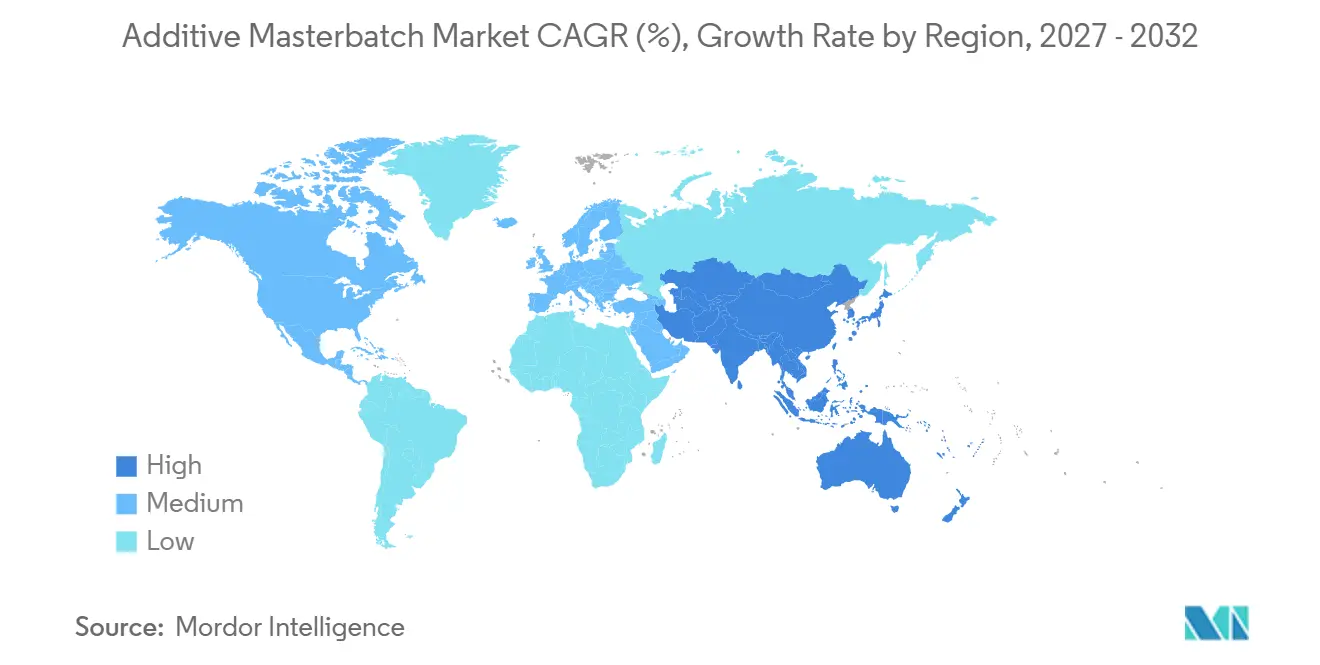
Asia-Pacific held 37.93% of the additive masterbatch market share in 2026 and is projected to advance at a 5.82% CAGR through 2032. The region combines packaging, automotive, and infrastructure demand across several polymer-processing industries. China benefits from integrated petrochemical and polymer-processing complexes that place resin production, additive manufacturing, and masterbatch compounding in the same industrial areas, reducing delivered costs and shortening qualification cycles. India has demand from flexible food packaging, automotive-component manufacturing, and infrastructure pipe production, while its production-linked incentive program for advanced chemical manufacturing is supporting domestic capacity additions. In August 2025, CLARIANT completed commissioning of a second Nylostab S-EED production line at its Cangzhou, China, joint-venture facility with Beijing Tiangang Auxiliary Co., Ltd.
Europe, North America and APAC Additive Masterbatch Market
Japan and South Korea sustain demand for halogen-free flame retardants and high-purity antistatic grades in electronics and semiconductor packaging. Indonesia, Vietnam, and Thailand are expanding as food processing and automotive assembly move from higher-cost production locations. North American demand is coming from packaging, automotive applications, and state-level recycled-content requirements. Europe is managing Packaging and Packaging Waste Regulation, Registration, Evaluation, Authorisation and Restriction of Chemicals (REACH), and construction-product requirements at the same time.
South America and MEA Additive Masterbatch Market
South America has demand from flexible packaging, agricultural film, and consumer goods, with Brazil and Argentina as key markets, and Brazil’s food-processing activity supporting antimicrobial and antioxidant masterbatches. The Middle East and Africa region is seeing construction-related demand from Saudi Arabia’s large project pipeline and South Africa’s infrastructure rehabilitation work. These uses include pipes, cables, and architectural polymer components that require ultraviolet stabilizers or flame retardants. In both regions, compounding infrastructure is limited, and supply chains depend more heavily on imported chemistries, though they provide longer-term opportunities as polymer-processing capacity develops.
Competitive Landscape
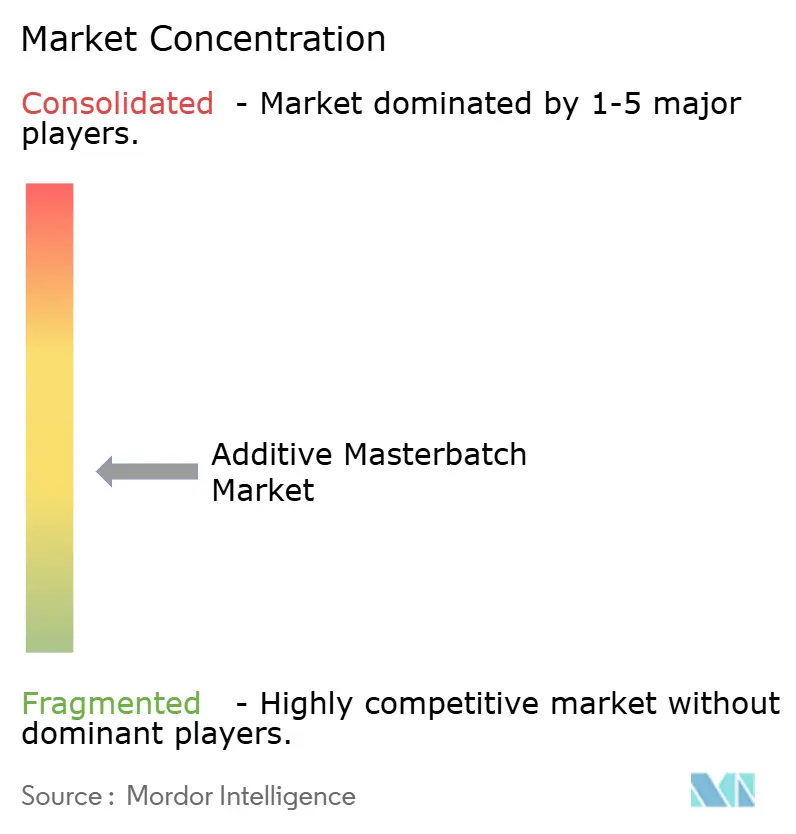
The additive masterbatch market is moderately concentrated, with the top five players including Avient Corporation, Ampacet Corporation, LyondellBasell Industries Holdings B.V., Tosaf Compounds Ltd., and PLASTIKA KRITIS S.A. Companies compete through formulation intellectual property, application-specific technical service, regulatory support, and supply reliability. Regional and niche suppliers can compete through faster development cycles and closer relationships with smaller accounts.
The strongest competitive activity is centered on formulations that restore performance in recycled polymers while meeting food-contact requirements. Near-infrared-detectable masterbatches, bio-based carrier resins, and single-pellet combination products are important technology routes. Cabot Corporation’s REPLASBLAK portfolio uses reclaimed carbon black and recycled polymer carriers under International Sustainability and Carbon Certification PLUS mass-balance certification, demonstrating how certification can support traceability requirements.
Strategic investment is focused on recycling capability, regional capacity, and non-halogenated products. LyondellBasell Industries Holdings B.V. strengthened recycled-material development at its Frankfurt Innovation Center in October 2025. CLARIANT expanded production of stabilizer technology in China in August 2025 to serve Asian demand for high-performance plastics additives. Tosaf Compounds Ltd. established a new production facility in Poland in April 2026, extending local support for Eastern European customers. These moves show that companies are pairing formulation development with local production and application support.
Additive Masterbatch Industry Leaders
-
Avient Corporation
-
Ampacet Corporation
-
LyondellBasell Industries Holdings B.V.
-
Tosaf Compounds Ltd.
-
PLASTIKA KRITIS S.A.
- *Disclaimer: Major Players sorted in no particular order
Additive Masterbatch Market Companies Covered in this Report
- Americhem
- Ampacet Corporation
- Avient Corporation
- Cabot Corporation
- CLARIANT
- FRILVAM S.P.A.
- Gabriel-Chemie GmbH
- Hubron International
- LyondellBasell Industries Holdings B.V.
- Penn Color Inc.
- Plastiblends
- PLASTIKA KRITIS S.A.
- RTP Company
- Sukano
- Tosaf Compounds Ltd.
Recent Industry Developments in Additive Masterbatch Market
- September 2026: Sukano partnered with Poddar Pigments Limited to expand the distribution of single-pigment dispersion black, white, and color masterbatches across the United States, Canada, and Latin America. The partnership supports the additive masterbatch market by broadening access to specialized masterbatch solutions for polyester, nylon, and other synthetic fiber applications.
- August 2026: ROWA Masterbatch introduced a near-infrared (NIR)-reflective black masterbatch designed to combine deep-black aesthetics with thermal functionality. The product supports the additive masterbatch market by expanding functional masterbatch solutions that help reduce heat absorption in plastic products while maintaining their desired appearance.
Global Additive Masterbatch Market Report Scope
Additive masterbatch is a concentrated mixture of functional additives dispersed in a carrier resin, which is incorporated into plastics during processing to impart specific performance characteristics. It helps improve properties such as oxidation resistance, antimicrobial protection, and flame resistance while supporting consistent additive distribution in finished plastic products.
The Additive Masterbatch Market is segmented by additive type, carrier resin, application, and geography. By additive type, the market is segmented into antioxidant additive, antimicrobial additive, flame retardant, and other additive types. By carrier resin, the market is segmented into polypropylene, polyethylene, polystyrene, polyvinyl chloride, polyethylene terephthalate, and other carrier resins. By application, the market is segmented into packaging, building and construction, consumer goods, automotive and transportation, agriculture, and other applications. The report also covers the market size and forecasts for additive masterbatch across 15 countries. For each segment, the market sizing and forecasts have been done on the basis of value (USD).
Segmentation Overview
| Antioxidant Additive |
| Antimicrobial Additive |
| Flame Retardant |
| Other Additive Types |
| Polypropylene |
| Polyethylene |
| Polystyrene |
| Polyvinyl Chloride |
| Polyethylene Terephthalate |
| Other Carrier Resins |
| Packaging |
| Building and Construction |
| Consumer Goods |
| Automotive and Transportation |
| Agriculture |
| Other Applications |
| Asia-Pacific | China |
| India | |
| Japan | |
| South Korea | |
| ASEAN Countries | |
| Rest of Asia-Pacific | |
| North America | United States |
| Canada | |
| Mexico | |
| Europe | Germany |
| United Kingdom | |
| France | |
| Italy | |
| NORDIC Countries | |
| Rest of Europe | |
| South America | Brazil |
| Argentina | |
| Rest of South America | |
| Middle East and Africa | Saudi Arabia |
| South Africa | |
| Rest of Middle East and Africa |
| By Additive Type | Antioxidant Additive | |
| Antimicrobial Additive | ||
| Flame Retardant | ||
| Other Additive Types | ||
| By Carrier Resin | Polypropylene | |
| Polyethylene | ||
| Polystyrene | ||
| Polyvinyl Chloride | ||
| Polyethylene Terephthalate | ||
| Other Carrier Resins | ||
| By Application | Packaging | |
| Building and Construction | ||
| Consumer Goods | ||
| Automotive and Transportation | ||
| Agriculture | ||
| Other Applications | ||
| By Geography | Asia-Pacific | China |
| India | ||
| Japan | ||
| South Korea | ||
| ASEAN Countries | ||
| Rest of Asia-Pacific | ||
| North America | United States | |
| Canada | ||
| Mexico | ||
| Europe | Germany | |
| United Kingdom | ||
| France | ||
| Italy | ||
| NORDIC Countries | ||
| Rest of Europe | ||
| South America | Brazil | |
| Argentina | ||
| Rest of South America | ||
| Middle East and Africa | Saudi Arabia | |
| South Africa | ||
| Rest of Middle East and Africa | ||
Key Questions Answered in the Report
What is the size of the additive masterbatch market?
The additive masterbatch market size was valued at USD 3.28 billion in 2026 and is estimated to grow from USD 3.44 billion in 2027 to reach USD 4.43 billion by 2032, at a CAGR of 5.18% during the forecast period (2027-2032).
What is driving demand for additive masterbatches?
Packaging performance, recycled-polymer processing, vehicle lightweighting, infrastructure demand, and hygiene and food-contact requirements are supporting the additive masterbatch market.
Which additive type held the largest share in 2026?
Antioxidant additive held 32.56% share in 2026 because they are used in polymer processing, compounding, and recycling.
Which application is projected to advance fastest through 2032?
Automotive and transportation are projected to advance at a 6.06% CAGR through 2032 within the additive masterbatch market.