
Additive Manufacturing In-Situ Imaging Market Size and Share
Market Overview
| Study Period | 2020 - 2031 |
|---|---|
| Market Size (2026) | USD 0.65 Billion |
| Market Size (2031) | USD 1.65 Billion |
| Fastest Growing Market | Asia-Pacific |
| Largest Market | North America |
| Market Concentration | Medium |
Major Players *Disclaimer: Major Players sorted in no particular order Image © Mordor Intelligence. Reuse requires attribution under CC BY 4.0. | |
Additive Manufacturing In-Situ Imaging Market Analysis by Mordor Intelligence
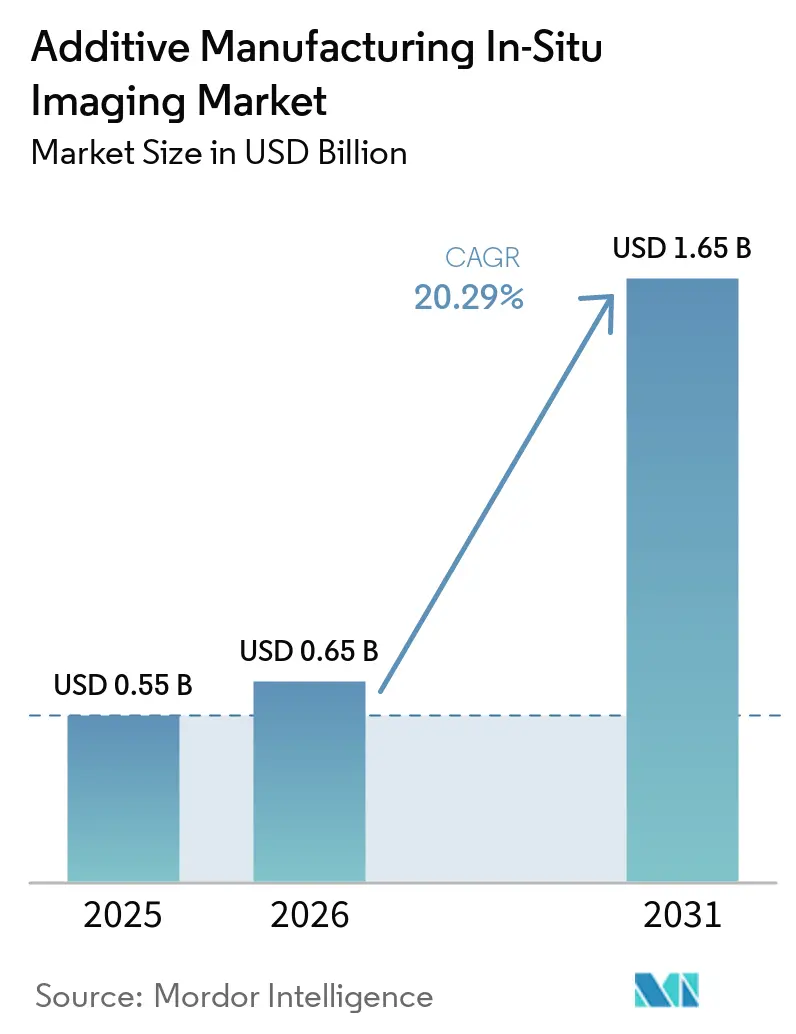
The Additive Manufacturing In-Situ Imaging Market size is expected to increase from USD 0.55 billion in 2025 to USD 0.65 billion in 2026 and reach USD 1.65 billion by 2031, growing at a CAGR of 20.29% over 2026-2031.
Demand is shifting toward systems that identify defects during each build layer instead of relying only on inspection after production. This shift is most important for parts used in aerospace, defense, medical devices, and space programs, where internal flaws can be difficult and expensive to identify later. Public qualification programs are also moving monitoring tools from research settings into production environments. Those programs increase demand among large manufacturers and extend monitoring requirements to suppliers that support certified production. The additive manufacturing in-situ imaging market is therefore moving toward software-led quality systems, cross-platform retrofit options, and records that can support qualification reviews.
Key Report Takeaways
- By imaging technology, thermal and infrared imaging held 37.51% share of the additive manufacturing in-situ imaging market revenue in 2025, while X-ray and other advanced imaging is projected to expand at a 24.21% CAGR through 2031.
- By additive manufacturing process, powder bed fusion held 60.33% of revenue in 2025, while directed energy deposition is projected to expand at a 23.26% CAGR through 2031.
- By offering, imaging and sensor hardware held 42.31% share of the additive manufacturing in-situ imaging market size in 2025, while monitoring software and analytics is projected to expand at a 23.91% CAGR through 2031.
- By end-user, aerospace and defense held 43.38% of demand in 2025, while medical devices and implants is projected to expand at a 24.50% CAGR through 2031.
- By geography, North America held 38.43% share of the additive manufacturing in-situ imaging market size in 2025, while Asia-Pacific is projected to expand at a 24.41% CAGR through 2031.
Note: Market size and forecast figures in this report are generated using Mordor Intelligence’s proprietary estimation framework, updated with the latest available data and insights as of January 2026.
Global Additive Manufacturing In-Situ Imaging Market Trends and Insights
Drivers Impact Analysis*
| Driver | (~) % Impact on CAGR Forecast | Geographic Relevance | Impact Timeline |
|---|---|---|---|
| Increasing Qualification Requirements for Safety-Critical Additive Manufacturing | +5.2% | Global, with peak activity in North America and Europe | Medium term (2-4 years) |
| Shift From Post-Process Detection to Real-Time Defect Prevention | +3.8% | Global, strongest in North America and Europe | Short term (≤ 2 years) |
| Expansion of Serial Production in Metal Additive Manufacturing | +3.2% | Global, with Asia-Pacific driving incremental volume | Medium term (2-4 years) |
| Integration of Artificial Intelligence With Layer-Wise Imaging Data | +2.8% | Global | Medium term (2-4 years) |
| Cross-Platform Retrofit Demand From Mixed Additive Manufacturing Fleets | +1.6% | North America and Europe, with spillover to Asia-Pacific | Short term (≤ 2 years) |
| Rising Demand for Closed-Loop Process Control and Digital Quality Records | +1.9% | Global, with North America and Europe as early adopters | Long term (≥ 4 years) |
| Source: Mordor Intelligence | |||
Increasing Qualification Requirements for Safety-Critical Additive Manufacturing
Qualification rules for safety-critical additive manufacturing parts are advancing faster than monitoring infrastructure. That mismatch is creating demand for systems that validate machine sensors and document production conditions. The National Institute for Aviation Research and the Air Force Research Laboratory published 2025 operational guidance for laser powder bed fusion qualification. The guidance supplements SAE AMS 7003 and AMS 7032 with machine-level sensor validation and process-monitoring documentation requirements. The U.S. Office of the Secretary of Defense directed USD 13.2 million through America Makes for the INSITE program. The program is intended to develop unified, certification-ready in-situ monitoring for defense-critical parts. Suppliers serving Lockheed Martin, GE Aerospace, and Boeing may need monitoring capabilities to preserve access to qualified supply chains. This expands purchasing beyond major original equipment manufacturers and supports adoption across smaller qualified suppliers.
Shift From Post-Process Detection to Real-Time Defect Prevention
Real-time prevention has a strong economic case for titanium, Inconel, and nickel-based superalloy parts. Rejection after post-build inspection can destroy the value created during a long and material-intensive build. ASTRO America received a USD 1.66 million award for the QTIME project in October 2025. The project is developing layer-by-layer inspection for laser powder bed fusion lattice structures.[1]ASTRO America, “ASTRO America Selected to Lead USD 1.6 Million Defense Manufacturing Project,” ASTRO America, astroa.org. It aims to reduce the inspection time from many hours of computed tomography scanning to less than 1 hour. It also aims to reduce inspection costs by as much as 90%. Phase3D's Fringe Qualification platform supports comparison of traceable build data across machines, materials, and facilities. This can reduce repeated qualification work for each machine and part combination. NASA work shows why manufacturers seek shorter qualification cycles for metal additive manufacturing parts.
Expansion of Serial Production in Metal Additive Manufacturing
Serial metal additive manufacturing is moving from pilot projects toward higher-volume production. Production settings require monitoring systems that can support throughput, repeatability, and large volumes of image data. China reported additive manufacturing output rising from CNY 20.8 billion (USD 2.88 billion) to CNY 70 billion (USD 9.7 billion) during the 14th Five-Year Plan period. The 15th Five-Year Plan includes a domestic target of CNY 147.9 billion (USD 20.5 billion) to CNY 150 billion (USD 20.8 billion) by 2030. The Civil Aviation Administration of China certified 23 additively manufactured titanium alloy structural components for the C919 aircraft in January 2026. This raises the requirement for reliable, machine-readable production records in commercial aerospace. Larger monthly build volumes also increase the need for edge computing and analytics that separate meaningful anomalies from normal process variation.
Integration of Artificial Intelligence With Layer-Wise Imaging Data
Artificial intelligence is moving from remote analysis toward deployment near the build machine. Edge devices can process layer-wise imaging data without routing each raw data feed through remote systems. A 2026 study described closed-loop control using infrared thermography, convolutional neural networks, and physics-informed models. The system adjusted the laser power and scan speed at 50 Hz on an NVIDIA Jetson AGX Orin platform. The study reported 99.79% relative density for Ti-6Al-4V laser powder bed fusion, verified by computed tomography. Early monitoring providers can build an advantage through larger and more diverse labeled anomaly datasets. Aalto University research reported defect-classification accuracy above 99% for leading convolutional neural network models. This shifts competition toward model quality, training data, and the traceability of dataset sources.
Restraints Impact Analysis*
| Restraint | (~) % Impact on CAGR Forecast | Geographic Relevance | Impact Timeline |
|---|---|---|---|
| High Cost of Integrated Imaging and Edge-Computing Infrastructure | -2.0% | Global, particularly acute in small and medium-sized enterprise-dominated markets in Asia-Pacific and South America | Medium term (2-4 years) |
| Limited Standardization of Image-to-Defect Correlation Across Machines | -1.5% | Global | Long term (≥ 4 years) |
| Proprietary Data Silos Restricting Cross-Machine Model Training | -1.2% | North America and Europe, where mixed-fleet operation is most prevalent | Long term (≥ 4 years) |
| High Data Volumes and Incomplete Certification Acceptance of In-Situ Evidence | -0.9% | Global, with compliance influence concentrated in North America, the European Union, and Japan | Long term (≥ 4 years) |
| Source: Mordor Intelligence | |||
High Cost of Integrated Imaging and Edge-Computing Infrastructure
Production-grade deployment requires high-resolution cameras, thermal sensors, photodiode arrays, edge-computing equipment, and data-correlation software. This total system cost can restrict adoption among smaller contract manufacturers and research institutions. Unlike post-build computed tomography, in-situ monitoring is installed in the production environment. It cannot usually be shared among facilities through an outside inspection provider. Integration and calibration also differ across machine platforms, which limits economies of scale. ASTM International Committee F42 continues work on standards that could define common sensor interfaces and calibration protocols.[2]ASTM International, “Committee F42 on Additive Manufacturing Technologies,” ASTM International, astm.org. Applicable standards remained in development during 2026. Until common integration practices become available, large original equipment manufacturer-linked deployments retain a cost advantage.
Limited Standardization of Image-to-Defect Correlation Across Machines
Raw imaging signals do not yet translate consistently into defect classifications across machines and materials. A thermal signal associated with lack-of-fusion porosity on 1 platform may have a different cause on another platform. Differences in laser settings, powder properties, and chamber geometry make models difficult to transfer. The National Academies identified the need for standardized and accessible models and common data repositories. End users can therefore face an investment risk when a proprietary model cannot move to an upgraded machine. ISO and ASTM work offers a partial framework, but it does not yet solve cross-machine data portability. This condition may limit willingness to pay among buyers who manage varied additive manufacturing fleets.
*Our forecasts treat driver/restraint impacts as directional, not additive. The impact forecasts reflect baseline growth, mix effects, and variable interactions.
Segment Analysis
By Imaging Technology: Thermal Methods Anchor the Market as X-Ray Imaging Scales
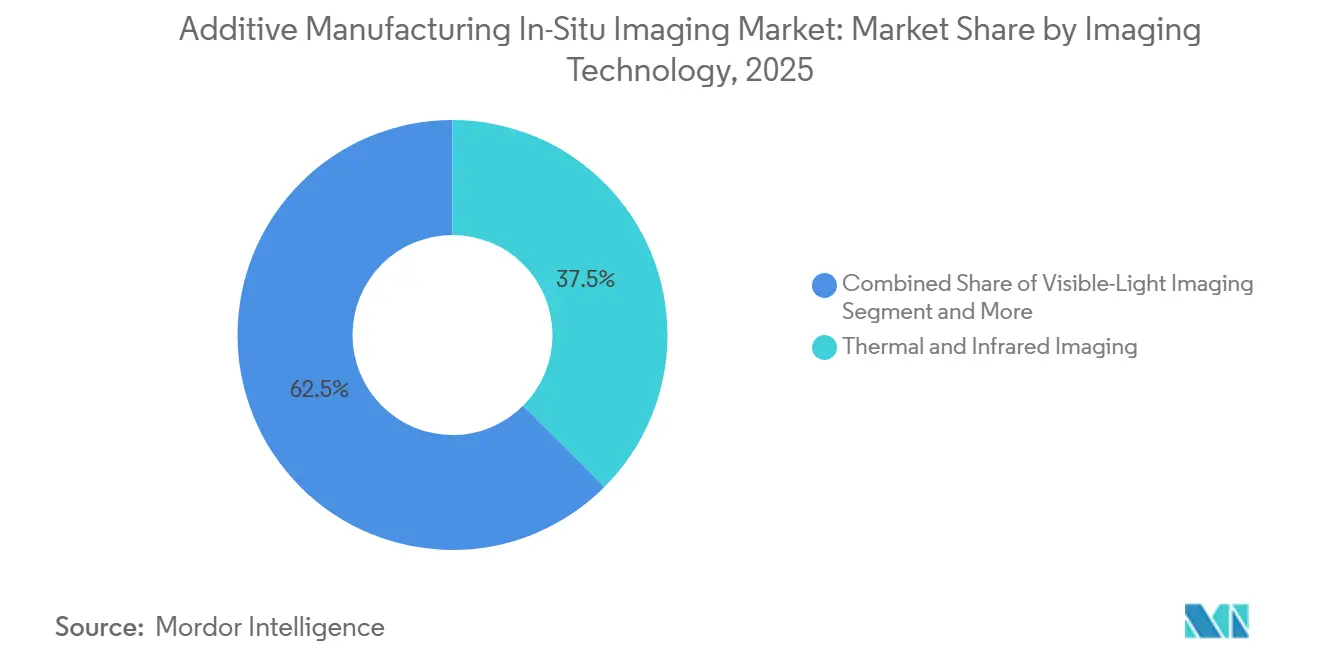
Thermal and infrared imaging held 37.51% of imaging technology revenue in 2025. This technology formed the largest part of the additive manufacturing in-situ imaging market share because it has long supported melt-pool monitoring. It is used most often in laser powder bed fusion and directed energy deposition systems. Infrared cameras can fit within existing build chambers with limited changes to optical access. Their output is also closely tied to the heat behavior of laser-material interaction. Operators can use that thermal information as a familiar process-control reference. Visible-light imaging represented the second-largest technology group. It captures powder-bed surface conditions layer by layer. Manufacturers increasingly combine visible and thermal sensors in multimodal systems. This combination can improve the location of suspected defects.
The U.S. Department of Energy Manufacturing Demonstration Facility evaluated a visible and near-infrared camera configuration on an EOS M290 system. The evaluation connected in-situ signatures with porosity detected by computed tomography.[3]U.S. Department of Energy Office of Scientific and Technical Information, “In-Situ Process Monitoring Evaluation and Demonstration Using Advanced Characterization With Laser Powder Bed Systems,” U.S. Department of Energy, osti.gov. Optical tomography and coherence imaging remain smaller commercial areas. They are relevant when users need to assess subsurface layer quality without relying only on post-build computed tomography. A 2026 study demonstrated optical coherence tomography integrated with fused deposition modeling print heads. The work enabled volumetric layer scanning during production. X-ray and other advanced imaging is forecast to expand at a 24.21% CAGR through 2031. The additive manufacturing in-situ imaging market size for this technology is supported by interest in production-relevant validation. Research described deep-learning reconstruction that produced volumetric images from 10 times fewer X-ray projections. This work supports the possibility of near-real-time computed tomography assessment during laser powder bed fusion builds.



By Additive Manufacturing Process: Powder Bed Fusion Commands the Market as Directed Energy Deposition Finds Its Production Footing
Powder bed fusion held 60.33% of process revenue in 2025. It led the additive manufacturing in-situ imaging market share because its enclosed chamber supports fixed imaging positions across the build plate. This design can reduce training complexity for monitoring algorithms. The laser powder bed fusion installed base is also the largest within metal additive manufacturing. That installed base makes the process a practical starting point for monitoring deployments. The 2025 ASTRO America and ASTM challenge focused on commercially viable monitoring for GE Concept M2 Series 5 laser powder bed fusion systems. Lockheed Martin and GE Aerospace procurement teams participated in an end-user evaluation. Binder jetting, material extrusion, and vat photopolymerization remain smaller monitoring applications. Vat photopolymerization has relevance for biomedical resin printing, where layer validation supports patient-matched devices.
Directed energy deposition is forecast to expand at a 23.26% CAGR through 2031. Its adoption for repair, multi-material deposition, and large aerospace structures creates a need for more capable monitoring. The moving deposition head changes the imaging reference frame during production. This makes fixed-camera monitoring more difficult than it is for powder bed fusion. A 2025 study described co-axial optical monitoring synchronized with wire directed energy deposition tool-center-point paths. It combined this approach with process-specific deep learning models at production-relevant speeds. A 2026 study tested monitoring and control for wire-fed directed energy deposition using infrared thermography and computer vision. The approach predicted and corrected heat accumulation during production. This addresses the microstructural variation that has limited wider use of the process for structural parts.
By Offering: Hardware Anchors Revenue as Analytics Software Gains Strategic Momentum
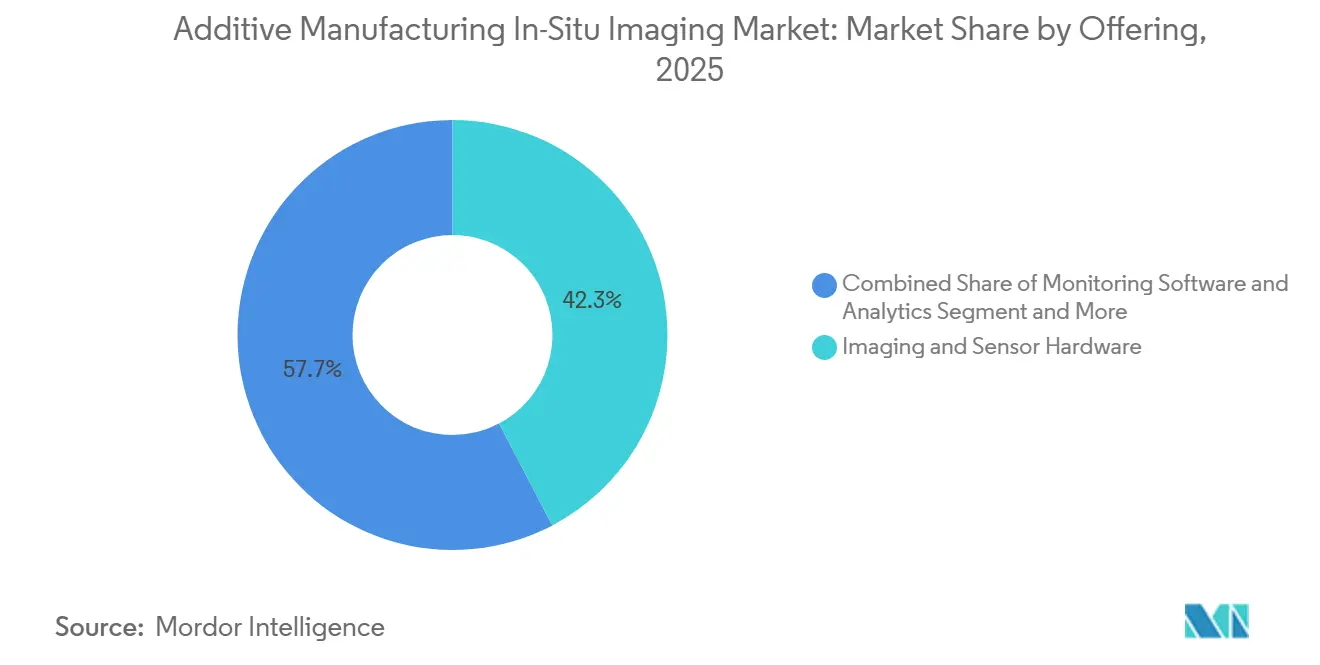
Imaging and sensor hardware held 42.31% of offering revenue in 2025. The segment reflects the capital cost of cameras, photodiode arrays, and thermal sensors installed on new or retrofit machines. Physical integration remains a central adoption issue for many buyers. Hardware therefore remains important even as software capabilities improve. Data-acquisition and edge-computing equipment form a separate offering area. These systems process large volumes of layer-wise image data at the machine. This reduces dependence on plant networks for transmission of raw data. It can also support data-security requirements in defense production. The additive manufacturing in-situ imaging industry remains shaped by the link between installed hardware and later analytical use.
Monitoring software and analytics is forecast to expand at a 23.91% CAGR through 2031. Buyers increasingly seek fleet-level quality intelligence rather than isolated sensor outputs. Enterprise platforms can compare signatures across machines, materials, facilities, and production runs. This creates switching costs that stand-alone hardware suppliers may find difficult to match. Phase3D's Fringe Qualification platform supports centralized use of traceable build data. Interspectral AB expanded its AM Explorer suite with MONITOR, DETECT, and QUALIFY modules in late 2025. The additive manufacturing in-situ imaging market is also supported by services for integration, calibration, validation, and technical support. These services help customers connect installed hardware with certification-ready operations. Many facilities do not maintain the specialized process-engineering capabilities needed for that transition.
By End-User: Aerospace and Defense Anchors Demand While Medical Devices Drive Fastest Growth
Aerospace and defense held 43.38% of end-user demand in 2025. The sector accounted for the largest use because parts are of high value, and qualification requirements are demanding. Government-funded research also supports the deployment of monitoring tools in this segment. Programs including QTIME, INSITE, Delta Qual 2.0, and DARPA SURGE support the adoption of in-situ quality evidence. Lockheed Martin, L3Harris Technologies, and Honeywell Aerospace support transition and commercialization activities in these programs. Supplier qualification requirements can reinforce demand beyond single research projects. This supports the use of documented monitoring information in aerospace production chains. The additive manufacturing in-situ imaging industry is closely tied to the sector's need for traceable manufacturing records.
Medical devices and implants are forecast to expand at a 24.50% CAGR through 2031. Patient-matched implants require traceability for individual parts rather than only batch-level statistics. This makes layer-wise quality data operationally useful for each production run. Medical manufacturers, therefore, have a distinct adoption rationale from aerospace users. Energy and power generation remain a smaller end-user area. Oil and gas operators and power producers use metal additive manufacturing for maintenance and replacement of critical components. Industrial machinery also represents a developing source of demand. Automotive and transportation users remain smaller but relevant adopters. Their interest rises when monitoring can support repeatable production at scale. The additive manufacturing in-situ imaging market has room to expand as process-specific requirements develop across these end-user groups.
Geography Analysis
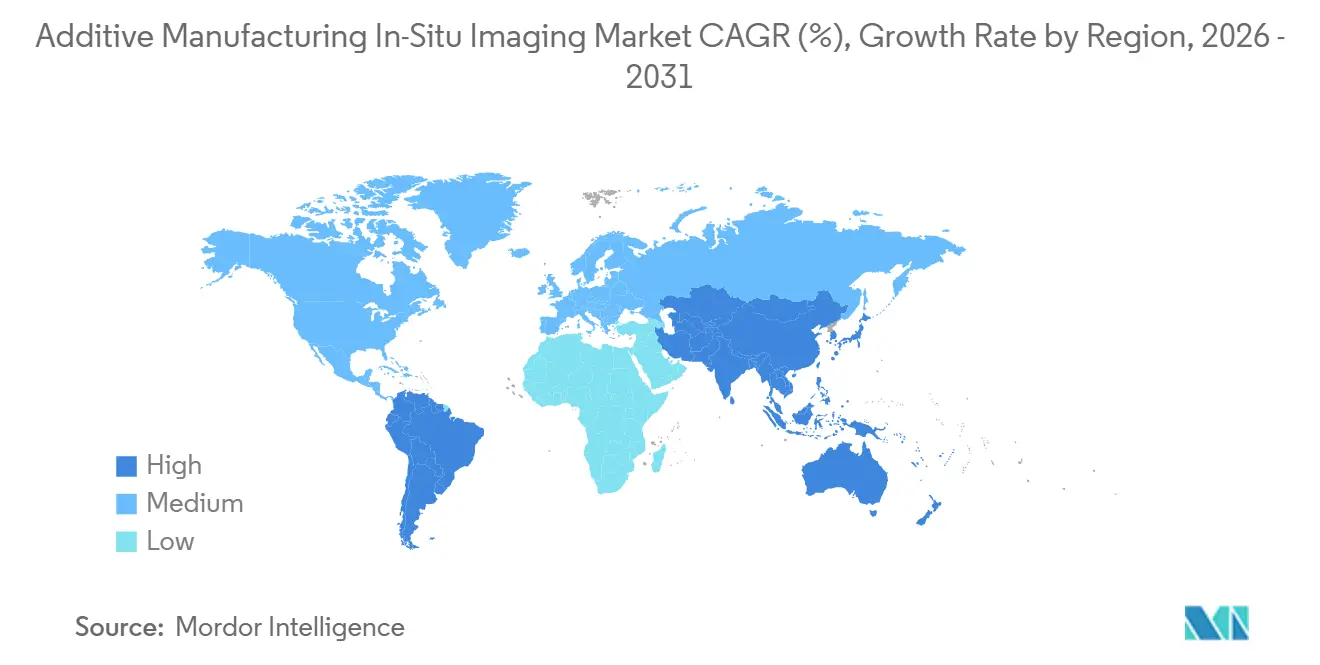
North America held 38.43% of global revenue in 2025. The region led the additive manufacturing in-situ imaging market share through its concentration of aerospace and defense manufacturers. America Makes, NASA, AFRL, OSD ManTech, and the Department of Energy Manufacturing Demonstration Facility provide institutional support. The USD 13.2 million INSITE program and the USD 1.66 million QTIME award are directed toward commercially deployable monitoring tools. Canada adds demand through aerospace component supply chains. Mexico's manufacturing corridor can extend monitoring requirements to suppliers that receive near-shoring investment. The United States remains the most important country for global market formation as a buyer and funder of commercialization programs.
Asia-Pacific is forecast to expand at a 24.41% CAGR through 2031. China is the principal regional driver because of its state-supported additive manufacturing plans and aerospace production activity. The input reported China's additive manufacturing output rising to CNY 70 billion (USD 9.7 billion) during the 14th Five-Year Plan period. It reported a 2030 target of CNY 147.9 billion (USD 20.5 billion) to CNY 150 billion (USD 20.8 billion). The January 2026 certification of 23 titanium alloy structural components for the C919 aircraft supports demand for machine-readable quality records. Japan is deepening metal additive manufacturing use in automotive and precision-machinery supply chains. South Korea adds demand through additive manufacturing for tooling and functional components in its semiconductor and consumer electronics ecosystem.
Europe retains a meaningful position in the additive manufacturing in-situ imaging market through German machinery and aerospace production. The United Kingdom has defense and medical device manufacturing capabilities. France and Italy contribute through Airbus supply chains. Renishaw expanded its InfiniAM monitoring offering through InfiniAM Spectral and InfiniAM Camera modules for RenAM 500 machines.[4]Renishaw plc, “InfiniAM Suite Additive Manufacturing Process Monitoring Software,” Renishaw, renishaw.com. Its integrations with Addiguru and Apex Additive Technologies reflect production-oriented monitoring deployment. Regional digital-manufacturing policies support closed-loop quality systems and machine-readable build records. Saudi Arabia and the United Arab Emirates represent early demand centers in the Middle East. South America and Africa remain early-stage markets, with activity concentrated in research institutions and Brazil's aerospace cluster.

Competitive Landscape
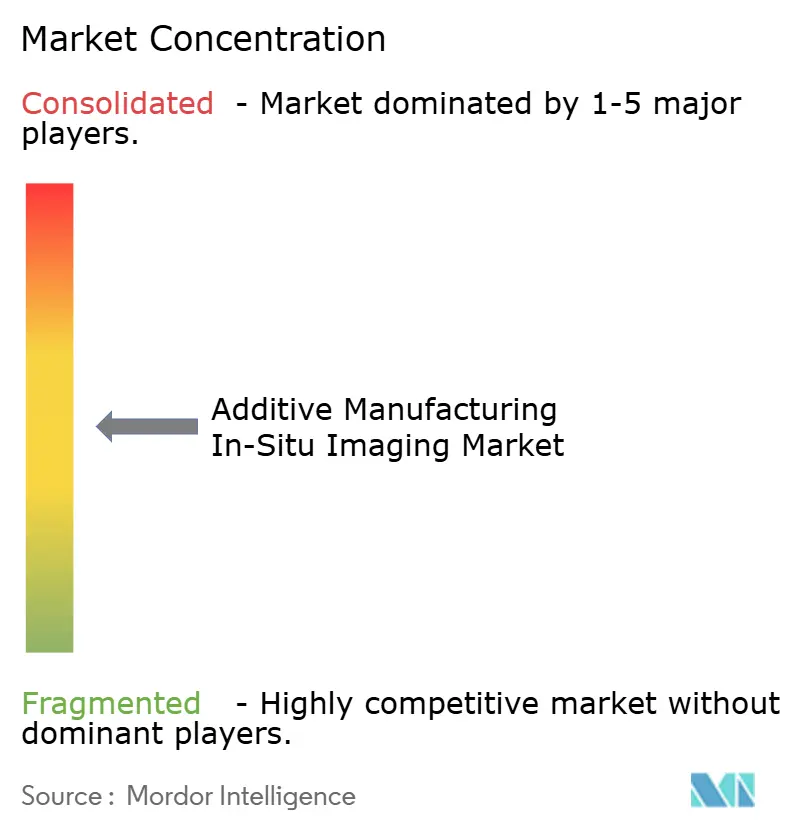
The additive manufacturing in-situ imaging market is moderately fragmented. Original equipment manufacturers form 1 competitive group, while machine-agnostic monitoring providers form another. EOS GmbH, Renishaw, TRUMPF SE + Co. KG, Nikon SLM Solutions, and Velo3D integrate monitoring hardware into their machine designs. Their systems include thermal cameras, photodiode arrays, and optical coherence sensors. These integrated designs create relationships with established machine users. They can also limit access for third-party sensor providers without original equipment manufacturer cooperation. Velo3D's Assure system uses live multi-sensor and physics-based detection methods during the build. It produces reports intended to support certification documentation. This combines hardware and software value within the sale of a single machine platform.
Machine-agnostic providers compete through compatibility across equipment fleets. Addiguru's platform combines optical, near-infrared, and long-wave infrared sensing. It has been validated on EOS M290 and X LINE systems, Renishaw RenAM 500Q systems, and Xact Metal machines. This gives mixed-fleet users an option that proprietary solutions cannot fully replicate. Interspectral demonstrated AM Explorer across AddUp, Freemelt, EOS, Nikon SLM Solutions, Renishaw, TRUMPF, and Velo3D platforms at Formnext 2025. The demonstration showed that cross-platform software validation is becoming a basic commercial expectation. Renishaw also expanded its InfiniAM suite with monitoring modules for its RenAM 500 series. These moves show that providers are combining machine data, sensor integration, and analytical tools.
Existing laser powder bed fusion fleets without native monitoring remain a potential retrofit opportunity. Non-metal processes including binder jetting, material extrusion, and vat photopolymerization have received less monitoring investment. Providers can address these areas with process-specific algorithms and calibration routines. Phase3D received U.S. Air Force support to extend Fringe Inspection from metal additive manufacturing to ceramic matrix composites. The work covers calibration, defect classification, and validation across ceramic matrix composite production steps. Fleet-scale analytics may become more important as buyers move from per-machine licensing to enterprise monitoring agreements. A DARPA SURGE-related patent cluster around artificial intelligence defect classification may raise barriers for later software entrants.
Additive Manufacturing In-Situ Imaging Industry Leaders
EOS GmbH
Renishaw plc
Additive Industries B.V.
3D Systems Corporation
Velo3D, Inc.
- *Disclaimer: Major Players sorted in no particular order

Recent Industry Developments
- August 2026: Phase3D and Phillips Federal partnered to expand in-situ inspection capabilities for defense manufacturing sites, extending Phase3D's Fringe Inspection platform into additional U.S. Department of Defense facilities and programs, broadening its defense-industrial-base footprint beyond prime contractors.
- April 2026: Addiguru, Apex Additive Technologies, and Renishaw formalized a three-way in-situ monitoring integration partnership, combining Addiguru's multi-sensor optical, NIR, and LWIR platform with Apex's process expertise and Renishaw's RenAM 500Q LPBF system via API integration with Renishaw Central and DataHUB for correlated, layer-by-layer defect analysis.
- October 2025: ASTRO America was selected to lead a USD 1.66 million QTIME, Quality Test and Inspection Methods Expediency, award, funded by OSD ManTech through America Makes and NCDMM. The 12-month project targets in-situ, layer-by-layer inspection of LPBF lattice structures on a Colibrium M2 Series 5 system using Inconel 718, aiming to reduce inspection time from many hours of CT scanning to under 1 hour and cut costs by up to 90%. Project partners include Applied Optimization, Penn State Applied Research Lab, Florida State University, Colorado School of Mines, and Honeywell Aerospace.


Global Additive Manufacturing In-Situ Imaging Market Report Scope
Additive Manufacturing In-Situ Imaging refers to the real-time, continuous visual monitoring of a 3D printing process at the layer-by-layer level using advanced optical sensors or high-resolution cameras. This technology allows manufacturers to instantly detect geometric defects, thermal anomalies, and structural irregularities during production, thereby minimizing component scrap rates and accelerating quality assurance.
The Additive Manufacturing In-Situ Imaging Market Report is Segmented by Imaging Technology (Visible-Light Imaging, Thermal and Infrared Imaging, Optical Tomography and Coherence Imaging, and X-Ray and Other Advanced Imaging), Additive Manufacturing Process (Powder Bed Fusion, Directed Energy Deposition, Binder Jetting, Material Extrusion, Vat Photopolymerization, and Other Additive Manufacturing Processes), Offering (Imaging and Sensor Hardware, Data Acquisition and Edge-Computing Hardware, Monitoring Software and Analytics, and Integration, Calibration, Validation, and Support Services), End-User (Aerospace and Defense, Medical Devices and Implants, Energy and Power Generation, Industrial Machinery and Heavy Engineering, Automotive and Transportation, Research Institutions and Universities, and Other End-Users), and Geography (North America, Europe, Asia-Pacific, Middle East, and Africa). The Market Forecasts are Provided in Terms of Value (USD).
| Visible-Light Imaging |
| Thermal and Infrared Imaging |
| Optical Tomography and Coherence Imaging |
| X-Ray and Other Advanced Imaging |
| Powder Bed Fusion |
| Directed Energy Deposition |
| Binder Jetting |
| Material Extrusion |
| Vat Photopolymerization |
| Other Additive Manufacturing Processes |
| Imaging and Sensor Hardware |
| Data Acquisition and Edge-Computing Hardware |
| Monitoring Software and Analytics |
| Integration, Calibration, Validation, and Support Services |
| Aerospace and Defense |
| Medical Devices and Implants |
| Energy and Power Generation |
| Industrial Machinery and Heavy Engineering |
| Automotive and Transportation |
| Research Institutions and Universities |
| Other End-Users |
| North America | United States |
| Canada | |
| Mexico | |
| South America | Brazil |
| Argentina | |
| Rest of South America | |
| Europe | Germany |
| United Kingdom | |
| France | |
| Italy | |
| Spain | |
| Rest of Europe | |
| Asia-Pacific | China |
| Japan | |
| India | |
| South Korea | |
| ASEAN | |
| Rest of Asia-Pacific | |
| Middle East | Saudi Arabia |
| United Arab Emirates | |
| Turkey | |
| Rest of the Middle East | |
| Africa | South Africa |
| Nigeria | |
| Rest of Africa |
| By Imaging Technology | Visible-Light Imaging | |
| Thermal and Infrared Imaging | ||
| Optical Tomography and Coherence Imaging | ||
| X-Ray and Other Advanced Imaging | ||
| By Additive Manufacturing Process | Powder Bed Fusion | |
| Directed Energy Deposition | ||
| Binder Jetting | ||
| Material Extrusion | ||
| Vat Photopolymerization | ||
| Other Additive Manufacturing Processes | ||
| By Offering | Imaging and Sensor Hardware | |
| Data Acquisition and Edge-Computing Hardware | ||
| Monitoring Software and Analytics | ||
| Integration, Calibration, Validation, and Support Services | ||
| By End-User | Aerospace and Defense | |
| Medical Devices and Implants | ||
| Energy and Power Generation | ||
| Industrial Machinery and Heavy Engineering | ||
| Automotive and Transportation | ||
| Research Institutions and Universities | ||
| Other End-Users | ||
| By Geography | North America | United States |
| Canada | ||
| Mexico | ||
| South America | Brazil | |
| Argentina | ||
| Rest of South America | ||
| Europe | Germany | |
| United Kingdom | ||
| France | ||
| Italy | ||
| Spain | ||
| Rest of Europe | ||
| Asia-Pacific | China | |
| Japan | ||
| India | ||
| South Korea | ||
| ASEAN | ||
| Rest of Asia-Pacific | ||
| Middle East | Saudi Arabia | |
| United Arab Emirates | ||
| Turkey | ||
| Rest of the Middle East | ||
| Africa | South Africa | |
| Nigeria | ||
| Rest of Africa | ||


Key Questions Answered in the Report
What is the additive manufacturing in-situ imaging market size?
The additive manufacturing in-situ imaging market was USD 0.65 billion in 2026 and is forecast to reach USD 1.65 billion by 2031, at a 20.29% CAGR from 2026 to 2031.
What is driving adoption of in-situ imaging for additive manufacturing?
Manufacturers are seeking layer-by-layer defect identification, traceable quality records, and shorter qualification cycles for high-value parts. Qualification programs also extend demand to suppliers serving certified production chains. The interest is strongest where a defect discovered after a build can result in the loss of a high-value component.
Which imaging technology leads adoption?
Thermal and infrared imaging led imaging technology revenue with 37.51% in 2025 because it supports melt-pool monitoring in laser powder bed fusion and directed energy deposition. Visible-light sensors can complement these systems for defect localization. X-ray and other advanced imaging is projected to expand at a 24.21% CAGR through 2031.
Which additive manufacturing process uses in-situ imaging most widely?
Powder bed fusion held 60.33% of process revenue in 2025, supported by its enclosed chamber and large installed base. Its fixed chamber geometry also supports more consistent imaging positions. Directed energy deposition is projected to expand at a 23.26% CAGR as repair and large structural applications increase.
Which end-user application is expanding fastest?
Medical devices and implants is projected to expand at a 24.50% CAGR through 2031 because patient-matched parts need individual traceability. Aerospace and defense remained the largest end-user group with 43.38% of demand in 2025. Energy, industrial machinery, and automotive uses represent additional but smaller areas of demand.
Which region is expected to expand fastest?
Asia-Pacific is projected to expand at a 24.41% CAGR through 2031, supported by Chinese production plans and aerospace activity. North America remained the largest regional contributor with 38.43% of global revenue in 2025. Europe retains demand through machinery, aerospace, defense, and medical manufacturing applications.
Page last updated on:





