
Active Directory Security Market Size and Share
Market Overview
| Study Period | 2021 - 2032 |
|---|---|
| Market Size (2027) | USD 1.41 Billion |
| Market Size (2032) | USD 2.74 Billion |
| Growth Rate (2027 - 2032) | 14.21 % |
| Fastest Growing Market | Asia-Pacific |
| Largest Market | North America |
| Market Concentration | Medium |
Major Players *Disclaimer: Major Players sorted in no particular order Image © Mordor Intelligence. Reuse requires attribution under CC BY 4.0. | |
Active Directory Security Market Analysis by Mordor Intelligence
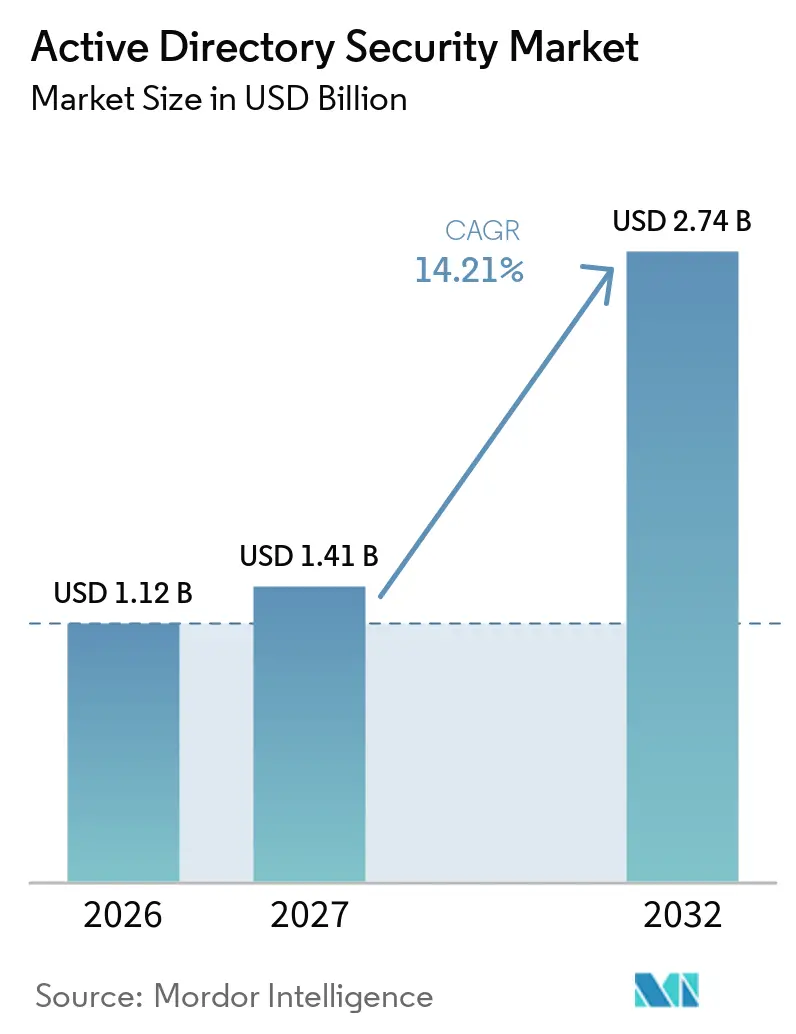
The Active Directory Security Market size is projected to expand from USD 1.12 billion in 2026 and USD 1.28 billion in 2027 to USD 2.74 billion by 2032, registering a CAGR of 14.21% between 2027 to 2032. Identity-based attacks are making directory security a core enterprise security priority because compromised credentials can provide broad access to systems and data. The spread of hybrid Active Directory and Microsoft Entra ID environments is creating security gaps that require coverage across on-premises and cloud directories. Buyers are moving from periodic checks toward continuous monitoring, automated remediation, and tested recovery capabilities. Competition is increasing as platform providers broaden their native identity tools while specialized vendors focus on deeper directory visibility, recovery, and cross-platform detection.
Key Report Takeaways
- By component, solutions held 79.12% of the Active Directory Security Market share in 2026 and are projected to expand at a 14.64% CAGR through 2032.
- By deployment mode, hybrid held 37.22% of the Active Directory Security Market share in 2026, while cloud-based deployment is projected to expand at a 14.37% CAGR through 2032.
- By organization size, large enterprises held 77.62% of the market share in 2026, while SMEs are projected to expand at a 14.98% CAGR through 2032, widening adoption within the Active Directory Security Market.
- By application, threat detection and response held 30.16% of the market share in 2026, while directory recovery and resilience is projected to expand at a 14.74% CAGR through 2032.
- By end user, BFSI held 25.24% of the market share in 2026, while energy and utilities is projected to expand at a 14.83% CAGR through 2032.
- By geography, North America held 40.87% of the market share in 2026, while Asia-Pacific is projected to expand at a 14.72% CAGR through 2032, making it the fastest-expanding geography in the Active Directory Security Market.
Note: Market numbers in this report are based on Mordor Intelligence's proprietary estimation framework, which combines nine months of actuals with Q4 projections for base year 2026.
Global Active Directory Security Market Trends and Insights
Drivers Impact Analysis*
| Driver | (~) % Impact on CAGR Forecast | Geographic Relevance | Impact Timeline |
|---|---|---|---|
| Rising Ransomware and Identity-Based Attacks | +3.8% | Global, concentrated in North America and Europe | Short term (≤ 2 years) |
| Zero-Trust and Identity Threat Detection and Response Adoption | +2.6% | North America, Europe, Asia-Pacific | Medium term (2-4 years) |
| Regulatory and Cyber-Insurance Pressure for Identity Controls | +2.1% | North America and EU, with spillover to Asia-Pacific | Short term (≤ 2 years) |
| Hybrid Active Directory and Entra ID Complexity | +2.0% | Global | Medium term (2-4 years) |
| Expansion of Non-Human Identity and Service-Account Attack Surface | +1.1% | Global, accelerating in Asia-Pacific and North America | Long term (≥ 4 years) |
| Shortage of Directory Security Specialists | +0.7% | Global, most acute in Asia-Pacific and Middle East and Africa | Medium term (2-4 years) |
| Source: Mordor Intelligence | |||
Rising Ransomware and Identity-Based Attacks
Ransomware groups are targeting identity infrastructure because it can open paths to systems across an enterprise. Stolen credentials appeared in 32% of breaches in 2025, showing how credentials can support access beyond the initial intrusion. Recorded Future identified 276 million credentials bundled with active session cookies in its 2025 identity threat report, and the volume had risen 30% over 1 year. Attackers can move from initial access to lateral movement in 1 hour 42 minutes, narrowing the time available for teams to identify suspicious directory changes. Semperis reported that only 60% of organizations with an ITDR strategy maintain dedicated, Active Directory-specific backup systems.[1] The Active Directory Security Market, therefore, benefits from demand for continuous monitoring and recovery that can limit the operational effect of identity compromise.
Zero-Trust and Identity Threat Detection and Response Adoption
Zero-trust programs require ongoing identity validation rather than occasional access reviews. The Identity Defined Security Alliance found that 95% of surveyed organizations had adopted zero trust in 2025. This approach increases the need for real-time Active Directory monitoring, behavioral analysis, and response workflows. Huntress reported that 65% of organizations had deployed ITDR and 74% planned to implement or expand it within 12 months.[2] Microsoft stated that phishing-resistant MFA can prevent 99.6% of identity-based attacks where it is deployed, although legacy enforcement gaps remain important.[3] The Active Directory Security Market gains as organizations add tools that can monitor on-premises forests alongside cloud identity controls.
Regulatory and Cyber-Insurance Pressure for Identity Controls
Identity controls are increasingly relevant to cyber-insurance pricing and coverage decisions. Delinea found that identity-related controls affected premium or coverage terms at renewal for most organizations. The same research identified PAM and identity governance and administration as leading factors influencing these terms. GDPR, HIPAA, and NERC CIP also require access controls and audit records that directory monitoring platforms can help organizations maintain. Delinea reported that many claimants said their incident was identity-related or resulted from privileged-account compromise. These requirements make the Active Directory Security Market relevant to risk, compliance, and procurement teams, not only security operations teams.
Hybrid Active Directory and Entra ID Complexity
Many enterprises operate on-premises Active Directory and Microsoft Entra ID simultaneously. This structure can create attack paths across synchronization services and connected identity systems. Tenable reported that Directory Synchronization Accounts retained access to sensitive synchronization APIs after Microsoft hardening updates, while ADSynchronization.ReadWrite.All created additional risk if a synchronization server was compromised. Semperis reported that hybrid environment security assessments indicated a moderate security posture. Microsoft’s recent Entra Connect upgrade requirement prompted teams to review synchronization configurations and security controls. This persistent complexity supports demand in the Active Directory Security Market for unified visibility across both directory environments.
Restraints Impact Analysis*
| Restraint | (~) % Impact on CAGR Forecast | Geographic Relevance | Impact Timeline |
|---|---|---|---|
| Microsoft Platform Bundling and Native-Control Substitution | -1.5% | Global, most acute in North America and Europe | Short term (≤ 2 years) |
| Integration Complexity Across Legacy and Cloud Directories | -1.0% | Global, most acute in Asia-Pacific and South America | Medium term (2-4 years) |
| Identity-System Change Windows and Recovery-Test Constraints | -0.7% | Global | Long term (≥ 4 years) |
| Evidence and Attribution Gaps for Security Return on Investment | -0.5% | Global, most acute in SME segment | Medium term (2-4 years) |
| Source: Mordor Intelligence | |||
Microsoft Platform Bundling and Native-Control Substitution
Microsoft bundles identity protection functions within widely purchased Microsoft 365 and Azure licensing plans. Entra ID Protection, Conditional Access, and Privileged Identity Management can provide a baseline option for procurement teams that need to control spending. The Conditional Access Optimization Agent entered public preview in 2026 and further automated policy tuning across identities, devices, and network conditions. This can reduce the need for a separate product where an organization only requires basic controls. The risk is strongest in audit, compliance, and monitoring functions where native logging has improved. Specialized providers in the Active Directory Security Market respond with deeper forensic analysis, recovery capabilities, and coverage across non-Microsoft directories.
Integration Complexity Across Legacy and Cloud Directories
Multi-forest Active Directory estates, Entra ID, and SCADA-connected directories can lengthen implementation timelines. Silverfort reported that a significant share of service accounts continued to use NTLM authentication. Legacy protocols, middleware requirements, and poorly configured trust relationships can require specialist work before a security platform becomes fully operational. Organizations can underestimate implementation budgets and defer broader monitoring deployments when integration costs rise. This issue is particularly important in the Asia-Pacific and South America, where some large organizations operate highly customized legacy environments. Longer deployment cycles can delay revenue recognition and raise churn risk for Active Directory Security Market suppliers that depend on rapid implementation.
*Our forecasts treat driver/restraint impacts as directional, not additive. The impact forecasts reflect baseline growth, mix effects, and variable interactions.
Segment Analysis
By Component: Solutions Lead Through Integrated Identity Protection
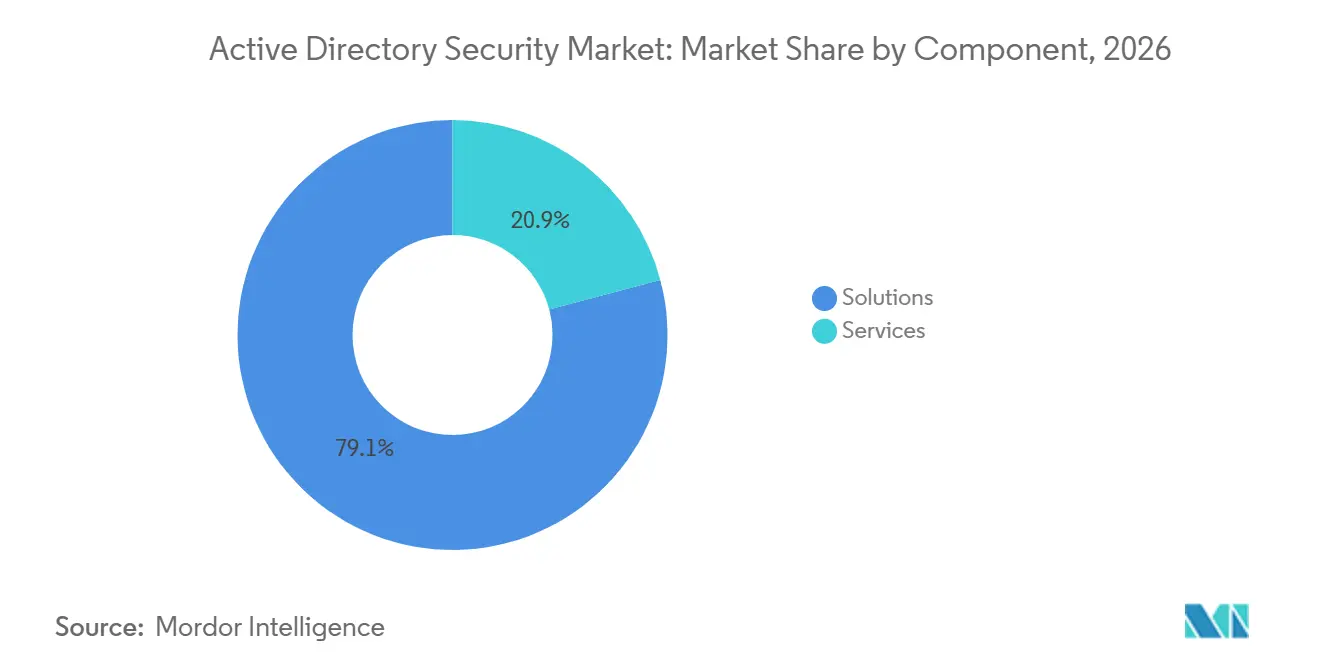
Solutions held 79.12% share in 2026 and are projected to expand at a 14.64% CAGR through 2032. The category includes identity threat detection and response, privileged access management, and identity governance and administration tools. Buyers are bringing detection, behavioral analytics, remediation, and recovery into fewer security platforms. ITDR is attracting spend that previously went to standalone audit products because enterprises want identity threats evaluated in real time. PAM has moved beyond credential storage toward just-in-time access and zero-standing-privilege controls. IGA remains important for organizations that need to document access decisions under GDPR, SOX, and HIPAA. CrowdStrike announced its acquisition of SGNL in January 2026 to add continuous, risk-based authorization across Active Directory and cloud identity systems. The move shows how platform vendors are extending identity security beyond their original product categories.
Services accounted for the remaining share of the Active Directory Security Market in 2026. Consulting, implementation, managed security, monitoring, training, and support remain necessary where directory environments are complex. Managed security services are the fastest-moving services area because many organizations lack teams that can monitor directory changes continuously. Providers can deliver specialized capabilities across several customers without each customer building a large internal team. The need is most visible in organizations with multiple Active Directory forests, older authentication protocols, or mixed cloud deployments. Service providers also help customers test recovery plans and prepare evidence for compliance audits. This work supports product adoption because implementation quality affects the value organizations receive from directory security tools. The component mix therefore combines high software demand with sustained demand for deployment and operational expertise.
By Deployment Mode: Hybrid Remains the Common Enterprise Architecture
Hybrid deployment held 37.22% share in 2026. Enterprises use this model when they keep Active Directory Domain Services for devices and older applications while moving selected workloads to cloud platforms. It reflects the practical pace of enterprise modernization rather than a short-term transition stage. Hybrid estates require security tools that can connect on-premises directory telemetry with Entra ID activity. They also require teams to manage synchronization accounts and permissions that span both environments. Microsoft’s September 2025 Entra Connect update led many enterprises to review synchronization settings and related security controls. Vendors that provide a consistent view of both environments can address risks that appear between infrastructure layers. This need keeps hybrid deployments central to current purchasing decisions.
Cloud-based deployment is projected to expand at a 14.37% CAGR through 2032, increasing the addressable demand for the Active Directory Security Market. Cloud adoption extends directory-managed identities into SaaS applications where traditional on-premises tools have limited visibility. Cloud-delivered ITDR can help security teams analyze identity activity across distributed environments. On-premises deployment will retain a role in government, defense, and critical infrastructure because data-residency and operational requirements can limit cloud migration. The three deployment models will therefore coexist through the forecast period. The Active Directory Security Market is not defined by a complete shift away from on-premises systems. It is defined by the need to protect connected identity layers as workloads are placed in different environments. Suppliers that support cloud visibility and on-premises monitoring at the same time are positioned to serve both cloud and hybrid customers.
By Organization Size: Large Enterprises Hold Spend While SMEs Increase Adoption
Large enterprises held 77.62% share in 2026. Their large multi-forest environments and formal audit requirements make directory protection a necessary procurement category. Financial services, healthcare, and government organizations often manage extensive privileged access across critical systems. These organizations also have the security teams and budgets needed to deploy integrated monitoring and recovery platforms. Large enterprise buyers typically evaluate forensic depth, integration with existing tools, and recovery assurance before selecting a provider. Their purchasing processes can be long, but successful deployments can cover broad directory estates. The segment’s leading position reflects the concentration of complex identity infrastructure in large organizations. It also reflects the potential operational effect of a directory compromise in a large environment.
SMEs are projected to expand at a 14.98% CAGR through 2032, widening adoption within the Active Directory Security Market. Managed detection and response providers are helping smaller organizations access directory security without maintaining large specialist teams. These services offer monitoring and response at price points that can suit organizations with fewer than 1,000 employees. Supply-chain exposure adds to the need because attackers may target IT service providers to reach enterprise customers. Huntress found that 89% of organizations expected to prioritize identity protection in the coming year. The higher SME growth rate reflects a catch-up in security adoption rather than lower exposure to identity threats. Accessible managed services can lower technical and staffing barriers for these buyers. This provides a wider customer base for the Active Directory Security Market during the forecast period.
By Application: Detection Holds Demand While Recovery Gains Priority
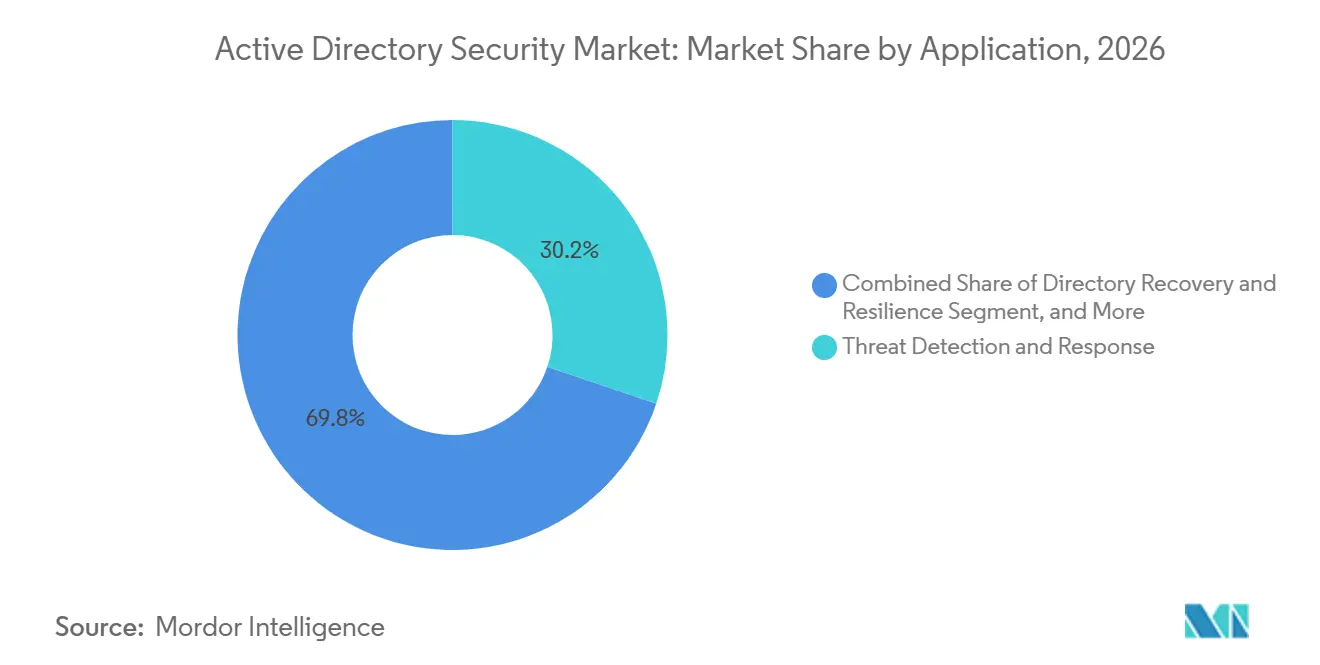
Threat detection and response held 30.16% share in 2026. Organizations use these tools to identify suspicious credential activity, privilege changes, and lateral movement. IAM was the second-largest application and covered provisioning and deprovisioning activities that determine access permissions. Compliance management, auditing, and monitoring also remain important because organizations need searchable records of access and directory changes. Specialized audit tools can meet these needs with less operational work than broad SIEM deployments. Detection continues to lead because teams need visibility before they can contain an identity-related attack. The application mix shows that prevention, detection, and documentation are connected purchasing priorities. It also shows why vendors are combining several application capabilities in a single platform.
Directory recovery and resilience is projected to expand at a 14.74% CAGR through 2032, strengthening a key use case in the Active Directory Security Market. Buyers increasingly recognize that not every attack on Active Directory can be prevented, making tested recovery a core requirement. Commvault expanded its Identity Resilience offering in November 2025 with tools to detect threats, record malicious changes, and restore affected directory objects. Cohesity introduced advanced ITDR capabilities in January 2026 and reported 90% faster Active Directory forest recovery compared with pre-deployment baselines. SailPoint also introduced Security Posture Management in September 2025 to automate privilege classification and just-in-time access. These releases show that prevention and recovery are becoming closely linked within identity security platforms. The Active Directory Security Market is therefore moving beyond tools that only issue alerts. Recovery and resilience are becoming important selection criteria for buyers seeking to reduce business disruption.

By End User: BFSI Holds the Largest Position While Energy and Utilities Expands Faster
BFSI held 25.24% share in 2026. Financial institutions manage dense networks of privileged identities across core banking systems, trading platforms, and reporting systems. These environments face strong requirements for access governance, auditability, and incident response. The large number of privileged accounts per employee makes directory security a necessary operational control. A compromised directory account can affect services that customers and regulators expect to remain available. Investment decisions in this vertical therefore extend beyond meeting compliance requirements. They also address operational continuity and protection of sensitive financial information. This combination supports BFSI’s leading position among end-user groups.
Energy and utilities is projected to expand at a 14.83% CAGR through 2032, creating a faster-moving demand area for the Active Directory Security Market. IT and operational technology are increasingly connected, bringing Active Directory-managed identities into SCADA-linked environments. DNV reported that 65% of energy professionals considered cybersecurity the greatest current business risk in 2025. NERC CIP and the NIS2 Directive require relevant operators to maintain access controls and audit trails. Healthcare also has a strong need because compromised directory credentials can disrupt electronic health records and patient safety operations. Government and defense, IT and telecommunications, retail and e-commerce, education, and manufacturing each balance directory investment against sector-specific risk and compliance requirements. The Active Directory Security Market serves these groups through security controls that can operate across varied critical systems. Energy and utilities stands out because operational disruption can extend from digital systems into physical infrastructure.
Geography Analysis
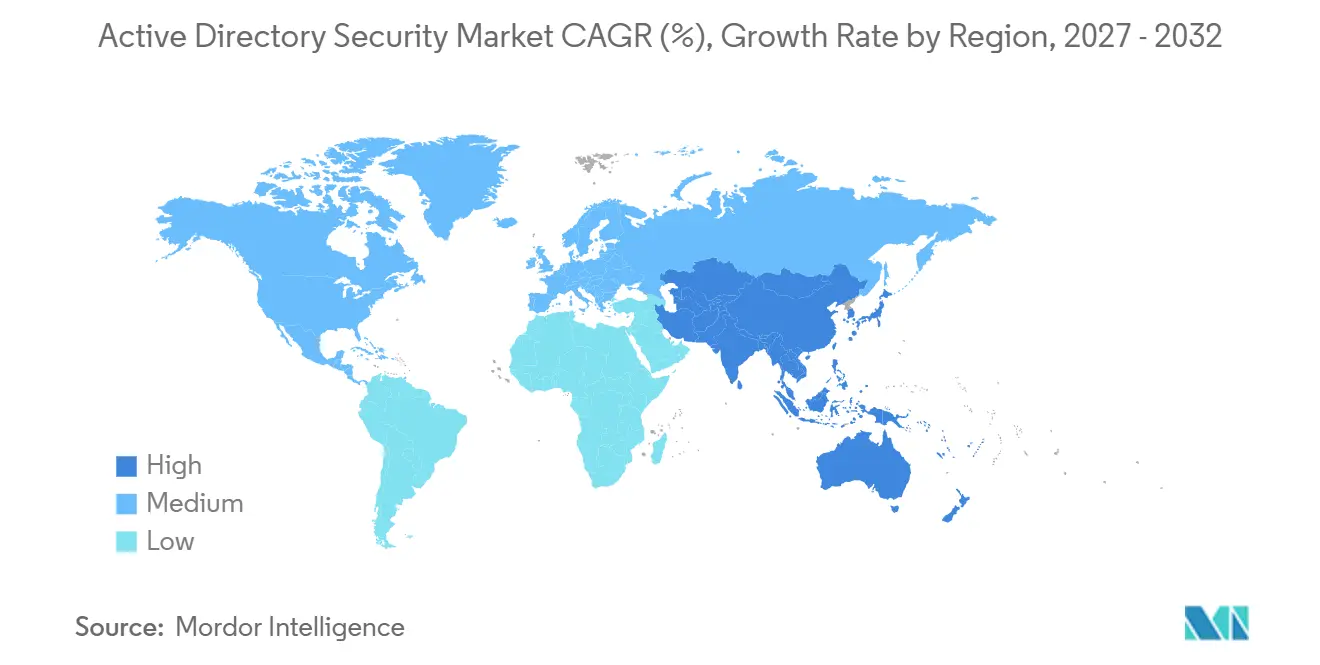
North America held 40.87% share in 2026, giving the Active Directory Security Market its most mature regional demand base. The region has mature enterprise Active Directory use, a developed managed security ecosystem, and an active cyber-insurance market. The United States accounts for most regional spending, supported by CISA guidance on detecting Active Directory compromise and the Office of Management and Budget’s zero-trust strategy. Canada adds demand through financial sector and public health requirements, while other adopters are often served through United States-headquartered managed service providers. Microsoft’s expanding native identity portfolio competes with specialized ITDR, PAM, and IGA suppliers, while public-sector and enterprise demand is expected to remain high through the forecast period.
Asia-Pacific is projected to expand at a 14.72% CAGR through 2032, making it the fastest-expanding geography in the Active Directory Security Market. Digitalization in India, China, South Korea, and Australia is increasing the number of environments that rely on Active Directory-managed identities. This regional expansion is supported by increasing enterprise use of connected identity systems and higher demand for security controls. India is expected to record the highest country-level cybersecurity CAGR in the region, supported by its large IT services sector. South Korea and Australia contribute through established enterprise use and more prescriptive cybersecurity frameworks, while other regional markets offer a longer-cycle opportunity as identity governance matures.
Europe held a significant share of the Active Directory Security Market in 2026, led by Germany, the United Kingdom, and France. GDPR requirements, the NIS2 Directive, Germany’s IT-Grundschutz standards, and United Kingdom Active Directory hardening guidance support spending on identity governance and access controls. South America remains at an earlier stage, although Brazil’s data protection framework strengthens the case for directory controls. Saudi Arabia and the UAE are advancing zero-trust identity frameworks, while Africa is emerging as digital infrastructure expands in South Africa, Nigeria, and Egypt.
Competitive Landscape
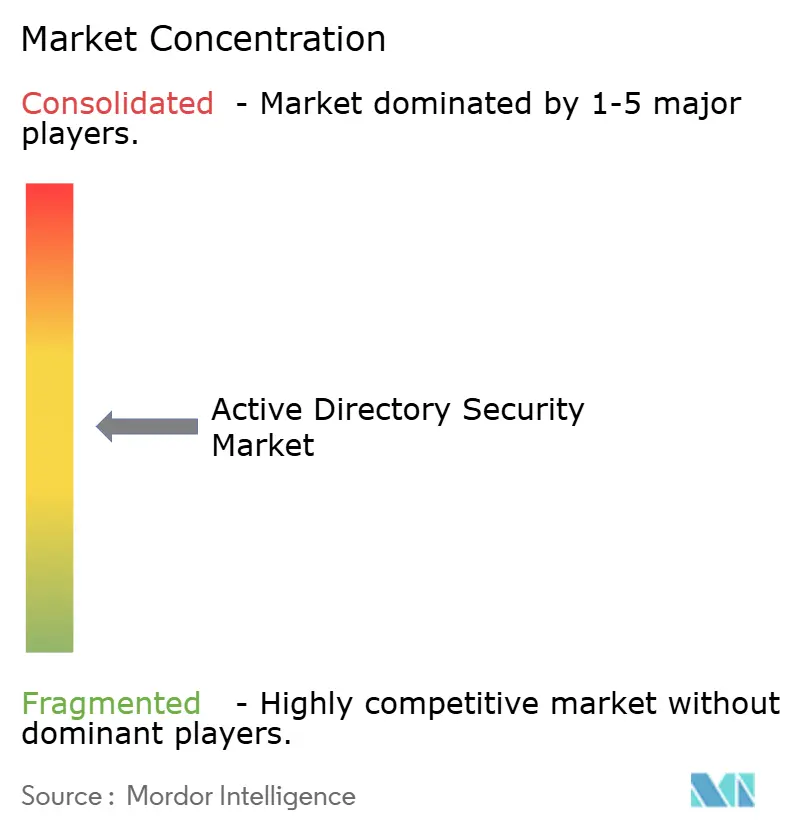
The Active Directory Security Market is moderately consolidated in premium enterprise accounts and more fragmented in the mid-market and managed-service channel. Microsoft, CyberArk, BeyondTrust, SailPoint, and Semperis have a strong presence in large-enterprise procurement, while specialists compete on deployment speed and recovery depth. Platform convergence is shaping competition as PAM, IGA, and auditing providers build adjacent capabilities. CyberArk’s acquisition of Venafi and introduction of CORA AI show its move into broader identity security. Cohesity’s January 2026 ITDR expansion added vulnerability assessment for Active Directory and Entra ID, malicious-change rollback, tamperproof tracking, and service-account protection.
Service-account governance is an important opportunity because Silverfort found that 94.3% of organizations lacked full visibility into non-human identities. Cross-platform detection and managed directory security for SMEs provide further ways for suppliers to differentiate. CrowdStrike’s planned SGNL acquisition targets continuous authorization and removal of standing privileges across human, non-human, and agentic AI identities. Okta completed its acquisition of Permiso Security in August 2026, adding more than 2,500 detection signals across over 70 identity providers. These moves make detection quality and response coverage central factors in enterprise selection.
ManageEngine, SentinelOne, and Tenable each offer Active Directory-focused products for governance, ITDR, assessment, or monitoring. Fortra is more closely focused on file transfer security, data protection, and penetration testing, with more limited Active Directory-specific capabilities than the other listed providers. Automated directory-state rollback and behavior-based service-account anomaly detection are emerging areas of technical differentiation. The field will remain divided between broad identity platforms and specialists with deep hybrid directory security and recovery capabilities.
Active Directory Security Industry Leaders
-
Microsoft Corporation
-
Quest Software Inc.
-
Semperis Inc.
-
Netwrix Corporation
-
CyberArk Software Ltd.
- *Disclaimer: Major Players sorted in no particular order
Recent Industry Developments
- October 2026: Semperis announced worldwide availability of Semperis Migrator for Active Directory 2.0, a ground-up architectural rebuild making AD migration observable, controlled, and security-centric at every stage. The release targets regulated industries in North America, Europe, and Asia-Pacific through a partner-first delivery model, and addresses enterprises consolidating multi-forest environments or migrating workloads to Entra ID.
- August 2026: Okta closed its acquisition of Permiso Security, a cloud-native ITDR platform covering human, non-human, and AI-agent identities across multi-cloud environments. The deal adds more than 2,500 research-driven detection signals across 70+ identity providers to the Okta platform, extending Okta's reach from identity management into security operations center workflows and real-time threat containment.
- June 2026: Netwrix unveiled AI governance capabilities for hybrid Microsoft environments through its 1Secure platform, enabling organizations to reveal and govern AI-agent access to sensitive data in AD-connected environments. The release addressed the emerging governance gap created by agentic AI workloads authenticating through service-account identities with directory-level permissions.
- February 2026: Cisco Duo launched Active Directory Defense, combining MFA enforcement with risk analytics tied to AD authentication paths including Kerberos and NTLM traffic. The solution provides visibility and enforcement for on-premises AD without requiring cloud migration, targeting the large installed base of enterprises with legacy directory infrastructure.
Global Active Directory Security Market Report Scope
The Active Directory Security Market comprises software and services that protect Microsoft Active Directory environments, the identity backbone for many major enterprises, from cyber threats, misconfigurations, and privilege abuse. These solutions span attack-path analysis, privilege escalation and lateral movement detection, AD hardening, auditing and compliance, identity threat detection and response (ITDR), and backup and recovery for AD.
The Active Directory Security Market Report is Segmented by Component (Solutions, and Services), Deployment Mode (On-Premises, Cloud-Based, and Hybrid), Organization Size (SMEs, and Large Enterprises), Application (IAM, Threat Detection and Response, Compliance Management, Auditing and Monitoring, and Directory Recovery and Resilience), End User (BFSI, Healthcare, IT and Telecom, Government and Defense, Retail and E-Commerce, Energy and Utilities, and Manufacturing), and Geography (North America, South America, Europe, Asia-Pacific, and Middle East and Africa). The Market Forecasts are Provided in Terms of Value (USD).
| Solutions | Identity Threat Detection and Response |
| Privileged Access Management | |
| Identity Governance and Administration | |
| Audit, Compliance and Monitoring | |
| Services | Consulting and Assessment |
| Implementation and Integration | |
| Managed Security and Monitoring | |
| Training and Support |
| On-Premises |
| Cloud-Based |
| Hybrid |
| Small and Medium Enterprises |
| Large Enterprises |
| Identity and Access Management |
| Threat Detection and Response |
| Compliance Management |
| Auditing and Monitoring |
| Directory Recovery and Resilience |
| Banking, Financial Services and Insurance |
| Healthcare |
| IT and Telecommunications |
| Government and Defense |
| Retail and E-Commerce |
| Energy and Utilities |
| Manufacturing |
| Other End Users |
| North America | United States |
| Canada | |
| Mexico | |
| South America | Brazil |
| Argentinaa | |
| Rest of South America | |
| Europe | Germany |
| United Kingdom | |
| France | |
| Italy | |
| Spain | |
| Russia | |
| Rest of Europe | |
| Asia-Pacific | China |
| Japan | |
| India | |
| South Korea | |
| Australia | |
| Rest of Asia-Pacific | |
| Middle East and Africa | Saudi Arabia |
| United Arab Emirates | |
| South Africa | |
| Egypt | |
| Rest of Middle East and Africa |
| By Component | Solutions | Identity Threat Detection and Response |
| Privileged Access Management | ||
| Identity Governance and Administration | ||
| Audit, Compliance and Monitoring | ||
| Services | Consulting and Assessment | |
| Implementation and Integration | ||
| Managed Security and Monitoring | ||
| Training and Support | ||
| By Deployment Mode | On-Premises | |
| Cloud-Based | ||
| Hybrid | ||
| By Organization Size | Small and Medium Enterprises | |
| Large Enterprises | ||
| By Application | Identity and Access Management | |
| Threat Detection and Response | ||
| Compliance Management | ||
| Auditing and Monitoring | ||
| Directory Recovery and Resilience | ||
| By End User | Banking, Financial Services and Insurance | |
| Healthcare | ||
| IT and Telecommunications | ||
| Government and Defense | ||
| Retail and E-Commerce | ||
| Energy and Utilities | ||
| Manufacturing | ||
| Other End Users | ||
| By Geography | North America | United States |
| Canada | ||
| Mexico | ||
| South America | Brazil | |
| Argentinaa | ||
| Rest of South America | ||
| Europe | Germany | |
| United Kingdom | ||
| France | ||
| Italy | ||
| Spain | ||
| Russia | ||
| Rest of Europe | ||
| Asia-Pacific | China | |
| Japan | ||
| India | ||
| South Korea | ||
| Australia | ||
| Rest of Asia-Pacific | ||
| Middle East and Africa | Saudi Arabia | |
| United Arab Emirates | ||
| South Africa | ||
| Egypt | ||
| Rest of Middle East and Africa | ||
Key Questions Answered in the Report
What is the size of the Active Directory security market?
The Active Directory security market is projected to expand from USD 1.12 billion in 2026 and USD 1.28 billion in 2027 to USD 2.74 billion by 2032, at a 14.21% CAGR.
What is driving demand for Active Directory security tools?
Identity-based attacks, ransomware, hybrid directory complexity, zero-trust programs, and insurance and compliance requirements are increasing demand.
Which component has the largest share?
Solutions held 79.12% share in 2026 and are projected to expand at a 14.64% CAGR through 2032.
Which deployment model is most common?
Hybrid deployment held the largest share at 37.22% in 2026 because enterprises continue to operate both on-premises Active Directory and cloud identity services.
Which end-user sector is expanding fastest?
Energy and utilities is projected to expand at a 14.83% CAGR through 2032 as IT and operational technology environments become more connected.
Which region is expanding fastest?
Asia-Pacific is projected to expand at a 14.72% CAGR through 2032, supported by digitalization and rising identity governance needs.