
Acetylene Market Size and Share
Market Overview
| Study Period | 2021 - 2031 |
|---|---|
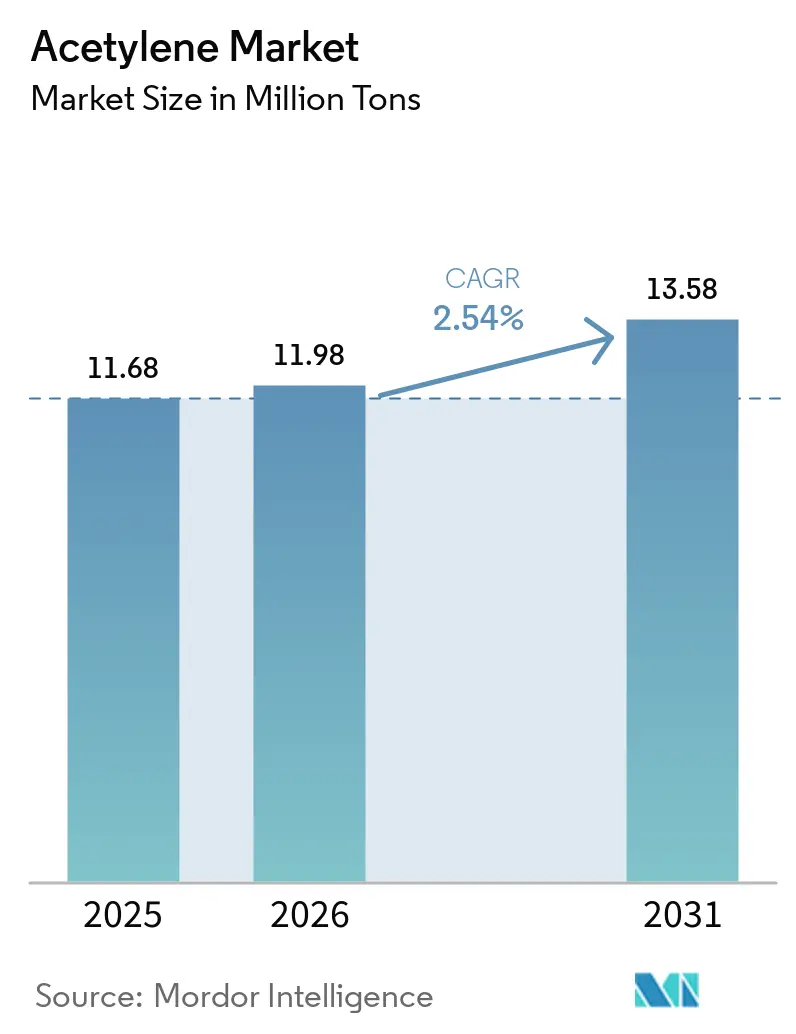
| Market Volume (2026) | 11.98 Million tons |
| Market Volume (2031) | 13.58 Million tons |
| Growth Rate (2026 - 2031) | 2.54 % |
| Fastest Growing Market | Asia Pacific |
| Largest Market | Asia Pacific |
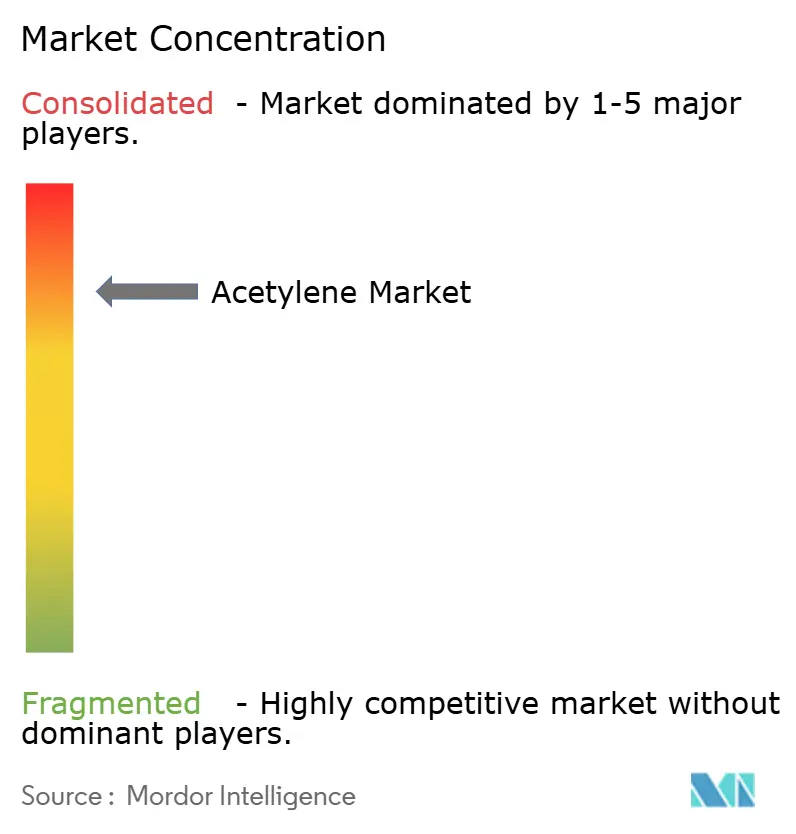
| Market Concentration | High |
Major Players *Disclaimer: Major Players sorted in no particular order Image © Mordor Intelligence. Reuse requires attribution under CC BY 4.0. | |
Acetylene Market Analysis by Mordor Intelligence
The Acetylene Market size is expected to increase from 11.68 Million tons in 2025 to 11.98 Million tons in 2026 and reach 13.58 Million tons by 2031, growing at a CAGR of 2.54% over 2026-2031. Rising demand for high-purity grades in battery materials, sustained metal fabrication activity, and a gradual pivot toward greener production routes are shaping volume growth. Chemical raw-material applications, notably specialty solvents and battery-grade acetylene black, are expanding fastest as manufacturers revisit C₂ chemistry to diversify away from traditional ethylene pathways. At the same time, modular on-site generators are shifting supply dynamics by lowering logistics costs for large fabricators. Competitive strategies center on capacity additions in Asia-Pacific, process innovations that lower carbon intensity, and selective acquisitions that enlarge geographic footprints. Safety regulation and fuel-gas substitution pressure temper overall momentum but continue to reward operators with superior compliance records and scale advantages.
Key Report Takeaways
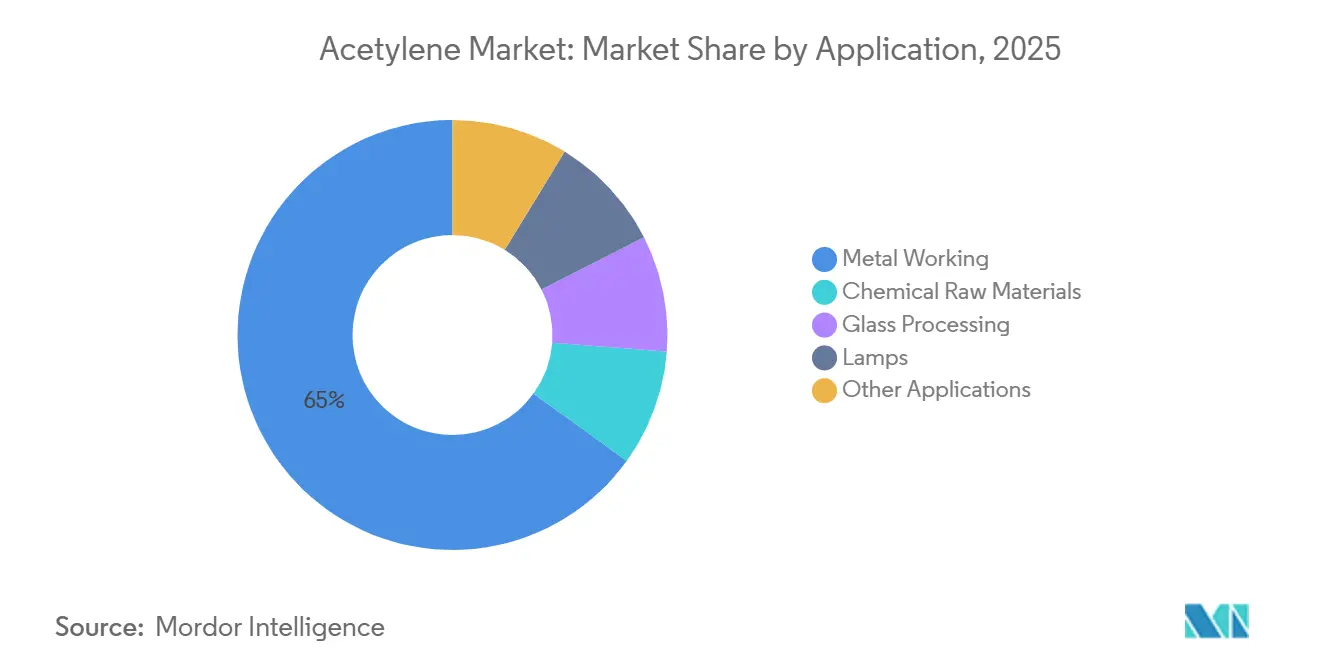
- By application, metal working held 65.04% of the acetylene market share in 2025, while chemical raw materials posted the highest forecast CAGR at 3.27% through 2031.
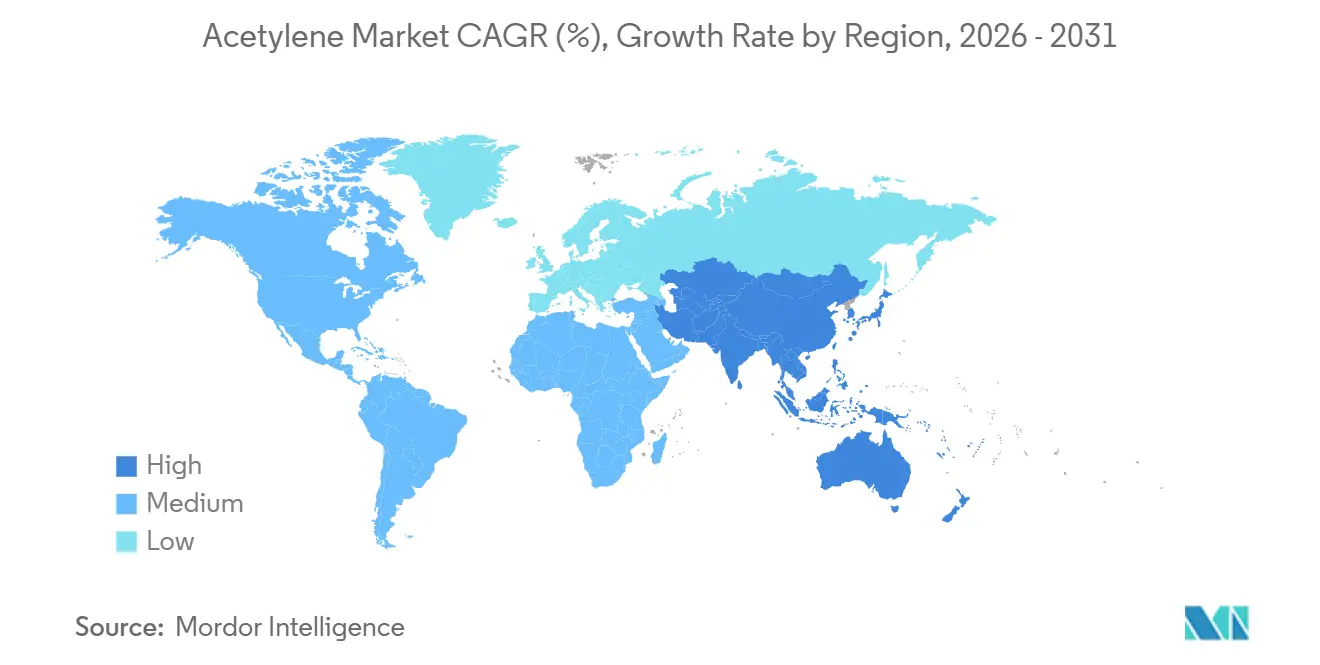
- By geography, Asia-Pacific commanded 81.91% of global volume in 2025 and is advancing at a 2.71% CAGR to 2031.
Note: Market size and forecast figures in this report are generated using Mordor Intelligence’s proprietary estimation framework, updated with the latest available data and insights as of January 2026.
Market Trends and Insights
Drivers Impact Analysis of Acetylene Market*
| Drivers | (~) % Impact on CAGR Forecast | Geographic Relevance | Impact Timeline |
|---|---|---|---|
| Growing demand from metalworking and fabrication | +0.8% | Asia-Pacific, North America | Medium term (2-4 years) |
| Rising PVC and downstream vinyl production in Asia | +0.6% | China, ASEAN | Short term (≤ 2 years) |
| Infrastructure-led construction boom in emerging economies | +0.5% | India, Middle East, South America | Medium term (2-4 years) |
| Surge in acetylene-black use for Li-ion batteries | +0.4% | Japan, Thailand, China; spill-over to North America, Europe | Long term (≥ 4 years) |
| Modular on-site acetylene generators gaining traction | +0.3% | North America, Europe, early Asia-Pacific clusters | Medium term (2-4 years) |
| Source: Mordor Intelligence | |||
Growing Demand From Metalworking And Fabrication
Legacy oxy-acetylene cutting and welding technologies retain prominence in construction sites, shipyards, and remote maintenance settings where reliable grid power is unavailable. The acetylene market benefits from the gas’s 3,160 °C flame temperature, which cuts steel faster than alternative fuels. However, plasma and laser systems are making inroads in automated workshops, incrementally trimming acetylene volumes in high-precision fabrication. Demand therefore skews toward low-volume, high-mobility tasks and infrastructure builds in emerging economies, keeping growth in line with overall market averages.
Rising PVC And Downstream Vinyl Production In Asia
Cost-advantaged coal-to-calcium-carbide complexes in China underpin the acetylene route to vinyl chloride monomer, sustaining regional dominance even as global producers favor ethylene-based chemistry. Recent capacity additions in Inner Mongolia and Xinjiang leverage amortized assets and local energy subsidies, boosting near-term consumption and supporting the calcium acetylide market. Provincial emission caps are tightening, yet ASEAN vinyl producers in Thailand, Vietnam, and Indonesia are scaling downstream PVC output, partially offsetting any decarbonization-driven slowdowns in mainland China.
Infrastructure-Led Construction Boom In Emerging Economies
Large transportation and housing projects across India, Saudi Arabia, and Brazil require on-site metal fabrication that values acetylene’s portability. National safety codes governing storage cylinders and explosive atmospheres raise compliance costs, which entrench established distributors and limit smaller entrants, but project pipelines stretching through 2030 safeguard volume growth. Suppliers are positioning depots close to megaprojects to reduce delivery lead times and secure multi-year contracts.
Surge In Acetylene-Black Use For Li-Ion Batteries
Rayong’s acetylene black facility, a Denka-SCG venture, is ramping up output for high-nickel cathode conductive additives[1]. The material’s superior conductivity and morphology compared with conventional carbon blacks position acetylene black as the standard for premium EV battery cells. While its share of total acetylene consumption is modest, the price premium and long-term battery outlook drive a measurable uplift to overall demand, particularly in the Asia-Pacific, where most gigafactories cluster.
Restraints Impact Analysis of Acetylene Market*
| Restraints | (~) % Impact on CAGR Forecast | Geographic Relevance | Impact Timeline |
|---|---|---|---|
| Stringent environmental and safety regulations | -0.5% | Europe, North America; tightening in Asia | Short term (≤ 2 years) |
| Substitution by alternative fuel gases (propane, LPG, LNG) | -0.4% | North America, Europe, urban Asia-Pacific | Medium term (2-4 years) |
| Escalating industrial-insurance premiums after safety incidents | -0.2% | Global | Short term (≤ 2 years) |
| Source: Mordor Intelligence | |||
Stringent Environmental And Safety Regulations
Global regulations deem acetylene as highly flammable and unstable. To counteract decomposition, they mandate the use of porous-mass cylinders filled with solvent. Compliance with U.S. OSHA PSM, European REACH, and China’s dual-carbon mandates raises production and handling costs. Smaller distributors struggle to absorb audit expenses and frequent cylinder inspections, thereby consolidating supply in the hands of multinational firms that can leverage scale to meet the stricter standards.
Substitution By Alternative Fuel Gases (Propane, LPG, LNG)
Propane delivers more energy per cubic foot compared to acetylene, and its cylinders are easier to handle because they avoid shock-sensitive acetylides. Many North American and European shops now reserve acetylene for piercing while shifting pre-heating and general cutting to oxy-propane, trimming overall acetylene volumes. Urban centers in Asia-Pacific are beginning to follow this cost-centric trend, although remote sites still favor acetylene’s portable high-temperature flame.
*Our forecasts treat driver/restraint impacts as directional, not additive. The impact forecasts reflect baseline growth, mix effects, and variable interactions.
Acetylene Market Segment Analysis
By Application:
Specialty Chemistry Gains Momentum Over Legacy FabricationGlobal metal working accounted for 65.04% of the acetylene market share in 2025. The segment owes its volume lead to decades of entrenched oxy-acetylene infrastructure in construction, shipbuilding, and field maintenance. However, capital-intensive plasma and laser systems are capturing precision jobs inside automated factories, generating a gradual volume shift. Chemical raw materials trail in absolute tonnage yet post the fastest 3.27% CAGR, reflecting renewed interest in acetylene-based 1,4-butanediol, tetrahydrofuran, and vinyl acetate. Environmental regulators encourage this pivot by scrutinizing ethylene-derived routes, prompting specialty-chemical producers to revisit acetylene’s C₂ advantage. Glass processing, lamps, and other niche uses maintain stable but low volumes, collectively offering limited upside to the wider acetylene market size narrative.
The acetylene industry is also witnessing heightened research and development into biochar-to-calcium-carbide routes and plasma-assisted methane cracking. These emerging pathways promise lower carbon footprints and could qualify for green-chemistry incentives in Europe and East Asia. Should technology demonstrations scale successfully, chemical applications may accelerate further, tightening supply in traditional welding markets and intensifying the search for efficiency gains among metal-fabrication end users. Overall, application-mix evolution supports price stability even as volumes shift toward high-margin specialty outlets.

Geography Analysis
APAC Acetylene Market
Asia-Pacific held 81.91% of global volume in 2025 and is on track for a 2.71% CAGR to 2031, underscoring its dual status as the principal producer and consumer of acetylene. China anchors this dominance through fully amortized coal-to-calcium-carbide complexes in Xinjiang and Inner Mongolia that deliver dissolved acetylene to vinyl chloride, solvent, and battery-carbon value chains. New units—such as Xinjiang Mingli Gas’s facility—represent late-cycle additions ahead of stricter emissions ceilings that will temper future expansions. Japan and South Korea exhibit mature consumption centered on electronics and precision welding, whereas Thailand’s Denka-SCG plant elevates the country to regional hub status for battery-grade acetylene black.
North America Acetylene Market
Imports and recovery from petrochemical steam crackers, utilizing dimethylformamide extraction, predominantly meet North America's demand. Integrated chemical companies monetize by-product acetylene internally, leaving metal-fabrication markets to merchant gas firms. Regulatory compliance under OSHA drives consistent but flat growth, and substitution by propane is most pronounced in high-labor-cost regions that optimize total ownership economics over peak flame temperature.
Europe Acetylene Market
Europe tallies a similar volume share to North America but faces higher compliance costs under REACH and the Industrial Emissions Directive. Germany’s BASF operates an acetylene unit at Ludwigshafen that feeds captive chemical chains rather than merchant outlets, illustrating the trend toward integrated producer-consumer models[2]. The United Kingdom and French markets remain dependent on cylinder distribution for shipbuilding and aerospace maintenance, yet propane displacement limits incremental growth potential.
MEA and South America Acetylene Market
South America and the Middle East-Africa together represent a small share of the acetylene market. Brazil and Argentina experience project-driven spikes tied to infrastructure megaprojects, though currency volatility and import dependency cap sustained gains. In the Middle East, Saudi Arabia and the UAE show robust demand linked to NEOM and Expo 2030 construction, but logistics constraints necessitate strategic storage hubs to ensure continuity of supply. Nigeria and Egypt remain nascent, characterized by fragmented distribution networks that often operate outside formal regulatory frameworks.
Regulatory Landscape
Acetylene remains tightly regulated globally because it is classified as an extremely flammable gas and is handled as a dissolved gas in porous-mass cylinders. In the United States, workplace and charging-plant requirements reference 29 CFR 1910.102, which points to Compressed Gas Association guidance (for example, CGA G-1 for cylinder safety practices) and related fire-code provisions for acetylene generation and use.
In Europe and the United Kingdom, compliance frameworks span REACH and CLP for substance registration and hazard communication, with major-accident and emissions controls under Seveso III and the Industrial Emissions Directive for relevant sites. The UK-specific Acetylene Safety Regulations (2014) add licensing and operational controls for certain activities, while technical conformity continues to be anchored by cylinder standards such as ISO 3807:2013 and industry codes from EIGA and AIGA that shape inspection, handling, and storage practices across supply chains.
Value Chain Analysis
The acetylene value chain starts with feedstock and process selection: calcium carbide-based production (carbide manufacture followed by hydrolysis) dominates in coal- and power-advantaged regions, while hydrocarbon cracking routes are used where natural gas and integrated petrochemical systems support by-product recovery. Electricity intensity and carbide availability strongly influence cost and reliability, so long-term sourcing agreements and integration with carbide producers are common risk-management levers in carbide-led geographies.
Midstream handling is shaped by safety and logistics constraints, as acetylene is typically distributed in dissolved form in specialized cylinders and cannot be handled like common compressed gases. Cylinder pool availability, periodic inspection requirements, and hazardous-goods transport rules create structural bottlenecks and raise barriers for smaller distributors. Downstream demand splits between merchant supply for metalworking and remote job sites, and captive consumption by integrated chemical producers (for example, BASF at Ludwigshafen) that convert acetylene into intermediates within large site networks, limiting spot-market liquidity in mature regions.
Competitive Landscape
The acetylene market is consolidated. Multinational industrial gas majors dominate high-volume segments by leveraging scale, proprietary cylinder technology, and established safety records. Specialty niches are less consolidated. Process-innovation race is intensifying: plasma-assisted methane cracking and biochar-derived calcium carbide are key research and development frontiers as producers aim to decarbonize portfolios and secure future carbon-credit revenues. Modular generator manufacturers target large fabricators willing to assume on-site production risk, but regulatory permitting remains a barrier. Concurrently, integrated chemical companies with captive acetylene units will continue internalizing consumption, limiting merchant-market growth in mature economies. The competitive arena is therefore bifurcated between high-volume integrated chains and high-margin specialty segments that reward technological differentiation.
Acetylene Industry Leaders
-
Linde plc
-
Gulf Cryo
-
Air Liquide
-
China Petrochemical Corporation.
-
Koatsu Gas Kogyo Co. Ltd.
- *Disclaimer: Major Players sorted in no particular order
Acetylene Market Companies Covered in this Report
- Air Liquide
- Air Products and Chemicals Inc.
- Asia Technical Gas Co. Pte Ltd.
- Axcel Gases
- BASF SE
- Butler Gas Products
- China Petrochemical Corporation.
- Coregas Pty Ltd.
- Denka Company Limited
- Gruppo SIAD
- Gulf Cryo
- Jinhong Gas Co. Ltd.
- Koatsu Gas Kogyo Co. Ltd.
- Linde plc
- Messer Group GmbH
- Nippon Sanso Holdings Corporation
- NOL Group
- Pune Air Products
- TOHO ACETYLENE Co.
- Transform Materials
Market Opportunities and Future Outlook
High-purity and secure-supply demand is creating whitespace for pipeline-connected and on-site supply models that reduce contamination risk and cylinder logistics. This is visible in new downstream buildouts that lock in acetylene access through long-duration contracts, including HydroGraph USA signing a 10-year purchase agreement with Western International in July 2026 to source acetylene via pipeline for its Bellville, Texas, graphene manufacturing facility, extending acetylene demand beyond traditional welding-heavy channels.
On the production side, tightening safety and emissions scrutiny continues to reward assets with better environmental performance and audited operating systems, reinforcing interest in lower-carbon routes already highlighted in industry R&D (for example, plasma-chemical approaches and other process innovations referenced by producers). In Asia-Pacific, acetylene’s role in the vinyl chain and conductive additives for batteries remains a key monetization path, while modular on-site generation and captive supply contracts offer a practical way to serve electronics and advanced manufacturing customers that prioritize purity and continuity over cylinder-based procurement.
Recent Industry Developments in Acetylene Market
- April 2026: Air Liquide announced a USD 350 million investment for a new air separation unit at the Koch Methanol facility in St. James Parish, Louisiana, alongside a long-term supply agreement with HYUNDAI-POSCO Louisiana LLC for oxygen, nitrogen, and argon. The added on-site supply footprint strengthens Air Liquide’s Gulf Coast network that supports large industrial clusters where acetylene and related industrial gases are co-consumed across fabrication and chemicals.
- May 2025: HydroGraph Clean Power Inc. signed a strategic agreement with a North American gas supplier and detailed plans for a Texas facility using high-purity acetylene to scale detonation-synthesized pristine graphene. The move underscores a specialty-demand outlet where acetylene purity, reliability, and upstream partnership structure directly shape downstream capacity ramp and product qualification.
- May 2024: Gulf Cryo signed a memorandum of understanding with HydroGraph Clean Power Inc. to explore commercial-scale graphene production using Gulf Cryo’s acetylene supply and feedstock capabilities. The collaboration signaled a shift by regional industrial gas suppliers toward higher-value carbon materials programs that can diversify acetylene demand beyond conventional metalworking distribution.
Acetylene Market Report Scope and Research Methodology
Market Definition and Coverage
This market is defined as the total acetylene gas supplied and consumed across end-use applications, measured in physical volume (tons) and counted at the point where acetylene is sold or transferred for use.
Scope exclusions: We exclude downstream chemicals and finished products made using acetylene, and we also exclude value estimates that mix revenue with volume.
Segments Covered in This Report
- By Application
- Metal Working
- Chemical Raw Materials
- Glass Processing
- Lamps
- Other Applications
- By Geography
- Asia-Pacific
- China
- India
- Japan
- South Korea
- ASEAN Countries
- Rest of Asia-Pacific
- North America
- United States
- Canada
- Mexico
- Europe
- Germany
- United Kingdom
- France
- Italy
- Spain
- NORDIC Countries
- Turkey
- Russia
- Rest of Europe
- South America
- Brazil
- Argentina
- Rest of South America
- Middle-East and Africa
- Saudi Arabia
- United Arab Emirates
- Qatar
- Nigeria
- Egypt
- South Africa
- Rest of Middle-East and Africa
- Asia-Pacific
Data Sources, Market Sizing, and Validation
Desk Research
Desk work starts with building the fact base for where acetylene is produced, traded, and used, so the later model has realistic boundaries. We typically rely on public sources such as UN Comtrade for trade flows, USGS and similar geology or minerals publications for calcium carbide context, and national statistics offices for manufacturing output signals that track metal fabrication activity.
To keep the assumptions grounded, we also review sources such as the International Energy Agency for energy cost direction for carbide routes, peer-reviewed chemistry and industrial gas journals for process yields and purity norms, and customs or port authority releases where shipment notes are available. Company annual reports, investor presentations, and reputable industry press are used to confirm capacity statements, plant changes, and application mix statements. Where needed, a paid subscription for company financials and a shipment-level import-export database are used to cross-check producer footprints and regional movement. These examples are not exhaustive, and many other public references were reviewed for data collection, validation, and clarification.
Primary Interviews and Surveys
Primary work is used to pressure-test the desk assumptions on how acetylene demand is split by application, how supply is contracted versus spot, and how on-site generation affects merchant volumes. We speak with a mix of producers, distributors, and large end users across APAC, EMEA, and the Americas so that utilization assumptions, conversion factors, and regional price direction can be checked, then aligned with the final model outputs.
Distribution of primary research fieldwork respondents
| Company type | Respondent position | Region |
|---|---|---|
| Top tier: 33% | CXOs: 12% | APAC: 46% |
| Mid tier: 50% | Functional/Unit leaders: 30% | EMEA: 33% |
| Smaller Players: 17% | Managers: 58% | Americas: 21% |
Market-Sizing & Forecasting
Sizing is built mainly through a top-down structure where industrial activity indicators and application demand pools are reconstructed into acetylene consumption by tons, and then mapped back to regional supply availability. For validation, we also run selective bottom-up checks using sampled producer capacities, channel checks on merchant supply versus on-site generation, and a volume-by-use build that multiplies typical consumption factors by activity levels.
A few practical inputs used in the model include steel fabrication and welding activity signals, chemical feedstock demand indicators tied to acetylene-based routes, estimated operating rates for relevant production units, and trade movement patterns that show cross-border balancing. When gaps appear in the bottom-up checks, we handle missing pieces by applying conservative utilization bands and cross-checking against regional import dependence and interview-led ranges. Forecasts are developed using scenario analysis supported by trend lines in the main drivers, and the forward assumptions are reviewed with interviewees so that short-term cycles and slower structural shifts are both reflected.
Data Validation & Update Cycle
Validation happens in layers so that obvious issues are caught early and subtle issues are caught before sign-off. We compare the model outputs against independent signals such as trade direction, capacity announcements, and application activity levels, and then recheck any large variances for unit conversion errors or scope mismatches.
If a number sits outside the expected range, follow-up calls are triggered to re-confirm the assumption that drives that variance, which could be utilization, on-site share, or application mix. A second analyst review is completed before finalization so that calculations and logic are checked end to end. Reports are refreshed annually, with interim updates when material events occur, and a fresh final review is done close to delivery so clients receive the most current view available.
Mordor Intelligence's Acetylene Market Sizing Compared With Other Published Estimates
Published market sizes for acetylene often do not line up because the unit of measure and what gets counted can change from one publisher to another. In this category, some figures are built as revenue for industrial gases, while others are built as physical tons supplied into end uses.
The table shows a clear spread that is mainly explained by whether the estimate is revenue-based or volume-based, and by how on-site generation is treated versus merchant supply. The table also reflects differences in base year choice and price assumptions, since a value estimate can move with currency timing and regional price swings even when tons are steady.
Benchmark comparison
| Source | Market Size | Gaps in Research Methodology |
|---|---|---|
| Mordor Intelligence | USD 0.01 T (2026) | |
| Global Consultancy A | USD 5.38 B (2023) | Revenue view within industrial gases, which can capture pricing effects and may not match a tons-based boundary, and it also uses a different base year and forecast window. |
| Industry Publisher B | USD 6.73 B (2025) | Value sizing that depends on assumed regional prices and currency conversion timing, with scope that may include broader acetylene-related commercial activity beyond merchant tons. |
The table points to the unit mismatch first, and then the scope treatment of supply, since in Mordor Intelligence's model the market is tracked in tons tied to acetylene volumes supplied into applications rather than being expanded through average selling price builds. When these choices are made explicit, we can keep the outputs traceable to activity drivers and conversion factors, which also makes later updates easier to reproduce.
Key Questions Answered in the Report
What is the current global volume of the acetylene market?
It stands at 11.98 million tons in 2026 and is forecast to reach 13.58 million tons by 2031.
Which region dominates acetylene consumption?
Asia-Pacific holds about 81.91% of global volume, anchored by China’s coal-to-carbide infrastructure.
Why is acetylene black important for electric-vehicle batteries?
Its superior conductivity and particle morphology enhance high-nickel cathode performance, making it the preferred conductive additive for premium EV cells.
How are environmental regulations affecting acetylene producers?
Stricter safety and emissions rules raise compliance costs, favor large integrated suppliers, and encourage research and development into low-carbon production routes.
What trends are shaping supply models for large fabricators?
Modular on-site acetylene generators are gaining traction, reducing cylinder logistics and offering cost advantages where daily demand is high.
Which application segment is growing fastest?
Chemical raw materials, including specialty solvents and battery-grade carbons, are forecast to expand at a 3.27% CAGR through 2031.