
Accounting Professional Services Market Size and Share
Market Overview
| Study Period | 2020 - 2031 |
|---|---|
| Market Size (2026) | USD 657.20 Billion |
| Market Size (2031) | USD 815.10 Billion |
| Growth Rate (2026 - 2031) | 4.40 % |
| Fastest Growing Market | Asia-Pacific |
| Largest Market | North America |
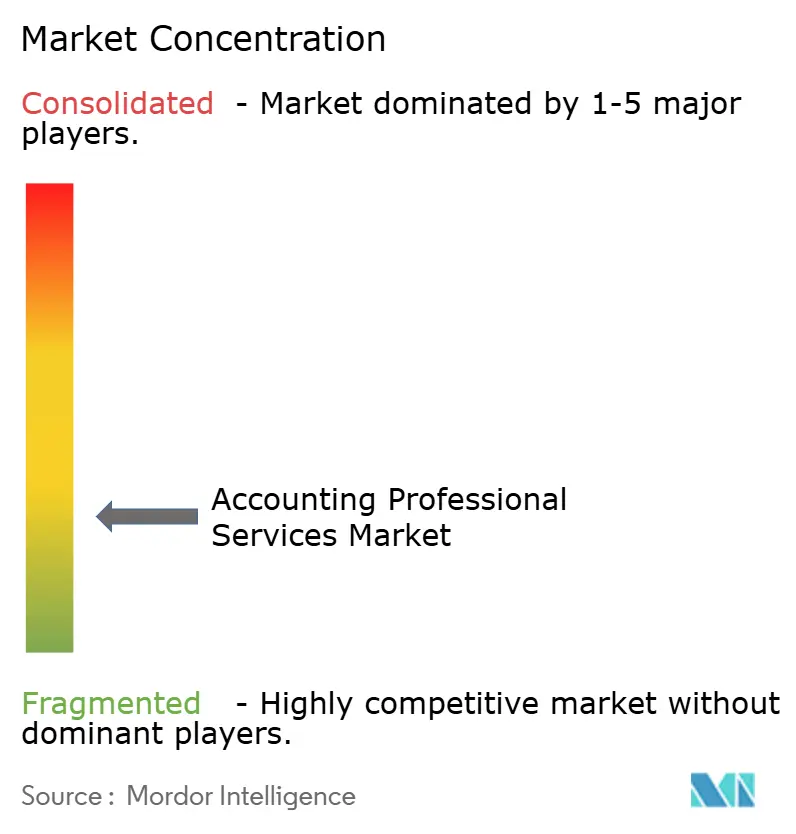
| Market Concentration | Low |
Major Players *Disclaimer: Major Players sorted in no particular order Image © Mordor Intelligence. Reuse requires attribution under CC BY 4.0. | |
Accounting Professional Services Market Analysis by Mordor Intelligence
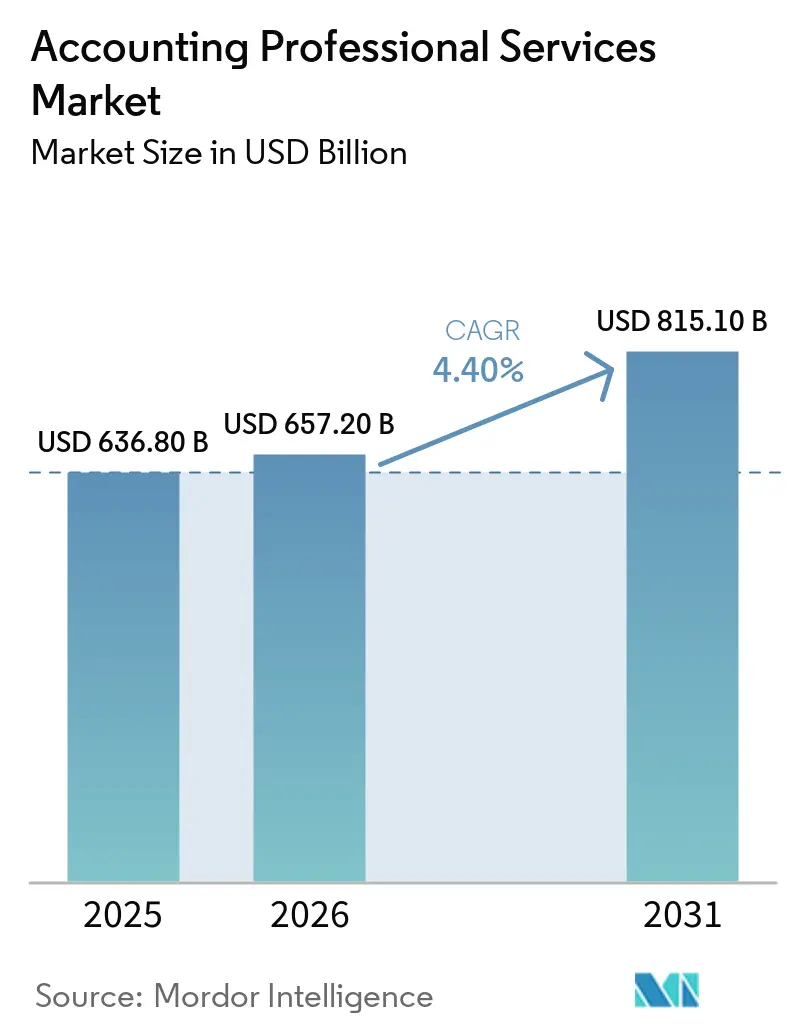
The Accounting Professional Services Market size was valued at USD 636.80 billion in 2025 and is estimated to grow from USD 657.20 billion in 2026 to reach USD 815.10 billion by 2031, at a CAGR of 4.40% during the forecast period (2026-2031).
The accounting professional services market is supported by a continuing move from internally managed finance work toward externally delivered services. More complex reporting rules across jurisdictions are also increasing demand for audit, tax, compliance, and assurance work. Artificial intelligence is changing labor needs and service delivery at the same time, rather than acting as a separate influence. The shortage of qualified staff encourages clients to outsource more work and encourages providers to invest in technology, which strengthens demand for firms that can provide both capabilities. Routine bookkeeping and standardized tax work face pricing pressure from automation, while advisory and technology-enabled engagements are becoming more important to provider revenue.
Key Report Takeaways
- By service type, audit and assurance captured 29.7% of the accounting professional services market share in 2025, while accounting and finance outsourcing services are projected to grow at a 7.2% CAGR through 2031.
- By client size, large enterprises captured 55.4% of the accounting professional services market share in 2025, while small and micro enterprises are projected to grow at a 6.4% CAGR through 2031.
- By industry vertical, BFSI captured 25.3% of the accounting professional services market size in 2025, while healthcare and life sciences are projected to grow at a 6.5% CAGR through 2031.
- By service delivery model, onshore/domestic delivery captured 77.2% of the accounting professional services market size in 2025, while offshore delivery is projected to grow at a 7.0% CAGR through 2031.
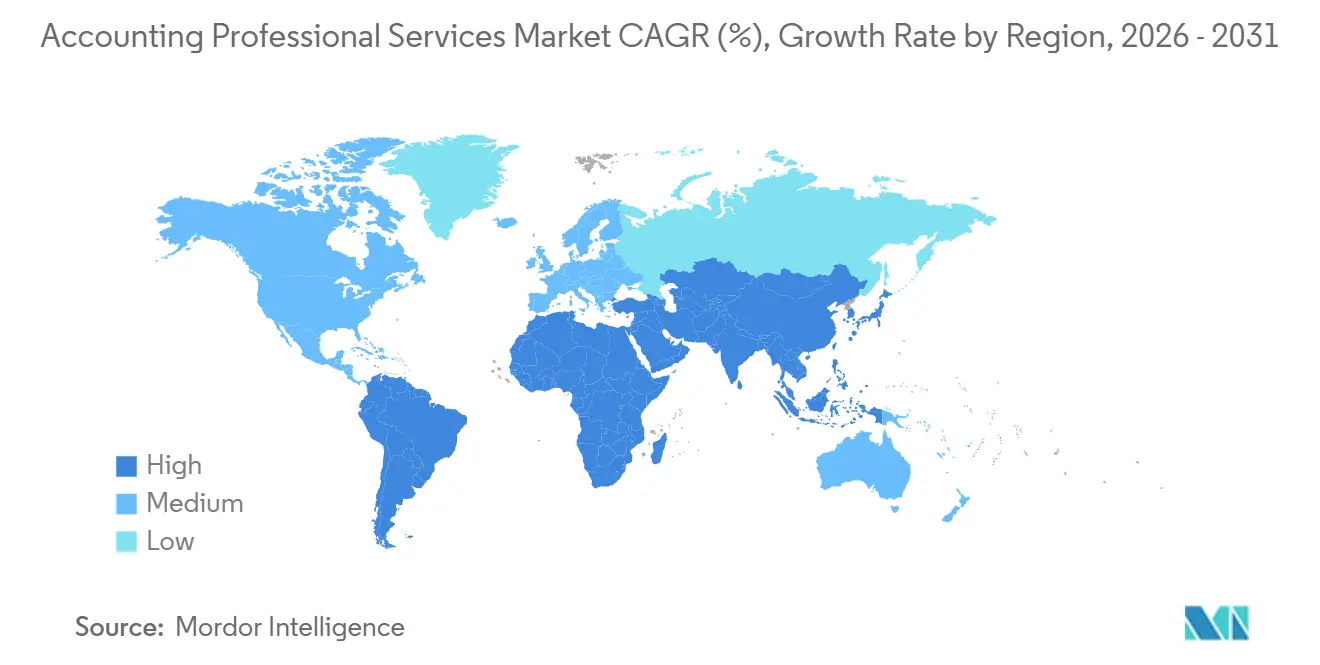
- By geography, North America captured 37.6% of the accounting professional services market in 2025, while Asia-Pacific is projected to grow at a 6.8% CAGR through 2031.
Note: Market size and forecast figures in this report are generated using Mordor Intelligence’s proprietary estimation framework, updated with the latest available data and insights as of January 2026.
Global Accounting Professional Services Market Trends and Insights
Drivers Impact Analysis*
| Driver | (~) % Impact on CAGR Forecast | Geographic Relevance | Impact Timeline |
|---|---|---|---|
| Increasing Outsourcing and Co-Sourcing of Finance and Accounting Functions | +1.2% | Global, with the highest intensity in North America, Asia-Pacific, and Western Europe | Medium term (2-4 years) |
| Growing Regulatory and Financial Reporting Complexity | +0.9% | Global, especially the European Union, North America, and Gulf Cooperation Council countries | Long term (≥ 4 years) |
| Adoption of Cloud-Based Accounting and Digital Financial Reporting | +0.7% | Global, with the highest adoption in North America and Northern Europe | Short term (≤ 2 years) |
| Expansion of AI-Enabled Accounting and Advisory Services | +0.8% | Global, with the fastest monetization in North America and Asia-Pacific delivery hubs | Short term (≤ 2 years) |
| Rising Demand for Real-Time Financial Insights and Decision Support | +0.6% | Global, particularly in large enterprises and the BFSI segments | Medium term (2-4 years) |
| Growing Cross-Border Business and International Tax and Accounting Requirements | +0.5% | Global, with the highest relevance in multinational-heavy North American, European Union, and Asia-Pacific markets | Long term (≥ 4 years) |
| Source: Mordor Intelligence | |||
Increasing Outsourcing and Co-Sourcing of Finance and Accounting Functions
Outsourcing is increasingly used as a strategic operating model rather than solely as a cost-control measure in the accounting professional services market. A February 2026 executive survey reported 5.1% adjusted organic revenue growth across the accounting sector during 2025, with client accounting services, consulting, and tax expected to support 7.3% growth in 2026[1]. The survey also found that 62% of participating accounting firms had moved from early artificial intelligence exploration to targeted implementation, while 53% expected reduced staff hiring as a result. An artificial intelligence-enabled accountant can manage 200 client entities, compared with 20 under traditional models. This change can lower unit costs for clients and alter the commercial basis of outsourcing contracts. Firms with established artificial intelligence delivery processes can therefore gain an early operating advantage in the accounting professional services market.
Growing Regulatory and Financial Reporting Complexity
Regulatory expansion continues to support the accounting professional services market because it creates recurring reporting and assurance needs. The European Union Omnibus I Directive entered into force in 2026 and raised Corporate Sustainability Reporting Directive thresholds, reducing the number of mandatory sustainability reporters by 80%. The smaller mandatory population redirects work toward companies that remain within the full reporting scope and require more complex assurance engagements. Companies outside the mandatory scope may still seek voluntary verification when lenders and investors request environmental, social, and governance data[2]. A 417% increase in institutional fines in the first half of 2025 reflects the wider compliance pressure on financial institutions. These conditions support demand for accounting, compliance, and assurance services in the accounting professional services market.
Adoption of Cloud-Based Accounting and Digital Financial Reporting
Cloud enterprise resource planning modernization is creating accounting and consulting work beyond software purchases. PwC is consolidating more than 100 legacy enterprise resource planning systems on a single SAP Cloud ERP platform, and more than 100,000 professionals in 19 countries are already working on the new platform[3]. Such projects require system integration, process redesign, data migration, and assurance during parallel operation. The shift from time-and-materials contracts toward outcome-based and fixed-price arrangements for cloud enterprise resource planning services requires providers to develop implementation and post-implementation assurance capabilities alongside their traditional offerings. Clients with complex enterprise resource planning estates may prefer bundled support, creating a broader service opportunity within the accounting professional services market.
Expansion of AI-Enabled Accounting and Advisory Services
Artificial intelligence is now used in professional services delivery rather than only in pilot programs. In 2026, 40% of professional services organizations actively used generative artificial intelligence, compared with 22% in 2025. Among current users, 82% engaged with generative artificial intelligence at least weekly, while 15% of organizations already used agentic tools[4]. Deloitte has committed more than USD 3 billion to generative artificial intelligence through fiscal year 2030 and introduced the Deloitte Global Agentic Network and ZoraAI. ZoraAI is designed for invoice processing, financial trend analysis, and compliance documentation workflows. EY reported a 30% rise in artificial intelligence-related revenue during fiscal year 2025, indicating demand for enterprise transformation and artificial intelligence governance services.
Restraints Impact Analysis*
| Restraint | (~) % Impact on CAGR Forecast | Geographic Relevance | Impact Timeline |
|---|---|---|---|
| Shortage of Qualified and Technology-Ready Accounting Professionals | -1.5% | Global, most acute in the United States, the United Kingdom, and Australia | Long term (≥ 4 years) |
| Rising Cybersecurity, Data Privacy and Regulatory Compliance Costs | -0.8% | Global, with the highest cost pressure in financial services-heavy markets | Medium term (2-4 years) |
| Automation-Induced Pressure on Routine Accounting Fees | -0.6% | Global, concentrated in the United States, the United Kingdom, and technologically mature Asia-Pacific markets | Short term (≤ 2 years) |
| High Technology Investment and Integration Costs for Accounting Firms | -0.5% | Global, most burdensome for mid-tier and regional accounting firms | Medium term (2-4 years) |
| Source: Mordor Intelligence | |||
Shortage of Qualified and Technology-Ready Accounting Professionals
The shortage of qualified professionals is a structural constraint on the accounting professional services market. The Controllers Council reported a 77% Talent Shortage Index in 2026, compared with a 108% Talent Surplus Index in 2025. Organizations reported an average of 17 open accounting and finance roles, compared with 5 in 2025 and 2 in 2024. The National Association of State Boards of Accountancy reported 653,408 actively licensed certified public accountants in August 2025, down from 671,855 a year earlier. The American Institute of Certified Public Accountants reported that accounting degree completions fell 6.6% year over year to 55,152 during the 2023-24 academic cycle. Fewer entrants, retirements, and demand for technology-ready skills are weakening the mid-level talent pipeline and favoring providers with scaled outsourcing and technology-enabled delivery models.
Rising Cybersecurity, Data Privacy and Regulatory Compliance Costs
Accounting firms retain highly sensitive tax, identity, and financial account information, which makes cybersecurity an operating and compliance concern. IBM reported a global average breach cost of USD 4.99 million in 2026, up 12% from the prior year, while the financial services average was USD 6.29 million. The United States average was USD 11.5 million per breach, more than twice the global figure. EY notified the California Attorney General of a breach involving a third-party information technology support platform and client tax information in July 2026. The event shows that risk can move through connected vendor tools as well as through a firm's own systems. Cybersecurity insurance, penetration testing, Safeguards Rule compliance, and client notification processes add fixed costs, particularly for mid-tier firms.
*Our forecasts treat driver/restraint impacts as directional, not additive. The impact forecasts reflect baseline growth, mix effects, and variable interactions.
Segment Analysis
By Service Type: Outsourcing Changes the Audit-Led Revenue Mix
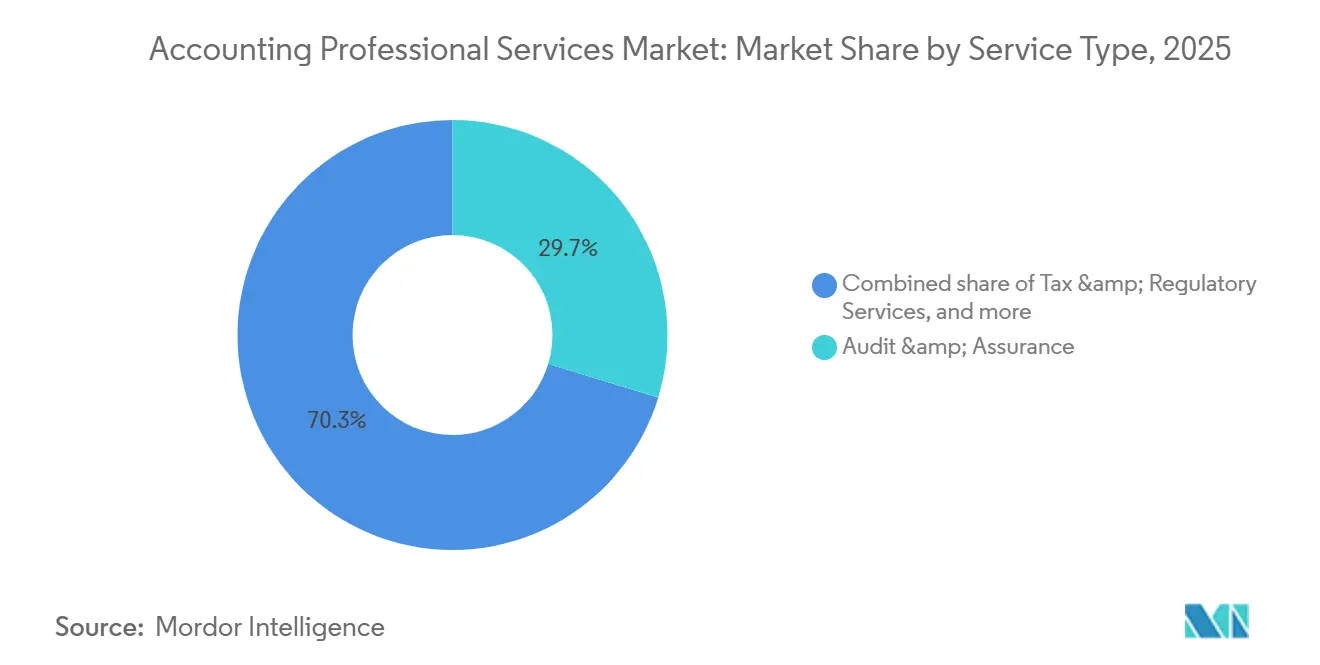
Audit & assurance held 29.7% of the accounting professional services market in 2025, making it the largest service category. Statutory audit requirements for listed entities continue to support this position. Expanding environmental, social, and governance assurance work also adds to audit demand. Accounting & Finance Outsourcing Services is projected to grow at a 7.2% CAGR through 2031. Chief financial officers are increasingly treating accounts payable, accounts receivable, payroll, and financial reporting as managed services rather than internal functions.
Tax & Regulatory Services remain resilient because global minimum tax rules and e-invoicing mandates extend compliance needs across jurisdictions. Advisory & Consulting Services benefit from artificial intelligence governance, enterprise transformation, and merger and acquisition due diligence. Risk, Compliance & Internal Audit Services are supported by board attention to operational risk after regulatory actions in financial services. Artificial intelligence tools can reduce the time required for bank reconciliations, transaction coding, and month-end close work by 30-70%. This automation redirects labor toward advisory and technology consulting work rather than reducing the accounting professional services market. Digital & Technology Consulting is also expanding with cloud enterprise resource planning projects and artificial intelligence readiness assessments.
By Client Size: Large Enterprises Lead Revenue While Small Businesses Expand Access
Large enterprises held 55.4% of the accounting professional services market in 2025. Their statutory, cross-border, and environmental, social, and governance reporting requirements remain complex. Large transaction volumes also create ongoing demand for support across several jurisdictions. Small & micro enterprises are expected to record the fastest growth at a 6.4% CAGR through 2031. Cloud-native accounting platforms, offshore delivery, and hybrid delivery models are making professional services more accessible to growth-stage businesses.
Mid-market enterprises are an important competitive area for private equity-backed accounting roll-ups and artificial intelligence-enabled boutique advisory firms. The segment has been historically underserved by the largest networks and can be expensive for smaller regional firms. Government & Public sector entities provide steady demand, especially where financial reporting reforms align with International Public Sector Accounting Standards. Large clients are increasingly negotiating fixed-fee and subscription-based arrangements instead of conventional hourly engagements. In 2026, 62% of accounting firms had moved from artificial intelligence exploration to targeted deployment. This efficiency is important where fixed-fee arrangements place pressure on realization rates.
By Industry Vertical: BFSI Leads Demand While Healthcare Expands Quickly
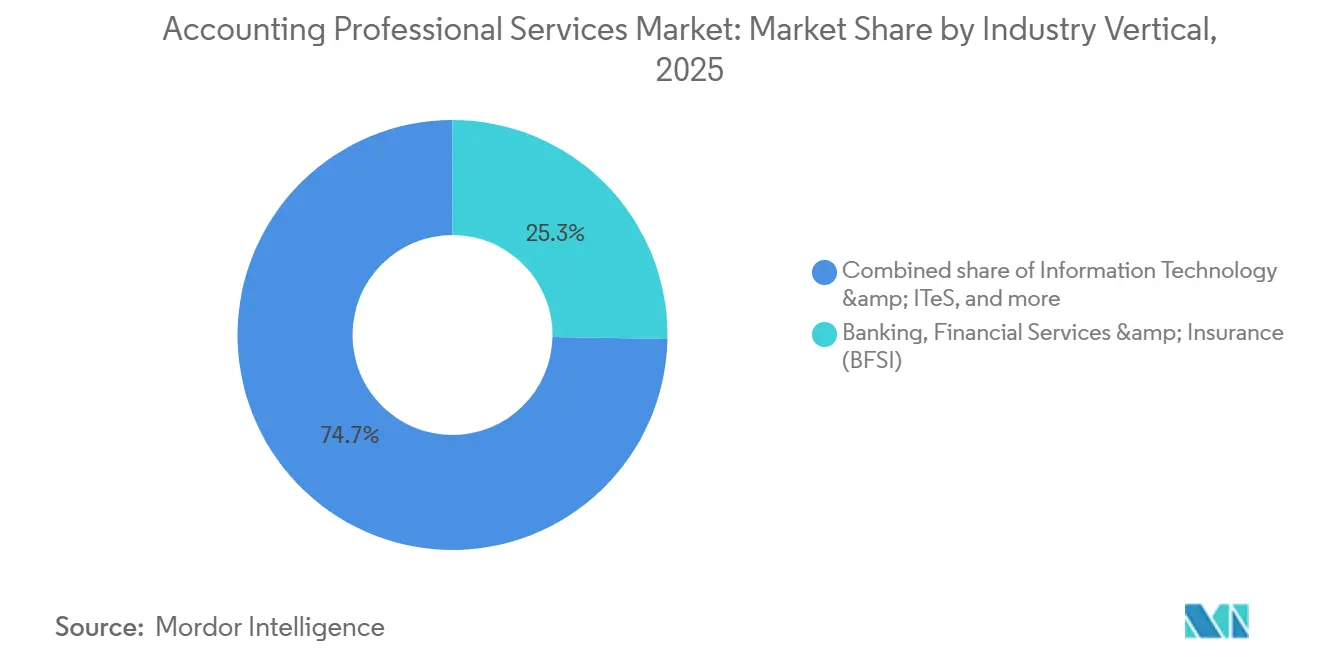
BFSI held 25.3% of the accounting professional services market size in 2025. Regulatory capital calculations, anti-money laundering monitoring, and fair-value accounting make the sector highly audit-intensive. These requirements require ongoing assurance and advisory work. Healthcare & Life Sciences is projected to grow at a 6.5% CAGR through 2031. More complex revenue cycle accounting and health information-related financial controls support demand for specialized outsourced services.
Healthcare recorded a 68% finance and accounting outsourcing adoption rate in 2026, with revenue cycle management, claims reconciliation, and payer reporting as the main outsourced activities. IT & ITeS require support for multi-entity stock compensation accounting. Manufacturing & industrial clients require cost accounting for global supply chains. Consumer & Retail, Energy & Utilities, and Real estate & construction are adopting outsourcing as they consolidate operations and manage back-office costs. Telecommunications, infrastructure, and transportation require specialized accounting for long-duration contracts and regulatory asset bases. KPMG found that 67% of healthcare investors expected greater deal activity in 2026, supporting demand for transaction advisory and financial due diligence.
By Service Delivery Model: Offshore Delivery Uses Talent and Technology Scale
Onshore/domestic delivery retained 77.2% of the accounting professional services market in 2025. Clients value proximity, time-zone alignment, and local regulatory familiarity. These factors are particularly important for audit sign-off, tax strategy, and advisory work that requires real-time interaction. Offshore delivery is projected to grow at a 7.0% CAGR through 2031. Its growth is increasingly linked to artificial intelligence-enabled talent scale rather than labor cost differences alone.
India's large accounting delivery base supports complex finance work as well as transactional processing. Hybrid delivery combines onshore relationship management, offshore execution, and digital automation for mid-market and large enterprise clients. By 2025, 65% of organizations planned to expand or restructure finance shared services, while 57% planned to integrate outsourced or hybrid delivery into these centers. This model can turn periodic vendors into embedded operating partners and increase switching costs. Providers that combine onshore artificial intelligence advisory work with offshore talent centers can establish a cost position that is difficult for fully onshore competitors to match.
Geography Analysis
North America held 37.6% of the accounting professional services market in 2025. The United States supports demand through Securities and Exchange Commission disclosures, Public Company Accounting Oversight Board inspections, Sarbanes-Oxley internal control requirements, and state certified public accountant licensing. Deloitte's Americas business grew 7.1% in local currency during fiscal year 2025, supported by consulting and tax advisory demand. Private equity activity is an important development in the United States, with financial buyers accounting for 54.8% of accounting merger and acquisition transactions year to date in 2026. Latin America, especially Brazil and Mexico, is developing as a nearshore delivery location because cross-border trade requirements and International Financial Reporting Standards adoption support demand. Colombia and other nearshore locations also benefit from time-zone alignment with United States buyers.
Asia-Pacific is projected to expand at a 6.8% CAGR through 2031, the fastest regional rate in the accounting professional services market. India serves as both a high-growth domestic location and a large offshore accounting delivery center. China maintains demand for compliance and advisory work as multinational companies manage evolving financial reporting requirements. Singapore, Australia, and Japan create demand for sophisticated advisory and environmental, social, and governance assurance services. The Institute of Chartered Accountants of India is preparing changes to the Chartered Accountants Act that would allow domestic firm consolidation, capital investment in practices, and a wider scope of advisory work. South Korea's insurance reporting requirements, together with rising foreign direct investment in Vietnam and Indonesia, add demand for accounting professional services across the Asia-Pacific.
Europe has an active regulatory pipeline that supports assurance and reporting activity. The Corporate Sustainability Reporting Directive Omnibus I changes in 2026 prompted companies to redesign reporting architectures and seek assurance advice. PwC's Europe, Middle East, and Africa revenue increased 2.5% in fiscal year 2025, with Central and Eastern Europe and Spain delivering strong growth. The Middle East and Africa remain an early-stage opportunity, as Saudi Arabia's Vision 2030 program broadens International Financial Reporting Standards adoption and the United Arab Emirates attracts regional corporate headquarters. Egypt and South Africa have large domestic bases where regulatory development expands the number of entities requiring formal accounting work.
Competitive Landscape
The accounting professional services market has two distinct competitive tiers. Deloitte, PwC, EY, and KPMG reported combined fiscal year 2025 revenue of USD 220.4 billion. Deloitte reported USD 70.5 billion, PwC reported USD 56.9 billion, EY reported USD 53.2 billion, and KPMG reported USD 39.8 billion. These networks are incorporating generative artificial intelligence into core service lines. Deloitte has committed more than USD 3 billion to generative artificial intelligence through fiscal year 2030, and PwC continues its USD 1.5 billion artificial intelligence program.
Below the largest networks, private equity is consolidating mid-tier accounting providers. Financial buyers represented 54.8% of accounting merger and acquisition transactions year to date in 2026, with 62 deals reported through July 2026. The alternative practice structure allows investment in an advisory affiliate while a separately owned licensed certified public accountant firm completes attest work. EisnerAmper and Baker Tilly represent private equity-backed platforms that are investing in technology and geographic expansion. Artificial intelligence-native platforms, including Ramp, Canopy, and Puzzle, are building ledger and practice-management integrations. These platforms can place further pressure on transactional services and increase the value of judgment-based advisory work.
Deloitte's Omnia and KPMG's artificial intelligence-enabled inspection tools are examples of proprietary audit analytics systems that require sustained investment. Forty percent of audit reports include Critical Audit Matters, which broadens the complexity and billable scope of statutory audit work. Smaller firms without comparable research and development budgets may find it harder to build equivalent capabilities. Grant Thornton Advisors agreed to acquire CBIZ in a USD 5 billion transaction supported by New Mountain Capital in July 2026. H.I.G. Capital became HBK's first institutional partner through a strategic growth investment in August 2026. Ryan completed its acquisition of Svalner Atlas Advisors in September 2026, expanding its presence across the Nordic and Benelux regions.
Accounting Professional Services Industry Leaders
-
Deloitte
-
PricewaterhouseCoopers (PwC)
-
Ernst & Young (EY)
-
KPMG
-
BDO Global
- *Disclaimer: Major Players sorted in no particular order
Recent Industry Developments
- June 2026: Ryan, LLC completed the acquisition of Svalner Atlas Advisors, a premier independent tax and transaction advisory firm headquartered in Stockholm, Sweden, expanding Ryan's presence across the Nordics and Benelux.
- August 2026: H.I.G. Capital announced a strategic growth investment in HBK, one of the United States' leading integrated accounting, tax, audit, consulting, technology, and wealth management firms, establishing H.I.G. as HBK's first institutional partner.
- July 2026: Grant Thornton Advisors entered into a definitive agreement to acquire CBIZ, Inc. in an all-cash transaction valued at USD 5 billion, supported by New Mountain Capital. The combined entity is projected to generate USD 7.5 billion in annual revenue with more than 34,000 staff globally, positioning it as the fifth-largest United States professional services, tax, and advisory provider.
Global Accounting Professional Services Market Report Scope
| Audit & Assurance |
| Tax & Regulatory Services |
| Advisory & Consulting Services |
| Risk, Compliance & Internal Audit Services |
| Accounting & Finance Outsourcing Services |
| Digital & Technology Consulting |
| Large Enterprises |
| Mid-Market Enterprises |
| Small & Micro Enterprises |
| Government & Public Sector Entities |
| Banking, Financial Services & Insurance (BFSI) |
| Information Technology & ITeS |
| Manufacturing & Industrial |
| Healthcare & Life Sciences |
| Consumer & Retail |
| Energy & Utilities |
| Real Estate & Construction |
| Infrastructure & Engineering |
| Telecommunications, Media & Entertainment |
| Transportation & Logistics |
| Other Industry Verticals |
| Onshore/Domestic Delivery |
| Offshore Delivery |
| Hybrid Delivery |
| North America | United States |
| Canada | |
| Mexico | |
| South America | Brazil |
| Argentina | |
| Rest of South America | |
| Europe | United Kingdom |
| Germany | |
| France | |
| Italy | |
| Spain | |
| Rest of Europe | |
| Asia-Pacific | China |
| Japan | |
| India | |
| South Korea | |
| Australia | |
| Indonesia | |
| Thailand | |
| Malaysia | |
| Singapore | |
| Vietnam | |
| Rest of Asia-Pacific | |
| Middle East and Africa | Saudi Arabia |
| United Arab Emirates | |
| Turkey | |
| South Africa | |
| Egypt | |
| Rest of Middle East and Africa |
| By Service Type | Audit & Assurance | |
| Tax & Regulatory Services | ||
| Advisory & Consulting Services | ||
| Risk, Compliance & Internal Audit Services | ||
| Accounting & Finance Outsourcing Services | ||
| Digital & Technology Consulting | ||
| By Client Size | Large Enterprises | |
| Mid-Market Enterprises | ||
| Small & Micro Enterprises | ||
| Government & Public Sector Entities | ||
| By Industry Vertical | Banking, Financial Services & Insurance (BFSI) | |
| Information Technology & ITeS | ||
| Manufacturing & Industrial | ||
| Healthcare & Life Sciences | ||
| Consumer & Retail | ||
| Energy & Utilities | ||
| Real Estate & Construction | ||
| Infrastructure & Engineering | ||
| Telecommunications, Media & Entertainment | ||
| Transportation & Logistics | ||
| Other Industry Verticals | ||
| By Service Delivery Model | Onshore/Domestic Delivery | |
| Offshore Delivery | ||
| Hybrid Delivery | ||
| By Geography | North America | United States |
| Canada | ||
| Mexico | ||
| South America | Brazil | |
| Argentina | ||
| Rest of South America | ||
| Europe | United Kingdom | |
| Germany | ||
| France | ||
| Italy | ||
| Spain | ||
| Rest of Europe | ||
| Asia-Pacific | China | |
| Japan | ||
| India | ||
| South Korea | ||
| Australia | ||
| Indonesia | ||
| Thailand | ||
| Malaysia | ||
| Singapore | ||
| Vietnam | ||
| Rest of Asia-Pacific | ||
| Middle East and Africa | Saudi Arabia | |
| United Arab Emirates | ||
| Turkey | ||
| South Africa | ||
| Egypt | ||
| Rest of Middle East and Africa | ||
Key Questions Answered in the Report
What is the forecast growth rate for accounting professional services through 2031?
The sector is projected to grow at a 4.4% CAGR from 2026 to 2031. Its value is expected to rise from USD 657.2 billion in 2026 to USD 815.1 billion by 2031. Growth reflects a wider shift toward external finance delivery, more complex reporting, and greater use of technology in service delivery.
Which accounting service has the largest revenue position?
Audit & Assurance held the largest share at 29.7% in 2025. Statutory audit requirements for listed companies provide a stable base of activity. Environmental, social, and governance reporting also broadens the need for assurance work, particularly where companies need support with reporting processes and related assurance engagements.
Which service is expected to grow the fastest through 2031?
Accounting & Finance Outsourcing Services is projected to grow at a 7.2% CAGR through 2031. Companies are moving accounts payable, accounts receivable, payroll, and financial reporting to managed-service models. This trend is supported by demand for scalable delivery, technology-enabled processes, and access to skilled accounting resources.
Why is the shortage of certified public accountants important?
The active certified public accountant population fell to 653,408 in August 2025. Organizations reported an average of 17 open accounting and finance roles in 2026. The shortage raises delivery constraints for providers and gives more value to outsourcing, hybrid delivery, and technologies that reduce time spent on recurring accounting tasks.
Which region is forecast to grow fastest?
Asia-Pacific is forecast to grow at a 6.8% CAGR through 2031. India has an important domestic and offshore delivery role, while China, Singapore, Australia, and Japan support demand for compliance, advisory, and assurance work. Foreign investment and changing reporting requirements also contribute to activity in several regional markets.
How is artificial intelligence changing accounting services?
Artificial intelligence supports automation of recurring tasks such as transaction coding, reconciliations, and month-end processes. It also expands demand for advisory, governance, cloud implementation, and technology assurance services. Providers are using these tools to support fixed-fee engagements while shifting professional capacity toward work requiring judgment, specialized knowledge, and client interaction.