
Access Certification and Review Market Size and Share
Market Overview
| Study Period | 2021 - 2032 |
|---|---|
| Market Size (2027) | USD 5.71 Billion |
| Market Size (2032) | USD 11.48 Billion |
| Growth Rate (2027 - 2032) | 14.99 % |
| Fastest Growing Market | Asia-Pacific |
| Largest Market | North America |
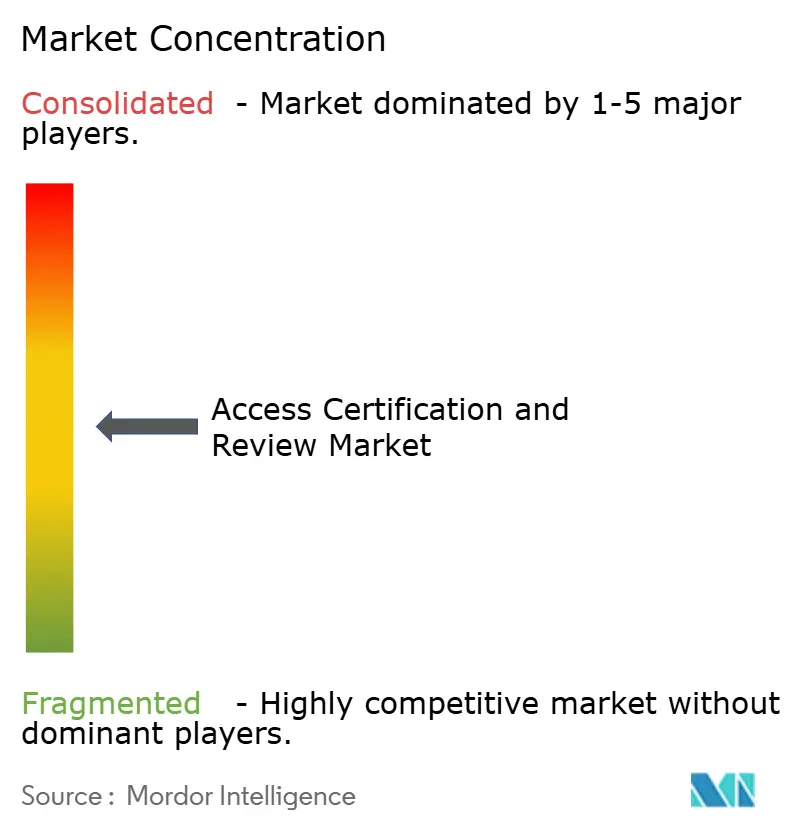
| Market Concentration | Medium |
Major Players *Disclaimer: Major Players sorted in no particular order Image © Mordor Intelligence. Reuse requires attribution under CC BY 4.0. | |
Access Certification and Review Market Analysis by Mordor Intelligence
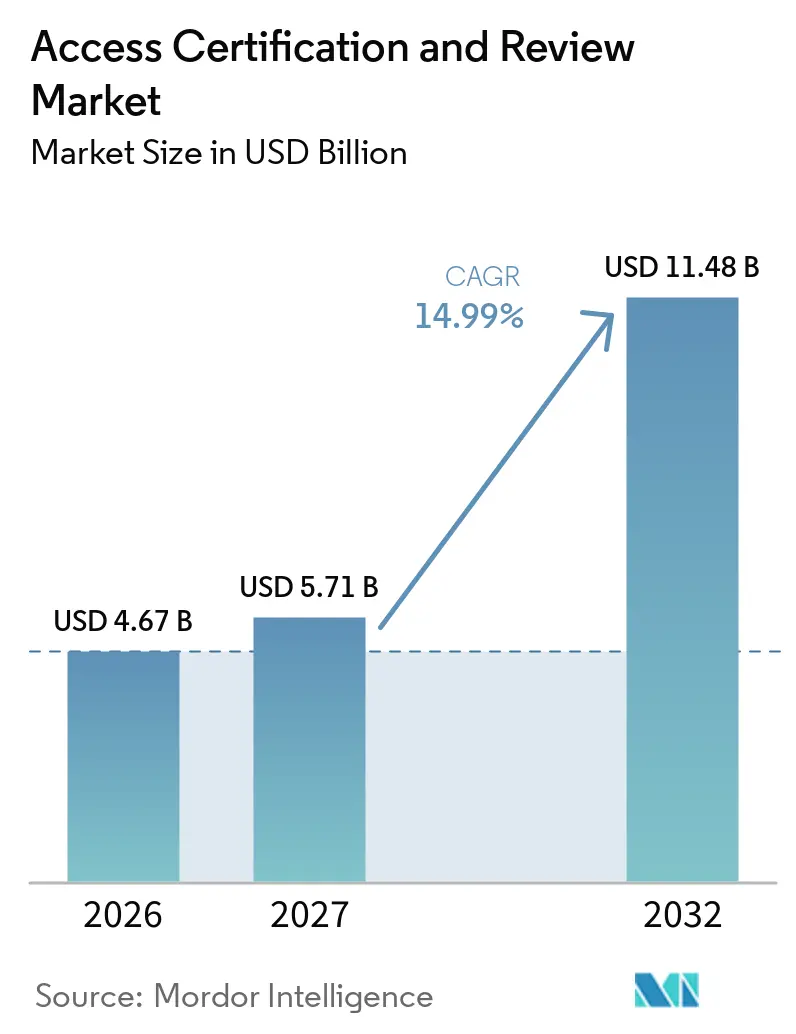
The access certification and review market size is projected to be USD 4.67 billion in 2026, USD 5.71 billion in 2027, and reach USD 11.48 billion by 2032, growing at a CAGR of 14.99% from 2027 to 2032. The access certification and review market is being shaped by the move from periodic compliance checks to continuous control of access rights. Regulations, including the EU Digital Operational Resilience Act, have increased the need for documented least-privilege policies and recurring entitlement reviews in regulated organizations. Zero-trust programs are also changing access reviews from fixed calendar campaigns into controls that can respond to changes in risk, identity, and application access. Vendors are responding by combining governance, privileged access management, cloud entitlement management, and AI-supported review functions in broader identity security platforms. This creates opportunities for providers that can reduce the effort of integration and help organizations produce clear audit evidence without increasing reviewer workloads.
Key Report Takeaways
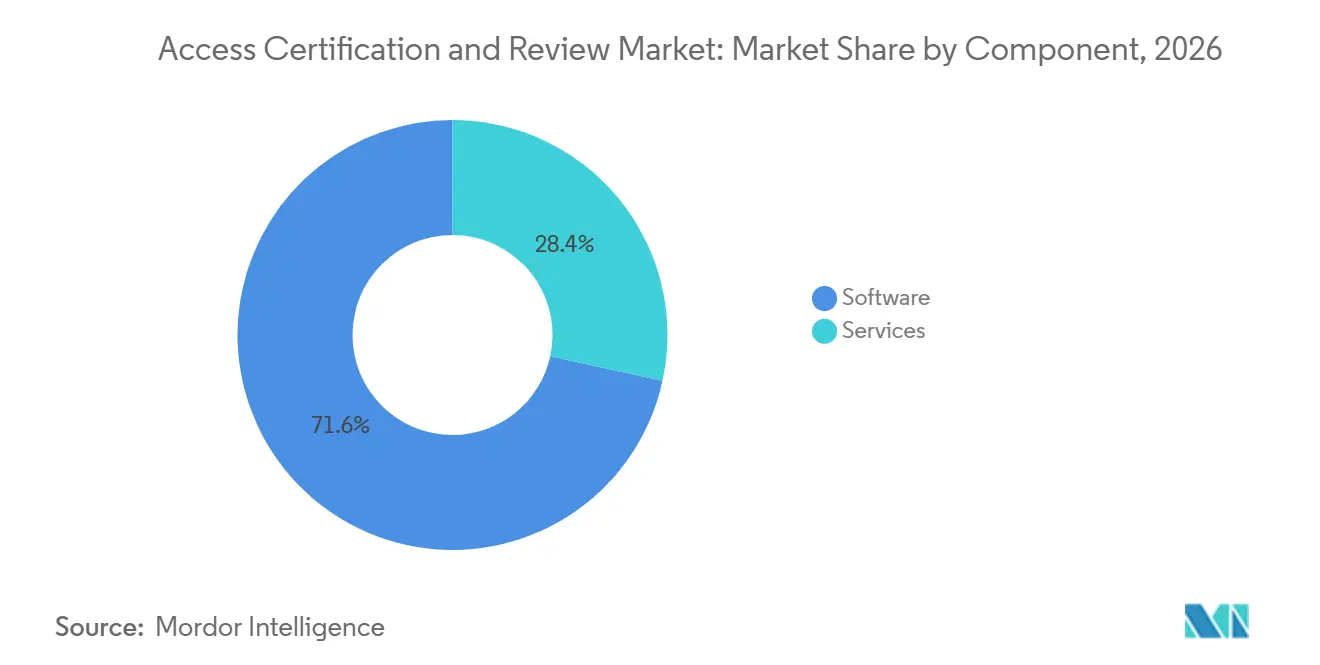
- By component, software held 71.58% of the access certification and review market share in 2026, while services are projected to expand at an 18.76% CAGR through 2032.
- By deployment mode, cloud-based deployment held 67.58% of the access certification and review market share in 2026.
- By organization size, large enterprises accounted for 68.54% of the access certification and review market share in 2026, while SMEs are projected to expand at a 16.72% CAGR through 2032.
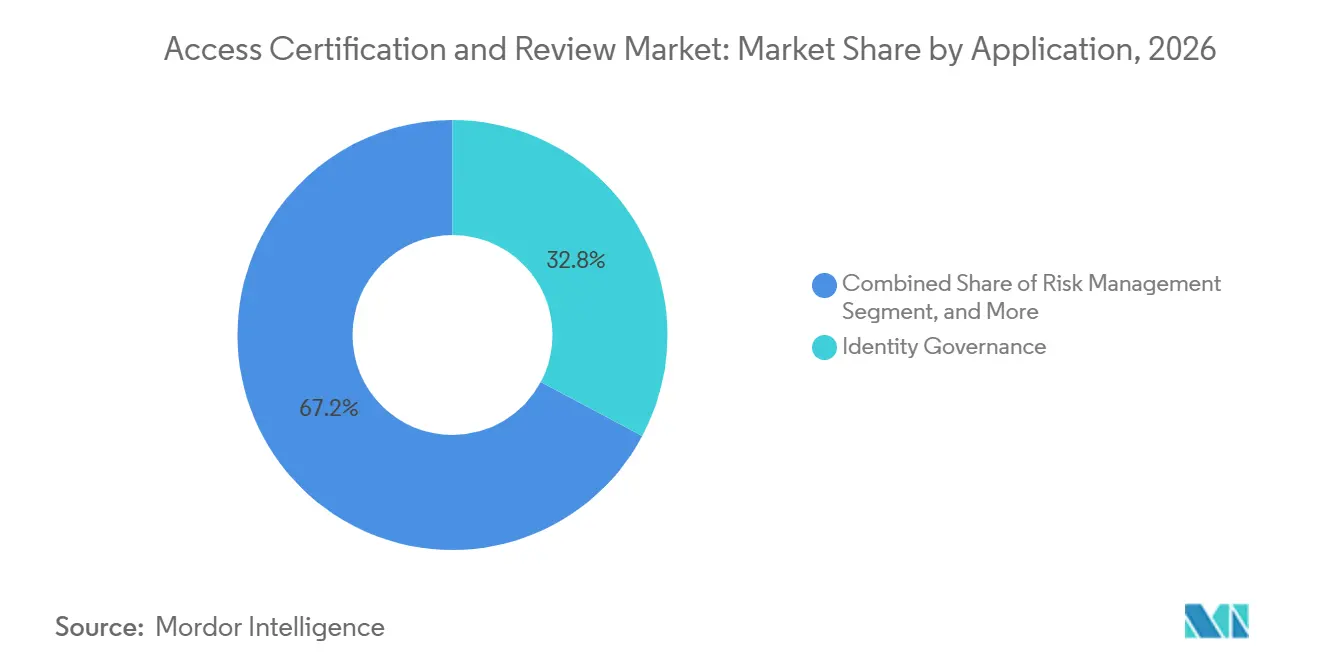
- By application, identity governance accounted for 32.79% of the access certification and review market share in 2026, while privileged access certification is projected to expand at an 18.72% CAGR through 2032.
- By end-user industry, BFSI held 27.69% of the access certification and review market share in 2026, while government and public administration is projected to expand at a 19.22% CAGR through 2032.
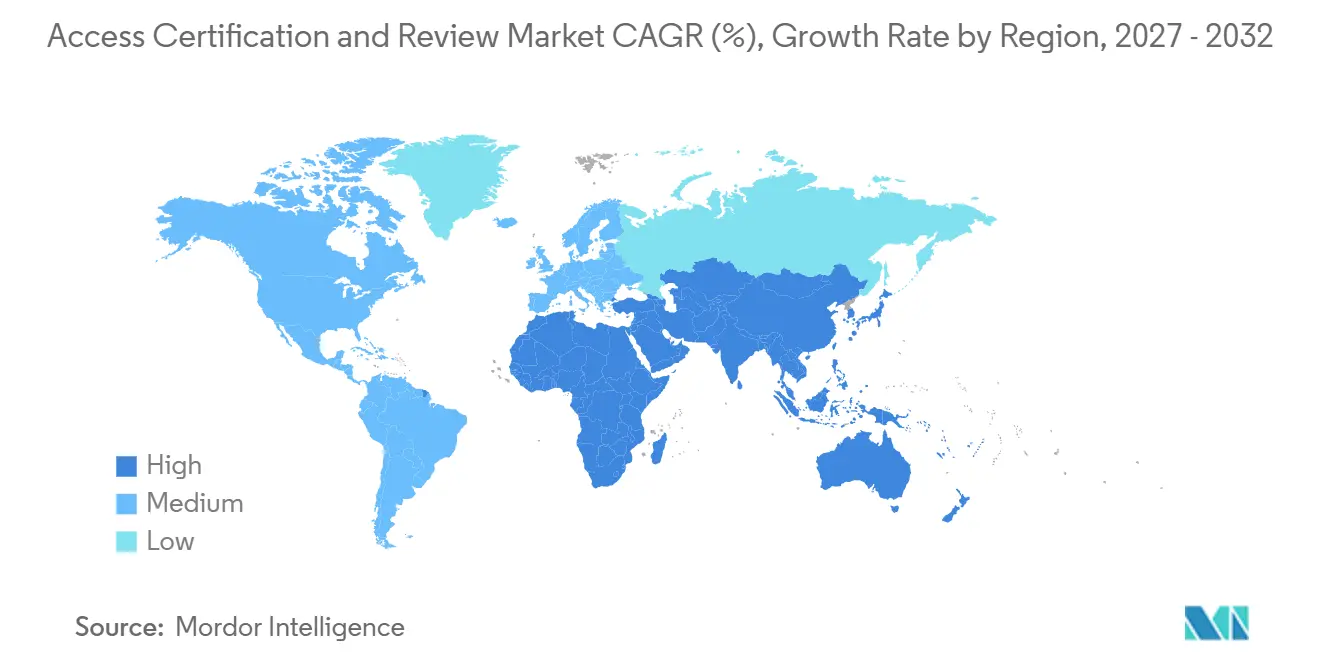
- By geography, North America held 41.64% of the access certification and review market share in 2026, while Asia-Pacific is projected to expand at a 17.93% CAGR through 2032.
Note: Market numbers in this report are based on Mordor Intelligence's proprietary estimation framework, which combines nine months of actuals with Q4 projections for base year 2026.
Market Trends and Insights
Drivers Impact Analysis of Access Certification and Review Market*
| DRIVER | (~) % IMPACT ON CAGR FORECAST | GEOGRAPHIC RELEVANCE | IMPACT TIMELINE |
|---|---|---|---|
| Regulatory Audit and Least-Privilege Requirements | +3.2% | Global, concentrated in North America and Europe | Short term (≤ 2 years) |
| Zero-Trust and Passwordless Programs Accelerating Entitlement Governance | +2.8% | North America and Europe, with spillover to Asia-Pacific | Medium term (2-4 years) |
| AI-Driven Risk Scoring and Review Recommendation Adoption | +2.4% | Global | Medium term (2-4 years) |
| PAM and IGA Convergence in Regulated Enterprises | +2.1% | North America, Europe, and Asia-Pacific | Medium term (2-4 years) |
| Sovereign-Cloud and Data-Residency Requirements | +1.7% | Europe, Middle East, and select Asia-Pacific markets | Long term (≥ 4 years) |
| Machine, Service, and AI-Agent Identity Expansion | +1.9% | Global | Long term (≥ 4 years) |
| Source: Mordor Intelligence | |||
Regulatory Audit and Least-Privilege Requirements
DORA has applied to EU financial entities since January 2025 and has reinforced the need for controlled access, least privilege, and documented reviews.[1] The access certification and review market benefits because these obligations make review records part of a regulated organization’s evidence base. ISO/IEC 27001 requires organizations to review user access rights at appropriate intervals, which supports recurring certification activity across both regulated sectors and supplier ecosystems. NIST SP 800-63-4 updates federal digital identity guidance for identity proofing, authentication, and federation, which encourages stronger evidence practices in identity programs. Organizations operating across several jurisdictions face different audit schedules, so access certification programs are often expanded in stages rather than through a single enterprise-wide rollout. This pattern supports continued demand for platforms that standardize policy, review, remediation, and audit reporting across applications.
Zero-Trust and Passwordless Programs Accelerating Entitlement Governance
Zero-trust architecture requires continuous access evaluation rather than trusting a user once inside a network. NIST identifies identity, credential, and access management as a core part of implementing zero-trust architecture.[2] This requirement makes entitlement certification more relevant because organizations need evidence that users, services, and applications retain only the access they require. Reviews can become event-driven when a role changes, an elevated privilege is granted, or a user moves between systems. Passwordless programs can improve identity attribution by reducing the use of shared credentials and strengthening the link between an individual and an access decision. Better attribution gives reviewers a clearer basis for validating entitlements and gives auditors a more complete record of approval. The access certification and review market, therefore, benefits when zero-trust and passwordless initiatives broaden the number of identities and resources that must be governed.
AI-Driven Risk Scoring and Review Recommendation Adoption
AI-supported certification tools use access history, peer comparisons, usage information, and policy signals to help reviewers focus on higher-risk decisions. This can shift campaigns away from broad approval requests and toward reviews that explain why an entitlement requires attention. SailPoint announced in October 2026 that its updated certification capabilities include a re-platformed engine, GxP-compliant sign-off, and conversational access requests. The access certification and review market gains from these functions because enterprises need to control campaign volume without weakening accountability. AI-generated recommendations also create a record of the signals considered in an access decision, which can support later audit and privacy reviews. The value of these tools depends on reliable identity data, clear entitlement ownership, and controls that allow a person to challenge or override a recommendation. Vendors that combine automation with visible approval logic are better placed to serve organizations with strict audit requirements.
PAM and IGA Convergence in Regulated Enterprises
Privileged access management and identity governance are increasingly being connected because separate tools can leave different systems with conflicting records of access ownership. CyberArk acquired Zilla Security in February 2025 to add cloud-native identity governance capabilities, including compliance automation, provisioning, and application integrations, to its identity security platform. A combined approach can give reviewers visibility from initial provisioning through privileged access use. This reduces the risk that a privileged entitlement remains outside a broader certification campaign. The access certification and review market also benefits when regulated buyers prefer fewer systems for policy administration, evidence collection, and remediation. At the same time, organizations with complex environments may still favor specialized governance capabilities when they need detailed role management, non-human identity controls, and large-scale certification workflows.
Restraints Impact Analysis of Access Certification and Review Market*
| RESTRAINT | (~) % IMPACT ON CAGR FORECAST | GEOGRAPHIC RELEVANCE | IMPACT TIMELINE |
|---|---|---|---|
| Identity-Engineering Skill Shortages | -1.8% | Global, most acute in Asia-Pacific and South America | Short term (≤ 2 years) |
| Brownfield Integration and API-Sprawl Costs | -1.5% | Global, pronounced in North America and Europe | Medium term (2-4 years) |
| Incomplete Entitlement Ownership and Stale Identity Data | -1.1% | Global | Medium term (2-4 years) |
| Reviewer Fatigue and Low Decision Accountability | -0.9% | Global | Long term (≥ 4 years) |
| Source: Mordor Intelligence | |||
Identity-Engineering Skill Shortages
Access certification programs need people who can map roles across applications, configure entitlement models, and translate audit requirements into practical review rules. This expertise is limited in many organizations, particularly where identity governance has only recently become a formal program. Smaller organizations can purchase cloud software but still struggle to define meaningful review populations and ownership structures. SailPoint introduced Accelerated Application Management in August 2025, combining expert assistance and automated onboarding to reduce deployment barriers.[3] The service response shows that software alone does not solve the configuration burden faced by new buyers. When programs are under-resourced, early campaigns may cover only a small set of applications and produce decisions that do not build confidence among business owners.
Brownfield Integration and API-Sprawl Costs
Legacy environments often contain custom applications, directory structures, and role models that do not fit standard connectors. Each exception can require tailored integration work before entitlement data can be reviewed at scale. The Cloud Security Alliance reported in 2026 that only 20% of organizations had formal processes to offboard and revoke API keys. This leaves organizations with machine identities and API permissions that increase the scope and cost of an initial certification program. Large enterprises with older ERP, banking, HR, and custom systems are especially exposed because they may need data normalization and specialized connectors. SailPoint stated that IdentityIQ 9.0 includes modernization and certification functions for complex on-premises structures, reflecting the continued importance of this implementation issue.
*Our forecasts treat driver/restraint impacts as directional, not additive. The impact forecasts reflect baseline growth, mix effects, and variable interactions.
Access Certification and Review Market Segment Analysis
By Component:
Software Platforms Anchor Spend, Services Address Implementation GapsSoftware held 71.58% of the access certification and review market share in 2026. The leading position reflects spending on entitlement discovery, policy enforcement, workflow automation, and audit-ready reporting. Organizations that have completed an initial deployment usually extend the number of applications covered by their platform. They also connect identity data with security operations and service management systems. These activities increase the value of licenses because they broaden the control environment without requiring a separate product for each process. The access certification and review market size for software is also supported by product features that automate evidence collection and highlight high-risk access. SailPoint’s October 2026 updates included a modernized certification engine and proactive separation-of-duties controls for regulated environments. These changes show why buyers continue to value platforms that can support large campaigns and specialized approval requirements.
Services are projected to expand at an 18.76% CAGR through 2032. Demand comes from implementation support, managed governance operations, and help with campaign design. Many buyers need assistance to connect legacy applications and create role models that reflect business responsibilities. This is particularly important for SMEs and public agencies with smaller identity teams. Services are also being included more often with SaaS subscriptions, which gives customers access to expertise during onboarding and ongoing program management. The access certification and review market can therefore add value through providers that combine technology with practical deployment support. Advisory work is likely to remain important where companies must extend governance to cloud infrastructure, APIs, and AI-agent permissions. Services also help organizations improve reviewer training and ownership models after the first certification cycle.
By Deployment Mode:
Cloud Leads Adoption, While On-Premises and Hybrid Remain RelevantCloud-based deployment held 67.58% of the access certification and review market share in 2026. Cloud platforms offer faster deployment, ongoing connector updates, and elastic capacity for changing review populations. These benefits are meaningful for enterprises that add SaaS applications regularly. Pre-built integrations can reduce the time required to enroll a new application in a certification campaign. Cloud delivery also allows vendors to update risk models and workflow features without a lengthy local upgrade. The access certification and review market is supported by this model because many buyers want to manage governance across distributed applications from a common service. Cloud-native access vendors can also use existing application connections to introduce governance functions to established customers. This approach supports broader adoption among organizations that want a faster path to structured reviews.
On-premises and hybrid environments remain important where identity data and audit records are subject to strict residency requirements. Some organizations cannot move certain entitlement information beyond national or regional boundaries. Hybrid models allow organizations to apply modern governance functions while retaining sensitive data in controlled environments. SailPoint continues to support on-premises modernization for organizations with highly customized programs and regulatory constraints. These conditions prevent cloud deployment from becoming a complete replacement for other models. Providers that support consistent policy and evidence across cloud and on-premises systems can address a wider group of regulated customers.
By Organization Size:
Large Enterprises Lead Spending, SMEs Widen the Buyer BaseLarge enterprises accounted for 68.54% of the access certification and review market share in 2026. They manage complex application portfolios, large workforces, and extensive third-party access. Financial regulators, external auditors, and cyber insurers increasingly expect documented review cycles, decision records, and exception handling. A 2025 Thales survey of BFSI decision-makers found that 93% prioritized workforce identity modernization and 89% had active mandates for third-party access solutions.[4] These priorities expand governance beyond employees to contractors, suppliers, and partner systems. Large companies often operate separate campaigns for workforce and external access because ownership and risk differ across these populations. They also have the resources to integrate certification with HR, service management, and security operations data. This makes large enterprises a sustained source of platform and service spending.
SMEs are projected to expand at a 16.72% CAGR through 2032. Cloud-delivered products lower the technical and financial barrier to starting formal access reviews. Many smaller businesses need structured controls to meet enterprise customer requirements, qualify for procurement programs, or strengthen their security assurance. ISO/IEC 27001 includes periodic access-right reviews, so certification programs can help suppliers demonstrate mature information security practices. The access certification and review market will reach more SME buyers when vendors offer templates, connectors, and managed support that do not require a dedicated identity engineering team. Preconfigured policies can help these organizations begin with a limited group of critical applications. Over time, they can extend coverage to more systems as data quality and internal ownership improve. This progression gives vendors a route to retain customers as their security programs mature.
By Application:
Identity Governance Sets the Base, Privileged Access Certification Advances FasterIdentity governance accounted for 32.79% of the access certification and review market share in 2026. Organizations generally begin with a broad view of identities, entitlements, lifecycle events, and separation-of-duties rules. This base makes later reviews more reliable because the company can identify who has access and why it was granted. Governance platforms also support role design and access request workflows that reduce the number of ad hoc permissions. Compliance management and access management remain important adjacent applications because joiner-mover-leaver processes create frequent control requirements. Risk management use cases benefit from links to security operations tools that provide contextual information on identity risk. Third-party access reviews are also becoming more important as supply-chain and partner ecosystems become larger. The access certification and review market benefits when buyers use identity governance as a foundation before moving into more specialized review categories.
Privileged access certification is projected to expand at an 18.72% CAGR through 2032. High-risk administrator rights, service accounts, API keys, and AI agents need review processes that differ from standard workforce attestation. The Cloud Security Alliance identified incomplete offboarding of non-human identities as a major governance gap in 2026. Access rights can persist after a service or agent is retired, which creates a control issue that is difficult to detect without connected identity data. Privileged certification can help validate ownership, purpose, and the continued need for sensitive access. Event-based reviews are especially useful where a machine identity changes role, receives a new permission, or is connected to a critical system. The access certification and review market size for this application is supported by buyers seeking controls that work across human and non-human identities. Providers must show that their products can document decisions without forcing reviewers to assess large volumes of low-risk technical accounts.

By End-User Industry:
BFSI Leads Current Demand, Government Expands With Digital ProgramsBFSI held 27.69% of the access certification and review market share in 2026. Financial institutions face overlapping requirements for audit trails, least privilege, and recurring review of employee and third-party access. DORA has increased the need for financial entities in the EU to document their digital operational resilience arrangements. Automated certification systems can help banks and insurers manage review schedules and create evidence for auditors. The sector is also extending governance beyond employees as open banking and fintech partnerships give external organizations access to shared systems. This increases the need to define owners for partner access and establish clear escalation processes. BFSI buyers tend to require detailed reporting, strong integration capabilities, and policy controls that apply across legacy and cloud applications. These requirements make the sector a significant source of high-value deployments.
Government and public administration are projected to expand at a 19.22% CAGR through 2032. Digital public services, sovereign identity programs, and zero-trust mandates are increasing the number of systems that require formal access controls. China issued measures on national network identity authentication public services in May 2025, illustrating the importance of national identity infrastructure in large public-sector digital programs. Government buyers often need to govern access across citizen-facing platforms and sensitive internal systems at the same time. Healthcare also remains a relevant user group because clinical systems, telemedicine services, and third-party access to patient data require clear privilege management. Telecommunications, media, retail, and e-commerce organizations need related controls for API entitlements, payment environments, and partner networks. The access certification and review market can serve these sectors when products accommodate different assurance levels and operational ownership structures.
Geography Analysis
North America Access Certification and Review Market
North America held 41.64% of the access certification and review market share in 2026. The region has a high concentration of zero-trust investments, financial services deployments, healthcare systems, and large technology companies. Federal guidance also supports public-sector spending on structured identity controls. The US Office of Management and Budget issued Memorandum M-26-18 in August 2026, directing agencies to adopt digital identity risk management processes aligned with NIST guidance and expand identity infrastructure for High Impact Service Provider systems. Canada is also seeing demand from public utilities, financial institutions, and healthcare networks responding to cybersecurity and privacy expectations. North American deployments are often more mature in their use of data quality controls, remediation workflows, and links between certification results and security operations. This maturity reflects the region’s established base of enterprise identity programs and integration work across widely used business platforms.
APAC Access Certification and Review Market
Asia-Pacific is projected to expand at a 17.93% CAGR through 2032. Government-led identity digitization, enterprise cloud adoption, and heightened regulatory expectations are driving demand across the region. Japan illustrates the need for governance layers that extend beyond authentication by managing recertification, lifecycle events, and role design. India’s digital public infrastructure and focus on interoperable identity systems create requirements for provisioning and access control across public and private organizations. China’s regulatory framework and domestic identity standards support demand for platforms that can operate within sovereign requirements. SMEs in manufacturing, logistics, and professional services are also adopting cloud tools when government contracts or enterprise supply chains require stronger access control. The access certification and review market benefits from products that offer regional deployment options and practical support for buyers with limited identity expertise.
EMEA and South America Access Certification and Review Market
Europe has a regulatory foundation for the access certification and review market through DORA, NIS2, the Data Act, and national compliance rules. The EU Data Act became applicable in September 2025 and broadened requirements around access to and use of data. Germany, the United Kingdom, and France remain important country-level markets because of their financial services, critical infrastructure, and public-sector demand. South America is at an earlier stage, with financial regulators and data protection authorities encouraging better documentation of access rights. The Middle East is emerging through government digitization programs and sovereign-cloud requirements in countries such as Saudi Arabia and the UAE. Africa remains nascent, led by financial services and telecommunications organizations in South Africa and Nigeria. These regions create longer-term opportunities for vendors that can match access review functions to local data residency and operating requirements.
Competitive Landscape
The access certification and review market is moderately fragmented in large enterprise and regulated-industry deployments. SailPoint, Saviynt, Microsoft, IBM, and CyberArk have substantial presence in these accounts, while Omada, Ping Identity, One Identity, and Netwrix compete in mid-market and focused use cases. Competition follows 2 broad approaches. Some providers build full identity security suites that combine governance, access management, and privileged access management. Others focus on detailed entitlement governance, AI-supported review capabilities, and non-human identity controls. The access certification and review market favors companies that can connect many applications and produce useful evidence for audit and security teams. Buyers still need to assess whether a broad platform has sufficient depth for their most complex review processes. This balance between integration breadth and governance specialization shapes vendor selection.
CyberArk completed its acquisition of Zilla Security in February 2025, adding cloud-native identity governance, compliance automation, and provisioning capabilities to its identity security platform. This was a notable move toward linking privileged access controls with broader certification workflows. Saviynt raised USD 700 million in a KKR-led financing round in December 2025 to support identity security development for AI-era enterprise needs. SailPoint introduced a modernized certification engine and related cloud and on-premises capabilities in October 2026. These moves show that leading suppliers are investing in platform integration, AI-assisted governance, and large-scale review workflows. Vendors also compete through the quality of their connector libraries, support services, and ability to handle regulated deployment models.
Open areas remain in AI-agent identity certification, SME governance, and sovereign-cloud deployments outside established Western markets. The OpenID Foundation published guidance on AI agent identity in October 2025, covering lifecycle management, governance policies, and accountability. This work supports the development of products that treat AI agents as governed identities rather than as a feature of an existing user account. Smaller buyers need simpler deployment paths, templates, and managed services that reduce their dependence on specialist staff. Sovereign-cloud requirements also create a need for products that can support regional data controls without limiting governance coverage. Procurement requirements such as SOC 2 Type II and ISO/IEC 27001 can influence vendor selection because buyers expect suppliers to demonstrate the controls they are asking customers to adopt. Competition is therefore likely to remain active across platform scope, deployment flexibility, and the operational usability of certification decisions.
Access Certification and Review Industry Leaders
-
SailPoint Technologies Holdings Inc.
-
Saviynt Inc.
-
Microsoft Corporation
-
IBM Corporation
-
Oracle Corporation
- *Disclaimer: Major Players sorted in no particular order
Access Certification and Review Market Companies Covered in this Report
- SailPoint Technologies Holdings Inc.
- Saviynt Inc.
- Microsoft Corporation
- IBM Corporation
- Oracle Corporation
- Okta Inc.
- One Identity LLC
- CyberArk Software Ltd.
- SAP SE
- Broadcom Inc.
- OpenText Corporation
- Ping Identity Holding Corp.
- Omada A/S
- Hitachi ID Systems Inc.
- Thales Group
- Netwrix Corporation
- Avatier Corporation
- Evolveum OÜ
- EmpowerID Inc.
- Veza Technologies Inc.
- Zilla Security Inc.
- Lumos Technologies Inc.
- Zluri Technologies Pvt. Ltd.
- ManageEngine, a division of Zoho Corporation Pvt. Ltd.
- Tools4ever B.V.
- SecureAuth Corporation
Recent Industry Developments in Access Certification and Review Market
- October 2026: SailPoint announced SailPoint IdentityIQ 9.0 and a fully re-platformed Human Fabric access certification engine at Navigate 2026, introducing enterprise-scale access reviews without record-volume limits, cryptographic GxP-compliant sign-off, real-time proactive separation-of-duties enforcement, and conversational AI-powered access requests, significantly advancing its competitive position in regulated-industry certification workflows.
- February 2026: Palo Alto Networks completed its acquisition of CyberArk, combining network security, identity governance, and privileged access management within a unified platform, creating a combined entity with significant cross-sell reach into enterprise access certification programs and positioning identity governance as a native layer within security operations architecture.
- December 2025: Saviynt raised USD 700 million in a Series B growth equity financing round led by KKR at a valuation of USD 3 billion, with participation from Sixth Street Growth and TenEleven Ventures. The round was framed as a commitment to identity management as foundational AI-era infrastructure, accelerating development of AI-agent identity coverage and non-human identity certification capabilities.
- October 2025: Saviynt unveiled major AI capabilities at its UNLOCK Roadshow, addressing AI-agent identity governance, non-human identity management, and accelerated application onboarding, covering the dual challenge of governing all applications and securing all identities, including autonomous AI agents.
Global Access Certification and Review Market Report Scope
The access certification and review market covers software and services used to review, certify, approve, revoke, and evidence user access across the enterprise. It includes identity governance, compliance management, access risk assessment, privileged access certification, third-party access reviews, and machine or AI agent entitlement reviews.
The Access Certification and Review Market Report is Segmented by Component (Software, and Services), Deployment Mode (Cloud-Based, On-Premises, and Hybrid), Organization Size (Large Enterprises, and Small and Medium Enterprises), Application (Identity Governance, Compliance Management, Risk Management, Access Management, Privileged Access Certification, Third-Party and Contractor Access Review, and Other Access Certification and Review Applications), End-User Industry (Banking, Financial Services, and Insurance (BFSI), Government and Public Administration, Healthcare and Life Sciences, Retail and E-Commerce, Telecommunications and Media, Travel and Hospitality, and End-User Industries), and Geography (North America, South America, Europe, Asia-Pacific, Middle East, and Africa). The Market Forecasts are Provided in Terms of Value (USD).
Segmentation Overview
| Software |
| Services |
| Cloud-Based |
| On-Premises |
| Hybrid |
| Large Enterprises |
| Small and Medium Enterprises |
| Identity Governance |
| Compliance Management |
| Risk Management |
| Access Management |
| Privileged Access Certification |
| Third-Party and Contractor Access Review |
| Other Access Certification and Review Applications |
| Banking, Financial Services, and Insurance (BFSI) |
| Government and Public Administration |
| Healthcare and Life Sciences |
| Retail and E-Commerce |
| Telecommunications and Media |
| Travel and Hospitality |
| Other End User Industries |
| North America | United States |
| Canada | |
| Mexico | |
| South America | Brazil |
| Argentina | |
| Rest of South America | |
| Europe | Germany |
| United Kingdom | |
| France | |
| Italy | |
| Russia | |
| Rest of Europe | |
| Asia-Pacific | China |
| India | |
| Japan | |
| Rest of Asia-Pacific | |
| Middle East | Saudi Arabia |
| United Arab Emirates | |
| Rest of Middle East | |
| Africa | South Africa |
| Nigeria | |
| Rest of Africa |
| By Component | Software | |
| Services | ||
| By Deployment Mode | Cloud-Based | |
| On-Premises | ||
| Hybrid | ||
| By Organization Size | Large Enterprises | |
| Small and Medium Enterprises | ||
| By Application | Identity Governance | |
| Compliance Management | ||
| Risk Management | ||
| Access Management | ||
| Privileged Access Certification | ||
| Third-Party and Contractor Access Review | ||
| Other Access Certification and Review Applications | ||
| By End User Industry | Banking, Financial Services, and Insurance (BFSI) | |
| Government and Public Administration | ||
| Healthcare and Life Sciences | ||
| Retail and E-Commerce | ||
| Telecommunications and Media | ||
| Travel and Hospitality | ||
| Other End User Industries | ||
| By Geography | North America | United States |
| Canada | ||
| Mexico | ||
| South America | Brazil | |
| Argentina | ||
| Rest of South America | ||
| Europe | Germany | |
| United Kingdom | ||
| France | ||
| Italy | ||
| Russia | ||
| Rest of Europe | ||
| Asia-Pacific | China | |
| India | ||
| Japan | ||
| Rest of Asia-Pacific | ||
| Middle East | Saudi Arabia | |
| United Arab Emirates | ||
| Rest of Middle East | ||
| Africa | South Africa | |
| Nigeria | ||
| Rest of Africa | ||
Key Questions Answered in the Report
What is the size of the access certification and review market?
The access certification and review market is projected to expand from USD 4.67 billion in 2026 and USD 5.71 billion in 2027 to USD 11.48 billion by 2032, at a 14.99% CAGR. This outlook reflects broader demand for repeatable access controls and audit evidence.
What is driving demand for access certification tools?
Regulatory requirements, zero-trust programs, and the need to govern complex user, service, API, and AI-agent access are major demand factors. These needs move access review from a periodic task toward an ongoing control.
Which component holds the largest share?
Software held 71.58% of revenue in 2026 because organizations invest in platforms for entitlement discovery, policy enforcement, workflow automation, and reporting. Platform features also support large-scale campaigns and remediation processes.
Which deployment model is most widely used?
Cloud-based deployment held 67.58% of revenue in 2026, supported by faster deployment and ongoing access to application connectors. It is particularly relevant for enterprises managing expanding SaaS portfolios.
Which end-user group is expanding fastest?
Government and public administration is projected to expand at a 19.22% CAGR through 2032, supported by digital public services and identity modernization programs. These programs need controls for both public-facing and internal systems.
Which region is projected to expand fastest?
Asia-Pacific is projected to expand at a 17.93% CAGR through 2032, driven by identity digitization, cloud adoption, and regulatory change. Regional deployment options are important for addressing local operating requirements.