Market Overview
| Study Period | 2020 - 2031 |
|---|---|
| Forecast Data Period | 2026 - 2031 |
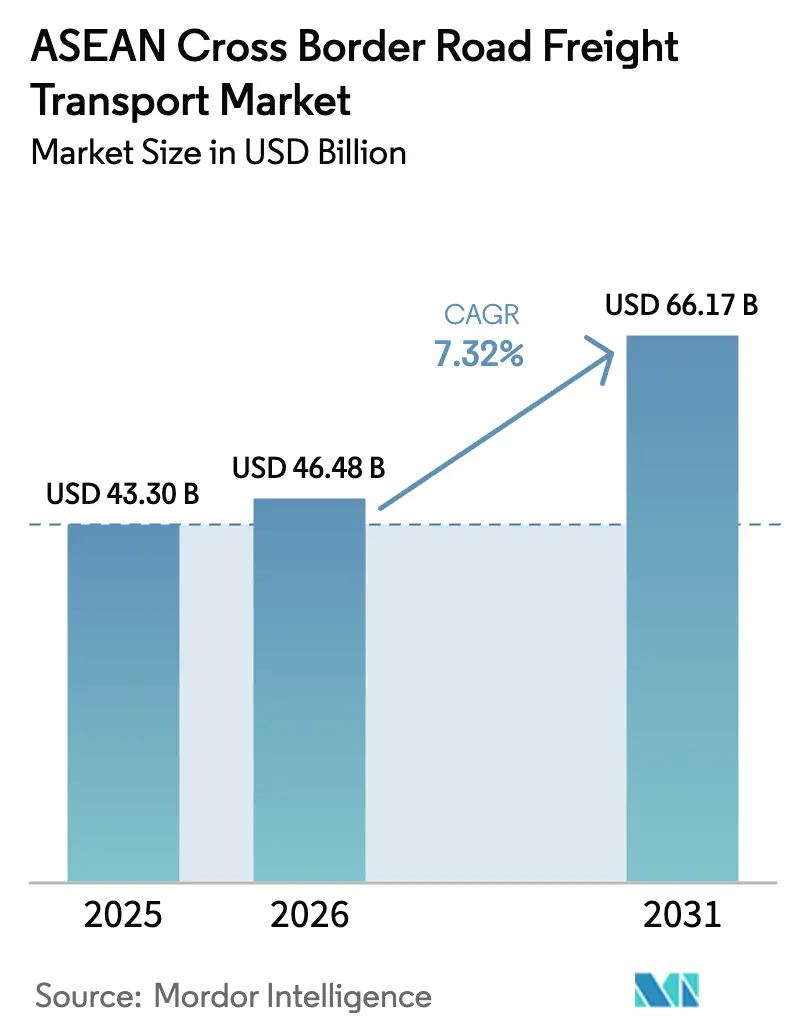
| Base Year Market Size (2025) | USD 43.30 Billion |
| Market Size (2026) | USD 46.48 Billion |
| Market Size (2031) | USD 66.17 Billion |
| Growth Rate (2026 - 2031) | 7.32 % |
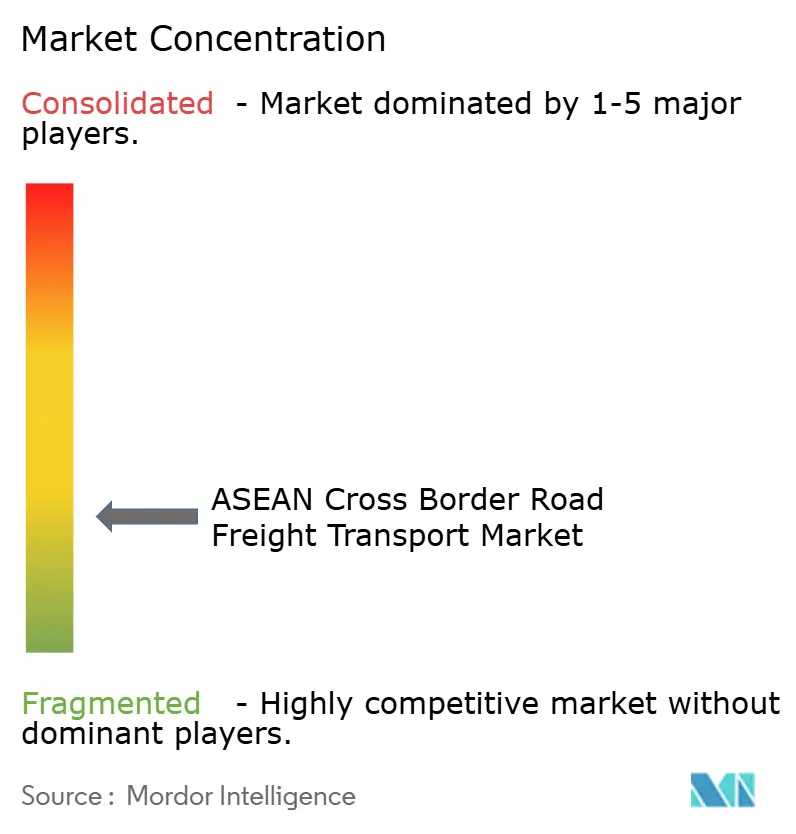
| Market Concentration | Low |
Major Players *Disclaimer: Major Players sorted in no particular order Image © Mordor Intelligence. Reuse requires attribution under CC BY 4.0. | |
ASEAN Cross Border Road Freight Transport Market Analysis by Mordor Intelligence
The ASEAN cross-border road freight transport market size is expected to grow from USD 43.3 billion in 2025 to USD 46.48 billion in 2026 and is forecast to reach USD 66.17 billion by 2031 at a 7.32% CAGR over 2026-2031.
Strong policy tailwinds, notably the Regional Comprehensive Economic Partnership (RCEP), are lowering duty costs and shifting modal choice toward trucks for mid-distance freight. New industrial parks in the Mekong sub-region and the BIMP-EAGA growth area are anchoring daily freight volumes that justify larger and cleaner fleets. Corporate sustainability targets are accelerating the retirement of Euro III assets in favor of Euro VI and LNG models, while IoT e-seals at key borders are reducing clearance time by more than 30% and boosting truck productivity. In parallel, the wave of data-center construction and the expansion of pharmaceutical manufacturing are spawning niche lanes for oversized and temperature-controlled cargo that command premium yields, further widening the opportunity set for the ASEAN cross-border road freight transport market.
Key Report Takeaways
- By truckload specification, full truckload held 80.73% of the ASEAN cross border road freight transport market share in 2025, while less-than-truckload is forecast to advance at a 9.02% CAGR through 2031.
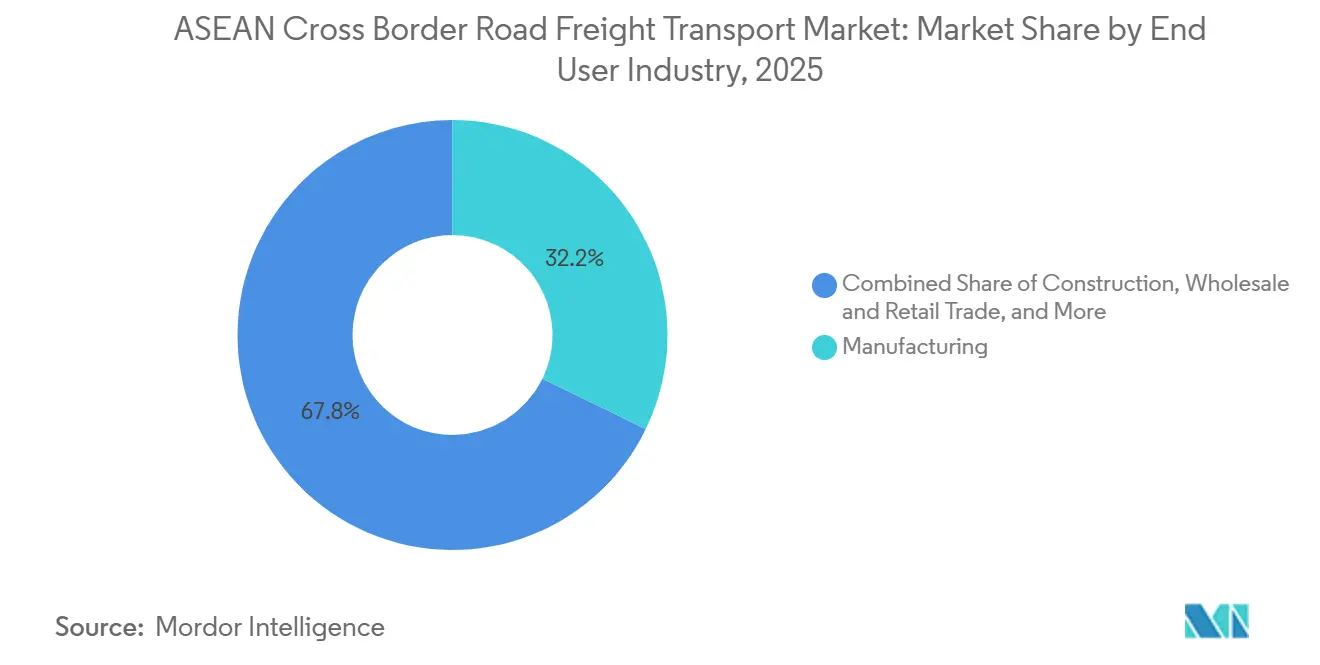
- By end user, manufacturing held 32.21% of the ASEAN cross border road freight transport market size in 2025, while wholesale and retail trade is forecast to advance at a 9.4% CAGR.
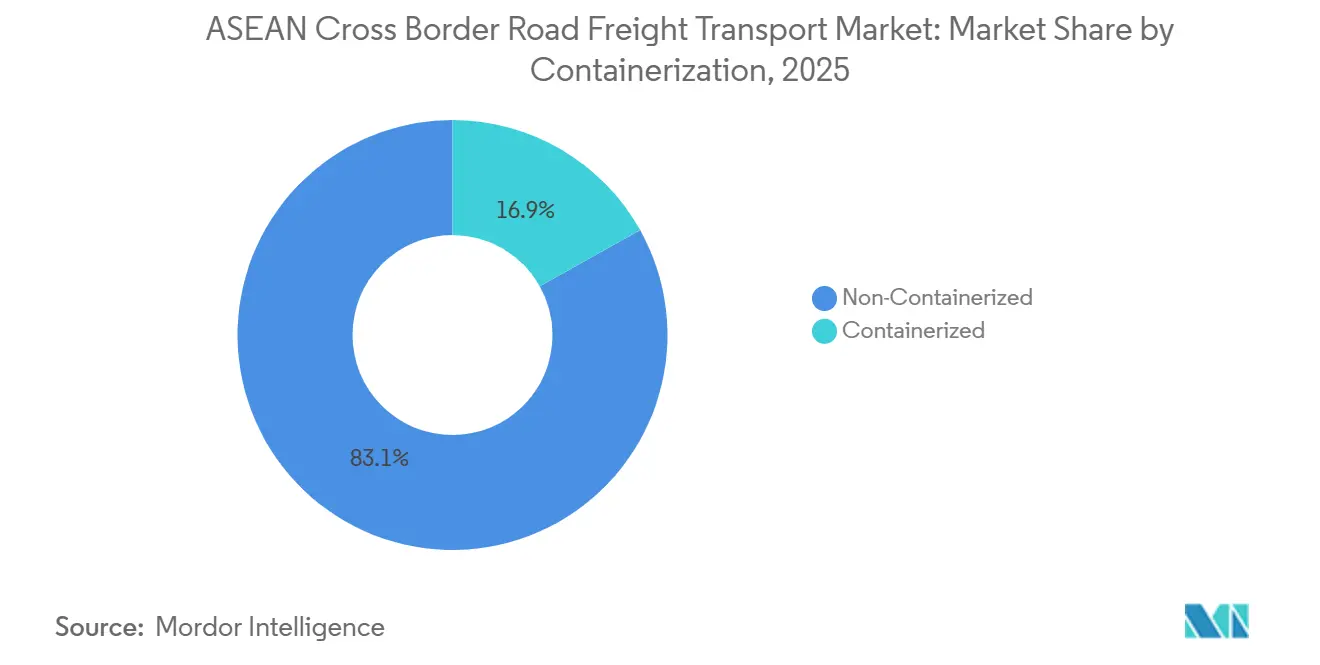
- By containerization, non-containerized freight accounted for 83.11% of the ASEAN cross border road freight transport market size in 2025, and containerized movements are set to expand at a 9.69% CAGR to 2031.
- By distance, long-haul moves captured 62.36% of the ASEAN cross border road freight transport market share in 2025, whereas short-haul shuttles are projected to climb at an 8.28% CAGR over 2026-2031.
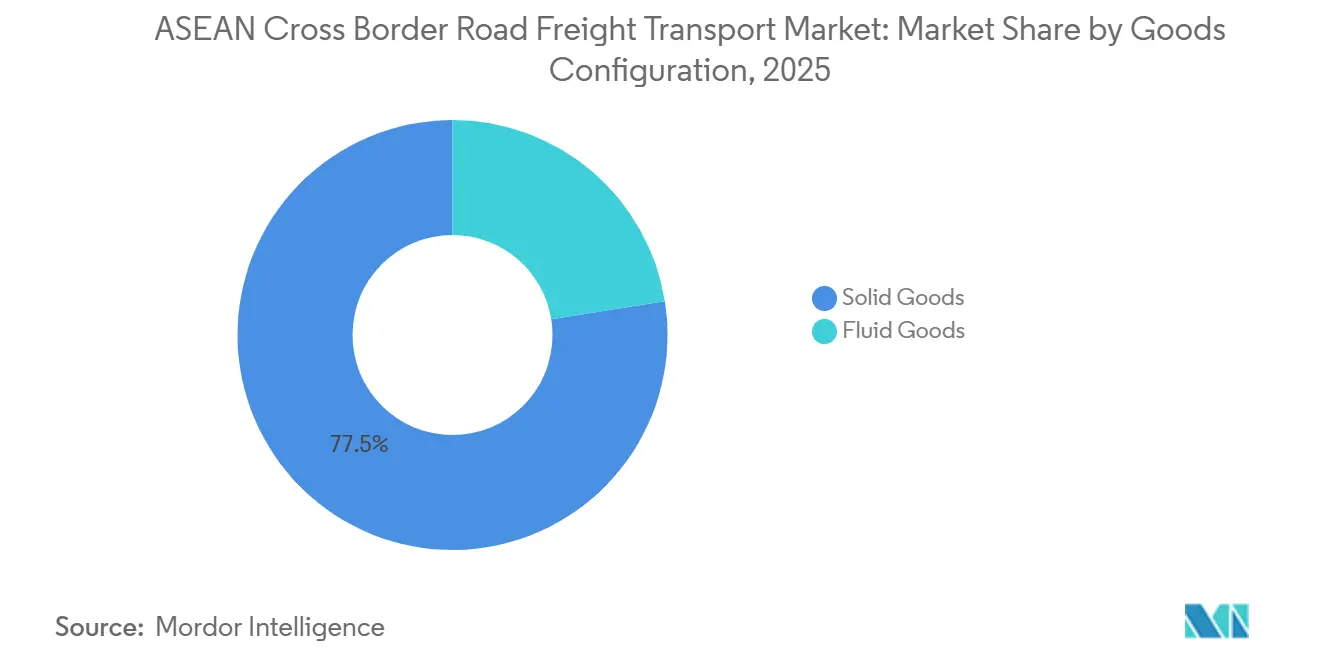
- By goods configuration, solid goods claimed 77.5% of the ASEAN cross border road freight transport market size in 2025, and fluid goods are poised to grow at an 8.89% CAGR to 2031.
- By temperature control, the non-efrigerated segment accounted for 95.03% of 2025 volume, and temperature controlled is advancing at an 11.2% CAGR driven by pharmaceutical lanes.
- By country, Indonesia led with a 41.38% share in 2025, while Vietnam is forecast to register the fastest 8.74% CAGR through 2031.
Note: Market size and forecast figures in this report are generated using Mordor Intelligence’s proprietary estimation framework, updated with the latest available data and insights as of 2026.
ASEAN Cross Border Road Freight Transport Market Trends and Insights
Drivers Impact Analysis*
| Driver | (~) % Impact on CAGR Forecast | Geographic Relevance | Impact Timeline |
|---|---|---|---|
| RCEP-triggered tariff reductions | +1.3% | Regional, strongest in Vietnam, Thailand, Malaysia | Long term (≥ 4 years) |
| New industrial parks along the Mekong and BIMP-EAGA corridors | +1.1% | Mekong region, Brunei, Indonesia, Malaysia, Philippines | Medium term (2-4 years) |
| Corporate ESG mandates accelerate fleet upgrades | +0.8% | Early adoption in Singapore, Malaysia, Thailand | Medium term (2-4 years) |
| IoT e-seal roll-outs at major land borders | +0.9% | Thailand-Malaysia, Malaysia-Singapore, Vietnam-China | Short term (≤ 2 years) |
| ASEAN pharma-manufacturing push | +0.7% | Singapore, Malaysia, Thailand, Vietnam | Medium term (2-4 years) |
| Data-center construction wave | +0.5% | Singapore, Malaysia, Indonesia, Thailand | Short term (≤ 2 years) |
| Source: Mordor Intelligence | |||
RCEP-Triggered Tariff Reductions Boost Intra-ASEAN Trucking Demand
The phased tariff removal under RCEP allows more than 90% of traded goods to move duty-free, improving the relative cost of trucking versus sea freight for consignments under 1,500 km. Rules-of-origin accumulation encourages component shuttling among multiple production bases, creating dense trucking networks. Vietnam’s hybrid of RCEP plus bilateral deals drives triangular flows-components from China to Vietnam, sub-assemblies onward to Thailand, and finished goods exported to Japan, each leg moving by road. Policy certainty is prompting manufacturers to lock in long-term trucking contracts, undergirding fleet investment decisions. Digital customs procedures embedded in the treaty further cut administrative overhead, inviting smaller carriers into cross-border lanes and enlarging the reachable client pool of the ASEAN cross border road freight transport market.
New Industrial Parks Along Mekong and BIMP-EAGA Corridors Generate Steady Freight Flows
Industrial hubs from Thailand’s Eastern Economic Corridor to Indonesia’s Batam-Bintan-Karimun FTZ are pulling in just-in-time truckloads of electronics, auto parts, and processed foods. The parks usually feature bonded depots and fast-track customs lanes that reduce border dwell to under two hours, letting carriers turn assets quicker. Daily round-trip frequencies anchor predictable demand that shields operators from the spot price volatility common on longer corridors. Clustered suppliers also allow carriers to run milk-run routes that equalize back-haul imbalances. Such ecosystem density is a structural tailwind for the ASEAN cross border road freight transport market[1]
Corporate ESG Mandates Accelerate Fleet Upgrades to Euro VI / LNG Trucks
Shippers with science-based carbon targets are baking emission criteria into tenders, and those demands are cascading through procurement chains. Singapore’s subsidy covering half the incremental cost of LNG tractors sparked a jump in alt-fuel orders, and Malaysia saw LNG trucks rise to 12% of new heavy-duty sales in 2024. Thailand’s planned retirement of Euro III by 2027 signals mandatory capex for laggard fleets. Operators that modernize early report 8-10% fuel-cost savings and enhanced win rates for multinational contracts, cementing a competitive moat. The capital need also accelerates consolidation, steadily concentrating the ASEAN cross border road freight transport market.
IoT E-Seal Roll-Outs at Major Land Borders Cut Clearance Time by More Than 30%
Electronic seals feeding tamper alerts and GPS data to customs dashboards now underpin risk-based inspection programs. On the Johor-Singapore Causeway, e-seal pilots lowered clearance time from four hours to less than 90 minutes for compliant loads. Thailand’s integration of seal feeds with its National Single Window further reduces random inspection frequency, dropping physical checks by 60%. Improved predictability lets operators guarantee delivery windows and shrink safety stock for shippers. Cost savings flow through to lower per-km rates, sustaining demand for the ASEAN cross border road freight transport market[2].
Restraints Impact Analysis*
| Restraint | (~) % Impact on CAGR Forecast | Geographic Relevance | Impact Timeline |
|---|---|---|---|
| Secondary-road bottlenecks in CLMV nations | -0.9% | Cambodia, Laos, Myanmar, Vietnam | Long term (≥ 4 years) |
| Rising expressway tolls and urban congestion charges | -0.7% | Singapore, Bangkok, Kuala Lumpur, Jakarta | Medium term (2-4 years) |
| Lack of harmonized cross-border carrier liability insurance | -0.6% | All ASEAN members | Medium term (2-4 years) |
| Trans-boundary haze events | -0.4% | Indonesia, Malaysia, Singapore, southern Thailand, and Brunei | Short term (≤ 2 years) |
| Source: Mordor Intelligence | |||
Secondary-Road Bottlenecks in CLMV Nations Limit Last-Mile Connectivity
Rural Cambodia and Laos still rely on gravel roads with 10-ton gross weight limits that force load transfers to smaller trucks, inflating delivery cost by up to 25%. Seasonal closures during monsoon periods disrupt export schedules for rice, rubber, and cassava, compelling shippers to hold extra buffer inventory. Vietnam’s plan to strengthen secondary roads to 10-ton axle capacity carries a USD 8 billion price tag, with funding gaps delaying execution. These bottlenecks narrow the effective service radius for carriers and suppress growth potential on otherwise promising lanes within the ASEAN cross border road freight transport market.
Rising Expressway Tolls and Urban Congestion Charges Erode Operator Margins
Thailand’s 20% toll hike on the Bangkok-Chonburi motorway in 2025 and Singapore’s dynamic Electronic Road Pricing can add double-digit cost increases on critical corridors. In a rate-sensitive industry, such costs are only partly recoverable, compressing fleet margins by 3-5 percentage points. Operators counter by adopting telematics to optimize routing during off-peak windows, but limited night-delivery permits in urban cores mute the benefit. Persistent toll inflation encourages modal shift to rail or coastal shipping on some lanes and could cap upside for the ASEAN cross border road freight transport market[3].
*Our forecasts treat driver/restraint impacts as directional, not additive. The impact forecasts reflect baseline growth, mix effects, and variable interactions.
Segment Analysis
By End User Industry: Manufacturing Maintains Lead While E-Commerce Lifts Trade Segment
The ASEAN cross border road freight transport market size by industry shows that manufacturing holds 32.21% of the total market share, while wholesale and retail trade is projected to grow at a CAGR of 9.4%. Wholesale and retail trade lanes are expanding as platform retailers centralize inventory in regional hubs to benefit from higher de minimis thresholds under RCEP.
Manufacturing continues to command the largest single share, driven by automotive and electronics assembly, though lane density favors established operators, creating higher entry barriers for newcomers. Oil and gas, mining, and quarrying experience moderate mid-single-digit growth, particularly in Indonesia and Malaysia. Construction-related freight largely depends on government infrastructure projects, offering cyclical opportunities rather than sustained structural growth. Agriculture and fisheries see modest benefits from phytosanitary harmonization, but margin expansion is constrained by commodity price volatility, collectively shaping the cadence of the ASEAN cross border road freight transport market.

By Truckload Specification: LTL Gains as E-Commerce Fragments Shipments
The ASEAN cross border road freight transport market size is led by the Full Truckload (FTL) segment, which captures 80.73% of the total market share, while the Less-than-Truck-Load (LTL) segment is projected to expand at a CAGR of 9.02%, signaling stronger growth momentum within the segment.
Digital load boards are supporting LTL expansion by enabling carriers to optimize partial trailer capacity and reduce empty runs. Full truckload continues to dominate high-value machinery and bulk commodity movements, as shippers prioritize reduced handling and dedicated capacity for synchronized production cycles. Rate structures vary by model: FTL typically operates on per-trip contractual pricing, while LTL applies zone-based tariffs that adjust frequently.
By Containerization: Intermodal Growth Drives Containerized Surge
The ASEAN cross border road freight transport market size by containerization indicates that Non-Containerized transport accounts for 83.11% of the market share, while Containerized transport is projected to grow at a CAGR of 9.69%. Improved connections between inland depots and seaports are streamlining the transfer of containers between trucks, rail, and feeder vessels. Expanding fleets of container-ready chassis are reducing repositioning costs and encouraging the adoption of standardized equipment to minimize theft.
Meanwhile, non-containerized cargo continues to dominate segments such as palm oil, coal, and oversized project freight, where bulk characteristics or out-of-gauge dimensions limit container usage. Carriers in this segment operate specialized assets, including tankers, flatbeds, and modular dollies, enabling them to command premium pricing due to technical expertise.
By Distance: Short-Haul Shuttles Benefit from Border-Area Industrialization
The ASEAN cross border road freight transport market size by distance type indicates that Long Haul contributes 62.36% of the total market share, while Short Haul is projected to register a CAGR of 8.28%. Industrial clusters developing within 50 km of the border areas are generating demand for high-frequency shuttle services.
Conversely, long-haul routes such as the China-Singapore corridor account for the largest revenue contribution despite comparatively moderate growth, as per-trip freight values are significantly higher. These movements typically require relay drivers and sleeper cab configurations, resulting in elevated operating costs per kilometer relative to short-haul services. Intensifying rail competition along key regional corridors is further moderating pricing power.
By Goods Configuration: Fluid Goods Expand with Refinery Capacity
The ASEAN cross border road freight transport market size by goods type shows that Solid Goods account for 77.5% of the total market share, while Fluid Goods are projected to grow at a CAGR of 8.89% through 2031. Indonesia’s Tuban refinery and Malaysia’s biodiesel plants are generating consistent tanker movements to regional blending hubs, strengthening cross border fluid cargo flows. The expansion of stainless-steel and insulated tanker fleets is essential for handling such shipments, increasing capital expenditure requirements, and limiting the pace of new market entry.
On the other hand, solid-goods carriers manage a broad range of cargo, including white goods and construction steel, maintaining absolute volume leadership across regional corridors. Accelerating digitization is enabling real-time rate quotations, prompting smaller operators to integrate into cooperative digital platforms to avoid margin pressures.
By Temperature Control: Cold Chain Races Ahead on Pharma and Fresh Produce
The ASEAN cross border road freight transport market size by temperature requirement indicates that Non-Refrigerated transport holds 95.03% of the total market share, while Temperature-Controlled trucking is projected to expand at a CAGR of 11.2%. Temperature-controlled transport represents a smaller but rapidly expanding segment, supported by specialized trade lanes such as durian shipments from Thailand to China and vaccine distribution from Singapore to Indonesia.
Meanwhile, ambient freight continues to dominate overall shipment volumes, though competition is largely price-driven due to limited service differentiation. Some operators are retrofitting refrigerated trailers for dual-purpose use to manage seasonal demand fluctuations, particularly during peak fruit export periods. Pilot deployments of electric reefer units powered by battery systems are also emerging on shorter cross-border routes, aligning with sustainability targets set by major pharmaceutical and food exporters.
Geography Analysis
Vietnam is the fastest-growing node at 8.74% CAGR as foreign electronics and textile plants deepen integration with supply partners in Thailand, Malaysia, and China. Exports tallied USD 354.5 billion in 2024, and nearly half were moved by road across neighboring borders. Investments to upgrade National Highway 1 and expand Moc Bai crossing shorten transit to Ho Chi Minh City, tipping modal preference toward trucks for consignments under 800 km.
Indonesia, with a 41.38% share in the ASEAN cross border road freight transport market in 2025, remains the demand anchor owing to nickel, palm oil, and coal flows that move by road to Malaysian ports and Singapore trading hubs. Industrial estates in Kalimantan and Sulawesi, tied to battery material processing, will open east-west trucking corridors once bridge upgrades are complete. Inter-island ferries feed volume into these land routes, reinforcing Indonesia’s lead position in the ASEAN cross border road freight transport market.
Thailand and Malaysia act as twin land bridges. Thailand’s Eastern Economic Corridor funnels automotive components southward, while Malaysia’s port-centric economy channels containerized imports north into Thai production belts. Both nations are piloting hydrogen-ready truck trials aligned with ESG targets, potentially seeding new fleet-conversion demand. Cambodia, Laos, and Myanmar collectively trail in share but present upside through planned expressways and special economic zones connecting to Vietnam and Thailand[4].
Competitive Landscape
The ASEAN cross border road freight transport market is low concentrated. Global integrators such as DHL and the newly combined DSV-DB Schenker leverage proprietary IT and AEO certifications to win multi-country contracts. Regional providers Gemadept in Vietnam, Tiong Nam in Malaysia offer deep border expertise, GDP-compliant warehouses, and hazmat certifications that attract niche shippers. Local owner-operators maintain cost advantages on short shuttle routes but risk disintermediation from digital freight platforms offering transparent rate comparison.
The DSV-DB Schenker merger creates the largest Europe-Asia land network, giving the firm negotiating clout for toll discounts and consolidated insurance packages. Nippon Express teamed with Gemadept to set up bonded depots that cut Vietnamese border dwellers by a quarter. Tiong Nam’s USD 103 million capex for cross-border terminals underscores confidence in e-commerce volumes. Meanwhile, venture-backed apps such as LOGISTEED’s blockchain platform reduce paperwork by 40%, eroding the administrative edge of incumbents.
Fleet modernization is emerging as a new battleground. Operators able to deploy LNG or eventually hydrogen tractors will align with shipper emission scorecards and command higher rates. Conversely, small fleets lacking access to green finance may exit or shift to brokerage models. Quality accreditation like ISO 9001 and GDP certificates is increasingly a precondition in RFQs, drawing a clear line between premium and price-fighter tiers within the ASEAN cross-border road freight transport market.
ASEAN Cross Border Road Freight Transport Industry Leaders
-
DHL Group
-
GEODIS
-
Kerry Logistics
-
Kuehne + Nagel
-
DSV (Including DB Schenker)
- *Disclaimer: Major Players sorted in no particular order
Recent Industry Developments
- February 2026: DHL signed SAF fuel partnerships and expanded electric truck deployments in the Asia Pacific, including Thailand and the Philippines, building greener transport capabilities that support road and multimodal freight.
- October 2025: Kuehne + Nagel expanded its road transport fleet in Southeast Asia (Thai base) with new prime movers and containers to strengthen regional road freight capacity across ASEAN markets.
- April 2025: DHL committed significant investment into healthcare logistics infrastructure across the Asia Pacific, which is likely to improve regional capabilities.
- April 2025: DSV completed its acquisition of DB Schenker, forming the world’s largest logistics provider.
ASEAN Cross Border Road Freight Transport Market Report Scope
By End-User Industry
| Agriculture, Fishing & Forestry |
| Construction |
| Manufacturing |
| Oil, Gas, Mining & Quarrying |
| Wholesale & Retail Trade |
| Others |
By Truckload Specification
| Full Truckload (FTL) |
| Less-than-Truckload (LTL) |
By Containerization
| Containerized |
| Non-Containerized |
By Distance
| Long Haul |
| Short Haul |
By Goods Configuration
| Fluid Goods |
| Solid Goods |
By Temperature Control
| Non-Temperature Controlled |
| Temperature Controlled |
By Country
| Indonesia |
| Thailand |
| Malaysia |
| Singapore |
| Vietnam |
| Rest of ASEAN |
| By End-User Industry | Agriculture, Fishing & Forestry |
| Construction | |
| Manufacturing | |
| Oil, Gas, Mining & Quarrying | |
| Wholesale & Retail Trade | |
| Others | |
| By Truckload Specification | Full Truckload (FTL) |
| Less-than-Truckload (LTL) | |
| By Containerization | Containerized |
| Non-Containerized | |
| By Distance | Long Haul |
| Short Haul | |
| By Goods Configuration | Fluid Goods |
| Solid Goods | |
| By Temperature Control | Non-Temperature Controlled |
| Temperature Controlled | |
| By Country | Indonesia |
| Thailand | |
| Malaysia | |
| Singapore | |
| Vietnam | |
| Rest of ASEAN |
Market Definition
- Agriculture, Fishing, and Forestry (AFF) - This end user industry segment captures the external (outsourced) logistics expenditure incurred by the AFF industry players on road freight transport service. The end user players considered are the establishments primarily engaged in growing crops, raising animals, harvesting timber, harvesting fish & other animals from their natural habitats and providing related support activities. Herein, across the value chain, Logistics Service Providers (LSPs) play a crucial role in acquisition, storage, handling, transportation, and distribution activities for the optimal & continuous flow of inputs (seeds, pesticides, fertilizers, equipment, and water) from manufacturers or suppliers to the producers and smooth flow of output (produce, agro-goods) to distributors/ consumers. This includes both termperature controlled and non-temperature controlled logistics, as and when required according to the shelf life of goods being transported or stored.
- Construction - This end user industry segment captures the external (outsourced) logistics expenditure incurred by the construction industry players, on road freight transport service. The end user players considered are the establishments primarily engaged in constructing, repairing and renovating residential & commercial buildings, infrastructure, engineering works, subdividing and developing land. Logistics Service Providers (LSPs) play a crucial role in increasing profitability of construction projects by maintaing the inventory of raw materials & equipment, time-critical supplies and by providing other value added services for effective project management.
- Containerized Road Freight Transport - The segment captures the external (outsourced) logistics expenditure incurred by the road freight transport service end users on Full-Truck-Load (FTL) services. FTL road freight transport is characterized as a full single load not combined with other shipments. It comprises of shipments (i) devoted to the goods of a single shipper (ii) taken directly from a point of origin to one or more destination points (iii) comprising of bulk mail truck transportation (iv) comprising of both Container (Full Container Load, FCL)/Non-Container trucking services (v)comprsing of goods requiring temperature controlled or non-temperature controlled transportation services (vi) comprising of bulk liquid tankering (vii) invoving trucking of waste (viii) hazardous material trucking. Related value added services (VAS) of sorting, consolidation, deconslidation are included in the other services segment of freight and logistics market.
- Export Trends and Import Trends - Overall logistics performance of an economy is positively and significantly (statistically) correlated to its trade performance (exports and imports). Hence, in this industry trend, total value of trade, major commodities/ commodity groups and the major trade partners, for the studied geography (country or region as per the scope of report) have been analysed alongside the impact of major trade/logistics infrastructure investments & regulatory environment.
- Fluid Goods - The segment captures the external (outsourced) logistics expenditure incurred by the road freight transport service end users for the transport of bulk liquids, that are often used in extraction, manufacturing, food processing, agriculture industries among others. It includes transportation of liquids like (i) Chemicals/ hazardous goods (for instance acids) (ii) Water (potable as well as waste) (iii) Oil and gas (upstream as well as downstream like gasoline, fuel, crude oil, or propane), (iv) Food grade bulk liquids (like milk, or juice), (v) Rubber, (vi) Agrichemical products, among others. These goods are generally transported through tanker trucking.
- Fuel Price - Fuel price spikes can cause delays and diruption for logistics service providers (LSPs), while drops in the same can result in higher short-term profitability and increased market rivalry to offer consumers with the best deals. Hence, the fuel price variations have been studied over the review period and presented along with the causes as well as market impacts.
- Full-Truck-Load (FTL) Road Freight Transport - The segment captures the external (outsourced) logistics expenditure incurred by the road freight transport service end users on Full-Truck-Load (FTL) services. FTL road freight transport is characterized as a full single load not combined with other shipments. It comprises of shipments (i) devoted to the goods of a single shipper (ii) taken directly from a point of origin to one or more destination points (iii) comprising of bulk mail truck transportation (iv) comprising of both Container (Full Container Load, FCL)/Non-Container trucking services (v)comprsing of goods requiring temperature controlled or non-temperature controlled transportation services (vi) comprising of bulk liquid tankering (vii) invoving trucking of waste (viii) hazardous material trucking. Related value added services (VAS) of sorting, consolidation, deconslidation are included in the other services segment of freight and logistics market.
- GDP Distribution by Economic Activity - Nominal Gross Domestic Product and distribution of the same, across major economic sectors in the geography studied (country or region as per scope of the report) have been studied and presented in this industry trend. As GDP is positively related to the profitability and growth of logistics industry, this data has been used in adjunction to the input-output tables/ supply-use tables for analyzing the potential major contributing sectors towards the logistics demand.
- GDP Growth by Economic Activity - Growth of Nominal Gross Domestic Product across major economic sectors, for the geography studied (country or region as per scope of the report) have been presented in this industry trend. This data has been utilized for assessing the growth of logistics demand from all the market end users (economic sectors considered here).
- Inflation - Variations in both Wholesale Price Inflation (YoY change in producer price index) and Consumer Price Inflation have been presented in this industry trend. This data has been used to assess the inflationary environment as it plays a vital role in smooth functioning of the supply chain, directly impacting the logistics operational cost components e.g., pricing of tyres, driver wages & benefits, energy/fuel prices, maintenace costs, toll charges, warehousing rents, custom brokerage, forwarding rates, courier rates etc. hence impacting the overall freight and logistics market.
- Key Industry Trends - The report section named "Key Industry Trends" include all the key variables/parameters studied to better analyze the market size estimates and forecasts. All the trends have been presented in the form of data points (time series or latest available data points) along with analysis of the paramter in the form of concise market relevant commentary, for the geography studied (country or region as per the scope of report).
- Key Strategic Moves - The action taken by a company to differentiate from its competitor or used as a general strategy is referred to as a key strategic move (KSM). This includes (1) Agreements (2) Expansions (3) Financial Restructuring (4) Mergers and Acquisitions (5) Partnerships, and (6) Product Innovations. Key players (Logistics Service Providers, LSPs) in the market have been shortlisted, their KSM have been studied and presented in this section.
- Less than-Truck-Load (LTL) Road Freight Transport - The segment captures the external (outsourced) logistics expenditure incurred by the road freight transport service end users on Less than-Truck-Load (LTL) services. LTL road freight transport is characterized as multiple shipments combined onto a single truck for multiple deliveries within a network. It comprises of establishments (i) primarily engaged in general and specialized freight trucking of less than complete truck-loads, (ii) characterized by the use of terminals to consolidate shipments, generally from several shippers, into a single truck for haulage between a load assembly terminal and a disassembly terminal, where the load is sorted and shipments are re-routed for delivery (iv) Less than-Container-Load (LCL) shipping/ Groupage Shipping in case of trucking services. The activities in scope include (i) local pick-up, (ii) line-haul, and (iii) local delivery. Related value added services (VAS) of sorting, consolidation, deconslidation are included in the other services segment of freight and logistics market.
- Logistics Performance - Logistics Performance and Logistics Costs are the backbone of trade, and influences trade costs, making countries compete globally. Logistics performance is influenced by market wide adopted supply chain management strategies, government services, investments & policies, fuel/ energy costs, inflationary environment etc. Hence, in this industry trend, the logistics performance of the geography studied (country/ region as per the scope of report) has been analysed and presented over the review period.
- Major Truck Suppliers - Market share of truck brands is influenced by factors like geographical preferences, portfolio of truck types, truck prices, local production, truck repair & maintenance service peneteration, customer support, technological innovations (like electric vehicles, digitalization, autonomous trucks), fuel efficiency, financing options, annual maintenance costs, availability of substitutes, marketing startegies etc. Hence, the distribution (share % for base year of the study) of truck sales volume for leading truck brands and commentary on current market scenario & market anticipation over the forecast period have been presented in this industry trend.
- Manufacturing - This end user industry segment captures the external (outsourced) logistics expenditure incurred by the Manufacturing industry players, on road freight transport service. The end user players considered are the establishments primarily engaged in the chemical, mechanical or physical transformation of materials or substances into new products. Logistics Service Providers (LSPs) play a crucial role in maintaining a smooth flow of raw materials across the supply chain, enabling timely delivery of finished goods to distributors or end customers and storing & supplying the raw materials to clients for just-in-time manufacturing.
- Modal Share - Freight Modal Share is influenced by factors like modal productivity, government regulations, containerization, distance of shipment, temperature control requirements, type of goods, international trade, terrain, speed of delivery, shipment weight, bulk shipments, etc. Also, modal share by tonnage (tons) and modal share by freight turnover (ton-km) differ as per average distance of shipments, weight of major commodity groups transported in the economy and number of trips. This industry trend represents the distribution of freight transported by mode of transport (tons as well as ton-km), for the study base year.
- Oil and Gas, Mining and Quarrying - This end user industry segment captures the external (outsourced) logistics expenditure incurred by the extraction industry players, on road freight transport service. The end user players considered are the establishments that extract naturally occurring mineral solids, such as coal and ores; liquid minerals, such as crude petroleum; and gases, such as natural gas. Logistics Service Providers (LSPs) covers entire phases from upstream to downstream and plays a crucial role in the transportation of machinery, drilling equipments, extracted minerals, crude oil & natural gas and refined/ processed products from one place to another.
- Other End Users - Other end user segment captures the external (outsourced) logistics expenditure incurred by the financial services (BFSI), real estate, educational services, healthcare, and professional services (administrative, waste management, legal, architectural, engineering, design, consulting, scientific R&D), on road freight transport service. Logistics Service Providers (LSPs) plays a crucial role in the reliable movement of supplies and documents to/from these industries such as transporting any equipment or resources required, shipping confidential documents and files, movement of medical goods & supplies (surgical supplies and instruments, including gloves, masks, syringes, equipment) to name a few.
- Producer Price Inflation - It indicates inflation from viewpoint of the producers viz. the average selling price received for their output over a period of time. Annual change (YoY) of producer price index is reported as wholesale price inflation in the "Inflation" industry trend. As WPI captures dynamic price movements in most comprehensive way, it is widely used by governments, banks, industry, business circles and is deemed important in formulation of trade, fiscal and other economic policies. The data has been used in adjunction to consumer price inflation for better understanding the inflationary environment.
- Road Freight Pricing Trends - Freight pricing by mode of transport (USD/tonkm), over the review period, has been presented in this industry trend. The data has been used in assessing the inflationary environment, impact on trade, freight turnover (tonkm), road freight transport market demand and hence the road freight transport market size.
- Road Freight Tonnage Trends - Freight tonnage (weight of goods in tons) handled by mode of transport, over the review period, has been presented in this industry trend. The data has been used as one of the parameters apart from average distance per shipment (km), freight volume (tonkm), and freight pricing (USD/tonkm) to assess the freight transport market size.
- Road Freight Transport - Hiring a road freight transport logistics service provider (LSP) or haulier (outsourced logistics), for the transport of commodities constitutes road freight transport market. The scope of study includes (i) road transport of goods reported by hauliers registered in the reporting countries (ii) transport of raw materials or manufactured goods (solids as well as fluids) (iii) transport using commerical motor vehicles (rigid trucks or tractor-trailers, (iv) Full-Truck-Load (FTL) or Less than-Truck-Load (LTL) transport (v) containerized or non-containerized transport (vi) temperature controlled or non-temperature controlled trasnport, (vii) short haul or long haul (Over-the-road, OTR) transport, (viii) used office or household goods transport (movers and packers), (ix) other specialized cargo transport (dangerous goods, oversized cargo) and (x) outsourced first mile/ middle mile/last mile delivery shipments undertaken by road freight transport players. The scope does not include (i) transport undertaken by hauliers registered in other countries (ii) last mile meal delivery market (iii) grocery delivery market (iv) transportation via road network undertaken/ reported by Courier, Express, and Parcel (CEP) players.
- Road Length - As infrastructure plays a vital role in an economy's logistics performance, variables like length of roads, distribution of road length by surface category (paved v/s unpaved), distribution of road length by road classification (expressways v/s highways v/s other roads), have been analysed and presented in this industry trend.
- Segmental Revenue - Segmental Revenue has been triangulated or computed and presented for all the major players in the market. It refers to the road freight transport market specific revenue earned by the company, over the base year of study, in the geography studied (country or region as per the scope of report). It is computed through the study and analysis of major parameters like financials, service portfolio, employee strength, fleet size, investments, number of countries present in, major economies of concern, etc. that have been reported by the company in its annual reports, webpage. For companies having scarce financial disclosures, paid databases like D&B Hoovers, Dow Jones Factiva have been resorted to and verified through industry/expert interactions.
- Short Haul Road Freight Transport - The segment captures the external (outsourced) logistics expenditure incurred by the road freight transport service end users on local trucking (less than 100 miles). It includes the road transport of goods (i) within a single administrative area and its hinterland, (ii) by smaller trucks and pickup trucks (iii) via containerized as well as dry bulk services (iv) intermodal from ports, container terminals or airports, and (v) outsourced first mile/ last mile delivery shipments undertaken by road freight transport players.
- Transport and Storage Sector GDP - Value and growth of Transport and Storage Sector GDP has a direct relation to the freight and logistics market size, and hence road freight transport market size. Therefore, this variable has been studied and presented over the review period, in value terms (USD) and as share % of total GDP, in this industry trend. The data has been supported by concise and relevant commentary around the investments, developments, and current market scenario.
- Trends in E-Commerce Industry - Enhanced internet connectivity and boom in smartphone penetration, coupled with increasing disposable incomes, has led to a phenomenal growth in the e-commerce market globally. Online shoppers require fast and efficient delivery of their orders leading to an increase in the demand for logistics services especially e-commerce fulfilment services. Hence, the Gross Merchandise Value (GMV), historial and projected growth, breakup of major commodity groups in e-commerce industry for the studied geography (country or region as per scope of the report) have been analysed and presented in this industry trend.
- Trends in Manufacturing Industry - Manufacturing industry involves the transformation of raw materials into finished products, while logistics industry ensures the efficient flow of raw materials to the factory, and the transport of manufactured products to the distributors & consumers. Demand-Supply of both industries are highly cross-linked and critical for a seamless supply chain. Hence, the Gross Value Added (GVA), breakup of GVA into major manufacturing sectors, and growth of manufacturing industry over the review period have been analysed and presented, in this industry trend.
- Trucking Fleet Size By Type - Market share of truck types is influenced by factors like geographical preferences, major end user industries, truck prices, local production, truck repair & maintenance service peneteration, customer support, technological disruptions (like electric vehicles, digitalization, autonomous trucks) etc. Hence, the distribution (share % for base year of study) of truck parc volume by type of truck, market disruptors, truck manufacturing investments, truck specifications, truck use & import regulations, and market anticipation over the forecast period have been presented in this industry trend.
- Trucking Operational Costs - The prime reasons for measuring/ benchmarking logistics performance of any trucking company are to reduce operational costs and increase profitability. On the other hand, measuring operational costs helps to identify whether and where to make operational changes to control expenses and identify areas for improved performance. Hence, in this industry trend, trucking operational costs and the variables involved viz. driver wages & benefits, fuel prices, repairs & maintenance costs, tyre costs etc. have been studied over the base year of study, and presented for the geography studied (country or region as per the scope of report).
- Wholesale and Retail Trade - This end user industry segment captures the external (outsourced) logistics expenditure incurred by the wholesalers and retailers, on road freight transport service. The end user players considered are the establishments primarily engaged in wholesaling or retailing merchandise, generally without transformation, and rendering services incidental to the sale of merchandise. Logistics Service Providers (LSPs) plays a crucial role in the reliable movement of supplies to and finished products from production houses to the distributors and finally to the end customer covering activites like material sourcing, transportation, order fulfillment, warehousing & storage, demand forecasting, inventory management etc.
| Keyword | Definition |
|---|---|
| Cabotage | Road transport by a motor vehicle registered in a country performed on the national territory of another country. |
| Cross Docking | Cross docking is a logistics procedure where products from a supplier or manufacturing plant are distributed directly to a customer or retail chain with marginal to no handling or storage time. Cross docking takes place in a distribution docking terminal; usually consisting of trucks and dock doors on two (inbound and outbound) sides with minimal storage space. The name ‘cross docking’ explains the process of receiving products through an inbound dock and then transferring them across the dock to the outbound transportation dock. |
| Cross Trade | International road transport between two different countries performed by a road motor vehicle registered in a third country. A third country is a country other than the country of loading/embarkation and than the country of unloading/disembarkation. |
| Dangerous Goods | The classes of dangerous goods carried by Road are those defined by the fifteenth revised edition of the UN Recommendations on the Transport of Dangerous Goods, United Nations, Geneva 2007. They include Class 1: Explosives; Class 2: Gases; Class 3: Flammable Liquids; Class 4: Flammable solids- substances liable to spontaneous combustion; substances which, on contact with water, emit flammable gases; Class 5: Oxidizing substances and organic peroxides; Class 6: Toxic and infectious substances; Class 7: Radioactive material and Class 8: Corrosive substances, Class 9: Miscellaneous dangerous substances and articles. |
| Direct Shipment | Direct shipment is a method of delivering goods from the supplier or the product owner to the customer directly. In most cases, the customer orders the goods from the product owner. This delivery scheme reduces transportation and storage costs, but requires additional planning and administration. |
| Drayage | A drayage is a form of trucking service that connects the different modes of shipping (intermodal), such as ocean freight or air freight. It’s a short-haul trip that transports goods from one place to another, usually before or after its long-haul shipping process. Drayage trucks move cargo to and from various destinations, such as container ships, storage lots, order fulfillment warehouses, and rail yards. Typically, drayage only transports goods in short distances and operates only in one metropolitan area. It also requires only one trucker in a single shift. But despite this, but it plays an important role in long-haul shipping because it gets the goods to the cargo and vice versa. It makes intermodal transport much more efficient and enables the seamless transfer of goods to the end customer. |
| Dry van | A dry van is a type of semi-trailer that's fully enclosed to protect shipments from outside elements. Designed to carry palletized, boxed or loose freight, dry vans aren't temperature-controlled (unlike refrigerated “reefer” units) and can't carry oversized shipments (unlike flatbed trailers). |
| Final Demand | Final demand includes all types of commodities (goods as well as services) consumed as final use and might include personal consumption, or consumption by government, by businesses as capital investment, and as exports. includes all types of commodities (goods as well as services) consumed as final use and might include personal consumption, or consumption by government, by businesses as capital investment, and as exports. |
| Flatbed Truck | A flatbed truck is a type of truck with rigid design. It has a back body that is flatly shaped for easy loading and unloading of goods. The flatbed truck is mostly used to transport heavy, oversized, wide and indelicate goods such as machinery, building supplies or equipment. Due to the truck open body, the goods transported with it must not be vulnerable to rain. By functionality, the flatbed truck is comparable to a flatbed trailer. |
| Inbound Logistics | Inbound logistics is the way materials and other goods are brought into a company. This process includes the steps to order, receive, store, transport and manage incoming supplies. Inbound logistics focuses on the supply part of the supply-demand equation. |
| Intermediate Demand | Intermediate demand includes goods, services, and maintenance and repair construction sold to businesses, excluding capital investment. |
| International Loaded | Place of loading of goods in reporting country (i.e., country in which the vehicle performing the transport is registered) and place of unloading in a different country. |
| International Unloaded | Place of unloading of goods in reporting country (i.e., country in which the vehicle performing the transport is registered) and place of loading in a different country. |
| OOG cargo | Out of Gauge (OOG) cargo is any cargo that can not be loaded into six-sided shipping containers simply because it is too large. The term is a very loose classification of all cargo with dimensions beyond the maximum 40HC container dimensions. That is a length beyond 12.05 meters – a width beyond 2.33 meters – or a height beyond 2.59 meters. |
| Pallets | Raised platform, intended to facilitate the lifting and stacking of goods. |
| Part load | A part load describes goods which only fills a truck partially. In essence, the quantity of the shipment is bigger than the Less Than Truckload (LTL) shipment. Also, the shipment cannot fully occupy a truck i.e. its capacity is much lower than a Full Truckload (FTL) shipment. |
| Paved Road | Road surfaced with crushed stone (macadam) with hydrocarbon binder or bituminized agents, with concrete or with cobblestone. |
| Reverse Logistics | Reverse logistics comprises of the sector of supply chains that process anything returning inwards through the supply chain or traveling ‘backward’ through the supply chain. |
| Road Freight Transport Service | Hiring a trucking agency for transport of commodities (raw materials or manufactured goods including both solids and liquids) form the origin to a destination within the country (domestic) or cross-border (international) constitutes road freight transport market. The service might be Full-Truck-Load or Less than-Truck-Load, containerized or non-containerized, temperature controlled or non temperature controlled, short haul or long haul. |
| Tautliner vehicle | Tautliner and curtainsider are used as generic names for curtain sided trucks/trailers. The curtains are permanently fixed to a runner at the top and detachable rails/poles at front and rear, allowing the curtains to be drawn open and forklifts used all along the sides for easy and efficient loading and unloading. When closed for travel, vertical load restraint straps are attached to a rope rail beneath the truck bed, connecting the truck bed and curtain along both sides. Winches at either end of the curtain tension it, hence the 'Tautliner' name. This stops the curtain from flapping or drumming in the wind and can also help retain light loads from slipping sideways. |
| Transport for hire or reward | The carriage for remuneration of goods. |
| Unpaved Road | Road with a stabilized base not surfaced with crushed stone, hydrocarbon binder or bituminized agents, concrete or cobblestone. |
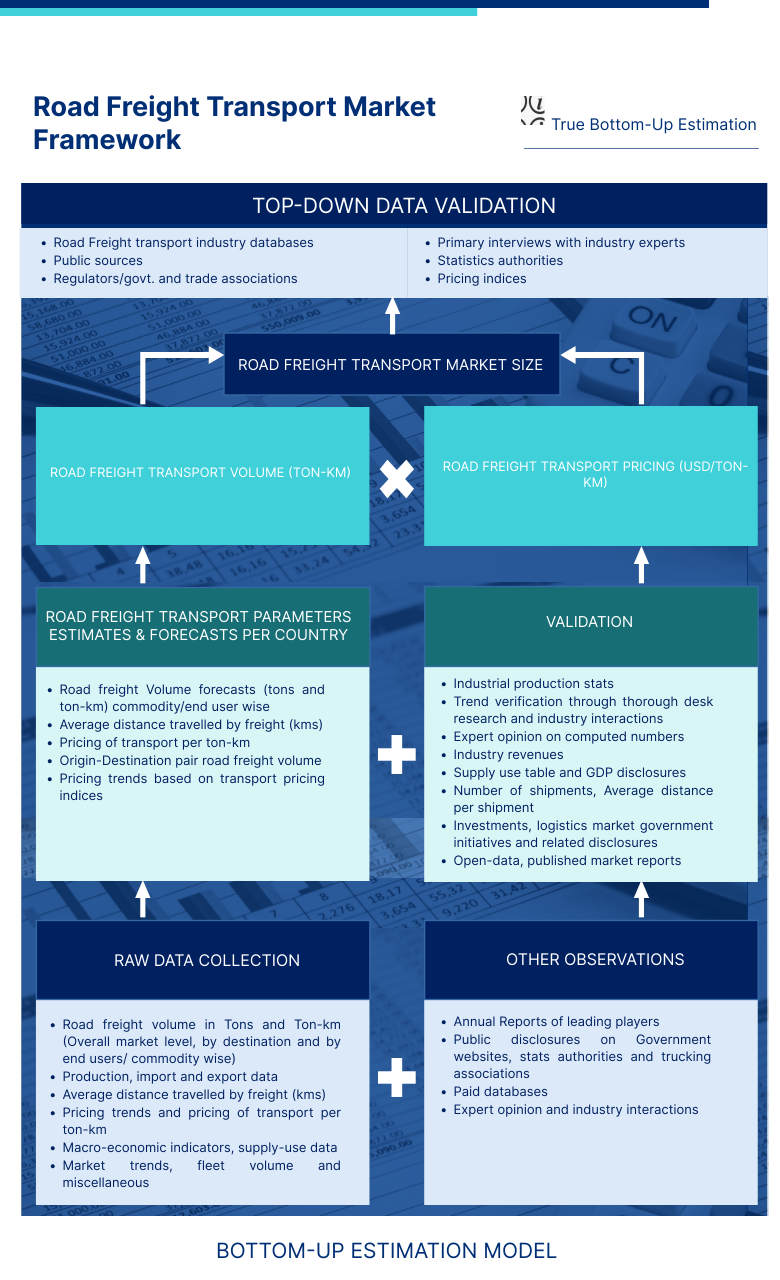
Research Methodology
Mordor Intelligence follows a four-step methodology in all our reports.
- Step-1: Identify Key Variables: In order to build a robust forecasting methodology, the variables and factors identified in Step-1 are tested against available historical market numbers. Through an iterative process, the variables required for market forecast are set and the model is built on the basis of these variables.
- Step-2: Build a Market Model: Market-size estimations for the forecast years are in nominal terms. Inflation is considered to be a part of the pricing, and the average selling price (ASP) is varying throughout the forecast period for each country
- Step-3: Validate and Finalize: In this important step, all market numbers, variables and analyst calls are validated through an extensive network of primary research experts from the market studied. The respondents are selected across levels and functions to generate a holistic picture of the market studied.
- Step-4: Research Outputs: Syndicated Reports, Custom Consulting Assignments, Databases & Subscription Platforms