
3D Radar Imaging For Industrial Automation Market Size and Share
Market Overview
| Study Period | 2020 - 2031 |
|---|---|
| Market Size (2026) | USD 1.08 Billion |
| Market Size (2031) | USD 2.31 Billion |
| Growth Rate (2026 - 2031) | 16.42 % |
| Fastest Growing Market | Asia-Pacific |
| Largest Market | Asia-Pacific |
| Market Concentration | Medium |
Major Players *Disclaimer: Major Players sorted in no particular order Image © Mordor Intelligence. Reuse requires attribution under CC BY 4.0. | |
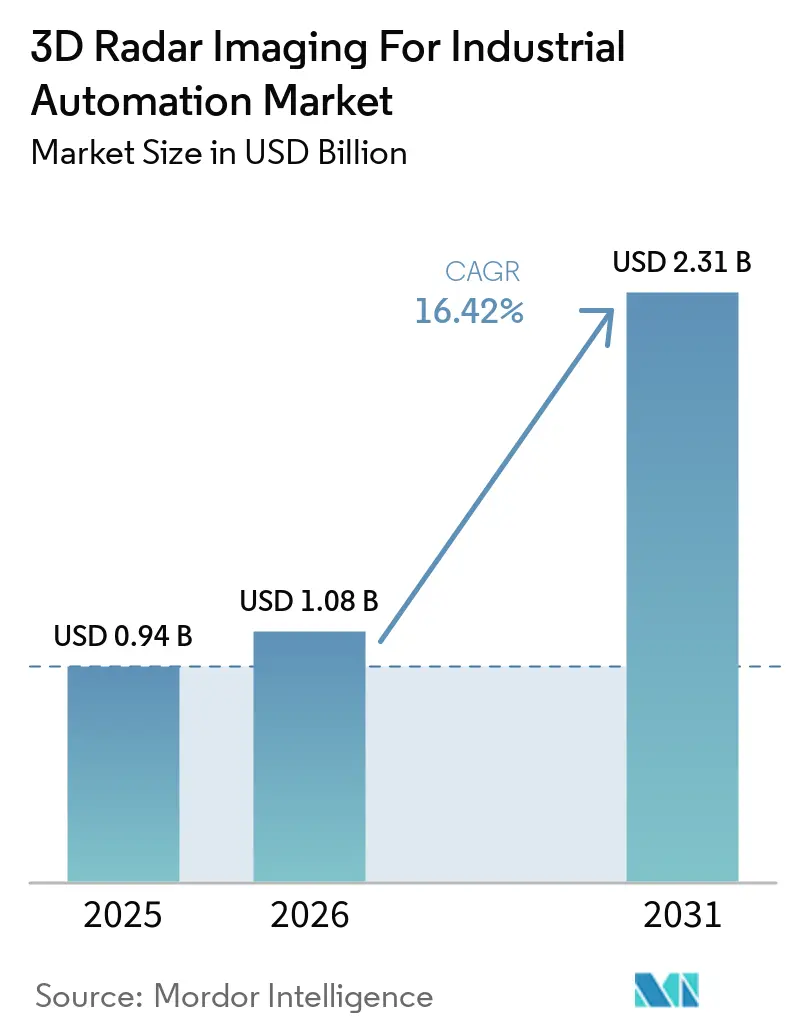
3D Radar Imaging For Industrial Automation Market Analysis by Mordor Intelligence
The 3D radar imaging for industrial automation market size is expected to grow from USD 0.94 billion in 2025 to USD 1.08 billion in 2026 and is forecast to reach USD 2.31 billion by 2031 at 16.42% CAGR over 2026-2031. The 3D radar imaging for industrial automation market is benefiting from wider use of autonomous mobile robots, lower millimeter-wave component costs, and a shift from fixed-plane scanning to three-dimensional perception. Industrial robot installations reached 542,000 units in 2024, while the operating stock reached 4,664,000 units, creating a broad base for sensing hardware and software. The 3D radar imaging for industrial automation market is also moving toward systems that combine radar, cameras, software, and safety functions in one product. Suppliers with established distribution networks compete with radar specialists and chip providers, while automotive radar experience is moving into industrial robot applications. Safety certification and the limited availability of labeled radar data remain important factors in vendor selection and product development.
Key Report Takeaways
- By product type, Integrated 3D Radar Imaging/Vision Systems held 38.72% of the 3D radar imaging for industrial automation market share in 2025, while Radar-Based Industrial Automation Systems are projected to expand at a 17.93% CAGR through 2031.
- By radar architecture, FMCW Radar accounted for 43.68% of the 3D radar imaging for industrial automation market share in 2025, while MIMO / Digital Beamforming Radar is projected to expand at a 17.76% CAGR through 2031.
- By application, Autonomous Mobile Robots and AGVs held 27.83% share in 2025, while Automated Storage and Retrieval Positioning is projected to expand at a 17.84% CAGR through 2031.
- By end-user, Warehousing, Logistics, and Distribution accounted for 24.61% share in 2025 and is projected to expand at a 17.57% CAGR through 2031.
- By geography, Asia-Pacific held 36.94% share in 2025 and is projected to expand at a 17.36% CAGR through 2031.
Note: Market size and forecast figures in this report are generated using Mordor Intelligence’s proprietary estimation framework, updated with the latest available data and insights as of January 2026.
Global 3D Radar Imaging For Industrial Automation Market Trends and Insights
Drivers Impact Analysis*
| Driver | (~) % Impact on CAGR Forecast | Geographic Relevance | Impact Timeline |
|---|---|---|---|
| Expansion of Autonomous Mobile Robot Fleets | +4.5% | Global, concentrated in Asia-Pacific, North America, and Europe | Medium term (2-4 years) |
| Integration of Radar Point Clouds With AI and Sensor Fusion | +3.8% | Global | Long term (≥ 4 years) |
| Migration From 2D Safety Scanning to 3D Spatial Awareness | +3.2% | Global, with early gains in North America and Europe | Medium term (2-4 years) |
| Automotive-Scale Millimeter-Wave Component Cost Declines | +2.5% | Global, strongest benefit in cost-sensitive Asia-Pacific markets | Short term (≤ 2 years) |
| All-Weather Near-Field Perception Requirements | +1.8% | Global | Medium term (2-4 years) |
| Radar-Based 3D Inventory and Bulk-Material Automation | +1.4% | Asia-Pacific, Middle East and Africa, South America | Long term (≥ 4 years) |
| Source: Mordor Intelligence | |||
Expansion of Autonomous Mobile Robot Fleets
The expansion of autonomous mobile robot and automated guided vehicle fleets is a major source of demand for the 3D radar imaging for industrial automation market. The International Federation of Robotics projected annual global robot installations of 575,000 units in 2025, with installations expected to exceed 700,000 units by 2028.[1] New mobile robot deployments often operate alongside older systems that use 2D safety scanners. This setting supports radar adoption in both new installations and retrofit safety projects. Autonomous Mobile Robots and AGVs held 27.83% of application demand in 2025. Aptiv’s PULSE sensor was selected by Robust.AI for its Gen 3 Carter collaborative mobile robot, with the program targeting Performance Level d certification under ISO 13849.
Integration of Radar Point Clouds with AI and Sensor Fusion
Radar point clouds are becoming a more central input for industrial robotics software in the 3D radar imaging for industrial automation market. Texas Instruments collaborated with NVIDIA in March 2026 to connect its IWR6243 mmWave radar with NVIDIA Jetson Thor through the NVIDIA Holoscan Sensor Bridge.[2] The arrangement supports low-latency radar and camera fusion for robot navigation. Radar can detect glass doors and reflective surfaces that may be difficult for cameras to identify. A 2025 IEEE study found that optimized FMCW radar configurations supported real-time human proximity detection, motion tracking, and robot stopping functions in collaborative robot settings. Radar-Based Industrial Automation Systems are projected to expand at a 17.93% CAGR through 2031 because suppliers can combine AI processing with safety firmware and application software.
Migration From 2D Safety Scanning to 3D Spatial Awareness
The replacement of single-plane laser safety scanners with three-dimensional radar systems creates a long-term opportunity for the 3D radar imaging for industrial automation market. A 2D scanner observes a fixed plane and can leave areas above or below that plane unobserved. These gaps can affect low-profile robots, raised conveyors, and seated workers. SICK’s safeRS3 FMCW safety radar is used in demanding environments, including wood processing and steel production, where multi-zone monitoring is needed.[3] Safety certification can make radar a practical option for systems that need wider area coverage. European machinery safety requirements also increase the importance of compliant sensing systems in procurement decisions.
Automotive-Scale Millimeter-Wave Component Cost Declines
Automotive radar production is lowering component costs for the 3D radar imaging for industrial automation market. Texas Instruments introduced the AWR2188, a single-chip 8×8 4D imaging radar transceiver, in January 2026. The company reported 30% faster analog-to-digital converter processing than its earlier device. Lower front-end costs shift more of the system value toward safety firmware, calibration tools, and application software. Standalone sensors, radar modules, and evaluation kits can benefit as pilot projects require less initial spending. MIMO / Digital Beamforming Radar is projected to expand at a 17.76% CAGR, supported by virtual-array designs that improve resolution without large antenna panels.
Restraints Impact Analysis*
| Restraint | (~) % Impact on CAGR Forecast | Geographic Relevance | Impact Timeline |
|---|---|---|---|
| Limited Object Classification Detail Versus Optical Vision | -2.3% | Global | Medium term (2-4 years) |
| Electromagnetic Interference and Multi-Radar Coordination Complexity | -1.6% | Global, particularly in dense manufacturing environments | Short term (≤ 2 years) |
| Sparse Industrial Training Data for Radar Point Clouds | -1.2% | Global | Long term (≥ 4 years) |
| Functional-Safety Validation and Integration Burden | -0.9% | North America and Europe, strict regulatory environments | Medium term (2-4 years) |
| Source: Mordor Intelligence | |||
Limited Object Classification Detail Versus Optical Vision
Limited object classification detail constrains the use of radar-only systems in the 3D radar imaging for industrial automation market. Industrial radar point clouds provide fewer points per cubic meter than structured-light and stereoscopic camera systems at close range. This limits the information available for tasks that depend on shape, surface texture, or color recognition. Radar remains suitable for presence sensing, proximity monitoring, and bulk-volume measurement. A 2025 study in *Information Fusion* reported 61.7% mean average precision and 76.5% multi-object tracking accuracy from feature-level radar and camera fusion in low-light and high-vibration conditions. Integrated radar and vision products address this limitation by combining radar’s environmental resilience with the semantic detail offered by cameras.
Electromagnetic Interference and Multi-Radar Coordination Complexity
Interference among co-located radar units can increase integration work in the 3D radar imaging for industrial automation market. FMCW sensors operating in overlapping frequency ranges may interfere with each other when installed at high density. This challenge is important in automated storage and retrieval facilities and port crane clusters. Time-division, frequency-hopping, and code-division approaches can reduce interference, but they add processing requirements and may affect latency. MIMO systems and software-defined waveforms offer partial solutions, although they require more advanced embedded processing. The lack of a dedicated harmonized standard for industrial radar arrays can delay qualification decisions in cautious process industries.
*Our forecasts treat driver/restraint impacts as directional, not additive. The impact forecasts reflect baseline growth, mix effects, and variable interactions.
Segment Analysis
By Product Type: Integrated Systems Lead Adoption
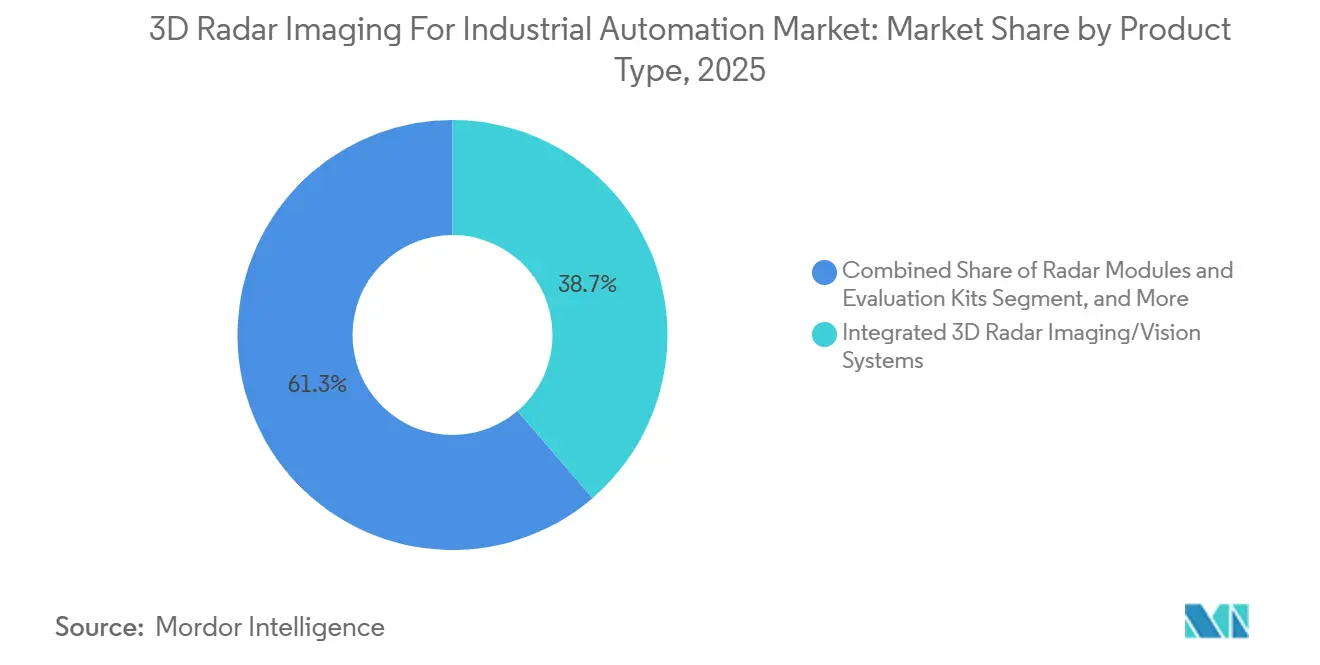
Integrated 3D Radar Imaging/Vision Systems held 38.72% of the 3D radar imaging for industrial automation market share in 2025. Buyers value calibrated modules that combine sensing, firmware, and safety assessment in a single product. These systems are being used in mobile robots, conveyor lines, and intralogistics facilities. A common circuit board and software stack can reduce the integration work associated with multiple sensor suppliers. The arrangement can also simplify portions of IEC 61508 and ISO 13849 assessment. Radar-Based Industrial Automation Systems are projected to expand at a 17.93% CAGR through 2031. These systems combine hardware with functions such as stacker automation, silo tracking, and crane positioning. Suppliers can package those functions as complete industrial solutions rather than separate components. Aptiv presented intelligent edge solutions at Automate 2026 that combined its PULSE sensor, computing capability, and camera-radar fusion in a certifiable module.
Standalone 3D Radar Sensors remain relevant when users have internal integration capability or need lower-cost retrofit options. They give equipment makers flexibility in the selection of software and complementary sensors. Radar Modules and Evaluation Kits serve research teams that are testing new perception designs. These products can help original equipment manufacturers move from a proof of concept to a production design. Lower automotive-derived chipset costs improve the economics of these entry products. The 3D radar imaging for industrial automation industry is therefore competing less on the basic radar front end. Software quality, calibration support, and certification readiness are becoming more significant differentiators. This shift favors suppliers that can provide both sensing hardware and validated application tools.

By Radar Architecture: FMCW Retains Scale While MIMO Advances
FMCW Radar held 43.68% of the 3D radar imaging for industrial automation market share in 2025. Its installed base spans level measurement, automated guided vehicle obstacle detection, and material-flow monitoring. Long-term use has created a broad set of application notes, calibration methods, and integration libraries. Those resources help sustain its position in mid-range sensing applications. FMCW radar provides dependable range information in many industrial settings. MIMO / Digital Beamforming Radar is projected to expand at a 17.76% CAGR through 2031. It can create a large virtual antenna aperture using compact physical arrays. This approach improves angular resolution while retaining the weather tolerance and reliability associated with radar. The architecture is increasingly relevant where detailed spatial perception is needed.
Pulse and Pulse-Doppler Radar retains a specialized role in long-range stockyard and port crane operations. Its direct velocity measurement can complement three-dimensional mapping in those settings. Hybrid and Sensor-Fusion Radar combines FMCW range precision with MIMO azimuth resolution. These systems can support navigation, obstacle detection, and inventory mapping from one mounted device. Architecture choices are becoming more closely tied to the operating environment and required safety function. The 3D radar imaging for industrial automation industry is also seeing demand for designs that can work in dust, steam, and low-light conditions. Buyers therefore assess radar architecture alongside integration effort and software capability. This supports a broader range of architectures rather than a single universal design.
By Application: Mobile Robots Lead While Intralogistics Accelerates
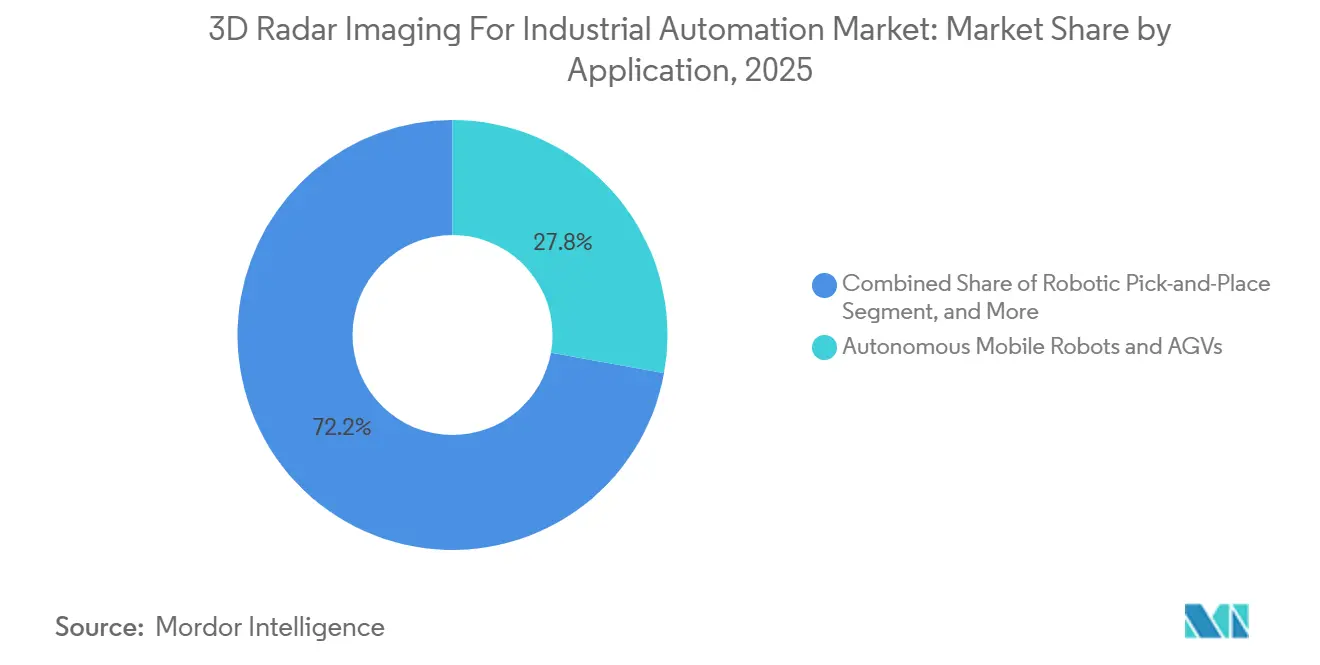
Autonomous Mobile Robots and AGVs accounted for 27.83% share of the 3D radar imaging for industrial automation market size in 2025. They use radar for simultaneous localization and mapping, safe-zone monitoring, and fleet coordination. Adoption spans automotive plants, e-commerce operations, and semiconductor facilities. Mobile robot platforms can use different sensing layers for safety and for navigation. Safety sensors emphasize SIL 2 certification and long service life. Navigation sensors emphasize point-cloud density and low latency. This creates a two-tier sourcing approach within a single robot platform. It supports demand for both safety-focused suppliers and high-performance perception specialists. The result is more specialized purchasing across the 3D radar imaging for industrial automation market.
Automated Storage and Retrieval Positioning is projected to expand at a 17.84% CAGR through 2031. High-bay warehouses use cranes and shuttle systems that require accurate positioning in dusty and low-light aisles. Robotic pick-and-place, machine tending, collision avoidance, personnel protection, and quality inspection remain important application areas. Bulk-material volume and level measurement is particularly relevant in mining and cement operations. Crane, shiploader, and yard equipment positioning also benefits from radar performance in steam and particulate-heavy settings. Texas Instruments outlined how its IWR6243 can create dynamic safety zones based on object distance and relative speed. Fixed safety scanner zones do not provide that same continuous adjustment. This capability supports use in facilities where traffic patterns and operating conditions change throughout the day.
By End-User: Warehousing Combines Scale and Momentum
Warehousing, Logistics, and Distribution accounted for 24.61% share in 2025 and is projected to expand at a 17.57% CAGR through 2031. E-commerce operations need high throughput in increasingly dense fulfillment centers. As space per shipment declines, the number of potential interactions among people, robots, and equipment increases. That can raise the number of sensors needed within a facility. The 3D radar imaging for industrial automation market size in this end-user group reflects both new warehouse projects and upgrades to existing sites. Automotive and Transportation is the second-largest end-user segment. It uses radar in body shop welding verification, paint-line measurement, and automated guided vehicle logistics. Electronics and Semiconductor sites require highly accurate positioning for wafer handling and printed circuit board assembly. High-frequency FMCW sensors can serve applications that need sub-millimeter range resolution.
Mining, Metals, and Cement operations use radar for bulk-material measurement and crane automation. indurad’s iSDR-P scanning radar offers a 180° × 120° field of view and ranges of up to 160 meters. Chemicals and Pharmaceuticals, Water, Wastewater, and Utilities, Food and Beverage, and Ports, Marine, and Heavy Equipment have distinct operating conditions. These conditions include flammable atmospheres, hygiene requirements, corrosive media, and outdoor weather exposure. Such conditions can favor radar over camera and LiDAR alternatives. ATEX and IECEx certification affects sensor selection in hazardous areas. indurad’s iSilo 3D portfolio includes ATEX-rated options for these applications. This range of end-user needs supports application-specific product design in the 3D radar imaging for industrial automation market.
Geography Analysis
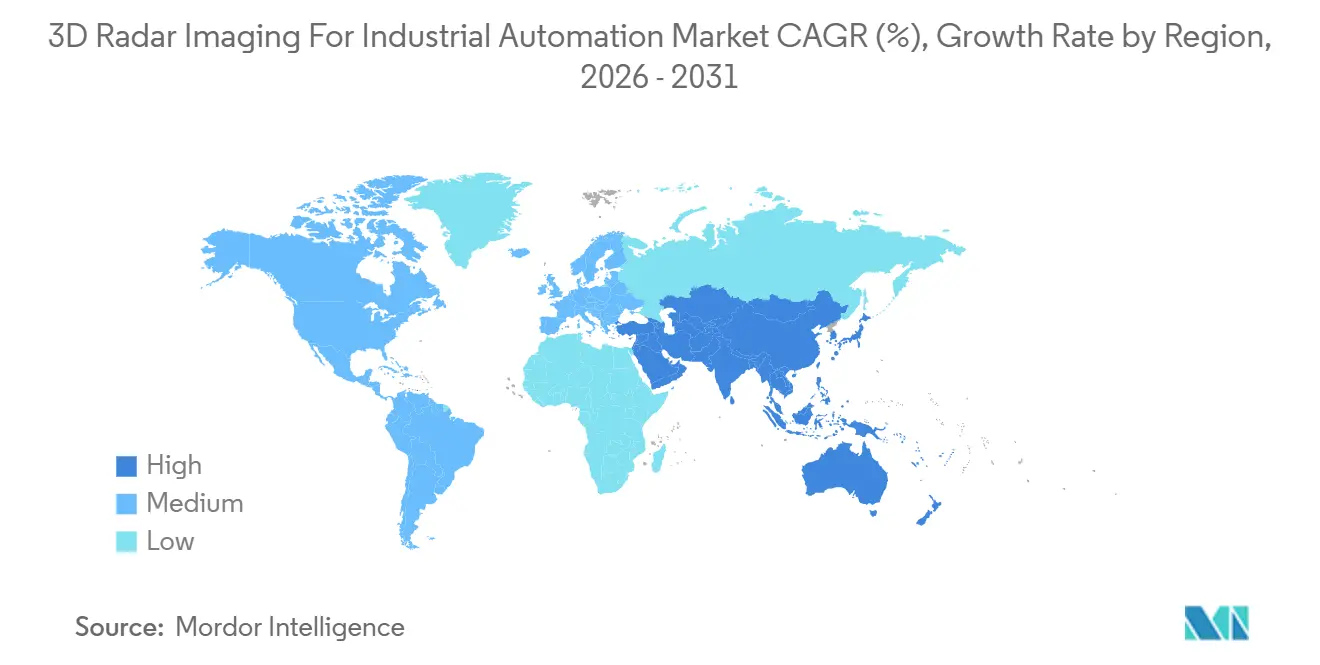
Asia-Pacific held 36.94% of the 3D radar imaging for industrial automation market share in 2025 and is projected to expand at a 17.36% CAGR through 2031. China installed 295,000 industrial robots in 2024, representing 54% of global installations. This installed base supports demand across automotive assembly, electronics production, and logistics automation. Japan and South Korea add demand from semiconductor and display manufacturing. These applications require precise three-dimensional positioning. India is expanding warehousing infrastructure alongside e-commerce logistics and manufacturing initiatives. Vietnam and Thailand are also adding electronics assembly capacity. New facilities in these countries can adopt three-dimensional radar systems without first investing in the earlier 2D scanner generation. Zadar Labs entered a distribution agreement with Cornes Technologies in Japan in August 2025.
North America and Europe are the second- and third-largest regional blocs in the 3D radar imaging for industrial automation market. The United States is supported by fulfillment automation, semiconductor fabrication, and industrial robotics. Canada and Mexico contribute through automotive supply-chain automation. Industrial robot installations in the Americas totaled 50,100 units in 2024. Germany has a dense base of automotive manufacturers, machine builders, and automation providers. The United Kingdom, France, Italy, and Spain add demand from chemicals, food and beverage, and port logistics. Strict functional-safety requirements make certification an important competitive factor. European suppliers with approved products can reduce qualification time for customers. The 3D radar imaging for industrial automation market benefits where buyers need notified-body approval.
South America, the Middle East, and Africa are smaller but distinct areas for the 3D radar imaging for industrial automation market. Brazil and Argentina provide demand through mining, bulk handling, ports, and inland conveyor networks. Saudi Arabia and the United Arab Emirates are building port and logistics capacity through infrastructure programs. Zadar Labs established Zadar Saudi Solutions as a regional hub in 2026. South Africa and Nigeria are important African locations for mining-related use cases. Turkey serves as both an industrial user and a distribution point for nearby markets. The United Arab Emirates also offers port infrastructure and early physical AI use cases. These regional conditions support demand for radar-based volume measurement, flow monitoring, and equipment positioning.
Competitive Landscape
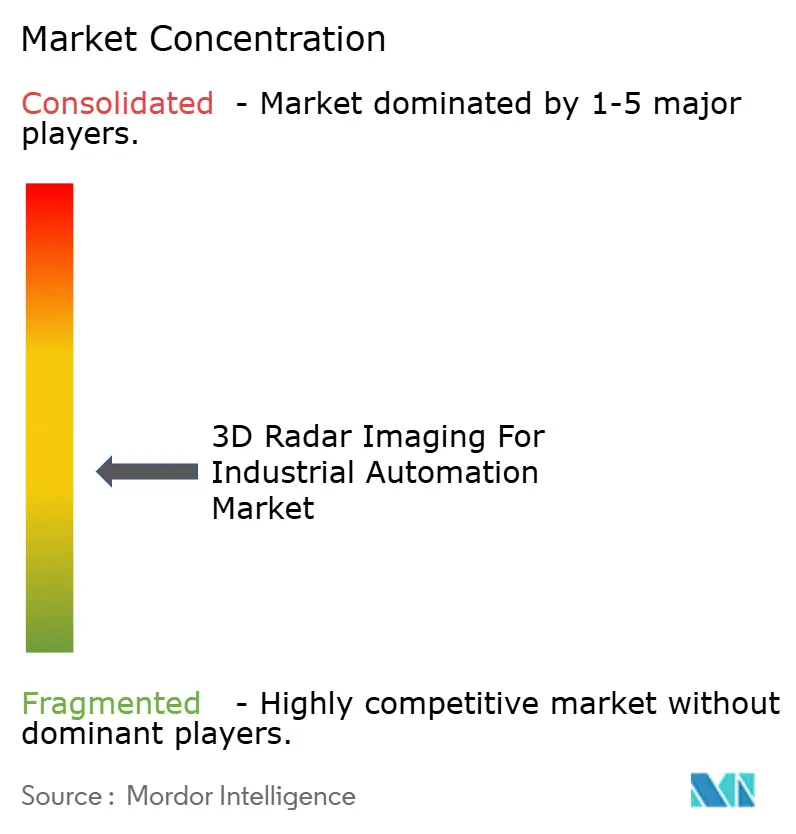
The 3D radar imaging for industrial automation market has a moderately fragmented competitive structure. No company holds a leading position across every application and end-user group. SICK AG, Pepperl+Fuchs SE, ifm electronic GmbH, and OMRON Corporation bring broad distribution coverage and established installed bases. Arbe Robotics Ltd., Vayyar Imaging Ltd., Zadar Labs, Inc., indurad GmbH, and Sonair AS focus more directly on radar and three-dimensional perception. Texas Instruments Incorporated and TDK Corporation provide components that support system development. Aptiv PLC and Continental AG are applying automotive radar knowledge to industrial robotics. Competition increasingly centers on safety certification, AI software, and edge processing. Suppliers that combine these capabilities can reduce integration effort for industrial customers.
Aptiv and Comau announced a co-development agreement in 2026 for radar- and vision-based systems for robotics, autonomous systems, and industrial logistics. The agreement illustrates the move toward application-focused safety systems. Zadar Labs uses software-defined imaging radar that allows changes in waveform, field of view, and resolution without replacing hardware. This can shorten the transition from product evaluation to deployment. Texas Instruments is also connecting radar hardware with accelerated computing platforms for physical AI applications. These moves show how component suppliers and system providers are seeking roles beyond basic hardware supply. The 3D radar imaging for industrial automation market is creating room for partnerships that combine sensing, computing, and industrial automation expertise.
Functional-safety certification is a key purchasing requirement for mobile robotics and machine safety applications. Suppliers also compete through AI model libraries designed for specific factory scenes. Edge inference can help customers process radar and camera inputs near the operating equipment. Firmware that is assessed against IEC 62061 and ISO 13849 can shorten customer qualification work. This can give established sensor providers and specialized firms different ways to compete. The 3D radar imaging for industrial automation market remains open to smaller suppliers that can address difficult operating environments or specific applications. Larger companies retain advantages in distribution, technical support, and installed-base access. The competitive landscape is therefore active, with differentiation based on capability rather than a single dominant supplier.
3D Radar Imaging For Industrial Automation Industry Leaders
-
Pepperl+Fuchs SE
-
ifm electronic GmbH
-
SICK AG
-
indurad GmbH
-
Aptiv PLC
- *Disclaimer: Major Players sorted in no particular order
Recent Industry Developments
- July 2026: Arbe Robotics disclosed that its radar technology was selected by a leading global defense and homeland security system integrator for 3 joint projects, with initial orders placed and first deliveries completed, marking Arbe’s expansion into non-automotive industrial and security sensing programs.
- July 2026: Aptiv PLC announced that Robust.AI selected its PULSE sensor, combining ultra-short-range radar with a surround-view camera, for the Gen 3 Carter collaborative mobile robot. The collaboration targeted Performance Level d certification under ISO 13849 for warehouse automation safety use cases.
- June 2026: Zadar Labs raised USD 17 million in Series A financing to accelerate volume shipment of its Software-Defined Imaging Radar platform across industrial automation, logistics, mobility, and security applications.
- March 2026: Texas Instruments collaborated with NVIDIA to integrate TI’s IWR6243 mmWave radar with NVIDIA Jetson Thor through NVIDIA Holoscan Sensor Bridge, providing low-latency three-dimensional perception for humanoid robot safety awareness.
Global 3D Radar Imaging For Industrial Automation Market Report Scope
The 3D Radar Imaging for Industrial Automation Market comprises the development, sale, and integration of advanced millimeter-wave and microwave radar systems that generate high-resolution, three-dimensional point-cloud representations of factory and logistics environments to enable precise object detection, localization, collision avoidance, and process optimization in automated production lines, robotic cells, and material-handling operations.
The 3D Radar Imaging for Industrial Automation Market Report is Segmented by Product Type (Standalone 3D Radar Sensors, Integrated 3D Radar Imaging/Vision Systems, Radar Modules and Evaluation Kits, and Radar-Based Industrial Automation Systems), by Radar Architecture (FMCW Radar, Pulse and Pulse-Doppler Radar, MIMO / Digital Beamforming Radar, and Hybrid and Sensor-Fusion Radar), by Application (Autonomous Mobile Robots and AGVs, Robotic Pick-and-Place and Machine Tending, Automated Storage and Retrieval Positioning, Crane and Shiploader and Yard Equipment Positioning, Conveyor and Chute and Material-Flow Monitoring, Bulk-Material Volume and Level Measurement, Collision Avoidance and Personnel Protection, Quality Inspection and Dimensional Measurement, and Other Applications), by End-User (Automotive and Transportation, Electronics and Semiconductor, Food and Beverage, Chemicals and Pharmaceuticals, Mining and Metals and Cement, Warehousing and Logistics and Distribution, Ports and Marine and Heavy Equipment, Water and Wastewater and Utilities, and Other End-User Industries), and by Geography (North America, South America, Europe, Asia-Pacific, and Middle East and Africa). The Market Forecasts are Provided in Terms of Value (USD).
| Standalone 3D Radar Sensors |
| Integrated 3D Radar Imaging/Vision Systems |
| Radar Modules and Evaluation Kits |
| Radar-Based Industrial Automation Systems |
| FMCW Radar |
| Pulse and Pulse-Doppler Radar |
| MIMO / Digital Beamforming Radar |
| Hybrid and Sensor-Fusion Radar |
| Autonomous Mobile Robots and AGVs (Navigation, Positioning, and Fleet Coordination) |
| Robotic Pick-and-Place and Machine Tending |
| Automated Storage and Retrieval Positioning (Intralogistics) |
| Crane, Shiploader, and Yard Equipment Positioning |
| Conveyor, Chute, and Material-Flow Monitoring |
| Bulk-Material Volume and Level Measurement |
| Collision Avoidance and Personnel Protection |
| Quality Inspection and Dimensional Measurement |
| Other Appliactions |
| Automotive and Transportation |
| Electronics and Semiconductor |
| Food and Beverage |
| Chemicals and Pharmaceuticals |
| Mining, Metals, and Cement |
| Warehousing, Logistics, and Distribution |
| Ports, Marine, and Heavy Equipment |
| Water, Wastewater, and Utilities |
| Other End-User Industries |
| North America | United States | |
| Canada | ||
| Mexico | ||
| South America | Brazil | |
| Argentina | ||
| Rest of South America | ||
| Europe | Germany | |
| United Kingdom | ||
| France | ||
| Italy | ||
| Spain | ||
| Rest of Europe | ||
| Asia-Pacific | China | |
| Japan | ||
| India | ||
| South Korea | ||
| ASEAN | ||
| Rest of Asia-Pacific | ||
| Middle East and Africa | Middle East | Saudi Arabia |
| United Arab Emirates | ||
| Turkey | ||
| Rest of the Middle East | ||
| Africa | South Africa | |
| Nigeria | ||
| Rest of Africa | ||
| By Product Type | Standalone 3D Radar Sensors | ||
| Integrated 3D Radar Imaging/Vision Systems | |||
| Radar Modules and Evaluation Kits | |||
| Radar-Based Industrial Automation Systems | |||
| By Radar Architecture | FMCW Radar | ||
| Pulse and Pulse-Doppler Radar | |||
| MIMO / Digital Beamforming Radar | |||
| Hybrid and Sensor-Fusion Radar | |||
| By Application | Autonomous Mobile Robots and AGVs (Navigation, Positioning, and Fleet Coordination) | ||
| Robotic Pick-and-Place and Machine Tending | |||
| Automated Storage and Retrieval Positioning (Intralogistics) | |||
| Crane, Shiploader, and Yard Equipment Positioning | |||
| Conveyor, Chute, and Material-Flow Monitoring | |||
| Bulk-Material Volume and Level Measurement | |||
| Collision Avoidance and Personnel Protection | |||
| Quality Inspection and Dimensional Measurement | |||
| Other Appliactions | |||
| By End-User | Automotive and Transportation | ||
| Electronics and Semiconductor | |||
| Food and Beverage | |||
| Chemicals and Pharmaceuticals | |||
| Mining, Metals, and Cement | |||
| Warehousing, Logistics, and Distribution | |||
| Ports, Marine, and Heavy Equipment | |||
| Water, Wastewater, and Utilities | |||
| Other End-User Industries | |||
| By Geography | North America | United States | |
| Canada | |||
| Mexico | |||
| South America | Brazil | ||
| Argentina | |||
| Rest of South America | |||
| Europe | Germany | ||
| United Kingdom | |||
| France | |||
| Italy | |||
| Spain | |||
| Rest of Europe | |||
| Asia-Pacific | China | ||
| Japan | |||
| India | |||
| South Korea | |||
| ASEAN | |||
| Rest of Asia-Pacific | |||
| Middle East and Africa | Middle East | Saudi Arabia | |
| United Arab Emirates | |||
| Turkey | |||
| Rest of the Middle East | |||
| Africa | South Africa | ||
| Nigeria | |||
| Rest of Africa | |||
Key Questions Answered in the Report
What is the 3D radar imaging for industrial automation market size?
The market is forecast to reach USD 2.31 billion by 2031, growing from USD 1.08 billion in 2026, at a 16.42% CAGR.
What is driving adoption of 3D radar in industrial automation?
Mobile robot deployments, safety requirements, sensor fusion, and lower millimeter-wave component costs are supporting adoption.
Which product type leads demand?
Integrated 3D Radar Imaging/Vision Systems led the market with a 38.72% share in 2025.
Which radar architecture is expanding fastest?
MIMO / Digital Beamforming Radar is projected to expand at a 17.76% CAGR through 2031.
Which end-user group is the largest?
Warehousing, Logistics, and Distribution held a 24.61% share in 2025 and is projected to expand at a 17.57% CAGR.
Which region leads demand?
Asia-Pacific held a 36.94% share in 2025 and is projected to expand at a 17.36% CAGR through 2031.