
Automotive Electric Drive Axle Market Size and Share
Market Overview
| Study Period | 2019 - 2031 |
|---|---|
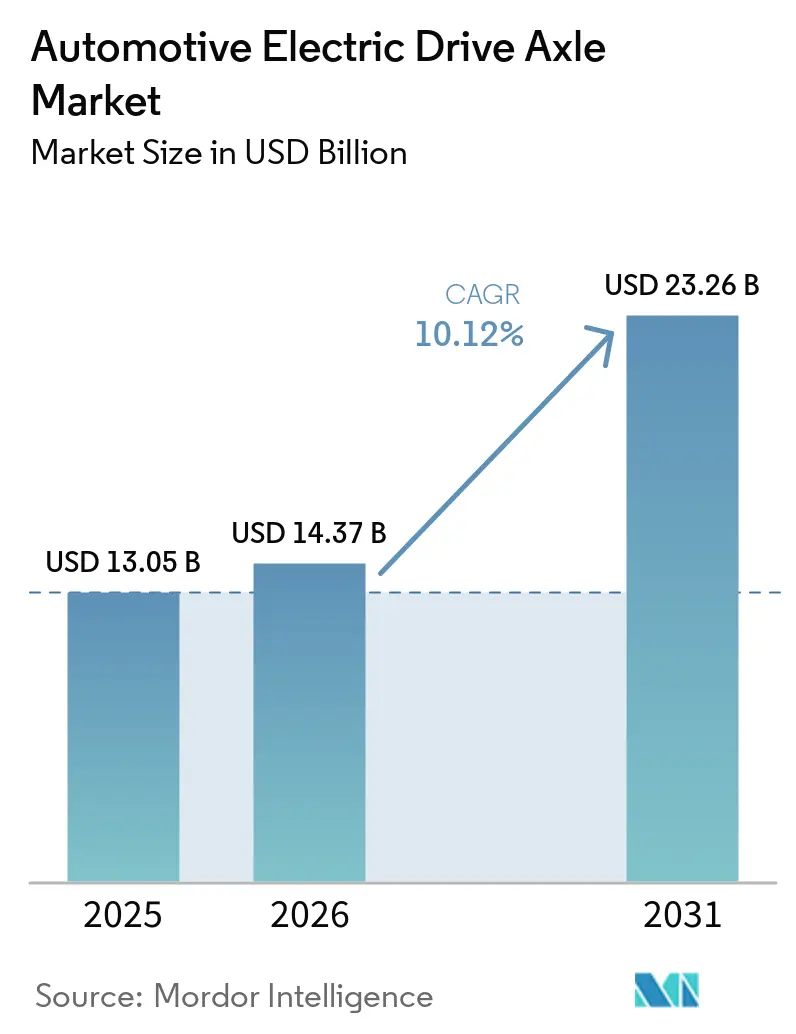
| Market Size (2026) | USD 14.37 Billion |
| Market Size (2031) | USD 23.26 Billion |
| Growth Rate (2026 - 2031) | 10.12 % |
| Fastest Growing Market | Asia-Pacific |
| Largest Market | Asia-Pacific |
| Market Concentration | Medium |
Major Players *Disclaimer: Major Players sorted in no particular order Image © Mordor Intelligence. Reuse requires attribution under CC BY 4.0. | |
Automotive Electric Drive Axle Market Analysis by Mordor Intelligence
The automotive electric drive axle market size was valued at USD 13.05 billion in 2025 and estimated to grow from USD 14.37 billion in 2026 to reach USD 23.26 billion by 2031, at a CAGR of 10.12% during the forecast period (2026-2031). The accelerating move to zero-emission mobility, mandated fleet CO₂ targets, and faster declines in battery costs are anchoring steady volume visibility for e-axle suppliers. Model launches built on 800 V systems, the rise of integrated 4-in-1 solutions, and expanded production footprints in Asia-Pacific are compressing cost curves and widening addressable demand. Competitive positioning now hinges on thermal-management know-how, rare-earth magnet alternatives, and the ability to package software-defined torque-vectoring features. Conversion kits for in-service vehicles, higher-margin dual-motor layouts for SUVs and pickups, and public subsidies for domestic drivetrain content are opening up additional revenue pools across the automotive electric-drive axle market.
Key Report Takeaways
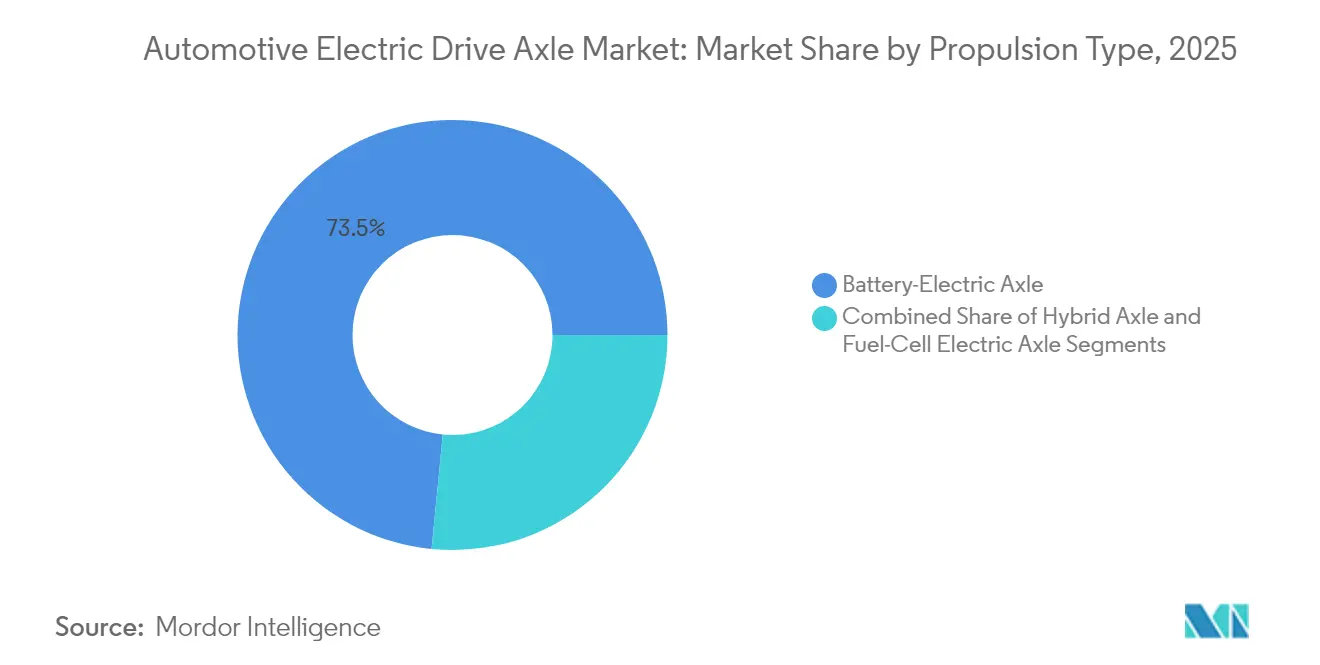
- By propulsion type, battery-electric axles led with 73.45% market share in 2025; fuel-cell axles are projected to grow at an 11.08% CAGR through 2031.
- By integration level, 3-in-1 systems held a 42.45% share of the automotive electric drive axle market in 2025, while 4-in-1 configurations are projected to grow at an 11.55% CAGR through 2031.
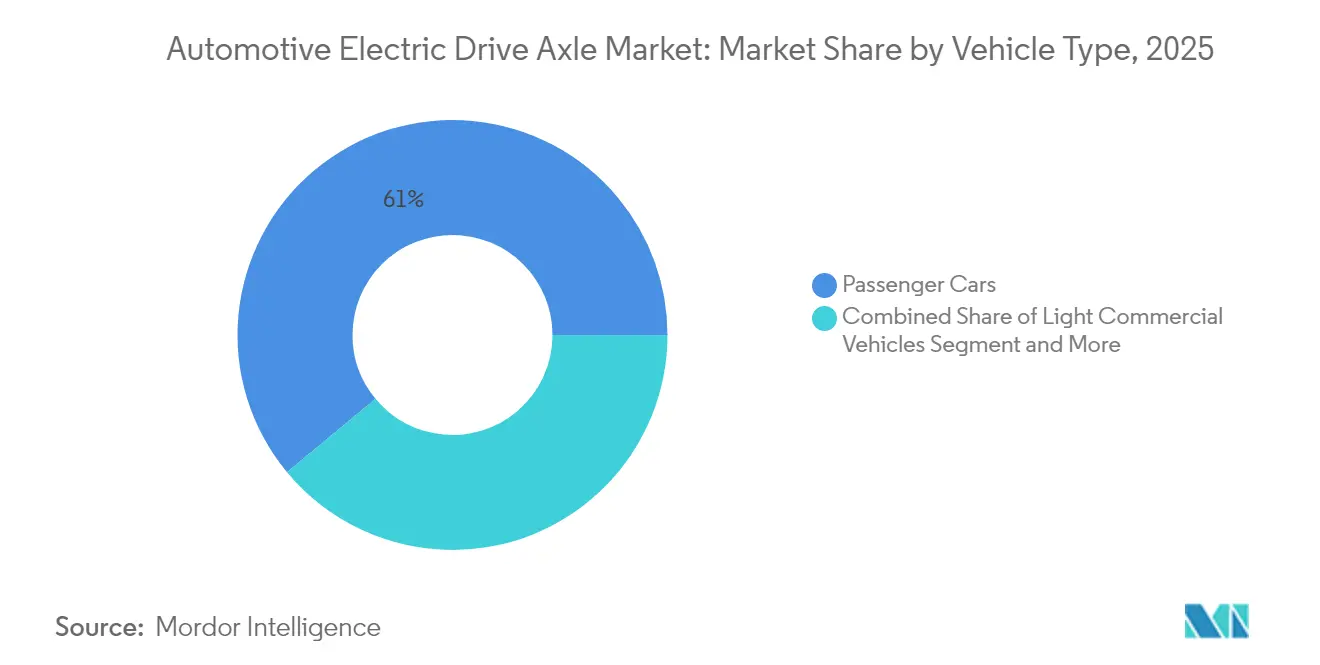
- By vehicle type, passenger cars accounted for 61.02% of the automotive electric drive axle market size in 2025; off-highway and specialty equipment are set to expand at a 10.78% CAGR to 2031.
- By sales channel, OEM-fitted units dominated, with an 88.12% share in 2025, while aftermarket retrofit kits are projected to grow at a 12.35% CAGR.
- By geography, Asia-Pacific commanded 44.70% of revenue in 2025 and is set to grow at a 13.24% CAGR.
Note: Market size and forecast figures in this report are generated using Mordor Intelligence’s proprietary estimation framework, updated with the latest available data and insights as of 2026.
Market Trends and Insights
Drivers Impact Analysis of Automotive Electric Drive Axle Market*
| Driver | (~) % Impact on CAGR Forecast | Geographic Relevance | Impact Timeline |
|---|---|---|---|
| Electrification Road-Maps Accelerate Demand | +2.1% | Global, led by China, EU, North America | Medium term (2-4 years) |
| Zero-Emission Mandates and Purchase Incentives | +1.8% | EU, California, China, spillover to emerging markets | Short term (≤ 2 years) |
| Battery-pack Cost Falls Below USD 80 /kWh | +1.5% | Global, highest impact in price-sensitive APAC markets | Medium term (2-4 years) |
| Surge in Battery-Electric SUV and Pickup Launches | +1.2% | North America, Europe, gradual APAC adoption | Short term (≤ 2 years) |
| 800 V Architectures Requiring Next-gen Axle Designs | +0.9% | Premium segments worldwide, early uptake in Germany and China | Long term (≥ 4 years) |
| Monetization of Software-Defined Torque-Vectoring | +0.7% | Developed markets with advanced connectivity infrastructure | Long term (≥ 4 years) |
| Source: Mordor Intelligence | |||
OEM Electrification Roadmaps Accelerate E-Axle Demand
Firm multi-year production targets from global automakers are giving Tier-1 suppliers unusually clear visibility into order volumes, encouraging larger capital outlays for dedicated e-axle lines and localized component sourcing. BMW’s sixth-generation eDrive for the Neue Klasse raises drivetrain efficiency by 20% while supporting both rear- and all-wheel layouts across sedans, SUVs, and compact crossovers. ZF secured EUR 31 billion (approximately USD 33.5 billion) in high-voltage e-mobility orders, demonstrating how locked-in road maps convert directly into binding, bankable contracts for suppliers in the automotive electric drive axle market.
Government Zero-Emission Mandates and Purchase Incentives
Binding sales quotas and steep non-compliance penalties are turning e-axle adoption from a discretionary choice into a regulatory requirement. The United Kingdom ZEV mandate started with 22% electric sales in 2024 and climbs to 100% by 2035, backed by GBP 15,000 (approximately USD 19,000) fines per non-compliant vehicle that materially exceed drivetrain cost premiums. California’s Advanced Clean Cars II rule compels 100% zero-emission light-duty sales by 2035 and full medium- and heavy-duty fleet conversion by 2036, cementing demand irrespective of short-term fuel-price swings [1].
Battery-Pack Cost Falls Below USD 80/kWh, Widening E-Axle Affordability
Rapid chemistry improvements, scaled cell factories, and policy incentives are jointly driving pack costs toward the critical sub-USD 80/kWh threshold that unlocks parity in total cost of ownership with diesel vans and compact cars. Argonne National Laboratory models a slide in the cost of a slide from roughly USD 140/kWh in 2023 to USD 86/kWh by 2035, even before tax credits. The International Council on Clean Transportation projects USD 72/kWh by 2030, enabling mainstream buyers to absorb the incremental cost of high-integration e-axles[2].
Surge in Battery-Electric SUV and Pickup Launches
Product pipelines are tilting toward high-margin trucks and SUVs that demand powerful dual-motor or e-beam axles, lifting average revenue per unit for suppliers. North America’s USD 100,000 electric truck cohort moved 58,000 units in H1 2024, a 35% sequential jump that validates latent consumer appetite for performance-oriented EVs. American Axle & Manufacturing’s 3-in-1 e-Beam delivers 150 kW and drop-in compatibility with body-on-frame architectures, directly addressing this fast-growing niche in the automotive electric drive axle market.
Restraints Impact Analysis of Automotive Electric Drive Axle Market*
| Restraint | (~) % Impact on CAGR Forecast | Geographic Relevance | Impact Timeline |
|---|---|---|---|
| Rare-Earth Magnet Price Volatility | −1.4% | Global, particularly cost-sensitive regions | Short term (≤ 2 years) |
| Cost Gap vs. Conventional Drivelines | −1.1% | Emerging markets and price-sensitive segments worldwide | Medium term (2-4 years) |
| OEM Squeezing Tier-1 Addressable Market | −0.8% | Developed regions with established OEM capabilities | Medium term (2-4 years) |
| Thermal-Management Limits at 4-in-1 Integration | −0.6% | High-performance applications globally | Long term (≥ 4 years) |
| Source: Mordor Intelligence | |||
Rare-Earth Magnet Price Volatility
Sharp swings in neodymium and dysprosium pricing are eroding margin predictability and pushing manufacturers toward alternative magnet chemistries or excitation technologies. Nissan targets a 30% cut in motor costs by substituting samarium-iron magnets, reducing exposure to supply chains concentrated in a single geography. GE Aerospace’s 23 kW dual-phase magnetic motor eliminates dysprosium while improving power density, demonstrating that performance compromises are no longer inevitable when moving away from rare-earth materials [3].
Up-Front Cost Gap vs. Conventional Drivelines
The higher purchase price of e-axle vehicles still deters buyers in regions with lower disposable income or subsidized diesel fuel, slowing fleet turnover. While battery and inverter costs trend downward, additional spending on charging infrastructure and thermal-management upgrades keeps sticker prices above comparable ICE models. Localized component production, import-duty relief, and scrappage incentives are being deployed to narrow the differential. Still, until lending mechanisms mature, the up-front premium remains a meaningful brake on penetration in many emerging markets in the automotive electric drive axle market.
*Our forecasts treat driver/restraint impacts as directional, not additive. The impact forecasts reflect baseline growth, mix effects, and variable interactions.
Automotive Electric Drive Axle Market Segment Analysis
By Propulsion Type:
Battery-electric Dominance Drives Market EvolutionBattery-electric axles are projected to account for 73.45% of revenue in 2025, underscoring their central role in the automotive electric drive axle market. Mass-production scale, expanding fast-charging infrastructure, and policies favoring zero-tailpipe-emission vehicles support this leadership. Hybrid e-axles serve transitional duty cycles, while fuel-cell axles, although nascent, are projected to grow at an 11.08% CAGR during the forecast period (2026-2031), driven by heavy-duty truck pilot programs and bus trials. The automotive electric drive axle market size for fuel-cell platforms is expected to expand in line with the development of hydrogen infrastructure, supported by initiatives such as Symbio’s 400 kW StackPack for Class 8 trucks. California’s support for bus deployments further validates the long-haul potential of fuel-cell axles.
Growing OEM interest in fuel-cell range extenders and national hydrogen strategies suggests a gradual broadening of powertrain diversity. Suppliers that can tailor modular housings to either battery-electric or fuel-cell stacks will hedge volume risk as fleet operators experiment with both technologies.

By Integration Level:
4-in-1 Systems Emerge Despite Thermal Challenges3-in-1 units that merge motor, gear, and inverter accounted for 42.45% share in 2025, offering cost-effective packaging within current cooling envelopes. Yet customer RFQs now favor 4-in-1 layouts that also integrate thermal loops, which will drive growth in that segment at an 11.55% CAGR during the forecast period. The automotive electric drive axle market size associated with 4-in-1 designs is forecast to compound as wide-bandgap semiconductors improve heat rejection and enable smaller cooling circuits. Schaeffler’s solution combines all elements into a 70 kg module that fits compact C-segment vehicles.
Thermal complexity still limits adoption in high-performance EVs, where sustained power loads require separate chillers. Suppliers are investing in phase-change materials and split-loop architectures to extend peak-power windows without raising mass.
By Vehicle Type:
Off-Highway Applications Drive Unexpected GrowthPassenger cars accounted for 61.02% of the market share in 2025, driven by urban incentives and strong consumer familiarity with electric sedans and crossovers. Light commercial vans are gaining traction as logistics companies seek to comply with last-mile zero-emission regulations. The automotive electric drive axle market is also shifting toward worksite machinery, as construction and agricultural equipment manufacturers electrify their fleets to meet noise and emissions limits. These off-highway applications are projected to grow at a CAGR of 10.78% during the forecast period (2026-2031).
Parker Hannifin couples electric drives with hydraulic work functions for loaders and excavators, proving that duty-cycle demands can be met through carefully tuned torque curves. Danfoss’s 43 kW onboard charger shortens downtime, a critical hurdle for rental fleets.
By Sales Channel:
Aftermarket Retrofit Gains MomentumFactory-installed systems dominated at 88.12% in 2025 as e-axles are tightly co-designed with chassis electronics. Yet retrofit kits will be gathering pace at a 12.35% CAGR during the forecast period because fleets view conversion as a capex-light compliance path. Valeo’s kit can upgrade a diesel van to electric for about half the price of a new EV. ZF Aftermarket’s Maintain-Repair-Replace program includes specialist fluids that extend inverter life and simplify workshop servicing.
Regulators in Europe are weighing tax credits for retrofits, which, if enacted, could further steepen the curve. Engineering standards for crash integrity and cybersecurity remain the gating factors for widespread adoption.
Geography Analysis
APAC Automotive Electric Drive Axle Market
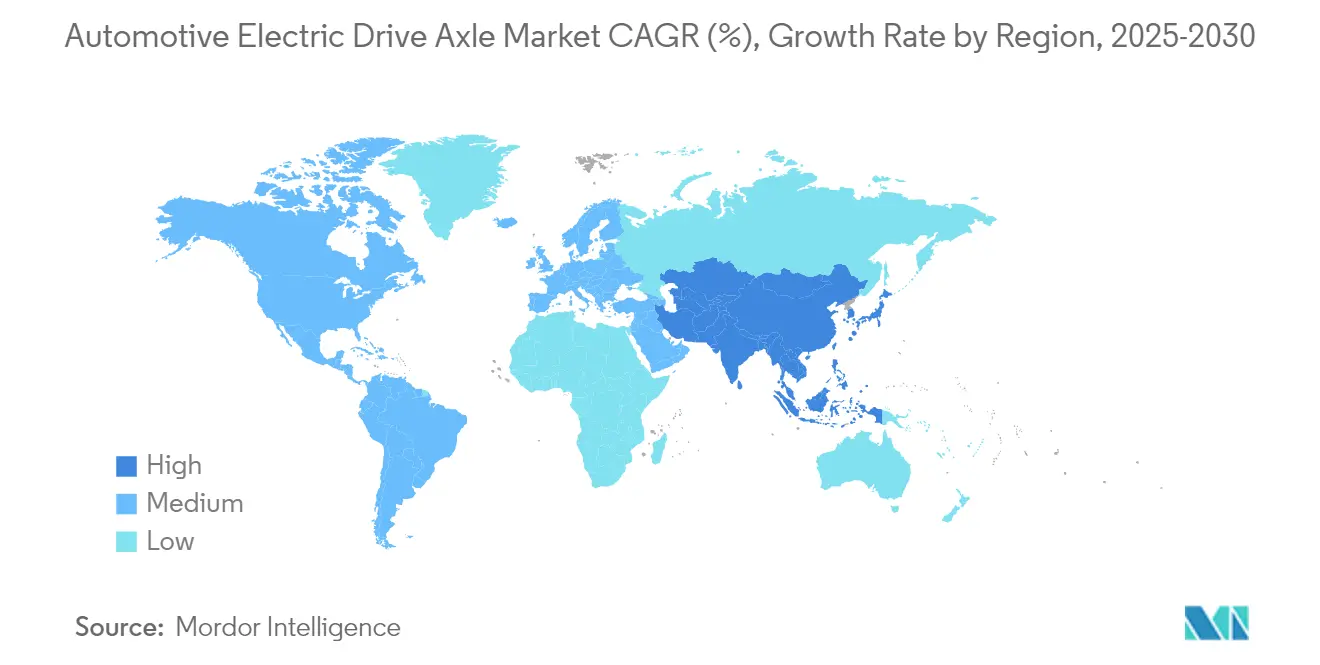
Asia-Pacific captured 44.70% of 2025 revenue and will expand at a 13.24% CAGR, making it the gravitational center of the automotive electric drive axle market. China produced more than 70% of global EVs in 2024, giving local e-axle makers unmatched scale advantages. State subsidies, domestic mining of battery materials, and aggressive quota targets sustain high plant-utilization rates. The region is projected to represent a major share of new EV sales by 2030. Japanese Tier-1s are pivoting quickly: Nidec is optimizing smaller e-motors tailored to low-cost micro EVs, while midsize suppliers are pooling R&D to close technology gaps.
North America Automotive Electric Drive Axle Market
North America is building momentum around electric pickups and policy-driven local content rules. The Inflation Reduction Act ties consumer rebates to regionally sourced drivetrains, steering fresh investment into axle assembly lines. BorgWarner reported a 47% year-on-year rise in e-product sales for Q1 2025, reflecting strong ramp-ups at US OEM plants. American Axle’s e-Beam targets this truck wave with 150 kW output for body-on-frame platforms.
Europe and ASEAN Automotive Electric Drive Axle Market
Europe maintains a lead in premium EV engineering underpinned by stringent fleet CO₂ rules. The 22% electric-sales mandate in 2024, rising to 100% by 2035, ensures steady demand for axles despite a softer macro backdrop. ZF is partnering with IVECO BUS for integrated driveline solutions while courting Foxconn for digital chassis systems. Thermal-management innovation and 800 V adoption shape tenders as brands strive for extended range on high-speed German motorways. Meanwhile, emerging ASEAN markets are poised for a significant EV CAGR through 2031, though financing and charging infrastructure must mature before large-scale axle assembly shifts south.
Regulatory Landscape
Electric drive axle demand is shaped by tightening zero-emission and safety compliance regimes that increasingly specify electric powertrain performance, durability, and high-voltage safety, rather than treating electrified drivetrains as a niche. In Europe, Regulation (EU) 2024/1257 introduces technical requirements, including electric energy consumption and battery durability, with mandatory compliance for new M1 and N1 vehicle types required by 29 November 2026. That timeline is strengthening pull-through for OEM-grade, integrated e-axle systems aimed at measured efficiency and durability targets.
Safety standard convergence is also progressing. The United States National Highway Traffic Safety Administration finalized FMVSS No. 305a on 20 December 2024, updating electric powertrain integrity and REESS safety requirements, with mandatory applicability starting 1 September 2027 for vehicles at or below 4,536 kg GVWR and 1 September 2028 for heavier vehicles. In the EU, Commission Delegated Regulation (EU) 2026/1188 mandates compliance with the 03 Series of Amendments to UN Regulation No. 100 for electric powertrain safety, effective 7 July 2026, reinforcing global alignment around high-voltage isolation, post-crash electrical safety, and standardized emergency-response documentation.
Value Chain Analysis
The automotive electric drive axle value chain runs from upstream materials and device supply (rare-earth permanent magnets and copper for motors, SiC power semiconductors and passive components for inverters, and aluminum castings or forgings for housings) through midstream mechatronic manufacturing (stator winding, rotor assembly, precision gears, inverter module and clean assembly, sealing and lubrication) to downstream integration and distribution. OEM direct supply dominates volumes, with service fluids, diagnostics, and replacement modules supporting lifecycle needs. As integration shifts toward 3-in-1 and 4-in-1 architectures, suppliers combine the motor, transmission, and power electronics into a single housing, which increases the importance of tightly controlled end-of-line testing for NVH, thermal behavior, and functional safety.
Regionalization is also becoming more visible because e-axles are heavy, high-value assemblies that benefit from proximity to vehicle assembly plants and from local-content programs. In India, Bosch and Tata Autocomp signed a 50:50 joint venture agreement (board approval reported in March 2026) to manufacture e-axles and electric traction motors, reflecting the direction toward local manufacturing footprints. OEM in-house capability continues to shape sourcing strategies, including BMW commencing series production of sixth-generation electric drive units at Steyr, Austria (August 2025). At the system level, Tier-1s and specialized axle makers also pursue partnerships to broaden capability, such as Garrett Motion and Shaanxi HanDe Axle agreeing to co-develop electric beam axle systems for commercial trucks (April 2025).
Competitive Landscape
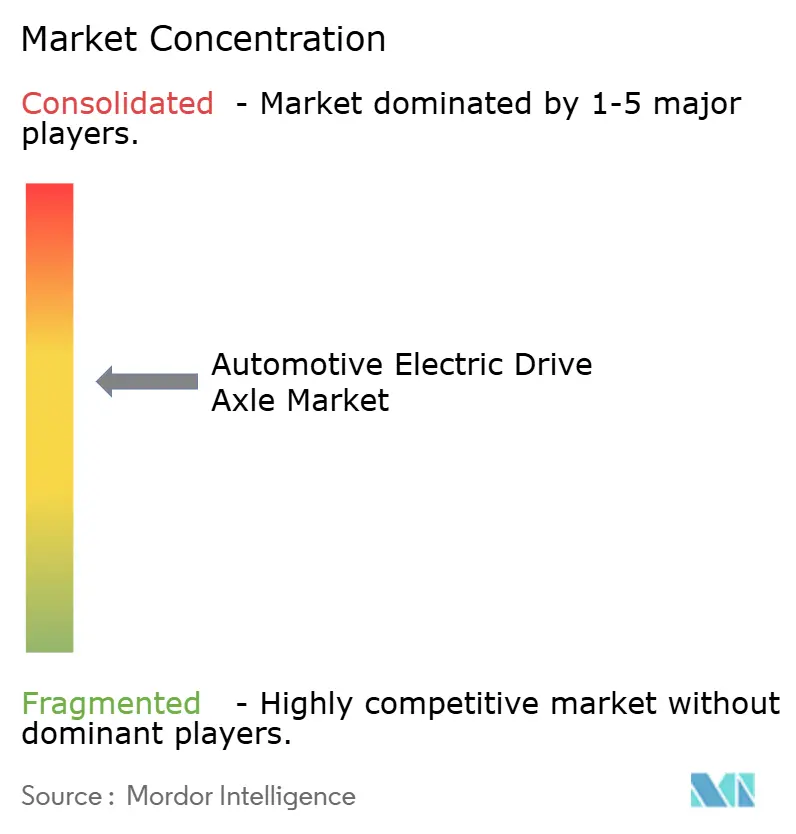
The automotive electric drive axle market shows moderate consolidation, with heritage Tier-1 suppliers facing OEM insourcing and cost-driven Asian entrants. ZF, Bosch, Magna, and Nidec leverage deep drivetrain portfolios yet must differentiate beyond mechanical precision. ZF is exploring a driveline spin-off and signed an MOU with Foxconn that pairs hardware breadth with consumer-electronics speed. Bosch broadened its permanent-magnet-free motor family to shield customers from rare-earth price swings. Magna’s 93% efficient 800 V eDrive locks in a foothold in premium German models.
Asian suppliers, buoyed by domestic scale, compete mainly on cost. BYD is beginning to export integrated e-axles bundled with LFP battery packs, threatening Western share in value-oriented segments. Nidec’s E-Axle Gen3 platform claims 15% lower mass by using hairpin winding and split-coolant channels. OEM vertical integration tightens margins for independents; Ford and Mercedes-Benz are internalizing e-motor assembly to lock in intellectual property.
White-space growth areas include retrofit kits, off-highway machinery, and subscription software layered over axle data. BorgWarner partnered with FinDreams Battery on LFP packs to offer an integrated propulsion module for light trucks. Suppliers able to blend mechatronics with analytics and remote updates are best placed to defend share as hardware margins compress.
Automotive Electric Drive Axle Industry Leaders
-
Robert Bosch GmbH
-
ZF Friedrichshafen AG
-
Nidec Corporation
-
Magna International Inc.
-
American Axle & Manufacturing
- *Disclaimer: Major Players sorted in no particular order
Automotive Electric Drive Axle Market Companies Covered in this Report
- ZF Friedrichshafen AG
- Robert Bosch GmbH
- Magna International Inc.
- Nidec Corporation
- American Axle & Manufacturing
- Dana Inc.
- GKN Automotive
- Schaeffler AG
- BorgWarner Inc.
- Aisin Corporation
- Cummins Inc.
- Valeo SA
- Hitachi Astemo
- BYD Co. Ltd.
- Hyundai Mobis
Market Opportunities and Future Outlook
Opportunities are clustering around platform-driven scaling of integrated drive units and localization of high-voltage powertrain manufacturing near major vehicle production hubs. OEM investments illustrate this shift: BMW expanded e-drive production at Steyr, Austria, including series production on a second electric-motor line in April 2026, and moved to two-shift operations, with weekly output exceeding 4,000 units in July 2026. That ramp strengthens the availability of supply for modular eDrive architectures. In Europe, Audi Hungaria initiated series production of the MEBeco electric drive unit at its Győr plant in June 2026 for the Volkswagen Group MEB+ platform, reinforcing the role of standardized platforms in enabling repeatable e-axle and EDU sourcing.
A second opportunity area involves new capacity build-outs in emerging EV manufacturing corridors where localization and cost targets create space for regional suppliers and joint ventures. Uno Minda announced approval in May 2026 to establish a greenfield facility in Chhatrapati Sambhajinagar, Maharashtra, to produce Electric Drive Units and Dedicated Hybrid Transmission systems, aligning with the market shift toward integrated propulsion modules. Alongside these capacity moves, suppliers also have room to differentiate through magnet-free or reduced-rare-earth motor architectures and higher-integration thermal solutions, reflecting pressure from rare-earth magnet price volatility and the thermal constraints observed at 4-in-1 integration levels.
Recent Industry Developments in Automotive Electric Drive Axle Market
- July 2026: ZF announced mass production of its eRE Plus four-in-one range-extender drive system in China, debuting the system on Leapmotor's D19 model. The commercialization underscores continued demand for highly integrated drive modules that package multiple functions to reduce space and assembly complexity while supporting range-extension use cases.
- April 2026: Valeo inaugurated a new manufacturing line in Pune, India, for integrated 3-in-1 electric powertrain systems, linked to support for Mahindra's Born Electric platform. The added localized capacity reinforces supplier strategies focused on regional content and shortened logistics for heavy drivetrain assemblies.
Automotive Electric Drive Axle Market Report Scope and Research Methodology
Market Definition and Coverage
For this study, the automotive electric drive axle market covers integrated e-axle assemblies used to propel road vehicles, typically combining the electric motor, reduction gear, and power electronics into one axle-drive unit sold to OEMs (and, in select cases, as retrofit kits).
Scope exclusions: It does not count wheel-hub drive systems, and it does not treat stand-alone e-motors added onto a conventional axle as an electric drive axle.
Segments Covered in This Report
- By Propulsion Type
- Battery-Electric Axle
- Hybrid Axle
- Fuel-Cell Electric Axle
- By Integration Level
- 2-in-1 (Motor and Gear)
- 3-in-1 (Motor, Gear, and Inverter)
- 4-in-1 (Motor, Gear, Inverter, and Thermal)
- By Vehicle Type
- Passenger Cars
- Light Commercial Vehicles
- Medium and Heavy Commercial Vehicles
- Off-Highway and Specialty (Construction and Agriculture)
- By Sales Channel
- OEM-Fitted
- Aftermarket Retrofit Kits
- By Geography
- North America
- United States
- Canada
- Rest of North America
- South America
- Brazil
- Argentina
- Rest of South America
- Europe
- Germany
- United Kingdom
- France
- Spain
- Italy
- Rest of Europe
- Asia-Pacific
- China
- Japan
- India
- South Korea
- Rest of Asia-Pacific
- Middle East and Africa
- United Arab Emirates
- Saudi Arabia
- South Africa
- Rest of Middle East and Africa
- North America
Data Sources, Market Sizing, and Validation
Desk Research
Desk work starts with building a fact base for EV and hybrid production, powertrain content assumptions, and regional vehicle mix, then mapping that to where e-axles are actually fitted by vehicle class.
We mainly pull from public sources such as IEA EV outlook datasets, national transport and vehicle registration statistics, US EPA and EU regulatory publications on CO2 and fleet targets, and trade sources like UN Comtrade for relevant powertrain component movements.
To make the model usable, we also review company annual reports, filings, investor presentations, product catalogs, and credible press coverage for integration trends (2-in-1, 3-in-1, and 4-in-1), plus typical fitment by vehicle class. When a cross-check is needed on supplier revenue splits, patent activity, or shipment and trade signals, we selectively use paid subscriptions for company financials and intelligence, patent databases, and shipment-level import and export records. These desk sources are not exhaustive, and other public references are also used to clarify and validate assumptions during the work.
Primary Interviews and Surveys
Primary work is used to pressure-test the adoption curve of integrated e-axles versus other electric propulsion layouts, and to confirm pricing and content assumptions by integration level and vehicle class. We speak with drivetrain suppliers, OEM-side engineering and purchasing teams, and channel participants covering APAC, EMEA, and the Americas, so any gaps from desk findings are closed before the final numbers are signed off.
Distribution of primary research fieldwork respondents
| Company type | Respondent position | Region |
|---|---|---|
| Top tier: 30% | CXOs: 18% | APAC: 49% |
| Mid tier: 51% | Functional/Unit leaders: 23% | EMEA: 32% |
| Smaller Players: 19% | Managers: 59% | Americas: 19% |
Market-Sizing & Forecasting
The market is built first using a top-down demand pool where vehicle production by powertrain is converted into e-axle equipped units, then translated into revenue using region-specific and integration-specific average selling prices.
After the structure is stable, we use selective bottom-up approximations to corroborate totals, such as rolling up sampled supplier revenue exposure to e-axles, checking announced platform sourcing, and validating implied ASP times volume against interview feedback.
The inputs that matter most are BEV and PHEV production by region, e-axle penetration by drivetrain layout (front, rear, and dual setups), the mix shift from 2-in-1 to 3-in-1 and 4-in-1 designs, magnet and power electronics cost direction, and the split between OEM fitment and retrofit demand. When data is thin for smaller vehicle classes or niche regions, we address gaps with nearest-neighbor assumptions from comparable markets, then use expert review to avoid unrealistic jumps.
For forecasting, scenario analysis is used because policy timelines, platform changeovers, and supply constraints can shift demand faster than a single straight-line trend. The scenarios are tied to variables experts can react to, such as EV sales growth, localization requirements, and expected integration upgrades, and then consolidated into a base case that stays consistent with observed production and pricing signals.
Data Validation & Update Cycle
Outputs are checked against independent signals such as EV sales trends, announced vehicle programs, and supplier capacity or expansion news. If we see a large variance, we trace it back to penetration or pricing assumptions.
Outliers are reviewed in more than one step, and we re-contact respondents when a key input, such as integration mix, ASP movement, or regional production share, appears misaligned.
The report is refreshed annually, and interim updates are made when material events occur, such as major regulatory changes or unexpected shifts in vehicle production outlook. Before delivery, a final analyst pass is completed so the dataset reflects the latest publicly available indicators and the most recent interview-based validations.
Mordor Intelligence's Automotive Electric Drive Axle Market Sizing Compared With Other Published Estimates
Different published market sizes can vary a lot in this space because some studies mix closely related product definitions, and they also use different base years and currency timing. Variation is also created when pricing is assumed as a flat average, or when fitment is assumed across all electrified vehicles without checking the actual drivetrain layout.
Some external estimates combine wheel-drive systems with electric axle drives, which expands the counted system types beyond integrated e-axles. In Mordor Intelligence, the market is limited to integrated electric drive axle assemblies used in automotive applications, and wheel-hub drives and stand-alone motor add-ons on a conventional axle are excluded, so the demand pool matches real e-axle fitment.
Benchmark comparison
| Source | Market Size | Gaps in Research Methodology |
|---|---|---|
| Mordor Intelligence | USD 14.37 B (2026) | |
| Industry Research Publisher A | USD 7.60 B (2024) | Often presented as a combined electric axle drive and wheel drive market, which can exclude some integrated e-axle configurations and also shifts the base year earlier, reducing the stated value versus a later-year sizing. |
| Market Research Publisher B | USD 15.38 B (2024) | Typically includes both electric axle drive and wheel drive systems and uses a broader component framing, which can pull in adjacent architectures and lift the total even if pure integrated e-axle fitment is lower in some vehicle classes. |
The spread in the table is mainly explained by what gets counted as the system and which year is used for the snapshot. When the scope is kept to integrated e-axles and the adoption and ASP path is tied back to vehicle production and layout checks, the resulting number is easier to trace and to re-run as new platform and pricing signals emerge.
Key Questions Answered in the Report
What is the current size of the automotive electric drive axle market?
The market stands at USD 14.37 billion in 2026 and is forecast to reach USD 23.26 billion by 2031.
Which propulsion type dominates the automotive electric drive axle market?
Battery-electric axles hold 73.45% share, far ahead of hybrid and fuel-cell alternatives.
Why are 4-in-1 e-axles gaining popularity?
They integrate motor, gear, inverter, and thermal management into one module, cutting weight and cost while supporting tighter packaging needs.
Which region is growing fastest for automotive electric drive axles?
Asia-Pacific will lead with a 13.24% CAGR due to strong policy support and large-scale EV manufacturing in China.