
Vietnam Cashew Market Analysis by Mordor Intelligence
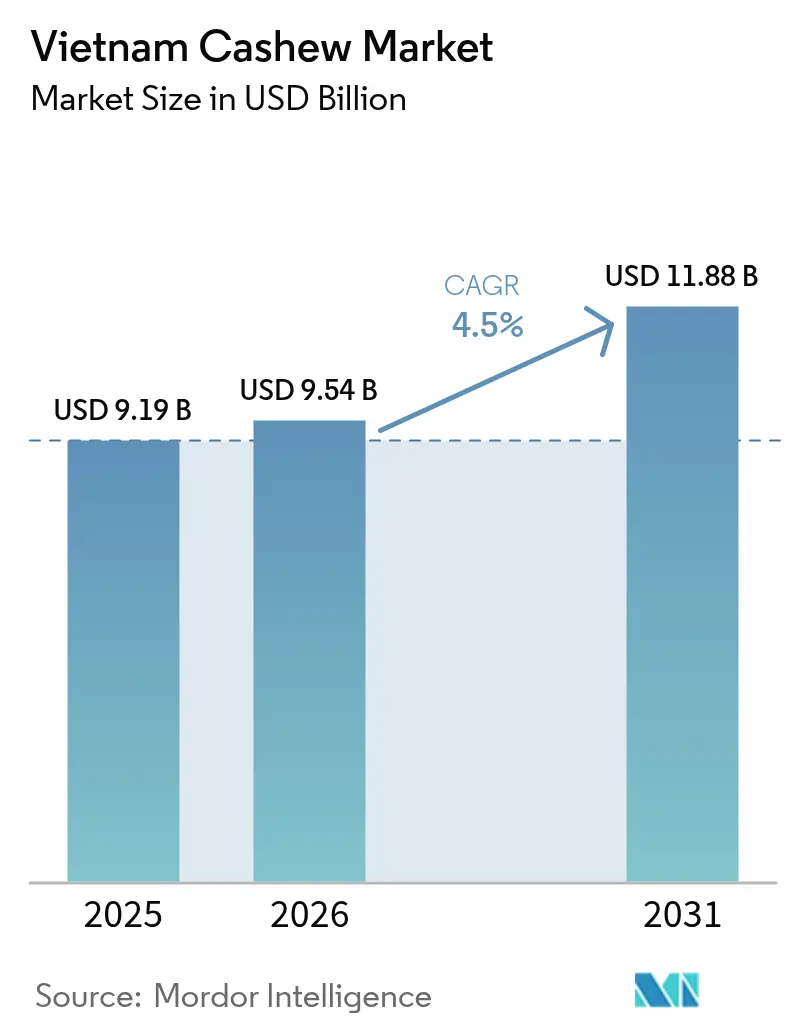
The Vietnam cashew market size was valued at USD 9.19 billion in 2025 and is estimated at USD 9.54 billion in 2026, to reach USD 11.88 billion by 2031, at a CAGR of 4.50% during the forecast period (2026-2031). Medium-term growth in the market is supported by government-funded replanting initiatives, the establishment of new supply corridors with Cambodia, and the expansion of e-commerce channels, enabling exporters to achieve retail margins exceeding 30%. Processors are investing in upgraded optical grading lines to reduce kernel breakage, while exporters benefit from traceability premiums in the European Union. Although regional competition from emerging African processors is increasing, Vietnamese firms maintain control over more than 80% of global kernel exports, backed by established processing capacity. Additionally, technology-driven productivity improvements and direct-to-consumer e-commerce channels are creating enhanced margin opportunities for small and medium-sized enterprises in the Vietnamese cashew market.
Key Report Takeaways
- By form, shelled kernels held 87.0% of the Vietnam cashew market share in 2025, while in-shell cashews are projected at a 11.3% CAGR through 2031.
Note: Market size and forecast figures in this report are generated using Mordor Intelligence’s proprietary estimation framework, updated with the latest available data and insights as of 2026.
Market Trends and Insights
Drivers Impact Analysis of Vietnam Cashew Market*
| Driver | (~) % Impact on CAGR Forecast | Geographic Relevance | Impact Timeline |
|---|---|---|---|
| Government reinvestment programs supporting the vietnam cashew market | +1.2% | National, concentrated in Binh Phuoc, Dong Nai, Binh Thuan, Lam Dong | Medium term (2-4 years) |
| Increased adoption of optical grading and automation technologies | +0.9% | National, led by Southern processing hubs | Short term (≤ 2 years) |
| Surge in global plant-based snack demand | +2.1% | Global, the strongest pull from North America, Europe, and China | Long term (≥ 4 years) |
| Rising European Union traceability premiums | +0.8% | Export-oriented, mainly Southern processors | Medium term (2-4 years) |
| Expansion of Vietnam-Cambodia raw nut supply | +1.5% | National, cross-border logistics into South | Medium term (2-4 years) |
| Growth of e-commerce export channels | +0.7% | Global, early traction in North America, Australia, and Japan | Short term (≤ 2 years) |
| Source: Mordor Intelligence | |||
Government Reinvestment Programs Supporting the Vietnam Cashew Market
In March 2025, the Ministry of Agriculture launched a VND 100 trillion (USD 4.2 billion) credit program to reduce capital costs for equipment upgrades, cold storage, and traceability solutions in the Vietnamese cashew market[1]. Commercial banks, including Vietcombank, have allocated VND 15 trillion (USD 644 million) to support cashew processors, facilitating mechanization and food-safety certification. This funding enables smaller factories to meet European Union sustainability standards and earn a USD 150 premium per metric ton, thereby enhancing cash flow resilience. Provincial authorities in Binh Phuoc are implementing bonded warehouse pilots to streamline customs clearance and lower inventory costs. The program's design addresses upfront capital challenges for smallholders, particularly ethnic minority farmers in upland provinces, by linking disbursements to technical assistance packages that improve agronomic practices and post-harvest handling. These fiscal measures bolster the long-term competitiveness of the Vietnam cashew market in response to increasingly stringent global compliance requirements.
Increased Adoption of Optical Grading and Automation Technologies
Automated optical sorters utilizing deep-learning algorithms to classify kernels by size, color, and defect presence have reduced breakage rates by over 4% points compared to manual grading. This improvement has resulted in higher export premiums for WW-grade lots. Processors employing collaborative robots, such as ABB GoFa cobots, achieve packing speeds of 35–36 bags per minute. Additionally, companies are leveraging deep learning algorithms with low-cost camera systems to classify cashews into multiple quality grades, addressing labor shortages while boosting productivity. The adoption of collaborative robots, as demonstrated by Dan D Pak's use of ABB GoFa cobots achieving 35–36 bags per minute packing speeds, highlights scalable automation solutions for medium-sized processors. This technological advancement allows Vietnamese processors to maintain a competitive edge over emerging African processing capacities while adhering to stringent international quality standards.
Expansion of Vietnam-Cambodia Raw Nut Supply
Cambodia delivered 780,700 metric tons of raw cashew nuts to Vietnam in the first half of 2024, a 36.7% year-over-year increase, and now accounts for 39% of Vietnam's total raw-nut imports, partially offsetting the collapse in Ivory Coast shipments by Cashew nut Association of Cambodia[2]. Cross-border plantation expansion, driven by Cambodian government incentives and supported by Vietnamese technical expertise, is projected to increase annual raw-nut production capacity by 350,000 metric tons by 2028. This growth will primarily occur in the Kampong Thom and Kampong Cham provinces. Concurrently, Cambodia is enhancing its domestic processing capabilities, including the construction of a USD 12 million factory in Kampong Thom with an annual processing capacity of 12,000 metric tons. This facility is scheduled to begin operations in March 2025 and is anticipated to redirect a portion of raw nuts away from Vietnamese processors. The Vietnam Cashew Association has signed memoranda of understanding with Cambodian counterparts to align harvest schedules and quality standards. There is a potential risk that Cambodia’s increasing domestic capacity and value-addition efforts could reduce Vietnam's influence over local production in the regional raw-nut market.
Growth of E-Commerce Export Channels
Direct-to-consumer platforms, such as Amazon Global Selling Vietnam, which is projected to achieve 50% value growth and 40% seller growth by 2025, allow Vietnamese processors to bypass traditional importer-distributor networks and capture retail margins exceeding 30% of final shelf prices. Brands like Newbam have introduced cashew SKUs on Amazon.com, targeting health-conscious consumers in North America. Additionally, Vietnamese exporters are creating virtual storefronts on Chinese platforms, including TikTok Shop, Kuaishou, Taobao, and JD.com. This approach diversifies revenue streams and reduces reliance on a limited number of bulk buyers. Achieving success requires investments in digital marketing, customer service, and adherence to platform-specific food safety certifications. E-commerce also presents challenges such as chargebacks, product returns, and reputational risks from negative reviews, which manual-processing cooperatives may struggle to address without external assistance.
Restraints Impact Analysis of Vietnam Cashew Market*
| Restraint | (~) % Impact on CAGR Forecast | Geographic Relevance | Impact Timeline |
|---|---|---|---|
| Intensifying farm labor shortages | -0.8% | National, especially Southern harvest zones | Short term (≤ 2 years) |
| Climate-driven pest pressure spike | -0.6% | South-central orchards in Binh Thuan and Ninh Thuan | Medium term (2-4 years) |
| Heavy reliance on imported raw nuts | -1.1% | National, all processing hubs | Long term (≥ 4 years) |
| Volatile ocean-freight container costs | -0.9% | Export corridors to the United States and Europe Union | Short term (≤ 2 years) |
| Source: Mordor Intelligence | |||
Climate-Driven Pest Pressure on the Vietnam Cashew Market
Erratic rainfall patterns and increased humidity have led to a rise in fungal infections, reducing Vietnamese cashew yields by up to 12% and decreasing the proportion of premium-grade kernels. Similar climatic conditions in Cambodia have affected import volumes, heightening kernel procurement risks for the Vietnam cashew market. In response, processors are mitigating risks by maintaining higher inventory levels and diversifying supply agreements across multiple origins. Research efforts are underway to develop drought-tolerant and pest-resistant cultivars, though deploying them will take several growing seasons to scale. Climatic volatility is projected to sustain raw nut price spikes, further pressuring processor margins. Integrated pest management protocols, promoted by the Ministry of Agriculture and Rural Development, face multi-year adoption timelines and require coordinated efforts among neighboring farms, delaying their overall effectiveness. The medium-term impact is influenced by the time required to scale biological control agents and pest-resistant varieties. These interventions remain in the field-trial phase and are not projected to be widely implemented until after 2026.
Volatile Ocean-Freight Container Costs
Houthi-related disruptions in the Red Sea have compelled container carriers to reroute shipments via the Cape of Good Hope, driving spot rates on Asia-Northern Europe routes to USD 5,085 per forty-foot equivalent unit by late 2024. European and North American buyers have resisted price increases, citing sufficient inventory levels and competition from Indian and Brazilian suppliers. As a result, Vietnamese processors have been forced to absorb the cost differential, either through reduced profitability or by delaying shipments. The short-term impact includes immediate cash-flow challenges, as exporters are required to prepay freight charges 30-45 days before receiving payments from buyers. These pressures are further exacerbated by the introduction of a value-added tax on agricultural inputs in July 2025, intensifying working-capital constraints.
*Our forecasts treat driver/restraint impacts as directional, not additive. The impact forecasts reflect baseline growth, mix effects, and variable interactions.
Vietnam Cashew Market Segment Analysis
By Form:
Kernel Dominance Masks In-Shell RevivalShelled kernels accounted for 87.0% of the Vietnam cashew market share in 2025, driven by their suitability for retail snacks, confectionery ingredients, and food-service applications requiring consistent size and appearance. This specialization enables processors to achieve higher margins while serving a variety of end-use applications, from snacks to industrial food ingredients. The growth of the kernel segment reflects advancements in grading and packaging systems, enabling Vietnamese processors to compete on quality. The segment's maturity is evident in decades of investment in shell and peel infrastructure. Vietnamese processors currently operate over 300 facilities equipped with automated lines, reducing labor intensity by 70-80%.
In-shell cashews are projected to grow at an 11.3% CAGR through 2031, supported by international certification requirements and consumer willingness to pay premiums for sustainability. This segment primarily caters to domestic consumption and specialty export markets where traditional formats hold cultural significance. The segment benefits from strong supply relationships with major food manufacturers that demand consistent quality and reliable delivery schedules, which smaller processors often cannot meet. In contrast, shelled kernels face increasing competition from African processors, who are expanding capacity with government subsidies and undercutting Vietnamese prices by 5-8% in commodity grades.


Geography Analysis
The Southeast region retained a significant share of the Vietnamese cashew market, supported by Binh Phuoc's extensive network of over 1,400 processing plants and its strategic proximity to Ho Chi Minh City's ports. Provincial authorities are introducing bonded warehouse facilities to streamline customs processing, enhancing working capital efficiency for small and medium-sized enterprises. The region's established industrial zones, such as Xuyen A Industrial Park, continue to attract snack and ingredient manufacturers who integrate their operations with kernel processors.
The Central Highlands region is experiencing the strongest growth, driven by agricultural diversification programs that leverage coffee-farming expertise for cashew cultivation. The region benefits from lower land costs and a favorable climate for cultivating new cashew varieties with improved kernel-to-shell ratios. International investors are setting up primary processing facilities near farming areas, minimizing transportation losses and increasing farmer profitability. Government extension services further support quality improvement through integrated pest management training, reducing quality variations in the Vietnamese cashew market.
The Mekong Delta capitalizes on its logistics infrastructure to transport kernels via Can Tho port. In flood-prone areas, investments in elevated drying yards and solar hybrid dryers help mitigate post-harvest losses. Meanwhile, the Red River Delta and Northern Mountainous regions focus on producing premium kernels known for their distinct flavor profiles. This regional distribution reduces reliance on single processing centers and creates employment opportunities across rural areas.
Regulatory Landscape
Vietnam’s cashew value chain sits within national crop-development and food-safety frameworks, alongside export-market compliance requirements. Decision 431/QD-BNN-TT (2024) sets development directions for key industrial crops to 2030, including a nationwide cashew area target of 280,000 to 300,000 hectares, which keeps policy focus on stable raw material areas and deeper processing. In March 2026, the Ministry of Industry and Trade issued Circular No. 14/2026/TT-BCT (effective May 10, 2026), updating EVFTA Rules of Origin requirements, which affects documentation and supplier qualification for shipments to the European Union.
Food safety, labeling, and inspection requirements continued to tighten in 2026. Amendments to the Quality Law (adopted in June 2025) took effect in January 2026, introducing risk assessment-led quality management and product grouping. The Ministry of Health’s mandatory nutrition labeling for pre-packaged foods under Circular 29/2023 also took effect in January 2026, increasing compliance needs for branded and retail-ready cashew products. Institutional oversight changed after government restructuring, with the Ministry of Agriculture and Environment assuming responsibilities for food safety and quarantine inspections for agricultural products in 2026, while exporters still need phytosanitary and Plant Quarantine certification for applicable shipments.
Value Chain Analysis
Vietnam’s cashew value chain covers farm production and raw nut collection, cross-border and overseas sourcing, industrial processing, quality assurance, and export distribution. Domestic orchards supply only about 10% of processing demand, so processors rely largely on imported raw cashew nuts from Cambodia and African origins such as Ivory Coast, Nigeria, and Ghana. Processing clusters remain concentrated in the Southeast, especially Binh Phuoc and Dong Nai, with export logistics anchored in Ho Chi Minh City-area gateways such as Cat Lai Port and Cai Mep Port.
During processing, raw nuts are converted into shelled kernels and value-added formats through shelling, peeling, grading, roasting, and packing. Export-facing plants align their operations with standards such as BRC and HACCP, and, where required by buyers, FSPCA, Halal, and Kosher. The chain is under pressure from raw material cost volatility and policy shifts in origin countries, alongside shipping disruptions and container-cost swings that tighten working capital for exporters. These factors are pushing processors toward more automation and higher grading accuracy, while increasing the value of traceability-ready lots and contract terms that reduce payment and logistics risk.
Competitive Landscape
The Vietnam cashew market consists of producers, importers, and exporters, with over 300 regular exporters competing for access to raw materials and export contracts. Key stakeholders, including Olam Vietnam, Long Son Joint Stock Company, and Donafoods, hold a significant share of total kernel output due to their scale advantages in procurement, processing, and distribution. Competitive intensity has risen as African countries, particularly the Ivory Coast and Nigeria, expand domestic processing capacity with the support of government subsidies.
Olam Food Ingredients operates seven factories and 4,500 staff, winning the 2025 Vincas Heritage Award for sustainability leadership, signaling ESG credentials as a fresh differentiator[3]. Competitive intensity has increased as African countries, particularly the Ivory Coast and Nigeria, expand domestic processing capacity with government subsidies. Technology adoption is reshaping competitive dynamics in the market. Processors utilizing automatic shelling and optical grading lines have achieved a 70-80% reduction in labor costs and improved yield recovery by over 4 percentage points, creating significant cost advantages over smaller manual operations.
Emerging disruptors include Cambodian processors, which are expanding capacity with Chinese investment and targeting direct exports to China's Hainan province. This strategy bypasses Vietnamese intermediaries and threatens Vietnam's monopsony power in regional raw-nut markets. Compliance with international standards, such as BRC Food, and HACCP (Hazard Analysis and Critical Control Points), has become essential for export-oriented processors, as buyers in Europe and North America increasingly require third-party audits to address food safety and reputational risks.
Market Opportunities and Future Outlook
Margin expansion is most concentrated in value-added processing, retail-ready compliance, and traceability-enabled access to premium channels. The government-backed VND 100 trillion credit program launched in 2025, with participating commercial lenders such as Vietcombank allocating VND 15 trillion, creates a funding pathway for processors to upgrade equipment, cold storage, and traceability systems. That support is geared toward deeper processing and branded export formats, rather than bulk commodity kernels. A second focus area is digital export, where direct-to-consumer programs such as Amazon Global Selling Vietnam are being used by Vietnamese brands to reach overseas retail audiences and capture higher retail margins compared with traditional importer-distributor routes.
Supply security and contract-risk management are also creating room for more structured procurement and compliance execution across the sector. Vietnam’s ongoing dependence on imported raw nuts, reflected in large import volumes in early 2026, is motivating efforts to rebuild domestic raw material areas through replanting and standardized farming (VietGAP/organic), alongside planting area codes and traceability systems in provinces such as Dong Nai under 2026-2030 sustainable development planning. With 2026 trade disruptions affecting some routes and markets, VINACAS guidance on commercial terms (including greater use of CIF/CNF) and logistics diversification is increasing the practical demand for stronger compliance, documentation, and end-to-end shipment visibility among exporters.
Recent Industry Developments in Vietnam Cashew Market
- May 2026: The Vietnam Cashew Association (VINACAS) urged debt rescheduling and preferential credit packages from the State Bank of Vietnam and commercial lenders to ease pressure across the cashew value chain. The request points to tighter working capital conditions tied to raw material costs and logistics volatility, and it centers on financing access for processors making deep-processing and compliance upgrades.
- September 2025: Vietnam introduced the Livelihoods under the Cashew Canopy initiative to support farmers and advance sustainable growth, positioning Dong Nai cashews as a national brand associated with environmentally friendly practices. The program targets higher farmer incomes and links orchard management, processing, and trade into a green economic ecosystem, raising expectations for traceability and sustainability-aligned product positioning.
- December 2024: Vietnam and Cambodia continued to deepen cross-border raw nut linkages following earlier VINACAS coordination with Cambodian counterparts. Cambodia’s increasing share of Vietnam’s raw cashew imports supports processor throughput and procurement resilience, while also serving as a watchpoint as Cambodia scales its own processing capacity and retains more raw nuts domestically.
Vietnam Cashew Market Report Scope and Research Methodology
Market Definition and Coverage
This market covers the value generated from cashew activity linked to Vietnam, where volumes and prices across trade and local use help describe demand and supply in one view.
Scope exclusions: We do not count downstream retail margins from finished snack mixes or confectionery products where cashew is only a minor ingredient.
Segments Covered in This Report
- By Form
- In-shell
- Shelled (Kernels)
- By Geography
- Production Analysis
- Production Volume
- Area Harvested and Yield
- Consumption Analysis (Value and Volume)
- Trade Analysis (Value and Volume)
- Import Market Analysis
- Import Value and Volume
- Key Supplying Markets
- Export Market Analysis
- Export Value and Volume
- Key Destination Markets
- Import Market Analysis
- Wholesale Price Trend Analysis and Forecast
- Regulatory Framework
- Logistic and Infrastructure
- Seasonality Analysis
- Production Analysis
Data Sources, Market Sizing, and Validation
Desk Research
Desk work was used to anchor the market to real, trackable series, and then to understand how much of the cashew flow is moving through exports versus local absorption. We relied on public data points such as Vietnam Customs trade releases, FAOSTAT supply statistics, the International Trade Centre (ITC) trade map, and World Bank macro indicators, which help set context for currency timing and demand health.
To translate these inputs into a sizing model, we also reviewed exporter and processor disclosures such as annual reports, investor presentations, and reputable press interviews that mention processing throughput, product mix shifts, and pricing commentary. In a few places, paid subscriptions were used for company financials and intelligence, patent databases (for processing upgrades), and shipment-level import-export records to cross-check directionally consistent trade flows. These desk sources are illustrative rather than exhaustive, and many other references were also used for data collection, validation, and research clarification.
Primary Interviews and Surveys
Primary discussions were run with people across the cashew value chain in Vietnam, including processors, exporters, traders, and large domestic buyers, so that pricing logic and volume splits could be checked in plain terms. We also spoke with logistics and quality-focused stakeholders to confirm what drives grade mix, rejection rates, and shipment timing, which then helped close gaps that desk data alone cannot explain.
Distribution of primary research fieldwork respondents
| Company type | Respondent position |
|---|---|
| Top tier: 31% | CXOs: 16% |
| Mid tier: 50% | Functional/Unit leaders: 32% |
| Smaller Players: 19% | Managers: 52% |
Market-Sizing & Forecasting
The sizing starts with a top-down reconstruction of Vietnam cashew value by linking official export and import volumes to observed price levels, and then adjusting for product form differences (in-shell versus shelled) so like-for-like value is maintained. After that, selective bottom-up checks are used, where sampled processor throughput, typical yield loss, and an average selling price range are multiplied to see if the total is directionally consistent.
A few practical inputs were treated as key drivers, such as export volume (tons), average export price (USD per ton), share of shelled kernels in the mix, import dependence for raw material supply, and seasonality around harvest and shipment windows. Where the model had gaps (for example, when small-scale trading volumes are not fully visible), the missing portion was filled using ranges validated by interviews and then tightened through trade consistency checks.
For forecasting, scenario analysis was applied so that price and volume can be moved separately, since these two often change for different reasons. The forward view was shaped by expected shifts in processing utilization, kernel price direction, and destination market demand signals discussed by interviewees, and the outputs were sanity-checked against macro indicators like consumer spending and trade growth.
Data Validation & Update Cycle
Outputs are validated through multiple checks, starting with internal consistency between export value, export volume, and implied prices, and then comparing those against independent trade and agriculture signals. When a variance appears, the assumptions driving it are reviewed, and follow-up calls are triggered with relevant respondents to confirm whether the shift is real or caused by timing, form mix, or currency conversion.
Before sign-off, the model and narrative pass through multi-step analyst reviews so that definitions, year alignment, and unit conversions stay consistent. Reports are refreshed annually, and interim updates are made when material events occur, such as sharp price swings, policy changes, or visible trade disruptions. Right before delivery, a fresh data pass is done so clients receive the latest updated view.
Mordor Intelligence's Vietnam Cashew Market Size Versus Other Published Estimates
Published values for Vietnam cashew can look far apart because different authors pick different starting points, and they may also mix up export value with total market value without stating it clearly. The year chosen, the price series used, and whether volumes are treated as in-shell or shelled can each move the number meaningfully.
The main spread comes from scope and conversion choices, where some figures lean heavily on export receipts only or use a single average price across forms, and the totals are kept aligned to Vietnam trade flows by reconciling in-shell versus shelled volumes with implied unit prices and refresh checks, as applied by Mordor Intelligence.
Benchmark comparison
| Source | Market Size | Gaps in Research Methodology |
|---|---|---|
| Mordor Intelligence | USD 9.19 B (2025) | |
| Global Consultancy A | USD 4.13 B (2024) | Uses a different base year and appears to report a narrower value pool, which can lean toward export and distribution-channel value rather than linking trade volumes to form-specific pricing. |
| Trade Publisher B | USD 4.24 B (2024) | Presented as an export-focused market view, so the value tracks shipments and export revenue more directly, which will not match a total cashew market construct that reconciles imports, exports, and form mix. |
Reading the three figures together, the difference is largely explained by whether the number is export-only or a broader market view, and by how form conversion and price timing are handled. Our method stays traceable because the core math is built from volumes and prices that can be checked, and then refined using interview-confirmed mix and yield assumptions.
Key Questions Answered in the Report
How large is the Vietnam cashew market in 2026?
The Vietnam cashew market was valued at USD 9.19 billion in 2025 and is estimated at USD 9.54 billion in 2026, to reach USD 11.88 billion by 2031, at a CAGR of 4.50% during the forecast period (2026-2031).
Which segment grows fastest through 2031?
In-shell cashews are forecast to post the highest CAGR at 11.30%, owing to organic and traceability-premium demand.
Why are Vietnamese processors investing in blockchain?
Platforms such as NDATrace help prove deforestation-free origin and earn European premiums of about USD 120 per metric ton.
What threatens Vietnam's raw-nut supply?
Ivory Coast's pivot to local processing and rising farm-gate prices, along with Cambodia's own new factories, tighten import availability.