Sugar-free Chewing Gum Market Size and Share

Sugar-free Chewing Gum Market (2026 - 2031)
Image © Mordor Intelligence. Reuse requires attribution under CC BY 4.0.

Sugar-free Chewing Gum Market Analysis by Mordor Intelligence

In 2025, the sugar-free chewing gum market was valued at USD 8.68 billion. Projections indicate an increase to USD 9.01 billion in 2026, with expectations to hit USD 11.54 billion by 2031, marking a CAGR of 5.07% during the forecast period (2026-2031). The market is driven by a growing preference for low-sugar confectionery, stricter regulations on caloric sweeteners, and increasing demand for functional oral-care products. Urban areas are leading this growth due to rising diabetes cases, higher dental-care spending, and greater wellness awareness. Major manufacturers are focusing on innovations such as natural polyols, dual-flavor technologies, and biodegradable gum bases, while smaller brands are targeting younger consumers with vegan formulations and compostable packaging. Consumer priorities are shifting towards flavor complexity, convenience, and social media engagement, which favor premium products and support higher pricing. North America remains the largest revenue contributor, while the Asia-Pacific region is experiencing the fastest growth, driven by a shift in countries like India and China towards sugar-free alternatives aligned with preventive health trends.

Key Report Takeaways

  • By form, stick gum led with 46.59% of the sugar-free chewing gum market share in 2025, while soft chew/cube formats are projected to grow at a 5.89% CAGR through 2031.
  • By sweetener type, artificial sweeteners commanded 71.51% volume share in 2025, whereas natural sweeteners are forecast to expand at a 5.91% CAGR to 2031.
  • By distribution channel, supermarkets/hypermarkets captured 43.87% share in 2025; online retail stores are on track to post a 6.84% CAGR during 2026-2031.
  • By geography, North America accounted for 42.92% revenue share in 2025, but Asia-Pacific is poised for the fastest regional climb at a 5.71% CAGR through 2031.

Note: Market size and forecast figures in this report are generated using Mordor Intelligence’s proprietary estimation framework, updated with the latest available data and insights as of January 2026.

Segment Analysis

By Form: Texture-Led Premiumization Broadens Appeal

Stick gum is the largest segment in the sugar-free chewing gum market, holding a 46.59% share in 2025. Its dominance is driven by decades of strategic merchandising at checkout lanes across North America and Europe, ensuring consistent consumer visibility and accessibility. Dragee gum also plays a significant role in this segment, particularly in office settings where its portion-controlled and crunch-free format meets the demand for discreet consumption. Additionally, tablet gums are expanding their presence beyond pharmacies into travel retail, leveraging dentist endorsements and innovative designs that offer a convenient, mess-free experience. These established formats continue to cater to a broad consumer base, maintaining their stronghold in the market.

Cube/soft-chew gums represent the fastest-growing segment, with a projected CAGR of 5.89% through 2031. This growth is fueled by advancements in flavor-transition technologies that enhance chew duration and support premium pricing. Gen Z's preference for unique textures has further driven the introduction of innovative products like crystal-coated squares and chewable gels, which combine the characteristics of gum and lozenges. Although these sub-categories currently hold a smaller market share, they generate significant online buzz, encouraging trials across various shopping channels. Manufacturers are also capitalizing on e-commerce subscriptions with bundled variety packs to foster consumer loyalty and streamline production, further accelerating the growth of these emerging formats.

Sugar-free Chewing Gum Market: Market Share by Form
Image © Mordor Intelligence. Reuse requires attribution under CC BY 4.0.

Note: Segment shares of all individual segments available upon report purchase

Get Detailed Market Forecasts at the Most Granular Levels
Download PDF

By Sweetener Type: Natural Polyols Charge Ahead Despite Cost Premiums

Artificial sweeteners held the largest share in the sugar-free chewing gum market, accounting for 71.51% of the market. Their widespread use is attributed to their cost efficiency and established role in product formulations. Aspartame, in particular, remains a key driver due to its favorable cost-to-sweetness ratio, making it a go-to choice for manufacturers. Despite growing regulatory scrutiny, artificial sweeteners continue to dominate, supported by their affordability and the ability to meet consumer demand for low-calorie options. Industry players are also leveraging these sweeteners in reformulated products to cater to shifting consumer preferences.

Natural sweeteners represent the fastest-growing segment in the market, with a projected CAGR of 5.91%. This growth is driven by increasing consumer demand for natural and "clean label" products, as well as the perceived health benefits of these sweeteners. Xylitol, a prominent polyol, is gaining popularity for its dental benefits, while innovations in stevia and monk fruit blends are addressing taste-related challenges. Although natural polyols currently face higher costs and supply chain complexities, efforts to diversify sourcing and improve production efficiencies are expected to support their adoption and enhance their competitiveness in the market.

By Distribution Channel: E-Commerce Reshapes the Impulse Paradigm

Supermarkets/hypermarkets emerged as the largest segment in the sugar-free chewing gum market, holding a significant 43.87% market share. Their dominance is attributed to high-traffic checkout racks that encourage impulse purchases and product trials. Convenience stores continue to play a vital role in regions like Japan and Mexico, where they maintain strong local relevance. However, the rise of real-time inventory apps is gradually shifting consumer preferences toward hypermarkets, which offer deep-discount multipacks. This shift highlights the evolving dynamics of traditional retail channels as they adapt to changing consumer behaviors and technological advancements.

Online retail is the fastest-growing segment in the sugar-free chewing gum market, with a projected CAGR of 6.84%. This growth is driven by the increasing popularity of subscription bundles that bypass traditional slotting fees and deliver products directly to consumers in compostable packaging. In India, quick-commerce platforms have further accelerated this trend, with 10-minute delivery windows seamlessly blending impulse and planned purchases. Additionally, e-commerce platforms are leveraging customer reviews to emphasize eco-friendly packaging and carbon-neutral distribution, appealing to environmentally conscious consumers. These factors collectively position online retail as a transformative force reshaping the impulse purchase paradigm in the market.

Sugar-free Chewing Gum Market: Market Share by Distribution Channel
Image © Mordor Intelligence. Reuse requires attribution under CC BY 4.0.

Note: Segment shares of all individual segments available upon report purchase

Get Detailed Market Forecasts at the Most Granular Levels
Download PDF

Geography Analysis

North America remains the largest market for sugar-free chewing gum, contributing 42.92% of the global revenue. The United States leads this region, driven by premiumization trends and functional product innovations. Canada is witnessing steady growth due to the expansion of pharmacy channels, while Mexico's high chewing frequency is rooted in cultural practices. Post-pandemic recovery in commuting has boosted impulse purchases, although the overall gum market faces challenges from shifting consumer preferences, particularly among younger demographics.

Asia-Pacific is the fastest-growing region, projected to grow at a 5.71% CAGR through 2031. Rising disposable incomes and increasing awareness of diabetes are key drivers in this region. India is experiencing a shift towards premium products, supported by the growing popularity of polyol-based gums. E-commerce is playing a significant role in the region's growth, with consumers in smaller cities adopting subscription models. China continues to dominate in scale, while Japan's aging population is driving demand for denture-safe options. Southeast Asia's growth is tied to affordability, with innovative pricing strategies expanding access to sugar-free gum.

Europe, South America, and the Middle East and Africa collectively account for the remaining market share. In Europe, regulatory mandates are pushing sugar-free gum to become the standard, with Germany leading in flavor innovation. South America faces economic challenges, but urban areas show growing interest in dentist-endorsed products. In the Middle East, premium formats are gaining traction due to duty-free sales and a large expatriate population. Sub-Saharan Africa's market remains underdeveloped due to low disposable incomes and distribution barriers, while Turkey leverages its strategic location to support exports to neighboring regions.

Sugar-free Chewing Gum Market CAGR (%), Growth Rate by Region
Image © Mordor Intelligence. Reuse requires attribution under CC BY 4.0.
Get Analysis on Important Geographic Markets
Download PDF

Competitive Landscape

The sugar-free chewing gum market is moderately concentrated, with key players focusing on innovation and sustainability to maintain their competitive edge. Niche players like Simply Gum, PUR Company, and Peppersmith are leveraging clean-label purity and direct-to-consumer strategies to capture market share. Their emphasis on chicle bases, vegan claims, and plastic-free packaging has resonated with environmentally conscious consumers. Functional-benefit specialists, including NeuroGum and Rev Gum, are carving out a unique space by incorporating caffeine and nootropics, targeting productivity-focused consumers and redefining traditional energy product segments.

Ingredient suppliers are playing a pivotal role in shaping the market landscape by driving innovation and supporting product development. Companies like Tate & Lyle and Roquette are introducing advanced solutions such as bitter-masking stevia and biodegradable starch bases, which are being piloted by multinational corporations. These developments are enabling manufacturers to align with evolving consumer preferences for sustainable and functional products. Additionally, patents for rapid-release micronutrients, moisture barriers, and compostable elastomers are becoming critical for companies aiming to differentiate themselves in the market.

Strategic partnerships and digital platforms are further influencing the competitive dynamics of the market. For instance, Mars has collaborated with Instacart to optimize product placement through algorithmic strategies. However, the industry faces challenges such as addressing gum-litter concerns, with municipalities considering levies similar to single-use plastic taxes. Resolving these issues will be crucial for companies relying on synthetic bases to sustain their market share and adapt to shifting regulatory landscapes.

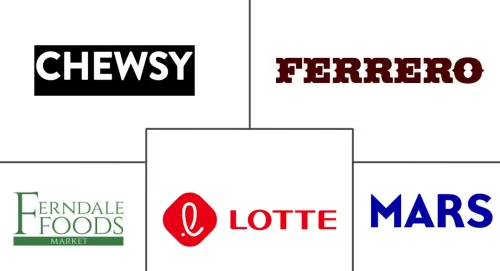
Sugar-free Chewing Gum Industry Leaders

  1. Chewsy UK Ltd

  2. Ferndale Foods Limited

  3. Ferrero International SA

  4. Lotte Corporation

  5. Mars Incorporated

  6. *Disclaimer: Major Players sorted in no particular order
Sugar-free Chewing Gum Market Concentration
Image © Mordor Intelligence. Reuse requires attribution under CC BY 4.0.
Need More Details on Market Players and Competitors?
Download PDF

Recent Industry Developments

  • May 2025: Perfetti Van Melle rolled out Trident Vibes Cotton Candy, the first sugar-free cotton-candy gum, at USD 3.84 per 40-piece bottle.
  • October 2024: Mars launched EXTRA plant-based gum in Germany, pairing chicle base with birch-xylitol and recyclable paper packaging to satisfy eco-lifestyle shoppers.
  • September 2024: Hershey debuted Ice Breakers Flavor Shifters, delivering mid-chew transitions from Wild Berry to Coolmint, in a bid to win Gen Z attention through sensory storytelling.

Table of Contents for Sugar-free Chewing Gum Industry Report

1. INTRODUCTION

  • 1.1 Study Assumptions and Market Definition
  • 1.2 Scope of the Study

2. RESEARCH METHODOLOGY

3. EXECUTIVE SUMMARY

4. MARKET LANDSCAPE

  • 4.1 Market Overview
  • 4.2 Market Drivers
    • 4.2.1 Oral health positioning and dental endorsements
    • 4.2.2 Rising global diabetes and pre-diabetes cases
    • 4.2.3 Flavor innovation to attract younger consumers
    • 4.2.4 Smoking-cessation and behavioral health trends driving growth
    • 4.2.5 Clean-label and natural cues driving growth
    • 4.2.6 Regulatory support for reduced sugar products
  • 4.3 Market Restraints
    • 4.3.1 Consumer skepticism toward artificial sweeteners
    • 4.3.2 Supply chain and ingredient risks for specific sweeteners, flavors, and gum bases
    • 4.3.3 Price sensitivity in developing markets
    • 4.3.4 Environmental concerns about gum base
  • 4.4 Consumer Behaviour Analysis
  • 4.5 Regulatory Landscape
  • 4.6 Technological Outlook
  • 4.7 Porter's Five Forces Analysis
    • 4.7.1 Threat of New Entrants
    • 4.7.2 Bargaining Power of Buyers
    • 4.7.3 Bargaining Power of Suppliers
    • 4.7.4 Threat of Substitutes
    • 4.7.5 Intensity of Competitive Rivalry

5. MARKET SIZE AND GROWTH FORECASTS (VALUE)

  • 5.1 By Form
    • 5.1.1 Stick Gum
    • 5.1.2 Dragee Gum
    • 5.1.3 Tablet
    • 5.1.4 Soft Chew/Cubes
    • 5.1.5 Others
  • 5.2 By Sweetener Type
    • 5.2.1 Natural Sweeteners
    • 5.2.2 Artificial Sweeteners
  • 5.3 By Distribution Channel
    • 5.3.1 Supermarkets/Hypermarkets
    • 5.3.2 Convenience Stores
    • 5.3.3 Online Retail Stores
    • 5.3.4 Others Distribution Channel
  • 5.4 Geography
    • 5.4.1 North America
    • 5.4.1.1 United States
    • 5.4.1.2 Canada
    • 5.4.1.3 Mexico
    • 5.4.1.4 Rest of North America
    • 5.4.2 Europe
    • 5.4.2.1 Germany
    • 5.4.2.2 United Kingdom
    • 5.4.2.3 Italy
    • 5.4.2.4 France
    • 5.4.2.5 Spain
    • 5.4.2.6 Netherlands
    • 5.4.2.7 Poland
    • 5.4.2.8 Belgium
    • 5.4.2.9 Sweden
    • 5.4.2.10 Rest of Europe
    • 5.4.3 Asia-Pacific
    • 5.4.3.1 China
    • 5.4.3.2 India
    • 5.4.3.3 Japan
    • 5.4.3.4 Australia
    • 5.4.3.5 Indonesia
    • 5.4.3.6 South Korea
    • 5.4.3.7 Thailand
    • 5.4.3.8 Singapore
    • 5.4.3.9 Rest of Asia-Pacific
    • 5.4.4 South America
    • 5.4.4.1 Brazil
    • 5.4.4.2 Argentina
    • 5.4.4.3 Colombia
    • 5.4.4.4 Chile
    • 5.4.4.5 Peru
    • 5.4.4.6 Rest of South America
    • 5.4.5 Middle East and Africa
    • 5.4.5.1 South Africa
    • 5.4.5.2 Saudi Arabia
    • 5.4.5.3 United Arab Emirates
    • 5.4.5.4 Nigeria
    • 5.4.5.5 Egypt
    • 5.4.5.6 Morocco
    • 5.4.5.7 Turkey
    • 5.4.5.8 Rest of Middle East and Africa

6. COMPETITIVE LANDSCAPE

  • 6.1 Market Concentration
  • 6.2 Strategic Moves
  • 6.3 Market Share Analysis
  • 6.4 Company Profiles (includes Global level Overview, Market level overview, Core Segments, Financials as available, Strategic Information, Market Rank/Share for key companies, Products and Services, and Recent Developments)
    • 6.4.1 Chewsy UK Ltd
    • 6.4.2 Ferndale Foods Limited
    • 6.4.3 Ferrero International SA
    • 6.4.4 Lotte Corporation
    • 6.4.5 Mars Incorporated
    • 6.4.6 Mazee LLC
    • 6.4.7 Mondelez International Inc.
    • 6.4.8 Peppersmith
    • 6.4.9 Perfetti Van Melle BV
    • 6.4.10 Simply Good Foods Co.
    • 6.4.11 Simply Gum Inc.
    • 6.4.12 The Hershey Company
    • 6.4.13 The PUR Company Inc.
    • 6.4.14 Xlear, Inc. (Spry)
    • 6.4.15 Verve, Inc. (Glee Gum)
    • 6.4.16 Chocoladefabriken Lindt & Springli AG
    • 6.4.17 Cloetta AB
    • 6.4.18 Peppersmith Ltd.
    • 6.4.19 BFresh, Inc.
    • 6.4.20 Tree Hugger All Natural Gum

7. MARKET OPPORTUNITIES AND FUTURE OUTLOOK

You Can Purchase Parts Of This Report. Check Out Prices For Specific Sections
Get Price Break-up Now

Global Sugar-free Chewing Gum Market Report Scope

Sugar-free chewing gum is designed without traditional sugars like sucrose, instead utilizing alternative sweeteners. These sweeteners include sugar alcohols (such as sorbitol, xylitol, and maltitol) along with high-intensity sweeteners (like aspartame, sucralose, and stevia). This composition provides sweetness while significantly reducing or eliminating sugar content. The Sugar-Free Chewing Gum Market is segmented by Form into Stick Gum, Dragee Gum, Tablet, Soft Chew/Cubes, and Others. Sweetener Types are categorized into Natural and Artificial Sweeteners. Distribution Channels include Supermarket/Hypermarket, Online Retail Store, Convenience Store, and Others. Geographically, the market covers North America, Europe, Asia-Pacific, South America, the Middle East, and Africa. Market Forecasts are presented in USD value terms.

By Form
Stick Gum
Dragee Gum
Tablet
Soft Chew/Cubes
Others
By Sweetener Type
Natural Sweeteners
Artificial Sweeteners
By Distribution Channel
Supermarkets/Hypermarkets
Convenience Stores
Online Retail Stores
Others Distribution Channel
Geography
North America United States
Canada
Mexico
Rest of North America
Europe Germany
United Kingdom
Italy
France
Spain
Netherlands
Poland
Belgium
Sweden
Rest of Europe
Asia-Pacific China
India
Japan
Australia
Indonesia
South Korea
Thailand
Singapore
Rest of Asia-Pacific
South America Brazil
Argentina
Colombia
Chile
Peru
Rest of South America
Middle East and Africa South Africa
Saudi Arabia
United Arab Emirates
Nigeria
Egypt
Morocco
Turkey
Rest of Middle East and Africa
By Form Stick Gum
Dragee Gum
Tablet
Soft Chew/Cubes
Others
By Sweetener Type Natural Sweeteners
Artificial Sweeteners
By Distribution Channel Supermarkets/Hypermarkets
Convenience Stores
Online Retail Stores
Others Distribution Channel
Geography North America United States
Canada
Mexico
Rest of North America
Europe Germany
United Kingdom
Italy
France
Spain
Netherlands
Poland
Belgium
Sweden
Rest of Europe
Asia-Pacific China
India
Japan
Australia
Indonesia
South Korea
Thailand
Singapore
Rest of Asia-Pacific
South America Brazil
Argentina
Colombia
Chile
Peru
Rest of South America
Middle East and Africa South Africa
Saudi Arabia
United Arab Emirates
Nigeria
Egypt
Morocco
Turkey
Rest of Middle East and Africa
Need A Different Region or Segment?
Customize Now

Market Definition

  • Milk and White Chocolate - Milk chocolates is a solid chocolate made with milk (in the form of either milk powder, liquid milk, or condensed milk) and cocoa solids. White chocolate is made from cocoa butter and milk and contains no cocoa solids whatsoever. The scope includes regular chocolates, low-sugar, and sugar-free variants
  • Toffees & Nougats - Toffees include hard, chewy, and small or one-bite candies marketed with labels as toffee or toffee-like confectionery. Nougat is a chewy confection with almond, sugar, and egg white as a basic ingredient; and it originated in Europe and Middle East countries.
  • Cereals Bars - A snack composed of breakfast cereal that has been compressed into a bar shape and is held together with a form of edible adhesive. The scope includes snack bars made with cereals such as rice, oats, corn, etc. mixed with a binding syrup. These also include products labeled as cereal bars, cereal treat bars, or grain bars.
  • Chewing Gum - This is a preparation for chewing, usually made of flavored and sweetened chicle or such substitutes as polyvinyl acetate. The types of chewing gums included in the scope are sugar-chewing gums and sugar-free chewing gums
Keyword Definition
Dark Chocolate Dark chocolate is a form of chocolate containing cocoa solids and cocoa butter without the milk.
White Chocolate White chocolate is the type of chocolate containing the highest percentage of milk solids, typically around or over 30 percent.
Milk Chocolate Milk chocolate is made from dark chocolate that has a low cocoa solid content and higher sugar content, plus a milk product.
Hard Candy A candy made of sugar and corn syrup boiled without crystallizing.
Toffees A hard, chewy, often brown sweet that is made from sugar boiled with butter.
Nougats A chewy or brittle candy containing almonds or other nuts and sometimes fruit.
Cereal bar A cereal bar is a bar-shaped food product, made by pressing cereals and usually dried fruit or berries, which are in most cases held together by glucose syrup.
Protein bar Protein bars are nutrition bars that contain a high proportion of protein to carbohydrates/fats.
Fruit & Nut bar These are often based on dates with other dried fruit and nut additions and, in some cases, flavorings.
NCA The National Confectioners Association is an American trade organization that promotes chocolate, candy, gum and mints, and the companies that make these treats.
CGMP Current good manufacturing practices are those conforming to the guidelines recommended by relevant agencies.
Unstandardized foods Unstandardized foods are those that do not have a standard of identity or that deviate from a prescribed standard in any manner.
GI The glycemic index (GI) is a way of ranking carbohydrate-containing foods based on how slowly or quickly they are digested and increase blood glucose levels over a period of time
Skimmed milk powder Skimmed milk powder is obtained by removing water from pasteurized skim milk by spray-drying.
Flavanols Flavanols are a group of compounds found in cocoa, tea, apples, and many other plant-based foods and beverages.
WPC Whey protein concentrate- the substance obtained by the removal of sufficient nonprotein constituents from pasteurized whey so that the finished dry product contains greater than 25% protein.
LDL Low density Lipoprotein- the bad cholesterol
HDL High density Lipoprotein- the good cholesterol
BHT butylated Hydroxytoluene is a lab-made chemical that is added to foods as a preservative.
Carrageenan Carrageenan is an additive used to thicken, emulsify, and preserve foods and drinks.
Free form Not containing certain ingredients, such as gluten, dairy, or sugar.
Cocoa butter It is a fatty substance obtained from cocoa beans, used in the manufacture of confectionery.
Pastellies A type of of Brazilian candy made from sugar, eggs, and milk.
Draggees Small, round candies that are coated with a hard sugar shell
CHOPRABISCO Royal Belgian Association of the chocolate, pralines, biscuit, and confectionery industry- A trade association that represents the Belgian chocolate industry.
European Directive 2000/13 A European Union directive that regulates the labeling of food products
Kakao-Verordnung The German chocolate ordinance, a set of regulations that define what can be labeled as "chocolate" in Germany.
FASFC Federal Agency for the Safety of the Food Chain
Pectin A natural substance that is derived from fruits and vegetables. It is used in confectionery to create a gel-like texture.
Invert sugars A type of sugar that is made up of glucose and fructose.
Emulsifier A substance that helps to mix to liquids that does not mix together.
Anthocyanins A type of flavonoid that is responsible for the red, purple, and blue colors of confectionery.
Functional Foods Foods that have been modified to provide additional health benefits beyond basic nutrition.
Kosher certificate This certification verifies that the ingredients, production process including all machinery, and/or food-service process complies with the standards of Jewish dietary law
Chicory root extract A natural extract from the chicory root that is a good source of fiber, calcium, phosphorous, and folate
RDD Recommended daily dose
Gummies A chewy gelatin-based candy that is often flavored with fruit.
Nutraceuticals Food or dietary supplements that are claimed to have health benefits.
Energy bars Snack bars that are high in carbohydrates and calories are designed to provide energy on the go.
BFSO Belgian Food Safety Organization for the food chain.
Need More Details on Market Definition?
Ask a Question

Research Methodology

Mordor Intelligence follows a four-step methodology in all our reports.

  • Step-1: Identify Key Variables: In order to build a robust forecasting methodology, the variables and factors identified in Step 1 are tested against available historical market numbers. Through an iterative process, the variables required for market forecast are set, and the model is built on the basis of these variables.​
  • Step-2: Build a Market Model: Market-size estimations for the forecast years are in nominal terms. Inflation is not a part of the pricing, and the average selling price (ASP) is kept constant throughout the forecast period for each country.​
  • Step-3: Validate and Finalize: In this important step, all market numbers, variables, and analyst calls are validated through an extensive network of primary research experts from the market studied. The respondents are selected across levels and functions to generate a holistic picture of the market studied.​
  • Step-4: Research Outputs: Syndicated Reports, Custom Consulting Assignments, Databases & Subscription Platforms
research-methodology
Image © Mordor Intelligence. Reuse requires attribution under CC BY 4.0.
Get More Details On Research Methodology
Download PDF