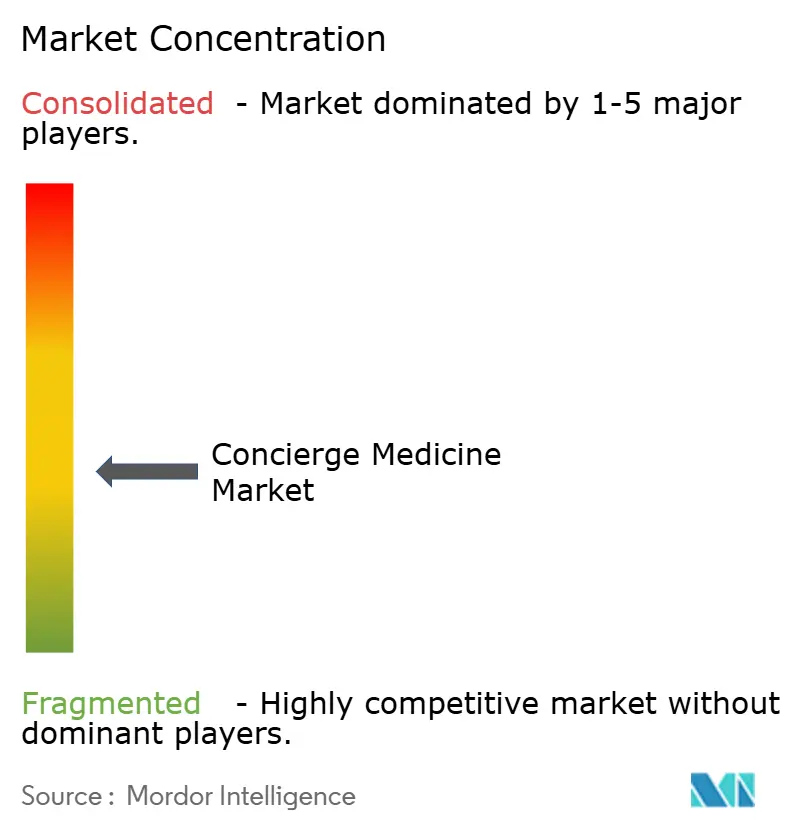
Top 5 コンシェルジュ医療市場 Companies

MDVIP
SignatureMD
Crossover Health
Castle Connolly Private Health Partners
Concierge Choice Physicians

Source: Mordor Intelligence
コンシェルジュ医療市場 Companies Matrix by Mordor Intelligence
Our comprehensive proprietary performance metrics of key コンシェルジュ医療市場 players beyond traditional revenue and ranking measures
Revenue rank and capability rank often diverge because concierge care is constrained by physician time, site readiness, and service reliability, not just sales and marketing spend. The MI Matrix emphasizes in scope reach, operational assets, recent service launches, and the ability to deliver consistent access across geographies and delivery modes. Many decision makers also want plain answers on pricing and billing. Concierge memberships usually cover access and coordination, while insurance still pays for covered visits, labs, imaging, and hospital care. Hybrid programs let patients opt in while a physician continues serving non members, which can reduce backlash and protect referral patterns. This MI Matrix by Mordor Intelligence is better for supplier and competitor evaluation than revenue tables alone because it weights deliverability, innovation cadence, and real operating signals.
MI Competitive Matrix for コンシェルジュ医療市場
The MI Matrix benchmarks top コンシェルジュ医療市場 Companies on dual axes of Impact and Execution Scale.
Analysis of コンシェルジュ医療市場 Companies and Quadrants in the MI Competitive Matrix
Comprehensive positioning breakdown
MDVIP
National reach drives MDVIP's model, which leans on a broad physician network to sell time, access, and continuity as the core product and positions it as a leading player. Consistency across many affiliated practices differentiates the company and makes employer and Medicare age cohorts easier to serve without rebuilding operations city by city. Policy risk remains real because membership fees sit outside traditional reimbursement and can trigger network participation rules. A plausible upside is deeper hybrid adoption through standardized digital touchpoints. The largest operational risk is uneven patient experience across independent offices, which can dilute trust and renewal rates.
SignatureMD
Longer visits support SignatureMD's brand promise, with always-on communication and extended appointment time at the center of the model, reflecting its role as a major supplier. The company benefits when independent physicians want a membership approach without abandoning insurance billing for covered services. Regulatory friction can rise if state level rules tighten around fee descriptions and what counts as covered care. A realistic what if is a sharper shift toward chronic care memberships, where retention can improve. The key weakness is dependence on affiliated physician execution, since service quality is felt locally.
Crossover Health
Employer demand anchors Crossover Health, which uses onsite, nearsite, and a national virtual network to stay relevant across distributed workforces and is a top operator. A 2023 launch of occupational medicine signals a push to become a broader workforce health partner rather than a narrow primary care vendor. Compliance exposure shows up in cross state telehealth workflows and the reporting expectations tied to large employer contracts. If utilization rises among high cost members, the model can show strong value quickly. The main risk is client concentration, since large employers can renegotiate hard during renewal cycles.
One Medical
Parent company backing and a scaled membership platform make One Medical a leading brand in employer and consumer channels, with Amazon tying pay-per-visit telehealth and membership access under one umbrella to widen the funnel beyond cities with clinics. Collaborations, including health system coordination in specific regions, can improve specialist referral paths and credibility. If Prime driven acquisition lowers churn, unit economics can improve even with lower price points. The main risk is patient trust if service feels too standardized, especially for complex care members.
Privia Health
Platform scale matters for Privia Health, since financial strength supports investment in tools that can enable membership style care inside physician groups. In 2025, Privia disclosed transactions such as an Arizona entry tied to a USD 95 million closing payment, plus a later agreement to acquire an ACO business for USD 100 million in cash. Those moves can improve negotiating leverage and care management capabilities that concierge programs often rely on. Policy risk is tied to value based arrangements and Medicare rules more than membership design. A plausible upside is packaging navigation, preventive outreach, and access promises into executive programs.
Frequently Asked Questions
What should a buyer verify before signing a membership agreement with a concierge provider?
Confirm what the membership fee covers versus what is billed separately to insurance or paid out of pocket. Ask about response time expectations and after hours coverage.
How do hybrid concierge programs differ from full membership only models?
Hybrid programs let patients opt in while the physician continues seeing non members. This can reduce patient disruption and preserve existing referral relationships.
What operational signals predict a better member experience?
Look for small patient panels, clear same day scheduling rules, and dedicated care coordination staff. Also validate specialist referral pathways and lab or imaging access.
How should employers evaluate executive health programs versus standard primary care memberships?
Employers should prioritize measurable uptime, fast appointment access, and clear escalation paths for urgent issues. They should also confirm multi location coverage for traveling executives.
What are the most common reasons concierge programs fail to meet expectations?
Mismatch between promised access and actual clinician availability is the top driver. Poor coordination with outside specialists and unclear billing rules also create dissatisfaction.
How should buyers compare virtual only, in person only, and hybrid options?
Virtual only can work for routine issues but may struggle with diagnostics and complex exams. Hybrid models often balance convenience with in person clinical certainty.
Methodology
Research approach and analytical framework
Public company IR, filings, and official press rooms were prioritized when available. For private firms, observable signals such as locations, program launches, and partnerships were used. Where data was sparse, multiple public references were triangulated to avoid single source bias. Scoring reflects only the scope described above.
Counts clinics, affiliated physicians, and supported programs across listed regions and delivery modes.
Reflects trust among patients, employers, and hospital programs where access and responsiveness drive renewal.
Uses proxies like membership scale, office count, and network breadth within concierge and hybrid access models.
Weighs committed assets such as owned sites, care teams, referral infrastructure, and 24/7 coverage capability.
Prioritizes new hybrid plans, virtual workflows, diagnostics access, and program expansions introduced since 2023.
Assesses ability to fund staffing, expansion, and technology while sustaining membership service expectations.