
Wine Cabinets Market Size and Share
Market Overview
| Study Period | 2020 - 2031 |
|---|---|
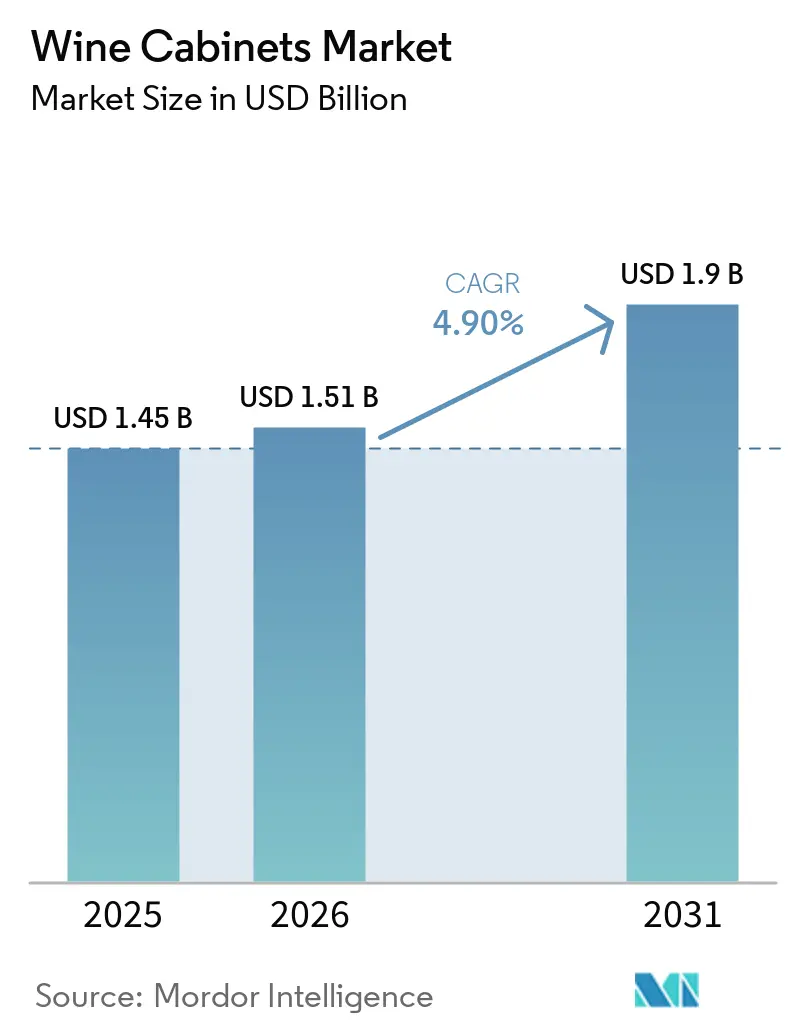
| Market Size (2026) | USD 1.51 Billion |
| Market Size (2031) | USD 1.9 Billion |
| Growth Rate (2026 - 2031) | 4.90 % |
| Fastest Growing Market | Asia-Pacific |
| Largest Market | North America |
| Market Concentration | Low |
Major Players
*Disclaimer: Major Players sorted in no particular order Image © Mordor Intelligence. Reuse requires attribution under CC BY 4.0. |
|
Wine Cabinets Market Analysis by Mordor Intelligence
The wine cabinets market was valued at USD 1.45 billion in 2025, is estimated at USD 1.51 billion in 2026, and is forecast to reach USD 1.92 billion by 2031, growing at a 4.90% CAGR during 2026–2031. The wine cabinets market is growing even as global wine consumption fell to 208 million hectoliters in 2025, its lowest level since 1957 [1]International Organisation of Vine and Wine, “State of the World Wine Sector in 2025,” OIV, oiv.int. Buyers are drinking wine less often, but they are putting more value on bottle quality and preservation. This supports demand for temperature-controlled storage that protects wine from temperature variation, light exposure, and vibration. North America and Western Europe remain the principal demand bases, while Asia-Pacific offers a separate path for growth through urban professionals and developing wine culture. Product design, kitchen renovation activity, connected functions, and energy rules are shaping how suppliers position their portfolios in the wine cabinets market.
Key Report Takeaways
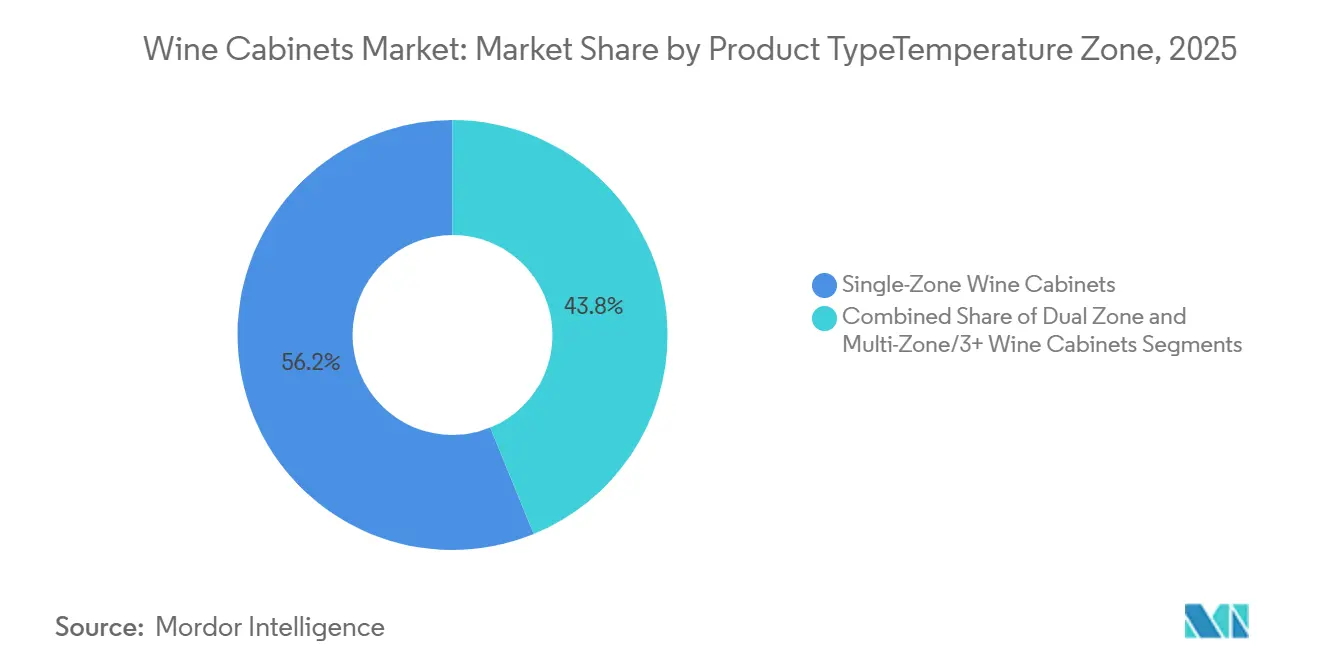
- By product type, single-zone wine cabinets accounted for the largest value share of the wine cabinets market, at 56.16% in 2025, while multi-zone/3+ wine cabinets are projected to grow at the fastest CAGR of 7.67% during 2026-2031.
- By installation type, freestanding wine cabinets accounted for the largest value share of the wine cabinets market, at 53.73% in 2025, while countertop wine cabinets are projected to grow at the fastest CAGR of 6.44% during 2026-2031.
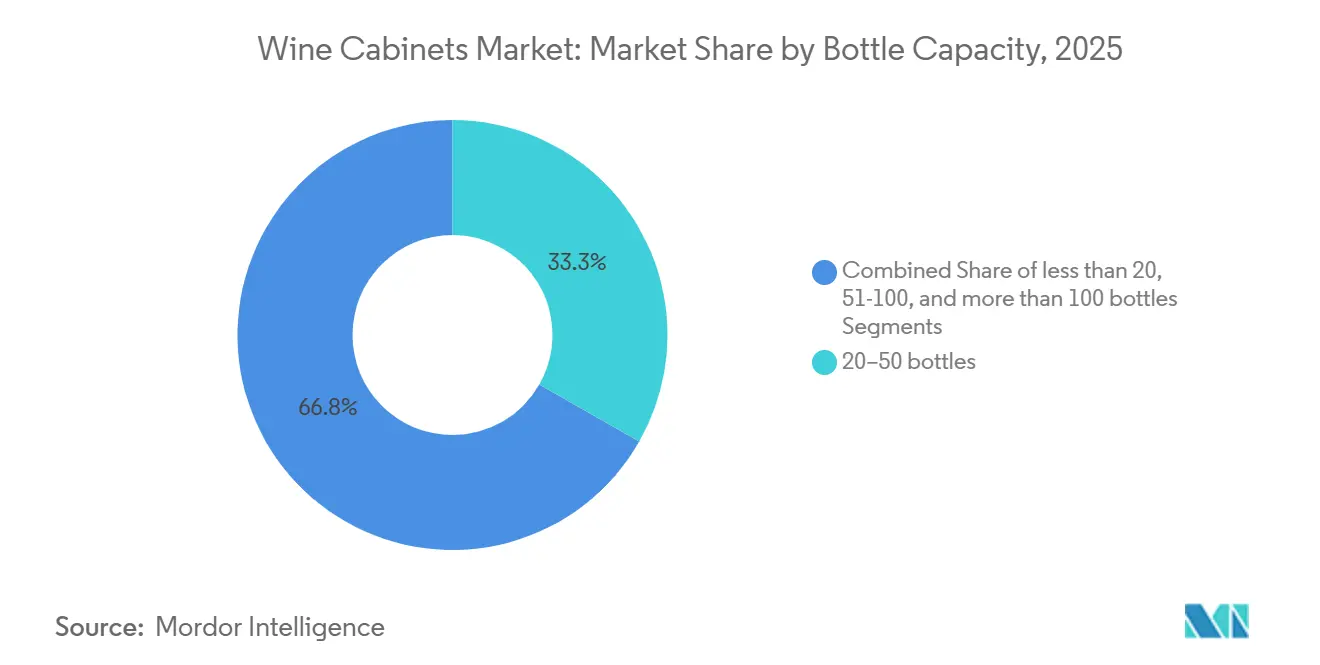
- By bottle capacity, the 20–50 bottle category accounted for the largest value share of the wine cabinets market, at 33.25% in 2025, while the under-20 bottle category is projected to grow at the fastest CAGR of 5.82% during 2026-2031.
- By end user, residential users accounted for the largest value share of the wine cabinets market, at 72.74% in 2025, while commercial users are projected to grow at the fastest CAGR of 6.63% during 2026-2031.
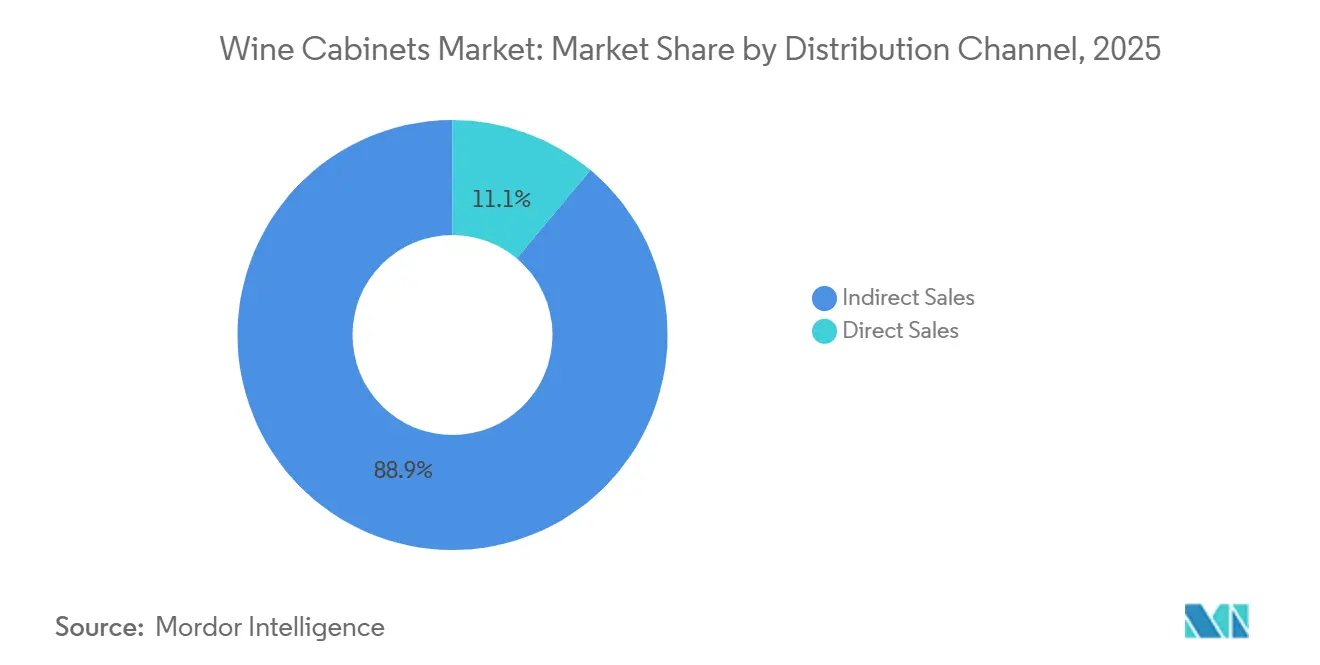
- By distribution channel, indirect sales accounted for the largest value share of the wine cabinets market, at 88.92% in 2025, and are projected to grow at the fastest CAGR of 5.51% during 2026-2031.
- By geography, North America accounted for the largest value share of the wine cabinets market, at 31.01% in 2025, while Asia-Pacific is projected to grow at the fastest CAGR of 7.05% during 2026-2031.
Note: Market size and forecast figures in this report are generated using Mordor Intelligence’s proprietary estimation framework, updated with the latest available data and insights as of January 2026.
Global Wine Cabinets Market Trends and Insights
Drivers Impact Analysis*
| Driver | (~) % Impact on CAGR Forecast | Geographic Relevance | Impact Timeline |
|---|---|---|---|
| Premiumization of Home Wine Storage | +1.5% | North America and Europe, with Asia-Pacific emerging | Medium term (2-4 years) |
| Growth of Luxury Kitchen Renovations | +0.8% | Asia-Pacific, South America, the Middle East, and Africa | Long term (≥ 4 years) |
| Expansion of Wine Culture in Emerging Markets | +0.9% | North America, Europe, and Australia | Medium term (2-4 years) |
| Smart Connected Wine Cabinet Adoption | +0.6% | North America, Europe, and the core Asia-Pacific markets | Medium term (2-4 years) |
| Hospitality and Wine Tourism Expansion | +0.5% | Europe, South America, Asia-Pacific, and luxury corridors in the Middle East and Africa | Short term (≤ 2 years) |
| Modular Storage for Urban Homes | +0.3% | Urban Asia-Pacific, Northern Europe, and North American metropolitan areas | Medium term (2-4 years) |
| Source: Mordor Intelligence | |||
Premiumization of Home Wine Storage
Dedicated preservation appliances are becoming more relevant for affluent households that purchase better bottles. The wine cabinets market benefits when buyers view storage conditions as part of protecting the value of a collection. Temperature inconsistency, ultraviolet exposure, and vibration can make a purpose-built cabinet more attractive than ordinary refrigeration. The 20–50 bottle tier held 33.3% of 2025 revenue, showing that demand extends beyond large collector installations. This range offers a practical balance of capacity, price, and kitchen footprint for regular premium-wine buyers. Manufacturers compete in this range through vibration reduction, humidity stability, ultraviolet protection, and usable capacity.
Buyers are paying closer attention to technical preservation features when comparing appliances. This behavior supports products that clearly explain their temperature management and cabinet design. The wine cabinets market also benefits from replacement purchases by owners of older wine refrigerators. Buyers who chose entry-level units between 2010 and 2015 can move toward multi-zone, built-in, or connected products as their expectations change. Long product life limits annual replacement volume, but it also makes a meaningful product upgrade more valuable when it occurs. The result is a steady preference for better-equipped cabinets rather than a simple increase in unit purchases.
Smart Connected Wine Cabinet Adoption
Connected functions are changing the value offered by premium wine cabinets. Temperature monitoring, lighting control, anomaly alerts, and preservation guidance give owners more visibility over stored bottles. EuroCave introduced the Harmonie collection in 2025 and announced EuroCave Connect app support for the range, covering remote temperature monitoring, alerts, and preservation guidance. Liebherr introduced Vinidor and Vinidor Selection freestanding wine refrigerators in March 2025 with SmartDevice functions and TempProtect Plus monitoring. These functions help suppliers compete on more than cooling hardware alone.
A connected cabinet can keep a buyer engaged with the manufacturer after the original purchase. Storage histories, alert settings, and wine-condition records can make a later switch less convenient. This matters most in premium installations, where consumers may have multiple bottles and higher expectations for preservation. The wine cabinets market gives early adopters of connected functions a way to differentiate products that can otherwise appear similar. Manufacturers that do not provide an app or comparable monitoring approach may be less competitive in premium categories before 2028. The connected tier also supports higher prices for products that combine preservation controls with inventory-related features.
Growth of Luxury Kitchen Renovations
Kitchen renovation activity creates a direct sales opportunity for built-in and integrated wine cabinets. These products are often selected while cabinetry, electrical connections, ventilation, and appliance placement are being planned. A built-in cabinet can therefore become part of the kitchen specification rather than an appliance added later. This route favors suppliers that work effectively with designers, kitchen studios, and appliance specialists. It also favors products with dimensions and finishes that fit contemporary cabinet layouts. The wine cabinets market gains from renovation projects because integrated models can support higher selling prices.
The strongest effect is visible in North America, Europe, and Australia, where premium kitchen projects are established. Built-in products can create a unified appearance that is important to affluent renovators. They also create more complex installation needs, which can limit the appeal for buyers who do not plan a full project. Suppliers need clear installation guidance, compatible ventilation requirements, and reliable channel support for this route to work well. Kitchen designers can favor brands with a record of wine-specific preservation features and a suitable integrated portfolio. This makes specification-stage relationships an important route for the wine cabinets market.
Expansion of Wine Culture in Emerging Markets
Emerging markets have different demand patterns and should not be treated as one uniform opportunity. China’s wine consumption fell 13% in 2025 to 4.8 million hectoliters, as purchasing moved away from protocol and gift occasions toward quality-focused consumption. China’s wine imports fell 3.2% to USD 879 million during January through July 2025 [2]United States Department of Agriculture Foreign Agricultural Service, “Wine Market Update 2025, China,” USDA FAS GAIN Report, apps.fas.usda.gov. Australian wine imports rose 28.3% to USD 366.5 million over the same period, reflecting tariff normalization rather than a broad recovery in demand. The remaining collector base in China can still support premium multi-zone cabinets because preservation matters more when purchases become more selective.
Brazil’s wine consumption reached 4.4 million hectoliters in 2025, a 41.9% increase from the previous year. India offers a separate first-purchase opportunity as wine tourism and premium consumption become more visible. Sula Vineyards reported wine tourism revenue of INR 60.3 crore (about USD 7 million) in FY25 (April 2024-March 2025), up 10.2% year over year [3]Sula Vineyards, “Sula Vineyards Plans Resort at Chandon Site as Wine Tourism Revenue Crosses INR 100 Crore,” The Hindu Business Line, thehindubusinessline.com. First-time buyers in India and Southeast Asia may favor compact products that fit apartment kitchens and smaller homes. Higher prices still limit household penetration in these markets. The wine cabinets market, therefore, needs accessible capacity, reliable basic preservation, and distribution suited to developing wine-buying habits.
Restraints Impact Analysis*
| Restraint | (~) % Impact on CAGR Forecast | Geographic Relevance | Impact Timeline |
|---|---|---|---|
| High Purchase and Installation Costs | -0.8% | Global, with greater pressure in South America, Southeast Asia, and Africa | Medium term (2-4 years) |
| Energy Consumption and Efficiency Concerns | -0.6% | Europe for regulation, and global markets for operating costs | Medium term (2-4 years) |
| Limited Awareness of Wine Preservation Requirements | -0.5% | India, Southeast Asia, Brazil, and Africa | Long term (≥ 4 years) |
| Cabinet Space and Installation Constraints | -0.4% | Japan, South Korea, Hong Kong, and Northern Europe | Medium term (2-4 years) |
| Source: Mordor Intelligence | |||
High Purchase and Installation Costs
Upfront price is the main barrier to wider household adoption. Integrated built-in units can cost more than USD 10,000 before professional installation. Installation can add USD 300 to USD 1,500 to the purchase. The total cost restricts the category to households with established collecting habits and sufficient discretionary income.
Price sensitivity is especially important in Brazil, India, Southeast Asia, and parts of Africa. In these settings, consumers compare a dedicated cabinet with an ordinary refrigerator and can postpone their first purchase. Long useful lives of 10 to 20 years also limit replacement frequency. Lower annual replacement demand can persist even as the installed base grows. The wine cabinets market needs compact and appropriately priced offerings to broaden access without reducing preservation performance. Specialist brands still retain an advantage among collectors who place a high value on technical controls.
Energy Consumption and Efficiency Concerns
Wine storage appliances run continuously, so energy use is a visible operating cost. This affects purchase decisions and can influence a manufacturer’s reputation. Commission Regulation (EU) 2019/2019 sets Ecodesign requirements for refrigerating appliances, including wine storage appliances [4]European Commission, “Commission Regulation (EU) 2019/2019, Ecodesign Requirements for Refrigerating Appliances,” EUR-Lex, eur-lex.europa.eu. Wine storage appliances with transparent doors have been subject to an Energy Efficiency Index ceiling of 172 since March 2024. This rule excludes less efficient legacy designs from the European market.
Regulation (EU) 2024/573 extends bans on fluorinated greenhouse gases to specified categories of new refrigeration equipment, including household refrigerators and freezers, from January 2026. Suppliers must shift toward lower-global-warming-potential refrigerants, including R-290 and R-600a. Smaller manufacturers with older compressor platforms can face design, certification, and capital costs. Liebherr introduced 21 integrated under-counter appliances in 2025 with energy ratings from A to C. This shows how compliance spending can support a stronger position with architects and kitchen designers.
*Our forecasts treat driver/restraint impacts as directional, not additive. The impact forecasts reflect baseline growth, mix effects, and variable interactions.
Segment Analysis
By Product Type/Temperature Zone: Multi-Zone Formats Challenge Single-Zone Dominance
Single-zone cabinets held 56.2% of the wine cabinets market share in 2025. Their leading position reflects their suitability for long-term aging at a uniform cellar temperature of 12–14°C. Single-zone products span entry-level countertop units, household cabinets, and larger professional systems. This range makes them relevant to buyers with different budgets and storage needs. A uniform temperature suits collections that are primarily held for aging. Their simpler configuration can also be easier to understand for buyers entering the category. Buyers with one dominant wine style may not need separate serving temperatures. This can make a single-zone cabinet a sensible initial purchase. The format also remains relevant where cabinet simplicity is valued. Larger versions can serve substantial collections without adding zone controls.
Dual-zone cabinets serve households that store red and white wines at the same time. They offer a middle option for buyers who want more flexibility without the cost of 3 separate zones. Multi-zone and 3+ zone cabinets are projected to grow at a 7.7% CAGR through 2031. These cabinets support different temperatures for still wine, sparkling wine, and dessert wine. Liebherr's triple-zone Vinidor Selection Wgb7470, introduced in the United States in March 2025, allows red, white, and sparkling wines to be held at separate temperatures in one freestanding unit. This flexibility suits collectors with a broader mix of bottles. It also suits hospitality venues that need both storage and service settings. Separate zones can reduce compromises between aging and serving needs. Suppliers are bringing this functionality toward mainstream residential price tiers.



By Installation Type: Freestanding Leads While Countertop Formats Grow Fastest
Freestanding cabinets accounted for 53.7% of the wine cabinets market share in 2025. Their position reflects simple installation, a wide product selection, and an established base of homeowners. Buyers can add a freestanding unit without undertaking a full kitchen renovation. This keeps the format relevant for replacement purchases and first-time buyers. The category also includes products across a wide range of capacity and price points. It gives owners flexibility when kitchen layouts change. It also avoids the specification requirements of an integrated product. Retailers can display these units as complete appliances. This helps buyers compare dimensions and interior features before purchase.
Built-in and integrated units are gaining relevance in premium kitchen projects. These products require specification during the design stage but provide a more unified appearance. Liebherr introduced the UWpri 3672 for Asia-Pacific in September 2025 and Europe in early 2026. The product used a décor-panel-ready door, TipOpen opening, and 2 temperature zones. Countertop cabinets are projected to be the fastest-growing installation format, with a 6.44% CAGR during 2026–2031. They serve urban buyers who do not have enough space for larger units. Their small dimensions support use in apartments and compact kitchens. Countertop products can be purchased without a design project. They can also introduce a buyer to dedicated wine preservation. Built-in products remain more dependent on professional specification and installation.
By Bottle Capacity: Mid-Range Sizing Anchors Mass Demand, Compact Format Accelerates
The 20–50 bottle tier accounted for 33.3% of the wine cabinets market size in 2025. It fits households that maintain an active home cellar without a dedicated collection room. The capacity balances storage volume with a manageable kitchen footprint. It also suits buyers who consume premium wine regularly but do not buy on the scale of serious collectors. Suppliers can compete in this tier through features, interior layout, and cabinet dimensions. This capacity avoids the footprint of a larger collector cabinet. It can fit the needs of a household with a rotating wine selection. Buyers can evaluate shelf design alongside total bottle count. The category, therefore, supports feature-led competition.
The 51–100 bottle category serves the move from enthusiast to collector. A household may purchase a second cabinet once a smaller unit is no longer sufficient. This creates an opportunity for brands to retain buyers within their product family. The over-100-bottle category is primarily relevant to commercial users and larger residential collections. The under-20 bottle category is projected to grow at a 5.8% CAGR through 2031. Demand comes from first-time buyers, gifting occasions, and urban consumers who still expect temperature precision and vibration control. Small cabinets reduce the commitment of a first purchase. They are suitable for buyers with a limited number of bottles. Their compact position does not remove demand for quality preservation. The larger tiers remain necessary as collections and commercial needs develop.
By End User: Residential Dominates, but Commercial Accelerates on Hospitality Investment
Residential users held 72.7% of the wine cabinets market share in 2025. Wine collectors, serious enthusiasts, and affluent lifestyle buyers made households the central source of demand. Serious collectors tend to select larger-capacity, multi-zone, and premium built-in units. These choices generate higher revenue per purchase than smaller entry products. Residential buyers also support demand across freestanding, built-in, and countertop installations. Their needs differ by collection size and available kitchen space. This creates demand for a broad portfolio rather than 1 standard product. Household buyers can prioritize cabinet finish alongside preservation controls. They can also move from compact storage to larger units over time.
Commercial use is projected to grow at a 6.6% CAGR through 2031. Wine tourism, restaurants, boutiques, private clubs, and executive lounges support this demand. Commercial buyers need storage that supports both presentation and service. Their procurement choices can be influenced by capacity, cabinet appearance, and operating requirements. Wine tourism revenue represented an average 25% of winery revenue in the 2025. This strengthens the case for serving and displaying equipment at winery venues. Commercial venues can use visible storage to support the guest experience. Their purchasing process can include foodservice and hospitality requirements. This makes product reliability important alongside appearance. The segment adds demand beyond household collecting.
By Distribution Channel: Indirect Channels Control Reach, Online Sub-Segments Shift Power
Indirect channels accounted for 88.9% of the wine cabinets market share in 2025. Home centers, specialty retailers, general trade outlets, and online marketplaces make up this route. Physical retail remains important because buyers often want to assess cabinet size, build quality, and noise before purchase. Retailers can also explain capacity and installation requirements. This makes indirect distribution central to reach the wine cabinets market. Retail display can make cabinet dimensions easier to understand. It can also help buyers compare door styles and interiors. Specialist retailers can explain wine-specific preservation features. This support remains useful where products have higher prices.
Indirect channels are projected to grow at a 5.5% CAGR through 2031. Online marketplaces are the fastest-growing part of this route as premium appliance purchasing becomes more omnichannel. In-store influence is still likely to matter at the final purchase stage. Direct routes include manufacturer showrooms, brand websites, and direct-to-consumer platforms. Wine-specialist retailers and luxury kitchen studios also serve higher-value professional buyers. These routes are particularly relevant for premium and ultra-premium cabinets where brand credibility is important. Online research can begin the purchasing process before a retail visit. Direct channels can give manufacturers more control over brand presentation. Kitchen studios can connect premium cabinets with integrated projects. Different channels, therefore, serve different price tiers and installation needs.
Geography Analysis
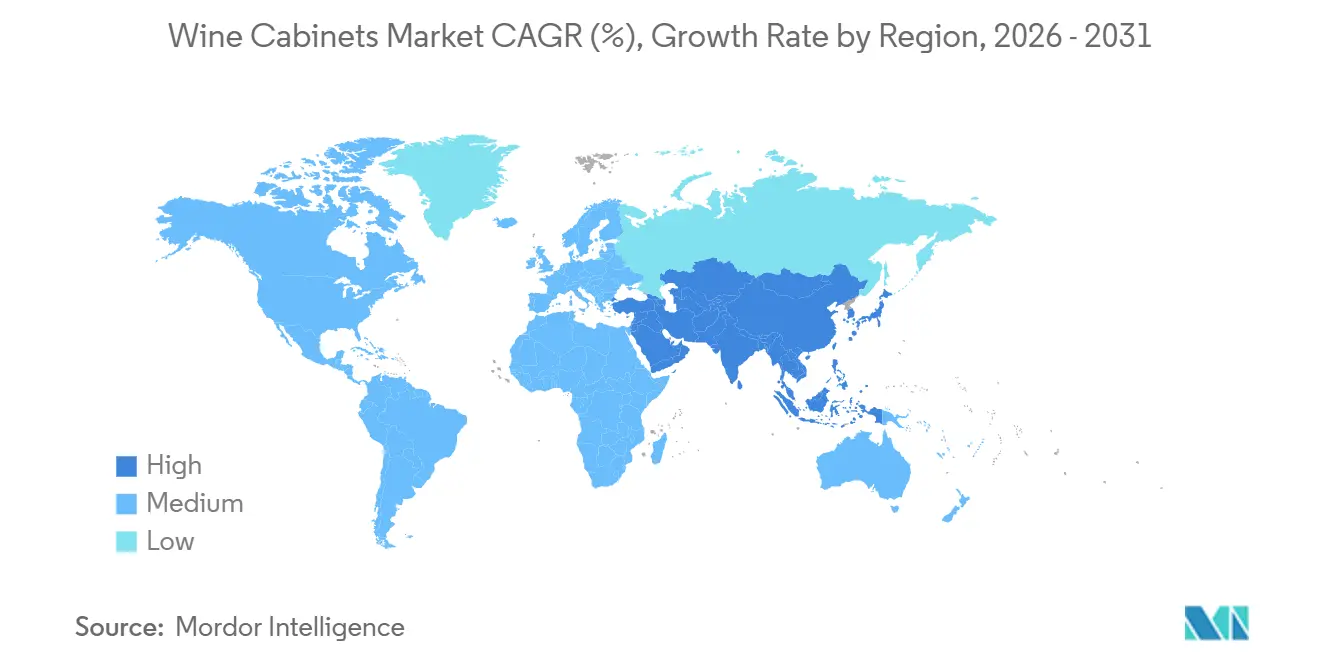
North America held 31% of the wine cabinets market share in 2025. The United States supports demand through renovation spending, affluent homeowners, and replacement purchases for older wine refrigerators. Liebherr USA's March 2025 launch of its Vinidor multi-zone range reflects the supplier's attention to the premium segment.
Asia-Pacific is projected to grow at a 7.1% CAGR through 2031, the fastest regional rate. China combines weaker aggregate wine consumption with a more quality-focused buyer base. India supports demand through premiumization and growth in wine-related tourism. Australia and Japan provide demand from mature wine cultures. Vietnam, Thailand, and the Philippines remain early-stage opportunities.

Competitive Landscape
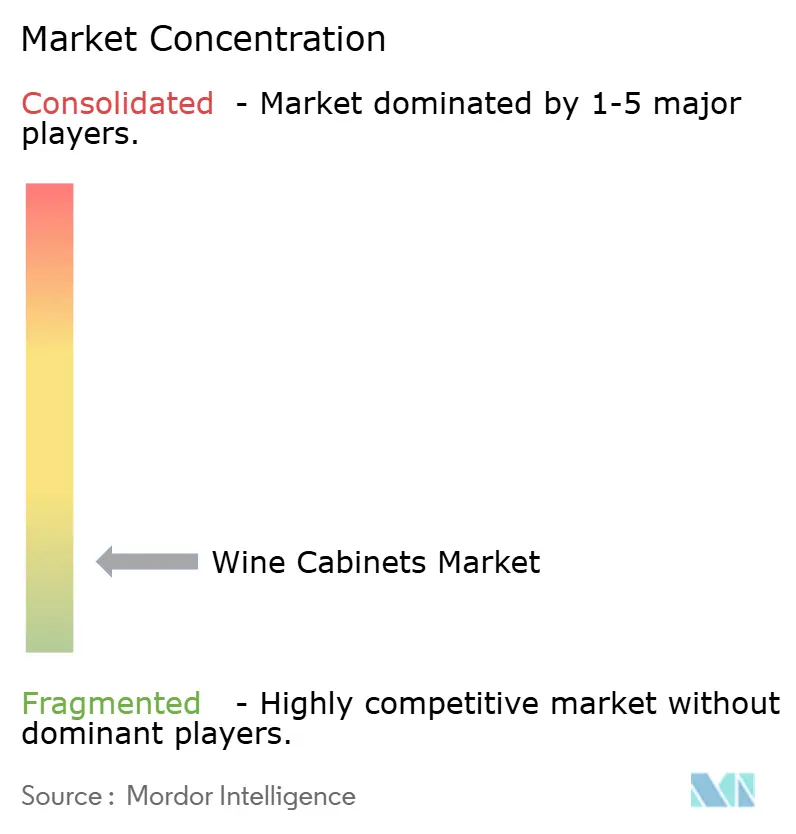
The wine cabinets market is fragmented, with the top 5 players holding an estimated 10.7% of broader wine storage revenue in 2025. EuroCave, Liebherr, and Climadiff hold specialist credibility in precision cooling and premium wine preservation. Their product knowledge is important for buyers who value temperature stability, vibration reduction, and cabinet design. Haier Group, BSH Home Appliances Group, Electrolux, and Whirlpool compete through broader distribution and connected appliance ecosystems. Vinotemp and NewAir serve the U-valueStates value tier. Marvel Refrigeration and Perlick Corporation address under-counter products with commercial-adjacent demand.
Entry-level dual-zone products are relevant for first-time buyers in emerging markets. Modular systems can serve kitchen remodeling projects and urban apartments. Smart connected countertop units can address smaller homes without giving up monitoring features. Perlick’s compliance with NSF/ANSI 7 is relevant in foodservice and hospitality procurement. Energy efficiency can influence specification choices where architects use labels as a practical sign of product design quality. Market concentration score: 2 out of 10, because the top 5 players held only 10.7% of broader wine storage revenue, which indicates a highly fragmented supplier base.
Wine Cabinets Industry Leaders
-
Sub-Zero Group, Inc.
-
EuroCave
-
Liebherr Group
-
Vinotemp International
-
U-Line Corporation
- *Disclaimer: Major Players sorted in no particular order

Recent Industry Developments
- February 2026: Haier introduced its wine cooler lineup in Lebanon, spanning 32- to 205-bottle single- and dual-zone models.
- April 2025: EuroCave launched the Harmonie collection, a horizontal wine-furniture cabinet with two temperature-controlled compartments, offered in light oak, pure white, and smoked brown finishes.


Global Wine Cabinets Market Report Scope
The wine cabinets market covers dedicated appliances designed to store, preserve, age, and serve wine under controlled temperature conditions. It includes single-zone, dual-zone, and multi-zone wine cabinets across freestanding, built-in, integrated, under-counter, and countertop formats. The scope covers cabinets across bottle-capacity ranges, including under 20 bottles, 20–50 bottles, 51–100 bottles, and over 100 bottles.
The assessment includes residential users, including wine collectors, enthusiasts, and affluent households, as well as commercial users such as restaurants, wineries, wine boutiques, private clubs, hotels, and executive lounges. It covers sales through direct channels, including manufacturer websites and showrooms, and indirect channels, including home centers, specialty retailers, general trade outlets, and online marketplaces.
The market covers North America, Europe, Asia-Pacific, South America, the Middle East, and Africa. It includes conventional and connected wine cabinets with features such as temperature monitoring, multi-zone controls, vibration reduction, ultraviolet protection, humidity management, lighting controls, remote alerts, and app-based preservation guidance.
| Single-Zone Wine Cabinets |
| Dual-Zone Wine Cabinets |
| Multi-Zone/3+ Wine Cabinets |
| Freestanding Wine Cabinets |
| Built-In / Integrated Wine Cabinets |
| Countertop Wine Cabinets |
| Less than 20 Bottles |
| 20–50 bottles |
| 51–100 bottles |
| Above 100 bottles |
| Residential (Wine Collectors & Serious Enthusiasts, Affluent Homeowners & Lifestyle Buyers) |
| Commercial (HoReCa, Premium Wine Boutiques, Specialty Liquor Stores, Executive Lounges, Private Clubs, etc.) |
| Direct Sales | Offline |
| Online (Direct-to-Consumer) | |
| Indirect Sales | Offline (home centers, specialty electronics retailers, general trade, trade shows, etc.) |
| Online (marketplaces) |
| North America | Canada |
| United States | |
| Mexico | |
| South America | Brazil |
| Peru | |
| Chile | |
| Argentina | |
| Rest of South America | |
| Europe | United Kingdom |
| Germany | |
| France | |
| Spain | |
| Italy | |
| BENELUX (Belgium, Netherlands, Luxembourg) | |
| NORDICS (Denmark, Finland, Iceland, Norway, Sweden) | |
| Rest of Europe | |
| Asia-Pacific | India |
| China | |
| Japan | |
| Australia | |
| South Korea | |
| South-East Asia | |
| Rest of Asia-Pacific | |
| Middle East and Africa | United Arab Emirates |
| Saudi Arabia | |
| South Africa | |
| Nigeria | |
| Rest of Middle East and Africa |
| By Product Type/Temperature Zone | Single-Zone Wine Cabinets | |
| Dual-Zone Wine Cabinets | ||
| Multi-Zone/3+ Wine Cabinets | ||
| By Installation Type | Freestanding Wine Cabinets | |
| Built-In / Integrated Wine Cabinets | ||
| Countertop Wine Cabinets | ||
| By Bottle Capacity | Less than 20 Bottles | |
| 20–50 bottles | ||
| 51–100 bottles | ||
| Above 100 bottles | ||
| By End-User | Residential (Wine Collectors & Serious Enthusiasts, Affluent Homeowners & Lifestyle Buyers) | |
| Commercial (HoReCa, Premium Wine Boutiques, Specialty Liquor Stores, Executive Lounges, Private Clubs, etc.) | ||
| By Distribution Channel | Direct Sales | Offline |
| Online (Direct-to-Consumer) | ||
| Indirect Sales | Offline (home centers, specialty electronics retailers, general trade, trade shows, etc.) | |
| Online (marketplaces) | ||
| By Geography | North America | Canada |
| United States | ||
| Mexico | ||
| South America | Brazil | |
| Peru | ||
| Chile | ||
| Argentina | ||
| Rest of South America | ||
| Europe | United Kingdom | |
| Germany | ||
| France | ||
| Spain | ||
| Italy | ||
| BENELUX (Belgium, Netherlands, Luxembourg) | ||
| NORDICS (Denmark, Finland, Iceland, Norway, Sweden) | ||
| Rest of Europe | ||
| Asia-Pacific | India | |
| China | ||
| Japan | ||
| Australia | ||
| South Korea | ||
| South-East Asia | ||
| Rest of Asia-Pacific | ||
| Middle East and Africa | United Arab Emirates | |
| Saudi Arabia | ||
| South Africa | ||
| Nigeria | ||
| Rest of Middle East and Africa | ||


Key Questions Answered in the Report
What is driving demand for wine cabinets?
Premium wine purchases, kitchen remodeling, smart controls, and hospitality investment support demand.
Which product format is growing the fastest?
Multi-zone and 3+ zone cabinets are projected to grow at a 7.7% CAGR through 2031.
Why do buyers choose multi-zone wine cabinets?
They store different wine styles at separate temperatures for aging and serving.
Which region is growing the fastest for wine cabinet sales?
Asia-Pacific is projected to grow at a 7.1% CAGR through 2031.
What limits wider household adoption of wine cabinets?
High purchase prices, installation costs, space limits, and low preservation awareness remain barriers.
Are smart wine cabinets becoming more important?
Yes. Monitoring, alerts, and preservation guidance help suppliers differentiate premium cabinets.
Page last updated on:


 Your data is secure and never sold or shared.


